PSEB 12th Class Sociology Solutions Chapter 5 Class Inequalities

Punjab State Board PSEB 12th Class Sociology Book Solutions Chapter 5 Class Inequalities Textbook Exercise Questions and Answers.

PSEB Solutions for Class 12 Sociology Chapter 5 Class Inequalities

Sociology Guide for Class 12 PSEB Class Inequalities Textbook Questions and Answers

Multiple Choice Questions:

1. The history of all existing societies is the history of class struggle is stated by:
(a) Karl Marx
(b) V.I. Lenin
(c) Antonio Gramsci
(d) Rosa Luxemburg
Answer:
(a) Karl Marx

PSEB 12th Class Sociology Solutions Chapter 5 Class Inequalities

2. Who propounded the concept of class-in-itself and class-for-itself?
Or
Who propounded the concept of class consciousness and class struggle?
(a) Marx
(b) Weber
(c) Durkheim
(d) None
Answer:
(a) Marx

3. The class theory given by Eric Olin Wright is synthesis of ideas of:
(a) Marx and Durkheim
(b) Marx and Weber
(c) Marx and Spencer
(d) Marx and Engels
Answer:
(b) Marx and weber

4. Property less white collar professionals as one of the classes is discussed by:
(a) Karl Marx
(b) Max Weber
(c) Lloyd Warner
(d) Vilfredo Pareto
Answer:
(b) Max Weber

5. Which does not reveal the distinction between caste and class:
(a) Ascription and achievement
(b) Closed and open mobility
(c) Sacred and Secular
(d) Ruling and ruled.
Answer:
(d) Ruling and ruled

6. Which does not constitute the means of production:
(a) Land
(b) Culture
(c) Labour
(d) Capital
Answer:
(b) Culture

7. Who gives importance to life chances and market situation for class analysis:
(a) Karl Marx
(b) Max Weber
(c) Alfred Weber
(d) C.W. Mills
Answer:
(b) Max Weber

8. The ownership over the means of production is a determinant of:
(a) Status group
(b) Class
(c) Caste
(d) Social category
Answer:
(b) Class

9. The class of serf is opposite to
(a) Lords
(b) Petty-Bourgeois
(c) Bourgeois
(d) Master
Answer:
(a) Lords

PSEB 12th Class Sociology Solutions Chapter 5 Class Inequalities

Fill in the Blanks:

1. Class system is ……………… in nature.
Answer:
open

2. Class system is …………… in status
Answer:
achieved

3. Weber considered class in ……………….. term.
Answer:
inequality

4. Class status is determined by …………….. and ………………… of an individual.
Answer:
income, education

True/False:

1. Class system is one of the major forms of social stratification.
Answer:
True

2. A social class is essentially a status group.
Answer:
True

3. According to Weber, wealth, power and status form the basis of inequality.
Answer:
True

4. Social classes are open groups.
Answer:
True

PSEB 12th Class Sociology Solutions Chapter 5 Class Inequalities

Match the Columns:

Column A Column B
1. Social classes Bourgeoisie
2. Capitalist Lifestyle of a particular class
3. Determinant of class Open group
4. Class consciousness Occupation
5. Mode of living Self-awareness

Answer:

Column A Column B
1. Social classes Open group
2. Capitalist Bourgeoisie
3. Determinant of class Occupation
4. Class consciousness Self-awareness
5. Mode of living The lifestyle of a particular class

Very Short Answer Type Questions:

Question 1.
In which social group members share the same relationship to the forces of production?
Answer:
Social class.

Question 2.
Can one have upward and downward mobility in classes?
Answer:
Yes, one can have upward and downward mobility in classes.

Question 3.
Individuals or groups between different social economic positions are known as:
Answer:
Class.
Question 4.
Which social class broadly composed of people is involved in blue collar or manual occupation?
Answer:
Labour class.

Question 5.
Identify two important features of class.
Answer:

  • There are many bases of class system.
  • People of a group have class consciousness for their class.

PSEB 12th Class Sociology Solutions Chapter 5 Class Inequalities

Question 6.
What do you mean by ownership over the resources?
Answer:
It means that some individual has ownership over resources and he is the owner of such resources.

Question 7.
Identify means of production.
Answer:
Those means which help in the production of anything are known as means of production such as machines, industries, tools etc.

Question 8.
Name two classes that were found during slavery.
Answer:
Master and Slave.

Question 9.
Who is a bourgeois?
Answer:
One who holds all the means of production with whose help, he exploits other classes is known as bourgeois such as an industrialist.

Short Answer Type Questions:

Question 1.
What do you mean by class?
Answer:
A class is a group of people who consider each other equal and every class has its own status in society. Members of every class are given certain specific responsibilities, rights and powers.

Question 2.
Differentiate between caste and class.
Answer:

  • Caste is a closed group but the class is an open group.
  • Membership of caste is based on birth but membership of class is based on individual ability.

Question 3.
Identify those classes found in rural India.
Answer:
Big landlords, the absentee landlords, the upper and middle peasantry, the capitalist farmers, low peasantry, marginal famers, landless agriculturists, money lenders etc. are the classes found in rural India.

Question 4.
“What is the meaning of this statement of Marx that the history of all existing societies is the history of class struggle”?
Answer:
‘According to Marx, till today, there existed many societies in which there were two main groups—one which owned all the means of production and the other which didn’t. That’s why, there existed a struggle among them. That’s why Marx said, “The history of all existing societies is the history of class struggle.”

Question 5.
Name those classes which have been discussed by Max Weber.
Answer:

  • Propertied bougeosie
  • Non-propertied white collar workers
  • Middle class
  • Class working in industries.

Long Answer Type Questions:

Question 1.
Discuss the views of Eric Olin Wright on class.
Answer:
Eric Olin wright gave class theory which was the mixture of Marx and Weber’s views. According to Wright, there are three bases of controlling economic resources in a capitalist society and these are:

  • Control over capital
  • Control over land, factory or offices
  • Control over labourers.

These bases form many classes such as owner, blue collar workers, white collar workers, professional employees, manual workers etc. According to him, workers of middle classs (managers and supervisors) have direct relation with the owners but labour class is exploited.

PSEB 12th Class Sociology Solutions Chapter 5 Class Inequalities

Question 2.
Differentiate between Caste and Class.
Or
What is the relationship between Caste and Class?
Answer:

Caste Class
1. Membership of caste is based on birth. 1. Membership of class is based on occupation and individual ability.
2. Ascribed status is given in caste. 2. There is achieved status in the class.
3. Caste is an endogamous group. 3. Class is an exogamous group.
4. Caste gets validity from the Hindu religious activities. 4. Class gets validity from individual ability in the capitalist system.
5. There is no mobility in the caste system as it is a closed system. 5. There is mobility in the class system as it is an open system.
6. One cannot change his caste in any case. 6. One can change his class at any time with his ability.

Question 3.
Briefly write about those classes which are found in Rural India.
Answer:
See Question No. 3-short answer type questions (III).

Question 4.
Briefly write about those classes which are found in urban India.
Or
Write about those classes which are found in Urban India.
Answer:

  • Corporate Capitalists
  • Industrial Capitalists
  • Financial Capitalists
  • Bureaucrats/Academia of upper category
  • Culture, political and economic elites
  • Middle class-managers, businessmen, traders, self-employed people, small shopkeepers, bankers etc.
  • Lower class
  • Industrial working class in organised sector
  • Working class in unorganised/semi-organised sectors
  • Construction workers on daily wages.
  • Unemployed persons.

Question 5.
Explain the middle class phenomenon.
Answer:
See Question 24—short answer type questions (other important questions)— Chapter-3.

Very Long Answer Type Questions:

Question 1.
Explain the Marxian theory of class.
Or
Describe the Marxian theory of class.
Answer:
Karl Marx has given conflict theory of social stratification and this-theory comes out because of political and social conflicts of 19th century. According to Marx, economic factor is the alone factor of social stratification and struggle in different classes. Marx has given this theory on the base of division of labour. According to him, labour is of two types—physical and mental and this difference is the main reason of difference in social classes.

Marx was of the view that there are two classes in society. First class is the owner of the means of production and second class is not the owner of means of production. On the basis of this ownership the position of owner class is higher and position of non-owner class is lower. According to Marx, owner class is capitalist class and non-owner class is labourer class. Capitalist class economically exploits the labourer class and labour class fights with capitalist class to get their rights. This is the result of stratification.

Marx was of the view that the main reason of stratification is the unequal distribution of property. Nature of stratification depends upon the classes of that society and the nature of classes depends upon the means of production. Ways of production depend upon technique. Class is a group in which relations of its members with forces of production are equal. In this way all those persons, who control the forces of production, come in first class i.e. capitalist class. Second class is that class

which is not the owner of forces of production but it earns its livelihood by selling its labour and that is labour class. Their name in different societies is different. For example, Feudal Lords and agricultural labourers in Feudal societies and capitalist and labourer in capitalist societies. Capitalist class has all the forces of production and labourer class has only its labour to sell with which it earns its livelihood. In this way the classes made on the basis of ways of production and unequal distribution of property are, according to Marx, social classes.

According to Marx, society today comes out of four stages or societies and these are:

  • Primitive ancient society or communism
  • Ancient society
  • Feudal society
  • Capitalist society

According to Marx, the classes did not come into being in first type of society but in later societies two main classes came into being. In ancient society owner and servant, Feudal Lords and agricultural labourer in Feudal society and capitalist and labourer class in capitalist society’came into being. In every society labour was being done by second class. Labour class is more in number and capitalist class is less in number. Marx has given two classes in every type of societies but on this point his views were not the same. Marx was of the view that there are three classes in capitalist society and these are labour class, capitalist class and land owners. Marx has given difference in these three classes on the basis of means of income, profit and rent of land. But Marx’s this three classes system never came into being in England.

Marx has written that with the development of capitalism three classes system will change into two classes system and middle class will come to an end. About this he has written in Communist Manifesto. Marx has also said about other classes in specific society. He has divided the capitalist class into two sub groups and these are effective capitalists and smaller capitalists. Effective capitalists are those capitalists which are bigger capitalists and industrialists which give work to thousands of labourers in their industries. Small capitalists are those small industrialists or shopkeepers whose business is at low level and they are not giving work to many labourers. They are doing most of their work themselves. Here Marx again says that with the development of capitalism middle class and small capitalists will come to an end and will join hands with labourer class. In this way there will be two classes in society and that is capitalist class and labourer class.

Relations Between Classes:

According to Marx capitalist class always exploits the labourer class and labourer class always fights for its rights. That is why the relations between both the groups are of opposition. Yet this opposition between these groups will hide due to their mutual interests but this opposition is always there. It is not necessary that we can see this opposition directly or opposition never comes in front of us but they know about each other’s opposition.

According to Marx, relations between the classes depend upon the mutual interdependence and conflict. We can take example of capitalist society in which two classes are there. First class is of capitalist class and second class is of labour class. These both classes depend upon each other for their existence. Labour class doesn’t have the ownership of forces of production. It doesn’t have any other mean to earn its livelihood except selling its labour. Labourers sell their labour to the capitalist class and are dependent upon them. They give their labour to capitalist and for that capitalist gives money to labourers for their labour. With this money or rent of labour, labourer takes care of the needs of the family. Capitalist also depends upon the labour of labourer because without their work, production in his factory is not possible and accumulation of capital is also not possible.

In this way both these classes depend upon each other. But this dependence doesn’t mean that they have relations of equality. Capitalist class always exploits the labour class. They want to make things in their factory by giving less money so that they can earn more profit. Labourer wants more money so that he can take care of the needs of his family. Capitalist tries to sell his product with more value by paying less money so that he can earn more profit. In this way conflict of interests is always there between both the classes. This conflict will give birth to communism later on in which there would be no opposition, there would be no exploitation and there would be no conflict of interests. This society will be classless society.

Karl Marx has explained the conflict theory of stratification on historical basis. Important things in the conflict theory of stratification of Marx are given below:

1. Two Classes in Society. Marx was of the view that generally two types of classes exists in every type of society. First one is” that which has all the means of production in its hands and this class is known as capitalist class. Second class is that which doesn’t have any means of production and which earns money only by selling its labour. This class is known as labour class. First class exploits the other class. It means that capitalist exploits and labourer is being exploited by capitalist.

2. Right Over Means of Production. While explaining stratification on historical basis Marx says that the stratification in society is based on the right over means of production. There exist two types of classes in every society on this base. First class is that which has the right over all the means of production. Second class is that which doesn’t have any right over means of production and which earns money by selling its labour.

3. Modes of Production. Nature of social stratification depends upon the modes of production. Position of that class is higher than other classes which has all the means of production. According to Marx, this class is known as capitalist or Bourgoisie. Second class is that which doesn’t have means of production, which is not satisfied by its position and which wants to change its position. Marx has given it the name of labour class or proletariat class.

4. Human History-History of Class Struggle: Marx was of the view that human history is the history of class struggle. We can take example of any society. Struggle in class is going on, in every society, in one form or the other. In this way Marx was of the view that two types of classes exist in all the societies- capitalist and labour class. Class struggle always goes on in both the classes. There are many reasons of class struggle in both the classes for e.g. too much economic differences between both the classes because of which class struggle is going on.

Capitalist becomes rich even without doing any hard work and labourer becomes poor even after doing a lot of hard work. With the passage of time, labour class makes its organization to save and meet its demands and this organisation does struggle with capitalist class to meet its demands. Result of this struggle between both the classes comes in the form of revolution which labour class does against the capitalist class.

After revolution, labourer class will eliminate the capitalist class and establish its authority. Capitalist tries to start anti-revolution movement against labourers but this movement will be suppressed and authority of the labourer class will be established. First of all communism and then the state of socialism will come in which every one will get according to its needs and ability. There will be no class in society and this will be a classless society in which every one will get equal share. No one will be of higher or lower status and the authority of labour class will remain there. Marx was of the view that this state has never yet come but it will come very shortly and stratification in society will come to an end.

PSEB 12th Class Sociology Solutions Chapter 5 Class Inequalities

Question 2.
Explain the Weberian theory of class.
Or
Discuss the Weberian view on the concept of class.
Answer:
Max Weber gave the theory of stratification in which he explained class, status group and party differently. Weber’s theory of stratification is considered as practical and rational. That’s why his theory is given enough importance by American Sociologists. Weber has explained stratification from three aspects and these are class, status and party. All these groups could be called as interest groups which not only can fight within themselves but they can fight even against each other. They tell us about a specific authority and are interrelated as well. Now we will explain . them one by one:

Class: Karl Marx has defined class on economic basis and in the same way Weber has also defined class on economic basis. According to Weber, “Class is a group of those people which are at equal status in structure of social, economic opportunities and which live in same conditions. These conditions depend upon their form and quantity of economic power.” In this way Weber talks about a type of group in which a specific number of people have equal chances in life. Yet this concept of Weber is not very much different from Marx’s concept of class but Weber has imagined class as the group of people living in same economic conditions not as a group of self-consciousness. Weber has given three types of classes which are given below:

  1. A Property Class
  2. An Acquisition Class
  3. A Social Class

1. A Property Class: A property class is that group whose position depends upon the fact that how much property it has? This class is again further divided into two parts:

  • The Positively Privileged Property Class. This class owns a lot of property and it lives on the income generated from its property. This class can keep monopoly over selling or buying of consumer goods, by collecting property or on taking education.
  • The Negatively Privileged Property Class. Illiterate, poor, property less and people under debt are major members of this group. But there is one another group between these two groups and that is Privileged Middle class in which members of both the given classes are included. According to Weber, Capitalist is member of this group due to his privileged position and Labourer is its member due to its negatively privileged position.

2. An Acquisition Class: It is that type of group whose position is determined by taking advantage from opportunities of services available in the market. This group is of three types:

  • The Positively Privileged Acquisition Class. This class keeps monopoly over administration of producer manufacturers. These factory owners are bankers, industrialists, financiers etc. These people not only keep control over administrative system but they exert influence on government’s economic policies as well.
  • The Middle Privileged Acquisition Class. This class belongs to middle class people in which small professional people, artisans, independent farmers etc. are included.
  • The Negatively Privileged Acquisition Class. People of lower classes are part of this group which include trained, semi trained and untrained labourers.

3. Social Class: Most number of people are included in this group. This class observes definite changes due to progress made by different generations. But Weber does not explain social class according to privileges. According to him people of labour class, lower middle class, intellectual class, property owner class are included in it.

According to Weber, members of class work with each other under specific circumstances and to this protest of doing work is being given the name of class action by Weber. According to Weber feeling of mutually related gives birth to class action. Weber has not believed that the thing like class action could take place all the times. Weber was of the view that there is no class consciousness in class but its nature is completely economic. There is no possibility among them that they would struggle collectively to achieve their common objectives. A class is only a group of people whose economic condition is same in the market. They can feel changes in their lives while collecting those things which have some respect in society and there is a possibility that they would collectively perform some action. Weber was of the view that if it does so then class can take the form of a community.

Status Group: Status group is generally considered as opposite to economic class stratification. Class is only based on economic assumption which is a group of same interests due to market conditions. These are not statistical classes but these are actually those groups whose life-style is common, outlook towards the society is common and which keeps unity among them.
According to Weber there is some difference between status group and class. Each has its own style and people can be unequal among them.

For example, teacher of a school. Yet his income might be 8-10,000 per month which is quite less in today’s age but his status is quite high due to his sacred profession. But on the other hand any smuggler or a prostitute could earn lakhs in a month but their status group will remain low because their profession is not sanctioned by society. In this way difference is there between both the, groups. Any occupational group can be called as a status group because in each type of profession, people get equal opportunities to earn money. This group also leads to same life-style of people. Members of one occupational group remain near to each other, wear same type of clothes and even have same type of values. That’s why its members have quite a wide circle.

Party: According to Weber, Party represents the determined interests associated with class status or status group. This party enrolls those members, in any condition, whose ideology matches with the ideology of party. But it is not necessary that the party could become status party for them. Weber was of the view that Parties always want to keep control over power. It means power should remain in their hands. Weber was of the view that yet parties are a part of political authority but even then power could be gained through various means like wealth, influence, pressure, rights etc. Parties want to obtain the power of State and State is an organisation.

Each activity of the party is concentrated on the fact that how the power could be obtained? Weber analysed the state and from here he gave the theory of Bureaucracy. According to Weber, parties are of two types. First one is Patronage party in which there are no .class rules, concepts, ideology etc. These are made for special purposes and could be left after the completion of objective. Second type of party is party of Principles which has clear and strong rules. These parties are not made for specific purposes. Weber was ‘of the view that there is quite much difference between these three i.e. class, status group and party but the mutual relation is always there among them.

PSEB 12th Class Sociology Solutions Chapter 5 Class Inequalities

Question 3.
What is the relationship between class, social mobility and social stratification?
Answer:
Class, social mobility and social stratification are deeply related but before checking their relation, we need to look into their meaning.

  • Class: Class is a group of people which is different from the other groups on one base or the other. Members of a group are conscious of their group and never let others to enter in their group very easily.
  • Social Mobility: Whole of the society is divided into different groups and when people leave their group to join the other one then this process is known as social mobility. With their individual ability, people change their class and the process of mobility is always going on.
  • Social Stratification: The process of dividing society into different layers is known as social stratification. Society is divided in different layers on different bases such as age, caste, sex, income, education, wealth, etc.

If we look at the meaning of all these concepts carefully, we observe that they have quite a close relationship with each other. The process of dividing society into different classes is known as stratification and people keep on changing their groups. One can change his class according to his ability and the process of moving from one group to the other is known as mobility.

Presently, people are taking education and are adopting different occupations. After getting an education, their social status moves upward and they get a better job. This job brings a lot of money for them and they reach a higher level of social stratification. Gradually, they change their job to earn more money. In this way, they become the members of different groups and the process of social mobility moves on.

After looking at the given explanation, we can say that class, mobility, and stratification are deeply related. All these help in individual as well as social progress.

Table Tennis Game Rules – PSEB 10th Class Physical Education

Punjab State Board PSEB 10th Class Physical Education Book Solutions Table Tennis Game Rules.

Table Tennis Game Rules – PSEB 10th Class Physical Education

Question 1.
Describe about the Table, Net, Ball and Racket in the game of Table Tennis?
Answer:
Table:
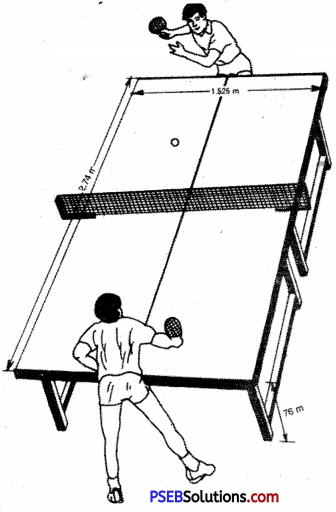
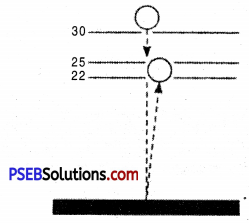
In table tennis, the table used is of rectangular shape. It is 2.74 metres in length and 1.52 metres in width. Its height from the ground is 76 cm. It can be made of any material. A ball when dropped from a height of 30.5 cm. on its surface shall give a bounce of not less than 22 cm. and not more than 25 cm.

table tennis image 1

The surface of the table is known as playing surface. It is of dark green colour. It shall have a 2 cm broad white line along each edge. The lines at the 152.5 cms ends are called End lines, and the lines at the 274 cms. ends are called Side lines. In Doubles, the surface of the table is divided into two parts by a 3 mm. wide white line, which is parallel to the side line and is at an equal distance from it. This is known as the centre line.

table tennis image 2

Table Tennis Game Rules - PSEB 10th Class Physical Education

Net:
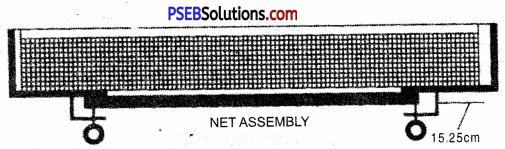
The net is 183 cms. in length. Its upper part is at the height of 15.25 cms. from the playing surface. It is tied by a cord to upright high posts of 15.25 cms. The outer limit of each post is 15.25 cms. outside the side line.

Ball:
The ball used in the game is spherical in size. It is made of celluloid or similar plastic but without reflection. Its diameter is not more than 40 mm. and not less than 37.2 mm. Its weight is not less than 2.40 gm. and not more than 2.53 gm.

Rackets:
The racket may be of any size, shape or weight. But its surface should be of dark colour. This game has 21 points.

Question 2.
How is the game of Table Tennis started?
Answer:
Order of Play. In Singles, a server does five services at a stretch whether he gets the score or not, thereafter the service passes on the other player. The other player also gets the right of doing five services. Thus, the service changes after every five services.

In Doubles, the server makes a goods service, then the receiver shall make a goods return. The partner of the server shall make a good service, thereafer, and the partner of the receiver, then, shall make a good return. Thus, turn by turn, each player shall make service and return in that order.

Good Service:
The server places the ball on the palm of his free hand, open and flat, with fingers pressed together and thumb free. Then he shall project the ball in the air and do the service in a manner that the ball remains visible to the judge. Then the ball shall be struck in a way that it touches the server’s court and passes directly over or around the net, and touches the receiver’s court.

In Doubles, the ball shall first touch the server’s right hand, right of court or the central line on the side of the net. Then the ball, passing over or around the net, touches the receiver’s right-half court, or the central line on his side of the net.

Good Return:
After having been served or returned in play, the ball shall be so struck as to pass directly over or around the net. It should touch directly the opponent’s court.

table tennis image 3

Ball in Play:
The ball is in play when it is projected from the hand for service. It shall be deemed to be in play until:

  • it has touched one court twice successively.
  • it has touched anything other than the net and supports.
  • it has been hit by a player more than one successively.
  • it has touched a player or anything he wears or carries.
  • in Doubles, it has touched the right half of the server or receiver.

A let:
A ball in play is called rally. A rally may be let if:

  • The served ball touches the net or its supports.
  • The service is delivered and the receiver is not yet ready.
  • A player fails to do good service or return owing to some accident.
  • The play is stopped for correction of the order of the game or the fault in ends.

Table Tennis Game Rules - PSEB 10th Class Physical Education

Question 3.
How are points scored in the game of Table Tennis?
Answer:
Points:
A player shall lose a point in case:

  • he fails to deliver good service.
  • he fails to deliver good return when his opponent has made goods service or return.
  • he or his racket touches the net when the ball is in play.
  • his free hand touches the playing surface when the ball is in play.
  • he returns the ball with volley.
  • in Doubles, he strikes the ball out of turn.

Game:
A player or pair who scores first 21 points shall win the game. If both the players or pairs score 20 points, then that player or pair shall be the winner who scores 2 points before the other player or pair.

The Choice of Ends and Service

In the game of tennis, the choice of ends and the right to serve first shall be decided by toss. The toss winning player chooses to serve or not to serve first, and the other player chooses the right to end (side).

Change the Ends and Service

The change of ends and service shall be made in the following manner:

In the play, a player or pair who starts a game at one end shall be at the other end in the second game, and so on. This will continue till the end of the match. The ends change when any player or pair score first ten points in the last possible game in a match. In Singles, the service is changed after five points, which means that the server shall become receiver, and recevier shall become server.

In Doubles, the selected partner of the pair shall deliver the first service, and shall be received by the appropriate partner of the opposing pair. The receiver of the first five services shall deliver the second five services. The third five services shall be delivered by the partner of the first receiver. The fourth five services are delivered by the partner of the first receiver and received by the first server. The fifth five services are to be delivered like the first five, and so on. This order will continue till the end of the game.

Out of Order of Ends, Serving or Receiving

In case the players have not changed ends in time, they shall change the ends as soon as the mistake is detected provided the game is not completed. In case the game has been completed, all points scored shall be counted. If a player serves or receives out of turn, the play shall be stopped as soon as the error is detected. The game shall be started again by the server who was serving at the start of the game, or at the time when the score was 10. In such circumstances, the scores made before the error is detected shall be counted.

Table Tennis Game Rules - PSEB 10th Class Physical Education

Important Information About the Table Tennis Game

  • Types of Table Tennis game = Two (Single & Double)
  • Size of the Table length & breadth = 274 × 152.5 cm.
  • The height of the playing floor = 76 cm.
  • The height of the net from floor = 15.25 cm.
  • Length of the net = 183 cm.
  • Weight of the ball = 2.55 gram to 2.7 gram
  • Circumference of the ball = 40m. m.
  • Colours of the ball = White
  • The ball is made of = Celluloid or plastic
  • The officials of match = One refree, one umpire one scorer, one assistant umpire.
  • The length of the table in table tennis is 2.74 metres and width 1.52 metres.
  • The game of table tennis is of two types singles and doubles. In Singles, there are two players, out of which one plays and the other is a substitute.
  • In Doubles, there are four players, out of which two play and two are substitutes. The game of table tennis is of Eleven points.
  • In Doubles game, the playing surface is divided into two parts by a 3 cm, wide white line.
  • The selection of ends (sides) and the right to first serve shall be decided by toss.
  • The toss winning player chooses to serve, whereas, the other chooses the end (side).
  • The service is changed after two points in Singles.
  • In the last possible game, the ends are changed when a player or pair scores ten points.
  • A match shall include five or seven games.
  • The lines on the table used in the game should be white in colour.
  • The remaining part of the table tennis is dark green.

Boxing Game Rules – PSEB 10th Class Physical Education

Punjab State Board PSEB 10th Class Physical Education Book Solutions Boxing Game Rules.

Boxing Game Rules – PSEB 10th Class Physical Education

Question 1.
Which type of competitions (according to weight) are held in Boxing.
Answer:
WEIGHT CLASSIFICATION IN BOXING

  1. Light Fly Weight = 48 kg.
  2. Fly Weight = 51 kg.
  3. Bantum Weight = 54 kg.
  4. Feather Weight = 57 kg.
  5. Light Weight = 60 kg.
  6. Light Welter Weight = 63.5 kg.
  7. Welter Weight = 67 kg.
  8. Light Middle Weight = 71 kg.
  9. Middle Weight = 75 kg.
  10. Light Heavy Weight = 80 kg.
  11. Heavy Weight = over 80 kg.
  12. Super Heavy Weight = over 100 kg.

Boxing Game Rules - PSEB 10th Class Physical Education

Question 2.
Describe Ring, Rope, Platform, Costumes, Gloves and duration of the bout?
Answer:
Ring:
In all boxing competitions the inside measurement of the ring is from 12 feet 20 feet to (3m. 66 cm to 6m. 10 cm) square. The height from ring floor level to the top rope shall be from 4 feet to 5 feet (lm 22 cm. to 1 m 52 cm.)

Rope:
The ring shall be formed by 2 or 3 sets of ropes covered with linen or with some soft material.

Platform:
The platform shall be erected in a way that it is totally safe, levelled and free from any obstructing projection. It will be constructed on lines of at least 18 inch ropes. It shall have four comer posts constructed in a manner as to prevent any injury.

Under-cover:
The floor shall be covered with an under-cover over which canvas shall be stretched.

Costumes:
Competitors shall do boxing by wearing vests, completely covering chests and backs. They shall wear shorts of reasonable length reaching to mid-tight positions. They shall wear light shoes. Wearing of swimming suits is not allowed. Competitors shall wear distinguishing colours such as red or blue sashes round the waist.

Gloves:
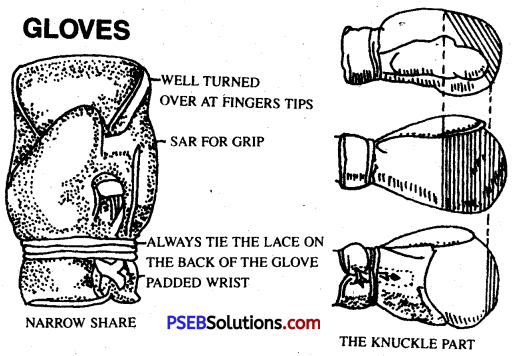
The gloves shall be of standard weight. Each glove shall weigh 8 ounces (227 gms.)

Bandages:
A soft surgical bandage, the length of which does not exceed 8 feet 4 inches (2.5 m) and width 1% inches (4.4 cm.), or a velpean-type banadge, which will not exceed 6 feet 6 inches (2 m.) in length and 1% inches (4.4 cm) in width, may be worn on each hand.

Duration of the Game:
The number and duration of rounds for Senior and Junior competitions shall be as under:

Boxing Game Rules - PSEB 10th Class Physical Education

COMPETITIONS

Senior National Level
3-1-3-1-3 – Three rounds of three minutes each after one minute rest in each bout.

Junior National Level
2-1-2-1-2 – Three rounds of two minutes each, one minute rest between each bout.

International Level
2-1-2-1-2-1-2-1-2 – Five rounds of two minutes each and one minute rest between each bout.

Question 3.
What do you know about the Draws, Byes and Walk over in Boxing?
Answer:
The Draw, Byes and Walk Over

1. A draw shall be made for all competitions after taking of weight and doing medical inspection.

2. In those competitions in which there are more than 4 competitors, a sufficient number of byes shall be drawn in the first series to reduce the number of competitors in the second series.

3. The boxers who draw a bye in the first series shall be the first to box in the second series. If there is an odd number of byes, the boxer with the last bye shall compete in the second series against the winner of the first bout in the first series.

4. No player can receive a bye in the first series and a walk-over in the second, or two consecutive walk-overs. In case such a position arises, a fresh draw shall be made of the competitors still in the competition to provide opponents to those competitors who have already received a bye walk-over in the preceding series.

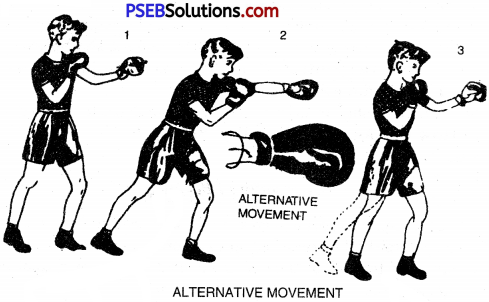
Boxing image 1

Boxing Game Rules - PSEB 10th Class Physical Education

Question 5.
Describe any Five Rules in Boxing?
Answer:
Competitions on Boxing
Limitation of Competitors. Only 4 to 8 competitors are allowed to participate in a competition. This rule does not apply to any championship organised by the Association. The club organising the competition has the right to nominate one of its members to compete provided that member does not participate in the competition.

Boxing image 2

Fresh Draw:
If two members of the same club are being drawn together in a series, and if one of them wishes to withdraw in favour of the other, a fresh draw will be made.

Withdrawal:
If a competitor wants to withdraw from the competition after the draw has been made, the official-in-charge will report to the Association.

Retirement:
If any competitor wants to retire from the competition due to any reason, he will have to inform the official-in-charge.

Byes:
Byes that arise after the first series shall be spared for specified time with an opponent approved by the official-in-charge.

Second:
Each competitor is attended by one second. No advice or coaching can be given to a competitor by his second during the progress of a round. But after the round is over, the assistance of the second can be taken for a second within the ring, and the other second can provide the competitor water and other essential items from the outside.

Boxing image 3

Boxing Game Rules - PSEB 10th Class Physical Education

Only Water Allowed:
No drink other than water can be given to the competitor immediately prior to or during a bout.

Table – Drawing Bouts and Byes

No.of Entries Bouts Byes No.of Entries Bouts Byes
5
6
7
8
9
10
11
12
1
2
3
4
1
2
3
4
3
2
1

7
6
5
4
13
14
15
16
17
18
19
20
5
6
7
8
2
2
3
4
3
2
1

15
14
13
12

(1) Referee or judge (2) Scoring (3) Foul.

Bouts Control

(1) All competitions and contests shall be controlled by a Referee, three or five Judges and a Time-keeper. The referee shall be in the ring. When the number of judges is less than three, the referee shall complete the scoring paper. The exhibition bouts shall be controlled by Referee.

(2) The referee shall use a score pad or introduction slip to record the names and colours of the boxers. In all such cases in which a bout is terminated due to injury or other cause, the Referee shall record the reason thereof, and hand it over to the official-in-charge.

(3) The time-keeper shall be seated on one side of the ring while the Judges on the remaining three sides. The seats shall be so placed as to offer a satisfactory view of boxing. The Referee shall be solely responsible for the control of the bout, and the judges shall independently award points.

(4) The Referee shall be dressed in white at all major tournaments.

Boxing Game Rules - PSEB 10th Class Physical Education

Question 6.
How are bouts conducted in Boxing?
Answer:
Awarding of Points

  1. In all competitions the judges shall award points.
  2. The points shall be recorded on the scoring paper at the end of each round and totalled at the end of the bout. Fractions cannot be taken into account.
  3. Each judge must declare a winner and sign his scoring paper.

The judge’s name shall be written in Block Letters as well as signed on all the scoring slips.

Scoring

1. The boxer who strikes his opponent the greater number of blows shall be awarded 20 points. The other boxer shall receive a lesser number of points in proportion to the number of blows he has struck.

2. When the judge observes that both the boxers have struck equal number of blows, he awards 20 points to each.

3. If the number of points awarded to each boxer at the end of the bout is equal, the judge will award the decision in the favour of the boxer who has done the most leading off, or if equal in this respect, then in favour of the boxer who has shown the better style. If in his opinion, both the boxers are equal in leading-off and style, he will favour the boxer who has shown the better defence.

Definitions:

The above rule is governed by the following definitions:

(A) Scoring Blows:
Blows struck with the knuckle part of the glove on the front or sides of the head or body above the belt.

(B) Non-scoring Blows:

  • Blows struck while committing any infringement of rules.
  • Blows on arms and on the back.
  • Soft blows or “taps” with no force behind them.

(C) Leading-off:
Leading-off means striking first, or attempting to strike first. Any infringement of the rules nullifies the scoring value of a leading-off move.

(D) Defence:
Avoidance ofblows by blocking, parrying, ducking, guarding, side-stepping, etc.

Fouls:
The decision of the judges or the referee in respect of fouls is final. The referee has the power to caution, warn or disqualify for any of the following acts:

  1. Hitting with the open glove, hitting with the inside or butt of the hand, hitting with the wrists, or any part of the glove other than the kunckle part of the closed glove.
  2. Hitting with the elbow.
  3. Hitting below the belt.
  4. Making use of Kidney Punch.
  5. Using the Pivot Blow.
  6. Hitting deliberately on the back of the neck or head.
  7. Striking a competitor when he is down.
  8. Holding the opponent.
  9. Lying on with head or body.
  10. Ducking below the belt in a manner dangerous to the rival.
  11. Butting or using the head dangerously.
  12. Roughing.
  13. Shouldering.
  14. Wrestling.
  15. Intentionally falling down without receiving a blow.
  16. Persistently covering up.
  17. Unfair use of ropes.
  18. Double blows to the ears.

The Break:
When a referee asks the two boxers to break, both of them must step one pace before recommencing the play. A boxer is not allowed to strike his rival on the “break”.

Down and Count:
A boxer is deemed to be down when any part of his body except his feet touches the ground, or when he is outside or partly outside the ropes, or hangs hopelessly on the ropes.

Stopping the Bout:
1. When a referee is of the opinion that a boxer, due to some injury, cannot continue the game, he stops the bout. In such a case, the rival player is declared the winner. The decision to stop the bout in such a case rests with the referee who can seek medical advice, if needed.

2. The referee has the right to stop the bout if he believes that the rival has got defeated or he is unable to continue the play. Failure to resume Bout. In all bouts, any boxer who fails to resume the fight, when there is time, loses the bout.

Break of Rules:
In case of infringement of rules by the competitor or his second, the competitor is liable to disqualification. A competitor who is declared disqualified shall not receive any award.

Suspected Foul:
If the refree suspects the foul which he has not clearly seen, he can consult the judges and give the decision accordingly.

Boxing Game Rules - PSEB 10th Class Physical Education

Important Information About the Boxing Game

  • Type of Ring = Square
  • The length of ope side = 20 feet
  • Numbers of Roper = 5
  • Number of weight = 12
  • Length of the Patti (Bandage 8′ 4”
  • Breadth of the Patti (Bandage 1 \(\frac{1}{4}\)” .
  • The height of the ring from flour = 3′ 4″
  • Duration of the bout for senior = 3-1-3-1-3 minutes
  • Duration of the bout for Junior = 2-1-2-1-2
  • Duration of international competition = 2-1-2-1+2+1+2+1+2
  • Boxing ring is square in size, each side of which is 20 feet.
  • The ring has three sets of ropes, the colour of whose one end is blue, and of the other red.
  • The weight classification for boxing is done in eleven parts.
  • The weight of gloves should not be over 8 ounces (227 gms.)
  • The length of the bandage should be 8 feet 4 inches, and width 1 1\(\frac{1}{4}\) inches.

PSEB 8th Class Science Solutions Chapter 5 Coal and Petroleum

Punjab State Board PSEB 8th Class Science Book Solutions Chapter 5 Coal and Petroleum Textbook Exercise Questions and Answers.

PSEB Solutions for Class 8 Science Chapter 5 Coal and Petroleum

PSEB 8th Class Science Guide Coal and Petroleum Textbook Questions and Answers

Exercises

Question 1.
What are the advantages of using CNG and LPG as fuels?
Answer:
Advantages of LPG:

LPG is considered to be a better fuel because of the following reasons:

  1. LPG has a high calorific value. Its calorific value is about 50 kJ/g. This means that when 1 gram of LPG burns in a gas stove, it produces about 50 kilo-joules of heat energy.
  2. It burns with a smokeless flame and so does not cause pollution.
  3. LPG does not produce any poisonous gases on burning.
  4. LPG is easy to handle and convenient to store.
  5. It undergoes complete combustion.
  6. LPG is a very neat and clean domestic fuel.

Advantage of CNG:
It does not cause air pollution.

Question 2.
Name the petroleum product used for surfacing of roads.
Answer:
Bitumen.

PSEB 8th Class Science Solutions Chapter 5 Coal and Petroleum

Question 3.
Describe how coal is formed from dead vegetation. What is this process called ?
Answer:
Formation of coal from dead vegetation:
About 300 million years ago, the forests got buried under the soil. They were compressed by soil deposits and temperature also rose as they sank deeper and deeper. Due to this high temperature and pressure coal was formed from dead vegetation by process of carbonisation.

Question 4.
Fill in the blanks.
(a) Fossil fuels are …………….. , …………… and ……………
(b) Process of separation of different constituents from petroleum is called ………………… .
(c) Least polluting fuel for vehicle is ………………..
Answer:
(a) Coal, petroleum, natural gas.
(b) refining.
(c) CNG (Compressed natural gas).

Question 5.
Tick True/False against the following statements.
(a) Fossil fuels can be made in the laboratory.
Answer:
False

(b) CNG is more polluting fuel than petrol.
Answer:
False

(c) Coke is almost pure form of carbon.
Answer:
True

(d) Coal tar is a mixture of various substances.
Answer:
True

(e) Kerosene is not a fossil fuel.
Answer:
True

Question 6.
Explain why fossil fuels are exhaustible natural resources.
Answer:
Fossil fuels are formed from remains of dead organisms and it took million of years to get these organisms converted into fuels. The known reserves of these fuels are limited and so, these are exhaustible fuels.

Question 7.
Describe the characteristics and uses of coke.
Answer:
Characteristics of Coke:

  1. It is tough, porous and black substance.
  2. It is pure form of carbon.

Uses of Coke:

  1. It is used to manufacture artificial graphite.
  2. It is used in manufacture of calcium carbide required for manufacture of acetylene gas. Acetylene gas is the basic raw material for manufacture of acetic acid and P.V.C.
  3. It is used in manufacture of water gas and producer gas used as an important fuel.
    • Water gas is not single gas. It is a mixture of equal volumes of carbon monoxide and hydrogen.
    • Producer gas is produced by passing controlled amount of air over red hot coke. Producer gas is in fact a mixture of one part of carbon monoxide and two parts of nitrogen by volume.
  4. It is used to extract metals like copper, iron, zinc, lead, tin etc., from their ores.
  5. Since coke does not produce any smoke, hence it is used as a household fuel.

Question 8.
Explain the process of the formation of petroleum.
Answer:
Formation of Petroleum.
Petroleum is formed from the bacterial decomposition of the remains of animals and plants which got buried under the sea millions of years ago. When these organisms died, they sank to the bottom and got covered by sand and clay. Over a period of millions of years, these remains got converted into petroleum oil by heat, pressure and catalytic action. The hydrocarbons formed rose through porous rocks until they were trapped by impervious rocks forming an oil trap. Natural gas is found above the surface of petroleum oil.

PSEB 8th Class Science Solutions Chapter 5 Coal and Petroleum

Question 9.
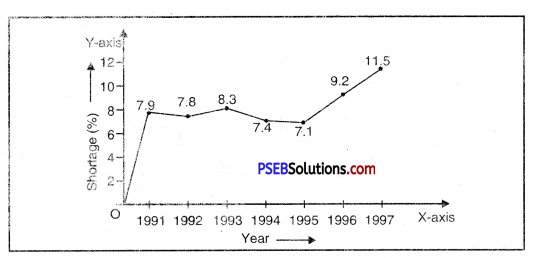
The following table shows the total power shortage in India from 1991-1997. Show the data in the form of a graph. Plot shortage percentage for the years on the Y-axis and the year on the X-axis.

S. No. Year Shortage %
1 1991 7.9
2 1992 7.8
3 1993 8.3
4 1994 7.4
5 1995 7.1
6 1996 9.2
7 1997 11.5

Answer:
PSEB 8th Class Science Solutions Chapter 5 Coal and Petroleum 1

PSEB Solutions for Class 8 Science Coal and Petroleum Important Questions and Answers

Multiple Choice Questions

Question 1.
Gurmeet’s mother uses cylinder to cook chapatti on gas burner at home. Name the gas in cylinder.
(a) Air
(b) Oxygen
(c) L.P.G.
(d) C.N.G.
Answer:
(c) L.P.G.

Question 2.
Monika read in a newspaper that a man became unconscious because of burning coal in a closed room. The teacher told her that during burning coal, a gas is produced which causes death of a person. Name
this gas.
(a) Oxygen
(b) Nitrogen
(c) Carbon-monoxide
(d) Hydrogen.
Answer:
(c) Carbon-monoxide.

Question 3.
The example of fossil fuel is:
(a) Air
(b) Sunlight
(c) Water
(d) Coal
Answer:
(d) Coal

Question 4.
Which out of the following is used as fuel in households ?
(a) Diesel
(b) Petrol
(c) Kerosene oil
(d) Bitumen.
Answer:
(c) Kerosene oil.

Question 5.
The purest form of carbon is:
(a) Coaltar
(b) Coal gas
(c) Diamond
(d) None of the above.
Answer:
(c) Diamond.

Question 6.
Which out of the following is the least pollution causing fuel ?
(a) Petrol
(b) Coal
(c) Kerosene oil
(d) C.N.G.
Answer:
(d) C.N.G.

PSEB 8th Class Science Solutions Chapter 5 Coal and Petroleum

Question 7.
Which is the natural solid fuel ?
(a) Coal
(b) Coke
(c) L.P.G.
(d) Coal tar
Answer:
(a) Coal.

Question 8.
Which among the following is the best domestic fuel ?
(a) Petrol
(b) Coal
(c) Kerosene oil
(d) C.N.G.
Answer:
(d) C.N.G.

Question 9.
Which of the following is the fossil fuel ?
(a) Air
(b) Hydrogen gas
(c) Water
(d) Coal.
Answer:
(d) Coal.

Question 10.
Which out of the following is the non renewable source of energy ?
(a) Air
(b) Sunlight
(c) Coal
(d) Forests
Answer:
(c) Coal

Question 11.
Which out of the following is called black gold ?
(a) Diesel
(b) Coal
(c) Bitumen
(d) Petroleum.
Answer:
(d) Petroleum.

Question 12.
Which out of the following is limited natural resource ?
(a) Air
(b) Sunlight
(c) Natural gas
(d) None of the above.
Answer:
(c) Natural gas.

Very Short Answer Type Questions

Question 1.
Name some natural materials.
Answer:
Air, water, soil, forests, minerals etc.

PSEB 8th Class Science Solutions Chapter 5 Coal and Petroleum

Question 2.
Name some man-made materials.
Answer:
Glass, cement, clothes, houses etc.

Question 3.
Define the term fossil fuel. Name three fossil fuels.
Answer:
Fossil fuels.
These are the fuels which are formed in nature from the dead remains of organisms over millions of years ago.
Examples. Coal, natural gas, petroleum etc.

Question 4.
How is coke prepared ?
Answer:
Coke is prepared by the destructive distillation of coal. The gases, and other substances present in coal are given off on heating. The black residue left behind is coke.

Question 5.
Name two products formed by Destructive distillation of Coal.
Answer:

  1. Coal gas
  2. Coal tar.

Question 6.
Name some products formed as a result of Fractional distillation of Petroleum.
Answer:
Asphalt, petrol, diesel oil, paraffin wax, fuel oil, kerosene oil.

Question 7.
Name three products of petroleum.
Answer:
Fertilizer, Insecticide, Artificial rubber.

Question 8.
What will happen if fossil fuels are used up at a fast rate ? Give reasons.
Answer:
Fossil fuel will get exhausted because the earth cannot recreate them rapidly.

PSEB 8th Class Science Solutions Chapter 5 Coal and Petroleum

Question 9.
Coal, petroleum, natural gas are example of which type of fuel ?
Answer:
Fossil fuel.

Question 10.
What is petroleum ?
Answer:
Petroleum. Petroleum is thick viscous crude oil with an unpleasant odour.

Question 11.
Which type of rocks store petroleum in them ?
Answer:
Impervious (non-porous) rocks.

Question 12.
Which process is used for refining petroleum ?
Answer:
Fractional distillation.

Question 13.
How is petroleum gas produced ?
Answer:
It is produced in the form of uncondensed gas during fractional distillation of crude petroleum oil.

Question 14.
What is the use of bitumen ?
Answer:
Road surfacing.

Question 15.
Which liquid fuel is used in stoves, lamps and jet air-crafts ?
Answer:
Kerosene oil.

Question 16.
Which product of petroleum is used for dry cleaning ?
Answer:
Petrol.

PSEB 8th Class Science Solutions Chapter 5 Coal and Petroleum

Question 17.
Name few exhaustible natural resources.
Answer:
Forests, wild life, minerals, coal etc.

Question 18.
Give examples of in-exhaustible natural resources.
Answer:
Air, water, sunlight etc.

Question 19.
Which natural material is available at a blacksmith’s place ?
Answer:
Coal.

Question 20.
What is main component of coal ?
Answer:
Carbon.

Question 21.
Which process converts dead vegetation into coal ?
Answer:
Carbonisation.

Question 22.
What happens when coal is heated or burn in air ?
Answer:
Carbondioxide gas is released.

Question 23.
Which condition is necessary for destructive distillation ?
Answer:
Absence of oxygen.

Question 24.
What is the latest use of coal-gas ?
Answer:
As a source of heat energy.

PSEB 8th Class Science Solutions Chapter 5 Coal and Petroleum

Question 25.
What is destructive distillation ?
Answer:
Destructive Distillation – The process of heating coal in the absence or limited supply of air is called destructive distillation.

Question 26.
What are hydrocarbons ?
Answer:
Hydrocarbons. The compounds of carbon and hydrogen are called Hydrocarbons.

Question 27.
What are Petrochemicals ?
Answer:
Petrochemicals.
These are the substances obtained from Petrol and Natural gas. These are largely used for the manufacture of detergents, synthetic fibres and plastics etc.

Short Answer Type Questions

Question 1.
Write two differences between Exhaustible and In-exhaustible Resources.
Answer:
Differences between Exhaustible and In-exhaustible Natural Resources.

Exhaustible Natural Resources In-exhaustible Natural Resources
1. Limited quantity in nature. 1. Limitless or unlimited quantity in nature.
2. Gets exhausted on consumption.

Examples: Forests, wild life.

2. Cannot exhaust on consumption i.e. can be retrieved back.

Examples: Air, Sun energy.

Question 2.
Where is petroleum found in India ?
Answer:
In India, petroleum is found in the states of Gujarat and Assam. It is also obtained from reservoirs buried deep under the sea bed near Mumbai. This oil-bearing region is called Bombay-High. Recently, oil has also been discovered in Godavari and Kaveri basins.

Question 3.
What are the major products of Petroleum refining ?
Answer:
During refining of petroleum following fractions are produced:

  1. Natural gas, Petrol,
  2. Naphtha,
  3. Kerosene oil,
  4. Gas oil (diesel),
  5. Lubricating oil/waxes,
  6. Fuel oil and
  7. Bitumen.

Question 4.
What are the products of coal ?
Answer:
Coal on heating in the absence of air gives coal gas, coal tar, and coke. Coal gas is also a good fuel. Coal tar gives important chemicals such as benzene, toluene, naphthalene, anthracene etc.

PSEB 8th Class Science Solutions Chapter 5 Coal and Petroleum

Question 5.
What is coal gas ? How is it formed ? Give its uses.
Answer:
Coal Gas. Coal gas is a mixture of methane, hydrogen and carbon monoxide.
When coal is heated in the absence of air, coal gas is formed.
Uses.

  1. It is used as a fuel.
  2. It is used for providing reducing atmosphere in metallurgical operations.

Question 6.
Give few uses of coal.
Answer:
Uses of Coal:

  1. As a fuel to cook food.
  2. To produce steam to run an engine.
  3. To produce electricity in Thermal Power plants.
  4. As a fuel in industry.

Question 7.
What is coal tar ? What are its uses ?
Answer:
Coal Tar. Coal tar is a black thick liquid with unpleasant smell. It is a mixture of about 200 substances, which are used as starting materials for the manufacturing of various daily need ithins such as paints, dyes, plastics, films, perfumes, explosives, drugs etc.
Coal tar is also used for road surfacing.

Question 8.
Name at least three constituents of petroleum and give their uses.
Answer:
Constituents of Petroleum

  1. Petrol
  2. Paraffin wax
  3. Diesel.

Uses of Petroleum:

  1. Petrol is used as a motor fuel and aviation fuel. It is also used for dry cleaning.
  2. Paraffin wax is used for making ointments, candles, vaseline etc.
  3. Diesel is used as a fuel for heavy motor vehicles and electric generators.

Question 9.
Define natural resource.
Answer:
Natural Resource. The resource that is obtained from nature is called natural resource.

Question 10.
What are the characteristics of a good fuel ?
Answer:
Characteristics of Good Fuel:

  1. It should be easily available.
  2. It should be cheap.
  3. It should be clean and should not produce poisonous gases and ash after burning.
  4. It should produce more energy.
  5. It should be easy to transport and store.

PSEB 8th Class Science Solutions Chapter 5 Coal and Petroleum

Question 11.
What is the difference between coal and coke ?
Answer:
Differences between Coal and Coke

Coal Coke
1. It is a non-crystalline form of carbon 1. It is an amorphous form of carbon.
2. It is obtained bj? death and decay of plants which remain buried under the earth for years together. 2. It is obtained by heating soft coal in the absence or limited siuply of air.

Long Answer Type Questions

Question 1.
What are fossil fuels ? How are they formed ? Why are they called non¬renewable sources of energy ?
Answer:
Petroleum, natural gas, coal etc., are main forms of fossil fuels. Millions of years ago, remains of animals, plants got buried under the earth before dinosaurs. These remains are called fossils. They remained inside the earth under huge pressure and high temperature in the absence of oxygen, these remains got converted into fossil fuel.

Fossils as a source of non-renewable source of energy.
Fossils were formed several hundred years ago under the earth. Man uses these for his various activities. These cannot be regained after use. So they are called non-renewable source of energy.

Question 2.
Describe the formation of
(a) Coal
(b) Petroleum.
Answer:
(a) Coal Formation.
Coal is believed to be formed from fossils which got buried inside the earth during earthquakes, volcanic eruptions etc., which occurred about 300 million years ago. These fossils were covered with sand, clay and water. In the absence of air and under high temperature and high pressure inside the earth, the fossils got converted into coal. This process of conversion of plants and animals buried inside the earth under high temperature and pressure to coal is called carbonisation. It is a very slow process and may have taken thousands of years.

(b) Formation of Petroleum.
It is believed that petroleum was formed and preserved in its crude state in the earth from the remains of dead microscopic marine plants (phytoplankton) which settled in muddy sediments at the bottom of sea millions of years ago. Prolonged sedimentation and cooking of these organic debris under pressure in the presence of natural catalysts, converted them into petroleum . For this reason, petroleum is also called fossil fuel.
PSEB 8th Class Science Solutions Chapter 5 Coal and Petroleum 2

Question 3.
What is petroleum? How does it occur? How is it mined?
Answer:
Petroleum.
It is dark coloured viscous, foul-smelling, oily liquid. It is a complex mixture of several solid, liquid, and gaseous hydrocarbons mixed with water, salt, and earth particles.

Occurrence of Petroleum.
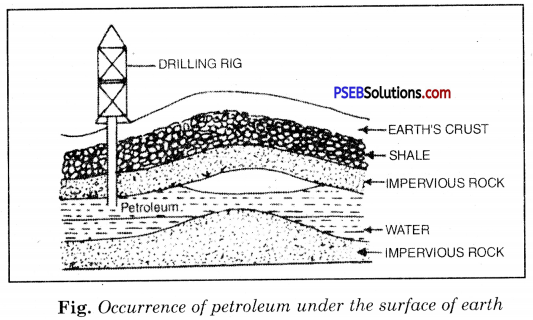
Petroleum occurs deep down under the earth between two impervious rocks (non-porous rocks) as shown in Fig. Natural gas occurs above the petroleum oil trapped under rocks.

The crude petroleum is obtained by drilling a hole into the earth’s crust and sinking pipes into it. When the pipe reaches the oil deposit, natural gas comes out with great pressure. After the pressure has subsided, the crude oil is pumped out of the oil well. This process of obtaining crude oil from its sources is called mining.

PSEB 8th Class Science Solutions Chapter 4 Materials: Metals and Non-Metals

Punjab State Board PSEB 8th Class Science Book Solutions Chapter 4 Materials: Metals and Non-Metals Textbook Exercise Questions and Answers.

PSEB Solutions for Class 8 Science Chapter 4 Materials: Metals and Non-Metals

PSEB 8th Class Science Guide Materials: Metals and Non-Metals Textbook Questions and Answers

Exercises

Question 1.
Which of the following can be beaten into thin sheets?
(a) Zinc
(b) Phosphorus
(c) Sulphur
(d) Oxygen.
Answer:
(a) Zinc.

Question 2.
Which of the following statements is correct?
(а) All metals are ductile.
(b) All non-metals are ductile.
(c) Generally, metals are ductile.
(d) Some non-metals are ductile.
Answer:
(a) All metals are ductile.

PSEB 8th Class Science Solutions Chapter 4 Materials: Metals and Non-Metals

Question 3.
Fill in the blanks.
(a) Phosphorus is very ……………… non-metal.
(b) Metals are …………. conductor of heat and ……………… .
(c) Iron is ……………… reactive than copper.
(d) Metals react with acids to produce ……………………. gas.
Answer:
(a) reactive.
(b) good, electricity.
(c) more.
(d) Hydrogen.

Question 4.
Mark ‘T’ if the statement is true and ‘F’ if it is false.
(а) Generally, non-metals react with acids.
(b) Sodium is a very reactive metal.
(c) Copper displaces zinc from zinc sulphate solution.
(d) Coal can be drawn into wires.
Answer:
(a) True
(b) True
(c) False
(d) False

Question 5.
Some properties are listed in the following Table. Distinguish between metals and non-metals on the basis of these properties. (From Board M.Q.P.)

Properties Metals Non-metals
1. Appearance
2. Hardness
3. Malleability
4. Ductility
5. Heat Conduction
6. Conduction of electricity

Answer:
Differences between metals and non-metals.

Properties Metals Non-metals
1. Appearance Silvery or grey in colour. Different coloured non-metals.
2. Hardness Solid at room temperature. Solid, liquid or gas at room temperature and brittle.
3. Malleability Can be beaten into sheets. Non-malleable.
4. Ductility Can be drawn into wires. Non-ductile.
5. Heat Conduction Present. Absent.
6. Conduction of electricity Possible. Not Possible.

Question 6.
Give reasons for the following :
(a) Aluminium foils are used to wrap food items.
(b) Immersion rods for heating liquids are made up of metallic substances.
(c) Copper cannot displace zinc from its salt solution.
(d) Sodium and potassium are stored in kerosene.
Answer:
(a) Aluminium foils are used to wrap food items because aluminium is malleable and less reactive to air and water.

(b) Immersion rods for heating liquids are made of metallic substances because metals are good conductors of heat and electricity.

(c) Copper is less reactive than zinc. As a result it cannot replace zinc from its salt solution.

(d) Sodium and potassium are very reactive metals. They react with air and water to form respective oxides and hydroxides. So, they are kept in kerosene.

Question 7.
Can you store lemon pickle in aluminium utensil ? Explain.
Answer:
No. Lemon pickle cannot be stored in aluminium utensils because acid present in lemon pickle reacts with aluminium to produce poisonous chemicals, which can cause food poisoning or other health hazards.

Question 8.
Match the substances given in Column A with their uses given in Column B.

Column A Column B
(i) Gold (a) Thermometers
(ii) Iron (b) Electric wire
(iii) Aluminium (c) Wrapping food
(iv) Carbon (d) Jewellery
(v) Copper (e) Machinery
(vi) Mercury (f) Fuel

Answer:

Column A Column B
(i) Gold (d) Jewellery
(ii) Iron (e) Machinery
(iii) Aluminium (c) Wrapping food
(iv) Carbon (f) Fuel
(v) Copper (b) Electric wire
(vi) Mercury (a) Thermometers.

PSEB 8th Class Science Solutions Chapter 4 Materials: Metals and Non-Metals

Question 9.
What happens when
(a) Sulphuric acid is poured on a copper plate ?
(b) Iron nails are placed in copper sulphate solution ?
Write word equations of the reactions involved. (From Board M.Q.P.)
Answer:
(a) When sulphuric acid is poured on copper plate, Hydrogen gas is given out.
PSEB 8th Class Science Solutions Chapter 4 Materials Metals and Non-Metals 1

(b) When iron nails are placed in copper sulphate solution, iron displaces copper from its salt to form iron sulphate
PSEB 8th Class Science Solutions Chapter 4 Materials Metals and Non-Metals 2

Question 10.
Saloni took a piece of burning charcoal and collected the gas evolved in a test tube.
(а) How will she find the nature of the gas ?
(b) Write down word equations of all the reactions taking place in this process.
Answer:
(a) To test the nature of the gas:
1. Take blue/red litmus solution turnwise into the jar of gas collected. It will turn blue litmus red while red litmus will remain unaffected. This shows that gas is acidic in nature.
2. Add some water to the jar. The liquid for turns blue litmus red showing acidic nature of the gas.

(b) When a charcoal is burnt, it reacts with oxygen to form an acidic oxide called
carbon dioxide.
PSEB 8th Class Science Solutions Chapter 4 Materials Metals and Non-Metals 3

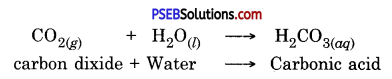
The acidic oxide, carbondioxide, dissolves in water to form an acid called Carbonic acid
PSEB 8th Class Science Solutions Chapter 4 Materials Metals and Non-Metals 4

Question 11.
One day Reeta went to a jeweller’s shop with her mother. Her mother gave an old gold jewellery to the goldsmith to polish. Next day when they brought the jewellery back, they found that there was a slight loss in its weight. Can you suggest a reason for the loss in weight ?
Answer:
Jewellers usually use a chemical solution named aquaregia for cleansing the jewellery. This solution is capable of dissolving gold in it. So, loss in weight is found.

Multiple Choice Questions

Question 1.
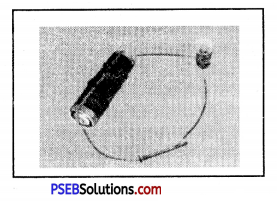
In order to keep the flow of electricity continue in circuit, which of the following items should be used in place of iron nail in the given circuit. (From Board M.Q.P.)
PSEB 8th Class Science Solutions Chapter 4 Materials Metals and Non-Metals 5
(a) Graphite
(b) Plastic
(c) Wood
(d) Rubber.
Answer:
(a) Graphite.

Question 2.
Sodium metal is stored ………………….
(a) In water
(b) In kerosene oil
(c) In Air
(d) None of these.
Answer:
(b) In kerosene oil.

Question 3.
When strip of iron is placed in moist air then after some days a layer is deposited over it which has colour:
(a) Green
(b) Red
(c) Dirty
(d) None of these.
Answer:
(b) Red.

Question 4.
Which of the following statements is correct ?
(a) All metals are ductile
(b) All non-metals are ductile.
(c) Generally metals are ductile
(d) Some non-metals are ductile.
Answer:
(c) Generally metals are ductile.

PSEB 8th Class Science Solutions Chapter 4 Materials: Metals and Non-Metals

Question 5.
Which of the following is a non-metal ?
(a) Iron
(b) Carbon.
(c) Gold
(d) Calcium.
Answer:
(b) Carbon.

Question 6.
Phosphorus is stored in:
(a) Water
(b) Air
(c) Oil
(d) None of the above.
Answer:
(a) Water

Question 7.
The metal which is found in liquid form is:
(a) Copper
(b) Silver
(c) Mercury
(d) Sodium.
Answer:
(c) Mercury.

Question 8.
Which metal is a good conductor of electricity and heat ?
(a) Sodium
(b) Potassium
(c) Copper
(d) None of the above.
Answer:
(c) Copper.

Question 9.
The best conductor of electricity is:
(a) Copper
(b) Lead
(c) Aluminium
(d) Silver.
Answer:
(d) Silver

Question 10.
Red colour makes the solution of litmus blue because of:
(a) Metal oxide
(b) Sulphur dioxide
(c) Carbondioxide i
(d) None of the above.
Answer:
(a) Metal oxide.

Question 11.
Non-metal on the base of hardness is:
(a) Iron
(b) Aluminium
(c) Copper
(d) Coal.
Answer:
(d) Coal.

PSEB 8th Class Science Solutions Chapter 4 Materials: Metals and Non-Metals

Question 12.
Which of the following gas is released when a metal react with acids ?
(a) Oxygen
(b) Hydrogen
(c) Sulphur dioxide
(d) Nitrogen
Answer:
(b) Hydrogen.

Very Short Answer Type Questions

Question 1.
Name the property because of which metals can be beaten into thin layers or sheets.
Answer:
Malleability.

Question 2.
What is ductility ?
Answer:
Ductility. The property by which metals can be drawn into wires, is called ductility.

Question 3.
Name the most ductile metal.
Answer:
Silver.

Question 4.
Name the metal which exists in the liquid state.
Answer:
Mercury.

Question 5.
Name one metal which is poor conductor of electricity.
Answer:
Lead.

Question 6.
Which metal is used in thermometer ?
Answer:
Mercury.

PSEB 8th Class Science Solutions Chapter 4 Materials: Metals and Non-Metals

Question 7.
Which metal and non-metal is liquid at ordinary temperature ?
Answer:
Metal – Mercury
Non-Metal – Bromine.

Question 8.
Write two properties of metals.
Answer:
Malleability and Ductility.

Question 9.
Name two metals which are good conductors of both heat and electricity.
Answer:
Copper and Aluminium are good conductors of both heat and electricity.

Question 10.
Name three metals which occur in the native state.
Answer:

  1. Silver
  2. Gold
  3. Platinum occur in the native state.

Question 11.
List two metals which are easy to cut.
Answer:

  1. Sodium
  2. Potassium.

Question 12.
What is that property, which allows metals to be drawn into wires, called ?
Answer:
Ductility.

Question 13.
Which metals are used to make electric wires ?
Answer:
Copper and Aluminium.

PSEB 8th Class Science Solutions Chapter 4 Materials: Metals and Non-Metals

Question 14.
Which metal is constituent of haemoglobin ?
Answer:
Iron.

Question 15.
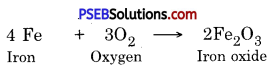
Write a chemical reaction of Iron with Oxygen.
Answer:
PSEB 8th Class Science Solutions Chapter 4 Materials Metals and Non-Metals 6

Question 16.
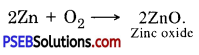
Write the chemical equation for the reaction of Zn with Oxygen.
Answer:
PSEB 8th Class Science Solutions Chapter 4 Materials Metals and Non-Metals 7

Question 17.
The set of metals in order of their increasing chemical reactivity is given below:
Silver, copper, lead, iron, zinc, magnesium and sodium.
(a) Which of the above metals is stored in kerosene ?
(b) Which metals will react with cold water ?
(c) Which gas will be liberated when metals react with cold water ?
(d) Which of the metals will react with oxygen when heated ?
(e) Which of the metals becomes black in the presence of hydrogen sulphide, H2S ?
(f) Which of the metals burns with white bright flame in oxygen ?
Answer:
(a) Sodium
(b) Sodium and Magnesium
(c) Hydrogen
(d) Magnesium
(e) Silver
(f) Magnesium.

Question 18.
Name five metals which are used in daily life.
Answer:
Metals used in daily life.

  1. Aluminium
  2. Iron
  3. Copper
  4. Zinc
  5. Tin.

Question 19.
Name five metals which are used in our industrial processes.
Answer:
Metals used in Industrial Processes.

  1. Aluminium
  2. Iron
  3. Copper
  4. Nickel
  5. Zinc.

Question 20.
Why do Sodium, Zinc, Magnesium and Aluminium not occur in their pure state ?
Answer:
Because these react with air, water and acids.

PSEB 8th Class Science Solutions Chapter 4 Materials: Metals and Non-Metals

Question 21.
Name atleast two metals which do not react with air, water and acids.
Answer:

  1. Gold
  2. Platinum.

Question 22.
Of what property, are metals used in jewellery ?
Answer:
Metallic lustre.

Question 23.
What is the colour of copper metal ?
Answer:
Eeddish-brown colour.

Question 24.
Of Iron, Copper and Magnesium, which metal can be cut easily ?
Answer:
Magnesium.

Short Answer Type Questions

Question 1.
What is the difference between a metal and a non-metal ? What is the total number of naturally occurring elements ?
Answer:
Metals have metallic lustre, are malleable, ductile, good conductors of heat and electricity, hard and combine with oxygen to form basic oxides.

Non-metals have dull lustre, not malleable and non-ductile, bad conductors of heat and electricity, brittle and combine with oxygen to form acidic oxides. The total number of naturally occurring elements is 92.

Question 2.
Why is Potassium metal not stored in water ?
Answer:
Potassium is a reactive metal. It reacts with air even at room temperature. Also it reacts with water at room temperature and catches fire. Hence, it is not stored in water but kept under kerosene oil.
PSEB 8th Class Science Solutions Chapter 4 Materials Metals and Non-Metals 8

Question 3.
State two physical properties on the basis of which metals may be distinguished from non-metals.
Answer:

  1. Metals are good conductors of heat and electricity. Non-metals are bad conductors of heat and electricity.
  2. Metals have a shiny appearance, that is, they show a metallic lustre. Nonmetals have a dull lusture. They generally do not reflect light well.

PSEB 8th Class Science Solutions Chapter 4 Materials: Metals and Non-Metals

Question 4.
State one chemical property which may be used to distinguish a metal from a non-metal.
Answer:
Metals when burn, combine with oxygen to form metallic oxides which are basic in nature, whereas non-metals combine with oxygen to form acidic oxides. This property can be used to distinguish a metal from a non-metal.

Question 5.
Why is sodium stored in kerosene oil ?
Answer:
Sodium is highly reactive metal. It readily combines with oxygen when exposed to air and sometimes it even catches fire. It also reacts with water forming its hydroxide. To prevent its oxidation, sodium is stored under kerosene oil.

Question 6.
Explain the following:
(а) Acidic oxides
(b) Basic oxides.
Answer:
(a) Acidic Oxides. These are the oxides of non-metals and give acids when dissolved in water.
Examples : CO2, SO2 etc.

(b) Basic Oxides. These are the oxides of metals and give alkaline or basic solutions in water.
Examples : Sodium oxide, Calcium oxide etc.

Question 7.
Explain the occurrence of metals in nature.
Answer:
Occurrence of Metals in Nature. Metals occur in the nature in free as well as in combined state.
1. Free or Native State. The metals which are not attacked by air and moisture generally occur in the free or native state e.g. metals like gold, platinum etc.

2. Combined State. Metals generally occur in nature in the form of compounds
such as oxides, sulphides etc. These metals are said to occur in the combined state, e.g. Aluminium oxide.

Question 8.
What do you understand by ductility and malleability of a metal ? Give examples of two metals which are both ductile and malleable.
Answer:
Ductility.
It is the property of metals by virtue of which metals can be drawn into thin unbroken wires. Metals exhibiting this property are called ductile.
Examples : Copper, Aluminium, Silver, Gold.

Malleability. It is the property of metals by virtue of which Metals which can be beaten into thin sheets and twisted or bent without breaking. Metals showing this property are called malleable.
Examples : Gold, Silver, Aluminium.
Examples of two metals which are both malleable and ductile :
Aluminium and Gold.

Question 9.
Silver does not combine easily with oxygen but silver jewellery tarnishes after some time. How ?
Answer:
Silver does not combine easily with oxygen of the air. But it readily combines with sulphur compounds such as hydrogen sulphide present in the air to form a black coating of silver sulphide. Therefore, silver jewellery tarnishes after some time.

Question 10.
Why do gold ornaments look new even after several years of use ?
Answer:
Gold does not tarnish. That is, it never corrodes as it is non-reactive. It is unaffected by air, water and acids. This is why gold ornaments look new even after several years of use.

PSEB 8th Class Science Solutions Chapter 4 Materials: Metals and Non-Metals

Question 11.
Magnesium and copper metals are heated directly over a flame. Which of these will burn in air ? Which is more reactive ?
Answer:
When magnesium and copper are heated directly over a flame, magnesium will burn in air. Magnesium is more reactive.

Question 12.
CuSO4 + Fe → FeSO4 + Cu
FeSO4 + Zn → ZnSO4 + Fe
On the basis of the above reactions, indicate which is the most reactive and which is the least reactive metal out of zinc, copper and iron ?
Answer:
In the first reaction, iron displaces copper from copper sulphate solution, therefore, iron is more reactive than copper. In the second reaction zinc displaces iron from iron sulphate, therefore, zinc is more reactive than iron. Therefore, zinc is the most reactive metal while copper is the least reactive.

Question 13.
Why are pickles, chutney and citrus fruits not stored in iron and aluminium utensils ?
Answer:
Certain foodstuffs, particularly citrus fruits, chutney, pickles and curd, which contain acids tend to attack kitchen utensils made of aluminium and iron forming poisonous salts. Iron and aluminium utensils are, therefore, not used to store pickles, chutney and citrus fruits.

Question 14.
What would you observe when a strip of zinc is dipped in the solution of copper sulphate ?
Answer:
Zinc being more reactive would replace copper from its salt solution i.e. copper sulphate.
Zn + CuSO4 → ZnSO4 + Cu

Question 15.
Can copper displace iron from iron sulphate solution ? Give reasons.
Answer:
No, because copper is less reactive than iron. As a result, it can’t replace iron from its salt solution i.e. iron sulphate. Only more reactive metals can replace less reactive metals from their salt solutions. Vice-versa is not possible i.e., less reactive metals cannot replace more reactive metals from their salt solutions.

Question 16.
Why does aluminium vassel lose its lusture after sometime ?
Answer:
Aluminium is a reactive metal. During its use, it comes in contact with air and water when it forms dull coating of aluminium oxide on its surface. Hence the vessel loses its shine.

PSEB 8th Class Science Solutions Chapter 4 Materials: Metals and Non-Metals

Question 17.
Why aluminium metal is preferred to copper for making cooking utensils ? Give two reasons.
Answer:
Because of the following two reasons, aluminium is preferred to copper for making cooking utensils.

  1. It is very light and is a good conductor of heat.
  2. It is not readily attacked by acids present in the food materials to be cooked.

Question 18.
What is corrosion ? What are the different ways to reduce corrosion ?
Answer:
Corrosion. Metals when exposed to moist air get covered with dull layer.
This layer can be easily removed giving place to the next such layer to be formed. In this way, metal is eaten up or corroded and the process is called corrosion.
Ways to reduce corrosion:

  1. By covering the metal with paint
  2. By applying oil or grease on the surface of metal.
  3. By coating the metal with some other metal which is not easily corroded by passing electricity.
  4. By making an alloy.

Question 19.
Sodium occurs in the combined state where as Gold in its native state, why ?
Answer:
Sodium is the most reactive metal. It readily combines with air and water to form its compounds. So it occurs as compound. On the other hand Gold is the noble metal and is not attacked by air, water or acids so it exists in its native form.

Question 20.
Does copper rust ? What will happen if copper is exposed to moist air ?
Answer:
Copper does not rust. When copper is exposed to moist air for long, it acquires a dull green coating. The green material so formed is a mixture of Copper hydroxide [CU(OH)2] and Copper carbonate [CuCO3], The following reaction takes place:
PSEB 8th Class Science Solutions Chapter 4 Materials Metals and Non-Metals 9

Question 21.
Give reasons for the following:
(i) Aluminium is used in making parts of aeroplane.
(ii) Copper is used in making electric wires.
(iii) Silver is used in making mirrors.
(iv) Graphite is used as an electrode in the Dry cell.
(v) Iron is used in constructing bridges and dams.
Answer:
(i) Aluminium being light and strong metal is used in making parts of aeroplanes.
(ii) Copper is a good conductor of electricity. So, it is used for making electric wires.
(iii) Silver is very shining white metal and has, therefore, high reflecting power.
(iv) Graphite is a good conductor, so it used for making electrode in dry cells.
(v) Iron being strong and rigid metal is used in the construction of bridges and dams.

PSEB 8th Class Science Solutions Chapter 4 Materials: Metals and Non-Metals

Long Answer Type Questions

Question 1.
Give general physical properties of metals.
Answer:
General physical properties of metals:

  1. Metals have a shiny appearance, i.e. they show metallic lustre.
  2. Metals are generally hard and their hardness varies from metal to metal.
  3. Most metals are malleable, i.e. they can be hammered into thin sheets.
  4. Metals are ductile and, therefore, can be drawn into wires.
  5. Metals are good conductors of heat and electricity. Electricity flows most readily through gold, silver, copper and aluminium.
  6. Metals are generally sonorous i.e. metals make sound when hit with an object.
  7. All metals except mercury exist in solid form at room temperature.
  8. Metals have high melting points.

Question 2.
Give general physical properties of non-metals.
Answer:
General physical properties of non-metals:

  1. Lustre. Non-metals possess dull lustre, i.e., they do not reflect light well. Exceptions are graphite and diamond.
  2. Conductivity. Non-metals are poor conductors of heat and electricity. Exception is graphite.
  3. State. Non-metals may occur as solids or liquids or gases at room temperature. For example Sulphur, Carbon and Iodine are solids. Bromine is a liquid. Chlorine and nitrogen are gases.
  4. Malleability. Non-metals are not malleable but they are brittle. Non-metals break into small pieces when hammered.
  5. Hardness. Non-metals are generally not hard but diamond is exception. Diamond is the hardest known substance.
  6. Ductility. Non-metals cannot be drawn into wires and are, therefore, not ductile
  7. Melting and Boiling Point. Non-metals have low melting and boiling points. A majority of non-metals are gases. Exception is graphite which has a high melting point.

Question 3.
How do metals react with acids ?
Answer:
Reaction of metals with acids :
1. Active metals like zinc, magnesium, iron etc. which lie above hydrogen in the electrochemical series or activity series can displace hydrogen from dilute mineral acids such as hydrochloric acid and sulphuric acid.
PSEB 8th Class Science Solutions Chapter 4 Materials Metals and Non-Metals 10

2. The metals which lie below hydrogen don’t displace hydrogen from dilute mineral acids such as hydrochloric acid, sulphuric acid etc.
For example, copper does not react with dil. HCl.

Question 4.
How do metals react with water ?
Answer:
Reaction of metals with water. Different metals have different reactivities with water. All metals react with water under different conditions to produce hydrogen gas.
1. Active metals like Na, K react with water at room temperature.
PSEB 8th Class Science Solutions Chapter 4 Materials Metals and Non-Metals 11
The reaction is so violent and exothermic that the evolved hydrogen catches fire.

2. Less active metals like Mg, Zn, Al, react with boiling water.
PSEB 8th Class Science Solutions Chapter 4 Materials Metals and Non-Metals 12
3. Metals like Fe, Ni react very mildly with steam
PSEB 8th Class Science Solutions Chapter 4 Materials Metals and Non-Metals 13

PSEB 8th Class Science Solutions Chapter 4 Materials: Metals and Non-Metals

Question 5.
Which of the following displacement reaction cannot occur ?
(a) CUSO4(aq) + Fe → FeSO4(aq) + Cu
(b) FeSO4(aq) + Zn → ZnSO4(aq) + Fe
(c) ZnSO4(aq) + Pb → PbSO4(aq) + Zn
(d) 2AgNO3(aq) + Cu → Cu(NO3)2 + 2Ag
(e) MgSO4(aq) + Cu → CuSO4 + Mg
Answer:
A more reactive metal (placed higher in the activity series) can displace the less reactive metal from its solution. Out of the above five reactions.
(c) cannot occur because zinc is more reactive than lead.
(e) cannot occur because magnesuim is more reactive than copper.

Question 6.
Name three metals that you come across in your daily life and also give their uses.
Answer:
We come across directly or indirectly the following metals in our daily life:

  1. Iron
  2. Copper
  3. Aluminium

1. Uses of Iron :

  • Iron mixed with other metals is largely used in making trains, automobiles and other machine parts.
  • Iron mixed with cement is used in constructing big buildings and dams.
  • Iron is used in making bridges and boilers for industry.

2. Uses of Copper:

  • It is used for making cooking utensils,
  • It is used in making photoframes, coins and statues.
  • It is used for making electrical wires.

3. Uses of Aluminium:

  • It is used for making aeroplanes
  • It is used for making electric wires and parts of electric gadgets.
  • Aluminium foils are used as packing material.

Question 7.
Distinguish between metals and non-metals on the basis of their chemical properties.
Answer:
Distinction between Metals and Non-metals

Property Metals Non-Metals
Chemical Properties-

1. Nature of Ions

Metals are electr-opositive elements and lose electrons to become electro-positive ions. Non-metals are electro-negative elements and gain electrons to form negative ions.
2. Nature of Oxides Form basic oxides Form acidic oxides.
3. Reaction with Water Mostly displace hydrogen. Do not react with water.
4. Reaction with Acids Metals above hydrogen in the activity series displace hydrogen from Non-metals do not react with dilute acids.
5. Nature of Hydrides Metals react with hydrogen to form ionic hydrides. Form covalent hydrides.
6. Nature of Chlorides Metals combine with chlorine to form solid ionic chlorides which conduct electricity. Non-metals combine with chlorine to form covalent chlorides which do not conduct electricity.

Question 8.
Give general chemical properties of non-metals.
Answer:
1. Reaction with Air or Oxygen. Non-metals react with air or oxygen to form their corresponding oxides which are acidic in nature. These oxides turn blue litmus red.
PSEB 8th Class Science Solutions Chapter 4 Materials Metals and Non-Metals 14

2. Reaction with Hydrogen. Non-metals like carbon, Nitrogen, and Phosphorous react with Hydrogen to form different compounds.
PSEB 8th Class Science Solutions Chapter 4 Materials Metals and Non-Metals 15

3. Reaction with other non-metals. Non-metals react with other non-metals to form compounds
PSEB 8th Class Science Solutions Chapter 4 Materials Metals and Non-Metals 16

4. Reaction with Acids. Non-metals react with acids to form corresponding oxyacids.
PSEB 8th Class Science Solutions Chapter 4 Materials Metals and Non-Metals 17

PSEB 8th Class Science Solutions Chapter 1 Crop Production and Management

Punjab State Board PSEB 8th Class Science Book Solutions Chapter 1 Crop Production and Management Textbook Exercise Questions and Answers.

PSEB Solutions for Class 8 Science Chapter 1 Crop Production and Management

PSEB 8th Class Science Guide Crop Production and Management Textbook Questions and Answers

Exercises

Question 1.
Select the correct word from the following list and fill in the blanks:
float, water, crop, nutrients, preparation
(a) The same kind of plants grown and cultivated on a large scale at a place is called ……………..
Answer:
crop

(b) The first step before growing crops is …………………. of the soil.
Answer:
preparation

(c) Damaged seeds would ………………… on top of water.
Answer:
float

(d) For growing of crop, sufficient sunlight, ……………… and ……………… from the soil are essential.
Answer:
water, nutrients

Question 2.
Match items in colun,.n ‘A’ with those in column ‘B’:

(A) (B)
(i) Kharif crops (a) Food for cattle
(ii) Rabi crops (b) Urea and super phosphate
(iii) Chemical fertilizers (c) Animal excreta, cow dung, urine and plant waste
(iv) Organic manure (d) Wheat, gram and pea
(e) Paddy and maize

Answer:

(A) (B)
(i) Kharif crops (e) Paddy and maize
(ii) Rabi crops (d) Wheat, gram and pea
(iii) Chemical fertilizers (b) Urea and super phosphate
(iv) Organic manure (c) Animal excreta, cow dung, urine and plant waste

PSEB 8th Class Science Solutions Chapter 1 Crop Production and Management

Question 3.
Give two examples of each.
(a) Kharif Crop
(b) Rabi Crop
Answer:
(a) Kharif Crop – (i) Paddy (ii) Maize.
(6) Rabi Crop – (i) Wheat (ii) Gram.

Question 4.
Write a paragraph in your own words on each of the following:
(a) Preparation of soil
(b) Sowing
(c) Weeding
(d) Threshing.
Answer:
(a) Preparation of Soil.
Soil is loosened and overturned to make it better ventilated and suitable for the growth of tiny organisms living in it. The entire process is called tillage and ploughing.

Soil if ploughed in dry season gets into big mud pieces or crumbs. These are broken down by plying a soil plank.
The ploughed soil is liable to be removed by wind and water. Wooden leveller is used to press the soil.

(b) Sowing.
The process of putting seeds in the soil is called sowing. It is the most important part of crop production. Before sowing, good quality of seeds are selected. The seeds are sown in the fields by hand (broadcasting) and by seed drill.

(c) Weeding.
It is a process of removal of unwanted plants i.e. weeds from the fields. It is necessary to remove the weeds since they compete with the main crop for water, nutrients, sunlight etc. The weeds may be removed manually by uprooting or cutting. The best time to remove them is before they produce flowers and seeds. It is done with a khurpi and a tractor driven harrow. Some chemicals called weedicides are used to control the weeds. They are sprayed in the fields for killing the weeds e.g. linazine, dalapon, etc.

(d) Threshing.
The separation of grains from the chaff in the harvested plants is called threshing. Animals are used on a large scale for threshing. In large farms, a machine called ‘thresher’ or a motorized machine called ‘combine’ are used for both harvesting and threshing.

Question 5.
Explain how fertilizers are different from manure.
Answer:
Differences between Manure and Fertilizers

Fertilizers Manure
1. These are mixtures of chemical compounds rich in nitrogen, phosphorus, potassium and manufactured in factories. 1. These are organic substances prepared from the decomposition of plant and animal wastes.
2. Chemical fertilizers are nutrients specific i.e. nitrogenous, phosphatic, etc. 2. They contain a mixture of various nutrients recycled from biomass wastes.
3. They are in a concentrated form. 3. They are not in a concentrated form.
4. They are easy to store or transport. 4. They are not easy to store or transport.
5. They are harmful if used in excess. 5. They are never harmful to the soil.

Question 6.
What is irrigation ? Describe two methods of irrigation which conserve water.
Answer:
Irrigation. Giving water to the fields at different intervals is called irrigation. The time and frequency of irrigation varies from crop to crop, soil to soil and season to season.

The latest irrigation methods help us to use water economically. The main methods used which conserve water are as follows:

1. Sprinkler System.
This system is more useful on the uneven lands where water is available in smaller quantity. The perpendicular pipes, having rotating nozzles on the top, are joined to the main pipe line at regular intervals. The water is allowed to flow through it with the help of a pump. The water escapes from the rotating nozzles. It is sprinkled on the crop as if it is raining. Sprinkler method is very useful for the sandy soil.

2. Drip System.
In this system, the water falls drop by drop just at the position of the roots. So it is called drip system.
Fig. Sprinkler System.
PSEB 8th Class Science Solutions Chapter 1 Crop Production and Management 1
It is the best technique of watering fruit plants, gardens and trees. Drip system consists of a main pipe to which lateral pipes are joined. The specially prepared nozzles are attached to these lateral pipes. It provides water to plants drop by drop. In this way, water is not wasted. So, it is a boon in regions where availability of water is poor.
PSEB 8th Class Science Solutions Chapter 1 Crop Production and Management 2

Question 7.
If wheat is sown in the Kharif season, what would happen ? Discuss.
Answer:
Wheat is a Rabi crop i.e. it is grown in winter season where there is low temperature and needs less water. So, if wheat is sown in Kharif season during rainy season, it gets more water which is harmful to the crop. The wheat crop droops down. It would not grow healthy.

PSEB 8th Class Science Solutions Chapter 1 Crop Production and Management

Question 8.
Explain how soil gets affected by the continuous plantation of crops in a field.
Answer:
For the continuous plantation and better growth of crops, manure and fertilizers are added regularly in the field. Manure and fertilizers are the nutrients like nitrogen, phosphorus, potassium etc. They can change the nature of the soil. The soil may become more alkaline or acidic with addition of the nutrients.

Question 9.
What are weeds ? How can we control them ?
Answer:
Weeds. Weeds are undesirable plants that may grow naturally along with the crop. The removal of weeds is called weeding.

Methods to Control Weeds. Following methods are used to control the weeds:

  • Tilling. The process of loosening and turning of the soil is called tilling or ploughing. This is done by using plough. Tilling helps in uprooting and killing of weeds.
  • Manual Removal. This method includes the physical removal of weeds by uprooting or cutting them close to the ground. This is done with the help of Khurpa or Harrow.
  • Chemical Method. In this method weeds are controlled by using some chemicals, called weedicides like 2, 4-D. The weedicides are sprayed in the fields with a sprayer.

PSEB 8th Class Science Solutions Chapter 1 Crop Production and Management 3

Question 10.
Arrange the following boxes in proper order to make a flow chart of sugarcane crop production.
PSEB 8th Class Science Solutions Chapter 1 Crop Production and Management 4
Answer:
PSEB 8th Class Science Solutions Chapter 1 Crop Production and Management 5

Question 11.
Complete the following word puzzle with the help of clues given below.
Down
1. Providing water to the crops.
2. Keeping crop grains for a long time under proper conditions.
5. Certain plants of the same kind grown on a large scale.

Across
3. A machine used for cutting the matured crop.
4. A rabi crop that is also one of the pulses.
6. A process of separating the grain from chaff.
PSEB 8th Class Science Solutions Chapter 1 Crop Production and Management 6
Answer:
PSEB 8th Class Science Solutions Chapter 1 Crop Production and Management 7

PSEB Solutions for Class 8 Science Crop Production and Management Important Questions and Answers

Multiple Choice Questions

Question 1.
The following implement is related to which agriculture practice.
PSEB 8th Class Science Solutions Chapter 1 Crop Production and Management 8
(a) Irrigation
(b) Sowing
(c) Weeding
(d) Harvesting.
Answer:
(d) Harvesting.

Question 2.
The figure given below represents which conventional method of irrigation ?
PSEB 8th Class Science Solutions Chapter 1 Crop Production and Management 9
(a) Pulley
(b) Chain Pump
(c) Dhekli
(d) Rahat.
Answer:
(c) Dhekli.

Question 3.
Mohan is sprinkling chemical solution to destroy weed plants growing along with main crops in his field. What is this chemical solution called ?
(a) Fertilizer
(b) Weedicides
(c) Yeast
(d) None of the above.
Answer:
(b) Weedicides.

PSEB 8th Class Science Solutions Chapter 1 Crop Production and Management

Question 4.
The mother of Naresh collects the waste material of living beings in an open space. According to her, after a few days, micro-organisms break the waste material of living beings and turn it into fertilizers. What is this fertilizer called ?
(a) Fertilizer
(b) Chemical fertilizer
(c) Manure
(d) None of the above.
Answer:
(c) Manure.

Question 5.
Jasbeer saw some weeds (unwanted plants) growing in his field along with main crops. What is this process called in which these weeds are removed from the field ?
(a) Sowing
(b) Irrigating
(c) Weeding
(d) Cutting.
Answer:
(c) Weeding.

Question 6.
In which season Kharif crops are grown ?
(a) Rainy season
(b) Autumn season
(c) Winter season
(d) None of the above.
Answer:
(a) Rainy season.

Question 7.
The process of loosening and overturning the soil is called:
(a) Ploughing
(b) Sowing
(c) Irrigation
(d) Weeding.
Answer:
(a) Ploughing.

Question 8.
The roots of bean plants have nodules and the microorganism which lives inside them is called:
(a) Virus
(b) fungi
(c) Rhizobium bacterium
(d) Algae
Answer:
(c) Rhizobium bacterium.

Question 9.
Which weedicides are used to remove weeds from the crops ?
(a) 2.4 D
(b) B.H.C.
(c) DDT
(d) All of the above.
Answer:
(a) 2.4 D.

Question 10.
What percentage of water is in plants ?
(a) 70%
(b) 80%
(c) 60%
(d) 90%
Answer:
(d) 90%.

Question 11.
Weeds are:
(a) Unwanted plants growing along with main crops
(b) Crop plants
(c) Bean plants
(d) Useful plants
Answer:
(a) Unwanted plants growing along with main plants.

PSEB 8th Class Science Solutions Chapter 1 Crop Production and Management

Question 12.
Which of the following is not the source of irrigation ?
(a) Well
(b) Sea
(c) River
(d) All of the above.
Answer:
(b) Sea.

Question 13.
The modern method of irrigation is
(a) Dhekli
(b) Chain pump
(c) Rahat
(d) Sprinkle system.
Answer:
(d) Sprinkle system.

Very Short Answer Type Questions

Question 1.
Define agriculture.
Answer:
Agriculture. The word agriculture consists of two Latin words – ager means field and culture means cultivate. So, agriculture is defined as to cultivate the fields.

Question 2.
What is staple Food ?
Answer:
Staple food. The food which forms the main part of our diet is called staple food e.g. rice and wheat. These are grown on a large scale in vast fields as they are consumed in large amounts.

Question 3.
What time does a crop take to mature ?
Answer:
It normally takes about 3-4 months for a good crop to mature.

Question 4.
What are weedicides ?
Answer:
Weedicides. Those chemicals which are sprayed over the field to check the growth of the weeds are known as weedicides.

Question 5.
What is animal husbandry ?
Answer:
Animal Husbandry. The study of all aspects such as food, shelter, health care of domesticated animals is called animal husbandry.

Question 6.
What is crop ?
Answer:
Crop. The plants of the same kind grown at a place is referred to as crop.

PSEB 8th Class Science Solutions Chapter 1 Crop Production and Management

Question 7.
Name two main crops of our country.
Answer:
Main crops of country. Wheat and Paddy are two main crops of India.

Question 8.
Define Produce.
Answer:
Produce. The crops are grown on ground or in water and what we obtain from the crop is called produce.

Question 9.
What are Kharif crops ?
Answer:
Kharif Crops. The crops grown during June-October are called Kharif crops, for example, paddy, maize.

Question 10.
What are Rabi crops ?
Answer:
Rabi Crops. The crops grown during November-April are called Rabi crops. These are not based on monsoon.
Example. Wheat, legumes like clover.

Question 11.
Name three crops sown by sowing seeds.
Answer:
Wheat, maize and millet.

Question 12.
Define irrigation.
Answer:
Irrigation. The supply of water at different levels is called irrigation.

Question 13.
Name two legume crops.
Answer:
Clover (barseem) and Gram.

PSEB 8th Class Science Solutions Chapter 1 Crop Production and Management

Question 14.
What is weeding ?
Answer:
Weeding. The removal of weeds is called weeding.

Question 15.
What is crop rotation ?
Answer:
Crop rotation. Sowing of different crops alternately in the field is called crop rotation.

Short Answer Type Questions

Question 1.
Why is soil turned and loosened before seeds are sown ?
Answer:
Soil is turned and loosened before seeds are sown because of following reasons:

  1. It allows the roots to penetrate freely and deeper.
  2. It allows the roots to breathe easily.
  3. The plant is secured more firmly.
  4. It aids the growth of worms and microbes present in the soil.

Question 2.
What are broadcasting and transplanting ?
Answer:
Broadcasting.
After the soil has been prepared, seeds of crop plants are sown in it. There are two methods of sowing them. Sowing by land or by using seed drill is called broadcasting.

Transplanting.
It is a process of taking out young plants or seedlings from nursery beds and transfer them to fields with required spacing, water and minerals for adequate growth.
PSEB 8th Class Science Solutions Chapter 1 Crop Production and Management 10

Question 3.
What are insecticides ?
Answer:
Insecticides.
The special chemicals which selectively kill the pests or harmful insects as well as their eggs and larvae, but do not affect the plants are called insecticides or pesticides.

Question 4.
Why should the harvested grains be protected from moisture ?
Answer:
Moisture and humidity promotes the growth of fungi or moulds on grains. Some of these microorganisms are poisonous also. So, it is very important to store harvested grains dry.

Question 5.
How does a farmer rotate crops in the fields ?
Answer:
Crop rotation involves the change of crop every year as alternate sowing of crops so that pathogen is killed in absence of suitable host.

Repeated growing of the same plant however may deplete the soil severely of specific nutrients. To prevent this it is advisable to cultivate two different types of plants alternately. For example, maize and wheat are grown alternately with groundnut. The groundnut plant, with its nitrogen fixing, bacteria enriches the soil with some nutrients, which are beneficial for wheat. Rotating different crops in this manner thus replenishes the soil naturally.

PSEB 8th Class Science Solutions Chapter 1 Crop Production and Management

Question 6.
How are pests controlled in a crop field ?
Answer:
Pests are living organisms which cause diseases or kill or destroy the crop plants. In order to control the pests, pesticides such as Malathion, Disyston, B.H.C. etc. are used. They are sprayed on the crops. They kill the microbes without causing harm to plants and human beings who consume them.
PSEB 8th Class Science Solutions Chapter 1 Crop Production and Management 11

Question 7.
What are the harms of excess of water in the fields ?
Answer:
Harms of excess of water

  1. It can destroy crops.
  2. Continued water logging increases the amount of salt in the soil and can damage it permanently.
    Excess water can be drained off by providing a suitable outlet.

Question 8.
Why is it important to wash off fruits, grains or vegetables before being consumed ?
Answer:
It is important to wash off fruits, grains or vegetables because these when brought from fields to the market often have a coating of pesticides. Otherwise they prove to be harmful.

Question 9.
What is field fallow ? Why is it important ?
Answer:
Field Fallow.
Some fields are allowed to rest and regenerate for at least a season to support a crop. This is called field fallow.

Importance.
The growth of humus picks up which in turn promotes the growth of soil micro-organisms during such undisturbed periods. It leads to a rich replenishment of nutrients.

Question 10.
How are the stored grains damaged ?
Answer:
Rats and other rodents damage the stored grains. The amount of grain eaten by rats and rodents is estimated to be over 25% of the total produce.
Stored grains are also damaged by insects and worms. Such infested grains if consumed by people, cause many diseases.

Question 11.
What are weeds ? How are they removed ?
Answer:
Weeds. Weeds are undesirable plants that may grow naturally along with the crop. The removal of weeds is called weeding.

Methods to Control Weeds. Following methods are used to control the weeds:
1. Tilling. The process of loosening and turning of the soil is called tilling or ploughing. This is done by using plough. Tilling helps in uprooting and killing of weeds.
2. Manual Removal. This method includes the physical removal of weeds by uprooting or cutting them close to the ground. This is done with the help of Khurpa or Harrow.
3. Chemical Method. In this method weeds are controlled by using some chemicals, called weedicides like 2, 4-D. The weedicides are sprayed in the fields with a sprayer.
PSEB 8th Class Science Solutions Chapter 1 Crop Production and Management 3

Question 12.
Give the structure of harrow. What is its main use ?
Answer:
PSEB 8th Class Science Solutions Chapter 1 Crop Production and Management 12
Structure of Harrow. It has small pointed iron rods or wooden rods. A strong, broad plate of iron is fixed to one of its ends and works like a blade. It uproots the weeds when moved in a crop field just like a plough.

Uses. It is used to remove the weeds of the field.
PSEB 8th Class Science Solutions Chapter 1 Crop Production and Management 13

PSEB 8th Class Science Solutions Chapter 1 Crop Production and Management

Question 13.
Why is ploughing of soil necessary before sowing seeds or crop plants ?
Answer:

  1. Ploughing tills the soil deeply. It may involve partial or complete turning over of soil.
  2. Ploughing clears land of the preceding crop and leaves the soil loosened.
  3. Repeated ploughing eliminates all weeds.
  4. Harmful insects are destroyed by ploughing.
  5. Ploughing makes the soil porous.
  6. Ploughing makes the soil soft, clean and suitable for sowing.

Question 14.
Why are fields manured ?
Answer:
Manuring of Fields.
Plants get their nutrients from the soil. If crops are grown continuously, they use all the nutrients present in the soil. To make up this deficiency of soil, manures are added to the soil.

Question 15.
What do you mean by harvesting and threshing ?
Answer:
Harvesting.
The cutting of the crop when it matures is called harvesting. Most of the crops are harvested with help of a sickle or huge combines.
PSEB 8th Class Science Solutions Chapter 1 Crop Production and Management 14

Threshing.
The separation of grains from the chaff is called threshing. Animals are used on a large scale for threshing.

Question 16.
What are the types of crops on the basis of seasons ? Give examples of each type.
Answer:
Crops are of two kinds on the basis of season:

  1. Kharif Crops. The crops which are grown during the monsoon season are called Kharif Crops.
    Examples. Maize, Bajra and Cotton etc.
  2. Rabi Crops. Those crops which are grown during the winter season are called Rabi Crops.
    Examples. Wheat, Gram and Mustard etc.
  3. Summer Crops. Those crops which are grown during summer seasons are called Summer Crops.
    Examples. Moong, Water melon, Cucumber, gourd etc.

Question 17.
What is mixed cropping ? Give an example.
Answer:
Mixed Cropping.
The practice of cultivating two crops simultaneously is done to economise the time and energy. This is called mixed cropping.
Example. The crop of groundnut is grown in the fields along with cotton.

Question 18.
Why is it necessary to sow seeds at an appropriate depth ?
Answer:
It is necessary to sow seeds at an appropriate depth because if the seeds are sown too deep, they will not be able to germinate. On the other hand, if they are sown at a shallow depth, then they will be eaten away by birds or animals.

Question 19.
How is the crop produce stored ?
Answer:
The crop produce is stored in godowns by agencies like Food Corporation of India and State Warehousing Corporations. Grains are sun dried before storing to reduce moisture contents of grains. This prevents the attack of pests. Large scale storing of grains is done in granaries and silos to protect grains from pests like rats and insects.

PSEB 8th Class Science Solutions Chapter 1 Crop Production and Management

Question 20.
Define Fertilizer.
Answer:
Fertilizers.
These are the chemical substances that are man-made and are rich in nitrogen, phosphorus and potassium, i.e. they are rich in organic macronutrients which are needed by plants.

Question 21.
Why should we use organic manures ?
Answer:
We should use organic manure because it helps in replenishing the soil nutrients without causing any harm to the soil. This manure is considered much better than the fertilizers. Crops like vegetables and fruits grown by organic manure are considered safe as compared to the crops grown by using chemical fertilizers. Therefore, we should use organic manure in growing vegetables and fruits.

Question 22.
Some seeds are given to you to grow. What factors will you keep in mind ?
Answer:
We will keep the following factors in mind. These are:

  1. We would sow them at the correct depth.
  2. We would water them regularly and check the amount of water that we are putting.
  3. We would use manure at the proper time.
  4. We would ensure that no weeds grow with the plant.
  5. We would also spray pesticides.
  6. We would also ensure that the plant gets adequate sunlight.

Question 23.
Why should we discourage the use of chemical fertilizers ?
Answer:
Chemical fertilizers are harmful in the following ways thus the use of such fertilizers be discouraged:

  1. They damage the soil by reducing its natural recomposting ability.
  2. They change the chemical nature of soil.
  3. These chemicals are leached in the soil and are again absorbed by crop plants and enter food chain and damage the plants and animals.

Question 24.
How do we store grains ? What is cold storage ?
Answer:
Storage of Grains.

  1. Farmers make small boxes of metal or mud to store dried grains. These are called granaries.
  2. Dried grains are transferred to properly ventilated cemented halls. These cemented halls are called godowns.
  3. The storage of some fruits and vegetables at a low temperature is called cold storage.

Question 25.
What are the basic requirements for growing a crop in an area ?
Answer:
The basic requirements for growing a crop in an area are as follows:

  1. Proper type of soil
  2. Use of manures
  3. Irrigation
  4. Better varieties of seeds
  5. Agricultural tools
  6. Chemicals to prevent diseases of the plant crop.

Question 26.
Why all the crops do not grow in the same season ?
Answer:
All crops do not grow in the same season because every crop has its own specific requirements of soil and climatic conditions like light, temperature and air at the various stages of its growth and development.

Question 27.
Do all the crops have identical requirements of manures and fertilizers ?
Answer:
No, every crop has specific requirements of manures and fertilizers for growth and development of the plants. Farmyard manure is useful for paddy crops. The groundnut plants have nodulated roots. These nodulated roots contain nitrogen-fixing bacteria which convert the atmospheric nitrogen into the compounds of nitrites and nitrates. For the crop of wheat, farmyard manure and green manure of sunhemp plants are mixed in the soil.

PSEB 8th Class Science Solutions Chapter 1 Crop Production and Management

Question 28.
Write any two points of difference between Insecticides and Weedicides.
Answer:
Differences between insecticides and weedicides

Insecticides Weedicides
1. These are the chemicals used to kill the plant pests i.e. organisms attacking plants. 1. These are the chemicals used to kill the weeds i.e. unwanted plants.
2. These affect human life. 2. These enter food chain.
3. Examples : DDT, BHC etc. 3. Examples : Bulachlor 2-4D. Linazine, Dalapon etc.

Question 29.
What is transplanting ?
Answer:
Transplanting.
It is a process of taking out young plants or seedlings from nursery beds and transfer them to fields with required spacing, water and minerals for adequate growth.

Question 30.
Discuss the various tranditional ways of irrigation diagramatically.
Answer:
The various traditional ways are :
(a) Moat (Pulley system) (b) Chain pump (c) “Dhekli” (Lever system) (d) “Rahat” [Fig. (a) to (d)]. ‘
PSEB 8th Class Science Solutions Chapter 1 Crop Production and Management 15
PSEB 8th Class Science Solutions Chapter 1 Crop Production and Management 16
PSEB 8th Class Science Solutions Chapter 1 Crop Production and Management 17
PSEB 8th Class Science Solutions Chapter 1 Crop Production and Management 18
For lifting water, pumps are commonly used. Diesel, biogas, electricity and solar energy are used to run the pumps. The pumps of various power are available. They are selected according to the requirement of the particular field.

Long Answer Type Questions

Question 1.
Explain the main agricultural practices.
Answer:
Main agricultural practices. The main agricultural practices are as follows:

1. Ploughing.
The process of loosening and turning the soil is called ploughing. This is done by using a plough. Ploughs are made of wood or iron. The ploughed land is then levelled so that the soil is not blown off by wind or drained off by water.

2. Sowing.
After the preparation of the soil, the seeds are sown in the fields by hand (broadcasting) or by seeds drill.

3. Irrigation.
Crop plants absorb water from the soil by roots. Water is essential for the growth of plants. Irrigation is done by various ways like lift irrigation, water wheel, swinging baskets, sprinklers and tubewells.

4. Manuring.
Every crop uses substantial amount of nutrients present in the soil. Soil is replenished with nutrients by adding manures to it.

5. Weeding.
Many unwanted plants also germinate and grow in the field. These plants compete with the crop for water, sunlight and nutrients. Therefore, it is necessary to remove these plants to get better crops. This is called weeding.

6. Protection of Crops.
Crops are spoiled by insects, fungi, bacteria and rodents etc. Chemicals like insecticides and weedicides are used to kill them.

7. Harvesting and Storage.
When the crop is ready, it is harvested at proper time. Crops are harvested by hand, using a sickle or by a harvester. The grains are separated from the chaff in the harvested plant. Then the grains are stored in big store houses. The amount of moisture in the grains should not be more than 14%.

Question 2.
What are the practices adopted to improve crop production ?
Answer:
The practices adopted to improve crop production are as follows:
1. Addition of fertilizers to the soil.
2. Selective breeding.
3. Weed control.
4. Control of plant diseases.

1. Fertilizers.
These are the chemical compounds which are added to the soil to increase the fertility. They make up for the deficiency of the required nutrients and help in increasing the crop production.

2. Selective Breeding.
Disease resistant seeds are produced by selective breeding. Regular use of high yield variety results in better crop production.

3. Weed Control.
The unwanted plants or weeds are controlled by using certain chemicals called weedicides.

4. Control of Plant Diseases.
Crops should be protected from insects, fungi, animals and other diseases. It is very useful practice for increasing crop production. Insects are very harmful to crops. So insecticides should be used to kill insects.

Question 3.
What are fertilizers ? What are mixed fertilizers ? Why do farmers add fertilizer to the soil ? How should we store fertilizers ?
Answer:
Fertilizers. Fertilizers are the chemical substances which maintain the fertility of soil.

Mixed Fertilizers. The fertilizers which supply many elements are known as mixed fertilizers.
Example.
1. NPK has nitrogen, phosphorus and potassium.
2. CAN is a mixed fertilizer of calcium, ammonium, nitrate.

Importance of Fertilizers.
The fertilizers and mixed fertilizers are added to the soil to make up for the deficiency for mineral elements like nitrogen, phosphorus and potassium. This deficiency is produced in the soil by growing the crops in succession. That is why farmers add fertilizers to the soil to improve crop-production.

Storing of Fertilizers.
Some fertilizers are moisture lover i.e. they are hygroscopic. If the fertilizers are stored in moist places, it is difficult to apply them in the fields. Some fertilizers spoil the bags in which they are stored. They should be stored in dry places.

Question 4.
Explain the various tools used for ploughing.
Answer:
Main tools used for ploughing. The tools used for ploughing are plough, hoe and cultivator.

1. Plough.
This is being used for tilling of soil, adding fertilizers to the crop, removing the weeds, scrapping of soil, etc. It is made of wood and drawn by a pair of bulls. It contains a strong triangular iron strip called ploughshare. The main part of the plough is a long log of wood which is called a plough shaft. There is a handle on one end. The other end is attached to a beam which is hung on the neck of bulls. One pair of bulls and a man can easily operate the plough.
PSEB 8th Class Science Solutions Chapter 1 Crop Production and Management 19

2. Hoe.
Hoe is a simple tool which is used for removing weeds and for loosening the soil. It has a long rod of wood or iron. A strong, broad and bent plate of iron is fixed to one of its ends and works like a blade. The other end of plough shaft is pulled by a pair of bulls.
PSEB 8th Class Science Solutions Chapter 1 Crop Production and Management 20

3. Cultivator.
Nowadays ploughing is done by tractor driven cultivator. Cultivator saves labour and time.
PSEB 8th Class Science Solutions Chapter 1 Crop Production and Management 21

PSEB 12th Class Physical Education Practical Softball

PSEB 12th Class Physical Education Practical Softball

Softball Game History
The name “Softball” dates back to 1926. The name was coined by Walter Hakanson of the YMCA at a meeting of the National Recreation Congress (In addition to ‘indoor baseball” name for the game included, “kitten ball”, “diamond ball”, “mush ball” and “pumpkin ball”. The game softball had spread across the United States by 1930. By the 1930s, similar sports with different rules and name were being played all over the United States and Canada.

By 1936 the Joint Rules Committee on Softball has standardized the rules and naming throughout the United States. The first British women’s softball league was established in 1953. The 1996 Olympic also marked a key era in the introduction of technology in softball. The 10C funded a land mark biomechanical study on pitching during the games. The 117th meeting of the International Olympic Committee held in Singapore in July 2005, voted to drop softball and baseball as Olympic sports for the 2012 summer Olympic games.

PSEB 12th Class Physical Education Practical Softball

Softball Game Important Points

  • Distance from home plate to first base: 60feet
  • Distance from first base to second base: 60feet
  • Distance from second base to third base: 60feet
  • Distance from third base to home plate: 60feet
  • Width of each base line: 3inch
  • Distance from base to third base: 34’10feet
  • Distance from home plate to second base: 2410 feet
  • L.ength and width of base: 15x15mches
  • Thickness of the base: 3 to 5 inches
  • Length of the batter bax: 7feet
  • Width of the batter box: 3feet
  • Length of catcher’s box: l0 feet
  • Width of catcher’s box: 8.5 feet
  • Length and width of home plate: 12×2.5×2.5 feet
  • Length and width of pitching nibber: 24x6incbes
  • Radius of Pitcher’s circle: 2feet
  • Weight of hail: 6’Ií4gm
  • Circumference of the ball: 12’1/4
  • Length of bat (Slugger): 34 inches
  • Weight of the bat: 38 ownce
  • Number of officials: 07
  • Total players: 16 to 18 (9 playing members)
    PSEB 12th Class Physical Education Practical Softball 2

PSEB 12th Class Physical Education Practical Softball

The Game:

  • There are 9 players in a softball team.
  • The playing field is divided into the infield and outfield.
  • The lines between the base are 60′ apart and when joined they form a diamond, inside the baseline is known as the infield.
  • Outside the baseline but inside the playing field is called the outfield.

Any ball going outside the 1st or 3rd base line is a foul ball (runners cannot advance and the batter gets another try unless the ball was caught in the air, which translates to an out) A official game is 7 innings (an inning is when both teams have had their turn to bat).
The visiting team bats in the first half of half of each inning, called the “top of the inning”, the home team bats in the second half of each inning, called the “bottom of the inning”. There is no set time that an inning lasts; each half of the inning continues until the defence accumulates three outs, if the game is tied after the last inning, the game goes into “extra inning”, and continues until one team holds a lead at the end of an inning.

Softball Game Key Rules
1. The pitcher’s delivery is made underarm and must begin with both feet in contact with the pitching rubber and the ball held with both hands in front of the body. The pitch itself begins when one hand is taken off the ball.

2. A pivot foot is used to maintain contact with the rubber or to push off from it for a delivery to be legal, the ball must be pitched into the strike zone. This is the space over any part of the home plate no higher than the home plate, no higher than the batters arm pit and no lower than his knee when he assumes his natural batting stance. If the ball deviates from the strike zone it is aro-ball (called a “ball”.)

3. A batter has three chances to strike the ball. He becomes a batter-runner as soon as he hits a fair ball, a legally batted ball. The ball must keep within the angle between first and third base (fair territory). It may pass out of the playing field and up to the outfield fence as long as it remains with this angle. The batter may also run after four balls.

4. The other runners in the field may advance to their next base as soon as the ball leaves the pitcher’s hand and while it continues to be in play, they must return to the base they legally occupied at the time the ball was pitched if the ball is caught, if it is batted illegally or if interference occurs on either side.

5. There are several ways in which a batter can be out. He is caught out if a fielder catches the ball after it has been struck and before it touches the ground (a fly ball). He is run out if the ball reaches the base he is running towards before he gets there. (The fielder receiving the ball must have at least one foot on the base.)

6. A strike occurs when the ball is pitched into the strike zone but the batter does not attempt to hit it or does make the attempt and misses. A player is allowed three after which he is out. A player is also out if he is touched with the ball before he touches first base, or while off any base during a live ball, he is touched with the ball.

7. Runners are declared out if they are touched with the ball in the hand of a fielder while they are not in contact with a base, if they deviate too much from the direct line between base in order to avoid being touched by a fielder in possession of the ball, if they overtake the runner in front of them, if they are hit by a fair ball or if the ball reaches the fielder at the base ahead of them before they do, i.e. run out. A ‘force out’ to advance due to the batter becoming a runner.

8. Violations by a player, any from of unsportsman-like conduct,are penalized with removal of the offender from the game.

PSEB 12th Class Physical Education Practical Softball

Pitching:

  • The pitcher must have both feet on the pitcher’s rubber and can only take one step forward while pitching.
  • The ball must be thrown underhand.
  • Both hands must be on the ball at start of the pitch.

Batting:

  • Batters must follow the same order throughout the whole game.
  • The batter is out if and when :
    • three strikes have been called.
    • a fly ball is caught.
    • the batter does not stand in the batter’s box.

Base Running:

  • Runners must touch each base in order.
  • Runners may over-run 1st base only, all other base the runner may be tagged and called out if they are off the base.
  • Runners can not lead off a base, they must be on base until the ball as left the pitcher’s hand.
  • After a fly ball has been caught the base runner must tag the occupied base before.
  • Advancing to the next base.
  • One base runner cannot pass another base runner that is ahead of them.
  • Stealing base is not permitted.
  • A runner is out if :
    • they are tagged with the ball before reaching base.
    • the ball gets to 1st base before the runner.
    • they run more than 3 feet out of the base line to avoid being tagged playing position.

PSEB 12th Class Physical Education Practical Softball

Outfielders (CF, RF, and LF):
Positioned beyond the infield, they catch and field “fly balls,’’ line drive, and ground balls hit into the outfield.

Rover (or Buck short):
Plays 10-20 feet outside the infield on the “Pull” side of the hitter, for example, a deep short stop for a right handed batter.

Second Basemen (2B):
Plays in the gap between the bag at second and the first baseman. Receives throws from fielders attempting to make outs at 2nd base and field ‘ ‘grounders” and “pop ups” hit to this side of the infield.

Short stop (SS):
Fields the balls hit to the infield between second and third base. She or he covers second base (along with second baseman) and is often involved in force plays and “double plays” with the second baseman.

Pitcher (P):
Throws the softball from the center of the diamond (pitcher’s mound) to the catcher. The pitcher uses an underarm motion to pitch the ball toward the “strike zone.” After making a pitch, the pitcher gets ready to field balls hit up the middle.

Third Basemen (3B):
Plays to the left of third base and covers any plays there. Receives throws from other fielders attempting to make outs at 3rd base.

First Basemen (B):
Positioned just to the left of the first base, their main role is to make fielding plays on balls hit toward first base.

PSEB 12th Class Physical Education Practical Softball

Catcher (C):
Plays in a semi- crouched position behind home plate and receives pitches thrown by the pitcher. Also receives throw from fielders attempting to make outs at home plate.

Scoring Runs:
A “run” is scored when a player has touched all four bases in order, proceeding counterclockwise around them. They need not be touched on the same play; a batter may remain safely on a base while play proceeds and attempt to advance on a later play. A run is not scored if the last out is a force out or occurs during the same play that the runner crosses home plate. For instance, if a runner is on third base prior to a hit, and he or she crosses home plate after an out is made, either on the batter or another runner, the run is not counted.

Ending The Game:
The team with the most runs after seven innings wins the game. The last (bottom) half of the seventh inning or any remaining part of the seventh inning is not played if the team batting second is leading. If the game is tied, play usually continues until a decision is reached, by using the international tie-breaker rule or if time is expired the score would be just tied. Starting in the top of the last inning, the batting team starts with a base-runner on second base, which is the player who is the last available to bat (in other words, the batter who last took their position m the batter’s box; regardless whether they were the last out or another runner was put out).

PSEB 12th Class Physical Education Practical Softball

Softball Game Important Questions

Question 1.
What is the name of playfied in softball?
Answer:
Softball Kite.

Question 2.
When did the name softball originated?
Answer:
In the year 1926.

Question 3.
How many playing members are there in the team?
Answer:
9 players.

Question 4.
Write down the dimensions of bat box.
Answer:
3’ x T 1 x 2.30 m.

Question 5.
In which year the rules of the games were published?
Answer:
In the year 1936.

PSEB 12th Class Physical Education Practical Softball

Question 6.
The sixteen inches softball was called ……….?
Answer:
Cabbage ball.

Question 7.
When did the British women’s softball league was established?
Answer:
In the year 1953.

Question 8.
Write down the dimension of catcher box.
Answer:
10′ x 8.5”, 9.15 x7.45 m.

Question 9.
What is the length of bat?
Answer:
34”.

PSEB 12th Class Physical Education Practical Softball

Question 10.
What should be the maximum width of bat?
Answer:
2 1/2.

Question 11.
What is the distance between the bases?
Answer:
60′.

Punjab State Board PSEB 12th Class Physical Education Book Solutions 12th Class Physical Education Practical Softball Important Notes, Questions and Answers.

PSEB 12th Class Sociology Important Questions Chapter 2 Rural Society

Punjab State Board PSEB 12th Class Sociology Important Questions Chapter 2 Rural Society Important Questions and Answers.

PSEB 12th Class Sociology Important Questions Chapter 2 Rural Society

Multiple Choice Questions:

1. Rural society is deeply related with
(a) Nature
(b) Neighbourhood
(c) City
(d) Metro city
Answer:
(a) Nature

2. How much of the Indian population lives in villages and cities?
(a) 70% and 30%
(b) 32% and 68%
(c) 68% and 32%
(d) 25% and-75%
Answer:
(c) 68% and 32%

PSEB 12th Class Sociology Important Questions Chapter 2 Rural Society

3. What is the main occupation of rural society?
(a) Industry
(b) Different occupations
(c) Technology
(d) Agriculture
Answer:
(d) Agriculture

4. In the Jajmani system, one who gives service is known as
(a) Jajman
(b) Praja
(c) Kammen
(d) One of these
Answer:
(c) Kammen

5. In the Jajmani system, one who takes service is known as
(a) Raja
(b) Jajman
(c) Praja
(d) Kammen
Answer:
(b) Jajman

6. Who said, “Real India lives in its villages.”?
(a) Mahatma Gandhi
(b) Sardar Patel
(c) B.R. Ambedkar
(d) Jawaharlal Nehru
Answer:
(a) Mahatma Gandhi

Fill in the Blanks:

1. Head of the village was known as ………………..
Answer:
Gramini

2. In 2011, around …………… crore people lived in villages.
Answer:
83.3

3. In …………… A.D., first book of rural people is …………….
Answer:
1916

4. Main occupation of the rural people is ……………
Answer:
agriculture

5. ……………. family exists in rural society.
Answer:
Joint

True/False:

1. Rural people mostly work in industries.
Answer:
False

2. Jajman takes the service.
Answer:
True

3. Green revolution started in 1956.
Answer:
False

4. Due to indebtedness, many farmers have committed suicide.
Answer:
True

PSEB 12th Class Sociology Important Questions Chapter 2 Rural Society

5. Panchayat acts as the government of the village.
ATruenswer:

One Word/One Line Questions Answers :

Question 1.
How much of Indian population lives in villages?
Answer:
Around 68.84% of the Indian population lives in villages.

Question 2.
What are features of rural society given by Robert Redfield?
Answer:
Small size, distinctiveness, homogeneity, self-sufficiency.

Question 3.
How much of the rural population is engaged in agriculture or related occuptions?
Answer:
Around 75% of rural population is engaged in agriculture or related occupations.

Question 4.
How many people in 2011, lived in villages?
Answer:
In 2011, out of total population of 121 crore, around 83.3 crore people lived in villages.

Question 5.
What was the most important event in the history of rural sociology?
Answer:
The establishment of Country Life Commission in U.S.A. was the most important event in the history of rural sociology.

Question 6.
When and who published the first book of rural sociology?
Answer:
J.N. Gillettee in 1916 published the first book of rural sociology.

Question 7.
Name few of the important scholars related with rural sociology.
Answer:
S.C. Dubey, Oscar Lewis, M. N. Srinivas, Marroitt, Bailey, Gough, KL.Sharma, Andre Beteille etc.

Question 8.
How is rural population in comparison with urban society?
Answer:
Rural population is quite less in comparison with urban society.

Question 9.
What type of relations rural people have with each other?
Answer:
Rural people have quite close and face to face relations with each other.

PSEB 12th Class Sociology Important Questions Chapter 2 Rural Society

Question 10.
Which type of family exists in rural society?
Answer:
Joint family exists in rural society.

Question 11.
What is joint family?
Answer:
That family whose three generations live under a common roof and they eat in a common kitchen.

Question 12.
Which type of marriage is available in rural society?
Answer:
Monogamy i.e. one male can marry with one female at a given time.

Question 13.
When did 73rd Constitutional Amendment take place?
Answer:
73rd Constitutional Amendment took place in 1992 A.D.

Question 14.
Which is the smallest political unit in rural areas?
Answer:
Panchayat is the smallest political unit in rural areas.

Question 15.
Name the three levels of Panchayat Raj System.
Answer:
Panchayat at village level, Block Samiti at block level and Zila Parishad at district level.

Question 16.
What are the major issues of rural areas?
Answer:
The problem of indebtedness and impacts of green revolution.

Question 17.
What is indebtedness?
Answer:
When one person takes loan from another on interest to do any work it is known as indebtedness.

Question 18.
What is meant by HYV Seeds?
Answer:
HYV seeds are High Yielding Variety Seeds.

Question 19.
Who is known as the father of green, revolution in India?
Answer:
Prof. Swaminathan is known as the father of green revolution in India.

Question 20.
What is the full form of IADP?
Answer:
Intensive Agriculture District Programme..

Question 21.
When was green revolution started?
Answer:
Green revolution started in 1966.

Question 22.
Name few important elements of green revolution.
Answer:
HYV seeds, fertilizers, pesticides, machines, new means of irrigation etc.

Question 23.
Give one feature of Rural society.
Answer:
Rural society is small in size and social uniformity is there in it.

Question 24.
What according to Pannikar is the strong base of Indian social system?
Answer:
According to pannikar, caste system, rural life and joint family system are the bases of Indian social system. .

Question 25.
Who are known for their deceiveness in rural areas?
Answer:
Money lenders are known for their deceiveness in rural areas.

PSEB 12th Class Sociology Important Questions Chapter 2 Rural Society

Question 26.
Give one result of Indebtness.
Answer:
A peasant comes under debt trap and finally money lender captures his land.

Question 27.
The production of which crops was increased with Green Revolution in Punjab?
Answer:
The production of Wheat and Rice was increased with Green Revolution in Punjab.

Very Short Answer Type Questions:

Question 1. Rural Society.
Answer: Rural society is the society which lives quite close to nature, whose people’s main occupation is agriculture, where people have close relation with homogeneity, who live in a particular geographical area and are self-dependent in all aspects.

Question 2.
Two features of rural society.
Answer:

  • Rural society is small in size in comparison with urban society and their population is quite less.
  • People living in rural areas have close relations with each other.

Question 3.
Caste Panchayat.
Answer:
During earlier times, there existed caste system and each caste had its own panchayat which solved its problems. This caste panchayat had all the powers of giving justice and to impose fine.

Question 4.
Joint family.
Answer:
Joint family is a type of family in which people of three generations live under one roof, eat in a common kitchen and all the members have equal rights on the property of family.

Question 5.
Panchayat.
Answer:
At village level, a local self-govt, is established.which is known as Panchayat. Its members are elected by the village gram sabha and panchayat is elected for five years. Panchayat is responsible for the development of village.

Question 6.
Endogamy.
Answer:
When an individual needs to marry within a particular group, it is known as endogamy. According to ancient rules, an individual was required to marry within his caste or sub-caste or he was thrown out of caste.

Question 7.
Exogamy.
Answer:
When a person needs to marry out of a particular group it is called exogamy. According to this rule, one needs to marry out of his family, kinship, gotra, etc. as they all are his blood relatives.

Short Answer Type Questions:

Question 1.
Rural Society.
Answer:
Rural society is that area where technology is scarcely used, primary relations are very important, small in size and where most of the population depends upon agriculture. In this way rural community is that community which lives at a definite place, which is small in size, which has very close relations in its members and primary relations exist in it. People know each other very well and the main occupation of the people is either agriculture or agriculture-related occupation.

PSEB 12th Class Sociology Important Questions Chapter 2 Rural Society

Question 2.
Two definitions of Rural Society.
Answer:
1. According to R.N. Mukherji, “A village is that community which is characterized by relative homogeneity, informality, prominence of primary groups, lesser density of population and agriculture as the main occupation.”

2. According to Peake, “The village community consists of a group of the related or unrelated persons larger than a single or unrelated persons, larger than a single family occupying a large house or a number of dwellings placed closed together, sometimes irregularly, sometimes in a street and cultivating originally in common a number of fields, dividing the available meadow land between them and pasturing their cattle upon surrounding waste land over which the community claims right as far as the boundaries of the adjacent community.”

Question 3.
Rural Society—Main occupation Agriculture.
Answer:
The main occupation of the tribal society is either agriculture or any of the related work because they are very much closely related with nature. Because they are closely related with nature, that’s why their views towards life are very much different. Yet many other occupations, like carpenter, blacksmith etc, are there in villages but they also make tools related with agriculture. Land is considered as a very important thing in tribal society and people like to live here because their life depends upon the land. Even the economic system and development of people and villages depend upon agriculture.

Question 4.
Rural Society—Scarcity of population and Homogeneity.
Answer:
Population of villages is very less as compared to urban areas. People are living in small groups and very much away from each other and these groups are known as villages. There are very less occupations in rural areas except agriculture because of which people like to go to cities to earn money and that’s why population in villages is very less. People have close relations with each other and their views are also same due to same occupation of agriculture. Customs, rituals, traditions etc. of rural people are common and there is hardly any. difference in their economic, moral and religious life. People in village are coming to live from far off places but they are the original inhabitants of villages or are living in the nearby areas. That? is why people have homogeneity among themselves.

Question 5.
Rural Society-Importance of Neighbourhood.-
Answer:
Neighbourhood has great importance in rural society. Main occupation of the people is agriculture in which they get enough pleasure time. This occupation hardly needs much time. That’s why people meet each other, talk with each other and co-operate with each other. People have very close relations with their neighbours. Neighbours generally are of same caste because of which their status is also same. People generally like to give respect to their neighbour. They come to help very quickly in each other’s problems. That’s why neighbourhood is of great importance in rural society.

Question 6.
Rural Family and Control of Family.
Answer:
Person is in complete control of the family in rural societies. Generally patriarchal families are there in the villages and every type of decision of the family is being taken by the head of the family. Division of labour in villages is being done on the basis of sex. Males are either doing agriculture or are going out of the house to earn some money and females are taking care of the house by living in the house. A joint family system is there in villages and a person adopts the traditional occupation of the family. Every member of the family works with each other and that’s why they have community feeling in them. Family is known as primary group. Younger ones like to give respect to elders. They have a great sense of co-operation due to same occupation. All the members of the family take part in all the festivals and religious activities. Person always takes the advice of the family before doing anything. In this way the family has complete control over its members.

Question 7.
Rural Society and closeness with Nature.
Answer:
Because the rural people live away from the artificial atmosphere, that’s why these people are very much close to nature. Their main occupation is agriculture and that’s why they are directly related with nature. Their life also depends upon nature. They worship Sun God, Varun, Indra etc. These people are very much afraid of natural forces like rain, flood, earthquake etc. because their agriculture depends upon these things. These forces can destroy their hard work of the whole year. That’s why these people are traditional and their outlook is also limited.

PSEB 12th Class Sociology Important Questions Chapter 2 Rural Society

Question 8.
Rural Society—Lower Status of Women.
Answer:
Status of women is very low in villages because females are limited only to household functions. The division of labor in villages in ancient time was based on sex. Females were doing household work and males were doing work out of the house. Yet the time is changing and people are sending their girls to schools but still their point of view towards women is the same.

Question 9.
Changes which are coming in Rural Society.
Answer:

  • Differences in urban and rural societies are decreasing.
  • Changes in the structure of agriculture and commercialization of agriculture.
  • Decreasing effect of religion.
  • Effect of technology has been increased.
  • Dependence on nature of farmers has been decreased.
  • Level of education is increasing.

Question 10.
Rural Society—Decreasing impact of Religion.
Answer:
Rural people were under great impact of religion in ancient times. Every type of agricultural activity was under the influence of religion but now this thing remains no more. In earlier times, trees, birds and animals were considered as sacred but now this has been reduced. Many changes have come in the religious beliefs, customs, traditions etc. of rural people. New generation hardly accepts these things. Daily life, in today’s technological age, is moving away from the influence of temples and gurudwaras.

Question 11.
Rural Family.
Or
Joint Family.
Answer:
Rural families are generally patriarchal and joint families. Father has the complete authority in rural family and all the members of rural family live in one house. Due to living in one house they make food in one kitchen and community feeling is too much. In this way joint families are there in rural societies in which members of many generations are living. These are large in size and every one has equal right over the property.

Question 12.
Rural Family—Patriarchal Family.
Or
More powers of father in Rural Family.
Answer:
More powers of father. Father has more powers in rural family. Father is wholly incharge of the family. Many functions of the family are there which are being done by father with his will, like division of labour on the basis of sex and age, marriage of children, taking care of income and house etc. Father has so much influence on the family that not even a single member can speak against him. Rural family is exactly opposite to the Urban family where every member of the family has its own importance.

Question 13.
Characteristics of Rural Family.
Or
Write four features of Joint Family.
Answer:

  • Rural families are quite large in size.
  • Rural families depend upon agriculture.
  • More community feeling or unity is there in rural families.
  • More interdependence and discipline are there in rural families.
  • Father has more rights in it.
  • The person has more participation in family functions.
  • Such families have a common kitchen, house etc. and they share family property within themselves.

Question 14.
Rural Familism.
Answer:
Family is a very important unit in the rural social structure. Every type of institution, which prevails in villages, is greatly influenced by rural families. That’s why the family has more importance in rural society as compared to an individual. It is known as Familism. When the whole family is given importance as compared to one or two persons then it is known as familism. Some sociologists are of the view that in agriculturalist societies, social and political organizations has the features of the family because family is the basic and most important unit in rural society. Influence of familial traits over social organizations of rural society are made according to the political organization is known as Familism.

PSEB 12th Class Sociology Important Questions Chapter 2 Rural Society

Question 15.
Rural Marriage.
Answer:
Marriage, in rural society, is not a contract but is considered a religious sacrament. Marriage, in villages, is being done in the traditional way and with complete rituals and customs. Gods and Goddesses are worshiped before marriage. Boy takes his Baraat to girl’s house and many rituals and customs are being performed related with marriage, with this marriage are completed. Yet these customs and rituals are decreasing in urban areas but rural societies are used to performing marriage with all customs and rituals. We can’t see the great pomp and show of cities in rural marriage but it is performed with complete traditions.

Question 16.
Rural Marriage is a Religious Sacrament.
Answer:
Marriage is considered a religious sacrament in rural society because its aim is religious. It has been written in religious books that a person will do marriage to make his house, to produce children, for the continuation of society, and to pay his debts. A person can pay his debts only by doing marriage and by producing children. Person in rural society has to go through many rituals from birth till death. That’s why it is considered a religious sacrament.

Question 17.
Arranged Marriage.
Answer:
Marriage in rural societies is not a relation of one male and female but is considered as the relation of two families, groups or two villages. That’s why parents play an important role in finding a mate for their children. Enough importance is given to the size, status, kinship and economic position of the family while selecting the mate of the child. With this, the personal traits of would-be mate are also given enough importance. If the child has any personal problem then it would be very difficult to find his/her mate. Parents are doing marriage of their child and they always try to do marriage with great pomp and show.

Question 18.
Rules of Mate Selection in Rural Areas.
Answer:
Kapadia has given three rules of mate selection in rural areas and these are as follows :

  • The field of selection
  • Parties for selection
  • Criteria of selection.

Question 19.
Village Exogamy.
Answer:
According to the rule of village exogamy members of one village cannot marry each other. A person has to marry out of his village. It is considered that all the citizens of a village are the children of one parent. Citizens of one village are considered as the relatives of each other. We can listen commonly in the villages of Punjab that sister or daughter of village is the sister or daughter of every one. That’s why a person has to marry out of his village. It is“known as village exogamy.

Question 20.
Dowry.
Answer:
Dowry. People are giving dowry to their girl at the time of marriage and this process is going on from the ancient times. At the time of marriage, parents are giving some gifts to the bridegroom and his relatives while sending their daughter to the boy’s house. These gifts are known as dowries. Every family gives dowry according to their economic status and according to the social status of the family of the bridegroom. If the economic status of the family is good then they give good dowry but if the economic status of the family is weak then they give less dowry. This custom is in great demand in modern times and it prevails equally in the whole of Indian society.

Question 21.
Rural Economy.
Answer:
The rural economy is based upon agriculture and agriculture is being done on land. That’s why land is of great importance in rural society and the rural economy. Around 70% population of our country is engaged in the occupation of either agriculture or any other agriculture-related occupation. Yet there are certain other occupations in the rural economy but agriculture is of great importance. People produce things by cultivating the land. Methods of production are still ancient. Yet farmers, in many parts of the country, are using modern technology and machines to do agriculture but still, most parts of the country are using old means of agriculture.

Question 22.
Indebtedness.
Answer:
Another important feature of the economy of Indian rural society is the indebtedness of farmers. There are many reasons behind the indebtedness of farmers. Rural families are large in size. Yet their income is less but their expenditure is more due to large family. They have to take loans on interest from money lenders to meet their needs because of which they come into the circle of indebtedness. Expenditure of agriculture has been increased to a great extent these days like rates of seeds and fertilizers have been increased, spending on diesel for pumps of irrigation due to unavailability of electricity. More expenditure on agriculture due to less rain, bad quality of production forces them to sell their produce at rates less than the minimum support price, etc. Due to these factors, farmers are unable to meet their expenditure on cultivation. That’s why they have to take loans either from banks or from money lenders. They are unable to repay their loans due to more rate of interest and slowly and slowly they come under the trap of indebtedness.

Question 23.
Jajmani System.
Answer:
The entire rural economy in the Jajmani system revolves around agriculture and farmer. Farmer has the most important place in rural economy and other castes have many related functions of agriculture. Farmer prepares the land for agriculture but other castes give their services for the completion of the whole agricultural process and they take their part from the produce of that land. The blacksmith makes the related tools of agriculture and cobler makes shoes for the farmer. The main feature of the Jajmani system is that human needs of life are fulfilled only at the local level. In this way rural economy moves in a proper way with the Jajmani system.

PSEB 12th Class Sociology Important Questions Chapter 2 Rural Society

Question 24.
Characteristics of Rural Economy.
Answer:

  • The main occupation of people in tribal economy is agriculture and life of the people depends upon this.
  • Production in rural economy is being done through agriculture and the means of production are still old.
  • The land is the base of every type of relation in rural economy and the farmer is the owner of the land.
  • More population is there in rural areas because of which pressure on land increases for more production.
  • There is a great problem of indebtedness in rural economy and farmers are always in debt of money lenders.

Question 25.
Reasons of Indebtedness in Rural Society.
Answer:

  • Means of income of farmers are temporary because of which they have to take loans if any need arises.
  • The population of the family of a farmer is more but income is limited because of which they have to take loan.
  • Farmers have the habit to show off because of which they spend more than they need. That’s why they have to take a loan for that.
  • The loan is easily available for farmers from money lenders because of which they get encouragement to take loans.
  • Money lenders never let any farmer to go out of its clutches. That’s why they are rounded in this cycle of indebtedness.

Question 26.
Zamindari System.
Answer:
Zamindari system was started in the rural society of our country after the advent of Britishers. Under this system, one person or zamindar was the owner of a very big piece of land. He himself was not doing anything and was living a very luxurious life. But he used to give his land to marginal farmers for cultivation. Some portion of the production was given to the marginal farmers. In this way, he was getting a lot of money without doing anything and was living a luxurious life. This system was abolished after independence.

Question 27.
Tenancy reforms.
Answer:
Tenancy reforms. The main aims of reforms related to tenants in five-year plans were

  • Security of laborers
  • to decrease rent
  • ownership of tenants. Even after the abolition of the zamindari system, labor was going on in large areas of the land. That’s why many steps were taken by governments of different states like the security of laborers and co-determine proper rent of land with which laborers came in direct contact with the state. These reforms were revived in the meetings of Chief Ministers in Nov. 1969 and Sept. 1970 and it was decided that more steps should be taken by the government for the improvement of position of labourers.

Question 28.
Panchayati Raj Institution.
Answer:
There are two ways for the development of the local areas in our country. Local governments are there for the development of urban areas and Panchayati Raj institutions are there for the development of rural areas. 70 % of the total population in our country lives in rural countries. That’s why the institutions which have been made for the development of rural areas are known as Panchayati Raj Institutions. It has three levels. Panchayat is there for the development at village level, Block Samiti is there for the development at block level and Zila Parishad is there for the development at district level. Its members are nominated as well as elected.

Question 29.
Gram Sabha.
Answer:
All the adult persons of the total population, of the village, are the members of Gram Sabha and it is the complete unit of the whole population of the village. This is the basic unit on which the whole structure of our democracy rests. Grain Sabha can be made in that village whose population is more than 250. If the population of one village is less than 250 then two villages can jointly make the Gram Sabha. Every adult of the village is a member of Gram Sabha, who has the right to vote. There is one chairman and some members of every Gram Sabha. It is elected for 5 years.

Question 30.
Gram Panchayat.
Answer:
Every Gram Sabha elects one Gram Panchayat from its area. In this way, Gram Sabha is an executive institution that elects members for the Gram Panchayat. It has one Sarpanch and 5-13 panches. There are certain places in panchayats that are reserved for backward classes and females. It is generally elected for 5 years but the state government can dissolve them even before 5 years if it will try to misuse its power. Government officials and mentally ill persons cannot fight the elections. Gram Panchayat solves the problems of the village and develops many things like industries, agriculture, cleanliness, means of recreation, and means of transport.

PSEB 12th Class Sociology Important Questions Chapter 2 Rural Society

Question 31.
Functions of Panchayat.
Answer:

  • The first function of Gram Panchayat is to uplift the social and economic life of the people.
  • Village panchayat tries to open schools in the village and motivates the people to send their children to schools.
  • Gram Panchayat also arranges for the means of a recreation like films, festivals and opening up of library in the village.
  • Panchayat tells the people about new techniques of agriculture and it arranges for new seeds and developed fertilizers.
  • For the industrial development of the village, it also tries to establish any industry in the village.

Question 32.
Nyaya Panchayat.
Answer:
Nature of two persons is not same. That’s why problems are arising among them. In this way problems between villagers are arising and they fight with each other. Nyaya Panchayat stops and solves these problems. One Nyaya Panchayat is generally formed for 5-10 Gram Sabhas. Its members are elected and Sarpanch makes one committee of 5 members. They have the right to ask questions to Panchayat.

Question 33.
Panchayat Samiti or Block Samiti.
Answer:
Panchayats coming under one block are the members of Panchayat Samiti and Sarpanches of these Panchayats are the members of Panchayat Samiti. Members of Panchayat Samiti are also elected. Panchayat Samiti takes care of the functions of the Panchayats which-are coming in its area. It checks the developmental functions of the village and directs the Panchayat for the welfare of the village. It is the second level of Panchayati Raj.

Question 34.
Zila Parishad.
Answer:
The highest level of Panchayati Raj is Zila Parishad which takes care of the functions of the Panchayats which are coming in the district. It is an executive institution. Chairman of Panchayat Samiti, elected members, members of Lok Sabha, Rajya Sabha, and Legislative Assemblies are the members of Zila Parishad. All these take care of the developmental functions done in the villages of the district. Zila Parishad does many functions like improvement of agriculture, improvement of land, irrigation, rural electrification, arrangement of seeds and fertilizers, education, industries, etc.

Long Answer Type Questions:

Question 1.
What is Rural Family? Explain its characteristics.
Answer:
Family keeps a very important place in rural social structure because family is of great importance in agriculturist societies. Generally, we can see many forms of families in villages but a joint family is that family which exists in all the rural societies. We can find Patriarchal joint families in every part of India. That’s why now we will discuss the joint family in rural society.

A joint family is a group in which members of many generations live with each other. It means that grand father-grand mother, mother-father, uncle-aunt, their children, wives of boys, and unmarried children live in one place.

According to Karve, “A joint family is a group of persons who generally live under one roof, who eat and cook at one hearth, who hold property in common and who participate in common worship and are related to each other as some particular type of kindred.”According to I.P. Desai, “We call that household joint family which has greater generation depth than the nuclear family and the members of which are related to one another by property, income and mutual rights and obligations.” So after looking at these definitions we can give some of the features of a joint family and these are :

  1. They are large in size.
  2. Members of this family have a sense of co-operation.
  3. Property in the family is common to all.
  4. All the members of the family live at one commonplace.
  5. All the economic, social, and cultural activities of the members are common in the family.

Desai was of the view that those societies, where occupations related to agriculture are more in number, have a patriarchal joint family. The joint family acts as an economic property in agricultural societies. Patriarchal rural joint family has many functional, psychological, political aspects which differentiate it from the urban family system. So from this description, it is clear that the generally patriarchal joint family exists in rural society. Characteristics of this type of family are given below : Characteristics of Rural Family

  1. Large in size
  2. Dependency upon agriculture
  3. More unity
  4. More inter-dependency and discipline
  5. More proudness of family
  6. More powers of the father
  7. More participation in household affairs.

Now we will explain them in detail.

1. Large in size: The first characteristic of rural family is that it is large in size because members of many generations live at one place. The increasing population of our country is responsible for its large size. Even at some places its members reach the number of 60-70. But generally one simple rural family has 6-15 members and that’s why it is large in size.

2. Dependency upon agriculture: The main occupation of the rural people is agriculture because of which all the members of rural family are engaged in agricultural activities. For example, ploughing is done by any one and any one else brings fodder for cattle. Females of the rural family work in fields because of which rural family is different from urban family. Many females give their help to the husbands in fields and work to fill the gap of labourer. Even females living at houses don’t have any leisure time. They give fodder and water to cattle. Their ideas, thinking etc. become the same because they work with each other in fields.

3. More unity: One of the important features of rural family is that it has more unity. Rural families have more unity as compared to urban families. Like husband- wife, grand father-grand son, parents have more emotional relations. If we look at the rural areas then we will come to know that rural people like to live in groups and their unity can be seen at the time of function of the family. All the members of rural family have same feelings, views, wishes, activities. They do same type of works and think in the same way. Importance of personal life is less as compared to the family. All the members live their fives according to the ideals and traditions of the family.

4. More inter-dependency and discipline: Members of rural family depend more upon each other as compared to urban families. Humans in urban areas fulfil their needs out of the family. But the economic, social, psychological, religious needs of humans are fulfilled only in the family. It is so because except family, no other means can fulfil human needs in villages and person alone cannot fulfil all of his needs. For example, no boy or girl in village can marry itself but family arranges for their marriage. Because of this more dependency family and elders have full control on their members. Younger members of the family never say no to elders for any work.

5. More proudness of family: Another important feature of the rural family is the more proudness of family. Because members of the family are interdependent and united that’s why family takes the form of a unit in which family has more importance than the member. In simple words family has more importance in rural areas than any individual member. Any work done by the member can become the proudness or black spot of the family. It is expected from every member of the family that he should maintain respect of the family. We can see example of proudness of the family that sometimes two families start fighting with each other for the respect of the family.

6. More powers of father: The father has more powers in rural family. Father is the wholly incharge of the family. Many functions of the family are there which are being done by father with his will, like division of labour on the basis of sex and age, marriage of chifdren, taking care of income and house etc. Father has so much influence on the family that not even a single member can speak against him. Rural family is exactly opposite to the urban family where every member of the family has its own importance.

7. More participation in household affairs: Another important feature of the rural family is that all the members of family greatly participate in household affairs. Members spend more time with each other due to same occupation and that’s why members of the family take part in every activity of the house: They work together in fields during day time and at home during night and that’s why they are very close to each other.

Except for these characteristics, rural families have many other characteristics like :

  1. Importance of religion
  2. Lower status of women
  3. Worship of ancestors
  4. Dominance of joint family

In this way many characteristics of rural family are given.

PSEB 12th Class Sociology Important Questions Chapter 2 Rural Society

Question 2.
What do you know about Rural Familism? Explain it.
Answer:
Family is a very important unit in the rural social structure. Every type of institution, which prevails in villages, is greatly influenced by rural family. That’s why family has more importance in rural society as compared to an individual. It is known as Familism. When the whole family is given importance as compared to one or two persons then it is known as familism. Some sociologists are of the view that in agriculturalist societies, social and political organizations has the features of the family because family is the basic and most important unit in rural society. Influence of familial traits over social organizations feel of rural society are made according to the and political organization is known as Familism.

According to Sorokin, “Because family is the basic social institution in rural society, that’s why it is naturally expected that feature of rural family and social institutions should have influence over agricultural groups. In other words it forms the basic social relations of all the rural familial relations. Word Familism is used for these social organizations.”
In this way when political and social institutions of the village are under the influence of religion then it is known as Familism. Familism has many features which are given below :

1. Family—in the form of an ideal. Family is considered as an ideal in the society. Family has some moral measurements, religious beliefs, social concept and if any one tries to break them or tries to destabilize the family then he is being criticised by others.

2. Family—a unit of social responsibility. Family is the basic unit of any rural society. That’s why it takes all the responsibilities and pays tax collectively. Any person in the village is known by his family. No one is known personally in the family.

3. Effect of family on political institutions. Forms of political institutions in agriculturalist societies are just like a rural family. Relation of ruler and general masses is just like as the relation of head of the family with other members of the family. Head of the family is the representative of the family in the political activities of the village. Even members give their vote to that party where head of the family says so.

4. Relations of co-operation. Relations in unban societies are not full of co-operation but are contractual. Person can disconnect his relation after the completion of his work. But relations in agriculturalist societies or in rural societies are not contractual but are full of co-operation, love and sympathy. Co-operative relations come forward due to living and working with each other by believing in same views and beliefs and with unity and integrity of the family.

5. Family—A unit of production, consumption and exchange. Economic system of rural society also has the features of rural family. Production and consumption is being done in the family. It means that production, in the family, is being done according to the needs of the family and family consumes that production. Exchange in villages is being done is a very simple way. People exchange things instead of exchange of money and things. Family is also the base of the exchange.

6. Many customs. All the process of rural life in agriculturalist societies moves around the customs of the family. Customs related to every aspect of life exists in rural society and they always affect every aspect of the life of the person.

7. Dominance of ancestral worship. Religion is of great importance in rural society. All the members of the family have to obey the customs and traditions of the family. Worship of ancestors is a very important part of rural society. People worship their ancestors with the worship of gods and godesses. In this way family has its own features in those societies where familism has its dominance.

Question 3.
What is Rural marriage? Explain its features.
Or
Explain the marriage system in rural society.
Answer:
Generally marriage is considered as necessary for every one because marriage is necessary for the continuation of the society. Children without marriage are not sanctioned by society and are considered as illegal. It is quite important in agricultural societies. Marriage of children is considered as necessary in rural society. Girl child is generally considered as burden on the parents. That’s why marriage of girl child is being done at very early age. In this way marriage is the relation between male and female whose aims are to make family, establish house, produce children and continuation of the society.

Marriage is the very important stage in human life. Indian society is basically a rural society because of which marriage is considered as a family affair. Two families make relations with each other with their help and boy and girl also make relations with each other. Marriage out of the clan and marriage within the caste is considered as necessary in rural society. We can come to know about the status of two families with marriage.

Marriage, in rural society, is not a contract but is instead considered as a religious sacrament. Marriage, in villages, is being done in traditional way and with complete > rituals and customs. Gods and Goddess are worshiped before marriage. Boy takes his Baraat to girls’ house and many rituals and customs are being performed related with marriage. With this marriage is completed. Yet these customs and rituals are decreasing in urban areas but rural societies used to perform marriage with all customs and rituals. We can’t see the great pomp and show of cities in rural marriage but it is being performed with complete traditions.

In this way whichever marriage, in rural society, is being performed with all , religious sacraments, customs, traditions etc. then it is known as rural marriage. With this marriage, not only religious customs are performed but the aims of marriage i.e. sexual satisfaction and procreation of children etc. are also fulfilled.

Characteristics of Rural Marriage:

1. Religious sacrament. Marriage is considered as a religious sacrament in rural society because its aim is religious. It has been written in religious books that person will do marriage to make his house, to produce children, for the continuation of society and to pay his debts. Person can pay his debts only by doing marriage and by producing children. Person in rural society has to go through many rituals from birth till death. That’s why it is considered as a religious sacrament.

2. Related with religion. Rural marriage is always related with religion because rural marriage is being performed with complete rituals and customs. Yet these religious rituals have been decreased to a great extent but they still exist in rural society. Person has to complete many religious rituals and that’s why he has to obey many duties like to pay many debts and to do many types of ‘yajnas’. It is necessary for a person to do marriage to do ‘yajnas’ because he cannot do yajna without marriage. In this way rural marriage is related with religion.

3. Marriage to be done with complete traditions. Marriage in rural society is performed after completing all the rituals and in a traditional way. Traditions, like boy goes to the girl’s house with Baraat, all the persons in Barat are dancing, after marriage boy takes the girl to his house in ‘Doli’ and then many religious customs are to be performed there with which marriage is performed. These traditions and customs not only exist in rural society but also prevail in Hindu marriage. That marriage is not considered as a complete marriage which is not performed with all the rituals and traditions.

4. Marriage cannot be broken. Marriage, in rural society, is not considered as a contract but is considered as a religious sacrament. If it is to be considered as a contract then it can be broken at any time like urban societies. But marriage is considered as a religious sacrament in rural society which cannot be broken at any time. Marriage is considered as a bond of seven births which cannot be broken.

5. Marriage is necessary. Marriage is considered necessary in rural society because unmarried children are considered as a burden on parents. It is necessary specially for girls because if the marriage of a girl is not performed then it is considered as the parents are unable to perform their duty. It has been believed in rural society that woman should bear a child and become a mother because it is necessary for the continuation of society. Marriage of girl is considered as necessary than that of boy because there is no fear of character losing of boy but if girl will go in a wrong direction then the status of the family will become lower.

6. Arranged marriage by parents. Marriage in rural societies is not a relation of one male and female but is considered as the relation of two families, groups or two villages. That’s why parents play an important role in finding mate for their children. Enough importance is given to the size, status, kinship and economic position of the family while selecting mate of the child. With this the personal traits of would be mate are also given enough importance. If the child has any personal problem then it would be very difficult to find his/her mate. Parents are doing marriage of their child and they always try to do marriage with great pomp and show.

7. Role of Priest. Brahmin or Priest has a tfery important role in marriage. Generally, in all societies, parents are matching the Janampatri (horoscope) of their children and this work is being done by astrologer. If Janampatri matches then they start the process of marriage but if Janampatri does not match then they stop the process at once. At the time of shagun, exchange of rings take place. In marriage he has a very important role to play because he performs the marriage after completing all the rituals of marriage. He reads many religious mantras to perform marriage. In this way religious person or priest has a very important role to play in marriage. With this one important thing is there in rural marriage and that is that boy and girl cannot meet each other during the time of mangni and marriage. Yet there is no restriction regarding this in urban areas. This short span of time is considered as very special because small things can create problems and marriage can also be broken.

Rules of Mate Selection:

Question 4.
Which types of rules are there in rural society regarding mate selection?
Answer:
The major question in front of parents, in any society, is to do marriage of their children. Mate is necessary for the marriage and selection of the mate is the biggest problem. Meaning of selection of mate is that finding life partner for their child. For selection of mate, it is necessary that the area of selection of marriage should be determined that where to do marriage and where not to do marriage. Some rules regarding selection of mate have been made in our societies that not to marry within clan or gotra but one has to marry within his caste or subcaste. Generally every society has its different rules and these rules are changing according to time and society. Selection of mate does not depend upon the wish of the person but is according to the rules made by society. That’s why selection of mate has been divided by Kapadia in three parts and these three parts are :

  1. The field of selection
  2. Parties for selection
  3. Criteria of selection.

Now we will explain them in detail.

1. Field of Selection. Some rules in Hindu society have been made regarding marriage like Endogamy and Exogamy. Field of .selection becomes limited after accepting and’ following these rules. Rules of endogamy and exogamy are given below :

1. Endogamy. According to the rules of Endogamy one needs to marry within his own caste. Caste was again divided into sub-castes. In this way man had to marry in sub-caste. During the times of caste system, this rule was strictly applied. If any one was trying to break or was breaking this rule then the -caste was throwing him out of caste and they were breaking or severing all types of relations with him. According to religious books society was divided into four castes. These castes were again divided into sub-castes. Every person has to marry in his own sub-caste. In this form of marriage many changes have come due to the passage of time. According to K.M. Kapadia, “The Hindu community is divided into a number of castes which are endogamous groups and in practice the caste is again divided into a number of sub-castes, each of which is further divided into sub-sections as visa and dasa in terms of locality.”

According to Hoebel, “Endogamy is a social rule which demands that a person should marry within a group of which he is a member.” There are different forms of endogamy available in India and these are given below :

  • Tribal Endogamy
  • Caste Endogamy
  • Class Endogamy
  • Sub-caste Endogamy
  • Racial Endogamy.

2. Exogamy. Institution of marriage is one of the important Social institutions. Any society cannot give permission to any couple to live as husband and wife without marriage. That’s why every society has made some rules to establish marriage in society. The most important function is the selection of the mate. Exogamy is also one of the rules of mate selection. In many societies the marital relations are forbidden between the persons who are related with each other by blood. According to Sumner, “Endogamy is conservative while exogamy is progressive.” In this way in exogamy marriage is prohibited within the group. Children of one parent are also forbidden to marry.

In Muslims marriage between the relatives of parents is permitted. In the Roman Catholic Church of England marriage with the sister-in-law, after the death of the wife, or Sororate marriage was not allowed. In Australia, boy can marry with the wife of his father if she is not his mother. According to the rule of Exogamy man is not permitted to marry in his caste, clan, Sapraver, Spinda etc. Some of its types are given below :

  • Gotra Exogamy.
  • Sapraver Exogamy
  • Spinda Exogamy
  • Village Exogamy
  • Totem Exogamy

2. Parties for Selection. It is right that societies have made different rules of selection of mate regarding marriage but other party to do marriage is also necessary. Many ways are there to find other party. The first way is that selection of other party should be done by the relatives of the boy or girl. They should fix the marriage after finding the boy or girl and after looking at their house etc. It is known as arranged marriage. Second way of finding other party is the selecting mate for marriage with the advice of their friends, relatives etc, This type of marriage prevails in higher class of Indian society. Third way is that boy and girl should find their mate themselves and marry with their respective choice: It is known as love marriage.

Relatives and friends play an important role in selection of mate regarding marriage. Parents, in rural areas, even ask their relatives and mediator for marriage so that they could find right match for their child. Brahmins also play an important role at this time because they move from one village to another and they know about the unmarried children of the village. Males of the family take the final decision. If any mediator finds the right match then he is generally rewarded by both the parties. Marriage in one’s own village is not allowed in rural society that’s why match is generally selected out of the clan, village and sparvar. This process is going on for a long time. The importance of mediator has been reduced in modern times and parents are finding themselves the mate of their child in far off places with the help of means of communication and transport.

Generally, parents fix the marriage of their children after asking them for their choice. These days children like to marry with their own choice because of which the trend of love marriages is increasing day by day. Inter caste marriages are also increasing due to love marriages.

3. Criteria of Selection. It is right that there are some rules regarding the selection of the mates and parties are also there. But there are some criteria to determine parties. These criteria are related with other party like family of other party, personal traits, dowry, etc. Their description is given below :

1) Family. In ancient times, more importance was given to the family for marriage instead of boy and girl. It was seen that whether family is fulfilling its religious duties or not. If family was completing its religious duties then that family was considered as good for the family unless it was not considered as fit for the marriage. Status of the family was also considered for the fixation of marriage.

Marriage, in rural society, is not considered as the relation between boy and girl but it is considered as the relation between two families, groups and two villages. Elders of the family play a very important role in fixation of the marriage. Choice of the boy and girl is given very less importance in marriage. Marriage is being done to fulfill social and religious responsibilities. Social status, economic status, size of the family, kinship of the other family are also kept in mind while selecting mate for marriage. With this also kept in mind that how much land other party has.

2) Individual abilities of the mate. Personal traits of the mate are also kept in mind with family while selecting mate for the child. Children, in rural societies, are also getting education these days and that’s why people also give enough importance to the personal traits of the mate. These traits are like character of the mate, age, household works, educational level, income, colour, physique, beauty, nature etc. If people want to find boy for their girl then it is also kept in mind that whether he is drug addict or not or what type of friend circle he has? If boy and girl are not beautiful, are black in colour, are handicapped etc. then very less chances are there of finding mate for them.

3) Dowry. People give dowry to their girl at the time of marriage and this process has been going on from the ancient times. At the time of marriage, parents are giving some gifts to the bridegroom and his relatives while sending their daughter to boy’s house. These gifts are known as dowry. Every family give dowry according to the their economic status and according to the social status of the family of bridegroom. If the economic status of the family is good then they give good dowry but if the economic status of the family is weak then they give less dowry.

This custom is in great demand in modern times and it prevails equally in whole of the Indian society. Yet, according to the Dowry Prohibition Act of 1961, giving and taking dowry is a punishable offence but still this process is going on in full swing. Selecuon of mate also becomes limited due to this process. It is so because every one wants to get more and more dowry and every one cannot give more dowry. That’s why around 6,000 girls every year die due to this. This custom also prevails in rural society. While selecting mate, it has been seen that which family can give how much dowry. In this way mate is selected on this given basis; Yet the importance of these rules is reduced due to many factors like increasing education, many laws made by government, effect of wasternization and intercaste marriages are increasing. But still these rules play an important role at the time of marriage.

PSEB 12th Class Sociology Important Questions Chapter 2 Rural Society

Question 5.
What do you know about Rural economy? Explain.
Or
Explain the characteristics of Rural economy.
Answer:
If we want to study rural society then first of all we have to understand rural economy because economic base of relations has a great importance in rural society. Land has been given a great importance in rural society because the main base of rural economy is land. 70% of the total population in India is engaged in agriculture or agriculture based occupations and agriculture is directly related with land. Land has direct influence on economic and social structure of rural society.

Because most of the Indian population is engaged in agricultural works, that’s why the economy of our country generally depends upon agriculture. Around half of the total income of the country comes from agriculture related functions. Yet there are many other occupations in villages but they are directly or indirectly related with agriculture. Many castes of a village give their services to many other castes and they get compensation of their service either in the form of money or their share in agriculture production. If people in villages do physical work then they are also related with agriculture like agricultural labourers. In this way we can see that generally most of the occupations in villages are related with agriculture. That’s why features of rural economy are related with either agriculture or land. Features of rural economy are given below :

1. Main Occupation-Agriculture. Main occupation of people of rural society is agriculture and agriculture is the main difference between rural economy and urban economy. The means and way of living for rural people is also agriculture. Ways of living, ideas, habits, thinking etc. of rural people ^Lso depend upon agriculture. The most important means of production in rural society is agriculture and land is considered as the base of social status. Animals, with land, are also considered as the property of the person. Many other occupations like carpenter, blacksmith* artists etc. are also the part of economy of rural society.

2. Production and Method of Production. Agricultural work, in the ancient times in rural societies, was being done with ploughs and oxen but agricultural work, in modern times, is being done with tractors, threshers, combines etc. Farmers grow many types of things like wheat, rice, maize, cotton, sunflower etc. Not only this, they also produce many types of vegetables and fruits. People are also engaged in many other related functions like piggery, poultry, dairy, fishing etc. Rivers, wells, tubewells etc. are being used for irrigation. Generally most of the farmers are used to plough their fields themselves but many farmers also give their land to other farmers on rent for agricultural functions. Production, before green revolution, from land was very less but it has been increased to a great extent after green revolution with the usage of new seeds and fertilizers. *Now farmers are using new seeds and chemical fertilizers to a great extent.

3. Ownership of Land. Many types of systems like Zamindari, Rayotwari, Mahalwari etc. were there in India in ancient times. According to these systems, farmers were only used to do agricultural work on land. They were not the owners of land. But systems were abolished after independence and farmers were made the owners of land. Now farmer is the owner and cultivator of the land. Big farmers are very less in number who have too much land. Marginal or small farmers are more in number who have small pieces of land. But this land is divided in the children of farmers. Many farmers have small pieces of land that they are unable to meet their demands with this much piece of land. That’s why government has started many programmes so as to improve their economic condition.

4. More Population. Rural societies have more population. Around two third part of population of our country lives in villages. Our country has second position in the world after China from the point of view of population. Because most of the people live in rural societies and depends upon agriculture that’s why economy of the country also depends upon agriculture. Half of the total income of our country comes from agriculture or from its related occupations. We hardly can see development in many parts of rural society due to more population.

5. Indebtedness. Another important feature of economy of Indian rural society is the indebtedness of farmers. There are many reasons behind indebtedness of farmers. Rural families are large in size. Yet their income is less but their expenditure is more due to large family. They have to take loan on interest from money lenders to meet their needs because of which they come in the circle of indebtedness. Expenditure of agriculture has been increased to a great extent these days like rates of seeds and fertilizers has been increased, spending on diesel for pumps of irrigation due to unavailability, of electricity. More expenditure on agriculture due to less rain, bad quality of production which forces them to sell their produce on rates less than the minimum support price etc.

Due to these factors farmers are unable to meet their expenditure on cultivation. That’s why they have to take loan either from banks or from money lenders. They are unable to repay their loans due to more rate of interest and slowly and slowly they come under the tjrap of indebtedness. In recent times, farmers are opting to do suicide in many areas of Maharashtra, Andhra Pradesh, Punjab, Haryana due to indebtedness. In this way indebtedness is a very important feature of rural economy.

6. Rural Industries. Another important aspect of rural economy is the availability of rural industries. These rural industries are small in size. Small industries, in ancient times, were- based on caste but rural industries, in modern times, are based on science and technology. Government is also encouraging people to establish small scale industries to give employment to the people Weaving of clothes, stitching, soap industry are some of the examples which are now the part and parcel of rural economy.

7. Production Relations. Institutional relations have a very specific place in agricultural production. Good relations can increase production and bad relations can decrease production. Yet, many changes are coming, in modern times, in institutional relations of agriculture, but still these relations have a great importance in Indian rural economy. Jajmani system is the most important among these relations.

Meaning of Jajman is that one who does service or who perform YAGYA’. With the passage of time, this word was started to be used for those people who accept services of other people. These ancestral relations of acceptance of service of giving service by different castes is known as Jajmani system. According to this system, generally priests, artisans and many other lower castes used to give their services to the people of higher castes, like any brahmin works as a priest for any specific caste, barber gives his service to that caste by cutting their hair and washerman washes their clothes. In this way all the members of that caste are the Jajmans of that brahmin, washerman and barber.

The whole rural economy in Jajmani system revolves around agriculture and farmer. Farmer has the most important place in rural economy and other castes have many related functions of agriculture. Farmer prepares the land for agriculture but other castes give their services for the completion of the whole agricultural process and they take their part from the produce of that land. Blacksmith makes the related tools of agriculture and cobler makes shoes for the farmer. The main feature of Jajmani system is that human needs of life are fulfilled only at the local level. In this way rural economy moves in a proper way with Jajmani system.

The relation of farmer and money lender also has a very important place in rural economy. If we look at the history then we will come to know that the Indian farmer is suppressed under the indebtedness of money lender right from the ancient times. Farmer needs money for many occasions like marriage, death, cultivation and this need is being fulfilled by money lender. It has been said that farmer takes birth under the indebtness of money lender, grows up and dies under it. In this way these relations are very important in rural economy.

Relations of farmer and labourer are also very important. In earlier times labourers used to work for their Jajmans under Jajmani system and farmers used to give some share of the product to these labourers. But now due to the decreasing effect of Jajmani system and increasing effect of money based economy it has brought many changes in these relations. Now contractual relations have come farward instead of Jajmani System. Rural economy also has a direct relationship with nature. If there is a good rain then production will be more but if less rain comes then production will also be less. Even science is unable to reduce the farmer’s dependency upon nature. In this way these relations have an important place in rural economy.

So after looking at these features we can conclude that the economy of rural society mainly depends upon agriculture and every type of relation of rural society is also related with agriculture.

Question 6.
What are the results of Indebtedness? How can we remove this problem?
Answer:
Results of Indebtedness. We can see many results of increasing indebtedness in many villages of India. Some of the results of ‘indebtedness’ are given below :

1. Slavery: The worst result of indebtedness can be seen in the increasing number of landless laborers. Moneylenders take advantage of the ignorance of illiteracy of helpless farmers and take away their land from them. In this way one farmer becomes a laborer and works as a laborer for money lender on his own land. Sometimes a person has to work for money lender to repay his debt and this position is not better than that of a servant. There is one tendency in some village that parents are sending their children to do work for money lenders to repay their loans were: Status of these children is just like slaves. In this way this problem of indebtedness has forced thousands of farmers to live a life of slavery.

2. Increase in Poverty: Another worst result of indebtedness can be seen in the increasing poverty because of which any person comes in the cycle of indebtedness. Then even with all of his efforts he cannot come out of that cycle and will remain poor for his whole life. It becomes very difficult for a person to repay his loan. Even sometimes grandson repays the loan of his grandfather.

3. Deterioration of Agriculture: Position of agriculture also deteriorates due to problem of indebtedness because farmer has to work for money lender on his own land. That’s why they hardly take care of agriculture which they were doing on their own land. Production also suffers with this and power of production of land also decreases with this.

4. Suicide: If any farmer comes under the cycle of indebtedness then he becomes weak day by day because he always remains in tension to repay his loan. Even some people try to do a lot of hard work but when they are unable to get the desired result then their mental condition becomes weak. In this way they commit suicide. Ways to Remove Indebtedness. Many suggestions have come forward to remove this problem and these suggestions are given below :

1. Governmental loan at low interest: Government should provide loans to farmers on a lower rate of interest so that they should be able to repay their loans at lower rate of interest. A system of small installments should be arranged for them to repay their governmental loans.

2. Co-operative societies and banks: Some cooperative societies and cooperative banks should be opened in villages to provide governmental loans at village level. With this farmers can get loans very easily and at very low rate of interest.

3. Arrangement for declaration of bankrupt: Sometimes the loan and interest on that loan become too much that it becomes impossible for the farmer to repay that loan with interest. That’s why arrangements should be made to declare him bankrupt and no one should take possession of his land and he should earn his bread .easily.

4. Laws for preventing dispossession of land: Government should make such laws that if any money lender tries to take possession of the land of the farmer then he should be prevented from doing this.

5. Control over the rate of interest. Money lenders take too much rate of interest from farmers. In some cases it becomes 5-10% per month. Government should fix the minimum and maximum rate of interest to be charged from farmers in villages. If any one tries to charge more then he should be strictly dealt.

6. Checking the accounts of the money lenders. Government should make some laws for money lenders to keep their records properly. These records and registers should be checked time to time. If any discrepancy would be found in the accounts then he should be punished. In this way we can keep a strict check on the problem of indebtedness to a great extent with these measures.

Question 7.
What do you know the concept of Panchayati Raj? Write in detail.
Answer:
There are two ways of developing local areas in our country. Local governments are there for the development of urban areas and panchayati raj institutions are there for the development of rural areas. Institutions of local government are based upon the concept of division of labour because functions here are divided in government and local groups. 70% of the population in our country lives in rural areas. The institution of local government which administers the rural areas is known as Panchayat. Panchayati Raj expresses only the institutional structure of rural area.

When British Empire was established in our country then the whole country was under the control of landlords and Zamindars. In 1935, Indian government passed a law which has given the complete sovereignity to states and the panchayati laws were given a new form. In Punjab, one Panchayat Act was passed in 1939 whose aim was to give some powers to the democratically elected institutions with which they would be able to work at a unit of local administration. On 2nd October 1961 the three-tier structure of Panchayati Raj was applied in the whole country. 73rd constitutional amendment was done in 1992 in which powers were decentralized upto the local level. With this the panchayati raj institutions were given many financial and other types of powers.

Many changes have taken place in Indian rural community during last 66 years. Most of the powers of Indian panchayats were taken away by Britishers. They wanted to run these panchayats according to their own way because of which they applied a new and common legal System in all the villages. Present panchayats are the result of the laws made after the independence.

1. According to A.S. Altekar, an authority on Indian polity, “The village panchayats in ancient India were responsible for various functions such as defence, collection of revenue, imposition of taxes, implementation of programme of public welfare and so on. They are very important institutions of decentralized administration.”

2. According to K. M. Panikar, “These Panchayats are the only permanent basis of ancient Indian history. These institutions have provided a solid base to the prosperity of the country.”

3. According to 4th part of Article 30 of the Constitution, “Organization of village Panchayats, the state shall take steps to organize panchayats, and endow them with such power and authority as may be necessary to enable them to function as units of self government.”
Village Panchayats are doing many functions for the development of villages and that’s why there are certain aims of panchayats and these aims are given below :

  • The first aim for the establishment of panchayats is to solve the problems of people at local level. These panchayats are finding solutions of problems and quarrels of the people.
  • Village Panchayats create the sense of cooperation, love and sympathy among the people so that every member of a village should contribute towards its progress.
  • Another aim of establishment of panchayats is to determine the members of panchayats for the smooth functioning of panchayats so that everyone should contribute towards the solution of the problems of the village. Function of public welfare is also completed with this.

Organization Of Village Panchayats:

There are two types of panchayats in the village. First type of panchayats which are elected according to the laws made by government and are formal in nature. Second type of panchayats are informal and they are known as caste panchayats. They don’t have any legal status but they play a very important role in keeping social control. Three types of organization of panchayats exist in our country and these are :

1. GRAM SABHA
All the adult persons of total population, of the village, are the members of Gram Sabha and it is the complete unit of the whole population of the village. This is the basic unit on which the whole structure of our democracy rests. Gram Sabha can be made in that village whose population is more than 250. If population of one village is less than 250 then two villages can jointly make the Gram Sabha. Every adult of the village is the member of Gram Sabha, who has the right to vote. There is one chairman and some members of every Gram Sabha. It is elected for 5 years. Functions of Gram Sabha. Gram Sabha approves the annual budget and the functions to be done for the development of the village and helps in applying these functions. It also helps in doing the functions of social welfare, programmes of adult education and of family’welfare. It also plays an important role in keeping unity in the village.

2. Village Panchayat Or Gram Panchayat

Every Gram Sabha elects one Gram Panchayat from its area. In this way Gram Sabha is an executive institution which elects members for Gram Panchayat. It has one Sarpanch and 5-13 panches. There are certain places in Panchayats which are reserved for backward classes and females. It is generally elected for 5 years but state government can dissolve them even before 5 years if it tries to misuse its powers. If any Gram Sabha is dissolved before completion of its term then all of its position will also come to an end. Village is generally divided in different parts to elect Panches and Gram Panchayat. Then the Panches and Sarpanch are elected by the members of Gram Sabha. One third of the total seats in Gram Panchayat are reserved for women and the seats are also reserved for backward classes according to the ratio of their population in that area. Any governmental official and mentally ill person cannot be elected for panchayat. Gram Panchayat works for the sanitation, recreation, development of industries and means of communication. It also solves the problems of the village.

Functions Of Panchayats:

Gram Panchayat does many functions for the village which are given below :

1. The first important function of Gram Panchayat is to raise the economic and social standard of the people. There are many social evils in villages. Panchayat motivates the people to remove those evils and tries to change their traditional point of view.

2. For allround development of any area, it is necessary that illiteracy should be eradicated from that area and it is the main reason of backwardness of Indian Society. Indian villages are also backward due to this reason. Panchayat tries to open schools in village and motivates the people to send their children in the school. It also arranges the adult education centre to teach the adults of the village.

3. Panchayat of a village also works for the welfare of the women and children of the village. It also arranges for giving education to females. The function of arrangement of good food and entertainment facilities is also of Panchayat.

4. There are no means of recreation in rural areas. That’s why Panchayat also arranges to provide recreational means in village. Panchayat arranges for. films, organizing fairs and the opening up of library in the village.

5. Increase in production is necessary in the agriculture based country. Panchayat tells the people about new techniques of agriculture, arranges for the new seeds and developed fertilizers for them so that their agricultural production could be increased.

6. It is very much necessary to establish small scale industries in villages for its allround development. That’s why Panchayat tries to establish small scale industries in villages with the help of governmental help. It helps in economic progress of the village and people get employment in their villages.

7. Means of irrigation are of great importance in good production of agriculture. Gram Panchayat arranges the wells and tubewells in Gram Panchayat. It also arranges for river water so that the people are able to irrigate their fields.

8. Generally people are fighting in villages. Panchayat tries to solve their problems in village.

9. Except these Panchayat also does many other functions like :

  • Function related to dairy, animal rearing, poultry.
  • Establishment of small scale industries.
  • Arrangement of means of transport and communication.
  • Arrangement of informal and formal education.
  • Arrangement of cultural activities etc.

Panchayati Raj Act was implemented in India on 21st April 1994. Three-tier structure of Panchayati Raj was implemented with this Act. This Act brought many changes in rural community. Village economy was also’improved with this. Panchayat does every type of function for welfare of village.

3. Nyaya Panchayat
The nature of two persons is not the same all the times. That’s why problems are arising among them. In this way problems between villagers are arising in and they fight with each other. Nyaya Panchayat stops and solves these problem. One Nyaya Panchayat is generally formed for 5-10 Gram Sabhas. Its members are elected and Sarpanch makes one Committee of 5 members. They have the right to ask questions to Panchayat.

4. Panchayat Samiti
Panchayats coming in one block are the members of Panchayat Samiti and Sarpanches of these Panchayats are the members of Panchayat Samiti. Members of Panchayat Samiti are also elected. Panchayat Samiti takes care of the functions of the Panchayats which are coming in its area. It checks the developmental functions of the village and directs the Panchayat for the welfare of the village. It is the second level of Panchayati Raj.

5. Zila Parishad
The highest level of Panchayati Raj is Zila Parishad which takes care of the functions of the Panchayats which are coming in the district. It is an executive institution. Chairman’s of Panchayat Samiti, elected members, members of Lok Sabha, Rajya Sabha and Legislative Assemblies are the members of Zila Parishad. All these take care of the developmental functions done in the villages of the district. Zila Parishad does many functions like improvement of agriculture, improvement of land, irrigation, rural electrification, arrangement of seeds and fertilizers, education, industries etc.

Question 8.
Explain the characteristics of Panchayati Raj according to 73rd Constitutional Amendment.
Answer:
73rd Constitutional Amendment was passed by Parliament in December 1992 and was sanctioned by President in April 1993. Panchayati Raj system was established through this constitutional amendment and its characteristics are given below :

1. There was no system of self-administration in Constitution for the local level before 73rd constitutional amendment. A new schedule and new part was added in Constitution through this Amendment. All the arrangements in this schedule and part are related with the Panchayati Raj system that which types of arrangements are there in this new system.

2. Definition of Gram Sabha is given in Constitution with this amendment according to which all the adults of the village, who have the right to vote, will be the members of Gram Sabha. State Legislative Assemblies can arrange Gram Sabha through law and can give them some functions. In this way Gram Sabha . will be established through a law passed by the State Legislative Assembly and it will determine its functions.

3. The definition of Panchayat is also given with the definition of Gram Sabha according to which Panchayat is an institution based on self rule which is established by state governments in rural areas.

4. One system in Constitution is established through this Constitutional amendment that the three-tier Panchayati Raj system will be established of self rule in rural areas. Panchayat will be at village level, Block Samiti at block level and the highest position will be of Zila Parishad at district level but state government can give them any other name.

5. This constitutional amendment says that the district will be divided at Panchayat level through this system and the members of Panchayat, Block Samiti and Zila Parishad will be directly elected by the people through the right of voting by adults of that area.

6. The responsibility of election at different levels, counting of votes and making of voters’ list will be of State Election Commission. This State Election Commission will be nominated by the Governor of that State. Its term, terms and conditions of ervice etc. will be determined according to the rules made by Governor. State Election Commission can be removed in that same way in which Judge of the high court is removed.

7. According to 73rd constitutional amendment the Sarpanch of the village Panchayat will be directly elected by the people.

8. Sarpanch of the village Panchayat can also be removed from his post even before the end of his term and the right of his removal is given to Gram Sabha. Gram Sabha can remove Sarpanch from his post if the Panchayat of that area gives its approval. There should be a majority behind this approval. For this one special meeting should be called and the presence of 50% members of Gram Sabha is necessary for this. If the Gram Sabha will pass the approval of removing Sarpanch from his post then the Sarpanch can be removed from his post.

9. In the same way members of Block Samiti and Zila Parishad will be elected by the people and their Chairman will be elected by the members themselves. Their Chairman can also be removed in that same way the Sarpanch can be removed. Chairman can be removed by two-thirds majority.

10. Some seats on these three tiers will be kept reserved.

  • Seats for Scheduled Castes and Tribes will be kept reserved in Panchayats. The number of reserved seats will be according to their ratio in the whole population.
  • One-third seats will be kept reserved for women.
  • One-third seats in Panchayats, Block Samitis and Zila Parishad will also be kept reserved. With this the l/3rd seats of Chairmen will also be kept reserved for women.

11. The term of these institutions is kept at 5 years. The term of any institution cannot exceed more than 5 years. If the state government comes to know about the misuse of powers by Panchayats then it can dissolve -it even before 5 years. But it should be elected again within 6 months. New elected Panchayat will complete the term of earlier Panchayat.

12. If any person cannot contest an election according to the law of state then he also cannot contest the election. But here is a difference in age. The age of 25 years is necessary to contest the election of state legislative assembly but the age of 21 years is fixed to contest the election of Panchayat.

13. Panchayats have been given some rights and duties according to the law of state legislative assembly. Panchayats have been given some rights to make and apply plans of economic development and social justice.

14. With this State Legislative Assembly can give them some powers to levy small taxes so that they can increase their income. With this state govt, will also give some share of the taxes, imposed by it, to these Panchayats. Grants will also be given as help for the development of the village.

In this way we can see that many important arrangements are kept by 73rd constitutional amendment through Panchayati Raj with which the importance of Panchayati Raj has been increased. Many steps have been taken to make this arrangement more effective.

PSEB 12th Class Sociology Important Questions Chapter 4 Caste Inequalities

Punjab State Board PSEB 12th Class Sociology Important Questions Chapter 4 Caste Inequalities Important Questions and Answers.

PSEB 12th Class Sociology Important Questions Chapter 4 Caste Inequalities

Multiple Choice Questions:

1. When was Untouchability Offence Act passed?
(a) 1956
(b) 1954
(c) 1955
(d) 1957
Answer:
(c) 1955

PSEB 12th Class Sociology Important Questions Chapter 4 Caste Inequalities

2. Which institution completely disintegrated the Indian society?
(a) Caste system
(b) Class system
(c) Joint family
(d) Dowry system
Answer:
(a) Caste system

3. Which of these is the base of caste?
(a) Money
(b) Birth
(c) Property
(d) Religion
Answer:
(6b) Birth

4. Who was the first one to use the word ‘Harijan’?
(a) Dr. Ambedkar
(b) Mahatma Gandhi
(c) The Indian Constitution
(d) G.S.Ghurye
Answer:
(b) Mahatma Gandhi

5. Who gave the six features of caste system?
(a) Ghurye
(b) Srinivas
(c) Dubey
(d) Karve
Answer:
(a) Ghurye

6. Who gave the traditional theory of caste origin?
(a) Majumdar
(b) Karve
(c) Srinivas
(d) Dubey
Answer:
(a) Majumdar

7. The mate selection within the group is called …………….
(a) Exogamy
(b) Endogamy
(c) Group Marriage
(d) Monogamy
Answer:
(b) Endogamy

PSEB 12th Class Sociology Important Questions Chapter 4 Caste Inequalities

Fill in the Blanks:

1. Ghurye gave ………………. features of caste system.
Answer:
six

2. ……………… system took the form of caste system.
Answer:
varna

3. Traditional theory is given in ……………….
Answer:
Rigveda

4. In the process of ………………… lower caste people adopt the ideas, habits, ways of living etc. of upper caste people.
Answer:
Sanskritization

5. With the process of …………………. untouchability has almsot eliminated from society.
Answer:
Secularization

6. The problem of untouchability is due to ……………….. system.
Answer:
caste

True/False:

1. Caste system is based on wealth.
Answer:
False

2. Untouchability Offence Act was passed in 1960.
Answer:
False

3. Traditional theory of caste origin is given in Rigveda.
Answer:
True

4. Caste system originated from the varna system.
Answer:
True

5. First three castes were known as ‘dwija’.
Answer:
True

PSEB 12th Class Sociology Important Questions Chapter 4 Caste Inequalities

One Word/One Line Questions Answers:

Question 1.
Which system has divided our society 7
Answer:
Caste system has divided our society.

Question 2.
From which language’s word, the word caste came?
Answer:
Word ‘caste’ was originated from a Portuguese word ‘CASTA’.

Question 3.
Which type of class is caste?
Answer:
Caste is a closed class.

Question 4.
Who were given the highest place in Caste system?
Answer:
Brahmins were given the highest place in caste system.

Question 5.
Which caste was greatly exploited in Caste system?
Answer:
Fourth caste was greatly exploited in caste system.

Question 6.
What is meant by Endogamy?
Answer:
When marriage is done within one’s own caste then it is known as endogamy. Question 7. Which type of occupation of an individual is there in caste system? An. In caste system, occupation of an individual is based on birth. It means one is required to adopt the occupation of his family.

Question 8.
On what, mutual relations in caste system are based?
Answer:
In caste system, mutual relations are based on superiority and inferiority.

Question 9.
What is meant by closed caste system?
Answer:
The class which cannot be changed is known as closed caste system.

Question 10.
What is used to make Kachcha food and Pakka food?
Answer:
Water is used to make Kachcha food and oil is used to make Pakka food.

PSEB 12th Class Sociology Important Questions Chapter 4 Caste Inequalities

Question 11.
On what division of labour in Indian society was based?
Answer:
Division of labour in Indian society was based on caste system.

Question 12.
Who gave the Racial theory of origin of caste system?
Answer:
G.S. Ghurye gave the racial theory of caste system.

Question 13.
Which theory was given by Ghurye about origin of caste system?
Answer:
Racial theory was given by Ghurye.

Question 14.
Who gave the Religious theory of origin of Caste system?
Answer:
Hockart and Senart gave the religious theory of origin of caste system.

Question 15.
Who gave the occupational theory about origin of Caste system?
Answer:
Nesfield gave this theory.

Question 16.
Who wrote the book ‘Caste in India’?
Answer:
The book ‘Caste in India’ was written by J.H. Hutton.

Question 17.
Who wrote the book Races and Culture?
Answer:
The book Races and Culture was written by Majumdar.

Question 18.
How many features of caste system are given by G.S. Ghurye?
Answer:
G.S. Ghurye has given six features of Caste system.

Question 19.
When was Untouchability Offence Act passed?
Answer:
Untouchability Offence Act was passed in 1955.

Question 20.
When was Civil Rights Protection Act passed?
Answer:
Civil Rights Protection Act was passed in 1976.

PSEB 12th Class Sociology Important Questions Chapter 4 Caste Inequalities

Question 21.
When was Hindu Marriage Act passed?
Answer:
Hindu Marriage Act was passed in 1955.

Question 22.
Which thing was restricted in Untouchability Offence Act?
Answer:
It was restricted that no one will be called as untouchable.

Question 23.
How many castes approximately are available in India?
Answer:
Approximately 3,000 castes are available in India.

Question 24.
Which type of marriage is allowed in Caste system?
Answer:
Endogamy is allowed in caste system.

Question 25.
In how many parts, ancient Indian society was divided?
Answer:
Ancient Indian society was divided into four parts.

Question 26.
What was the merit of caste system?
Or
Write about one positive function of caste system.
Answer:
It has protected Hindu society, has given stability to society and has given definite occupation to the people.

Question 27.
Which type of change is coming in caste-system?
Or
Mention one change in caste system.
Answer:
Prestige of Brahmins is declining, untouchability remains no more and traditional occupations are coming to an end.

Question 28.
Give main features of caste system.
Or
Mention any two features of caste.
Answer:
Membership of caste remains for life, segmental division of society is there and one has to adopt his traditional occupation.

Question 29.
What is the demerit of caste system?
Answer:
Lower castes are exploited, untouchability increased and personality of an individual is unable to develop.

Question 30.
Who gave the Multifactor theory of origin of caste system?
Answer:
It was given by Hutton.

Question 31.
Who has accepted caste as a political unit?
Answer:
Saxena has accepted caste as a political unit.

Question 32.
What is the base of membership of caste?
Answer:
Base of membership of caste is birth.

Question 33.
What is the permanent form of stratification?
Answer:
Caste is the permanent form of stratification.

PSEB 12th Class Sociology Important Questions Chapter 4 Caste Inequalities

Question 34.
Which institution has greatly disintegrated the Indian society?
Answer:
Caste system has greatly disintegrated the Indian society.

Question 35.
Which scholar has divided functions of caste system into three parts?
Answer:
J.H. Hutton has divided functions of caste system into three parts.

Question 36.
In which Veda’s purushsukta, the description of origin of caste system is given?
Answer:
In Rigveda’s purushsukta, the description of origin of caste system is given.

Question 37.
From which word, the word caste is originated?
Answer:
The word caste is originated from the Portuguese word ‘CASTA’.

Question 38.
Which are the main bases of caste?
Answer:
Caste is a very large group whose bases are caste based differences and birth based differences.

Question 39.
Why are restrictions kept in caste system?
Answer:
So that the different castes could not come in each other’s contact and caste superiority and inferiority could remain as it is.

Question 40.
How is caste a closed group?
Or
Is caste a closed group?
Answer:
Caste is a closed group because one cannot change it even if one has the ability to do so.

Question 41.
How is occupation fixed in Caste System?
Or
Definite occupation in caste.
Or
Hereditary occupations.
Or
Traditional occupation.
Answer:
Occupation in caste is traditional. It means one has to adopt the occupation of his family.

Question 42.
Which two laws have helped in the weakening of caste system?
Answer:

  • Hindu Marriage Act, 1955.
  • Untouchability Offence Act, 1955.

Question 43.
What is social disability of lower castes?
Answer:
Social disability of lower castes is that they cannot keep relations with upper castes and cannot take water from their wells.

Question 44.
What is religious disability of lower castes?
Answer:
Lower castes cannot take religious education, cannot read religious books and cannot go into temples.

Question 45.
How has industrialization affected the Caste system?
Or
Effect of industrialisation on Caste System.
Answer:
In industries, people of different castes started to work together with which caste based restrictions came to an end.

PSEB 12th Class Sociology Important Questions Chapter 4 Caste Inequalities

Question 46.
Caste develops the feeling of Co-operation.
Answer:
It is right because members of one caste work with each other due to same occupation co-operate with each other.

Question 47.
Untouchability.
Or
What is Untouchability?
Answer:
The process in which people of few castes were not allowed to touch the upper caste people was known as untouchability.

Question 48.
Inter-caste Marriage.
Answer:
When people of two different castes marry with each other then it is known as inter-caste marriage.

Question 49.
Is Caste system changing?
Answer:
Yes, caste system is changing due to a number of factors like education, industrialisation, urbanisation, laws etc.

Question 50.
Maintenace of Purity of Blood.
Answer:
When one marries within his own caste then it maintains the purity of blood. Blood of other castes never mixes with one’s caste.

Question 51.
Endogamy.
Answer:
When an individual does marriage within his own caste or group then it is known as Endogamy.

Question 52.
Is class intermarriageable?
Answer:
Yes, class is intermarriagable. It means endogamous as well as exogamous.

Question 53.
Hierarchy in Caste.
Answer:
There were four castes—Brahmins, Kshatriyas, Vaishyas and Lower castes. This was the hierarchy in caste.

PSEB 12th Class Sociology Important Questions Chapter 4 Caste Inequalities

Question 54.
What are the bases of class?
Answer:
Money, wealth, prestige, education, occupation etc. are the bases of class.

Question 55.
What is the fundamental basis of caste system?
Answer:
Fundamental basis of caste system was the superiority of few castes and inferiority of few castes.

Question 56.
Restrictions on feeding and social relations in Caste.
Answer:
Different castes in Caste system were not allowed to keep feeding and social relations with each other.

Question 57.
Restrictions regarding marriage in a caste.
Answer:
There was restriction regarding marriage in a caste. It means members of different castes were not allowed to marry with each other.

Question 58.
Maintenance of Purity of Blood.
Answer: Members of different castes cannot marry with each other. So their blood never mixes with other caste and it maintains purity of blood.

Question 59.
Caste membership based on birth. .
Answer: A person remains member of that caste in which he is born and he cannot change his caste even if he has the ability to do so.

Question 60.
Caste provides social security.
Answer:
If any problem comes to an individual, then members of his caste always help him. In this way, caste provides social security.


Question 61.
State any two abuses of caste system.
Answer:

  • In caste system, one particular caste was exploited.
  • In caste system, hatredness prevailed among different castes.

Question 62.
What is the basis of class?
Answer:
In modern times, wealth occupation, business etc. are the bases of class.

PSEB 12th Class Sociology Important Questions Chapter 4 Caste Inequalities

Very Short Answer Type Questions:

Question 1.
Hierarchy of Castes.
Answer:
Society was divided into four castes and due to this division, there was a definite system of high or low social status in society. This system of division of society into four castes is known as hierarchy of castes.

Question 2.
How is the social status of an individual determined?
Answer:
In caste system, the social status of an individual was determined by the caste in which he was born. But in class system, the social status of an individual is based on his individual ability.

Question 3.
Caste develops the sense of Co-operation.
Answer:
It is a fact that caste develops the sense of co-operation among its members. As members of one particular caste have same occupation, that’s why they work in co-operation with each other.

Question 4.
What is Kachcha food?
Answer:
Kaccha food is that food in whose making, oil or ghee is not used, only water is used. In caste system, it is fixed that from which caste one can take kaccha food and from which caste one can take pakka food.

Question 5.
What is Pakka food?
Answer:
Pakka food is exactly opposite to Kachcha food. Pakka food is that’food in whose making ghee or oil is used. It is fixed that from which caste one can take Pakka food. ‘

Question 6.
Modern Education and Caste.
Answer:
Now people are taking modern education which is based on Science and reason. That’s why gradually people come to know about demerits of caste and it leads to removal of caste restrictions from the society.

Question 7.
Social Security in Caste.
Answer:
If any problem comes to an individual then all the members of one caste collectively solve that problem. In this members of each caste get social security from their respective castes.

Question 8.
Membership of caste based on birth.
Answer:
It is a fact that membership of caste is based on birth. One cannot leave the caste in which he is born. At any cost he cannot leave his caste even if he is having the ability to do so.

Question 9.
To maintain purity of blood.
Answer:
Caste is an endogamous group in which one needs to marry in his own caste. It helps in maintaining purity of blood as blood from all the castes never mixes with each other.

Question 10.
Give one definition of caste.
Answer:
According to Martindale and Mona Chesi, “A caste is aggregate of persons whose share of obligations and privileges is fixed by birth, sanctioned and supported by magic and religion.”

Question 11.
Exploitation of lower castes.
Answer:
In caste system, lower castes were exploited by the upper castes. They were misbehaved and were not given any rights. They lived their fives in hell-like conditions.

Question 12.
Discuss two changes in the Caste System.
Answer:

  • Due to the passing of many Legislations, the discrimination of untouchabifity is coming to an end.
  • Due to the advent of many new occupations, the hierarchical order of the caste system and the superiority of many castes is changing.

Question 13.
Caste as Segmental division of society.
Or
Give the number and name of castes.
Answer:
In caste system, whole of the society was divided into different parts. First part comprised the Brahmins, second part comprised the Kshatriyas, third part was Vaishyas and the fourth part comprised the people of lower castes.

Question 14.
Change in the caste regarding marriage.
Answer:
Now people work with each other and come closer to each other. It led to increase in inter-cas’te marriages. People started to marry according to their own wish. Child marriage no more prevails, widow marriage is increasing day by day.

PSEB 12th Class Sociology Important Questions Chapter 4 Caste Inequalities

Short Answer Type Questions:

Question 1.
Meaning of Caste.
Or
Caste.
Answer:
Hindu social system has one of the important complex and interesting institutions which is known as caste system. Word Caste has been taken from Portuguese word ‘Casta’ whose meaning is birth. Caste is an endogamous group whose membership is based on birth, occupation is hereditary and traditional. Many types of restrictions are there regarding ways of living, eating, relations and marriage.

According to Risley, “Caste is a collection of families or group of families bearing a common name, claiming a common descent from mythical ancestor, human or divine. Professing to follow the name hereditary calling and regarded by those who are competent to give an opinion as forming a single homogeneous community.”

Question 2.
Give any four characteritics of Caste.
Answer:

  • Membership of caste is based upon birth.
  • Caste is an endogamous group.
  • Restrictions on social relations are there in caste.
  • Restrictions are there in caste regarding feeding.
  • Occupation of a person is hereditary in caste. It means that no one can adopt any occupation of his choice.
  • Society is divided in different segments.
  • There is a definite hierarchy in caste system.

Question 10.
Give one definition of caste.
Answer:
According to Martindale and Mona Chesi, “A caste is aggregate of persons whose share of obligations and privileges is fixed by birth, sanctioned and supported by magic and religion.”

Question 11.
Exploitation of lower castes.
Answer:
In caste system, lower castes were exploited by the upper castes. They were misbehaved and were not given any rights. They lived their lives in hell-like conditions.

Question 12.
Discuss two changes in the Caste System.
Answer:

  • Due to the passing of many Legislations, the discrimination of untouchability is coming to an end.
  • Due to the advent of many new occupations, the hierarchical order of the caste system and the superiority of many castes is changing.

PSEB 12th Class Sociology Important Questions Chapter 4 Caste Inequalities

Question 13.
Caste as Segmental division of society.
Or
Give the number and name of castes.
Answer:
In caste system, whole of the society was divided into different parts. First part comprised the Brahmins, second part comprised the Kshatriyas, third part was Vaishyas and the fourth part comprised the people of lower castes.

Question 14.
Change in the caste regarding marriage.
Answer:
Now people work with each other and come closer to each other. It led to increase in inter-caste marriages. People started to marry according to their own wish. Child marriage no more prevails, widow marriage is increasing day by day.

Short Answer Type Questions:

Question 1.
Meaning of Caste.
Or
Caste.
Answer:
Hindu social system has one of the important complex and interesting institutions which is known as caste system. Word Caste has been taken from Portuguese word ‘Casta’ whose meaning is birth. Caste is an endogamous group whose membership is based on birth, occupation is hereditary and traditional. Many types of restrictions are there regarding ways of living, eating, relations and marriage.

According to Risley, “Caste is a collection of families or group of families bearing a common name, claiming a common descent from mythical ancestor, human or divine. Professing to follow the name hereditary calling and regarded by those who are competent to give an opinion as forming a single homogeneous community.”

Question 2.
Give any four characteritics of Caste.
Answer:

  • Membership of caste is based upon birth.
  • Caste is an endogamous group.
  • Restrictions on social relations are there in caste.
  • Restrictions are there in caste regarding feeding.
  • Occupation of a person is hereditary in caste. It means that no one can adopt any occupation of his choice.
  • Society is divided in different segments.
  • There is a definite hierarchy in caste system.

Question 3.
What is Hierarchy?
Answer:
There was a definite hierarchy in caste system. Society was divided in different segments on the basis of their higher or lower status. Brahmins got the higher status in all parts of India. Kshatriyas were coming at second place and third place was of Vaishyas. Fourth and the last place was given to lower castes. Social status of any person in society was determined on the basis of this hierarchy.

Question 4.
Caste as Segmental division of Society.
Or
Segment division of Society.
Answer:
The Indian society was divided in many segments in caste system and generally it was divided in four segments. Status, place and functions of member of every segment were pre-determined. Every caste had its own rituals, customs, traditions, values etc. That is why the scope of relations of members of every caste was generally limited to its own caste. Every caste was a social unit in itself where a person can spend his whole life.

PSEB 12th Class Sociology Important Questions Chapter 4 Caste Inequalities

Question 5.
Membership based on birth.
Or
How is membership of caste fixed or determined?
Answer:
Membership of any caste is based upon birth. No one can detrmine his caste according to his wish. Social status of a person was determined by that caste in which caste that person was born. No one can change his caste even if he has the ability to do so. In this way the person used to get social status according to the caste in which he was born, not on the basis of individual ability.

Question 6.
Which type of restrictions are there in caste regarding food?
Answer:
Some clear rules are there in caste system which tell us that with which caste we can establish relations regarding food or feeding. Whole food has been divided into two parts-Kachcha food and Pakka food. Kachcha food is that food which can be made with the help of water and Pakka food is that food which can be made with the help of oil or ghee. A general rule is that any person never takes kachcha food till that time until it has not been made by the person of his own caste. Brahmins accept Pakka food from any specific caste.

Question 7.
How is occupation fixed in caste?
Answer:
According to the rules of caste system, all the castes have their traditional, specific and hereditary occupations. Every person has to adopt the occupation of that caste in which he is born even if the other occupations are more profitable. Person had no choice instead of adopting his traditional and hereditary occupations. Main function of the brahmins was to perform religious function and to give education to people. Function of Kshatriyas was to protect the country and rule over the country. Vaishyas were doing agriculture and business and the function of lower castes was to serve the people of higher three castes. All of them had to adopt traditional occupations.

Question 8.
What are the rules regarding marriage in caste?
Answer:
Most of the castes have been divided in sub-castes in caste system and all of these sub-castes are not allowed to marry with the people of other caste or sub-caste. Person has to marry in his own caste. Yet in some conditions person was free to marry with the girl of lower caste but the general rule was that person has to marry in his own caste. If any one was trying to break this rule he was generally thrown out of his caste and he was not allowed to enter in any other caste or sub-caste. In this way all of them were allowed to marry within their own castes.

Question 9.
Restrictions regarding castes.
Or
Which restrictions were related with caste?
Answer:
Some rules are there in every caste regarding restrictions on some points like:

  • Every person had to adopt the occupation of his own caste.
  • He has to obey the restrictions regarding rules of feeding.
  • He has to marry in his own caste.
  • Lowfer were not allowed to get education and to enter into the temples.
  • Lower people were not allowed to touch the people of higher castes and to take water from wells of people of higher castes.

Question 10.
Restrictions on Social relations.
Or
Which type of restrictions were there in caste system regarding Social relations?
Answer:
Society was divided in different castes in earlier times and the sense of high and low was there in these castes. People of higher castes lived inside the village and people of lower castes lived outside of the village. They kept themselves away from each other.Lower castes were also not allowed to perform Upanayana Samskara. In this way restrictions were there on people to establish relations with people of other castes.

PSEB 12th Class Sociology Important Questions Chapter 4 Caste Inequalities

Question 11.
How caste provides social security?
Answer:
Caste provides social security to its members. Members of every caste are always ready to help the members of their castes. There was ho need for a person to be worried from any point of view because he was aware of the fact that caste will definitely help him if any need arises. Caste gives social security in two ways. Firstly it determines the social status of a person and secondly it protects the person from every type of problem.

Question 12.
Describe the functions of caste.
Answer:

  • Caste determines the occupation of a person.
  • Caste provides social security to a person.
  • Caste gives mental security to a person.
  • Caste maintains purity of the blood.
  • Caste provides political stability to the country.
  • Caste saves the technical knowledge.
  • Caste determines the rules related to education.

Question 13.
Purity of blood.
Or
How caste maintains purity of blood?
Answer:
Caste is an endogamous group with which the purity of the blood can be maintained. There were very strict restrictions regarding marriage. No one was allowed to marry out of his own caste. That is why the marriages were performed only within the caste. If any one was trying to break this rule then he was generally thrown out of the caste. With this the purity of blood was maintained. No one was trying to marry out of his caste which helps in the maintenance of purity of blood.

Question 14.
Caste and Occupation efficiency.
Or
How caste brings efficiency in occupation?
Answer:
Occupation of every caste was fixed in caste system. These occupations were according to the family and lineage and were transmitted from generation to generation. Efficiency of occupation comes in every child due to his ancestral traits because he gets atmosphere of that occupation in the family in which he is born. In this way efficiency of occupation and specialization comes in a person automatically without getting education.

Question 15.
Untouchability.
Or
Caste gives rise to untouchability.
Or
Contribution of Caste in increasing untouchability.
Answer:
The reason of increasing untouchablity was the division of the caste system. A large portion of total population were considered as impure because the occupation adopted by them was known as impure. They were kept away from the society. They were not allowed to touch anyone. This restriction was known as untouchability. People of lower castes lived out of the village or the city. That is why many problems like poverty, illiteracy etc. came in our society. Even restrictions regarding relations and feeding were there with them.

PSEB 12th Class Sociology Important Questions Chapter 4 Caste Inequalities

Question 16.
Caste is a closed group.
Or
Is Caste a closed group?
Answer:
Yes, caste is a closed group. Meaning of closed group is that the membership is based on birth. Social status of a person was determined by that caste in which he was bom. Person can neither leave his caste nor can change his caste. Anyone cannot change his caste even if he has enough ability. Membership of caste was not based upon the ability and wish of the person but was based upon birth. In this way it is a closed group.

Question 17.
Give merits of Caste.
Or
Two merits of Caste.
Answer:

  • Caste does division of labour.
  • Caste maintains the social unity.
  • Caste maintains the purity of blood.
  • Caste makes the rules of education.
  • Caste produces cooperation in society.
  • Caste provides mental and social security to the person.

Question 18.
Caste hindrance in Social Unity.
Or
Caste hinders Social Mobility.
Answer:
It is right that the caste is a hindrance in social unity and social mobility. It is so because society has been divided in many segments. There are many restrictions in keeping mutual relations in different castes. That is why there was no feeling of love and sympathy in people of different castes. Every caste thinks only about its members. People of lower castes were exploited by the people of higher castes because of which hatredness comes in castes and the sense of casteism comes in front of us. In this way caste is a hindrance in social unity. No one can change his caste because of which it lacks social mobility.

Question 19.
Causes of change in Caste.
Or
Why is Caste changing?
Answer:

  • Socio-religious movements.
  • Efforts of Indian government and making of legislations.
  • Contribution of Britishers towards change.
  • Change in caste due to industrialization.
  • Because of the spread of education.
  • Because of development in the means of transport and communication.

Question 20.
Is Caste changing?
Or
Future of Caste.
Answer:
Yes, caste is changing. Now importance is laid on money instead of caste. The policy of reservation is being adopted in jobs for scheduled castes. Now person can adopt any occupation. Inter-caste marriages have been started. Many changes have taken place in the rules of feeding. Now elections are fought on the name of caste. In this way after looking at this we can say that the caste is changing.

PSEB 12th Class Sociology Important Questions Chapter 4 Caste Inequalities

Question 21.
Demerits of Caste.
Answer:

  • Position of women is lower in caste system.
  • Caste system increases untouchability.
  • Caste system increases casteism.
  • Caste system increases cultural conflict.
  • Caste system is a hindrance in social unity and social mobility.
  • Caste system produces hindrance in efficiency of the person.
  • It is against the democratic values of the country.

Question 22.
Difference in caste and class.
Answer:

  • Caste is based upon birth but class is based upon wealth and money.
  • Caste cannot be changed but class can be changed.
  • Caste is a closed system but class is an open system.
  • Caste is against democratic system but class is according to the rules of democratic system.
  • Caste is putting many restrictions on its members but there is no restriction in class system.
  • There is no consciousness in caste but there is consciousness in differnt classes.

Question 23.
What do you mean by Inter-caste marriage?
Answer:
In ancient times, marriage out of the caste was not allowed. But there is no such restriction in modern times. When any person marries with the girl of other caste instead of his own caste then it is known as Inter-caste marriage.

Question 24.
Caste is Intra-marriage.
Or
Endogamy.
Or
Caste Endogamy.
Answer:
It is right that caste is Intra-marriage. It means that the person has to marry in his own caste. He is not allowed to marry out of his caste. If he marries out of his caste then he can be thrown out of his caste. It can help in maintaining purity of blood.

PSEB 12th Class Sociology Important Questions Chapter 4 Caste Inequalities

Question 25.
The Caste gives Social Structure.
Answer:
The whole society was divided in four segments in caste system. Every segment had its own social status and every segment had its predetermined traditional and hereditary occupations. No one was allowed to change his caste. Castes were restricted to make relation with other castes regarding marriage, feeding and keeping relations. In this way the whole society runs like an organisation or structure in caste system in which #11 the segments worked in their own way. In this way caste system gives social structure.

Question 26.
Give differences between caste and class.
Answer:

Class Caste
1. Social status of a person is made with the individual ability of its members. 1. There is no place of individual ability in caste. Social status Is based upon birth.
2. Membership of class is based upon money, status etc. 2. Membership of caste is based upon birth.
3. Person in class has more freedom of doing anything. 3. There are many types of restrictions on the person regarding feeding, relations, marriage etc.
4. Very less mutual distance is there in class. 4. Different castes are very much far away from each other.
5. Class system is based upon the theory of Democracy. 5. Caste system is completely against the system of Democracy.
6. Any person can change his class with his individua ability. 6. Person cannot change his caste even if he has the ablity to do so.
7. Different persons are very much conscious about their class in class system. 7. There is no consciousness in caste system because no one can change his caste.

Question 27.
Power.
Answer:
Society is generally divided into classes and humans are given status and roles according to these classes. Each person has different status and role. This division of society into different classes is known as stratification. When a person gets any position in society while obeying his role and status then we can say that he has achieved the power. In- this way power is a proces of contract in which decisions are taken in relation to preferences.

Question 28.
Caste Panchayat.
Answer:
During ancient times, there were caste Panchayats in villages which used to decide on the matters of different castes. Generally elders of upper castes were their members. It was believed that these caste panchayats decided impartially but actually decisions were given after looking at the caste of an individual. If the crime was committed by the person of upper caste then he was given less punishment but if even small type of crime was committed accidently by a lower caste person then he was given quite a heavy punishment. These caste panchayats have been abolished by the Indian Constitution.

PSEB 12th Class Sociology Important Questions Chapter 4 Caste Inequalities

Long- Answer Type Questions:

Question 1.
What is Varna System? Explain its meaning.
Answer:
The mixture of materialism and spiritualism is the main feature of the Indian Hindu Culture. According to this, meeting with God is the biggest pleasure but the pleasures of the world cannot be ignored. So the Hindu Culture has generated a system to get the pleasures of the mixture of both. This is known as Varna system. The Varna system was an unseparated part of Hindu culture inspite of basic base of Hindu Social system. Therefore, the duties related to Varna were called Varna Dharma. The relations between person and society were described systematically. With this help a person gives his help to run a social organisation. The Varna system had divided Indian society into four different parts so that the social functions could function systematically.

Literal meaning of Varna is colour. During Vedic period the Indian society was divided into four groups or Varna. The work of Brahmins was to give education and perform religious activities, Kshatriya’s work was to protect society and to defend country, the work of Vaishya was trade and agriculture. The work of fourth Varna was to serve all the three classes. Similarly the colour was given to these groups as per their work. For example, white colour to Brahmin, red colour to Kshatriya, yellow colour to Vaishya and black colour to fourth Varna were given. The white colour was the symbol of purity, the red colour was the symbol of anger and bravery, the yellow colour was the symbol of life’s physical commodities like food, clothes etc. Such division was done to fulfil the desires of human beings. Inspite of Indian society, we can find such division of work also in other societies of the world.

Meaning of the Varna. According to literature the word Varna is taken from word Vari’ which means to ‘choose’. Varna relates to the selection of work. In the same way the people of same Varna have same profession. Varna also means colour which was given to different classes. The same colour indicates the function of that
Varna. According to Dr. Sharma, it was not possible for the people of the Vedic period that they could evaluate their physical features. So, the meaning of Varna cannot be the colour. Therefore, word Varna mainly was related to qualities and Karma. Similarly, the Varna system was a system which divided different persons as per their qualities and profession in different classes.

In Varna system, the aim of these four divisions of whole society was to attain salvation as per their fate Karma-Dharma and religion which is the main aim of every Hindu life. In Varna system the responsibilities were organised in a way that every person could attain salvation by doing these functions.

Another thought about Varna system comes in mind that we should make one system to make / keep social system stable and that is Varna system, so that people cannot interfere in each other’s functions. The Varna system defines the area of work of each Varna. When this work is done then the desire of social and personal development arises. On one side the Varna system inspires a person to perform his hereditary profession and reduces physical desires and on other side it inspires a person to get knowledge, power and enjoy his life.

In this way, Varna system was a system in which the functions of a person are divided according to his birth. It is hoped from a person that he will do this work for the whole life, so that the whole system that is social system can remain stable or it can work systematically.

Question 2.
Explain in detail about Varna System.
Or
Explain Varna System as the traditional basis of Indian society.
Or
Explain functions of all ‘Varnas’ in system of Varna. (Varna system)
Answer:
Varna System was the base of traditional Hindu society and social organisation. There were many theories for Varna system to come in existence such as fate, birth, colour and man. These theories show similarity in the functions of Varna’s. In the form of tradition, Indian society was divided in four divisions on the basis of work. Varnas are formed to organise the society. The functions of Varna were determined so that no conflict may occur. Some rules were formed to fulfil the functions. To obey these rules was compulsory for all. The functions of four Varnas are given below:

1. Functions of Brahmins. The Brahmins were considered the highest of all the Varnas. The main function of Brahmin Varna was to give education and knowledge. In Vedas, Brahmin was accepted as supreme member of the society. According to Bhagwat Geeta, the qualities of a Brahmin were purity, to tolerate pain for religion, to excuse and, purity of body. So he was given supreme functions. The main function of Brahmin was to perform “Yagya”, study of Vedas, education and to perform religious functions. All functions were considered incomplete without the presence of Brahmin. People used to give them charity. If they could not feed themselves on their profession, then they could adopt the profession of Kshatriya and Vaishya. The responsibilities of Brahmins were to educate society and perform all religious functions from birth to death.

2. Kshatriya’s Functions. In the Varna system the work of Kshatriya was to protect people and to defend the country. Word “Rajad” was used for the people of Kshatriya Varna in Rigveda which means ‘King’ or ‘Great’. Therefore this word was always used for ruling class of the state. It was considered that if a country is insecure then it cannot do progress. So, the main function of Kshatriya was to protect the society and to defend the country. According to Bhagwat Gita, the real duty of the Kshatriyas was to rule with bravery, zeal and patience. In society the Kshatriyas had second position. So, the work of Kshatriyas was to protect the society internally and defend the country externally.

3. Functions of Vaishya. The group of persons which was related to economic activities of the society was called Vaishya. First of all the word Vaishya is used in Rigveda. According to Manu Samriti, the functions of Vaishya were to protect the animals, give charity, perform yagya, study, trade, take interest by lending money, do agriculture, rear animals and do sale and purchase business. They could perform the works of others also as per needs.

4. Functions of Fourth Varna. A group was established for the service of all three Varnas which is fourth Varna. According to religious books the main duty of this Varna was to serve the other three Varnas-Brahmin, Kshatriya and Vaishyas. This Varna was considered the lowest of all Varnas in the society. So, they were not given any economic, religious and social rights. They were not allowed to read and listen to Vedas’. Later on they were allowed to do the functions like art, agriculture and carpentery. This system had an important place in Hindu Social organisation. Traditionally this system was the base of Indian Society. There’is no evidence in the History that the Varnas were based on birth and fate. According to all religious scriptures, the Varna system was based on the traits and professions of a person, not on birth.

PSEB 12th Class Sociology Important Questions Chapter 4 Caste Inequalities

Question 3.
Explain the main features of Varna System.
Or
Explain the importance of Varna System.
Or
Explain the significance of Varna System in Indian Society.
Answer:
Varna system was established in Indian social system so that the Indian society could be administered smoothly. To run this society efficiently, the society was divided in four different parts. Function of every part was kept different so that no tension would come in the distribution of occupations. Main features and importance of Varna system is given below:

1. Division of Labour. The function of every Varna was determined in Varna system so that all of the social needs of humans could be fulfilled. That’s why function of every Varna was determined. In this every person does his determined work and contributes towards the progress of society. Brahmins were given the function of education, Kshatriyas were given the function of security, Vaishya’s function was of business and fourth Varna was given the function to give service to higher three Varnas. In this way division of labour occurs in Varna System.

2. It is based upon Traits and Nature. Some persons are of the view that the Varna System is based upon birth and person had to adopt the occupation of that Varna in which he was born. But if we look at the ancient scriptures then we come to know that it was not based upon birth. In earlier times it was based upon personal traits and nature of the person. But with the passage of time it became rigid and instead of based upon traits it became based upon birth.

3. Stress on Theory of Karma. This system gives stress on the theory of Karma that person will adopt the traditional occupation of that Varna in which he was born and will live his whole life while doing that work. With this the person was also told about the concept of recarnation or rebirth that if he will perform his duties in a proper way then he will get the next birth in the high Varna. With this the people started to perform their duties in an efficient manner and became satisfied with their respective positions.

4. Division of Rights and Duties. Every Varna in Varna system has been given some duties and rights. In this, the status of Brahmins is highest and that’s why their rights are also more than others. Duties of every one are determined in it and the duties of all are useful for the society. This system will shatter in the absence of one. Rights are also determined in it. That’s why definite levels were fixed in all Varnas and their higher or lower status was determined in society.

5. Determination of Occupation. Occupations of every Varna in Varna system are pre-determined and traditional and every person has to adopt the occupation of his Varna. Advantage of this system is that there is no need for person to move here and there to earn money because his occupation is already determined by birth.
In this way we can say that Varna system was of great importance in society and Karma System also came into being due to this.

Question 4.
Give features of caste system as given by G.S. Ghurye.
Answer:
Ghurye has given features of caste sytem which are more acceptable:

  • Segmental division of society
  • Hierarchy
  • Restrictions on feeding and social intercourse .
  • Civil and religious disabilities and privileges of various castes.
  • Lack of unrestricted choice of occupation
  • Restriction on marriage.

Now we will see these features in detail:

1. Segmental division of society. Caste system divides the Hindu society in many parts in which it determines or fixes the status, position and functions of the members of every part. That is why members of any specific group are conscious about their position and because of which they think themselves as unbreakable part of that group. The area of interaction of members of one caste is limited to its own caste because of this division of society in parts. Every caste has its own ways of living, traditions, values etc. Generally members of one caste interact with the members of its own caste. In this way according to Ghuriye one caste is a social unit in which person lives his whole life.

2. Hierarchy. In most parts of India, Brahmin varna has got the highest status. We can see a definite hierarchy in caste system in which all castes are kept in a definite hierarchy. In this system the status of highest and lowest caste is definitely determined but there is some unclarity between the middle caste.

3. Restrictions on feeding and social intercourse. There are some definite and detailed rules in caste system which tell us that with which caste a person can keep social relations and with which caste he can keep relations of feeding. Whole food has been divided in two categories of ‘Kacha Food’ and ‘Pakka Food’. We need water to cook ‘Kacha Food’ and we need oil to cook Pakka Food. There are a number of restrictions in giving and taking food of different castes.

4. Civil and religious disabilities and privileges of various castes. Different castes have special civil and religious disabilities. In ancient times impure castes were kept out of the limit of the village. There were restrictions on social intercourse with impure castes. They were restricted to go to the temples of higher castes, they were restricted to take water from the wells. They were restricted to read religious books. Children of lower castes were restricted to get education. Higher castes had special privileges over lower castes.

5. Lack of unrestricted choice of occupation. According to the rules of caste system, some castes had traditional occupations. Members of the caste had to adopt the traditional occupation. But some occupations like trade, agriculture, job etc. were free to be done by anyone. But still with that a number of castes had definite occupations like carpenter, blacksmith, potter etc.

6. Restrictions on marriage. Castes were again divided into sub-castes. These sub-castes were restricting its members to marry out of their group. The characteristic of caste is that it is an endogamous group. Person has to marry in his own sub-caste. If any one was breaking this rule then he was generally thrown out of his caste.

PSEB 12th Class Sociology Important Questions Chapter 4 Caste Inequalities

Question 5.
Give features of Caste System.
Or
Write a detailed note on the main characteristics of caste system.
Or
Explain the characteristics of caste.
Answer:
Caste is a group whose membership is based on birth. Person cannot leave his caste until he is not thrown out of his caste. Caste is a closed group. It means no one can marry out of his caste and there are restrictions on living in it. Caste system has certain characteristics which are given below:

1. Membership is based on birth. Membership of caste is based upon birth and no one can fix his caste with his own wish. One cannot change his caste even if he has the ability to do so. Is this way membership of caste is based upon birth, not on the ability of an individual.

2. Restrictions on social relations. In earlier times, whole of the society was divided into different castes and their status was pre-determined. There were a number of restrictions regarding keeping relations with other castes. People of upper castes were keeping relations only with upper castes. They were not allowed to keep relations with lower castes.

3. Restrictions on Eatables. Few clear rules are there in the caste system which tells that with which caste one has to keep feeding relations or not. Whole of the food was divided into two categories and these were Kachha food and Pakka food. Water was used to make Kachha Food and oil was used to cook Pakka food. There was a general rule that one never eats the Kachha food unless it is made by the member of his own caste or the food must be made by the Brahmin or his Guru. That’s why most of the castes accepted the food given by Brahmins. But Brahmins never accepted Kachha food made by any one of the other caste. Pakka food was accepted only by a specific caste. In this way restriction on feeding was one of the major features of caste system.

4. Restriction on occupation. According to the rules of caste system, castes had their specific traditional occupations. Person had to adopt the occupation of his own caste even if the other occupations were more profitable. Man had no choice except adopting his caste’s occupation. But some occupations were free to be adopted by any one like trade, agriculture, job in military etc. Even many castes were free to adopt any occupation but many castes used to do their traditional functions like carpenter, blacksmith, barber, potter etc. Main function of Brahmins was to give education and to perform religious rites, function of Kshatriya was to protect the country, function of Vaishyas was to do agriculture and trade and lower castes used to serve the higher castes. They had to perform their traditional functions.

5. Restrictions on marriage. Caste system was again divided and different
castes were divided into sub castes. These sub castes used to restrict their members to marry out of their group. Endogamy is the important feature of caste system. It means to marry in the group. Yet in some specific .conditions, there were some relaxations. But generally they had to marry in their own caste. If anyone was breaking this rule then he was generally thrown out of his caste and was restricted to enter any other caste. In this way everyone used to marry in his own caste or sub-caste. ”

6. Segmental division of society. Hindu society was divided into many parts by caste system and the status, place and function of every part were determined by it. That is why members had some consciousness of being members of a group and used to think themselves as the unavoidable and unbreakable part of the group. Because of this segmental division of society the area of interaction for a person was generally restricted to his own caste. Panchayat was free to give punishment to the person who will break the rules of caste. Different castes had different traditions and ways of living. People of one caste were generally interacting with the persons of their own caste.

7. Restrictions related with caste. Restrictions related with caste are given below:

  • Person had to adopt the occupation of his own caste.
  • He had to obey the restrictions related to feeding.
  • He had to marry in his own caste.
  • Lower castes were forbidden to get education and to enter the temple.
  • Lower castes were also restricted to touch anyone and to take water from the wells.

9. Each caste consists of many sub-castes. In India, there are about 3000 castes. Again every caste is divided further into many sub-castes. Persons have to work according to these sub-castes. Every person has to marry in his own sub-caste.

10. Endogamy. There were strict restrictions related to marriage. A person was not allowed to marry out of his caste but he had to marry in his own sub-caste. If anyone was breaking this rule then he was generally thrown out of his caste. Anulom marriage was also allowed to a certain extent. That is why boy of higher caste used to marry girl of lower caste. So endogamy was the main base of caste system. Even after doing different functions different castes were dependent upon each other because the occupation of every caste was definite. Members of every caste were dependent upon the members of other castes to fulfil their needs. From economic point of view, position of higher castes was better and lower castes were very much suppressed by high castes. That is why their economic condition was not good.

PSEB 12th Class Sociology Important Questions Chapter 4 Caste Inequalities

Question 6.
What are the merits and demerits of caste system?
Or
Write a note on advantages and disadvantages of caste system.
Or
Discuss merits and demerits of caste system.
Answer:
Caste is that’group in itself which has played an important role in the Hindu society and in India. The functions which caste system has done for Indian society, all the other social organizations are jointly unable to do that much work for Indian Society. In this way we can see that caste system has many merits and advantages. But with these advantages there are certain disadvantages also of caste system. All these advantages and disadvantages are’ given below

Merits or Advantages of Caste System:

1. It gives Social Security. The biggest advantage of caste is that it provides social security to its members. Members of one caste are always ready to give help to other members of the caste. That is why there is no need to worry to’ anyone because he knows that if any problem comes on him then his caste will definitely give him help. Caste system determines social status of man and reduces the possibility of competition.

2. Fixation of Occupation. Another characteristic of caste system is that it determines the occupation or function for the person. This occupation is according to his family and is transmitted from one generation to another generation. Occupational qualities come automatically in the child of the family. In this way specialization comes in the person without any formal education. Except this it also reduces the competition of occupation in society and provides economic security. In this way it is an important advantage of caste system,

3. Purity of Blood. Caste System is an endogamous group. The meaning of endogamy is that man has to marry in his own caste and if any one was trying to break this rule then he was forced to leave the caste. Advantage of this thing is that it stops the blood of other castes to come in their caste and it maintains the purity of blood. In this way its advantage is that it helps in maintaining purity of blood.

4. Division of Labour. Another important advantage of caste system is that it produces feeling of love and dedication among humans towards their duties. Humans with lower duties were doing their functions properly. Caste system fills one feeling within its members that every person has got his function according to the deeds of his previous birth and if he does good deeds in this birth then he will get next birth in higher caste. It reduced the sense of hatred towards their functions and toward others. With this people did their functions properly. Caste system has divided the society in four varnas. Everyone knows about its functions properly. All of them do their functions properly and transmit their trade secrets to their next generations. In this stability is maintained in the society towards their functions and it helps in increasing division of labour and specialisation.

5. To make Rules of Education. Another important merit of caste system is that it has made definite rules regarding getting education and has made religion as the base of education. Education helps the person in learning self control, knowledge about occupation and to live in discipline. Education also gives knowledge about daily routine and occupation. Caste system determines that who will get education and which rule he has to obey. In this way caste system arranges the education for person according to the social status of his caste.

6. It maintains Social Unity. Another merit of caste system was that it kept the Indian society in unity. Caste system has divided the whole society in four parts and has given different functions to different parts. The way in which everyone has different functions in division of labour, in that same way caste system has produced division of labour in society. These different parts do different functions but help each other and fulfill each other’s needs. In this way .even after this division, they are tied in the thread of unity.

7. It gives Mental Security. The caste gives mental security to its members.
From the rules of caste, every person comes to know that which occupation he has to adopt, in which group he has to marry and perform religious customs and with which groups he has to establish social relations. In this way when a person is free from these burdens then he feels secured himself mentally.

8. Carrier of Culture. Caste system is the carrier of culture. Caste system helps in transmitting culture of one caste from one generation to another generation. Every caste has some rules related to eating, money, wearing, relations etc. and these rules are transmitted to another generation by caste system so that it can be preserved. In this way caste system regulates the social behaviour according to cultural rules.

9. Co-operation in Society. Caste system has established such a system in a society that people from different background are working with each other for the welfare of the society. With the help of caste system even foreigners were mixed in Hindu Society. So it increases co-operation in society.

10. Security of Hindu Society. Many foreign invaders had invaded India. First of all tribes of Central Asia, then Muslims, Mughals, Britishers came to India and ruled over it. If caste system would not have been there then Hindu society might have mixed in any one of these societies. But caste system has prevented this. Caste system is an endogamous system in which marriage out of its caste is restricted and a number of restrictions were there regarding feeding and social intercourse. That is why there were very less relations of Hindu society with foreigners and they were saved from mixing in them. In this way caste system has saved the Hindu society.

Demerits or Disadvantages of Caste System:

Yet a number of merits exist of the caste system and it has played an important role in keeping social unity but still it has produced a number of problems and evils in society which are given below:
1. Low Status of Women. The main reason of low status of women is caste
system. Because of controls of caste system, the position of Hindu women was not more than a maid in the family. Because caste is an endogamous group, that is why to find a match for their children in their own caste, they advocated the child marriage. It has resulted in polygamy. Kuleen Vivaha has also produced many evils, in society like polygamy, dowry system. Females used to work only in the house. The^ had no rights. In this way the main reason behind all the problems of women? vias caste system. Even it has not given the permission of widow remarriage ancFfemale was a server for the family only. .

2. Untouchability. Problem of untouchability came into being because 6f division of society by caste system. A big portion of total population was made untouchable and they were generally disgraced by the higher castes because their function was known as non-sacred. Their position was even less than servants. They were restricted in many ways. They were not allowed to take part in economic sector. In this way a large portion of population was just like a burden on society. That is why poverty came in society. It produced the sense of hatred in society and the problem of casteism came into being.

3. Casteism. With caste system, our thinking has been shrinked. Too much dependence upon caste related to marriage, occupation, social relations etc. increased the sense of casteism among people. It has increased th’e sense of prestige and hatred among people. It has increased the social and physical farness among the people. Because of this we have to face the problem of casteism. People only think about their caste.

4. Cultural Conflict. There are many restrictions in the relations of different castes and because of this every caste is a closed group which has ita own ways of living. This differentiation has given birth to cultural conflict. Different pastes have been divided in different cultural groups. We can see a number of conflicts in these groups. Higher castes think that their culture is superior and that is why they keep themselves away from other castes.

5. It Stops Social Mobility. Distribution of status in caste system depends upon birth. No one can change this with his ability. Every member knows that he cannot change or improve his position. This system never motivates to do hard work because person knows that he cannot change his position even with hard work. It is an obstacle in economic progress. People cannot invent anything even if they have ability to do so because people have to adopt their traditional occupation. Many occupations are running at very less pace because of caste system.

6. It Stops Efficiency Among Persons. The main reason of people lacking in efficiency is that they are under the control of caste and caste system. All the members of all the castes are not working by coordinating with each other instead they try to create obstacles in the way of other caste. Their occupation is hereditary and even if they don’t have any ability to do that work, they have to adopt their ancestral occupation. It reduces efficiency in persons.

7. Caste System and Democracy. Caste system is against the modern democratic system. Equality, freedom and social consciousness are the three bases of democracy but caste system is against these three bases. It is based upon inequality. Caste orders the person to live according to the life of caste which is totally against the democratic rules. Lower castes were restricted in many ways and they were unable to use their ability.

8. Hindrance to Social Unity. Caste system has divided our society in different segments and a system of hierarchy exists in these segments. There was strict restriction in establishing social contacts with other castes. Concept of sacred and non-sacredness exist in it. Person from higher caste was restricted to keep contacts with the persons of lower castes. In this way person has to keep contacts with the members of his own caste. Members of one caste were helping each other. In this way their mutual relations were of hatred. Caste system has divided the whole Indian society. It has increased dangers to national security. In this way the relations among people were of hatred and conflict. So caste system is not in favour of national unity. This is the main disadvantage of caste system.

9. Hindrance to Individual Personality. Caste system has produced obstacles in the development of individual. Sometimes people were not interested in their traditional occupation but they were forced to do so. This situation increases the mental tension. Individual have many traits but he cannot show his traits and caste becomes an obstacle in this. Children of one parents don’t have same capabilities but still they have to adopt their traditional occupation. In this way it hinders the individual personality. ”
In short we can say that caste system has produced relations of hatred among members of different castes. So it is necessary to remove these problems so that our country should be able to develop like Western Countries.

PSEB 12th Class Sociology Important Questions Chapter 4 Caste Inequalities

Question 7.
Why are changes coming in Caste System?
Or
Is Caste System changing into Class System? What are the factors responsible for the change?
Answer:
Yes, Caste system changes into Class system. Like all other institutions, a number of changes are coming in caste system. Actually caste system was not there in Vedic age but caste system came into being because of division of labour. Slowly and slowly it was extended in such a way that different castes were gone far away from each other. Many invaders invaded India and caste system put restrictions on its members on social intercourse with foreigners with which caste system became more strict. With this caste became a closed group. After 19th century a number of changes came in Indian society and these changes have affected a lot the caste system and with which its effect has been reduced. These changes did not come at once. Many reasons have contributed towards changes which are given below:

1. Socio-Religious Reforms Movements. Even before the advent of British empire many religious movements had criticised the caste system. Buddhism, Jainism, Islam and Sikhism had criticised caste system. Gautam Buddha had criticised caste system 2500 years back. Except this Islam and later on Sikhism also criticised caste system. In 19th century many social reformers had started movements against this. Some of these movements were Brahmo Samaj by Raja Ram Mohan Roy, Arya Samaj by Dayanand Saraswati, Rama Krishna Mission etc. were important. Except these Jyoti Ba Phule established Satya Shodhan Samaj in 1873 whose main aim was to provide equality to every person. Mahatma Gandhi and B.R. Ambedkar also criticised the caste system.

2. Efforts of Indian Government. Under the British empire and after independence many important laws were passed by government which contributed towards weakening of caste system. Caste and rural panchayats were very powerful before British rule. These panchayats had the rights to give punishment to criminals. During British empire One Law i.e. ‘Caste Disabilities Removal Act, 1850’ was passed which has weakened the Caste Panchayats. In this way ‘Special Marriage Act, 1872’ gave approval to the marriage of different castes. After independence a number of laws like Untouchability Offences Act, 1955 and Hindu Marriage Act, 1955 also weakened the caste system. In 1949 Hindu Marriage Validation Act was passed in which legal sanction was given to inter-caste marriage.

3. Contribution of the Britishers. A comprehensive opposition against caste system was started during the British reign. The British had applied the rule of equality in front of_ law. Rights from caste based Panchayats were taken back. Educational system of the British was secular. Government jobs were open to everyone. The British started modern industries, rails, buses etc. which was a strong slap on the face of caste system. All the people jointly worked in the industries and travelled in rails and buses with each other which resulted in the establishment of contacts between different castes.

4. Industrialization. Industrialization played an important role in bringing change in caste system. It increased the importance of ability of the person. Importance of materialism has also been increased. People came out of their houses to go to job. Everyone started to work in industries. In industries no one asks for anyone’s caste but they look to each other’s abilities. Lower castes have also got higher status with their hard work.

5. Modern Education. Modern education has also put a great effect on caste system. In ancient Hindu Society, education was confined only for higher castes and education was also based upon religion. But with the advent of Britishers, a rule of equality was started by Britishers. Then educational institutions were opened for everyone. Western Education was started instead of religious education. Boys and girls both started to get education. In this way modern educational system started to give importance to individual’s abilities instead of any one’s caste. With this inter-caste relations started to establish. After independence Indian Constitution also started to apply democratic values which was a great setback to caste system.

6. Urbanization. Urbanization was also developed with industrialization because people came out of their house for work. Urban features like more density of population, individual’s feelings, social mobility, more occupations etc. have weakened the caste system. People live with each other in big cities. Feeling of assimilation of higher and lower caste was increased. The individual abilities started to control the society. Man has to achieve status in society. Difference on the basis of gender in cities was decreased. Males and females started to work together. In this way females came out of the four walls of houses and started to work in offices. They became economically independent. Urbanization has increased the mutual contacts between different castes which resulted in exogamy instead of endogamy.

7. Importance of Money. Caste System started to weaken due to an increase in materialistic approach of the people. People get status due to money in society. Every one gives respect to rich persons irrespective of his caste. In Modem Society person works only for the sake of his profit. Every one tries to earn more and more money. It increases the importance of individuals’ abilities. In this way the importance of money has been increased and the importance of caste system has been reduced.

8. Formation of New Social Groups. People doing different jobs have made their new groups like Trade Unions. People from different castes and groups are included in these groups and their aim is to protect their interests. With this people of different castes come-closer to each other and start to co-operate with others. With this class consciousness comes into being instead of caste consciousness.

PSEB 12th Class Sociology Solutions Chapter 4 Caste Inequalities

Punjab State Board PSEB 12th Class Sociology Book Solutions Chapter 4 Caste Inequalities Textbook Exercise Questions and Answers.

PSEB Solutions for Class 12 Sociology Chapter 4 Caste Inequalities

Sociology Guide for Class 12 PSEB Caste Inequalities Textbook Questions and Answers

Multiple Choice Questions:

1. Which is not the features of caste:
(a) Achieved status
(b) IJereditary occupation
(c) Profane sacred distinction
(d) Endogamy
Answer:
(a) Achieved status

2. Traditional theory of caste is based upon the idea.of:
(a) G.S. Ghurye
(b) D.N. Majumdar
(c) Louis Dumont
(d) J.H. Hutton
Answer:
(b) D.N. Majumdar

3. Which caste is not considered as twice born:
(a) Brahmin
(b) Kshatriya
(c) Vaishya
(d) Shudra
Answer:
(d) Shudra

PSEB 12th Class Sociology Solutions Chapter 4 Caste Inequalities

4. According to Bottomore which one is not the feature of social stratification:
(a) Slavery
(b) Caste
(c) Class
(d) Gender
Answer:
(d) Gender

5. The Samskar that makes person twice born:
(a) Jatakaram
(b) Janam Samskar
(c) Upnayan Samskar
(d) Nama-karna
Answer:
(c) Upnayan Samskar

6. The term ‘Antyaj’ refers to:
(a) Touchable Shudras
(b) Untouchable Shudras
(c) Landless agriculturist
(d) Tribals
Answer:
(b) Untouchable Shudras

7. Which section of the society is linked with protective discrimination policy:
(a) Upper castes
(b) Middle Castes
(c) Scheduled castes
(d) Dominant castes
Answer:
(c) Scheduled castes

Fill in the Blanks:

1. ……………… refers to deeper understanding of own caste identity.
Answer:
Caste consciousness

2. Caste is an ……………. status.
Answer:
ascribed

3. In caste system there are ……………….. and ………………… types of marriage.
Answer:
Endogamy, Exogamy

4. The term twice-born express ……………… birth.
Answer:
two times

5. Occupational theory is associated with the idea of ……………
Answer:
Nesfield

PSEB 12th Class Sociology Solutions Chapter 4 Caste Inequalities

True/False:

1. In Varna system, individual could not have possibility of mobility.
Answer:
False

2. The untouchable castes are also known as Antyaj.
Answer:
True

3. Caste is a dominant social system of Indian society.
Answer:
True

4. Caste is an endogamous group.
Answer:
True

5. Civil and religious disabilities do not lead to untouchability.
Answer:
False

Match the Columns:

Column A Column B
Vaishyas Based upon a philosophical understanding of supernatural
Brahmins Marrying outside the caste
Exogamy The Red
Rakta Varna Trade and business
Traditional Theory Performance of religious rites, rituals.

Answer:

Column A Column B
Vaishyas Trade and business
Brahmins Performance of religious rites, rituals.
Exogamy Marrying outside the caste
Rakta Varna The Red
Traditional Theory Based upon a philosophical understanding of supernatural

Very Short Answer Type Questions:

Question 1.
A social division of labour based on achievement is called:
Answer:
Class system.

Question 2.
Who were associated with defence services?
Answer:
Kshatriyas.

Question 3.
The practice of marrying within one’s caste/group is known as:
Answer:
Endogamy.

PSEB 12th Class Sociology Solutions Chapter 4 Caste Inequalities

Question 4.
Caste system is based upon which model of hierarchy?
Answer:
Varna system.

Question 5.
Second birth of religio-cultural nature is based on which samskar?
Answer:
Upanayana Samaskar.

Question 6.
What is Varna?
Answer:
Varna is one of the groups of social hierarchy which means to select.

Question 7.
What is purity pollution principle?
Answer:
In caste system, upper three castes were considered the pure one and the fourth caste was considered the polluted caste.

Question 8.
Identify that term from which caste has originated.
Answer:
The term caste has originated from the Portugneese word ‘CASTA’.

Question 9.
Name that Varna which is considered outcaste.
Answer:
Shudra Varna.

Question 10.
Define varna model of hierarchy.
Answer:
There were 4 varnas in varna model of hierarchy—Brahmin, Kshatriya, Vaishya and Shudra.

Short Answer Type Questions:

Question 1.
What is caste system?
Answer:
According to Risley, “Caste is a collection of families or group of families bearing a common name, claiming a common descent from mythical ancestor, human or divine. Professing to follow the same hereditary calling and regarded by those who are competent to give an opinion as forming a single homogeneous community.”

Question 2.
What is ascriptive status?
Answer:
That status which one gets without any hard work and on the basis of his family, age, caste etc. is known as ascriptive status. In Caste system, upper three castes had higher status and lower caste was given the lower status.

Question 3.
Mention those occupations which are traditionally associated with varna.
Or
Duties of Varna Brahmin.
Answer:

  • Brahmin Varna. Teaching and to complete religions customs.
  • Kshatriya Varna. Fighting and to rule the state
  • Vaishya Varna. Trade and agriculture
  • Shudra Varna. To serve the upper three varnas.

Question 4.
What is caste mobility?
Answer:
The meaning of caste mobility is to adopt other caste by abandoning parent caste. Traditionally it was not possible but in modern times, due to the processes of sanskritisation and westernization, lower caste people are adopting upper class people’s ways of living to help in caste mobility.

Long Answer Type Questions:

Question 1.
Describe the characteristics of caste mentioned by G.S. Ghurye.
Answer:

  • Segmental Division of Society
  • Hierarchical division
  • Restrictions on feeding and social intercourse.
  • Civil and religious disabilities and privileges.
  • Lack of unrestricted choice of occupation.
  • Restriction on marriage.

PSEB 12th Class Sociology Solutions Chapter 4 Caste Inequalities

Question 2.
What is traditional theory of caste origin?
Or
Write the traditional theory of caste origin.
Answer:
This theory is based on the writings of origin of caste in religious scriptures. According to the Purushsukta Shloka of Rigveda, Brahmins were born from the mouth of Brahma, Kshatriyas from arms, Vaishyas from legs and fourth varna was born from the feet of Brahma. The same thing also has been written in Vrihadayathak Upnishda. The same thing is written in Vrihadayathak Upnishda, Shantiparva of Mahabhartha and Manusmriti. In this way the origin of Varnas is considered as from Brahma. Critics of this view say in its opposition that Varna and caste are twb different concepts. Varna is based on Karma or function but the base of caste is birth. Actually Varna is the main base of caste which has taken the form of caste in its evolution. Question 3. What is Occupational theory of caste origin?
Or
Explain the occupational theory of origin of caste.
Answer:
Nesfield has given the occupational theory of caste system. According to him, occupation and only occupation is responsible for the origin of caste system. All the occupations are not the same. Persons with higher occupation got higher status in society and persons, who adopted lower occupations were considered as of lower castes.

Question 4.
Identify those factors which have led to dynamics of caste.
Answer:

  • Socio-religious movements brought great changes in caste system.
  • Due to the efforts of Indian government and with the making of many laws, caste system is changing.
  • The British started many processes in India which completely changed the caste system.
  • With the spread of industries, people started working with each other which loosened the bonds of caste system.
  • Caste system also weakened with development in the means of transport and communication.

Very Long Answer Type Questions:

Question 1.
What do you understand by caste? Explain the differences between Caste and Varna?
Or
What do you mean by caste?
Or
Describe caste as form of social stratification.
Or
Explain caste as form of social stratification.
Or
Define caste.
Or
What do you understand by caste? Explain the difference between caste and varna.
Or
Explain caste as a form of social stratification.
Answer:
Caste System is one of the most important social institutions which is coming on from ancient times. It was one of the important bases of social stratification on the basis of which status and role of a person was determined in society. It has been believed that caste system was originated from Varna System. Person was free to adopt any one of the occupations in Varna system because he used to adopt that occupation which he had been able to do in a proper way. But later on rigidity of occupation came into being among humans and this rigidity was related to caste system.

Occupation of the person was related to his birth. Person had to adopt the occupation of that family in which he had taken birth. In this way Varna system was completely changed into caste system. Slowly and slowly caste system started to keep control over society in such a way that the life of the person was determined, right after his birth, that how he was to live his life. It has not only affected the social progress of our society but it also came into being as a social evil of the society. But if any one wants to get knowledge of Indian society then certainly he needs to take help of caste system.

Meaning of Caste System. The word ‘caste’ originated from the Portuguese word ‘Casta’ whose meaning is Race. It is also closely related with the Latin word ‘Castus’ which means Pure race. Actually, caste system is based upon birth. The caste in which the person takes birth, he needs to live with that caste only for the whole life. With the birth of the child, his ways of living life are determined. It keeps some restrictions on its members which are necessarily to be obeyed by the person.

This caste system was one of the main bases of Indian social system and all the aspects of Hindu social life were affected by this system. Its effect was so powerful that it affected every group and community living in India. Word caste has been taken from the Sanskrit word ‘Jana’ whose meaning is birth. Yet this system prevailed in other societies also but its developed form was available in India.

PSEB 12th Class Sociology Solutions Chapter 4 Caste Inequalities

Definitions of Caste System:

To know the better meaning of Caste it is necessary for us to look at the definitions of Caste System given by different sociologists and psychologists.

  • According to Risley, “Caste is a collection of families or group of families bearing a common name, claiming a common descent from mythical ancestor, human or divine. Professing to follow the same hereditary calling and regarded by those who are competent to give an opinion as forming a single homogeneous community.”
  • According to Robert Bierstdt, “When a class system is a closed group on one or more than one issue then it is known as caste system.”
  • According to Blunt, “A caste is an endogamous group or collection of endogamous groups, bearing a common name, membership of which is hereditary, imposing on its members certain restrictions in the matter of social intercourse, either following a common traditional occupation or claiming a common origin and generally regarded as forming a single homogeneous community.”
  • According to Ketkar, “Caste is a social group having two characteristics:
  • Membership is confined to those who are born as members and includes all persons so bom.
  • The members are forbidden by a social law to marry outside the group.”
  • According to Martindale and Mona Chesi, “A caste is aggregate of persons whose share of obligations and privileges is fixed by birth, sanctioned and supported by magic and religion.

Difference Between Varna and Caste:

Generally Varna and Caste are considered as the same and their meaning is also taken as same. A layman consideres both of them as same. But if we look at them carefully then both of these are different concepts and a number of differences are their in them. These differences are given below:

Varna Caste
1. Functions in Varna system are given enough importance and person can change his Varna with his Karma or function. 1. Birth in Caste system has been given more importance. Person i8 not allowed to change his caste in which he is born.
2. There were only four Varnas in society in Varna system and society was divided only in four Varnas. 2. Society, in Caste system was not divided only in four castes but was divided in a number of castes and sub castes.
3. Varna system was not strict in sense but was a flexible system. 3. Caste system was not flexible but was a very rigid system.
4. No restrictions were there on person in Varna system. He was free to establish relations with any Varna. 4. There were strict restrictions on person in Caste system. Person was free to establish relations only with the persons of his caste but not with persons of other castes.
5. Varna system was based on equality and all the Varnas were given equal importance. 5. Caste system was not based upon equality but was based upon the stratification of higher-lower castes.
6. There was no restriction on person in Varna system. He was free to marry in any of the four Varnas. 6. There were strict restrictions in keeping marital relations in Caste system and person was free to marry only in his own caste.

PSEB 12th Class Sociology Solutions Chapter 4 Caste Inequalities

Question 2.
Traditional and Occuptional theories of caste origin do not explain the total facts of its origin. How?
Answer:
Actually there are many other theories about the origin of caste system except traditional and occupational theories. That’s why these both theories of caste origin do not explain the total picture of caste origin. The complete explanation of all these theories is given below:

  • Traditional Theory
  • Racial Theory
  • Geographical Theory
  • Occupational Theory
  • Evolutionary Theory
  • Religious Theory
  • Mana Theory

The description of these theories is given below:

1. Traditional Theory. Traditional theory related to the origin of caste system is written in Hindu religious books. The most ancient explanation in Vedic literature about caste system is based upon one Mantra of‘Purush Sakta’ of ‘Rigveda’. According to this Mantra all the four Varna’s were originated from the different parts of the body of Brahma. Brahmins were originated from the mouth of Brahma, Kshatriyas ^.from arms, Vaishya’s from legs and lower castes were originated from the feet of Brahma. In Manu Smriti, Manu has also given the functions of all four Varnas. Brahmin will give education because he came from mouth, Kshatriya will use weapons and will protect the people because he came from arms. Vaishya will do the work of business, agriculture and rearing animals. In the end lower caste people will serve the higher three Varnas because they came from the feet of Brahma.

In ‘Mahabhartha’ it is also written that how different castes and sub castes were originated. In Vedic age there was no existence of Pratiloma marriage, only Anuloma marriages were there. Because Pratiloma marriage was not sanctioned by society that is why the children produced by this marriage were not given any Varna and they were differentiated from Hindu society. Later on they became lower castes and sub-castes.

But this traditional theory has been criticised because the explanation of Varna System is there in this theory but there is no name of caste system in it and caste and Varna both are different from each other. Critics also disagree upon the fact that all the castes and sub castes were originated due to Anuloma and Pratiloma type of marriage. While criticisng Manu, many scholars say that the division of castes was not originated due to Varna system. If it could have happened then the number of sub-castes would have been lesser than that of main castes but it is actually opposite to it.

2. Racial Theory. Many scholars have given the racial theory about the origin of caste system. According to Risley, Maclever, Weber, Crober etc. racial element is very important in the origin of caste system. Ghurye, Dutt and Majumdar also gave support to it. According to Risley three factors are responsible for the origin of caste system—(i) Racial exchange (ii) Interrelation due to exchange and (Hi) Sense of class difference.

Caste system in India was started after the arrival of Indo-Aryan people. The society of this race was’divided in 4 parts and they also applied this concept on India after their arrival to India First of all Aryans had defeated the original inhabitants of India and then they had established one sided marital relations with them because females in Aryans were less in number. From here the custom of Anuloma marriage was started. Pratiloma marriage was not given sanction because Aryans refused to marry their daughters with Indian people. When the’ needs of Aryans were fulfilled then they stopped the custom of Anuloma marriage. Racial mixture was increased due to Anuloma marriage and different castes ceyne into being.

According to Ghurye, Aryan people had given themselves higher status than original inhabitants of India. They started the policy of living away from original inhabitants to maintain racial purity. They kept themselves, in higher three varnas and had given the status of slave or shudra to the original people of India. With the passage of time society was divided in the groups of higher or lower status. That is why, according to Ghurye, caste system is the contribution of Brahmins and Aryan Culture.

Majumdar was of the view that cultural conflict and racial exchange has originated the groups of higher and lower status in India. Many reasons were there of racial mixture like less number of females in India, developed Dravidian culture, their matrilineal system, worship of gods and goddesses, wish to live life at one place, different customs etc. After the conquest of Aryan people over Dravidian people mutual exchange and cultural conflict was started among them. That is why many social groups came into being who became endogamous. From here the status of every group or caste was determined according to the racial purity and on the basis of living away from other groups.
Racial theory has been criticised because it has explained about the restrictions of marital relations but has not explained about the rules of feeding. Muslims and Christians are unable to take the form of a caste, even they have cultural differences. In this way caste system came into being because of many reasons, not because one reason.

3. Geographical Theory. Gilbart gave the geographical theory about the origin of caste system. According to him caste system came into being due to living of different groups in different parts of the country. This view is also given in Tamil Literature. This view can be explained on the basis of many examples. For example Brahmins living near to the bank of Sarswati river were known as ‘Sarswat Brahmins’ and people living in Kannouj were known as Kannoujias. In this way names of many other castes were kept on the basis of their living place. But this theory has been criticised by most of the scholars because many castes exist in one geographical area and the names of all these castes are not related with that geographical area.

4. Occupational Theory. Nesfield and Dahlman gave the occupational theory about the origin of caste system. According to Nesfield, different castes were originated on the basis of different occupations and he completely disagrees with racial factors. Racial mixture was at its advanced level even before the origin of caste system. According to him caste system has not been originated due to religion because religion cannot give that fundamentalist base which is necessary for caste system. In this way, according to Nesfield, only occupation is responsible for the origin of caste system.

According to Dahlman earlier Indian Society was divided in three parts-priests, King or ruler and Botirgouisee. Occupations of all the three classes were related with religious, political and economic activities. Then with the passage of time these groups were divided into small-small groups on the basis of occupation and relations. Earlier they had taken the form of business enterprises and then were changed into business federals. Later on these federals were developed into castes.

This theory has also been criticised. It is not correct to tell the direct relation between religion and caste. This theory is away from racial theory because there is some racial difference between higher and lower groups. With this if caste system was originated from business enterprises then why it originated only in India and not in any other country. This theory is unable to give answers of these questions.

5. Evolutionary Theory. This theory was given by Denzil Ibbetson. According to him, caste system was not originated on the basis of four varnas but was originated by the organizations which were formed on economic basis. According to him, earlier people lived like wanderers and there was no existence of caste system. Blood relations were there among people and there was no feeling of higher or lower among them. But slowly and slowly and by living with each other economic development was started and people started to do agricultural work. With the passage of time economic life became complex and a need was felt of divison of labour.

It became the duty of the king to make such a policy which could be based on division of labour and occupational differences. With this many new classes came into being. Community feeling was developed due to living with each other. With time these groups had made their unions to secure their interests. Every union had adopted the policy of endogamy to save its occupational secrets. In this way due to endogamy caste system came into being. Slowly and slowly these groups had made their place in social hierarchy.

This theory has also been criticised because unions on the basis of occupations are available in all the societies. Then why the caste system developed in India. Economic factor can be taken as one of the factors of origin but cannot be taken as the alone factor.

6. The Religious Theory. This theory was given by Hokart and Senart. According to Hokart, caste system’s origin and division of Indian society was happened due to religious customs and theories. In ancient Indian society religion was very important and any animal was also sacrificed to gods. In the custom of sacrifice, reading of mantras and worship was also involved in which many persons were required. Slowly and slowly people, who were doing religious work, were organized and it took the form of caste system. According to Hokart, occupation of every caste goes on from generation to generation. The main base of occupation is not economic but was religious.

According to Senart, restrictions related to feeding came due to religious factors and people were divided into castes and sub-castes. But some sociologists are of the view that caste system is a not a religious institution but is a social institution. That is why this theory is not correct. Caste system is very complex and this theory related to its origin is very simple which is not correct.

7. Mana Theory. Hutton was of the view that the elements of caste system were there in India even before the arrival of the Aryans in India. When Aryans came to India then they strengthened these elements to secure their interests. Social divison in India was not very much clear before them but the Aryans had differentiated it and kept themselves at the top of the system. According to Hutton, this was at an early stage. It had accepted the restrictions of Caste System and clarified it with the help of Taboo. In ancient times, Mana was considered as invisible divine force which exists in every person and can move from one person to another just by touching each other. Tribal people believe that difference among humans is because of Mana power. People stay away from foreigners because they are afraid of Mana. Even they never touch those people in their tribe, which are considered as evils. In this way tribe keeps some restrictions on its members on some things which are known as Taboo.

According to Hutton, even Hindu, Muslim, Parsis and Buddhist people also believe in Mana and Taboo. Discrimination related to Mana and Taboo were there even before the Aryans came to India. That is why restrictions among different groups related to marriage, feeding, occupation etc. were there: When caste system was started then it kept many restrictions over its members.

This theory has also been criticised by scholars. They say that yet Mana and Taboo also exist in tribes of other countries of the world but we cannot find caste system anywhere else. With this the culture of tribes never represents the whole Indian culture. Hutton has also not given any proof on the basis of which one can accept that Mana and Taboo were there in pre-Aryans period.

PSEB 12th Class Sociology Solutions Chapter 4 Caste Inequalities

Question 3.
Identify those changes which raise the possibility of India as casteless society.
Answer:
1. End to the Discrimination and Untouchability. In 1955, Indian government passed a law ‘Untouchability Offence Act’ and tried to eradicate untouchability. Now if any one says ‘Untouchable’ to any person of lower caste then he will be considered as criminal. Government adopted the policy of reservation in government institutions to uplift the lower castes. On the basis of this policy, special provision is kept to give jobs to lower caste people. In modern times person of every caste is doing every type of work. Government gave scholarships to the people of backward classes so that they should be able to get any status in society with some hard work. In this way the discrimination of untouchability has been reduced to a great extent.

2. Change in Caste Hierarchy. The hierarchy which was determind by the caste system in Indian society, has been changed completely. Lower castes have been uplifted in society by a number of processes like urbanization, industrialization, sanskritization etc. In modern times, no caste considers inferior itself than the other castes. Even people of higher castes are ready to marry in the lower castes. Some want to obtain the facilities given to lower castes by the government and some want to marry in them after looking at their richness. In this way social mobility came into being in Indian society and now we cannot find the hierarchy of castes anywhere.

3. Changes in Restrictions of Food and Drink. In ancient times, feeding of the caste was determined by the caste. Food was divided into two parts and feeding relations of a caste were pre-determined. But in modern times it was very difficult to adopt these restrictions. When people of different c&stes came in contact with each other in cities then these restrictions slowly and slowly came to an end. Cooks in hotels belong to different castes and people eat jp hotels by sitting with each other and without asking each other’s caste. In cities people work with each other and that is why they started to eat with each other. In this way a number of changes came in the feeding restrictions of a caste. ,

4. Decline in the Status of Brahmins. Changes in caste system were started even under the rule of Britishers on Indian society. First of all British government started to behave equally with all .the people of different castes. According to them all of them are IndiAnswer: They started to give western education to Indian people instead of religious education. Every one was free to get education in these educational institutions. In this way there was no question of superiority of brahmins because humans started to attain social status according to their ability and not on the basis of their caste.

Lower castes have taken their status upwards by doing progress in economic sector. After Independence, Indian government tried to remove the superiority of upper castes by making some laws. Now every one can get higher status in society by getting higher education. In this way the importance of the birth of the person has come to an end. Importance of money has reduced the superiority of upper castes. Now one rich person gets more respect and prestige in society.

5. Freedom in Selection of Occupation. In ancient Indian society, occupation of person was determined right after his birth and it was according to his caste. Person had to adopt the occupation of his caste, even against his wish. He was not allowed to adopt any other occupation except his pre-determined occupation. But because of many reasons, society started to give importance to personal ability. Now humans are free to adopt occupation of their choice. It means that person can select the occupation according to his ability. Even the concept of profit has been tied with this. No occupation is higher or lower in their eyes. Now they adopt that occupation in which they see more profit. In this way the freedom, which person has got in selection of occupation, has brought changes in caste system.

6. Change in Status of Woman. Status of woman was not good under the influence of caste system. She used to spend her life only by living in the four walls of the house. She was neither free to get education nor she was free to speak on any subject. In this way she had to spend her life in a suppressed way. But in modern times, she has got freedom in all sectors of life and she is now no more under the control of males. Now she is economically self-dependent. Status of females has been completely changed. Now people feel happy in case of birth of a baby child. Now there is no difference in boy or girl child. Even government has given reservation to females for their upliftment. Now every female is free to marry anywhere she wants. Even her parents are not interfering in her decisions.

7. Change in the Marriage System. During the ancient times, caste system has made many tough rules related to marriage. No one was free to marry out of his sub-caste. But in modern times people have started to work with each other with which they come closer to each other. Inter caste marriage got sanctions of society. Now person can marry anywhere with his wish.

Second change which came in the sector of marriage is that earlier child marriage was very popular. Widow had to live as a widow for the whole life and she was not allowed to remarry. But government has banned child marriage and has set the age for mariage i.e. 18 years for girl and 21 years for boy. Widow -remarriage was also given sanction by society and governments.

Question 4.
Mention those examples which reveal that caste is still a dominant system of Indian society.
Answer:
Caste system is an integral part of Indian society from ancient times. Even in today’s modern age, caste system exists in Indian rural society. But when we are talking about the interface of caste then two things generally come in front of us.

  • Caste system is changing
  • Caste is restrengthening

Now we will see them one by one.

1. Is caste system being replaced by class system? Many scholars are of the view that after looking at the changes coming in caste system we can say that caste is changing in class. According to them, because of modernization, urbanization, westernization, industrialization etc. many changes have taken place in the structure of the caste. Importance of birth has been decreased and the feature of caste related to occupation has been changed. Now one caste has been changed into many classes and persons of different castes are taking form of one class. Caste is adopting the features of class. For example many trade unions have been made in factories which protect the interests of labourers.

Members of these trade unions belong to different castes. They come together because their occupation is same, class consciousness comes in them and they fight collectively to meet their demands. People from lower castes collectively are making their organization. At one time caste system was a closed group but now it is opening up like class. This situation comes in industries as well as in agricultural sector. Because of industrialization household rural industries and traditional occupations have been destroyed because of which people are doing agriculture. Farmers who don’t have land are doing labour. Indian government has passed a number of laws. They have been given a number of economic, political and social rights.

Reservation is given to the people of lower castes in every section. They have been given political rights and all the castes are collectively forming a class. Many changes are coming in castes. That’s why caste is getting features of class. In this way on the basis of given description we can say that caste is getting features of class and is taking the form of class. In this way caste is changing.

2. Caste is restrengthening. Yet many scholars are of the view that caste is changing into class and reasons are given above. But many scholars are also of the view that caste is not changing but is restrengthening. We cannot say that really the caste is changing. Base of caste is social and the base of class is economic. These scholars are of the view that because of number of changes are there in their nature and form, that is why they are strengthening. They are giving following reasons for that:
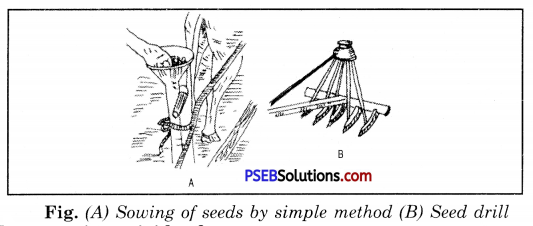
  • Members of one caste are using modern means of communication, press to spread their message to the other members of caste.
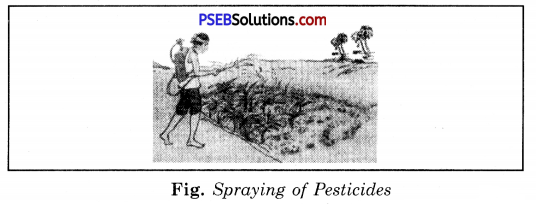
  • Educational institutions based upon caste have been opened up which are
    propagating in the favour of their own caste and which give support to their candidates in elections.
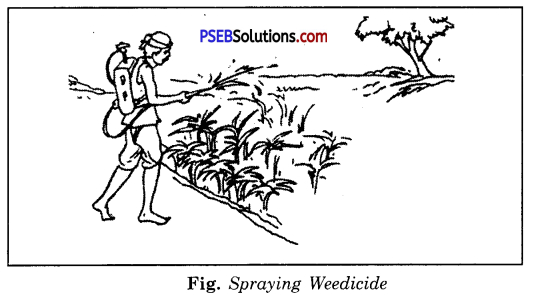
  • During elections, selection of the candidate is being done on the basis of population of any particular caste. Candidate is generally selected from the most populated caste that city.
  • Different castes are joining hands with each other, while keeping in mind their interests, so that their interests could be secured.
  • Many political parties based on caste came into existence.
  • Even today people are choosing boy or girl of their own caste to marry. Number of intercaste marriages are very less.
  • Government has given reservation to different castes in jobs and in educational institutions. That is why hatredness between different castes is increasing and caste consciousness is increasing day by day.
  •  Caste consciousness is increasing because of facilities given to different castes about jobs and education. After looking at this we can say that yet many changes are coming in caste and it is changing in caste but still it exists quite firmly in rural society. Our democratic system has also given strength to it due to reservations.