Basketball Game Rules – PSEB 10th Class Physical Education

Punjab State Board PSEB 10th Class Physical Education Book Solutions Basketball Game Rules.

Basketball Game Rules – PSEB 10th Class Physical Education

Question 1.
Describe the game of Basketball, its court and Restricted Area?
Answer:
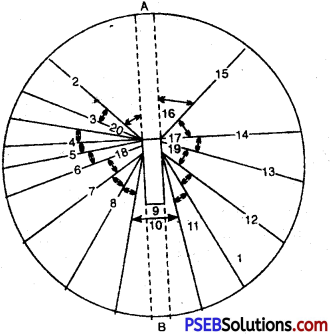
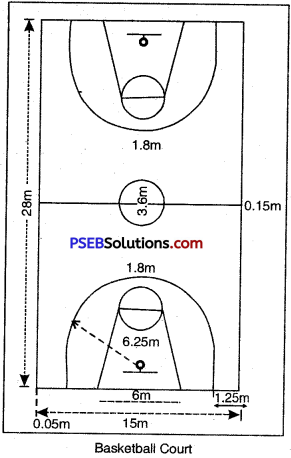
The game of basketball is played between two teams. Each team consists of 5 players. The number of substitutes is 5-7. Each team aims at throwing the ball into the basket of the opposing team, and the opposing team tries to prevent the other team from securing the goal. The basketball court is 28 metres long and 15 metres broad. Its length and breadth can be decreased by 2 and 5 metres respectively in proportion to the two sides.

The height of the hall is 7 metres, and the light should be uniform. Its floor should be wooden or cemented: It can be made of synthetic rubber. For the competition of FIBA (International Amateur Basketball Federation) the court should be of specified dimensions. The boundary lines of the basketball court shall be marked at every point at least 2 metres away from any obstruction. The breadth of lines shall be 5 cms.

Board:
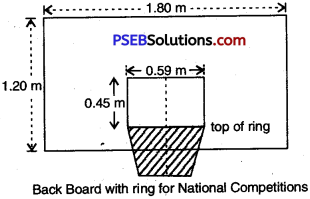
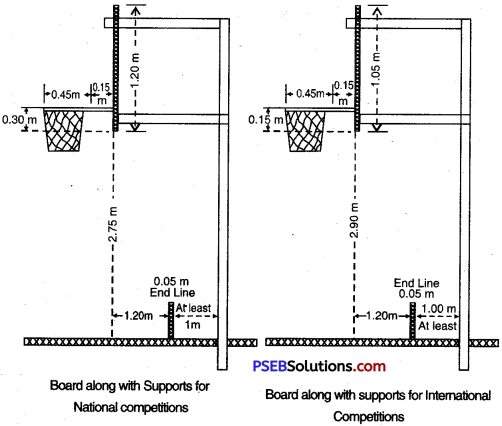
Backboards should be made of hard wood or of fibre glass. Each board should be 2 cm. thick. A rectangle behind the ring above the board of the dimension of 59 cms. horizontal and 45 cms. vertical is made with 5 cm. broad lines. The boundary of the board is also marked with 5 cm. broad lines. The lower edge of the board from the ground is 2.75 metre high.
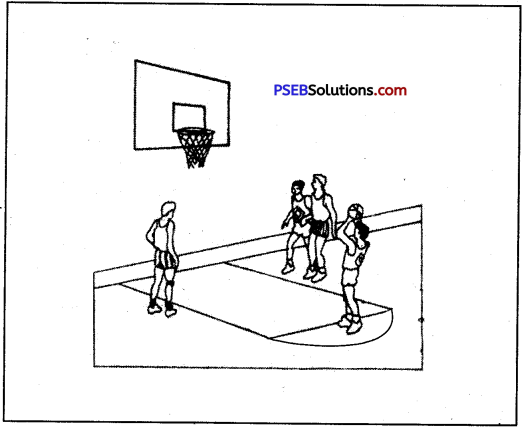
Basketball image 1
Basket:
The basket is made of white net with iron rings. The length of the net is 40 cm. and the radius of the ring is 45 cms. while its thickness is 20 mm.

Centre Line:
A centre line, parallel to the end lines, shall be marked. It shall divide the court into Front Court and Back Court. This line shall be 15 cm. outside on both sides.

Centre Circle:
A circle with a radius of 1.80 m. shall be marked exactly in the centre of the court. It shall be measured from the outer line of the circle.

Three Points Field Goal Area:
The three points field goal area is marked by two arcs, which is from a radius of 6.25 metres to the outer edges of the centre of the side line. It is directly perpendicular to the centre of the basket. The end lines are parallel to the side lines. The distance between the end line and the lines of the three point field goal area is 1.25 m. The centre point is 1.575 metre from the inside edge of the mid point of the end line. The arc is only upto semi-circle and is thereafter parallel to the side line.

Restricted Area, Free Throw Lines:
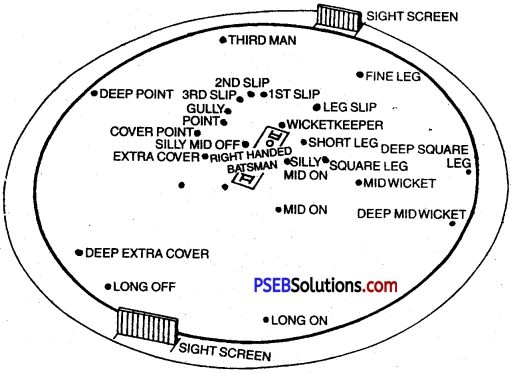
Parallel to each end line, a free throw line with its further edge at a distance of 5.80 m. shall be drawn. It shall be 3.60 m. long and its mid-point shall be on the line joining the mid points of the two ends.Basketball image 2
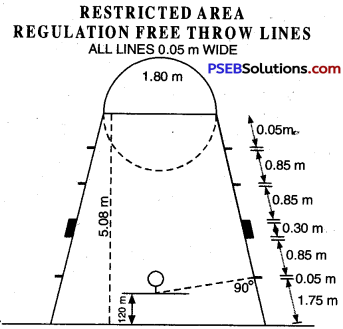
The restricted area is formed by the lines from end lines and free-throw lines. Its radius is marked by end lines and free-throw lines. The outer edge of these lines shall be 3 metres from the mid-points of end-lines and finish at the ends of the free throw lines. This line is in the semi-circle with a r idius of 1.80 m. in the court.

The first line is 1.75 m. from the inside edge of the end line. The first lane place shall be limited by a line 85 cm away. Next to it will be neutral zone 30 cm in width. The second lane place shall be 85 cm in width and is close to the neutral zone. The third lane place will be adjacent to the second lane place and shall be 85 cm in width. Each marked portion in the broken semi-circle shall be 35 cm. in length and the gap between two portions shall be 40 cm.

Basketball Game Rules - PSEB 10th Class Physical Education

Backboard Size, Material and Position:
Backboards should be made of hard wood or of fibre glass. Each backboard is 3 cm. in thickness. It is 1.80 metre horizontally and 1.20 metre vertically. A 59 × 45 cm. rectangle is made behind the ring on the board. The width of its lines is 5 cm. The upper edge of this line is parallel to the level of the ring. The board is limited by 5 cm. thick lines. The lower edge of the board is 2.75 metre high from the ground. The uprights that support the backboards“shall be at a distance of 1 m. from the outer-edges of the end-lines in the restricted area.
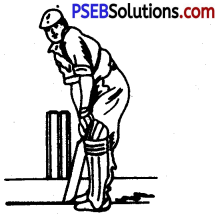
Basketball image 3
BASKET:
The basket is made of rings and net. It is 40 cm. in length. It is fixed with an iron ring. The rings are 45 cm. in inside diameters. The radius of this orange painted basket is 45 cm. The metal of rings is 20 mm. thick. A net made of white cord suspends from the rings. The rings are made in such a way that when the ball passes through it, they check it momentarily. The length of the net should be 40 cm.

Ball:
The ball is spherical. It is made of leather and has in it a rubber bladder. Its circumference is from 75 to 78 cm. Its weight is from 600 to 650 gms. The rules also now permit the use of used ball. The referee may choose a used ball. The ball should have been so much inflated that when it falls on the ground from a height of 1.80 m. it does not bounce from its upper edge, by not less than 1.20 m. and not more than 1.40 m.

A ball, once selected, cannot be used by any player before the match. A new ball may be used in case a suitable used ball is not available.
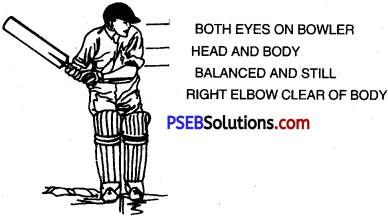
Basketball image 4

Basketball Game Rules - PSEB 10th Class Physical Education

Question 2.
What type of technical equipment is used in the game of Basketball?
Answer:
Technical Equipment

(a) (i) Game Watch
(ii) Time-out Watch

(b) Score-sheet

(c) Marks numbered from 1 to 5 having a minimum size of 20 cm × 10 cm. Marks from 1-4 shall be black while mark 5 is red.

(d) An efficient instrument visible to players and spectators to implement the 30 second rule.

(e) A Score Board, visible to all, having game points (scores) of both the teams written on it.

(f) Scorers shall have two red flags as foul markers of both the teams. The flag will be brought to the side of the team in case of eight fouls during a certain period and will be visible to the players, coach and game officials.

Question 3.
What is the number of officials conducting the game of Basketball?
Answer:
Officials and their Assistants and their Duties

(i) Referee’s Duties:

  1. It is the referee’s duty to look after the whole equipment and to give advice to the players through signs
  2. To perform other functions according to rales.
  3. To make the scorer fill up the record sheet.
  4. To toss in the middle of the game
  5. To conduct the whole game under his care. He gives proper decisions to both the teams. His decisions are adhered to by all the players
  6. He also adjudicates in case of misunderstanding among players, and conducts the game according to rales
  7. If a player plays wrongly, he awards him penalty (8) He signs the score sheet at the end of the play and awards victory or defeat.
    Basketball image 5

Time-Keeper:

(1) His function is to have control over time during the play. Before the start of the game he informs the referee that the game is to begin within three minutes so that he may inform the teams. After the interval he also reminds the referee that two minutes have left in the beginning of the game.

(2) He keeps the whole record from the start to the end of the game. He has to remember as to how long the game could not be played. When the time keeper rings the bell, the referee also blows his whistle to declare that time is over.

Scorer:

  1. His duty is to note the scores made by a player in the score sheet.
  2. He writes down the names of the all the players on the score sheet before the start of the game.
  3. The scorer should know as to how many scores have been made by an individual player.
  4. He adds each score made by a player very carefully to his account.
  5. He should note all the fouls done by a player on the side of his fouls. When a player makes five fouls, he informs the referee about it so that the player may be expelled from the game.
  6. After the end of the play, scorer gets the signature of the referee on the score sheet. Two scores are made if the ball falls from above in the basket. One score is made in case of a free throw.

Player Leaving Court:

No player can leave the court until the interval or until the rules permit without the permission of the game officials.

Captain:

Only the captain can talk to the officials for seeking any information or interpretation of any sort. The right to substitute a player lies with the coach or the captain acting as a coach.

Duration of Play:

The game is played in the four durations of 20 minutes each. There is an interval of 10 minutes for rest between the four durations.

Start of Play:

The referee starts the game. He shall toss the ball for a centre jump between two opponent players in centre circle. The game shall not start until five players of each team have entered the ground. If within five minutes after the starting time, a team does not enter the playground, the opposing team shall get walk over, that is, it is declared winner without playing.

Basketball Game Rules - PSEB 10th Class Physical Education

Question 4.
What is the Jump ball in Basketball, what type of fouls can occur during Jump ball?
Answer:
Jump Ball. At the time of jump ball the two jumpers shall stand with their feet inside the half of the circle beside their respective basket, and one of their feet shall be beyond the centre of the line that is between them. An official shall toss the ball upward in such a way that no player can reach it by jumping and the ball drops between them.

No player shall tap the ball before it reaches its full height. A jumping player can tap the ball only twice. The moment the violation during the jump ball is made, it is penalised with a throw in at the side line. It is mid point for the opponents.

Goal:
A goal is scored when the ball enters the basket from above and is held there or passes through it. Two points are counted when a goal from the field is attempted from within the 3 point line, and one point when a goal is attempted from free throw. A field goal attempted from beyond the 3-point line would count 3 points.

Obstacle during Attack:
When the ball goes downward flight above the basket, no player shall touch or catch it even if an attempt is being made for goal.

Obstacle during Defence:
When an opponent tries for a goal by tossing the ball and the ball is above the level of the basket area and begins its downward flight, then no defender shall try to touch it. In case of violation, the ball shall become dead. If the violation occurs at the time of free throw, the thrower is awarded one point, and if it occurs at the time of attempting a goal, the thrower is awarded two points.

Ball in the Play after the Goal:
Five seconds after a goal has been secured, any player of the opposing team shall put the ball in play from any point out of bounce at the end of the court.

Decision of Play:
A team scoring greater number of points is declared the winner.

Forfeit of Play:
If any team does not enter the playfield after the interval or when the time is due on the call of the referee, the ball shall be brought in the ground and the absent team shall forfeit the game. If during the play the number of players of a‘team comes down to 2, the game shall come to end and that team forfeits the game.

Score and Extra Time:
In case the score is a tie at the end of the second half, five minutes more and such time more will be given till the decision of the game is given. In an extra period, there shall be tos? to select the basket, and thereafter in every extra period the basket shall be changed.

Time-out:
Each team can get two times-out until interval and one time out in one extra period. A time-out of one minute is given in case a player receives an injury. If during this time the injured player does not get well, a substitute is taken.

Basketball Game Rules - PSEB 10th Class Physical Education

Question 5.
Describe five second, Eight second, three second and twenty four second rules?
Answer:
Five second Rule:
If a closely-guarded player blocks the ball from play and does not attempt to throw the ball in the game within five seconds, it is called blocking.

Eight second Rule:
When a team receives the ball in its back court, it has to send the ball into its front court within ten seconds.

Twenty four second Rule:
As per new rule, a new 24 second period does not begin following a throw in from out of line bounds at the side line until:

(a) The ball has gone out of bounds and throw-in is taken by a player from the same team.
(b) The officials have suspended the play to protect an injured player and the throw-in is taken by a player from the team to which the injured player belongs. After 30 seconds the operator will re-start the device from the time it was stopped when team control is again established by the same team after the thrown-in has been made.

Termination of Play:
On receiving the signal of the termination of play by the time keeper, the game shall be terminated.

Substitution of Player:
A substitute player before entering the court shall report to the scorer and shall be ready to play the game immediately. As soon as he gets the signal he shall reach the court. He should not take more than twenty seconds in reaching the court. If he takes more time, it shall be deemed as time-out, and it shall be charged against the opposing team.

Dead Ball:
The ball is dead when the ball, already in flight, on a shot for a goal, is touched by any player after time has expired for half or extra period or after a foul has.been called.

Three-second Rule:
When the ball is in the control of a team, no player of that team can remain for more than three seconds in the opponent court.

Dribbling:
Dribbling holds an important place in basketball. A player learns half of the game when a player has learnt to have full control over the ball and to dribble the ball. When a player continues to toss the ball into the air, fall it on the ground, and then re-takes it, it is called dribbling. When a player after having taken the ball places his foot on the floor in such a way that he appears to be rotating on a point, it is called pivot foot.

Ball in Play after Foul:
When a ball goes out of play by a foul, this dead ball shall be taken in play by

  • a throw-in from out-of-bounds, or
  • by a jump-ball at one of the circles, or
  • by one or more free throws.

Throw-in:
A ball shall be known to be dead in case of violation of rules, and the opposite team is awarded a throw-in from a close point on side line. The rule now permits a player who is to make the throw-in to touch the end line, and it is no longer a violation now.

Free throw:
A player on whom the foul is made takes a free throw. But in a technical foul any player can take a free throw. When a free throw is attempted, the positions of other players shall be as follows:

  1. Two players of the opposing team shall stand near the basket.
  2. Other players shall take alternate positions.
  3. Other players can take any position provided they do not disturb a free-throw.

Violation of Free-throw Rules:
After the ball has been given to a player for a free throw:

(a) He must throw the ball within five seconds and in such a way that it enters the basket or touches the ring
(b) While the ball is on its way to the basket or is on or within the basket, no player shall touch it.
(c) The thrower shall not touch the floor or across the free throw line. No. player of either team shall touch the free-throw line or create an obstacle for the player taking free throw.

Game to be Forfeited. As per the new rule it is no more necessary for the referee to put the ball in play in a manner as if both the teams were on the floor ready to play and forfeit the game. Now, if after the call for play by the referee a team refuses to play, the team shall forfeit the game.

Ball Return to Back Court. As per the new rule, the ball is sent into team ‘A’s back court provided it is touched by a player of the team A only when team ‘A’ has control of the ball in front court. Accordingly, a touch by player of the team ‘A’, while the ball is in control of the team B in the team A’s front court, if made to go into the team A’s back court, is not considered as caused to go into back court.

Further, during a throw-in from mid-point, the official makes it certain that the player takes his position by having his one foot on either side of the extended centre line.

Violation on Out of Bounds Play:
It is not considered to be a violation when a player, who has been awarded a throw-in, steps on the line while releasing the ball.

Penalty:
(i) If the infringement is made by the free-thrower, no point shall be recorded. The ball shall be given out of bounds on the side line to the opponent.

(ii) In case there is an infringement by a team-mate of the free thrower, the point shall be recorded. If the violation is done by both the teams, no point shall be recorded and the play will be restarted with a jumping ball on the free-throw line.

(iii) In case of the violation of rule (c) by a team-mate of the free thrower and the free-throw is successful, the goal shall be counted ignoring the violation. In case the free-throw is not successful, it shall be penalised.

(iv) In case of the violation of rule (c) by the free thrower’s opponents and the success of the free throw, a goal shall be counted ignoring the violation.

(v) If the rule (c) is violated by both the teams and the free-throw succeeds, the goal shall be counted ignoring the violation. If the free-throw does not succeed, the play shall be resumed by a jump ball on the free- throw line.

Basketball Game Rules - PSEB 10th Class Physical Education

Question 6.
How many types of fouls are there in the game of Basketball?
Answer:
Technical Foul by Player. No player shall ignore the warning given by the official, and behave in a manner which does not behove a good player, for example:

  1. Addressing an official in a disrespectful manner, or meeting him.
  2. To misbehave,
  3. Troubling an opponent or obstructing his vision by waving the hand before his eyes.
  4. Obstructing or delaying the game in an improper way.
  5. Not raising the arm properly on the signal of a foul.
  6. Changing his playing number without reporting to the scorer or referee.
  7. Sending the substitute in the court without reporting to the scorer.

Penalty:
Every offence shall be considered a foul and the opponents shall be awarded two free throws for one foul. For repeated offence of this rule, the player shall be disqualified and expelled from the game.

Technical Foul by Coach or Substitute Player:
No coach or a substitute player can enter the court without the permission of the official. He can neither leave his place to follow the action in the court nor address an opponent disrespectfully.

Penalty:
On the violation of this rule by the coach, a four shall be recorded against him. For each offence a free-throw shall be awarded and the ball shall be given to the same team for throw-in on the central line. On the repeated violation of this rule, the coach can be removed from the vicinity of the court.

Personal Foul:
The person who makes a personal foul blocks, attacks, catches or pushes an opponent carrying the ball normally. At such a moment the referee blows his whistle and awards penalty.

Penalty:
If a foul is committed on a player who is in the act of shooting, then

(i) if a goal is scored, it shall be counted, and one free-throw shall be awarded, (ii) if the shot for goal (2 points) does not succeed, two free- throws shall be awarded, and (iii) if the shot for goal (3 point attempt) remains unsuccessful, three free-throws shall be awarded.

Intentional Foul:
It is that personal foul which a player commits intentionally. A player who commits this foul time and again is disqualified and expelled from the play.

Penalty:
An offender shall be charged of personal foul, and two free-throws shall be awarded. If this foul is committed by a player who scores a goal, the goal shall be counted, and an extra free-throw shall be awarded.

Double Foul:
A double foul is committed in such a situation in which two opposing players strike against each other, and both of them are at fault. This foul is recorded against both the players. In case of this foul, the play is resumed from the near circle by a jump ball.

Multiple Foul:
A multiple foul is committed when two or more players of a team commit a personal foul on one opposing player. In case of such a situation, a foul shall be recorded against each offending player, and the player against whom it is committed shall be awarded a free-throw. If the foul has been committed against a player during the act of shooting, the goal, if made, shall be counted and one free-throw shall be awarded.

Five Fouls:
If a player commits five fouls, either personal or technical, he shall be turned out.

Three for two Rule:
When a player is about to score a goal and an opponent commits a foul, if the goal is scored, one more free-throw shall be given. In case no jfoal is scored and if neither of the two free-throw succeeds, an additional free-throw shall be awarded.

Right of Option:
The right of option for a throw-in from mid-point is applicable in respect of one and two throws and three free-throws. Before the option is made, the captain is permitted to have a Brief consultation with the coach.

Four Fouls by a Team:
After a team has committed four player fouls (personal or technical) in a half all subsequent players shall be penalised by two free throws. If a player’s foul includes two or three free-throws.

Jump Ball:
The game is played with jump-ball at the start of the game, after the interval or when double or multiple foul is committed. The referee tosses the ball between the opposing players inside the centre circle. Both the players try to catch the ball by jumping. The game starts with the touch of a player on the ball.

Fouls during Jump Ball:
During jump ball the player commits following types of fouls:

  1. Jumping at each other.
  2. Touching the line.
  3. Touching the ball in flight after it has been tossed by the referee.
  4. Elbowing or pushing the opponent during jumping in order to block the opponent’s jump.
  5. Blocking the opponent’s jump by placing one’s foot on the opponent’s foot during the process of jumping.
  6. Touching the lines of the radius during jumping.
  7. Moving of the players from one place to the other while jumping.

Basketball Game Rules - PSEB 10th Class Physical Education

Question 7.
Describe the important passes in basketball?
Answer:
Important Passes In Basketball

1. Two Hands Chest Pass:
The pass is made quickly by placing the ball in front of the chest with both the hands. This pass is made when the player faces no opponent. It is given to the team mates by holding the ball in both the hands, raising shoulders and arms, bending the body a little and by pressing one foot forcibly. This is a normal practice in the game.

2. Side Arm Pass:
This pass is given to the team-mates by either extending or raising the arm. This way is put into practice when a player wants to give pass to his playmate who is away. This pass can be given when an obstruction occurs during the process of dribbling. Then a player gives pass to another by extending his arm. Some teams are very well- versed in putting the ball jnto the ring from the centre.

3. Over-head Pass:
This pass is given to the team-mates by raising both the arms. It is considered to be proper when a player is surrounded by many opponents. The player makes the pass by crossing the ball over many heads raising his arm. The opponents have to make very bard efforts to block such a ball given through this type of pass.

4. Ground Pass:
This pass is given when the opposing player is tall, and the ball cannot be crossed over his head. At that time, the pass is given by throwing the ball on the ground.

5. Back Pass:
This pass is given from Back Side. The player moves to by tossing the ball on the hands, and in case there is an obstruction on the way, he gives back pass to his team mate standing behind.

Important Information About the Basketball Game

  • The length and breadth of court = 28 × 15 m
  • Number of players in one team = 12, five players, seven substitutes.
  • Radius of central circle = 1.80 meter
  • Breadth of lines = 5 c.m.
  • Thickness of the board = 3 c.m. c
  • Height of the board from floor = 2.90 meter
  • Dimension of board = 180 × 120 c.m.
  • Circumference of the ball = 75 to 78 c.m.
  • Weight of the ball = 600 to 650 gm
  • Rectangle size of the board = 49 × 45 c.m.
  • Distance of each pole = 2 meter
  • Duration of the game = 10-2-10 (10) 10-2-10 from half
  • Officials of the match = One table commissioner, One referee, One Umpire, One chief Refree, One time keeper, One scorer and 24 second operator.
  • A match of basketball is played between two teams. Each team has 5 players, and 5 or 7 substitutes.
  • The basketball court is rectangular. It is 28 metres long and 15 metres broad. The court must be made of wood or cement.
  • Each member of the team shall be numbered from 4 to 15 on the front and back of his vest or shirt. The front numbers should be 6″ long and the back numbers 15″.
  • The game has four durations of 10-2-10-10, 10-2-10. Until the interval which is of 10 minutes, no player can leave the court without the permission of the concerned official.
  • During the play players can be substituted any number of times but their names must appear on the score sheet, and the substitution of player can take place at the throw or watch of the substituted team or at dead ball.
  • Two or three free throws are awarded, as per the situation, after a foul which follows 4 fouls in one half of a team.
  • A player is expelled from the match after he has done five fouls.
  • The weight of the basketball is from 600 to 650 gms. and its circumference is from 75 to 78 cms.
  • During the play of a game, a coach can secure a time out (which is of 1 minute) two times for rest.
  • The radius of the centre circle of the basketball court is 1.80 m, the thickness of the board is 3 cm, the height of the lower edge of blackboard from the ground is 2.75 m, the height of the ring is 3.05 m and the length of the white net is 40 cms. The breadth of all boundary lines is 5 cms.
PSEB 9th Class Agriculture Solutions Chapter 1 Kharif Crops

Punjab State Board PSEB 9th Class Agriculture Book Solutions Chapter 1 Kharif Crops Textbook Exercise Questions and Answers.

PSEB Solutions for Class 9 Agriculture Chapter 1 Kharif Crops

Agriculture Guide for Class 9 PSEB Kharif Crops Textbook Questions and Answers

(A) Answer in one-two words:

Question 1.
Name two Kharif bowls of cereal.
Answer:
Paddy, Maize, Jowar.

Question 2.
Name two important varieties of rice.
Answer:
P.R.-123, P.R.-122.

Question 3.
Give seed requirement of desi cotton hybrid for one acre.
Answer:
1.5 kg seed per acre.

PSEB 9th Class Agriculture Solutions Chapter 1 Kharif Crops

Question 4.
Name one major insect pest of maize.
Answer:
Maize borer

Question 5.
Name two diseases of sugarcane?
Answer:
Red rot, Red stripe, wilt, etc.

Question 6.
Name two Pulse crops.
Answer:
Moong, Mash, Arhar.

Question 7.
Give seed rate of maize for one acre.
Answer:
It is 7 kg for pearl popcorn and 8 kg per acre for other varieties. For fodder crop, it is 30 kg per acre.

Question 8.
Give sowing time of cotton.
Answer:
1 April to 15 May.

Question 9.
Name one intercrop in sugarcane.
Answer:
Summer Moong or Summer Mash.

Question 10.
Name two fodder crops.
Answer:
Maize, Bajra, Guara.

(B) Answer In one-two sentence:

Question 1.
What is crop rotation?
Answer:
Different types of crops which are sown in a sequence in the field in one year is called crop rotation, e.g. Paddy-wheat, Paddy- Potato-Sunflower, etc.

PSEB 9th Class Agriculture Solutions Chapter 1 Kharif Crops

Question 2.
Name two rice-based crop rotations.
Answer:
Rice-wheat/Berseem, Rice-wheat-sathi maize/sathi moong. Rice-Potato-Sathi Moong/Sunflower.

Question 3.
What are the deficiency symptoms of zinc in rice?
Answer:
Due to the deficiency of zinc, seedlings remain stunted and tillerless. Lower leaves become rusty, near the base. The central vein of leaves changes color and leaves ultimately dry up. To avoid and control this malady, apply 25 kg zinc sulfate per acre at the time of puddling.

Question 4.
Write sowing method of maize.
Answer:
Maize is sown from the last week of May to the end of June, can be sown in the second fortnight of August. Row spacing should be 60 cm and plant spacing should be 20 cm. Use 7 kg seed per acre for pearl popcorn and 8 kg for other varieties.

Question 5.
Give control of Its in Maize.
Answer:
It’s can be controlled by using Atrataf within 10 days of sowing.

Question 6.
Why puddling is done in Paddy?
Answer:
Paddy needs a lot of water. Due to puddling, the water holding capacity of the field increases to a large extent. The rate of evaporation of water is decreased. It also helps to prevent the growth of weeds. Transplanting, of paddy, becomes easy.

Question 7.
Give seed requirement of sugarcane.
Answer:
The seed rate for cane crops is twenty thousand, three budded sets or four budded sets 15 thousand, or five budded sets-12 thousand for one acre.

PSEB 9th Class Agriculture Solutions Chapter 1 Kharif Crops

Question 8.
Write time and method of sowing for Autumn sugarcane.
Answer:
Autumn sugarcane is sown from 20 September to 20 October and sowing is done in rows with a spacing of 90 cm.

Question 9.
Give the method of defoliation in moong for combined harvesting.
Answer:
If combine is to be used to harvest the Moong crop, then at the time when 80% of pods are mature, Gramoxone is sprayed to make the leaves and stem dry i.e. for defoliation.

Question 10.
Write method of weed control in rice.
Answer:
Swank and Motha weeds grow in rice. Hoeing should be done twice manually by hands, use paddy weeder for inter-culture. After 15 and 30 days of transplanting pull out the weeds from the fields. Suitable herbicides should be used at the proper time in the required amounts. Herbicides that can be used are Machete, Refit, Top- star, Arozin, etc. use Algrip for a gorilla, Sanni, etc.

(C) Answer in five-six sentences:

Question 1.
Discuss the use of fertilizers in rice.
Answer:
The fertilizer requirement for rice for an acre is 50 kg nitrogen, 12 kg phosphorus, and 12. kg potassium. Potassium dose should be applied on a soil test basis. Divide nitrogen dose into three parts. Apply one part of nitrogen and a whole of phosphorus and potassium (if needed) before the last puddling. The remaining two parts of nitrogen are broadcasted in two equal splits at three and six weeks after transplanting. If rice is sown after wheat which had received a recommended supply of phosphorus, then there is no need to apply phosphorus for rice crops.

Question 2.
Explain direct seeding of rice.
Answer:
Rice should be sown directly in only medium to heavy soils. In light (sandy) soils there occurs deficiency of iron in the crop and the yield is reduced.
Time of sowing: Suitable time for direct sowing is the first fortnight of June.
Seed rate: Seed requirement is 8-10 kg per acre.
The depth and row spacing: Seed should be sown at a depth of 2-3 cm using a paddy drill and row spacing should be 20 cm. Early maturing variety of Paddy should be used for direct sowing.
Weed control: Use stomp within 2 days of sowing. If after 30 days of sowing, swank, and motha are seen in the crop then use nominee gold. Segment herbicide is used to control broadleaf weeds.
Fertilizers: Apply 60 kg nitrogen per acre in three equal splits. Broadcast nitrogen after two, five, and nine weeks of sowing.
Irrigation: Keep watering the crop at 5-10 days intervals.

PSEB 9th Class Agriculture Solutions Chapter 1 Kharif Crops

Question 3.
Give details of seed treatment in cotton.
Answer:
Seed rate for B.T. varieties is 750 grams, for non-B.T. hybrid varieties 1 kg, for normal varieties 3 kg, for desi cotton varieties it is 1.5 kg and for simple varieties, it is 3 kg per acre. Use the adviced chemicals for seed treatment. For prevention from Jassid use Gaucho or Cruiser.

Question 4.
Discuss preventive measures for lodging in sugarcane.
Answer:
We should make efforts to prevent the lodging of sugarcane crops because frost has a bad effect on fallen crops. To prevent lodging, we should earth up heavily the crop before the outset of monsoon, nearly the end of June. Prop the crop at the end of August or at the beginning of September.

Question 5.
For which crops and why sulfur is essential?
Answer:
Sulfur is essential for oilseed crops. Single superphosphate is used as a source of phosphorus because it contains sulfur also. If this fertilizer is not available, use gypsum as a source of sulfur.

Very Short Answer Type Questions:

Question 1.
What is the time of sowing for the Kharif (Sawani) crop?
Answer:
June-July or in Monsoon.

Question 2.
When is Sawant or Kharif crop harvested?
Answer:
In October-November.

Question 3.
How can you categorize the Kharif crop?
Answer:
Three categories of Kharif crops :

  1. Cereals
  2. Pulses and Oilseed crops
  3. Cotton, Sugarcane, and fodder.

Question 4.
Name Kharif cereal crops.
Answer:
Paddy, Basmati, Maize, Bajra (Sorghum).

PSEB 9th Class Agriculture Solutions Chapter 1 Kharif Crops

Question 5.
Which country is the highest producer of Paddy?
Answer:
China

Question 6.
Which state of India is the highest producer of Paddy?
Answer:
West Bengal.

Question 7.
What is another name for Paddy?
Answer:
Rice and Jeeri, Dhaan, Jhonna.

Question 8.
How much area is occupied by Paddy crop in Punjab?
Answer:
28 lakh hectare.

Question 9.
How much is the average yield of Paddy in Punjab?
Answer:
60 quintal per hectare.

Question 10.
Which Karqha is used to level the field before Puddling it for the Paddy crop?
Answer:
Laser Karahd.

Question 11.
What is the seed rate for Paddy?
Answer:
It is 8 kg per acre.

Question 12.
Which chemical is used to control broadleaf weed like Gorilla in Paddy?
Answer:
Algeria or Segment.

Question 13.
Which device is used to save water for irrigation of Paddy crop?
Answer:
Tensiometer.

Question 14.
What type of soil is suitable for direct sowing of paddy?
Answer:
Medium to heavy soil.

Question 15.
What is used if there is a deficiency of zinc in Paddy and what is its quantity used?
Answer:
Zinc sulfate, 25 kg per acre.

Question 16.
What should be the moisture content for storing rice in godowns?
Answer:
12%,

Question 17.
Name varieties of Basmati.
Answer:
Punjab Basmati-3, Pusa Punjab Basmati-1509, Pusa Punjab Basmati-1121.

Question 18.
What is the time of sowing, for raising the nursery of Paddy?
Answer:
Nursery sowing for Pusa Punjab Basmati-1509 is done in the second fortnight of June and for other varieties, it is done in the first fortnight of June.

Question 19.
What happens to Paddy if excess nitrogen is applied to it? (high doses of nitrogen)
Answer:
It causes excessive vegetative growth and plants attain more height. This causes lodging of the crop and yield is reduced.

Question 20.
Which country is the highest producer of maize?
Answer:
The United States of America.

PSEB 9th Class Agriculture Solutions Chapter 1 Kharif Crops

Question 21.
Which state of India is the highest producer of maize?
Answer:
Andhra Pradesh.

Question 22.
How much area of land is occupied by maize crop in Punjab?
Answer:
1 lakh 25 thousand hectares.

Question 23.
What is the average yield of maize in Punjab?
Answer:
15 quintals per acre.

Question 25.
How much rain is suitable for maize?
Answer:
50 to 75 cm.

Question 25.
What type of soil is suitable for maize?
Answer:
Well-drained medium to heavy (loam and silty loam).

Question 26.
Give seed rate for Pearl popcorn (maize variety).
Answer:
7 kg per acre.

Question 27.
Give varieties of maize for normal use.
Answer:
PMH-1, PMH-2.

Question 28.
Name special purpose varieties of maize.
Answer:
Punjab sweet corn-1, Pearl popcorn.

Question 29.
What is the time of sowing for maize?
Answer:
Maize can be sowed from the last week of May to the end of June and in the second fortnight of August.

Question 30.
What are row spacing and plant spacing for maize crops?
Answer:
60 cm, 22 cm.

Question 31.
Which weedicide is more effective for Its in maize?
Answer:
Strata.

Question 32.
What is sown in the Helds of maize crop to prevent weeds?
Answer:
Rawang (grams).

Question 33.
Which herbicide is used to control dila/motha (common sedge)?
Answer:
2, 4-D.

PSEB 9th Class Agriculture Solutions Chapter 1 Kharif Crops

Question 34.
How much irrigation is required for normal maize?
Answer:
4-6 irrigations are needed.

Question 35.
Which state in India is the highest producer of pulses?
Answer:
Rajasthan.

Question 36.
How much area is occupied by Moong crop in Punjab?
Answer:
5 thousand hectares.

Question 37.
What is the yield of Moong in Punjab?
Answer:
350 kg per acre.

Question 38.
Which type of soil is not suitable for Moong?
Answer:
Saline-alkaline or waterlogged soils are not suitable.

Question 39.
What is the seed rate for Moong?
Answer:
8 kg per acre.

Question 40.
Give the time of sowing for Moong,
Answer:
The first fortnight of July.

Question 41.
What are row spacing and plant spacing for moong crop?
Answer:
Row spacing is 30 cm and plant spacing is 10 cm.

Question 42.
Which herbicides are used to control weeds in Moong?
Answer:
Treflan or Basalin.

Question 43.
How much land is occupied by the Mash crop in Punjab?
Answer:
2 thousand hectares.

Question 44.
What is the average yield of Mash in Punjab?
Answer:
180 kg acre.

Question 45.
Which soil is not suitable for the Mash crop?
Answer:
Saline-alkaline or water-logged soils.

Question 46.
What is the seed rate for Mash?
Answer:
6-8 kg per acre.

PSEB 9th Class Agriculture Solutions Chapter 1 Kharif Crops

Question 47.
What is the time of sowing of Mash in the Sub-mountainous region?
Answer:
15 to 25 July.

Question 48.
What is a time of sowing of Mash in regions other than the Sub-mountainous region?
Answer:
Last week of June to the first week of July.

Question 49.
What is row spacing for Mash?
Answer:
30 cm.

Question 50.
Which pesticide is used in Mash?
Answer:
Stomp.

Question 51.
Which country is the highest producer of Soyabean?
Answer:
The United States of America.

Question 52.
Which state of India is the highest producer of Soyabean?
Answer:
Madhya Pradesh.

Question 53.
Give Soyabean based crop rotation cycle.
Answer:
Soybean—Wheat/Barley.

Question 54.
Name varieties of Soyabean.
Answer:
SL-958, S.L.-744.

Question 55.
Give the time of sowing for Soyabean.
Answer:
First fortnight of June.

Question 56.
What is row spacing for Soyabean?
Answer:
45 cm.

Question 57.
Which herbicide is used to control weeds in Soyabean?
Answer:
Stomp, primate.

Question 58.
Name insects/pests which attack Soyabean?
Answer:
Hairy caterpillar and whitefly.

Question 59.
Which crop is a pulse as well as oilseed?
Answer:
Soybean.

Question 60.
Which country in the world is the highest producer of oilseed?
Answer:
The United States of America.

PSEB 9th Class Agriculture Solutions Chapter 1 Kharif Crops

Question 61.
Which state in India is the highest producer of oilseeds?
Answer:
Rajasthan.

Question 62.
Which country in the world is the highest producer of groundnut?
Answer:
China.

Question 63.
Which the State Of India is the highest producer of groundnut?
Answer:
Gujarat.

Question 64.
How much area is occupied by groundnut in Punjab?
Answer:
15 thousand hectares.

Question 65.
Give average yield of groundnut in Punjab.
Answer:
7 kg per acre.

Question 66.
Name a crop rotation cycle involving groundnut.
Answer:
Groundnut-wheat.

Question 67.
Name varieties of groundnut.
Answer:
S.G.-91, S.G.-84.

Question 68.
Give seed rate for groundnut.
Answer:
38-40 kg seed (Kernel) per acre.

PSEB 9th Class Agriculture Solutions Chapter 1 Kharif Crops

Question 69.
What is the time of sowing for rainfed groundnut?
Answer:
With the advent of the monsoon.

Question 70.
What is the time of sowing for irrigated groundnut crops?
Answer:
From end April to end May.

Question 71.
Which herbicides are used to control weeds in groundnut?
Answer:
Treflan, Stomp.

Question 72.
Name Kharif fodder crops.
Answer:
Maize, Jowar, Bajra.

Question 73.
Which country in the world is the highest producer of cotton?
Answer:
China.

Question 74.
Which state of India is the highest producer of cotton?
Answer:
Gujarat.

Question 75.
How much area is under the cotton crop?
Answer:
5 lakh hectare.

Question 76.
What is the average yield of cotton in Punjab?
Answer:
230 kg lint per acre.

Question 77.
Which type of soil is not suitable for cotton?
Answer:
Sandy, saline, or water-logged.

Question 78.
Give normal varieties of cotton.
Answer:
L.H.-2108.

Question 79.
Give seed rate for BT cotton.
Answer:
750 gram per acre.

Question 80.
Name a hybrid variety of desi cotton.
Answer:
PAU 626 H.

Question 81.
Give the time of sowing for cotton.
Answer:
1 April to 15 May.

Question 82.
Give row spacing for cotton.
Answer:
67 cm.

Question 83.
Name herbicides used to control weeds in cotton.
Answer:
Treflan, stomp, gramoxon, Roundup.

Question 84.
Which country is the highest producer of Sugarcane?
Answer:
Brazil.

Question 85.
Which state in India is the highest producer of Sugarcane?
Answer:
Uttar Pradesh.

Question 86.
How much area is occupied by sugarcane crop in Punjab?
Answer:
80 thousand hectares.

Question 87.
What is the average yield of sugarcane in Punjab?
Answer:
280 quintals per acre.

Question 88.
How much sugar is obtained from sugarcane?
Answer:
9%.

Question 89.
What type of soil is suitable for sugarcane?
Answer:
Medium to heavy soil.

Question 90.
Name early maturing varieties of spring cane.
Answer:
CoJ-85, CoJ-83.

Question 91.
What is the seed rate if four budded sets are used for a cane?
Answer:
15 thousand per acre.

Question 92.
What is the seed rate for the cane on the basis of weight?
Answer:
30 to 35 quintals per acre.

Question 93.
What is the time of sowing for a cane?
Answer:
Mid-February to end March.

Question 94.
Name herbicides to control weeds in cane crops.
Answer:
Strata, Senior.

Question 95.
Name varieties of Autumn cane.
Answer:
CoJ-85, CoJ-83.

PSEB 9th Class Agriculture Solutions Chapter 1 Kharif Crops

Question 96.
What is a time of sowing for an autumn cane?
Answer:
20 September to 20 October.

Question 97.
Which weedicide should be used if Raya or wheat is intercropped in the autumn cane?
Answer:
Isoproturon.

Question 98.
Which herbicide is used in cane crop if summer moong and summer mash is intercropped?
Answer:
Stomp.

Question 99.
How much green fodder is required for an adult animal per day?
Answer:
40 kg green fodder.

Question 100.
Name Kharif fodder crop.
Answer:
Bajra, Maize, Jowar, Napier Bajra, Guniea Grass, Guara, etc.

Question 101.
How many days, Maize, Kharif fodder take to become available for harvesting?
Answer:
50-60 days.

Question 102.
Name the variety of maize, a Kharif fodder.
Answer:
J-1006.

Question 103.
What is the time of sowing for fodder maize?
Answer:
The first week of March to mid-September.

Question 104.
Which pest attacks the fodder maize?
Answer:
Maize borer.

Question 105.
Which fodder is liked by animals?
Answer:
Jowar.

Question 106.
Name varieties of Jowar?
Answer:
S.L. 104.

Question 107.
What is the sed rate of Jowar?
Answer:
20-25 kg per acre.

Question 108.
What is the time of sowing for early maturing Jowar?
Answer:
Mid-March.

Question 109.
What is a suitable time for sowing for Jowar?
Answer:
Mid-June to middle July.

Question 110.
What is row spacing for Jowar?
Answer:
22 cm.

PSEB 9th Class Agriculture Solutions Chapter 1 Kharif Crops

Question 111.
If a mixture of Guara and Jowar are sown together which herbicide is used ?
Answer:
Stomp.

Question 112.
Write time of harvesting of Jowar?
Answer:
65-80 days, from boot to milk stage.

Question 113.
Give crop rotation cycle consisting of Bajra.
Answer:
Bajra-Maize-Bersem.

Question 114.
Give varieties of Bajra.
Answer:
PHBF-1, FBC-16.

Question 115.
Give seed rate for Bajra.
Answer:
6-8 kg seed per acre.

Question 116.
Give the time of sowing for Bajra.
Answer:
March to August.

Question 117.
What is the method of sowing for Bajra?
Answer:
Bajra is sown by the broadcasting method.

Question 118.
Which herbicide is used to control weeds in Bajra?
Answer:
Atrataf.

Question 119.
What do you know about the irrigation of Bajra?
Answer:
Normally 2-3 irrigations are required.

Question 120.
After how many days Bajra is harvested?
Answer:
After 45-55 days.

Question 121.
Give diseases of Bajra.
Answer:
Green ear, grain smut.

Question 122.
Write insects pest which attacks Bajra.
Answer:
Root bug, grasshopper.

PSEB 9th Class Agriculture Solutions Chapter 1 Kharif Crops

Short Answer Type Questions:

Question 1.
Give details of climate and soil for cultivating Paddy.
Answer:
Paddy needs high temperature, excess moisture and excess of water. Medium to heavy soil is suitable. It can also grow in alkaline and acidic soil.

Question 2.
Give details of seed rate and seed treatment for paddy.
Answer:
8 kg seed per acre is needed for raising the nursery. To save crops from disease, seeds should be treated with recommended fungicides, soak the seed for 8 to 10 hours in recommended chemicals.

Question 3.
How will you control broadleaf weeds in Paddy?
Answer:
Broadleaf weeds like Gorilla, sunny etc. grow in paddy. Use Algrip or segment after 15-20 days of transplanting.

Question 4.
Why is green manure used?
Answer:
Leguminous plants are used for green manure e.g. Pulse crops, Sunhump, dhaincha, etc. These crops help in the fixation of nitrogen in the soil. Green manure crop is cultivated and it is mixed into the soil of the field. This helps in the increasing of humus and- makes the soil more fertile.

Question 5.
Discuss the harvesting and storing of Paddy.
Answer:
The crop can be harvested when ears are nearly ripe and the straws change color to yellow. Produce can be stored in godown when the moisture content is not more than 12%.

Question 6.
Give the time of nursery sowing for Basmati.
Answer:
For Pusa Punjab Basmati 1509, the time of nursery sowing is the second fortnight of June and for Punjab Basmati-3 and Pusa Basmati-1121, it is the first fortnight of June.

Question 7.
What is the time of transplanting seedlings of Basmati?
Answer:
For Pusa Punjab Basmati-1509, the time of transplanting is the second fortnight of July and for Punjab Basmati-3 and Pusa Basmati-1121, it is the first fortnight of July. Transplanting is done in a puddled field. Transplant 33 plants per square meter.

PSEB 9th Class Agriculture Solutions Chapter 1 Kharif Crops

Question 8.
Give details about climate and soil for maize.
Answer:
Maize requires a moist and hot climate from germination to flowering. If there is less moisture and a very high temperature at the time of flowering, it may damage the foliage. This causes dryness (desiccate) of the pollen and proper pollination does not take place, it results in a poor grain setting. 50 cm to 75 cm rain is suitable for maize. Well-drained, medium to heavy soil is suitable.

Question 9.
What do you know about the irrigation of maize?
Answer:
Maize requires 4-6 irrigations, but it depends on the rainfall. Proper care should be taken to irrigate during the pre-tasselling and silking stages.

Question 10.
What do you know about harvesting Maize?
Answer:
When husk covers become dry and brown even when the stalks and leaves are somewhat green, the crop is ready to harvest. Moisture content should not be more than 15% in the grains.

Question 11.
What do you know about climate and soil for Moong?
Answer:
The hot climate is suitable for Moong. This crop can bear more heat and extra dryness as compared to other pulses. Saline and waterlogged soils are not suitable for this crop.

Question 12.
Give details of land preparation and- application fertilizers for Moong.
Answer:
Prepare the land by giving 2-3 ploughings and level the soil using plank. At the time of sowing apply 5 kg nitrogen a^id 16 kg of phosphorus by drilling.

Question 13.
Explain how to control weeds in Moong?
Answer:
To control weeds one or two hoeings should be done. Use Treflan or Basalin to control weeds before sowing. Use stomp within two days of sowing.

Question 14.
Discuss the harvesting of moong.
Answer:
When nearly 80% of pods are mature, moong can be harvested by using a sickle. Thresher can be used to thresh moong. If combined is to be used to harvest moong, spray gramophone to make leaves and stem dry when about 80% of pods are mature.

Question 15.
What do you know about climate and soil requirements for Mash?
Answer:
For this crop hot and moist climate is found to be suitable. Nearly all types of soils can be used to grow mash, but saline-alkaline or water-logged soil are not suitable for this crop.

Question 16.
What do you know about improved varieties, land preparation and control of weeds for Mash ?
Answer:

  • Improved Varieties: Mash-114, Mash-338.
  • Land preparation: Plough two or three times and then use Suhaga to leveler.
  • Weed Control: Hoeing should be done after one month of sowing or use stomp within 2 days of sowing.

Question 17.
What is the time of sowing for Mash?
Answer:
The time of sowing for Mash in sub-mountainous regions is from 15 to 25 July and in other regions, it is the last week of June to the first week of July. The rainfed crop should be sown with the onset of the monsoon. Sowing should be in rows with spacing 30 cm.

Question 18.
What do you know about the irrigation and harvesting of Mash?
Answer:

  • Irrigation: Normally Mash crop does not need irrigation. But in summer it needs irrigation.
  • Harvesting: When leaves fall off and pods change color to greyish black, then crop fs ready to harvest.

Question 19.
What do you know about climate and soil for soybean?
Answer:
It needs a hot climate. It can be grown in all types of soils but well-drained, non-saline/alkaline, fertile soil is more suitable for its cultivation.

PSEB 9th Class Agriculture Solutions Chapter 1 Kharif Crops

Question 20.
Write about improved varieties, crop rotation, and land preparation for soybean.
Answer:

  • Crop rotation: Soyabean-Wheat/Barley.
  • Improved varieties: S.L.-958, S.L.-744.
  • Land preparation: Plough twice and use sugar for leveling.

Question 21.
Write about the seed rate, seed treatment, and method of sowing for Soyabean.
Answer:
The seed rate is 25-30 kg per acre. Treat the seed with recommended chemicals. If Soyabean is being sown for the first time, apply bacterial culture to the seeds. Row spacing should be 45 cm.

Question 22.
What do you know about weed control in Soyabean?
Answer:
Hoeing should be done twice to control weeds. Hoeings should be done after 20 and 40 days after sowing. Use stomp after 1-2 days of sowing or use primate after 15-20 days of sowing to control weeds.

Question 23.
Write about the fertilizer application for Soyabean.
Answer:
Apply 4 tonnes per acre of farmyard manure (FYM) before sowing Soyabean. Apply 13 kg nitrogen and 32 kg phosphorus per acre at the time of sowing.

PSEB 9th Class Agriculture Solutions Chapter 1 Kharif Crops

Question 24.
Write about the irrigation of Soyabean.
Answer:
Soybean normally needs 3-4 irrigations. At the time of pod-filling, one irrigation is necessary. In case there is rain, then there is no need for irrigation.

Question 25.
What do you know about the harvesting of Soyabean?
Answer:
When all leaves fall off and pods change their color, crop is ready for harvesting. For storing, moisture content should not be more than 7%.

Question 26.
What do you know about insects/pests and diseases of Soyabean?
Answer:
Hairy caterpillar and whitefly attack Soyabean crop. The disease which affects the crop is the yellow mosaic virus.

Question 27.
What do you know about climate and soil for groundnut?
Answer:
For rainfed crops, nearly 50 cm of rain is a must in July, August, and September. Light to Medium type soils is suitable for groundnut.

PSEB 9th Class Agriculture Solutions Chapter 1 Kharif Crops

Question 28.
Write about improved varieties, land preparation, and crop cycle for groundnut.
Answer:

  • Improved varieties: S.G.-99, S.G.-84.
  • Land preparation: Prepare the land by plowing it twice.
  • Crop cycle: Groundnut-Rabi crops.

Question 29.
Write about seed rate, seed treatment method of sowing for groundnut.
Answer:
Use recommended chemicals for seed treatment. The seed rate is 38-40 kg seed (Kernels) per acre. Sow after Rauni in 30 x 15 cm spacing.

Question 30.
Write about the application of fertilizers in groundnut.
Answer:
Groundnut needs 6 kg nitrogen, 8 kg phosphorus, and 10 kg potash per acre. Potash should be applied after testing the soil. Use superphosphate for phosphorus. It has sulfur also which is necessary for oil seed crops. If phosphorus is not required then 50 kg Gypsum per acre should be applied.

Question 31.
Write about weed control in groundnut.
Answer:
Hoeing is done after 3 and 6 weeks. To control weeds spray stomp after two days of sowing or spray Treflan and sow the crop the same day.

Question 32.
Write about irrigation of groundnut.
Answer:
Depending on rain, groundnut requires 2 or 3 irrigations. If there is less rain then irrigate at the time of flowering. Apply one or two irrigations depending upon rain at the time of pod formation.

Question 33.
Write about harvesting (digging), insects/pests, and diseases of groundnut.
Answer:

  • Digging of groundnut: Crop is ready to harvest when uniform yellowing of the leaves takes place and old leaves fell off.
  • Insects/Pests and diseases: Hairy caterpillar, white grub, Aphid, etc. can attack the crop. Collar rot, Root-knot, and Tikka, etc. are its diseases.

Question 34.
Write about climate and soil for cotton.
Answer:
Cotton can grow well in hot and dry climates. Cotton can grow on all types of soil but saline, water-logged soil is not suitable.

Question 35.
Write about varieties of cotton and crop cycle.
Answer:
Crop Cycle (rotation) : Ahpos-wheat/Barley, Kapas- sunflower, Kapas-Raiya, cotton-senji/Barseem/oats.
Improved varieties

  • B.T. Varieties—NSC-855, Ankur- 3028, MRC-7017, RCH-650.
  • Non-B.T. hybrid—LH-144.
  • Normal varieties—LH-2108.
  • Desi hybrid varieties—PAU-626H.
  • Desi Normal varieties—FDK-124, L.D.-694.

Question 36.
Write about seed rate and seed treatment.
Answer:
Seed rate: For one-acre seed rate is :

  • B.T. cotton: 700 gram
  • Non-B.T. hybrid cotton: 1 kg.
  • Normal variety : 3 kg.
  • Hybrid desi cotton: 1.5 kg.
  • Desi Normal variety : 3 kg.

Seed should be treated with recommended chemicals. To save it from Jassid use Gaucho or cruiser.

Question 37.
Write about the time and method of sowing for cotton.
Answer:
Time: 1 April to 15 May.
Row spacing: 67 cm.
Plant spacing: For normal varieties, it is 60 cm. For BT and non-BT hybrid varieties, plant spacing is 75 cm. For desi cotton it is 45 cm, for desi cotton hybrid varieties, it is 60 cm.

PSEB 9th Class Agriculture Solutions Chapter 1 Kharif Crops

Question 38.
Write about weed control in cotton.
Answer:
Hoeing is done to control weeds. 2 to 3 hoeings are enough. First time hoeing is done before first irrigation. We can use a cultivator attached to the tractor or can use a trial driven by a bullock. Its/chapatti, Madhana/Makra can be controlled by using Stefan before sowing or spray stomp within 24 hours of sowing and hoeing should be done after 45 days or use one of gramophone and round up and spray directly on weeds by using safety hood.

Question 39.
Write about fertilizer application for cotton.
Answer:
Normal varieties: 30 kg nitrogen and 12 kg phosphorus per acre.
B.T. and non-B.T. Ijybrid Varieties: Apply 60 kg nitrogen and 12 kg phosphorus per acre. Apply potash after testing the soil. Apply all amounts of phosphorus at the time of sowing and half nitrogen at the time of thinning and remaining nitrogen at the time of flowering.

Question 40.
Write about irrigation and picking of cotton.
Answer:
Cotton needs 4 to 6 irrigations depending upon rain. First irrigation is applied after 4 to 6 weeks of sowing and after that irrigation is applied at a gap of two or three weeks. Picking Pick clean and dry bolls within 15-20 days so as to get a proper price from the mandi.

Question 41.
Write about insects/pests of cotton.
Answer:
Insects/pests which can damage the crop are Aphid, Jassid, Millibug, Pink bollworm, Tobacco caterpillar, American bollworm, Whitefly, etc.

Question 42.
Which insects do not attack and which attack B.T. cotton?
Answer:
American Bollworm does not attack B.T. cotton because B.T. cotton is genetically modified by the insertion of genes from a bacteria, which produces a protein, which acts as a poison for the bollworm. Sucking Pests and Tobacco caterpillars can attack.

Question 43.
Write about climate and soil requirements for sugarcane.
Answer:
The hot climate is suitable for sugarcane, medium to heavy soil is suitable. This crop can bear saline and alkaline soil to some extent.

PSEB 9th Class Agriculture Solutions Chapter 1 Kharif Crops

Question 44.
Write about improved varieties and crop rotation for spring sugarcane.
Answer:
Crop rotation—Paddy/Maize/Cotton-Raya-Sugarcane- Ratoon-Ratoon II-Wheat.
Improved varieties

  • Early maturing—CoJ-85, CoJ-83,
  • Mid season varieites—CoPB-91 and CoJ-88
  • Late maturing—CoJ-89

Question 45.
Write about land preparation for soil.
Answer:
Four to six hoeings are required. Use sugar after every hoeing. Hoeing should be done up to a depth of 45-50 cm, this is beneficial for the crop since it breaks the hard layer under the soil. Water retention ability is increased. Roots can go deep.

Question 46.
Write about seed selection and seed rate on the basis of weight.
Answer:
Use the top two-thirds portion for sowing. Use 30 to 35 quintal per acre seeds on the basis of weight.

Question 47.
Write about time and method of sowing.
Answer:
Time of sowing—Mid February to end March.
Method of sowing—Plant in rows with spacing of 75 cm and give planking and then water it. One more irrigation should be applied after 4-5 days.

Question 48.
What do you know about inter-crops in SHgarcane?
Answer:
Between two rows of sugarcane, inter-crop a row of summer moong or mash. This way we can get an additional yield of 1 to 2 quintals per acre for these crops. These crops help in increasing the. fertility of the soil and also do not affect the cane yield.

Question 49.
What do you know about fertilizer application for cane crops?
Answer:
FYM (Farm Yard Manure)—Apply 8 tonnes of FYM per acre before 15 days of sowing.
Nitrogen Fertilizer—For plant crops apply 60 kg nitrogen and for Ratoon crops use 90 kg of nitrogen per acre.
Phosphorus fertilizer—Based on soil testing, if a deficiency of phosphorus is found, apply 12 kg phosphorus per acre.
The deficiency of Potash usually does not occur in Punjab.

Question 50.
Give the method to apply fertilizers for sugarcane?
Answer:

Fertilizer Method to apply
Nitrogen
  1. Apply the first half nitrogen dose with the first irrigation after germination to the planted crop.
  2. The remaining half dose is to be applied in May or June.
  3. Apply three doses in equal quantity to the ratoon crop in February, April, and May.
Phosphorus
  1. Apply full dose at the time of planting.
  2. Phosphorus is drilled rows at the time of cultivation in February.

Question 51.
Write about weed control in sugarcane.
Answer:
To control weeds, two three hoeings are required. We can spread trash between the cane rows to suppress weeds and conserve soil moisture. We can use Atrataf or sensor within two-three days of planting. For Climbing vel and Broadlife weeds use 2, 4-D. In case of summer Moong or summer Mash is sown in sugarcane then stomp herbicide should be used instead of above said herbicides.

PSEB 9th Class Agriculture Solutions Chapter 1 Kharif Crops

Question 52.
Write about irrigation requirements for sugarcane.
Answer:
Climate is hot and dry from April to June. Therefore, irrigate the crop at intervals of 7-12 days. During winter, irrigation should be applied at monthly intervals.

Question 53.
Write improved varieties, time of sowing, and method of sowing for the autumn cane.
Answer:

  • Improved varieties—CoJ-85, CoJ-83.
  • Time of sowing—20th September to 20th October.
  • Row spacing-—90 cm spacing.

Question 54.
Write about intercropping and weed control for the autumn cane.
Answer:
Intercropping. Potato, wheat, toria, cabbage, Raya, gobhi Sarson, gram, pea, radish, garlic etc. Weed control. If wheat or Raya is sown in cane use isoproturon and in case garlic is sown then apply stomp.

Question 55.
Write about the time of sowing and sowing method for fodder crop Maize.
Answer:
Time of sowing. From the first week of March to mid-September.
Row spacing—30 cm.

Question 56.
Write about fertilizer requirements for fodder crop maize.
Answer:
At the time of field, preparation applies 10 tonnes of farmyard manure per acre. Apply 23 kg nitrogen and 12 kg phosphorus per acre.

Question 57.
Write about weed control in fodder maize.
Answer:
Use Atrataf for controlling weeds. Apply within two days of sowing the crop. It can also be used when the crop is at the 2-3 leaves stage. In case of maize and cowpea are sewn together then stomp can be used within two days of sowing.

Question 58.
Write an improved variety of sorghum, field preparation, seed rate, and treatment of seed.
Answer:
Field preparation. One plowing using harrow and two ploughings with a cultivator followed by planting.
Improved variety. SL 44 Seed rate and treatment. 20-25 kg seeds per acre. Use recommended fungicides for the treatment of seeds.

Question 59.
How to control weeds in sorghum?
Answer:
Use Atrataf within two days of sowing. It is helpful in controlling seasonal weeds like its sit/chupati. I guara and sorghum are sown together stomp can be sprayed within two days of sowing.

PSEB 9th Class Agriculture Solutions Chapter 1 Kharif Crops

Question 60.
Write about crop rotation, improved variety, field preparation for Bajra.
Answer:

  • Crop rotation—Bajra—Maize-Berseem.
  • Improved Varieties—PHBF 1, FBC 16
  • Field preparation. 2-3 ploughings are needed.

Long Answer Type Questions:

Question 1.
Give details of agricultural practices for Bajra.
Answer:
Do it yourself.
Question 2. Write about nursery sowing of paddy.
Answer:
The optimum sowing time for the nursery is 15th to 30th May. At the time of field preparation mix 12-15 ton well rotten farmyard manure per acre. Fertilizers that are applied at the time of sowing are 12 kg nitrogen, 10 kg phosphorus, 13 kg zinc per acre. Treated seeds with recommended fungicides are spread on a thick layer of 7-8 cm wet gunny bags and are also covered by wet gunny bags. This helps in pre-germination. Keep the gunny bags wet by sprinkling water on them. Seeds germinate in 24 to 36 hours. Sow these germinated seeds by the broadcast method of sowing. The seed rate is 8 kg per acre for nursery raising. To prevent weeds use Butachlor or soft herbicide. After 15 days of sowing apply 12 kg nitrogen per acre. Seedlings are ready when they are 20-25 cm tall or have 6-7 leaves.

Question 3.
How to use a mechanical transplanter for transplanting rice?
Answer:
This is a new technique to transplant rice. For this purpose, the nursery is grown on perforated polythene sheets which are of the size of the transplanter frames. Iron frames are placed over it and soil is filled in the frames up to the top surface. Pre-germinated seeds are spread on this soil in the frames and are covered with a thin layer of soil. Sprinkle water on the soil. The frame is lifted carefully and the required number of -such mats are prepared by the same procedure. Mats are kept wet by sprinkling water on a daily basis. For 200 mats nearly 10-12 kg seed is required, which are needed for transplanting for one acre.

Question 4.
Write about the cultivation of rice (Basmati).
Answer:
Do it yourself.

Question 5.
Write about the cultivation of Maize.
Answer:
Do it yourself.

Question 6.
Write about the cultivation of Moong.
Answer:
Do it yourself.

Question 7.
Write about the cultivation of Mash.
Answer:
Do it yourself.

PSEB 9th Class Agriculture Guide Kharif Crops Important Questions and Answers

Multiple Choice Questions:

1. Kharif cereal crops are :
(a) Maize
(b) Rice
(c) Sorghum
(d) All correct
Answer:
(d) All correct

2. Time of sowing for cotton is :
(a) 1 April to 15 May
(b) 1 January to 15 January
(c) December
(d) June
Answer:
(a) 1 April to 15 May

PSEB 9th Class Agriculture Solutions Chapter 1 Kharif Crops

3. Seed rate for pearl popcorn is :
(a) 7 kg per acre
(b) 20 kg per acre
(c) 25 kg per acre
(d) None
Answer:
(a) 7 kg per acre

4. Time of harvesting of Kharif crop is :
(a) January-February
(b) October-November
(c) April-May
(d) Whenever

5. State which is at the top position in India in the production of pulses is :
(a) Himachal Pradesh
(b) Rajasthan
(c) Punjab
(d) Gujarat.
Answer:
(b) Rajasthan

True/False:

1. Varieties of Basmati rice are Punjab basmati-3, Pusa Punjab basmati-1509, Pusa basmati-1121.
Answer:
True

2. In the production of Maize, the United States of America is at the top position in the world whereas Andhra Pradesh is at the top position in India.
Answer:
True

3. Moong requires a cold climate.
Answer:
False

4. Soyabean belongs to both pulses as well as oilseed categories.
Answer:
True

5. Disease which can affect Soyabean yellow mosaic virus.
Answer:
True

PSEB 9th Class Agriculture Solutions Chapter 1 Kharif Crops

Fill in the Blanks:

1. Harvest the Moong crop when about ………………. are mature.
Answer:
80% of pods

2. Maize needs an environment which is considerable……………….. from the germination to flowering.
Answer:
moist and warm

3. Soyabean requires ………….. climate.
Answer:
warm

4. High doses of …………… application to basmati should be avoided.
Answer:
nitrogen

5. Seed rate for Soyabean is …………… seed per acre.
Answer:
25-30 kg

PSEB 7th Class Science Solutions Chapter 3 Fibre to Fabric

Punjab State Board PSEB 7th Class Science Book Solutions Chapter 3 Fibre to Fabric Textbook Exercise Questions and Answers.

PSEB Solutions for Class 7 Science Chapter 3 Fibre to Fabric

Science Guide for Class 7 PSEB Fibre to Fabric Intext Questions and Answers

Think and Answer (Textbook Page No. 24)

Question 1.
Name any two natural fibres obtained from plants.
Answer:
Natural Fibres obtained from Plants : (1) Cotton, (2) Bamboo.

Question 2.
Name any two natural fibres obtained from animals.
Answer:
Natural fibres obtained from animals : (1) wool, (2) silk.

PSEB 7th Class Science Solutions Chapter 3 Fibre to Fabric

Question 3.
Name any three animals which provide us wool.
Answer:
Animals that provide wool : (1) sheep, (2) yak, (3) goat.

Question 4.
Why do some animals have a thick coat of hairs ?
Answer:
The hair of some animals is dense because the wool-giving sheep that are found in cold regions have a dense coat of hair over their body, so that they can keep their body warm in winter. Hair traps a lot of air. This air is a poor conductor of heat and prevents the body heat to escape to the surrounding environment and thus keeps the sheep warm.

Think and Answer (Textbook Page No. 29)

Question 1.
What difference in smell you notice on burning silk thread, thread and wool ?
Answer:
The process of burning of silk gives a smell like burning of meat. When cotton thread bums, it gives smell like burning of paper but the burning of wool gives strong smell like burning of hair.

Question 2.
What type of ash is formed in the above activity ?
Answer:
The ash left after burning of cotton thread is of grey colour. The burning of silk thread and woollen thread produces ash like hollow bead of black colour.

Question 3.
Does the smell of burning of silk thread is same as the smell of burning woollen thread ?
Answer:
No. The smell of burning of silk thread is just like burning of hair while the smell of burning of wool thread is like cooking meat.

PSEB 7th Class Science Guide Fibre to Fabric Textbook Questions and Answers

1. Fill in the Blanks:

(i) Wool is obtained from the …………….. of sheep, goat and yak.
Answer:
hairs

(ii) Long hair on the body protect animals from ………………
Answer:
cold

(iii) Removal of fleece from the skin of animal is called ………………
Answer:
shearing

PSEB 7th Class Science Solutions Chapter 3 Fibre to Fabric

(iv) Rearing of silkworm is called ………………….
Answer:
sericulture

(v) The process of unwinding the filaments from the boiled cocoons, is called ………….. .
Answer:
reeling

2. Match the Column ‘A’ with Column ‘B’:

Column ‘A’ Column ‘B’
1. Scouring

2. Sericulture

3. Protein

4. Mulberry leaves

5. Lohi

(a) Food of silkworm

(b) Sheeps found in Rajasthan and Punjab

(c) Silk fibre made up of

(d) Rearing of silkworms

(e) Cleaning sheared fleece

Answer:

Column ‘A’ Column ‘B’
1. Scouring

2. Sericulture

3. Protein

4. Mulberry leaves

5. Lohi

(e) Cleaning sheared fleece

(d) Rearing of silkworms

(c) Silk fibre made up of

(a) Food of silkworm

(b) Sheep found in Rajasthan and Punjab

3. Choose the Correct Answer:

Question (i)
The fibre which is not produced by animals:
(a) Angora Wool
(b) Wool
(c) Jute
(d) Silk
Answer:
(c) Jute.

Question (ii)
Wool is commonly obtained from:
(a) Sheep
(b) Goat
(c) Yak
(d) All of the above
Answer:
(a) Sheep.

Question (iii)
Washing of sheared hair is called:
(a) Scouring
(b) Sorting
(c) Shearing
(d) Dyeing
Answer:
(a) Scouring.

Question (iv)
Wool is chemically:
(a) Fat
(b) Protein
(c) Carbohydrate
(d) None of these
Answer:
(a) Fat.

Question (v)
The animal that does not yield wool is:
(a) Alpaca
(b) Woolly dog
(c) Camel
(d) Goat
Answer:
(b) Woolly dog.

PSEB 7th Class Science Solutions Chapter 3 Fibre to Fabric

4. Write True or False:

(i) Air is a bad conductor of heat.
Answer:
True

(ii) Air trapped in long hair does not allow body heat to escape from body.
Answer:
True

(iii) In Tibet and Ladakh, wool is obtained from yak.
Answer:
False

(iv) Rearing of silk moths is called apiculture.
Answer:
True

(v) The cover around the body of caterpillar is called cocoon.
Answer:
False

(vi) Tassar silk and moonga silk are produced by silk moth who have been feeding on non-mulberry trees.
Answer:
False

5. Very Short Answer Type Questions:

Question (i)
Names any two plant fibres and animal fibres.
Answer:
Fibres obtained from plants : (1) Husk fibre, (2) Cotton.
Fibres obtained from animals : (1) Wool, (2) Silk.

PSEB 7th Class Science Solutions Chapter 3 Fibre to Fabric

Question (ii)
What is sericulture ?
Answer:
Sericulture. Cultivation of silkworms to obtain silk is called sericulture.

Question (iii)
Name the common animals who yield fleece.
Answer:
(1) Yak, (2) Sheep, (3) Camel (4) Goat

6. Short Answer Type Questions:

Question (i)
What do you understand by Angora and Kashmere wool ?
Answer:
North Angora wool. It is obtained from goats found in mountainous places like Jammu and Kashmir.
Kashmere Wool. Kashmere wool is woven into pashmina shawls.

Question (ii)
Write the states where the following breeds of sheep are found : Lohi, Bakharwal, Nali and Marwari.
Answer:

Types of Sheep State where they are found
Lohi Punjab, Rajasthan
Bakharwal Jammu, Kashmir
Nali Punjab, Haryana, Rajasthan
Marwari Gujarat

Question (iii)
Write all the steps involved in processing fibres into wool.
Answer:
The Different Stages of Rise to the North

  1. Shearing or cutting
  2. Scouring
  3. Sorting
  4. Combing
  5. Dyeing
  6. Spinning or weaving.

Question (iv)
Why do some animals have a thick coat of hair ?
Answer:
The hair of some animals is dense because the wool-giving sheep that are found in cold regions have a dense coat of hair over their body, so that they can keep their body warm in winter.
Hair traps a lot of air. This air is a poor conductor of heat and prevents the body heat from circulating in the external environment which keeps the sheep warm.

PSEB 7th Class Science Solutions Chapter 3 Fibre to Fabric

Question (v)
How is silkmoth reared ?
Answer:
Rearing of Silkworm. The female silkworm lays hundreds of eggs at a time. These eggs are carefully collected on cloth strips or paper and kept in healthy conditions, at suitable heat and humidity conditions. The eggs are kept warm to a suitable temperature to allow the larvae to hatch. The larvae, called caterpillars or silkworms, are housed on mulberry leaves.

They eat these leaves day and night and increase in size considerably. Then these are kept in clean bamboo trays with fresh mulberry leaves. After 25-30 days, they stop eating and the caterpillars are moved to bamboo chambers to make cocoons. So the twigs are placed in a tray, with which the cocoons clrng. Caterpillar or silkworms form cocoons in which silkworm develop.

7. Long Answer Type Questions:

Question (i)
Write all the steps in processing silk from cocoons.
Answer:
The process of making silk from the cocoon. The cocoon has a continuous growth of insect inside it. Silk thread is obtained from the cocoon of the silkworm. Silk threads are used to make silk fabrics. These soft silk threads can be as strong as steel wires. There are many types of silkworms that look different from each other.

The different textures (rough, soft, shiny etc.) of silks like tusser silk, mooga silk, consa silk etc. are obtained from different types of insect cocoons. The most common silkworm is the mulberry silkworm. The silk obtained from this worm is very soft, shiny and flexible. It can be painted in beautiful colours. Sericulture or rearing of silkworms is a very old occupation in India. India produces a lot of silk commercially.

Question (ii)
Draw a labeled diagram and explain the life cycle silkmoth.
Answer:
PSEB 7th Class Science Solutions Chapter 3 Fibre to Fabric 1
Life Cycle of Silkmoth. The life cycle of the silkworm is summarized in the following steps:
Step 1. The female silkworm lays eggs on the leaves of mulberry.

Step 2. The eggs give birth to larvae that take on an insect-like structure over the next two weeks called a caterpillar or silkworm.

PSEB Solutions for Class 7 Science Fibre to Fabric Important Questions and Answers

1. Fill in the Blanks:

(i) The wool is obtained from the …………….. of sheep, goat and yak.
Answer:
skin

(ii) Long hair on the body of animals protect them from ……………… .
Answer:
cold

(iii) The process of yielding wool from the skin of animal is known as ………………….. .
Answer:
shearing

PSEB 7th Class Science Solutions Chapter 3 Fibre to Fabric

(iv) Rearing silk worm is called ………………. .
Answer:
sericulture

(v) The process of removing threads from the boiled cocoon is called ………………….. .
Answer:
reeling.

2. Match the Column I with Column II:

Column I Column II
1. Scouring

2. Mulberry leaves

3. Yak Cocoon

(a)  Yields silk fibres

(b)  Wool yielding animal

(c)  Food of silk worm.

(d)  Reeling

(e)  Cleaning sheared skin.

Answer:

Column I Column II
1. Scouring

2. Mulberry leaves

3. Yak

4. Cocoon

(e) Cleaning sheared skin.

(c) Food of silk worm.

(b) Wool yielding animal

(a) Yields silk fibres.

3. Choose the Correct Answer:

Question (i)
We get from yak:
(a) silk
(b) cotton
(c) wool
(d) None of these.
Answer:
(c) wool.

Question (ii)
For making Pashmina shawls, wool is obtained from:
(a) Yak
(b) Camel
(c) Sheep
(d) Angora goat.
Answer:
(d) Angora goat.

Question (iii)
In South America wool is obtained:
(a) Llama and Angora goat
(b) Llama and yak
(c) Sheep and Llama
(d) Llama and Alpaca.
Answer:
(d) Llama and Alpaca.

Question (iv)
Bakharwal breed of sheep is found:
(a) In Punjab
(b) In Rajasthan
(c) In Haryana
(d) In Jammu and Kashmir.
Answer:
(d) In Jammu and Kashmir.

PSEB 7th Class Science Solutions Chapter 3 Fibre to Fabric

Question (v)
The sheep’s hair are mostly cut in:
(a) Summer
(b) Winter
(c) Both Summer & Winter
(d) Neither very hot or cold season.
Answer:
(a) Summer.

Question (vi)
Process of taking out silk yarn from cocoons:
(a) Rearing silk worms
(b) Sericulture
(c) Reeling
(d) None of these.
Answer:
(c) Reeling.

Question (vii)
Lohi breed of sheep is found in:
(a) Punjab and Rajasthan
(b) Punjab and Himachal
(c) Punjab and Gujarat
(d) Punjab and Jammu.
Answer:
(a) Punjab and Rajasthan.

4. State True or False:

(i) Pashmina Shawl is made from llama and alpaca wool.
Answer:
True

(ii) Wool is chemically a carbohydrate.
Answer:
False

(iii) Warm silk is obtained from leaf-eating insects.
Answer:
True

PSEB 7th Class Science Solutions Chapter 3 Fibre to Fabric

(iv) The wool obtained from the Marwari sheep (breed of Gujarat) is very soft.
Answer:
False

Very Short Answer Type Questions

Question 1.
How do hair help animals to keep them warm ?
Answer:
Hair trap a lot of air. As air is bad conductor of heat so it does not allow heat of the body to go to the surroundings and therefore, keeps the animal warm.

Question 2.
From where wool is derived ?
Answer:
Hairy skin of animals.

Question 3.
Name wool yielding animals.
Answer:
Yak, Sheep, Goat, Lama, Alpaca.

Question 4.
What is pashmina ?
Answer:
Pashmina is soft wool obtained from Kashmiri goat.

Question 5.
In which part of India is Yak wool commonly seen ?
Answer:
Tibet and Ladakh.

Question 6.
Which animal is commonly reared for wool ?
Answer:
Sheep.

PSEB 7th Class Science Solutions Chapter 3 Fibre to Fabric

Question 7.
What is called woollen thread ?
Answer:
Fiber.

Question 8.
In winter, which food is given to sheep ?
Answer:
Leaves, grains, dry fodder.

Question 9.
Which instrument is used for shearing ?
Answer:
Machine similar to those used by barbers.

Question 10.
In which season, fleece is sheared off ?
Answer:
Summer or hot season.

Question 11.
Name some Indian breed of sheep.
Answer:
Lohi, Rampur bushair, Nali, Marwari, Bakharwal, Patanwad.

Short Answer Type Questions

Question 1.
Write down the different steps for obtaining wool from sheep.
Answer:
Steps for obtaining wool
Shearing, scouring, sorting, drying, dyeing, spinning and weaving.

Question 2.
In which part of India, sheep are reared for wool ?
Answer:
Hills in Kashmir, Himachal, Uttranchal, Arunachal, Sikkim and plains of Haryana. Punjab, Rajasthan and Gujrat.

Question 3.
Why does shearing not hurt the sheep ?
Answer:
Hair grow on uppermost layer of the skin, which consists of dead cells. So sheep do not feel pain of the time of shearing.

PSEB 7th Class Science Solutions Chapter 3 Fibre to Fabric

Question 4.
Why is fleece scoured ?
Answer:
Fleece is scoured to remove dirt, grease and dust from it. This process is known as scouring

Question 5.
What happens when silk fibre and artificial silk thread is burned ?
Answer:
Burning of silk fibres produces no smell and no residue is left behind.
While burning of artificial silk thread produces pungent smell and a fluffy residue formed.

Long Answer Type Questions

Question 1.
Write in brief the process of obtaining silk ?
Answer:
Silk is obtained from silk moth which are reared and their cocoons are collected to get silk fibre. The process involves two steps:
(i) Rearing silk worms.
(ii) Processing silk.

(i) Rearing silk worms. The eggs layed by female silk moth are stored carefully on strips of cloth or paper and kept under hygienic conditions and suitable temperature and humidity.
PSEB 7th Class Science Solutions Chapter 3 Fibre to Fabric 2
Sometimes eggs are warmed to hatch larvae and these larvae are fed on fresh leaves of mulberry tree. These larvae called caterpillars or silkworms eat day and night to grow into enormous sizes.

These larvae are kept in clean bamboo trays along with freshly chopped mulberry leaves. After 20 to 25 days, the caterpillass or silkworms stop eating and move to a tiny chamber of bamboo tray to spin cocoons. Inside cocoon, develops the silk moth.

(ii) Processing silk. A pile of cocoons is collected and kept under the sun. or boiled or exposed to steam to separate out the silk fibres. These silk fibres are reeled and then spun into silk threads which are woven to give silk cloth.

Question 2.
Describe in brief the steps involved in obtaining wool from sheep.
Answer:
Processing of silk involves the following steps:
(i) Boiling. First cocoons are first boiled in hot water then treated in ovens to kill larvae inside. If in case of larvae a not killed, they are allowed to grow. They will break the cocoon and thereby reducing the length of the silk fibre. The hot water softens the silk gum to the unwinding silk fibre as one continuous thread.

(ii) Reeling. It is the process of taking out the thread from the cocoon. Reeling is done with the help of special machines.

(iii) Throwing. In this step raw silk is twisted to produce thrown silk. It prevents the silk from splittings into individual fibres.

(iv) Deying. Thrown silk is then dyed for making coloured fabrics. Dyed Silk fibres are spun into silk threads, which are waven into silk clothes.

PSEB 11th Class Sociology Solutions Chapter 4 Social Groups

Punjab State Board PSEB 11th Class Sociology Book Solutions Chapter 4 Social Groups Textbook Exercise Questions and Answers.

PSEB Solutions for Class 11 Sociology  Chapter 4 Social Groups

Sociology Guide for Class 11 PSEB Social Groups Textbook Questions and Answers

Answer the following very short answer questions in 1-15 words each:

Question 1.
Who discussed the two types of group, Ingroup, and Outgroup?
Answer:
W.G. Sumner gave this classification of groups.

Question 2.
Mention two examples of Ingroups.
Answer:
Family and, playgroups are examples of In-groups.

Question 3.
Give examples of Outgroups.
Answer:
Father’s office and Mother’s school are examples of Out-groups.

Question 4.
Who coined the term Reference group?
Answer:
This term was given by Robert K. Merton.

PSEB 11th Class Sociology Solutions Chapter 4 Social Groups

Question 5.
What is we-feeling?
Answer:
We-feeling is a feeling within an individual with which he associates himself that he is a member of this group.

Question 6.
Name the examples of primary groups given by C.H. Cooley.
Answer:
Family, Neighbourhood, and Playgroup.

Answer the following short answer questions in 30-35 words each:

Question 1.
Define social group.
Answer:
According to Ogburn and Nimkoff, “Whenever two or more individuals come together and influence one another, they may be said to constitute a social group.”

Question 2.
What do you mean by primary group ? Give its example.
Answer:
The groups with which we have physical proximity, about which we have we-feeling, with which we like to live are primary groups; for example, family, neighbourhood, play groups etc.

Question 3.
What do you mean by secondary group ? Give its example.
Answer:
Secondary groups are the groups whose membership is taken for a particular objective and after the completion of which, one can leave their membership. They are temporary in nature; for example, political parties.

PSEB 11th Class Sociology Solutions Chapter 4 Social Groups

Question 4.
State two differences between ‘in-groups’ and ‘out-groups’.
Answer:
(i) People have a we-feeling for in-groups but out-groups lack such feeling.
(ii) An individual likes to live within in-groups but he never likes to live in out-groups.

Question 5.
Explain the features (characteristics) of secondary group.
Answer:

  1. Membership of secondary groups is based on objectives.
  2. Membership of secondary groups is temporary. It means one can leave their membership after the completion of his objective.
  3. Secondary groups have a formal organisation.
  4. Members of secondary groups have indirect relations with each other.

Question 6.
Explain the features (characteristics) of primary groups.
Answer:

  1. Their members have physical proximity with each other.
  2. Their size is quite limited.
  3. Their members have permanent relations with each other and they know each other well.
  4. These groups are permanent in nature.
  5. Members have continuity of relations among them.

Answer the following short answer questions in 75-85 words each:

Question 1.
Discuss the features of a social group.
Answer:
Members of a group have mutual relations among them. Social group is not the collection of the humans but this collection is a group because of their mutual relations. These relations are because of interaction between them.

  1. Sense of unity exists in society. Because of this unity members of a group are tied with each other.
  2. Members of the group have we-feeling among them. They help each other and love and sympathy come because of this unity. .
  3. Group has control over the behaviour of its members and this control is because of traditions, customs and rules etc.
  4. Members of the group are interacting wfth each other because of mutual relations. ’
  5. Members of the group have sense of commonness among them.

PSEB 11th Class Sociology Solutions Chapter 4 Social Groups

Question 2.
Write down the importance of primary groups.
Answer:
Members have physical proximity among them.

  1. There is a stability among these groups.
  2. They are small in size.
  3. They have limited self-interests.
  4. They have similarity of background.
  5. They have mutual cooperation among them.
  6. They are for longer duration.
  7. They have continuity in relations.
  8. They have complete control on their members.

Question 3.
What are the differences between primary and secondary groups ?
Answer:

  1. Primary groups are small in size and secondary groups are large in size.
  2. Relations in primary groups are direct, personal and informal but in secondary groups, relations are indirect and formal.
  3. Members of primary groups have feeling of cooperation among them but in secondary groups cooperation is because of any specific motive.
  4. Primary groups are available in villages but secondary groups are available in cities.

Question 4.
Discuss the features of in-group.
Answer:
The groups classified by Sumner exist in all the cultural developments because humans are very much influenced by these. In-groups are also known as we-groups because a person considers them as his own groups. In-groups are peace loving groups and the qualities such as mutual co-operation, friendship etc. exist in these groups.

Their point of view towards others is of enemy and they keep certain restrictions on their members. Many a time members of such groups come closer to each other to challenge other groups. We-feeling exists in such groups. For example, caste, religion, tribe etc. are few of the in-groups about which a person has the complete knowledge.

PSEB 11th Class Sociology Solutions Chapter 4 Social Groups

Answer the following short answer questions in 250-300 words each:

Question 1.
What do you understand by a social group ? Write a detailed note.
Answer:
A layman uses the word group in daily language. Generally people don’t have the same meaning of the group but everyone gives a different meaning of this word. If we want to study the effect of anything on people, we have to keep that thing in two groups. One is that group which uses that thing and the other group is that which does not use that thing.

May be these groups are living near each other or may be living far away from each other but this thing is not important for us. In this way we can see that if our aims are different then groups can be different also. In this way in simple language and for a layman collection of people is the group.

Man is a social animal. His daily life is related with the activities of group. First of all in family, then he joins other groups by moving out of family. In social group meaningful actions of persons are there. Man is not limited to the establishment of relationships in the group but he fulfils his needs as well. But question arises that what is group. There is a lot of difference between the meaning of group for a layman and for Sociology. For a layman, group is collection of some people but in Sociology, it is different. In Sociology collection of people is a group where people have definite relations among them.

PSEB 11th Class Sociology Solutions Chapter 4 Social Groups

Definitions of Group:
1. According to Bogardus, “A social group may be thought of as a number of persons, two or more, who have some common objects of attention, who are stimulating to participate in similar activities.”

2. According to Sanderson, “Two or more people between whom there is an established pattern of psychological interaction, it is recognised as an identity by its own members and usually by others because of its particular type of collective behaviour.”

3. According to Harry M. Johnson, “Social group is a system of interactions.”

4. According to Bennet and Tumun, “A group always consists of people who are in interaction and whose interaction is a unit.” After looking at the given definitions we can say that we cannot call a group to be collection of people who have physical proximity but do not cooperate with each other to achieve common goals and who do not affect each other by mutual interaction.

It can be called only a crowd or collection of people. In Sociology group is the collection of people who are equal to each other, whose members have mutual social action, interactions, social relations, consciousness, common interests, stimulations and feelings.

Question 2.
How will you describe Primary and Secondary groups ?
Answer:
Primary Groups. Charles Hurton Cooley was an Amercian Sociologist who classified social groups into Primary and Secondary groups. Every sociologist accepted this classification in one way or the other. Cooley included very close relations in Primary group like family, neighbourhood, play group etc.

According to him, relations of man in this type of group are of great love, cooperation and respect. Man works in these groups without any hesitation. These groups lack feeling of selfishness. These relations are not of hatredness. Instead of individual feeling community feeling is there in these groups. Man fulfils his basic needs in these groups. Cooley gave his views about Primary groups.

According to Cooley, primary groups are primary in many senses. They are primary because they fulfil the basic human needs. Man keeps contact with society, with the help of these groups., Because of face to face relation, they have the feeling of love, cooperation, personalism and sympathy. Humans bind together in such a way that the feeling of individualism comes to an end and they ignore small things.

PSEB 11th Class Sociology Solutions Chapter 4 Social Groups

If need arises they also help each other. These are also important in the development of personality. According to Cooley,“These are practically universal belonging to all times and all stages of development and are accordingly a chief basis of what is universal in human nature in human ideals.”

According to Cooley, these three groups are important primary groups :
1. Family
2. Play group
3. Neighbourhood.

According to Cooley, these three groups are universal and are selected with every age and area of the society. Exactly after his birth man enters into these groups. Child of a man cannot live by itself after his birth. That’s why family takes care of him. Child’s socialization is possible only in family. Child learns ways of living while living in society. It means that child gets basic education only in family. Man gets culture, customs, traditions in family. In family man has face to face relations and has the feeling of mutual cooperation.

After the family, child is related with neighbourhood because when child comes out of family he goes to the neighbourhood. In this way he gets love from neighbourhood like family. He knows how to respect the elders and how to talk to others. After his contact with neighbourhood he comes in contact with play group. When he joins play group he feels like independent like other children of his age.

In play group he gives creative expressions to his social habits, while playing he cooperates with others and obeys certain rules. He comes to know how to live in discipline. He learns to work according to the behaviour of others. With this his personality develops. These all groups have face to face and close relations. That’s why these groups are known as Primary groups.

PSEB 11th Class Sociology Solutions Chapter 4 Social Groups

Secondary Groups. Cooley gave a detailed description of secondary groups. In present societies man cannot fulfil his needs only by living in primary groups. He needs to depend upon other persons. That’s way secondary groups are of great importance in modern societies and that’s why the importance of primary groups has been decreased. They have been replaced by other institutions. Specially in urban societies, primary groups are declining day by day.

These secondary groups are big in size and members have relations among them, fn secondary groups members are doing functions but still they are connected with each other. Members of these groups have specific objectives which can be fulfilled by mutual cooperation. We can take country, associations, political parties, clubs in the category of secondary groups.

They are large in size. They are formed to meet any specific motive. That’s why all the members of these groups don’t know each other and they indirectly cooperate with each other. To understand modern industrial society it is necessary to get knowledge about secondary groups.

Secondary groups generally develop for any special motive. They are large in size. Man enters into these groups for his personal interests and leaves them after the attainment of his motives. There is no closeness of mutual relations among the members of such groups. It is very difficult to know each of the members personally because of large size.

Except this, members are controlled by formal means of control. Each member has to control his behaviour according to these means. Kimbal Young has given them the name of special interest group. With these, social rules, customs and institutions are also formed.

PSEB 11th Class Sociology Solutions Chapter 4 Social Groups

Question 3.
As a member of society you must be interacting with and in diferent groups. How do you see these from a sociological perspective?
Answer:
We all live in society and while living in the society, we interact with many groups. If we observe from a sociological perspective, we can divide them into many parts. We live in a family, interact with neighbours, sit with a group of friends. These are primary groups because we directly interact with the members of such groups and we like to sit with them.

We are the permanent members of such groups and members have informal relations among them. These groups are of great importance in our lives because we cannot live without them. Wherever we move, family, neighbourhood, and playgroups (primary groups) exist everywhere.

Along with the primary groups, an individual is a member of other groups whose membership is optional and he takes it according to his own will. Such groups are known as secondary groups. Such groups have a formal organisation whose members are elected periodically. He takes the membership of such groups to achieve a particular objective and can leave this membership after attaining it. Political parties, trade unions, etc. are two examples of such groups.

When a common man interacts with different groups, he might not have a different meaning for such groups. But from a sociological perspective, such groups can be divided into different types. Even different sociologists have given different types of groups because we interact with them in different ways.

PSEB 11th Class Sociology Solutions Chapter 4 Social Groups

Question 4.
Man’s life is group life. Discuss with examples.
Answer:
There is no denying the fact that human life is group life because he takes birth in a group and dies in it. When a child takes birth, he comes into the hands of the family i.e. the basic primary group. If we compare a human child with other organisms, we can say that it remains under the protection of his family for most of the time. Family takes care of its child, up brings him and as a result, he loves his family more than anything. Family socializes its children, tells them the ways to live in society, arranges for their education so that they could become good citizens in the near future. So family i.e. a primary group tells him the first lesson of community life.

After family, the next group coming in contact with the child is neighbourhood. A small child is taken to neighbourhood where neighbours show him a lot of affection and love. A child is scolded for displaying wrong behaviour. When a child comes in contact with the children of his locality, they form a playgroup where he learns new rules of life. In playgroup, leadership qualities develop in him which are very much necessary for his social life. Both of these groups are primary groups.

PSEB 11th Class Sociology Solutions Chapter 4 Social Groups

When the same child becomes young, he becomes a member of many other groups which are known as Secondary groups. He takes a job in any office, becomes a member of any club, institution, association, etc. to achieve his objectives. He also takes membership of a political party, trade union, or any other group and he remains a member of any group for the rest of his life. Till his death, he takes many memberships and leaves them at his will. So, from the given description it is clear that there is no time in an individual’s life when he is not a member of a group. So, his life is a group life and in the absence of groups, there is no existence of his life.

PSEB 11th Class Sociology Solutions Chapter 3 Society, Community and Association

Punjab State Board PSEB 11th Class Sociology Book Solutions Chapter 3 Society, Community and Association Textbook Exercise Questions and Answers.

PSEB Solutions for Class 11 Sociology Chapter 3 Society, Community and Association

Sociology Guide for Class 11 PSEB Society, Community and Association Textbook Questions and Answers

Answer the following very short answer questions in 1-15 words each

Question 1.
State the meaning of society.
Answer:
According to Maclver, “Society is the web of social relationships.”

Question 2.
Society and community are derived from which words ?
Answer:
Word Society is derived from a Lgtin word ‘Socivs’ which means companionship or friendship. Word Community is also derived from a Latin word ‘Communitias’ which means things held in common or shared.

Question 3.
Who said, “Man is a social animal.”?
Answer:
These words are of Aristotle.

PSEB 11th Class Sociology Solutions Chapter 3 Society, Community and Association

Question 4.
Who gave the simple compound society, compound society, double compound society and trebly compound society classification?
Answer:
This classification is given by Herbert Spencer.

Question 5.
What is association?
Answer:
When few people co-operate with each other, form an organisation to achieve a particular objective, this organisation is known as Association.

Question 6.
What is an open society ?
Answer:
The society in which people are free to move from one class to another, is known as an open society.

 Answer the following short answer questions in 30-35 words each

Question 1.
Discuss the three characteristics of society.
Answer:

  1. Society is a group of people with mutual relationship among them.
  2. Society always depends upon likeness and differences.
  3. Society is based upon co-operation and conflict.

Question 2.
Describe the types of society.
Answer:
There exist many societies in the. whole world such as tribal society, rural society, industrial society, post-industrial society etc. But different scholars have given different classification on different basis such as Comte (intellectual development), Morgan (social development), Spencer (the degree of structural complexity), Tonnies (types of social ties), Durkheim (types of solidarity) etc.

PSEB 11th Class Sociology Solutions Chapter 3 Society, Community and Association

Question 3.
What is community?
Answer:
When few individuals live in a group, in a particular geographical area and they spend whole of their life over there without any particular purpose, it is known as community. It is a concrete concept and members have ‘we’ feeling among them.

Question 4.
How is society different from community? Mention two points.
Answer:

  • Society is not having any geographical area but community develops in a particular geographical area.
  • Conflict and co-operation both are there in society but only co-operation exists in community.

Question 5.
Define association and discuss its characteristics.
Answer:
According to Bogardus, “An Association is usually a working together of people to achieve some purpose.” It is having certain characteristics such as it is established deliberately, it is having a definite objective, it develops and comes to an end, its membership is based on individual’s wish etc.

Question 6.
State two differences between community and association.
Answer:

  • Community is not made for a particular objective but association is formed for a particular objective.
  • Membership of community is not optional but of association, it is optional.

Answer the following long answer questions in 75-85 words each

Question 1.
Write a short note on human society.
Answer:
When sociologists use the word society then their meaning is not only by the collection of people. Their meaning of society is by the web of relationships among members of society with which people are connected with each other. Just by collection of some persons, we cannot make a society. Society can be made only when meaningful relations are established among people of the society.

These relations are abstract in nature. We cannot see them and they don’t have any concrete form. We can only feel them. They exist in every form of life. We cannot separate them from each other. These are so much interrelated that it is very difficult to differentiate and separate them. The web of these social relationships is known as society. We cannot see them because they are abstract in nature.

PSEB 11th Class Sociology Solutions Chapter 3 Society, Community and Association

Question 2.
Name the three stages of human society as identified by Auguste Comte.
Answer:
Auguste Comte gave three stages of human society’s evolution and these are :

  1. Theological Stage
  2. Metaphysical Stage
  3. Positive Stage.

Question 3.
Which are the main bases of Community ?
Answer:

  1. A Community develops of its own.
  2. Each Community has its particular name.
  3. Each Community develops in a particular geographical area in which an individual lives.
  4. These days community is having a specific base that it is self-dependent in itself.
  5. We-feeling always exists in each community.
  6. Stability is always there in community. It means they never break up.

Question 4.
Give three examples of association.
Answer:

  • Political Parties
  • Labour Union
  • Religious Organisation
  • International Associations.

Question 5.
What are the types of society discussed by Tonnies ?
Answer:
(i) Gemein Schaft. According to Tonnies, “Gemein Schaft is a community whose members live by co-operating each other and spend their lives. Permanent and primary relations are there in its life; for example, rural society.”

(ii) Gesell Schaft. According to Tonnies,“Gesell Schaft is a new phenomenon which is formal and of less duration. It is nothing but individuals live in society. Its members have secondary relations among them.”

PSEB 11th Class Sociology Solutions Chapter 3 Society, Community and Association

Answer the following long answer questions in 75-85 words each

Question 1.
What do you understand by the term society ? Write a detailed note.
Answer:
In simple language, the meaning of society is generally taken as a group of people. Many philosophers use this word in the same sense. In this way meaning of society can be taken from the group of persons, not from their mutual relations. Sometimes meaning of society is taken from any institution such as Arya Samaj, Brahmo Samaj etc. In this manner in the language of a layman, meaning of the word society has been taken in the same sense. But in Sociology its meaning is quite different from this meaning.

In Sociology meaning of word society is not the group of the people but is taken by those laws which emerge out of their mutual relationships’. Social relationships are very important among people. They are an integral part of a society. It is not a thing but is a process. The important thing in society is the mutual relationships and interactions among people with which people live with each other. When any sociologist uses word society in general form then his meaning of society is by the web of social relationships and when he uses word society in special sense then his meaning is that society is a group of people in which special type of relations exist.

Society:
When Sociologists use the word society then their meaning is not merely by the collection of people. Their meaning of society is by the web of relationships among members of society with which people are connected with each other. Just by collection of some persons, we cannot make a society. Society will be made only when the meaningful relations will be established among the people of society.

PSEB 11th Class Sociology Solutions Chapter 3 Society, Community and Association

These relations are abstract in nature. We cannot see them and they don’t have any concrete form. We can only feel them. They exist in every form of life. We cannot separate them from each other. These are so much interrelated that it is very difficult to differentiate and separate them. The web of all these social relationships is known as society. We cannot see them because they are abstract in nature.

Some writers are of the view that society can be made only then when its members know each other and when they have some mutual interests. For example, if two persons are sitting in a bus and they don’t know each other then they cannot make a society. But when they start talking to each other, come to know about each other then existence of society starts. They should have mutual interaction among them to form a society.

Actually society is the web of social relationship. Humans who live at one place have mutual relations and mutual interests. They are dependent upon each other and they make a society. This thing will become clear when we will see the definitions of society given by different sociologists.

Question 2.
Individual and society are interrelated. Comment.
Answer:
According to Greek philosopher Aristotle, “Man is a Social Animal.” It means that man lives in society. Without society there is no value of man. The person, who does not live collectively with others, is at the lowest level of humanity. To live a long life, man has to fulfil his needs and to fulfil his needs, he is dependent upon others. He is dependent upon others for his security, food, education, many types of services etc.

We can call a man social animal on these three bases :
1. Man is social by nature. First of all, man is social by nature. Man cannot live alone. No one can develop in a proper way by living outside the society. Many Sociologists have experimented on this that the children who develop by living beyond the societies cannot develop properly. Even one child of 17 years of age cannot walk properly. Even after giving him education he was unable to live like a simple man. Like this one more case came in our notice.

PSEB 11th Class Sociology Solutions Chapter 3 Society, Community and Association

In 1920, two children were found in a den of wolf. Out of those two, one died sometimes after their discovery but second behaved in a strange way. He was not able to walk like humans, eat like humans and even talk like humans. He walked on all two hands and legs like animals, he did not have any language, and that’s why he crawled like wolves. After that when some loveable attitude was adopted for him then only he was able to learn social habits and behaviour.

Another case was experimented in America with an orphan child. No one was aware about his parents. He was kept alone in a room from the age of six months. At the age of 5 years it was seen that the child was unable to talk and walk and even he was afraid of humans. All these examples show that man is social by nature.

Humans can develop properly only in that condition when they live in society and share their life with other humans. From these examples we can see that those children had the capacity like humans but in the absence of social contact they were not developed socially. Society is a thing which fulfils the needs of nature of man. It is not a thing forced by God but man is social by nature.

2. Necessity makes a man social. Man lives in society because he needs a lot from the society. If he will not cooperate with other members of society then most of his needs will not be fulfilled. Every human is the result of mutual relation of men and women. Child grows in the presence of his parents and he learns a lot while living with his parents. Child is totally dependent upon society for his existence. If the society will not give security to a newly born baby then that baby will not be able to live for more than one day. Child of a man is so helpless that he needs help of society.

PSEB 11th Class Sociology Solutions Chapter 3 Society, Community and Association

We can fulfill his needs of eating, wearing and living because we all live in society and all of our needs can be fulfilled only by living in society. From the given examples we can see that those children who were brought up by animals, were behaving like animals. For the physical and mental development of man society is necessary. Only then a person can be called a human when he lives in society. Hunger forces the person to make relations with others. That’s why he needs to do some work which forces him to make relations with others. In this way just not because of nature of man but to fulfil his needs man lives in society.

3. Society makes Personality. Man lives in a society to increase his physical and mental conditions. Society protects and preserves cultural heritage so that it can be transmitted to next generation. It also gives us independence so that we can improve our qualities and can change our behaviour, wishes, beliefs, customs etc. Without society the mind of man is just like the mind of child. Our culture and our heritage make our personality because our culture puts a great effect on our personality. Society not only fulfils our physical needs but it also fulfils our mental and psychological needs.

So in this way we can say that man is social by nature. If a man wants to live then he needs society. It is not that for one or two needs he needs a society but for all of his needs and for the development of personality he needs society. Without human society also cannot exist. Society is nothing but is the web of social relationships and relationships can exist only among humans. That’s why they both are dependent upon each other. This relation is not a one sided affair.

They both are necessary for each other’s existence. We cannot call men only an organism and society is not only the means of fulfilling the needs of a man. Society is that without which humans cannot exist and humans are those without which society cannot be formed. Now question arises that whether society is more necessary for humans or humans are more necessary for society. This question is like that question whether hen came first or the egg. Actually all humans are born in society and exactly after their birth they enter the society. No one can be completely individualistic and no one can be completely social. Actually they both are dependent upon each other.

PSEB 11th Class Sociology Solutions Chapter 3 Society, Community and Association

If one will not be there then other’s existence will be in danger. They both are complimentary to each other. Society develops self of an individual. While living in society only, man adopts social habits and becomes social. Thus society cannot be made without humans. To make a society we need at least two humans and relation is necessary between them. In this way society is the web of relationships of humans. Their existence depends upon each other. One’s existence depends upon other’s existence.

In the end we can say that man is a social animal and he can fulfil his needs only by living in society. It is not possible for humans to live alone. For his needs he needs other humans. In the same way society makes a human a social animal. We cannot call him a human until he does not live with other humans. When we call anyone a social animal then it doesn’t mean that he is very intelligent or is very beautiful. He is social animal in the sense that he needs social relations. In this way he cannot live without society.

Question 3.
What do you mean by community? Discuss the characteristics of community in detail.
Answer:
Different types of groups are there in each society. Different names are given to these different groups and community is one of them. Community is a society in itself and is in definite area like any village or city. The day from which man has started to live at one place, from that same day community came into being and from that day till today man is living in community. First of all when man started to do agriculture from that day man started to live in community because he started to live at one place and with this his exchange was started.

The word community has been taken from two Latin words ‘Com’ and ‘Munus’. Meaning of the word Com is ‘to live together’ and the meaning of word Munus is to make. If we will join them then the literal meaning of community is to make jointly. In this way literal meaning of community is that when some people jointly live in a group for the whole life then it is called community.

Characteristics or Elements of Community:
1. We-feeling. Community has this characteristic that it has we-feeling. Because of this we-feeling every member of community cannot differentiate from each other but they believe each other and think that they are one. Everyone believes that he is one of them.

PSEB 11th Class Sociology Solutions Chapter 3 Society, Community and Association

2. Role feeling. The second characteristic of community is that its members have role feeling. In community every one has some status-and role to play and he knows that which work he has to do and what duties he has to do.

3. Dependence. Another important characteristic of a community is that the members of a community depend upon each other for their needs because it is not possible for any one to live alone. Man cannot do all of his functions that’s why he is dependent upon others for most of his different functions.

4. Permanence. Community is permanent. Its members’ are permanent. If any one leaves his community for some time he still belongs to his community. If any one goes abroad and leaves his community then the area of community starts to widen because even after going abroad he never forgets his community. Today man is not a member of just one community. Man is the member of different communities at different times. That’s why it doesn’t matter that to which community he belongs. Community is permanent.

5. Common Life. Community does not have any particular aim. It has just one aim and that is that its members should live an easy life and man spends his life while living in community.

6. Geographical area. Every community has its geographical area in which he lives. Without any particular area community can be formed.

PSEB 11th Class Sociology Solutions Chapter 3 Society, Community and Association

7. Spontaneous birth. Community came into being automatically. Community doesn’t have any particular aim. It is established knowingly. Wherever man starts to live community comes automatically. Community provides all those facilities with which humans can fulfil their needs very easily.

8. Particular Name. A particular name is generally given to community which is necessary for its formation.

Question 4.
Define community. Discuss in which respect Community differs from society.
Answer:
1. According to Maclver and Page, “Wherever the members of any group, small or large, live together in such a way that they share, not this or that particular interest,but the basic conditions of a common life, we call that group a community. The mark of a community is that one’s life may be lived wholly within it. The basic criterion of community then is that all one’s social relationships may be found within it.” .

2. According to Kingsley Davis, “The community is the smallest territorial group that can embrace all aspects of social life. Although the household is a smaller contiguous group, it is also more limited in scope. The community on the other hand is a local group broad enough to include all the major institutions, all the statuses and interests, that make a society. It is the smallest local group that can be and often is a complete society.”

3. According to Bogardus, “A community is a social group with some degree of we-feeling living in a given area.”

4. According to Lundberg, “Community is a human population living within a limited geographical area and carrying on a common independent life.”

PSEB 11th Class Sociology Solutions Chapter 3 Society, Community and Association

5. According to Ogburn and Nimkoff, “Community is the total organization of social life within a limited area.”
In this manner after looking at the definitions of community we can say that the geographical group of humans where they spend’their complete life, is a community. Community has its special features and that is man can spend whole of his life in the community. Man cannot spend his whole life in his office, temple, club etc. but he can spend his whole life in his village or city. In community every type of social relationships are there. ‘

Difference between Community and Society :

  1. Society is a group of people which develops automatically and community develops automatically in a particular area.
  2. Society does not have any specific geographical area but community does have a specific geographical area.
  3. There is no specific name of society but community does have a specific name.
  4. Society is based upon social relations, that’s why it is abstract but community is a concrete concept.
  5. Each society is not self-dependent but each community is self-dependent in itself and it fulfills all the needs of its members.
  6. Members of society do not have any we-feeling but community members do share we-feeling with each other.

Question 5.
Draw a comparison between community and association.
Answer:

  1. The community develops spontaneously. It is not formed. Association is formed with special efforts.
  2. The community doesn’t have any specific objective. It fulfills the needs of everyone but the association has some definite objective.
  3. One person can become a member of one community at a time but a person can become a member of many associations at a time.
  4. Membership of a community is necessary but the membership of an association depends upon the wish of the person.
  5. A definite geographical area is necessary for a community but it is not necessary for an association.
  6. The community has an aim in itself but the association is a means for the attainment of any objective.
  7. Community is permanent but the association is temporary.
  8. Man takes birth in the community and dies in the community but the man takes part in association to fulfill any of his objectives.
  9. The community doesn’t have any Legal Status but the association has some Legal Status.

Question 6.
Discuss the difference between society and association.
Answer:
Association is a group of people that are formed for specific objectives but society is a group of people that develops automatically. Membership of the association is based on an individual’s wish and one can leave its membership after the attainment of his objectives.

But membership in society is not optional. It means one needs to be a member of any society till his death.
Association is a concrete concept because it is based upon individual needs. But society is an abstract system because it is based on social relations which are abstract in nature.

Association is formed with conscious efforts but society develops automatically and no conscious efforts are required in it.
Association has a formal structure that includes Chairman, Secretary, Cashier, Members, etc., and they are elected for a fixed term. But society does not have any formal structure and all the individuals are its members. They cannot leave their membership in any case.

PSEB 11th Class Sociology Solutions Chapter 3 Society, Community and Association

The origin and development of an association is the result of individual .efforts whose specific objectives are attached to it. But society originates when all the people agree to it and no selfish interests are attached to it. Individuals can leave or break the association once” their objectives are achieved. But no one can break society and its existence remains intact.
The origin of an association is related to any objective but the origin of society depends upon social relations.

PSEB 11th Class Sociology Solutions Chapter 2 Relationship of Sociology with Other Social Sciences

Punjab State Board PSEB 11th Class Sociology Book Solutions Chapter 2 Relationship of Sociology with Other Social Sciences Textbook Exercise Questions and Answers.

PSEB Solutions for Class 11 Sociology  Chapter 2 Relationship of Sociology with Other Social Sciences

Sociology Guide for Class 11 PSEB Relationship of Sociology with Other Social Sciences Textbook Questions and Answers

Answer the following very short answer questions in 1-15 words each

Question 1.
Who considers Sociology and Anthropology as twin sisters?
Answer:
Kroeber considered Sociology and Anthropology as twin sisters.

Question 2.
Name a few issues that are studied both by sociologists and economists.
Answer:
Capitalism, industrialization, labour relations, globalisation etc. are a few of the issues that are studied both by sociologists and economists.

Question 3.
What are the two areas of the study of Anthropology ?
Answer:
Physical Anthropology and Cultural Anthropology.

PSEB 11th Class Sociology Solutions Chapter 2 Relationship of Sociology with Other Social Sciences

Answer the following short answer questions in 30-35 words each:

Question 1.
What is Sociology ?
Answer:
Science of society is known as Sociology. In Sociology, groups, institutions, associations, organisationed and human mutual relations are studied and this is done in a scientific way. In simple words, Sociology is the scientific study of society.

Question 2.
What do you mean by Political Science ?
Answer:
Political Science is the science of State and Government. It mainly studies such social groups who attain power in the state. Major aspects of its study are power, political systems, political processes, types and functions of government, inter¬state relations, constitution etc.

Question 3.
What do you mean by Physical Anthropology ?
Answer:
Physical Anthropology is the branch of Anthropology which mainly deals with origin and development of man, their description and the changes coming in their physical features. It studies the physical features of early man and tries to understand ancient and modern cultures.

Question 4.
What is Cultural Anthropology ?
Answer:
Cultural Anthropology is the branch of Anthropology which deals with the origin and development of culture and gradually the changes come in it. This branch of Anthropology also studies how different institutions of human society come into being.

PSEB 11th Class Sociology Solutions Chapter 2 Relationship of Sociology with Other Social Sciences

Question 5.
What is Economics ?
Answer:
Economics is related with the economic activites of different individuals in a society. It tells us about our prevailing resoures and the methods to save our depleting resources. It is also related with production, consumption, distribution and exchange.

Question 6.
What is History ?
Answer:
History is the study of past events. It deals with dates, events and conflicts prevailing over the time. It is mainly related with past events and their impact on society. History is also known as microscope of past, horoscope of present and telescope of future.

Answer the following long answer questions in 75-85 words each:

Question 1.
Bring out two ‘differences between Sociology and Political Science.
Answer:
(i) Sociology is the study of society and social relations as Political Science is a science of State and Government.
(ii) Sociology studies organised, unorganised and unsystamatic societies but Political Science mainly concentrates on the politically organised societies.
(iii) The subject matter of sociology is quite large and unlimited but the scope of Political Science is quite limited.
(iv) Sociology is a general science and Political Science is a special science.

Question 2.
What is the relationship between Sociology and History ? Mention two points.
Answer:
History is the study of the past human society. It explains human society in a sequence starting from early man till today. Only after studying history, we may come to know how did social institutions, relations, customs etc. originate. Sociology is the study of present society. In Sociology, social relations, traditions, customs, institutions, cultures etc. are studied.

So, Sociology studies present social institutions, relations etc. If we observe the relations between the-both, we can say that History studies every aspect of past society, but Sociology studies the same aspects of present society. Both the sciences need each other’s help in their study which they cannot do in each other’s absence. .

Question 3.
Discuss in brief the relationship between Sociology and Anthropology.
Answer:
Anthropology takes the help of Sociology to understand its culture and social actions. Anthropologists have made many hypotheses on the base of knowledge of modern society and on this base it has studied the ancient Societies in quite a better way. Culture is a part of every society. We cannot imagine any society without culture. To get knowledge about cuture, Anthropology depends upon Sociology. Except this it also studies the social and cultural elements which produce collective stability and produce division in society.

Question 4.
How is Sociology associated with Economics ? Discuss in brief.
Answer:
We have to take help of social facts to solve any economic problem. For example, to know the solution of the problem of unemployment, economics can tell only economic reasons but social aspect gives its views to solve it that .the main reason of the problem of unemployment is the degradation of social values. That’s why economic activities are the result of social interactions. Economics takes help of Sociology to understand these social interactions.

PSEB 11th Class Sociology Solutions Chapter 2 Relationship of Sociology with Other Social Sciences

Many famous economists have studied the social sector after studying the economic sector. Whenever Sociology has to study the reason of break up of social relations or society from individual point of view then it has. to take help of economics. ‘The economics gives many reasons like increasing importance of Money. Except this economic factor is related with many of the social problems. To remove these problems from the Society it has to take help from economics.

Question 5.
Discuss the relationship between Sociology and Psychology.
Answer:
Psychology gives its help to Sociologists to solve many problems of modern and complex society. Psychology studies the ancient primitive societies and helps Sociology to understand modern society. In this way Sociology is dependent upon the data and knowledge collected by Psychology. In this way Psychology gives a lot to Sociology.

Psychology needs the help of subject matter of Sociology to study individual behaviour. No person can live out of society. Even Aristotle has said that man is a social animal. To understand the mental actions of a person Psychologist needs to study his social conditions. In this way to know about individual behaviour it needs help of Sociology.

Question 6.
How Sociology and Political Science are interrelated ? Explain in brief.
Answer:
Whenever political scientists make a law, they always keep social conditions in mind. It is so because if the government makes a law without the social approval, people take the course of movement which becomes a hinderance in the way of social progress. That’s why Political Scientists always depend upon the Sociologists.

No society can develop without control. Political institutions keep control over society. The help of political institutions was required to remove many evils from our society, such as Poloygamy, Sati-system, no-widow remarriage. In this way to bring social change Sociologists are required to take the help from the Political Scientists.

Question 7.
Discuss in brief the difference between Sociology and Anthropology.
Answer:
(i) Sociology studies economic system, political system, etc. in its own way. It means that it studies social strucutre, social organization and disorganization. But Social Anthropology studies every aspect of a society such as political, economic system, social structure, religion, art etc. and it studies any ’society completely as a whole.

(ii) Anthropology keeps itself to the study of problem only but Sociology moves forward in the future and tries to give the solution of that problem.

(iii) Sociology is related with social relationship but Anthropology is related with the completness of the society. In this way they both are different in their subject matter.

PSEB 11th Class Sociology Solutions Chapter 2 Relationship of Sociology with Other Social Sciences

Question 8.
Discuss in brief the difference between Sociology and Economics.
Answer:
(i) Sociology studies the different parts of Society and Economics studies only the economic part of Society. Units of Sociology are two or more than two persons but the unit of Economics is one person and his economic activities.

(ii) Sociology is a general science but Economics is a special science. Sociology uses historical, comparative methods but Economics uses inductive and deductive methods.

(iii) Subject matter of both the Sciences is different. Sociology gives a clear picture of different parts of Society. That’s why its area is very big. But Economics is limited only to the study of economic part of Society and that’s why its subject matter is limited. .

(iv) Sociology uses historical method, comparative method, and Economics uses inductive and deductive methods.

Question 9.
Differentiate between Sociology and Psychology.
Answer:

  1. Psychology studies the minds of humans and Sociology is related the group.
  2. Point of view of Psychology is individual but point of view of Sociology is Social.
  3. Psychology uses Experimental method but Sociology uses Historical and comparative methonds.
  4. Sociology studies human behaviour from social point of view but Psychology studies human behaviour from psychological point of view.
  5. Scope of Sociology is quite large but scope of Psychology is quite limited.

Question 10.
Distinguish between Sociology and History in brief.
Answer:

  1. Sociology is an abstract science because it studies the social processes and relations which are abstract but History is a concrete science. It studies the social phenomenon which occurs due to social processes and relations.
  2. They both are using different methods. Sociology uses comparative method but History uses descriptive method.
  3. Units of both the Sciences are different. Sociology’s unit of analysis is a human group but History gives emphasis on the study of human events.

Answer the following long answer questions in 250-300 words each:

Question 1.
How is Sociology different from other social sciences ? Discuss any two in detail.
Answer:
We can divide sciences into two parts :
1. Natural Sciences
2. Social Sciences.

1. Natural sciences are those sciences which are related with biological and natural phenomena; for example, Astronomy, Chemistry, Physics, Botany etc.

2. Social sciences are those sciences which are related with phenomena, processes, methods of human society; like, Economics, Political Science, Psychology, History, Anthropology. All these sciences scientifically study human behaviour. Sociology and other social sciences are related with the study of human society yet their point of view of study is different. These all are different from each other as well as they are inter-related. They all study society. They all are dependent upon each other as well as interrelated.

PSEB 11th Class Sociology Solutions Chapter 2 Relationship of Sociology with Other Social Sciences

Our life is very complex. Human life is related with many directions. When Sociology wants to study any society then it needs the help of Economics and Political Science. For example, Economics tells us about production, distribution, consumption, etc. History tells us about old things. Sociology has been able to study widely with their help. That’s why it is known as mother of all social sciences.

Except this different sociologists have different views about the subject of Sociology. Some are of the view that Sociology is an independent science but some are of the view that Sociology is synthesis of other social sciences. Herbert Spencer was of the view that Sociology cannot be completely separated from other social sciences because it uses subject matters of all the social sciences.

Maclver has also written in his book ‘Society’ that we cannot study all the social sciences by completely separating from each other. According to him, “Sociology is about social relationships, the network of relationships we call society.” According to these scholars, Sociology doesn’t have its own independent identity. In fact it is the synthesis of other sciences.

Some sociologists accept it as an independent science. Sociologists like Giddings and Ward are of the opinion that Sociology is dependent upon sociological laws to understand its subject matter. But when it studies whole society then it needs to study the subject matter of other social sciences.

PSEB 11th Class Sociology Solutions Chapter 2 Relationship of Sociology with Other Social Sciences

According to Barnes, “Sociology is regarded neither as the mistress nor as the handmaid of the social sciences but as their sister.”In this way we can see that any other social science does not study institutions, processes, relations but are studied only by Sociology. In this way Sociology studies whole of the social life. It has its own subject matter. Other social sciences do not study those aspects which it does.

From this description we come to conclusion that if Sociology takes help of other social sciences then it doesn’t mean that it just takes help and does not give help. In short, we can say that to find the solution of any problem, it is not possible for any social science to find it alone. If the problem is related with economic factor then economist cannot find its solution alone but it has to take help of other social sciences. That’s why all the social sciences are inter-related but their subject matter is different from each other.

Question 1.
Difference between Sociology and Economics :
Answer:
(i) Sociology studies the different parts of Society and Economics studies only the economic part of Society. Units of Sociology are two or more than two persons but the unit of Economics is one person and his economic activities.

(ii) Sociology is a general science but Economics is a special science. Sociology uses historical, comparative methods but Economics uses inductive and deductive methods.

(iii) Subject matter of both the Sciences is different. Sociology gives a clear picture of different parts of Society. That’s why its area is very big, But Economics is limited only to the study of economic part of Society and that’s why its subject matter is limited.

(iv) Sociology uses historical method, comparative method, and Economics uses inductive and deductive methods.

Question 2.
Difference between Sociology and Political Science :
Answer:

  • Sociology is the study of society and social relations as Political Science is a science of State and Government.
  • Sociology stuthes organised, unorganised and unsystamatic societies but Political Science mainly concentrates on the politically organised societies.
  • The subject matter of sociology is quite Large and unlimited but the scope of Political Science is quite limited.
  • Sociology is a eneral sciencŒ and Political Science is a special science.

Question 2.
Write a detailed note on the relationship between Sociology and History.
Answer:
History and Sociology both study the human society. History prepares a description of main events from ancient times till today’s human society and describes it as a story in a proper sequence. Sociology and History both study human society. Actually Sociology is originated from History. In Sociology a historical method is used which has been taken from History.

History studies past time of human society. It prepares sequel description of human society from ancient times till today. History does not explain only ‘what was’ but it also analyses ‘how it happened’. That’s why after stu3dying history we come to know that how society originated and how relations, customs, institutions etc. came in this. In this way history is related with our past times that is what, why and how any thing happened in our past times.

PSEB 11th Class Sociology Solutions Chapter 2 Relationship of Sociology with Other Social Sciences

History studies past time of human society. It prepares sequel description of human society from ancient times till today. History does not explain only ‘what was’ but it also analyses ‘how it happened’. That’s why after stu3dying history we come to know that how society originated and how relations, customs, institutions etc. came in this. In this way history is related with our past times that is what, why and how any thing happened in our past times.

History studies past time of human society. It prepares sequel description of human society from ancient times till today. History does not explain only ‘what was’ but it also analyses ‘how it happened’. That’s why after stu3dying history we come to know that how society originated and how relations, customs, institutions etc. came in this. In this way history is related with our past times that is what, why and how any thing happened in our past times.

On contrary to this Sociology studies present human society. It studies social relationships, their forms, customs, traditions, institutions etc. With this Sociology also studies human culture and different forms of culture. In this way Sociology studies different relationships and institutions of present society.

From this description it is clear that History studies every aspect of past society and Sociology does that same work in present sqciety. Contribution of History to Sociology. Sociology uses the material given by History. Human society is the web of social relationships which are coming from ancient times. We have to go to the past to study and understand them. Origin of life, ways, every thing is the part of past. For their study Sociology takes help of History because we can get knowledge of social facts only from History. That’s why to understand present we need the help of History.

In Sociology comparative method is used to compare different institutions. For this we need historical material.In the study of ‘social fact’ Durkheim used information given by history. Actually the help of history is required by those sociologists who use comparative method in their study.

Different social institutions are influencing each other. Because of these effects changes come in them. To see these changes we need to see the effect of other institutions. Historical material helps us to understand this. In short to understand social conditions, sociologist is completely dependent upon history. That’s why a new branch of Sociology-Historical Sociology has been developed.

Contribution of Sociology to History. History also uses the material given by Sociology. Modern history has included some of the sociological concepts in its subject matter. That’s why a new branch of ‘Social History’ has been developed. Social History is not the study of any king but is the study of evolution of any institution and the changes which came in this. In this way History borrows that thing from Sociology now which earlier it was borrowing from Philosophy.

PSEB 11th Class Sociology Solutions Chapter 2 Relationship of Sociology with Other Social Sciences

Difference between Sociology and History. It is right that they both are inter-related but they both are different from each other. Their main

differences are given below :
1. Difference in outlook. Both these subjects study same subject matter from different point of views. History explains the war but Sociology studies those processes which were behind the war. Sociologist explains those phenomenon from social point of view. In this way History gives stress on past societies and Sociology gives stress on present. ‘

2. Difference in subject matter. Subject matter of Sociology is very wide as compared to Histoy’s subject matter. History studies some of the special events but Sociology studies general phenomenon or laws. History only tells us that why anything happened but Sociology is interested in the inter-relations of different phenomena and then tries to tell the reason of that phenomenon.

3. Difference in methods. Comparative method is used in Sociology but History uses descriptive method. History explains any phenomenon and studies the different stages of its development for which descriptive method is oppropriate. On contrary to this after studying any phenomenon in different times and countries, Sociology establishes the laws of change of that phenomenon. In this way we can say that there is a lot of difference in the methods of History and Sociology.

4. Difference in Units. The unit of analysis of Sociology is human society and group but History stresses on the study of functions and events of humans.

Question 3.
Why is sociological understanding necessary for political scientists ?
Answer:
Sociology and Political Science both are deeply related with each other. Both are interrelated with each other. According to Plato and Aristotle, both state and society are one and the same thing. Later on their meanings were differentiated and then Political Science was confined only with the functions of state.

At the same time after 1850 Sociology had made its own subject matter and it was also differentiated from Political Science. Political Science studies the origin and development of state, organization of state, administrative system of government and functions related with institution. It studies the groups and institutions related with political life of a person.

Political Science studies the political life of a person and the related institutions. It also studies the origin and development of state, characteristics, organization of state, government and its administrative system and the institutions related to the state. In this way Political Science studies only political relations.

PSEB 11th Class Sociology Solutions Chapter 2 Relationship of Sociology with Other Social Sciences

On the other side Sociology studies social relations, different forms of relations, groups, customs, norms, structures, institutions and their inter-relations, mores, traditions, etc. Political Science studies the politics which means state and government and on the other side Sociology studies the main agencies of social control i.e. political institutions. These both sciences study the entire society. Sociology looks at the state as political institution and Political Science looks it in the form of law and organization of state.

Contribution of Sociology to Political Science. Political Science considers a person as a political person but it never tells us that how and when he becomes political. For this Political Science takes help of Sociology. If Political Science takes help of the rules of Sqciology then it can make studies related to a person very easy and correct. When Political Science is making its policies then it has to keep in mind the social values and social ideals. While making laws, political science has to keep in mind the social conditions of society.

Our social customs, traditions, values, culture etc. are made to control the members of society and to run the society in an organized way. But when these are accepted by government then they become laws. For example, we can see that different countries have different customs. Status of women was very low in India.

People tried to change this custom. When some leaders tried to uplift the status of women with some movements then many laws were made to uplift the status of women. It was so because social sanctions were there behind these movements. Actually we cannot overlook the social traditions and customs while making laws for society.

Sometimes public movements come into being due to laws made by government. When government tries to overlook the customs made by society then the society moves toward the situation of social disorganization which can create obstacles in the way of social progress. Political Science depends upon Sociology to know about social conditions or customs. We can solve many problems of society with the help of laws.

PSEB 11th Class Sociology Solutions Chapter 2 Relationship of Sociology with Other Social Sciences

So from the given description it is clear that Political Science needs a lot of help of Sociology to study its subject matter. It helps in social progress, development and maintenance of organization. But it doesn’t mean that only Sociology gives help to Political Science. In fact Political Science also gives help to Sociology.

Question 4.
How does Psychology influence Sociology ?
Answer:
Sociology and Psychology both are deeply inter-related. They both study behaviour of man. According to Cretch and Cretchfield, “Social Psychology is the science of behaviour of the man in the society.” In short, Sociology studies the social relations and Psychology studies mental relationships. Now we will see literal meaning of Social Psychology.

Social Psychology studies individual behaviour. It means that whatever effect of society is exerted on mental part, Psychology studies it. To understand individual behaviour it is not necessary to see its social circumstances but it is necessary to see Neuro Glandular system. Mind, Reflection, Learning, Love, Hatred, Emotions and these are mental processes which are actually studied by Social Psychology. Sociology studies, scientifically, these social processes.

These both sciences are very inter-related. According to Maclver, “Sociology in special gives aid to Psychology just as Psychology gives special aid to Sociology.” According to Allport, “Social Psychology is the study of the behaviour of the individuals in their reactions with other individuals and the behaviour through which individuals stimulate one another in such situations.”

PSEB 11th Class Sociology Solutions Chapter 2 Relationship of Sociology with Other Social Sciences

According to Kimbal Young, “We might say that while our major emphasis is on the individual in interaction with others, such interactions can only be understood within the social life and cultural matrix in which they occur.” From this given description we can say that the base of scientific study of social phenomenon is Psychology and we can observe it directly. So in this way they both are inter-related and that’s why a new branch of Psychology called ‘Social Psychology’ came into being.

Contribution of Psychology to Sociology. In Sociology we study social relationships. To understand social relationships, we need to understand human behaviour because the mental and physical needs of a man affect his relationships with other humans. Psychology studies these mental processes, thoughts, ideas of mind minutely. To understand behaviour of man and society, Sociology needs the help of Psychology.

For this branch of Psychology, Social Psychology is very helpful which studies experiences, behaviour and personality, of humans, in the social context. Sociologists are also of the view that psychological bases are very important to understand the changes of society. Ip this way we can say that to understand the society we need to understand behaviour of man which is the work of Psychology.

PSEB 9th Class Computer Solutions Chapter 2 MS Excel Part-II

Punjab State Board PSEB 9th Class Computer Book Solutions Chapter 2 MS Excel Part-II Textbook Exercise Questions and Answers.

PSEB Solutions for Class 9 Computer Science Chapter 2 MS Excel Part-II

Computer Guide for Class 9 PSEB MS Excel Part-II Textbook Questions and Answers

1. Fill in the Blanks

1 …………….. contains everything inside the chart window.
(a) Data markers
(b) Axis
(c) Chart area
(d) None of these.
Answer:
Chart area

2. …………….. feature allows you to set up certain rules.
(a) Data validation
(b) Pivot Table
(c) Char
(d) None of these.
Answer:
Data validation

3. …………….. in Excel allows you to try out different scenarios.
(a) Data validation
(b) Pivot Table
(c) Chart
(d) What if analysis.
Answer:
What if analysis

PSEB 9th Class Computer Solutions Chapter 2 MS Excel Part-II

Question 4.
We can …………….. the worksheet window into separate panes.
(a) Hide
(b) Split
(c) Arrange
(d) None of these.
Answer:
Split

Questions 5.
By using …………….. you can keep rows or columns visible while scrolling.
(a) Hide
(b) Split
(c) Freeze Panes
(d) None of these.
Answer:
Freeze Panes

Question 6.
…………….. is a set of commands grouped together that you can run.
(a) Goal seek
(b) Macro
(c) What if analysis
(d) None of these.
Answer:
Macro

2. Short Answer Type Questions

Question 1.
What is a Chart in MS Excel?
Answer:
Charts are used to display series of numeric data in a graphical format to make it easier to understand large quantities of data and the relationship between different series of data. To create a chart in Excel, you start by entering the numeric data for the chart on a worksheet. Then you can plot that data into a chart by selecting the chart type that you want to use on the Insert tab, in the Charts group.

Question 2.
Write down types of Charts in MS Excel.
Answer:
The list of charts in MS Excel

  • Column charts
  • Line charts
  • Pie charts
  • Bar charts
  • Area charts
  • XY (scatter) charts
  • Stock charts
  • Surface charts
  • Doughnut charts
  • Bubble charts
  • Radar charts

Question 3.
What is a Pivot Table?
Answer:
Pivot tables are one of Excel’s most powerful features. A pivot table allows you to extract the significance from a large, detailed data set. An Excel pivot table can summarize the data in the above spreadsheet, to show the number entries or the sums of the values in any data column. For example, the pivot table on the right shows the total sum of all sales, for each of the four salespeople, for the first quarter of 2016.

PSEB 9th Class Computer Solutions Chapter 2 MS Excel Part-II

Question 4.
What is Data Tools?
Answer:
In Microsoft Excel Data Tools are simply tools that make it easy to manipulate data. Some of them are used to save your time by extracting or joining data and others perform complex calculations on data.

Question 5.
Define What-if analysis?
Answer:
What-if analysis is the process of changing the values in cells to see how those changes will affect the outcome of formulas on the worksheet.
Three kinds of what-if analysis tools come with Excel: scenarios, data tables, and Goal Seek. Scenarios and data tables take sets of input values and determine possible results. A data table works only with one or two variables, but it can accept many- different values for those variables. A scenario can have multiple variables, but it can accommodate only up to 32 values. Goal Seek works differently from scenarios and data tables in that it takes a result and determines possible input values that produce that result.

Question 6.
What is Goal Seek?
Answer:
The goal seeks function, part of Excel’s what-if analysis toolset, allows the user to use the desired result of a formula to find the possible input value necessary to achieve that result. Other commands in the what-if analysis toolset are the scenario manager and the ability to create data tables. This guide will focus on the goal seek command.

Question 7.
What is Macro?
Answer:
It allows you to perform multiple operations just by clicking a simple button or changing a cell value or opening a workbook etc. It enables you to work in a smart and efficient way. In terms of productivity, it is very productive as it reduces lots of manual work and gets things done very fast.

3. Long Answer Type Questions

Question 1.
What is a Chart? Write down the steps to create a chart in MS Excel.
Answer:
A simple chart in Excel can say more than a sheet full of numbers.
The followings are the steps to create charts in MS Excel

  • Click the Insert tab.
  • Click the chart type from the Charts section of the ribbon. The sub-type menu displays.
  • Click the desired chart sub-type. The chart appears on the worksheet.
  • If you want to create a second chart, click somewhere in the worksheet to “deselect” the current chart first, or the new chart will replace the current chart.

Question 2.
Write down the Elements of a Chart.
Answer:
Basic Elements of Excel Charts
The above chart is the basic charts in Excel, We can customize the charts by dealing with different Chart Element Objects and their properties. In this session we will focus on different elements of charts objects: Here is an examples Column Chart for the same data shown above :
PSEB 9th Class Computer Solutions Chapter 2 MS Excel Part-II Img 1

And here I have marked the basic chart elements in Excel each element with different clor for understanding purpose. Most of the time we generally deal with Chart Area, Plot Area, Chart Title, Legends, X-Axis, Y-Axis, Data Labels Data Series, and Gridlines. Here is the pictorial representation of Chart Elements or Chart Objects in Excel:
PSEB 9th Class Computer Solutions Chapter 2 MS Excel Part-II Img 2

Now will see each element of the Excel Chart in detail :

Chart Area
Chart area in Excel Charts is the largest element (portion) of the Chart. We can format the Chart Area and change its border and background colors to make the charts look more cleaner. Legends, Chart Titles, and Plot Areas are the three major child elements of Chart Area. Generally, we do not change the background color of the charts to make them look more professional. Charts look more cleaner with white or default background color. However, we can change the background color to suit the other parts of the excel sheets to make them consistent.

Basic Elements of Excel Charts – Plot Area
Plot Area is the second-largest element (portion) in Excel Charts. It covers the actual chart data area. We can access the Plot Area and Format it to suit our needs. It is the same as Chart Area, if your project needs different background color then we change it. Otherwise default background color (white) looks more cleaner.

PSEB 9th Class Computer Solutions Chapter 2 MS Excel Part-II

Question 3.
What is Convert Text to Columns? Write down the steps to convert Text to columns.
Answer:
Sometimes we need to separate the contents of one Excel cell into separate columns. For this, you can use the ‘Convert Text to Columns Wizard’.

  1. Open the worksheet that contains the text you would like to convert to columns.
  2. Select the cells that you would like to convert.
  3. On the Data tab, click Text to Columns in the Data Tools group.
  4. Choose the format of your current data. Select Delimited if the text contains a character such as a comma, tab, space, or semi-colon to separate the various fields. Otherwise, select Fixed Width if there are a certain number of spaces between each field.
  5. A preview of the data in columns appears below, according to the delimiter selected. Click Next.
  6. You now need to choose the format for each of the columns. Select the column heading in the Data preview and then select a data type from the column data format options.
  7. A preview of your selected data appears below. Click Next.
  8. Select the type of character that separates the various fields. You can select as many as are applicable. If you would like to include your own characters that aren’t listed, select the Other checkbox and enter the specific character in the field provided.
  9. Once you have selected the data type for each column, click Finish.
  10. Your text will now appear in several columns, depending on the number of delimiters in the original list.

Question 4.
What is Data Validation? How to create a Data Validation Rule?
Answer:
Data validation allows you to control exactly what a user can enter into a cell. In our example, we can use data validation to ensure that the user chooses one of the three possible shipping options. To make things even easier, we can insert a drop-down list of the possible options. This kind of data validation allows you to build a powerful, fool-proof spreadsheet. Since users won’t have to type in data manually, the spreadsheet will be faster to use, and there’s a much lower chance that someone can introduce an error.

Data validation in Excel
Since we already have a list of shipping options in the Shipping worksheet, we’re going to tell Excel to use the data in that list to control which values a user can select. But before we do this, we actually need to name the cell range first. Naming cell ranges is one way to keep track of important cell ranges in your spreadsheet.
To create a data validation drop-down list:
Select the cell where you want the drop-down list to appear. In our example, that’s cell E6 on the Invoice worksheet.

  1. On the Data tab, click the Data Validation command.
  2. A dialog box will appear. In the Allow: field, select List.
  3. In the Source: field, type the equals sign (=) and the name of your range, and then click OK. In our example, we’ll type =ShipRange.
  4. A drop-down arrow will appear next to the selected cell. Click the arrow to select the desired option. In our example, we’ll select Standard. Alternatively, you can type the shipping option, but Excel will only accept it if it is spelled correctly.
  5. The selected value will appear in the cell. Now that we’re searching for the exact name of a shipping option, our VLOOKUP function is working correctly again.

Question 5.
What is Protection? Write down the steps to protect a Worksheet.
Answer:
To prevent a user from accidentally or deliberately changing, moving, or deleting important data from a worksheet or workbook, you can protect Certain worksheet or workbook elements, with or without a password. You can remove the protection from a worksheet as needed.
Protect worksheet elements

1. Select the worksheet that you want to protect.
2. To unlock any cells or ranges that you want other users to be able to change, do the following:

  • Select each cell or range that you want to unlock.
  • On the Home tab, in the Cells group, click Format, and then click Format Cells.
  • On the Protection tab, clear the Locked check box, and then click OK.

3. To hide any formulas that you do not want to be visible, do the following:

  • In the worksheet, select the cells that contain the formulas that you want to hide.
  • On the Home tab, in the Cells group, click Format, and then click Format Cells.
  • On the Protection tab, select the Hidden check box, and then click OK.

4. To unlock any graphic objects (such as pictures, clip art, shapes, or Smart Art graphics) that you want users to be able to change, do the following:

  • Hold down CTRL and then click each graphic object that you want to unlock. This displays the Picture Tools or Drawing Tools, adding the Format tab.

5. On the Review tab, in the Changes group, click Protect Sheet.
6. In the Allow all users of this worksheet to list, select the elements that you want users to be able to change.

PSEB 9th Class Computer Solutions Chapter 2 MS Excel Part-II

Question 6.
What is Split Worksheet? Write down the steps to split a worksheet.
Answer:
Split your worksheet to view multiple distant parts of your worksheet at once. To split your worksheet (window) into upper and lower parts (pane), execute the following steps.

  1. Click the split box above the vertical scroll bar.
  2. Drag it down to split your window.
  3. Notice the two vertical scroll bars. For example, use the lower vertical scroll bar to move to row 49. As you can see, the first 6 rows remain visible.
  4. To remove the split, double click the horizontal split bar that divides the panes (or drag it up),

PSEB 9th Class Computer Guide MS Excel Part-II Important Questions and Answers

Fill in the Blanks

1. …………….. means to stabilize an object.
(a) Hide
(b) View
(c) Freeze
(d) Pivot
Answer:
(c) Freeze

2. …………….. is a sequence of commands.
(a) Pivot
(b) Macro
(c) Tree
(d) Record.
Answer:
(b) Macro

Short Answer Type Questions

Question 1.
How do I put the password to protect my entire Spreadsheet so data cannot be changed?
Answer:
Perform the followings steps :
1. Click Tools 2. Scroll down to Protection, then Protect Sheet 3. Enter a password, Click OK 4. Re-enter password, Click OK

Question 2.
What is the shortcut to put the filter on data in Microsoft Excel 2013?
Answer:
Ctrl+Shift+L is the shortcut key to s it the filter in data.

PSEB 9th Class Computer Solutions Chapter 2 MS Excel Part-II

Question 3.
What are Freeze Panes and how do I do it?
Answer:
The followings are the steps to perform:
1. Row – Select the row below where you want the split to appear 2. Column – Select the column to the right of where you want the split to appear 3. Go to the Menu Bar 4. Click Windows and then click Freeze Panes.

Question 4.
How do I combine different chart types into my Excel spreadsheet?
Answer:
To combine chart types, follow these steps: 1. If the Chart toolbar isn’t already displayed, right-click any Toolbar and select Chart. 2. On the chart, click the series you want to change. 3. On the Chart toolbar, click the arrow next to the Chart Type button and then select the new chart type for the series (in our example, a line chart).

Question 5.
What is the Ribbon?
Answer:
The ribbon is an area that runs along the top of the application that contains menu items and toolbars available in Excel. The ribbon has various tabs that contain groups of commands for use in the application. The ribbon can be minimized or maximized by pressing CNTRL FI.

Question 6.
What is a Macro in Excel and how would you create an Excel Macro?
Answer:
Excel Macros as sets of instructions that a user records for repetition purposes. Users create macros for repetitive instructions and functions they perform on a regular, basis. To record an Excel macro, you need to select record macro from the developer’s tab and then record the instructions used in the worksheet. Macros can be triggered via a keyboard shortcut.

PSEB 9th Class Computer Solutions Chapter 2 MS Excel Part-II

Question 7.
What is Chart in MS-Excel? Why is it important to you an appropriate chart?
Answer:
The chart is a medium to present the data in graphical visualization, and it is the most important insight of the data. To present the data with perfect visualization and appropriate information, we should always pre-decide on the information to be presented.

As appropriate charts lead to the right decision, it’s necessary to use relevant charts. Refer to the below process chart for appropriate charts :
PSEB 9th Class Computer Solutions Chapter 2 MS Excel Part-II Img 3

Question 8.
What is a Dashboard and what are the important things we should keep in mind while creating a dashboard?
Answer:
The dashboard is a technique used to present important information through graphical representation. It is helpful in presenting huge data on a single computer screen so it can be monitored with a glance. There are few things that should be taken care of while preparing the dashboards:

  1. Minimum distraction
  2. Simple, easy to communicate
  3. Important data
  4. Few Colors
  5. Relevant graphs
  6. The dashboard should be on a single computer screen.

Question 9.
How can you format a cell? What are the options?
Answer:
We can format a cell by using the “Format Cells” option and there are 6 options :

  1. Number
  2. Alignment
  3. Font
  4. Border
  5. Fill
  6. Protection

Long Answer Type Questions

Question 1.
Is it possible to make Pivot Table using multiple sources of data? How?
Answer:
Yes, this is possible by using the data modeling technique.
Start with collecting data from various sources :

  • Import from a relational database, like Microsoft SQL Server, Oracle, or Microsoft Access. You can import multiple tables at the same time.
  • Import multiple tables from other data sources including text files, data feeds, Excel worksheet data, and more. You can add these tables to the Data Model in Excel, create relationships between them, and then use the Data Model to create your Pivot Table.

Question 2.
How to use Data Modeling for creating Pivot Table?
Answer:
After creating relationships between tables, make use of the data for analysis.

  • Click any cell on the worksheet
  • Click Insert > Pivot Table
  • In the Create PivotTable dialog box, under Choose the data that you want to analyze, click Use an external data source
  • Click Choose Connection.
  • On the Tables tab, in This Workbook Data Model, select Tables in Workbook Data Model.
  • Click Open, and then click OK to show a Field List containing all the tables in the Data Model.

PSEB 9th Class Computer Solutions Chapter 2 MS Excel Part-II

Question 3.
What is the IF function in Microsoft Excel?
Answer:
‘If function’ is one of the logical functions in Excel. We use this function to check the logical condition and specify the value whether it’s true or false. ‘If function’ has three arguments but only the first argument is mandatory and the other two are optional.

Question 4.
How can we merge multiple cells’ text strings in a cell?
Answer:
We can merge multiple cells text strings by using the Concatenate function and “&” function.
Example: We have three names: First Name, Middle name, Last name in 3 columns. To merge the names and make it a full name, follow the steps below :
Concatenate Function

  • Enter the formula in cell D2
  • =CONCATENATE(A2,” “,B2,” “,C2)

Cricket Game Rules – PSEB 10th Class Physical Education

Punjab State Board PSEB 10th Class Physical Education Book Solutions Cricket Game Rules.

Cricket Game Rules – PSEB 10th Class Physical Education

Question 1.
Describe briefly cricket Ball, Bat, Pitch, Wickets, Bowling, Popping Creaser, Innings, the start and end of play and intervals.
Answer:
The cricket ball shall weigh not less than 5 \(\frac{1}{2}\) ounces (155.9 gms.) and not more than 5 \(\frac{3}{4}\) ounces (163 gms). Its circumference shall not be less than 8 \(\frac{13}{16}\)” (22.4 cms.) and not more than 9″ (22.9 cms.) It shall be made of leather which is painted shining red. During the matches played during nights the white ball is used. Each captain asks for the new ball before the beginning of a new innings. In case the ball is lost or damaged, the umpire can allow a new ball, the condition of which should be like that of the lost or damaged ball.
Cricket img 1
Bat:
The length of the bat including the handle is 38″ and its width from the widest part cannot be more than 4\(\frac{1}{4}\)“. The weight of an ordinary cricket bat is 2\(\frac{1}{2}\) pounds.

Pitch:
The area of the ground between the bowling creases is known as the pitch. It is 5′ (1.52 metres) wide on either side of the imaginary line joining the centre of the wickets. The breadth of the entire pitch is 8′ 8″.

Wickets:
Three-three wickets shall be fixed in front of each other, and the distance between these fixed wickets shall be 22 yards. The breadth of the wickets shall be 9″. The wickets have three stumps each and there shall be two bails to be placed on them. The stumps shall be equal and shall be so planted as to prevent the ball from passing through them. The top of the stumps from ground shall be 28″. Each bail shall be 4, \(\frac{3}{8}\)” in length and when in position on the position on the stumps shall not project more than \(\frac{1}{2}\)” above them.

Bowling and Popping Creases:
The bowling creases shall be drawn 8′ 8″ straight in length, with stumps in the centre. The popping creases shall be marked 4 feet in front of and parallel to the bowling crease. It shall extend by 6′ on either side of the stumps. The return crease shall be drawn perpendicular to the two ends of the bowling crease, and it shall be extended to meet the popping crease. Both the return and popping creases, are deemed unlimited in length.
Cricket img 2
Innings:
Each team has to play two times by turn. It is decided by toss as to which team shall play first. If the team playing first has scored 200 runs in 5 or more than 5 day match, 150 runs in 3 day match. 100 runs in two day match and 50 runs in 1 day match over and above the runs made by the opposing team, it can ask other team to play again that is it can declare follow on. The captain of the batting team can also declare the close of innings before time.

Start and Close of Play and Intervals:
Everyday at the start of each innings or before the start of the match the captain says “play” and if his team refuses to play, it shall lose the match. Ten minutes in each innings and maximum 2 minutes in the coming of each new batsman are allowed. Runs are reckoned for scoring.

When a batsman after hitting the ball reaches from one end to the other, one run is deemed to completed. If a batsman turns back without reaching the other end that is not considered as run. This is called short run. If while making the run, the ball is in the air and is caught, no run shall be deemed to be scored. Similarly, If a batsman is run out, the run being attempted shall not be counted.

  1. A cricket match is played between two teams. Each team has 11 players. Each team had its own captain who nominates his players before the toss for the innings.
  2. If during the game a player is incapacitated by illness or injury, a substitute is allowed. But substituted player can only do fielding. He can neither bat nor bowl.
  3. Before the toss for the innings, one umpire for each erid is appointed to make impartial decisions of the game.
  4. Scorers are appointed to keep record of all runs scored. They obey all the signs and orders of the umpire.

Cricket kit:
It is essential for a cricket player to put on cricket kit. It means white pants, shirt, shoes, socks, pad, abdominal guar, gloves and bat.

Cricket Game Rules - PSEB 10th Class Physical Education

Question 2.
What do you understand by No ball, Wide Ball, Bye and leg Bye, Batsman’s Retirement, Bowled, Catch, Handles the ball, Hit the ball twice, Hit Wicket, L.B.W (Leg Before Wicket), Stumped, Run out in Cricket?
Answer:
No Ball:
While playing the ball if the front foot of the bowler goes ahead of the batting crease or cuts the returning crease, the umpire declares. No Ball. After hitting the ball the batsman can make as many runs as possible. The runs made in this way will be added to the score. If no run had been made, only one run will be added to the score. By spreading one of his arms the umpire gives the signal of no ball.

Wide ball:
The umpire declares a wide ball if the bowler bowls the ball high over or wide over the wicket which, in the opinion of the umpire, is out of the reach of the batsman. The runs made during the wide ball are reckoned in the wide ball. If no run is attempted, it is reckoned one run. The umpire gives the signal of wide ball by spreading his both arms straight.

Bye and Leg-Bye:
The umpire shall declare “bye’’ if the properly bowled ball passes the batsman (striker) without touching his bat or body and run is obtained. But it should not be no-ball or wide-ball. But if the ball touches any part of the striker’s body except his hands which hold the bat and any run is got, the umpire shall declare “leg – bye”.

Out of his Ground:
A batsman shall be reckoned to be out of it his ground until some part of his bat in hand or of his person is grounded behind the ground of popping crease.

Batsman’s Retirement:
A batsman owing to illness or injury may retire at any time. He may bat but he will have to seek the permission of the captain of the opposing team to know his number of batting. Bowled. If the wicket is bowled down, the striker (batsman) is said to be bowled out, even if the ball has touched first his body or foot.

Catch:
If the ball from the stroke of a bat or of the hand holding the bat (not the wrist) is caught by a fieldsman before it touches the ground, the batsman is “caught out”. At the time of a catch both the feet of the fieldsman should be on the ground of the playfield. If the fieldsman catches the ball out of the boundary line, the batsman is not reckoned to be out, but is awarded 6 runs. If the ball lodges in the pads of the wicket-keeper, the batsman shall be reckoned to be “caught out”.

Handle the Ball:
During play, if the batsman touches the ball with his hand he shall be reckoned to be out “handle the ball out”. Hit the Ball Twice. If the ball is struck or stopped by any part of the batsman’s body after it has been hit, and if the batsman deliberately strikes it again, he shall be out”. The ball can be hit twice only to defend the wicket but the condition is that it must have been done to defend the wicket. If any run is made in this process, it is not counted.

Wicket is Down or Hit Wicket:
If during the play, the batsman hits down his wicket with any part of the bat or body, it is called “hit wicket out”. If the wicket falls down as a result of the fall of his cap or hat or any broken part of his bat, even then he shall be reckoned to be “hit wicket out”.

L.B.W. (Leg Before Wicket):
The batsman is considered to be “L.B.W. out” when he tries to obstruct the ball with any part of his body before touching the ball with his bat, and in the opinion of the umpire, the ball and the wicket are in a straight line. If the batsman had not obstructed the ball with any part of his body, the ball would have straight hit the wicket. Obstructing the field. If a batsman deliberately obstructs a fieldsman from catching the ball, he can be out “obstructing the field.”

Stumped:
A batsman is out of his ground if his bat in hand or his foot is not on the ground behind the supposed popping crease. The batsman is considered to be out stumped when the ball is not “no ball” and is bowled and the batsman goes out of his ground otherwise than attempting a run, and the wicket-keeper outstumps the wicket (removes the stumps placed over the wickets).

Run Out:
The batsman is run out when the ball is in play, the batsman goes out of his ground to score a run, and his wicket is put down by the opposite side. If batsmen cross each other, that batsman will be considered to be “run out” who is running to the fallen wicket.

Wicket-keeper:
The wicket-keeper shall always remain behind the wickets until a ball delivered by a bowler touches the bat or the body of the striker or passes the wicket or the batsman is “out”. He cannot catch the ball.

Boundary:
If the ball crosses the boundary line having touched the ground, after a batsman has hit it, it is called boundary. Four runs are given for a boundary. If the hit ball falls out of the boundary line Without touching the ground, six runs are made. If the boundary results from an overthrow or is intentionally made by the fieldsman, then the scored runs and the runs of the boundary shall be counted in the score.

Lost Ball:
If the ball is lost, any fieldsman can declare it to be lost. In such a situation, the umpire can restart the game with a new ball the condition of which resembles that of the lost one.

Results:
Any team which makes more runs in its two innings is considered winner team. In case a match is not completed, it is regarded as a draw.

Over:
In each over the ball is bowled six times. These overs are done alternately on each wicket. Eight balls can also be given in an over, if decided earlier. “No ball” and “wide ball” are not reckoned in an over. The number of extra balls bowled in an over shall be equal to the number of “no balls” in that over. No bowler can bowl two overs continuously in one innings. If the umpire fails to remember the number of balls in an over, the over considered by the umpire shall not be counted.

Fall of Wickets:
The wicket is known as down when the batsman himself or his bat or ball removes either bail from the top of the stumps or both bails be off or strikes a stump out of the ground.

(i) Dead Ball:
The ball shall be deemed to be a dead ball in the following cases:Cricket img 3

  1. When the ball has been properly caught by the bowler or wicket keeper.
  2. When the ball reaches or bounces over the boundary.
  3. When the ball, without being played, lodges in the dress of a batsman or a bowler.
  4. When a batsman is out.
  5. If the umpire decides to stop the game after the bowler gets back the ball.
  6. On the call of ‘over’ or ‘time’ by the umpire.

Fielders:
The fieldsman can stop the ball with any part of his body. He is not allowed to stop the ball with his cap. If he does so, its penalty shall be four runs. In case no run has been made, four runs shall be added.

Cricket img 4

A.

  1. wickets
  2. Bowling crease
  3. Return crease
  4. Popping crease

B. Position of players.

  1. slips
  2. 3rd man
  3. Gully
  4. Point
  5. Cover – point
  6. Extra-cover
  7. Mid-off
  8. Bowler
  9. Straight
  10. Mid-on
  11. Long-on
  12. Mid-wicket
  13. Square leg
  14. Fine leg
  15. Leg-slips
  16. Short leg
  17. Silly mid-off
  18. Silly mid-on
  19. Silly point
  20. Backward point
  21. Wicket-keeper

Cricket Game Rules - PSEB 10th Class Physical Education

Field, Weather and Light:
Before a match starts captains of both the teams will decide about the suitability of the field, weather and light. If they have not given their consent regarding these issues, the umpire shall decide the matter.

Appeal:
The umpire shall not order any batsman out unless a fielder makes an appeal in this regard. This appeal should be made before the delivery of the next ball and before the time is over. The fielder while appealing shall ask the umpire how it happened. The umpire signals ‘out’ by raising the index finger.

Mandatory over:
On the last day of the match, one hour before the close of the match, the umpire signals about the mandatory over. After this, a game of 20 overs is played. 6 Balls are bowled in an over. If it seems the match would be a draw, the game can be ended before the completion of these overs.

Dead Ball:
Dead ball is considered only in certain situations when the ball settles down completely in the hands of a bowler or wicket keeper or reaches the boundary line; when it is lodged in the dress of the umpire or batsman or the umpire gives the call of ‘over’ or ‘time’, and in addition to these, when a player is out or receives a serious injury.
Cricket img 5
Obstructing the Field:
If a batsman intentionally obstructs the game of the opposing team as a result of which the opposing team is obstructed from catching the ball, then the batsman is reckoned to be out. This is called ‘obstructing the field’.

One-day Match:
There is a one day national and international match in which both the teams play in 40-40 or 50-50 overs. The team which scores more runs becomes the winner.

Field Setting:
The fieldsman normally take their positions according to the following illustrations:

Cricket Game Rules - PSEB 10th Class Physical Education

Question 3.
Describe some techniques in the game of cricket?
Answer:
Some Important Techniques in Cricket
Expertise And Techniques in Batting

Cricket img 6
To play a hit successfully batsmen should pay heed tp three points to find out the ball and attend to it; to decide which hit will be appropriate; and to turn the body to play the hit in a proper manner.

It seems to be very easy, but in fact, it is not so easy. It is easy to think that you are looking at the ball. In reality, it is easy to watch the coming ball provided you sire mentally prepared. It is indeed a tough task to form the habit of judging, in the real sense of the term, of each and every ball in the entire innings. You can do it by learning to concentrate on the task in your hand. It is, indeed, difficult, but if you learn to do so, not only will it prove to be of use to you in cricket but in life as well.

To take a right decision as to how to hit a particular ball is a matter of a sort of inner-inspiration which in cricket is often called “child understanding.” However, it is a matter of experience.
The position of the player:

Cricket img 7

A player’s restful, tension-free and balanced position is very essential. On it depends the right judgement of the ball and the foot movement for each stroke. Normally, the feet should remain parallel to the sides of the crease, and their toes directed towards the aim.

Back Lift

A right back lift is of immense importance. The left arm and wrist should do the whole job, and as the bat rises its front side should be directed towards the aim. The head and body should remain perfectly motionless. As the bat is raised, the right elbow should be slightly separated from the body and the left hand should be upward exactly in front of the right pocket.

The bat should move on the desired hit line below. It is but natural that the back lift will be firmer at the time of attack.

The Forward Stroke In Defence For The Straight BallCricket img 8

hit should be towards off-side., In fact, the bat will begin its downward movement from the line of fine leg. As far as possible, the whole of the bat should move through the hit-line.

On-drive
Cricket img 9
Cricket img 10
Many boys lack the ability of on-drive. If they get it, they can increase their capacity or ability of taking more runs. In it, the left shoulder is kept slightly low, the left foot and the line of balance are kept in right proportion and the head is moved ahead. It will enable one to approach the line of ball. The left foot shall remain slightly away.

The batsman should take the aim of hit, and the whole wide side of the bat should move down towards the line. In his on-drives, a batsman will have to resolutely discourage the tendency of depending too much on his right hand and right shoulder for the hit. He should also have a check on his left buttock going afar.

Until a batsman has a good judgement of the pitch he should continue to play with back stroke. In this way, he will get time to judge the ball after the pitch. In case of slow ball and more difficult pitch he must depend upon the back stroke.

The right foot with toe in parallel to the crease can make good movement inside and back side of the ball line. The weight of the body can be shifted on this foot but the head must lean slightly forward. The left foot on toe acts as a good balancer.

The ball should meet immediately below the eyes, and it should be at the level as eyes watch the ball downward the pitch. The control over hit is made by raising the elbow by the left hand and arm. The right hand, in the hold of the thumb and fingers, is relaxed. As far as possible the body should be kept side ways.

Cricket Game Rules - PSEB 10th Class Physical Education

Even Bat Stroke

A boy cannot become a batsman until he learns how to take a direct hit. He should also know how to play a wrong ball, and it can be possible and effective through cross-bat hits. It seems to be particularly true in the case of long and full bounces, and provides good opportunities of scoring 4-runs (hitting boundary) particularly in the junior cricket.

These hits are more easy as they are more natural than direct bat hits. But in order to play these hits effectively you should learn to play more efficiently.

Back-foot Square cut

In order to tackle the ball received from the ball line and point from the front and back sides, the right foot moves across the buttock line. Then the wrists and hands are moved down from a high bat-lift, and the head and body move over the bent right knee in the stroke line
Cricket img 11

LET-CUT

This hit is similar to the above-mentioned hit except that it begins with a sharper turn of the left shoulder, and the right foot on the toe, towards third slip, is on the ground. The ball is received at the level of wickets, and the batsman hits it in the direction of the gully or second slip. In these two cuts, the left foot remains on the toe in the relaxed condition, and the weight remains fully on the bent right shoulder.

Cricket img 12

Important Information About the Cricket Game

  • Number of players in a team = 16 (11-5)
  • Distance to wicket to wicket = 22 yards 20.12 cm
  • Breadth of the pitch = 4′.4″
  • Breadth of wicket = 8 to 9″
  • Circumference of the ball = 9″
  • Weight of the ball = 5\(\frac{1}{2}\) to 5\(\frac{3}{4}\) ounces
  • Breadth of the bat = 4\(\frac{1}{4}\)“
  • Length of the bat = 38″
  • Colour of the ball = Red for day match, White for night match
  • The distance of outer circle = 75 yards to 85 yards from centre (68 m – 58 m)
  • The height of wicket from floor = 28″
  • Type of match = 20-20, one day, test match of five days
  • Number of umpires = two umpires, one third umpire.
  • The match is played between two teams. Each team has eleven players.
  • Two umpires are appointed for the match one for each end.
  • The scorer keeps record of all the runs scored.
  • A player can be substituted in case of injury or illness. A substitute is not allowed to bat or bowl. He can run for the other player between the wickets or can do fielding.
  • A substitute cannot do fielding at his special position.
  • The captains of the teams decide which team is to bat and which is to do fielding.
  • A new ball is taken at the start of each innings. A new ball can also be taken after 200 runs have been scored or after 75 overs. A new ball can also be taken in case the ball is lost or damaged but its condition should resemble that of the lost or damaged ball.

PSEB 10th Class Physical Education Solutions Chapter 1 Effects of Exercise on Respiratory System, Blood Circulation, Muscles and Excretion

Punjab State Board PSEB 10th Class Physical Education Book Solutions Chapter 1 Effects of Exercise on Respiratory System, Blood Circulation, Muscles and Excretion Textbook Exercise Questions and Answers.

PSEB Solutions for Class 10 Physical Education Chapter 1 Effects of Exercise on Respiratory System, Blood Circulation, Muscles and Excretion

Very Short Answer Type Questions

Question 1.
What is pulse rate ?
Answer:
It indicate the rate at which the heart beat. It ranges between 72-80 per minute.
PSEB 10th Class Physical Education Solutions Chapter 1 Effects of Exercise on Respiratory System, Blood Circulation, Muscles and Excretion 1
Heart rate is the same as the pulse rate. We can feel the pulse by putting the fingers of one hand on the forearm of the other hand by pressing it.

Question 2.
Write the function of the blood.
Answer:
Blood supplies oxygen to the body and removes waste product through Excretory system from the body.

Question. 3.
What are the uses of nose breathing ?
Answer:
It provides fresh and warm air to the body.

Question 4.
Which gas do we take while breathing ?
Answer:
Oxygen.

Question 5.
What do you mean by Physical Fatigue ?
Answer:
Body becomes lazy and prohibits to do more work. Mental fatigue relates to mind.

PSEB 10th Class Physical Education Book Chapter 1 Effects of Exercise on Respiratory System, Blood Circulation, Muscles and Excretion

PSEB 10th Class Physical Education Solutions Chapter 1 Effects of Exercise on Respiratory System, Blood Circulation, Muscles and Excretion

Question 6.
What are the kinds of Fatigue ?
Answer:
It is of two types :
1. Physical
2. Mental.

Question 7.
Name the organs of Blood circulation.
Answer:

  1. Heart
  2. Veins
  3. Arteries.

Question 8.
Which vitamins are soluble in water ?
Answer:
A, B, C vitamins.

Question 9.
Which gas is exhaled during respiration.
Answer:
Carbondioxide.

Question 10.
What is Mental Fatigue ?
Answer:
After doing continuous work body become lazy and prohibits to perform more work. It is called fatigue. When it relates to mind, it is known as mental fatigue.

Question 11.
What are the benefits of Pranayam ?
Answer:
Pranayam improves the health and mind and body become active.

Question 12.
Define Muscles.
Answer:
The skeleton of our body is composed of thousands of fibers. Fibers are attached to one another because of connective tissues. The fibers are as thick as our hair. The muscles contract and cause the movement.

PSEB 10th Class Physical Education Solutions Chapter 1 Effects of Exercise on Respiratory System, Blood Circulation, Muscles and Excretion

Question 13.
Name the types of muscles.
Answer:

  1. Voluntary muscles.
  2. Involuntary muscles.
  3. Cardiac muscles.

Question 14.
What is Excretory system ?
Answer:
Excretory system is the one by which harmful and wasteful products are excreted from our body. These wasteful products are urea, carbon dioxide, perspirational water. These products excrete through different organs like lungs, kidney, skin and intestines.

Question 15
Name the organs of Excretory system.
Answer:
Lungs, Kidney, Skin, Intestines.

Question 16.
Give two functions of Muscles.
Answer:

  1. Our body is in movement because of muscles.
  2. Muscles act as lever in our body.

Question 17.
What is Voluntary Muscles ?
Answer:
Voluntary Muscles. Voluntary muscles are those muscles which function according to one’s will such as the muscles of legs and arms.

Short Answer Type Questions

Question 1.
What is respiratory system ?
Answer:
By respiration, we mean taking in of air (inhalation) and expelling it out (exhalation). The taking in of air is known as Inspiration and expelling it out is called Expiration. Respiration is very important for human being. Generally, man breathes 20 to 22 times per minute.

PSEB 10th Class Physical Education Solutions Chapter 1 Effects of Exercise on Respiratory System, Blood Circulation, Muscles and Excretion

Question 2.
What is Blood?
Answer:
Blood is the red-coloured liquid found in every part of the body. It sends essential elements to the cells and carries waste products from there.

Question 3.
Write down the composition of blood.
Answer:
Blood consists of the following constituents:

  1. Plasma
  2. White corpuscles
  3. Red corpuscles
  4. Platelets.

Plasma: It is a yellow transparent liquid. It also contains salt. Red and white corpuscles float in the plasma. Red corpuscles are dislike in shape. The span of life of a red blood corpuscles is about 4 months. It is produced in bone marrow and ends in spleen. The chief function of white blood corpuscles is to protect the body against the invading external germs. These cells are colourless and change their shape. They are bigger and smaller in number as compared to red corpuscles. Blood platelets are meant for blood clotting.

Question 4.
What is Blood Pressure ?
Answer:
PSEB 10th Class Physical Education Solutions Chapter 1 Effects of Exercise on Respiratory System, Blood Circulation, Muscles and Excretion 2
Blood exerts pressure on the walls of those vessels through which it passes. It is called blood pressure. During the period of the contraction of heart, the blood pressure is found to be the lowest in ventricle. During the period of the expansion of heart, Sphygmomanometer the blood pressure is found to be thehighest in big veins. Blood pressure can be measured by shyphogono manameter.

Question 5.
Describe the function of Muscles.
Answer:
Functions of Muscular System:

  • Muscles are joined to the bones in the body.
  • Muscles act as lever in our body.
  • Our body is in movement because of muscles. The various organs of our body function because of muscles.
  • Muscles help in the activities of our body such as eating, breathing, talking, etc. No part of our body can function without them.
  • Muscles maintain balance among various organs of our body.
  • Muscles make use of substances brought by blood in the form of food.
  • Like other cells of the body, muscles too, help in excretory process.

Question 6.
Describe the various types of muscles.
Answer:
Types of Muscles
Muscles are of the following three types :

  1. Voluntary or Striped Muscles.
  2. Involuntary or Unstriped Muscles.
  3. Cardiac Muscles.

1. Voluntary or Striped Muscles:
The muscles which work according to one’s will are known as voluntary or striped muscles. These muscles are related to our brain: Among these types of muscles are those of hands, legs, neck, the upper part of the abdomen, etc. With continuous work these muscles are prone to fatigue. These muscles continue to work on the received message, and provide movement to the body, keep the body safe and produce heat in the body.

2. Involuntary or Unstriped Muscles:
Involuntary muscles are those which are not controlled by one’s will or desire. They continue to work unintendedly. Such muscles are found in heart, liver, intestines, etc. They continue to function even when one is asleep. They help in the functioning of blood circulation and digestion. Their chief characteristics are contraction, expansion and flexibility.

3. Cardiac Muscles.
Muscles of heart are a mixture of the first two types of muscles. But they are not under one’s control.

PSEB 10th Class Physical Education Solutions Chapter 1 Effects of Exercise on Respiratory System, Blood Circulation, Muscles and Excretion

Question 7.
Write down briefly the structure of skin.
Answer:
Skin has two layers :
(i) The outer layer called Epidermis and (ii) The inner layer called Dermis.
Thousand of cells are formed from the inner layer of epidermis. These cells come to the outer surface and die. Everyday we wipe off lakhs of these cells with clothes or towel. Dermis is made of connective tissues. It has many small and big vessels.

Question 8.
What are the main causes of Mental Fatigue?
Answer:

  • Deficiency of nutritional elements in food.
  • Soundless sleep.,
  • More work load than the capacity of an individual.
  • Disease.
  • Lack in concentration.

Question 9.
Describe the functions of kidneys.
Answer:
Kidneys. Kidneys are two in number. These are located towards the back side of stomach. They are in shape like that of bean.
Functions of Kidneys

  1. Urea mixes with blood and enters the kidneys.
  2. These tubes put out toxic substances like uric acid circulatingin arteries and veins around the nerves.
  3. Kidneys filter toxic substances like uric acid.
  4. The waste matter dissolves in water and goes into the big tubes of the tower inside the kidneys.

Tops of the kidney towers have holes. The waste matter and water come in the upper broad portion bymeans of ureter through these holes. From the broad side this urine gets through urethra.

PSEB 10th Class Physical Education Solutions Chapter 1 Effects of Exercise on Respiratory System, Blood Circulation, Muscles and Excretion

Question 10.
What is vital capacity of lungs ? Write in brief.
Answer:
Vital Capacity
PSEB 10th Class Physical Education Solutions Chapter 1 Effects of Exercise on Respiratory System, Blood Circulation, Muscles and Excretion 3
By the vital capacity of lungs we mean that quantity of air which we breathe in of the lungs with the deepest breath. Generally, about 500 cubic cm. air goes into the lungs as we inhale, and about 1800 cubic cm. air comes out of the lungs as we exhale. If we exhale forcefully, another 1500 cubic cm air shall come out but even then about 500 cubic cm. air remains in the lungs. Therefore, we can say that after the deepest inhaling of air, the volumeof air that comes out when air is vigorously exhaled is known as vital capacity of lungs. It is about 4000 cubic cms. The vital capacity of lungs is measured with spirometer.

Question 11.
What is meant by the Composition of Blood ? What are the functions of Blood ? Give its composition.
Answer:
Blood and its composition. Blood is the red coloured liquid found in every part of the body. It sends essential elements to the cells, and carries waste products from there. Composition. If we see a layer of the drop of blood on a glass slide under a microscope we see that there are countless small white coloured particles floating in it. Their colour is slightly yellowish. The collective colour of these countless particles is red. That is why, blood seems to be of red colour.

We can divide blood into the following parts :
PSEB 10th Class Physical Education Solutions Chapter 1 Effects of Exercise on Respiratory System, Blood Circulation, Muscles and Excretion 4
1. Plasma:
It is a yellow transparent liquid in it the Cells of blood continue to float. It contains 90% water and 10% chemical antitoxic substances. This part of blood contains proteins and their amount comes to about 8%. The protein part is called fibrinogen. It also contains salts. It has sodium chloride, magnesium bicarbonate, phosphorus and iron, etc.The remaining part of blood is made of 0.1% fat amino-acid, glucose, uric acid, cretinin, cholesterol, etc.

It provides strength to the tissues. It prepares anti-toxins to kill disease germs. It also performs the function of excreting waste products of the body through excretory system. It has in it nitrogen and urea mixed and it carries it to the kidneys. Kidneys expel it out of the body through urethra.

2. White Corpuscles:
These cells are colourless and change their shape. They are bigger and smaller in number as compared to red corpuscles. For every 500 red corpuscles there is only one white corpuscle. There are 8000 white corpuscles in a cubic millilitre. They are formed in red marrow of the bones.

PSEB 10th Class Physical Education Solutions Chapter 1 Effects of Exercise on Respiratory System, Blood Circulation, Muscles and Excretion

Their chief function is to protect the body against the invading external germs. Whenever the disease germs attack our body from the outside, white corpuscles fight and kill them. If the white corpuscles are weak, fhey will themselves be killed, and the body will catch the disease. They repair the torn out tissues of our body. If any part of our body receives an injury, they reach the injured place at once and destroy the germs. They also produce anti-toxins in the body.

3. Red Corpuscles:
If we-examine a drop of blood through the microscope, we find that its colour is white or light yellow. If a group of such cells (one drop of blood) they will look red. It has many small corpuscles which cannot be seen with naked eye. They can be seen only with the help of a microscope. They are disc-like in shape, and are made of small flexible cells.

A cubic millilitre has about 5000,000 red blood corpuscles. They have a compound which is known as Haemoglobin. This compound is made of protein and iron. Ordinarily, 100 gm of blood has 15 gm of haemo¬globin. It has the capacity of absorbing oxygen in it, and forms oxyhaemoglobin. Tissues get oxygen from it.The span of life of a red blood corpuscle is about 4 months. It is produced in bone marrow and ends in spleen. The colour of bile is green because of the dead red blood corpuscles.The main function of these types of corpuscles is to carry oxygen to cells. They also do the work of carrying waste products to vessels by means of blood.

4. Platelets/Thrombocytes:
Blood has some other types of cells which are called platelets or thrombocytes. They are born in sunlight and vitaminised food. They also perform the function of protecting the body against germs of diseases. The body swells up when their number decreases. On being hurt, the whole blood- of the body, because of the presence of these cells, stops flowing and the person is saved.

Functions of Blood. Blood is a vital part of our body. It is impossible for us to live without it. It carries oxygen to various parts of our body, and helps expel waste products produced in the body by excretion.There is a very complex network of blood vessels in our body. After the digestion of food, the digested food mixes from the walls of the intestines with blood of the fine blood vessels.

PSEB 10th Class Physical Education Solutions Chapter 1 Effects of Exercise on Respiratory System, Blood Circulation, Muscles and Excretion

The various functions qf blood in our life are as follows:

  • It carries oxygen to the various organs of our body. In the presence of haemoglobin, it carries greater amount of oxygen with it.
  • It performs the function of expelling carbon dioxide produced in our body because of the process of cellular oxidation
  • in the body. It reacts with carbon dioxide and forms sodium bicarbonate. Sodium bicarbonate again undergoes a change
  • in the lungs and gets converted to sodium carbonate and carbon dioxide gets expelled. „
  • It carries digested food in our body to various parts of our body.
  • White corpuscles in the blood protect the body against the invading disease germs.
  • Platelets in the blood perform the function of checking the flowof blood in case of injury.
  • It keeps our body temperature normal.
  • It does the work of carrying such substances as hormones or Anti-toxins to various parts of our body.
  • The nitrogenous substances harmful to the body reach the kidney and get converted into urine and expelled out of the body.
  • Being liquid, blood produces blood pressure in various parts of the body.
  • The Rh factor of blood helps in the sexual selection.
  • Blood does the work of carrying injected medicine to the various parts of our body.

Importance of Blood Circulation:

  • Blood circulation is vital to our life. Human body dies when the blood stops to circulate.
  • It is blood that carries oxygen, digested food and carbon dioxide to various parts of our body.
  • It proves to be helpful in excreting the waste products produced in our body.

Long Answer Type Questions

Question 1.
Describe the various organs of Respiratory System. Discuss the effects of exercise on Respiratory System.
Answer:
By respiration, we mean taking in of air (inhalation) and expelling it out (exhalation). The taking in of air is known as Inspiration, and expelling it out is called Expiration.
(a) Inspiration: Diaphragm is like a round dome. When it contracts, it flattens itself in shape, as a result of which the volume of thoracic cavity increases. The air enters from outside rushes in the lungs through respiratory passage.

(b) Expiration: Expiration takes place because of the coming back to the normal position of the chest wall, being flexible and because of the raising up of diaphragm. The pressure on lungs increases, as a result of which air in lungs get expelled.

Importance of Respiratory System

Respiration is an essential activity not only for human being but also for every living creature. A creature can live for some time without water and food but it cannot live ever for a few moments without respiration.

Important Organs taking part in Respiration
The following seven parts are involved in respiratory system:

  1. Nose
  2. Pharynx
  3. Larynx
  4. Trachea
  5. Bronchial Tubes
  6. Lungs
  7. Diaphragm.

1. Nose.
Nose is the most prominent of all respiratory organs It is a sort of tunnel in the skull. Respiration is possible because of it. The membrane of the nose divides it into two parts. It has three plates of bones in it. .
Functions of Nose.
The functions of nose are as follows :
(i) It warms up the air we inhale. The temperature of the air which we inhale is more than the temperature of the air outside. When air enters the body, it joins the blood vessels and its temperature becomes equal to the internal temperature of the body.

(ii) It purifies the air we inhale. When we inhale, the air from
outside enters our body. This air has numerous dust particles and many other types of bacteria. When this air passes through the nose, the fine hair in the tunnel of the nose separates these unnecessary substances and send pure air into our body. These hair ward off the dust particles and bacteria present in the air at the very outset. These dust particles and diseased germs stick to the soft wall of the nose. This part of the nose has phagocytes which kill the deseased germs and purify the air.

2. Pharynx.
Pharynx is in the shape of a tube made of muscles. It is located in the hinder part of the nose. It is placed below the skull. It has two openings in its hinder part. One of them is called gullet and the other is called glottis for respiration.

3. Larynx.
Larynx is like a box, made of cartilage. This cartilage is made of ligaments joining the muscles. There are membranes on both sides of the larynx, which are called vocal cords. The spacebetween these two membranes is called glottis.

PSEB 10th Class Physical Education Solutions Chapter 1 Effects of Exercise on Respiratory System, Blood Circulation, Muscles and Excretion

4. Trachea.
Trachea, a sort of tube, starts from the larynx and in diameter. It is composed of incomplete rings of cartilage. These rings are not joined to the hinder part because the hinder part of the trachea is flat. The rings are 16-20 in number. The inside surface is like the throat. It has small hair to filter the air. This tube at its lower end divides into two parts. One part goes to the right lung and the other part to the left lung. Every part of it is called bronchus.

5. Bronchial Tubes.
The trachea is divided into two parts. These parts are called bronchial tubes. They have cells like those of trachea. These tubes reach the roots of the lungs.

6. Lungs.
Lungs are the most prominent part of the respiratory system. They are situated on both sides of the heart in
the chest. Each lung is covered by a membrane called Pleura. A sticky substance comes out of its middle wall. It saves small bags of lungs (alveoli) from friction of the walls during the expansion of lungs.Small cells assume the forms of expanded air bags which look like the bunches of grapes. The lungs are spongy because of these air bags. Many blood vessels and nerves pass through lungs and supply them nourishment.
PSEB 10th Class Physical Education Solutions Chapter 1 Effects of Exercise on Respiratory System, Blood Circulation, Muscles and Excretion 5

7. Diaphragm.
The main partition which helps in inhaling is called diaphragm. Ib is like a dome, and its central position is projected towards the abdomen. When we breathe, the diaphragm contracts, becomes straight and pushes the liver downwards. When we exhale, these muscles relax and the diaphragm comes back to its original position.

Functions of Respiratory System
The respiratory system has following main functions
1. Every cell of our body gets oxygen with the functioning of the respiratory system.

2. Oxygen causes oxidation. As a result of this phenomenoh, the body gets rid of the waste products produced in it. During metabolism, oxygen combines with hydrogen to form water and with carbon to form cabon dioxide. Water and cabon dioxide are exhaled during exhalation (breathing out.)

Effects of Exercise on Respiratory System
1. Effect on the Factors of Respiration.
The functioning of the respiratory system depends upon factors like the structure of
blood, blood circulation, alkaline reserve, the size of curved chest, the muscles of chest, stomach membrane and acidic nature of blood. Exercise exerts positive effect on all these factors.

2. Increase in the Blood Circulation of Lungs.
More air passes through our lungs by exercise, as a result of which the exchange of gases becomes complete and rapid. Not only does blood get oxygen in proper quantity but there is also an increase in the blood circulation of lungs.

3.Increase in the Lung Capacity.
The lung capacity increases as a result of doing exercise. The high lung capacity is very helpful in doing hard jobs.

4. Expansion of Chest.
The respiration becomes rapid by exercise. It happens because tissues need more amount of oxygen. As a result, heart and lungs have to exert more vigorously. The muscles of chest have also to exert due to exercise, the result of which is that chest expands.

5. Increase in Vital Capacity.
By doing exercise there is an increase in one’s vital capacity. The chest develops as a result thereof. This development is different in different persons. With long time exercises such as marathon, cycling for a long time, one can increase
if one’s vital capacity.

6. Exit of Greater Amount of Carbon Dioxide and Entrance of Greater Quantity of Oxygen in the Body.
The respiratory system and the blood circulatory system are inter-related. Both the activities increase by doing exercise. Thus the greater amount of carbon dioxide exits our body, and greater amount of oxygen enters our body.

7. Increase in the Resistance Powers of the Body.
Lungs develop uniformly as a result of exercises. The respiratory system improves with exercise and with the improved respiratory system, the resistance power of the body also improves.

PSEB 10th Class Physical Education Solutions Chapter 1 Effects of Exercise on Respiratory System, Blood Circulation, Muscles and Excretion

Question 2.
What are the effects of Exercise on the Circulatory System ?
Answer:
Blood Circulatory System:
Blood reaches various organs of our body. This is known as blood circulation. The group of parts which participate in this process are known as Blood Circulatory System. This system is a blessing to the human beings. It is through blood that various organs of our body get food and oxygen and carbon dioxide and other waste products excrete through the system.

The following organs of our body take part in blood circulatory system :

  1. Heart
  2. Arteries
  3. Veins
  4. Capillaries

Blood plays an important role at the time of exercise. At the time of exercise more oxygen is needed for energy in the muscles. By doing exercise the rate of heart beat increases and more blood flows in arteries. The result is that our blood pressure increases. It increases the blood circulation in the body. With the increase in the blood circulation, there is a corresponding increase in activities of the lungs. As a result of some chemical changes in the lungs, the temperature of the body increases. The blood circulation helps in maintaining the balance in this increased temperature. It also sends the waste product produced as a result of chemical action for exeretion to its right place.

Effects of Exercise on the Blood Circulatory System:
The blood circulation is extremely essential for human body. The proper blood circulation makes our body physically fit and healthy. In order to make the right diagnosis, the blood tests of a patient are done at first. These tests reveal any infection in the blood-circulation. Then, the source of infection is removed and the balanced blood is sent to various organs of body. For balanced blood circulation exercise is of great importance.

Exercise has some special effects on our blood circulation, which are as follows :
1. Exhaling of Proper Amount of Carbon Dioxide.
While doing a strenuous exercise the condition of heart is that there is an increase in blood pressure and frequency of palpitation and there is quick movement in blood circulation. The quantity of oxygen is 0.5% in the position of rest, and it increases by 10% at the time of exercise, 15% of increase is needed at the time of doing a heavy exercise. There is also an exhaling of carbon dioxide.

2. Quick Movement of Blood Circulation.
When a person does exercise there is a quick movement of circulation of blood in his body. Blood takes 21 seconds to complete one circle in a position of rest, while it takes 15,10 or even 8 seconds to do so at the time of doing an exercise.

3. Uniform Temperature of Human Body.
Exercise keeps the temperature of human body uniform. With exercise blood circulates quickly in the human body and keeps the temperature of all body organs, even though these organs are covered with clothes or naked such as human face, hands, feet, etc.

4. Increase in the Working of Productive Capacity of Heart.
The muscles of heart function as a central controller. With every contraction of the heart 5 gm. of blood is sent into aorta. It becomes 4 litres in one minute. When a trained player does heavy work, both the sides of his heart send 30 litres of blood per minute. Thus, the working or productive capacity of heart gets increased in this manner. The ratio between simple non-exercising and exercising condition is 1:7.

5. Change in the Composition of Blood.
Exercise brings about a change in the composition of blood. There is an increase of 10% of haemoglobin and red corpuscles in the blood as a result of exercise. There is also an increase in white corpuscles in the blood. We get more oxygen with the increase in red corpuscles. Our body becomes sufficiently strong to combat diseases with the increase in white corpuscles and these corpuscles work as watchmen of our body.

6. Pure Blood. Pure blood is the base of our body.
It is exercise that helps in forming pure blood in adequate quantity in our body. Alcohol, tobacco and other intoxicants badly affect white corpuscles in the blood. It is only by doing exercise that we can keep whitecorpuscles in good condition.

7. Increase in the Supply of Blood.
Exercise increases the supply of blood in our body. Capillaries expand, and even those capillaries which usually remain closed open as we exercise. There is so much increase in the quantity of blood in the outer capillaries of our body that even the colour of our skin appears to be, red.

8. Supplying Greater Quantity of Blood to a Particular Organ.
Sometimes a particular organ of our body requires greater quantity of blood. For example, our stomach needs more blood after taking food. In this condition the arteries of the stomach expand and blood flows greatly in them. Digestive system, therefore, gets improved with exercise. It is through exercise that blood, the base of our life, circulates properly in our body.
For example, the doctor advises theexercise of the paralysed part of a person suffering from paralysis. According to the doctor, that part may start functioning again with the increased flow of blood in it as a result of exercise. That is why, a player is asked to do exercise.

9. Decreasing the Rate of Heartbeat.
The rate of heartbeat of a common man is 72-80 per minute. But if he begins to do vigorous exercise, the capacity of the blood flow in the arteries of his heart increases, and the rate of his heart beat comes down to 60-65 per minute. Thus, the speed of our heart beat decreases with exercise, and there is an increase in the blood supply in the big artery of the heart.

10. Prevention of Diseases.
As a result of exercise, the blood flows through the veins of our body at a rapid speed. The result is that fat does not deposit on the walls of blood veins and arteries, and there is no blockage in the flow of blood. Consequently, a person who does vigorous regular exercise does not fall a prey to diseases like high blood pressure. Blood circulates slowly in the veins in the bodies of non-exercising persons.

Fat gets deposited on the walls of their veins, as a result of which such persons fall a prey to high blood pressure. For example, if the water in the sewerage pipe that takes the dirty waste matter out of the house flows slowly, Some water with waste matter will remain in the pipe and germs will grow and breed on the dirty waste matter. But if the flow of water in the pipe is fast, all the waste matter will flow out with the rapid flow of water , and no waste matter shall remain in the pipe. Similarly, if the blood flow in our body is fast, there will be no blockage and no disease.

PSEB 10th Class Physical Education Solutions Chapter 1 Effects of Exercise on Respiratory System, Blood Circulation, Muscles and Excretion

Question 3.
What are muscles ? Describe the effect of exercises on Muscular System.
Answer:
Muscular System. Different organs of our body are covered with flesh which is formed of many muscles together. In our body there are over 500 muscles. 45% of the weight of our body is composed of muscles. Muscles are red coloured chunks of flesh which we can see by removing the upper skin of our body.
Parts of Muscles. There are three following parts of muscles.

1. Belly
2. Insertion
3. Origin.

1. Belly.
The innermost and the thickest part of the muscle is called belly.

2. Insertion.
The part of the muscle connected with movable bone is called insertion.
PSEB 10th Class Physical Education Solutions Chapter 1 Effects of Exercise on Respiratory System, Blood Circulation, Muscles and Excretion 6

Muscular System

3. Origin.
The part of the muscle connected with immovable bone is known as origin.

Types of Muscles :
Muscles are mainly of two types.
1. Voluntary Muscles:
Voluntary muscles are those muscles which function according to one’s will, such as the muscles of legs and arms.

2. Involuntary Muscles:
These types of muscles do not function according to one’s will. One’s will or desire has no effect upon them. Such muscles are those of heart, liver and intestines.

Every function of our body depends upon the contraction of muscles. Muscles receive messages from the Central Nervous System. On receiving the messages muscles obtain energy from some chemical changes for contraction, and the fibres of muscles assume a new form. The skeleton of our body is composed of thousands of fibres. Fibres are attached to one another because of connective tissues. These fibres are as thick as our hair, and each of these fibres is 1 to 1.5 inches in length
PSEB 10th Class Physical Education Solutions Chapter 1 Effects of Exercise on Respiratory System, Blood Circulation, Muscles and Excretion 7

Involuntary Muscles
Each of these fibres is a cell, and it differs in length- and width. This cell has in it a liquid called sarcoplasm which, in turn has myofibrils which are capable of contraction and expansion. It i$ due to these myofibrils that muscles contract and expand. Each fibre is covered with membrane called sarcolemma.

About a hundred of such fibres form a bundle called Fasciculus. Such small bundles form a bigger bundle, and some bundles give rise to a muscle. There are several blood capillaries in a muscle which distribute blood. These blood capillaries form a sort of network. In the state of rest most of these blood capillaries close, but in the state of action or movement, they open up, thereby fulfilling the need of blood.

Effects of Exercise on Muscular System.
The following changes take place in our muscular system as a result of regular exercise :
1. Moving the Muscles and Total Development of the Body:
The chief objective of exercise is to bring the muscles of body into motion. The development of whole body gets stimulated as a result of regular exercise.

2. Respiration Easy and Effective:
Exercise helps in the expansion of chest muscles. As a result of exercise, respiration becomes easy and effective.

3. Quick Response to Minor Excitement:
As a result of regular exercise, muscles become beautiful and flexible. Their tone also improves, resulting in their quick response even when there is minor stimulation or excitement.

4. Co-ordination between Groups of Muscles:
Co-ordination is developed among different groups of muscles by doing regular exercise, and the habit is developed to work together. If there is no or any lack of this co-ordination, it becomes difficult to do certain tasks.

5. Proper Blood Circulation:
The palpitation of heart increases with exercise. As a result of exercise, blood reaches every part of the body properly and adequately, and the muscles of the heart begin to function properly.

6. Increase in the Power of Muscles:
Exercise brings an increase in the power of muscles. This increase in muscle power depends upon the vigour, tempo and frequency of exercise. The hill labourer and carpenter have long and strong arms because they make maximum use of these parts of body while doing their jobs. Swimming, wrestling, gymnastics, weight-lifting, basketball, football and many other games help in development in the muscle power.

7. Effects on Bones and Joints:
Regular exercise affects bones and joints immensely. By doing exercise the bone muscles become strong and developed. Bones also increase. The bones ofchildren are thin, soft and amorphous. The activity of their muscles have much good effect. Owing to lack of activity their bones remain soft and begin to assume ugly look.

8. Maintaining Muscles in Working Order:
As a result of regular exercise muscles remain in good working order. They are capable of fulfilling various needs of body. They have the power to expand in proportion and in size. It is possible only if we get adequate food. But if muscles are not put to proper use, even the good food will fail to bring about any increase in their size and power.

9. Increase in the Size of Muscles in Length and Breadth:
By doing exercise one can increase muscles in size, in length as well as breadth. For example, if one exercises arms with weight or perform ‘dandas’, there will be an increase in the size of arm muscles. The biceps and triceps of arms will begin to looks strong and thick.

10. Assistance to Maintain Correct Body Posture in Old Age:
As a result of regular exercise muscles in the body become strong and increase in size. It helps one in old age in keeping correct body posture. But if one has not done exercise and the muscles have remained weak, one may suffer from hunchback and other bad states of health in old age.

11. Increase in the Neuro-Muscular Co-ordination:
Regular exercise increases the neuro-muscular co-ordination. For example, a player hits the ball, the rival player is able to block the hit by immediately turning his body the moment the hit is taken. The kick is made in the twinkling of an eye but the rival player is able to stop the ball because of his excellent neuro-muscular co-ordination.

12. Increase in the Speed of Deoxygenated Blood towards the Heart:
When we do exercise oxygenated blood reaches the minutest cells of the muscles in our body, and deoxygenated blood therefrom quickly travels to the heart for purification. By doing exercise one increases the speed of deoxygenated blood towards the heart, because with exercise the cells need more oxygenated blood.

PSEB 10th Class Physical Education Solutions Chapter 1 Effects of Exercise on Respiratory System, Blood Circulation, Muscles and Excretion

Question 4.
What are the effects of exercises on the Excretory System?
Answer:
Excretory System:
Excretory system is the one by which harmful and wasteful products are excrete from our body. If these useless and harmful products remain inside the body, the body becomes a victim of many diseases. Among these wasteful products are urea, carbon dioxide, perspiration and water. These products excrete through different organs like lungs, kidneys, skin and intestines.

Effects of Exercise on Excretory System:
Exercise has good effect on excretory system. Some of these.good effects are as follows

  1. Body gets activated as a result of exercise. The blood circulation increases thereby. Due to exchange of gases in the body, food elements get digested and waste products get excreted. It helps in keeping the temperature of the body uniform.
  2. Muscles have to get into motion as a result of exercise. It results into some body change. The dirty elements come out of the skin, and the body remains free from skin diseases.
  3. With exercise poisonous and waste products continue to be excreted from body. Diseased germs do not get accumulated in the body. The body becomes able to fight out these diseased germs.
  4. Kidneys expel out waste products in the form of urine. They act as sieve. With exercise they become activated and efficient.

Question 5.
Write a short note on the followings :

  1. Functions of Skin
  2. Kidneys
  3. Heart
  4. Arteries and Veins

Answer:
1. Skin and their Functions

Skin-Structure and Functions:
Skin is the outermost covering of the body. It keeps the whole body covered, and protects all the muscles and other organs of the body. It maintains the body temperature.

Structure

Skin has two layers:
(i) the outer layer called Epidermis and
(ii) the inner layer called Dermis.

Epidermis: The outer skin, that is, epidermis, is made by mixing of several layers of cells. The first layer is made of lifeless, hard transparent and colourless, countless cells. Its thickness is different in different parts of the body. It is 1/200 cms., on the face and 1/20 cm. on the heels. It has no blood vessels.

So when this part of the skin in cut, neither does the blood flow nor is pain felt. Just as a snake casts away its outer skin, so does our outer skin get worn out and old skin is replaced with the new. There are pigment grains in the lower surface of the epidermis. They are greater in number in dark coloured people as compared to the fair-complexioned. The main function of epidermis is to protect dermis.
PSEB 10th Class Physical Education Solutions Chapter 1 Effects of Exercise on Respiratory System, Blood Circulation, Muscles and Excretion 8

If we examine the skin under a microscope, we see very small holes. These are the mouths of sweat glands by means of which the waste products of the body come out in the form of sweat.

Dermis:
It is also known as inner-skin. It is below the outer skin, that is, epidermis. It is made of connective tissues. It has many small and big blood vessels. Moreover, there are nerve fibres which function like small machines.It continues to collect feelings, experiences, excitements and sensations.. The collection of these sensations reaches the brain.

Skin Glands:
There are two types of glands in the inner skin.
1. Sweat Glands.
The sweat glands are 20-50 lakhs in number. These are present in all organs of the body except lips, sex organs, etc. They are present in greater number on the palms of the hands and soles of feet. Sweating results in lowering of body temperature. When sweat dries up, it takes up heat from the body, as a result of which the body temperature is lowered.
2. Sebaceous Glands. These glands are related only to the roots of the hair.
When sweat is formed, it does not have foul sihell, but when the bacteria of the skin act upon it, it starts emitting foul smell.

Functions of the Skin:

  • It covers and protects the body.
  • It protects our body from heat and cold.
  • It is an organ of excretory system. It purifies blood by excretingwaste products such as urea and non-living mineral substances through sweat.
  • It keeps the body beautiful. Had there been no skin, our bodyWould have looked like a dreadful skeleton.
  • It maintains the temperature of the body.
  • It produces in us the sensations of warmth and coldness.
  • It acts as a sensory organ.
  • It prevents disease germs from entering our body.

2 Kidneys

Structure and Functions of Kidneys

Kidneys: Kidneys are two in number. These are located towards the back side of stomach. They are in shape like that of bean. They help in excreting urine from the body. They keep the quantities of water and blood equal. Urea, uric acid, minerals etc. continue to be excreted from the body through these orgAnswer:If it is cut and viewed, an empty space will be seen. There are fine tubules around this empty space. They are pretty long and curve together to join other tubules.
PSEB 10th Class Physical Education Solutions Chapter 1 Effects of Exercise on Respiratory System, Blood Circulation, Muscles and Excretion 9
The external part of each kidney is convex while the internal is concave. The open space in the concave part is known as Hilum. It is here that the renal artery enters and the renal vein comes out of the kidney. It collects the blood and takes it to the renal vein. Every ureter is 10″ long and opens into a bag after covering full distance. This bag is known as urinary bladder. Urine collects in this bag.

PSEB 10th Class Physical Education Solutions Chapter 1 Effects of Exercise on Respiratory System, Blood Circulation, Muscles and Excretion

Functions of Kidneys:

  • The waste matter of the body mixes with the blood and forms urea. Urea mixes with blood and enters the kidneys.
  • Urea mixed with blood comes into the cells of the kidneys.
  • These tubules pull out toxic substances like uric acid circulating in arteries and veins around the nerves.
  • Kidneys filter toxic substances like uric acid.
  • The waste matter dissolves in water and goes Into the big tubes of the towers inside the kidneys.
  • The tops of the kidney towers have holes. The waste matter and water come in the upper broad portion by means of ureter through these holes.
  • From the broad side this urine gets excreted through urethra.

3 & 4 Heart, Arteries and Veins:

The major portion of the amount of blood of the human body remains in this part. It is made of flexible tissues of flesh. It is an extremely delicate and the most important organ of the body. It is located to the left of the chest. It resembles a closed fist in size.
PSEB 10th Class Physical Education Solutions Chapter 1 Effects of Exercise on Respiratory System, Blood Circulation, Muscles and Excretion 10

Lengthwise, it is divided into two parts. Each part is further divided into two parts upper and lower parts. The upper parts are called auricles, and the lower parts are called ventricles. The pure blood from different parts of the body reach the right auricle by veins and then reach the right ventricle by tricuspid valve. From right ventricle blood reach lungs for purification through pulmonary artery, and on its way back oxygenated blood reach left auricle of the heart. It reaches the left ventricle by bicuspid valve. From the left ventricle blood reaches different parts of body through Aorta. Thus, the blood continues to circulate in this manner.

Veins and Arteries
The pipes which bring the blood from lungs, and from other parts of the body to the heart are known as veins. The structure of the walls of veins resembles that of arteries, but the layer of their flexible tissues and muscles is very thin. Except pulmonary vein, all other veins carry the deoxygenated blood to the heart.

Arteries:
Arteries carry the oxygenated blood from heart to various parts of our body. These are made of flexible, but thick walls. Oxygenated blood flows through them. But the artery which carries blood to lungs has in it deoxygenated blood.This artery carrying deoxygenated blood is known as Pulmonary Artery. The prominent of all arteries is called Aorta.
PSEB 10th Class Physical Education Solutions Chapter 1 Effects of Exercise on Respiratory System, Blood Circulation, Muscles and Excretion 11

PSEB 11th Class Political Science Solutions Chapter 18 Salient Features of the Indian Constitution

Punjab State Board PSEB 11th Class Political Science Book Solutions Chapter 18 Salient Features of the Indian Constitution Textbook Exercise Questions and Answers.

PSEB Solutions for Class 11 Political Science Chapter 18 Salient Features of the Indian Constitution

Long Answer Type Questions

Question 1.
Describe the salient features of the Indian Constitution.
Or
Discuss the chief features of the Indian Constitution.
Answer:
Since long the Indian leaders were making a persistent demand for the establishment of a Constituent Assembly to frame a Constitution for India. It was in 1946 when the Cabinet Mission came to India and conceded this demand of the IndiAnswer: The Indian Constituent Assembly came into existence in accordance with the Cabinet Mission Scheme.

The new Constitution was inauguarated on January 26, 1950. The makers of the Constitution studied the working of governmental systems of various countries, chose their merits and incorporated them in the Indian Constitution. Keeping in view the particular and peculiar circumstances of the country, they were determined to make India a Welfare State.

The following are the salient features of the Constitution:
1. Written and Detailed Constitution:
The Indian Constitution is a written Constitution. It was framed by a Constituent Assembly whose elections were held in 1946. The Indian Constitution is also a detailed Constitution. It is seven times as big as that of the Fourth Republic of France. The makers of the Constitution left very little scope for customs and conventions. The Constitution consists of 395 Articles and 12 Schedules. According to Dr. Jennings, “The Indian Constitution is the longest and the most detailed in the world”

2. Creation of a Sovereign Democratic Republic:
The Preamble to the Indian Constitution declares India to- be a “Sovereign Democratic Republic”. But by the 42nd amendment preamble to the Constitution is amended. For the words ‘Sovereign Democratic Republic’ the words “Sovereign Socialist Secular Democratic Republic” are substituted. And for words ‘Unity of the Nation’, the words “Unity and Intergrity of the Nation’ are substituted.

3. People’s Own Constitution:
The Indian Constitution has been framed by the Constituent Assembly by the people of India. The Constitution has not been imposed upon us. It originates from the people of India and is promulgated in the name of the people. The Preamble emphasises the ultimate sovereignty of the people—“We, the people of India…. do hereby Adopt, Enact and Give to Ourselves this Constitution.” The people are, thus, the source of all authority and all power lies with them.

Since the Constitution is founded on the authority of the people, no State or group of States can destroy it. No State can go out of the Indian Union.

PSEB 11th Class Political Science Solutions Chapter 18 Salient Features of the Indian Constitution

4. Secular State:
The constitution of India establishes Secular State. By 42nd amendment the word “Secularism” is included in the preamble to the Constitution. By Secular State, we mean that the State has no religion, it does not patronize any religion, it does not make its policies and is not guided in the discharge of its functions by the teachings of any particular regligious faith, whatsoever may be the numerical strength of its followers.

Under the Indian Constitution all religions are treated alike and the State cannot discriminate one against the other on the basis of religion. The citizehs have been guaranteed freedom of religion. In India, religion is the personal affair of the people themselves and the State does not interfere in that. The Constitution clearly lays down that for appointments under the State, merit shall be the sole criterion, not the religious belief of the people.

5. Flexible and Rigid Constitution:
The Indian Constitution is rigid as well as flexible. Some of the Articles of the Constitution can be amended by a simple majority of the Parliament, for example, changing the names of the States, altering the boundaries of the State, matters relating to citizenship etc. Some of the Articles of the Constitution can be amended by at least 2/3rd majority of the members of Parliament with ratification by the legislatures of at least one-half of the States. For example, if any change is intended in the method of the election of the President of India, it can be done only when the amending bill is first passed

  • by majority of the total membership in each House of the Parliment;
  • a majority of not less than 2/3rd of the members of present and voting in each House of Parliment; and
  • ratification by the legislature of one-half of the States. There is yet third method of the amendement of the Constitution and i.e. some of the Articles of the Constitution can be amended by 2/3rd majority of he members of Parliament.

In this way the Indian Constitution is both rigid as well as flexible.

6. Federation with a Unitary Bias:
Though the word ‘Federation’ has not been used in any of the Article’s of the Constitution yet the Constitution establishes in form federation in India. According to Art. 1 of the Constitution: “India shall be a Union of States.” The Indian Constitution possesses all the necessary characteristics of a federation, viz.

  • The Indian Constitution is a written and rigid one;
  • power between the Centre and the States have been divided by the Constitution and
  • there exists an independent Supreme Court to determine the constitutionality of laws passed by the legislature and orders issued by the executive. The Supreme Court is the guardian of the Constitution.

In spirit, however, the Indian Constitution is unitary. About the Indian Constitution it is often said that “It is federal in form but unitary in spirit.”

7. Parliamentary form of Government:
The Indian Constitution establishes a parliamentary form of Government in India. The new Constitution clearly lays down that there shall be a Council of Ministers to aid and advise the President in the discharge of duties. Under 42nd amendment the President was bound to accept the advice of the Council of Ministers. But according to 44th Amendment the President has the discretion to remit the advice back to the Council of Ministers for reconsideration but he shall act in accordance with a reconsidered advice.

The Council of Ministers has been made responsible to the legislature. The Lok Sabha can dislodge the Govt, from office by passing a resolution of no-confidence. Thus, the President is the nominal head while Prime Minister is the real head. Similarly, in Provinces the Governor is the nominal head and the real functionary is the Cabinet.

8. Fundamental Rights:
Part III of the Indian Constitution deals with the fundamental rights of the people. One of the characteristics of these rights is that while some rights are only for the citizens, others are available to all citizens as well as aliens. Rights are essential for the all-round development of man; hence their inclusion in the Constitution. Indian citizens enjoy six categories of fundamental rights

  1. Right to Equality.
  2. Right to Freedom.
  3. Right to Religion.
  4. Cultural and Educational Rights.
  5. Rights against Exploitation.
  6. Right to Constitutional Remedies.

Under the Bill of Rights all the citizens have been given equal rights. There can be no discrimination between one citizen and the other on the basis of religion, language, caste, creed, sex, place of birth. Freedom of speech, expression, assembly, association, etc. have also been guaranteed.

9. Directive Principles of State Policy:
Chapter IV of the Indian Constitution embodies Directive Principles of State Policy. They have been declared “fundamental in the governance of the country.” It is the moral duty of the State to apply these principles while making laws. These principles embody those ideals on the basis of which social and economic democracy can be established in India. The makers of the Constitution were convinced that without economic democracy, political democracy has no significance. In other words, they aimed at the establishment of a Welfare State in India.

10. Fundamental Duties:
By 42nd amendment after Part IV of the Constitution, Part IV A is inserted in the Constitution. For the first time a set of 10 Fundamental Duties of Citizens have been enumerated. One more fundamental Duty was incorporated in Part 4-A of Article 51-A by the 86th Amendment made in Dec, 2002. The chapter of 11 Fundamental Duties is by far the most fundamental and very important for every generation, present as well as future.

11. Independent Judiciary:
Independent Judiciary is a bulkwork of democracy. The Indian Constitution makes provision for the establishment of an independent judiciary. An independent judiciary is essential not only for the protection of the fundamental rights of the people, it is equally essential in a Federal Government. The President of India is bound to consult the Chief Justice of India in the appointment of every judge of the Supreme Court and the High Courts.

The Constitution also lays down the qualifications of the judges. The judges are given high salaries which cannot he decreased (except during the financial emergency) during the period they hold office. The judges of the Supreme Court retire at the age of 65 while that of High Courts at the age of 62. The President cannot remove the judges arbitrarily. The Constitution provides a strict procedure for their removal. The Indian Judiciary has demonstrated its independence and impartiality in a number of cases. The most notable cases have been the Golak Nath case, the Bank Nationalization case and the Privy Purses case.

12. Bicameral Legislature:
Another features of the Indian Constitution is that the Indian Parliament consists of two Houses-the Lok Sabha and the Rajya Sabha. The Lok Sabba, a Lower House, represents the whole nation while Rajya Sabha, an Upper House, represents the states. The Lok Sabha is more powerful than the Rajya Sabha.

13. Single Citizenship:
Normally, in a federation there is the provision for double citizenship-citizen of one’s own State and citizen of the country. Despite the establishment of federation, there is single citizenship in India. All are the citizens of India. The Indian Constitution does not recognise State citizenship.

14. Judicial Review:
Unlike the American Constitution, the Indian Constitution has specially provided for the judicial review. Under the Indian Constitution, Parliament is not a sovereign body as the Supreme Court can strike down the acts passed by the Parliament. Similarly, the orders of the executive are subject to judicial review. This power of the Supreme Court extends to the orders issued and laws passed by the State legislatures also.

15. Rule of Law:
Another distinctive feature of the Indian Constitution is Rule of Law. It means in India, law is supreme and it is the law which rules over the people. So long as a citizen obeys the laws, he need hot be afraid of any individual. All persons are equal in the eyes of law irrespective of their rank or position. No man, whatever his political or social status be, is above the law and everyone is subject to the same punishment for the breach of law which can be given to an ordinary citizen for the breach of the same law. An Individual can be punished only for a breach of law and for nothing else.

16. Adult Franchise:
Before the inauguration of the new Constitution, the Franchise under the Act of 1935, was very much limited. The new Constitution provides for universal adult suffrage. Every Indian citizen of 18 years or above has the right to vote.

17. A happy blend of many Constitutions:
It is sometimes alleged that the new Constitution of India has no originality. Our Constitution is a ‘unique document drawn from many sources’. For example, the influence of the American Constitutional system is evident in the chapter on Fundamental Rights and the role given by Constitution to the judiciary.

The idea of concurrent list has be&i taken from the Australian Constitution, that of Directive Principles of State Policy and the nomination of 12 members of the Rajya Sabha by the President of India, from the Irish Constitution of 1937; provision to strong centre from the Canadian Constitution and the Parliamentary system of Government from the British Constitution.

18. Joint Electorate System:
The Constitution abolishes the communal electorate system which was introduced in the Indian politics by the Government of India Acts of 1909, 1919 and 1935. Now joint electorate system is the feature of the Constitution.

19. Untouchability Abolished:
Another important feature of the Constitution is the abolition of Untouchability which the Congress had for years been trying to achieve through public enlightenment.

20. Protection of Minorities, Scheduled and Backward Classes and Tribes:
The Indian Constitution contains special provisions for the protection of minorities, Scheduled and Backward Classes and Tribes. Though all the citizens have been made equal before law, yet these classes and tribes have been given special rights and privileges. Seats have been reserved for them in the Parliament and the State Legislatures. In matters of appointments also certain quota of seats is reserved for them. According to Art. 336 the Anglo-Indian Community has also been given special privileges. According to the 95th amendment of the Constitution these special privileges shall be enjoyed by them till 2020.

21. Administrative Tribunals:
By 42nd amendment a new part XIV-A is inserted in the Constitution. The title of the this new part is Tribunal. In this new part two Articles 323 A and 332 B are inserted in the Constitution. Parliament by law may provide for the establishment of an administrative tribunal for the Union and a separate administrative tribunal for each State or for two or more States. Parliament will decide the procedure, jurisdiction, power and authority of these tribunals.

PSEB 11th Class Political Science Solutions Chapter 18 Salient Features of the Indian Constitution

Question 2.
Discuss in brief the procedure for the amendment of the Indian Constitution.
Or
Write a short note on procedure to amend the Constitution.
Or
How is the Constitution amended? Describe the amendment procedure.
Answer:
The method of amending the Constitution in Indian is neither very difficult nor so easy. The framers of the Indian Constitution adopted the middle path and made the Indian Constitution neither too rigid nor too flexible. The procedure of amendment is mentioned in Article 368. There are three types of procedure of amending the Indian Constitution:

1. Amendment by the Parliament by a Simple Majority:
There are certain articles of the constitution which can be amended by a simple majority. The articles which can be amended in this way are concerned with matters like the admission of new States into India, creation of new States, to change the territory boundary or make of any State, consequential changes in the first and fourth schedules required because of the above given amendments, etc.

Similarly, the Parliament may, by simple majority, create or abolish a legislative council on the recommendations of the Legislative Assembly of the State. The Parliament has the authority to increase the jurisdiction of the Supreme Court. It may create high courts for the Union Territories. It may entrust additional functions to the Public Service Commission. The Parliament is also empowered to lay down some more qualifications for the members of the Parliament and the State Legislatures.

The pay and allowances of the members of Parliament and the central ministers are fixed by the Parliament. But the laws made concerning subjects are not considered amendments of the constitution according to article 368 of the Constitution. In fact, the right of making changes in the Constitution is given to every Parliament and those changes are not considered amendments of the Constitution.
2. Amendment by the Parliament by a Two-third Majority.

The process of amending the Constitution is given in the article 368. The article or subjects which are not given in this article, can be amended by the Parliament alone with special majority. The bill for such an amendment may be introduced in any one of the two Houses. If both the Houses pass it with absolute majority and 2/3rd majority of the members present and voting, it will be sent to the President. The Constitution will stand amended on that point, when that bill is signed by the President.

3. Amendment by the Special Majority of Parliament and Ratification by State Legislature:
If an amendment is concerned with the article and the subjects given in the article 368, it must be approved by 50% of the States after being passed by both the Houses with absolute majority and 2/3rd majority of the members present and voting. The amendment will come into force after being signed by the President. The subjects given in article 368 are as follows:

  1. Election of the President,
  2. The manner and election of the President,
  3. Extent of executive power of the Union,
  4. Extent of executive power of the States,
  5. High Courts for Union Territories,
  6. Union Judiciary,
  7. The High Courts in the States,
  8. Legislative relations between the Centre and States,
  9. List of the VII Schedule,
  10. The representation of States in Parliament, and
  11. Article 368 itself.

It is quite clear that most important provisions of the Constitution cannot be amended by the Parliament itself rather the consent of half the States is required.

Blend of Flexibility and Rigidity:
The Indian Constitution is a blend of flexibility and rigidity. It is neither flexible like the British Constitution nor rigid like the American. British Constitution is very flexible whereas American Constitution is very rigid. But our Constitution is changeable according to needs of the time.

Criticism:
The method of amending the Constitution suffers from certain defects j also. Method of amendment is criticised on the following grounds:

1. States have no Initiative for Constitutional Amendment:
The power of initiating an amendment lies only with the Parliament. The States have not been given any such power of initiating amendment. Besides, the approval of the States is not essential for all the amendments.

2. No Time Limit Fixed for Ratification by States:
The procedure suffers from another defect that no time limit is fixed in the Constitution for the approval of the States. They may take as much time as they like. There is no constitutional limitation on their power of delay.

3. Disagreement of two Houses of Parliament over a Constitutional Amendment:
There is no method of resolving the differences between the two Houses regarding a bill concerning the constitutional amendment. But this criticism is baseless because a bill concerning an amendment of the Constitution will be considered an Ordinary Bill, the procedure of which is clearly given in the Constitution. A joint sitting of both the Houses will be called to resolve the differences regarding the bill.

4. Assent of the President over Constitutional Amendments:
Nothing about the veto power of the President is given in the procedure of amendment. It is also not mentioned in the Constitution that an amendment which is approved by the States requires the assent of the President or not.

5. Some Notable Provisions:
There are certain provisions in the Constitution which can be changed even without introducing the amendment bill in the Constitution. Article 253 is of this nature. The Parliament can make law in order to enforce any treaty or agreements made with a foreign country.

6. Constitutional Protection:
According to Dr. Jennings, “It is quite obvious that there are clauses which don’t need to be constitutionally protected. An example taken at random is Article 22, which empowers a retired Judge to sit in a High Court. If the provision of such constitutional importance that it needs to be constitutionally protected and be incapable of amendment except with the approval of two-thirds of the members of each House, sitting and voting in the Union Parliament.”

PSEB 11th Class Political Science Solutions Chapter 18 Salient Features of the Indian Constitution

Short Answer Type Questions

Question 1.
Mention the written nature of the Indian Constitution.
Answer:
The Indian Constitution is a written constitution. It was framed by the Constituent Assembly whose election were held in 1946. The Constitution was enforced on January 26, 1950. The constitution consists of 395 Articles and 12 schedules. Indian Constitution is the longest written constitution of the world. The makers of the Constitution left very little scope for customs and conventions.

Question 2.
Mention four features of our Constitution.
Answer:

  • Indian Constitution is written and lengthiest constitution of the world.
  • It establishes parliamentary government. The President is the nominal head of the state.
  • It provides Fundamental rights and Fundamental duties.
  • It contains Directive Principles of State Policy.

Question 3.
Mention four sources of the Indian Constitution.
Answer:

  • Amendment is the main source of Indian Constitution.
  • Acts of Parliament is another source of Indian Constitution.
  • The Act of 1935 is an important source of Indian Constitution. The Constitution derives a lot from the
  • Government of India Act 1935.
  • The Judicial decisions is another source of Indian Constitution.

Question 4.
Why is Indian Constitution bulky?
Answer:
Indian Constitution is the lengthiest constitution in the world. Indian Constitution is very lengthy due to the following reasons:

  • There is only one constitution for the central government as well as for the States.
  • The distribution of powers between the Center and the States are discussed in detail.
  • Fundamental Rights mentioned in Part III of the Constitution are in detailed.
  • Directive Principles of State Policy has also increased the volume of the Constitution.

PSEB 11th Class Political Science Solutions Chapter 18 Salient Features of the Indian Constitution

Question 5.
“The Indian Constitution is both rigid and flexible.” Explain.
Answer:
The Indian Constitution is a blend of flexibility and rigidity. It is neither flexible like the British Constitution nor rigid like the American. Some of the Articles of the Constitution can be amended by a simple majority of the Parliament, for example, changing the names of the States, altering the boundaries of the State, matters relating to citizenship etc. Some of the Articles of the Constitution can be amended by at least 2/3rd majority of the members of Parliament with ratification by the legislatures of atleast one half of the States.

Question 6.
What we have taken from British Constitution?
Answer:
The framers of the Indian Constitution have drawn freely from the British Constitution. The following are the gifts of the British Constitution to our new Constitution-

  • The Indian President is a Constitutional head like the British King/Queen.
  • Like the British House of Commons, the Indian Lok Sabha is more powerful than the Second Chamber i.e., Rajya Sabha.
  • Like the British, Cabinet is responsible to the Parliament.
  • Like England, India has adopted Parliamentary form of Government.
  • Rule of law is also taken from England.

Question 7.
What features have we borrowed from U.SA.?
Answer:

  • The preamble of the Indian Constitution is akin to the Preamble of the American Constitution.
  • The Vice-president of India is like the Vice-president of the U.S.A.
  • Fundamental Rights of Indian Constitution resemble to the Bill of Rights of the U.S-A.
  • Like American Judiciary, Indian Judiciary is independent.

PSEB 11th Class Political Science Solutions Chapter 18 Salient Features of the Indian Constitution

Question 8.
Why the Indian Constitution was enforced on 26th January, 1950?
Answer:
On December 31, 1929 the Congress passed a resolution of complete independence at Lahore session and decided to celebrate 26th January as the independence day. After that every year 26th January was celebrated as independence day. That is why our new Constitution which was adopted by the Constituent Assembly on November 26, 1949 came into effect on 26th January, 1950.

Question 9.
Write down any four characteristics of the method of Amendment of the Indian Constitution.
Answer:

  • Each part of the Indian Constitution can be amended. But in Keshavanand Bharti Case, Supreme Court held that the parliament had the power to amend all provision of Constitution but had no power to change the basic structure of the constitution.
  • Indian Constitution is a Combination of rigidity and flexibility.
  • Constitutional Amendment Bill can be introduced in either House of the Parliament.
  • State legislatures cannot initiate constitutional amendments. Amendment Bill can be introduced in the parliament only.

Question 10.
How is the constitution of India is amended?
Or
Describe the methods through which Indian constitution can be amended.
Answer:
The process of amending the constitution of India is given in the Art. 368. The method of amending the constitution of India is neither very difficult nor so easy. The framers of the Indian constitution adopted the middle path and made the Indian constitution neither too rigid nor too flexible. There are three types of procedure of amending the Indian constitution:

  • Amendment by the Parliament, by a simple Majority.
  • Amendment by the Parliament by a Two-third Majority.
  • Amendment by the special Majority of Parliament and Ratification by more than 50% states of India.

PSEB 11th Class Political Science Solutions Chapter 18 Salient Features of the Indian Constitution

Very Short Answer Type Questions

Question 1.
Mention the written nature of the Indian Constitution.
Answer:
The Indian Constitution is a written constitution. It was framed by the Constituent Assembly whose election were held in 1946. The Constitution was enforced on January 26, 1950. The constitution consists of 395 Articles and 12 schedules.

Question 2.
Explain any two features of our Constitution.
Answer:

  • Indian Constitution is written and lengthiest constitution of the world.
  • It establishes parliamentary government. The President is the nominal head of the state.

Question 3.
Mention two sources of the Indian Constitution.
Answer:

  • Amendment is the main source of Indian Constitution.
  • Acts of Parliament is another source of Indian Constitution.

PSEB 11th Class Political Science Solutions Chapter 18 Salient Features of the Indian Constitution

Question 4.
Why is Indian Constitution bulky?
Answer:

  • There is only one constitution for the central government as well as for the States.
  • The distribution of powers between the Centre and the States are discussed in detail.

Question 5.
What is Secular State?
Answer:
A Secular State is that which is not based on any religion. A secular state guarantees individual and corporate freedom of religion, deals with the individual as a citizen irrespective of his religion, is not constitutionally connected to a particular religion nor does it seek either to promote or interfere with religion,

Question 6.
What we have taken from British Constitution?
Answer:
The following are the gifts of the British Constitution to our new Constitution-

  • The Indian President is a Constitutional head like the British King/Queen.
  • Like the British House of Commons, the Indian Lok Sabha is more powerful than the Second Chamber i.e., Rajya Sabha.

Question 7.
What features liave we borrowed from U.S.A.?
Answer:

  • The preamble of the Indian Constitution is akin to the Preamble of the American Constitution.
  • The Vice-president of India is like the Vice-president of the U.S.A.

PSEB 11th Class Political Science Solutions Chapter 18 Salient Features of the Indian Constitution

Question 8.
Describe the methods through which Indian constitution can be amended.
Answer:
There are three types of procedure of amending the Indian constitution:

  • Amendment by the Parliament, by a simple Majority.
  • Amendment by the Parliament by a Two-third Majority.
  • Amendment by the special Majority of Parliament and Ratification by more than 50% states of India.

Question 9.
Mention any two criticisms, against the procedure Of amendment in the constitution.
Answer:

  1. State have no Initiative for Constitutional Amendment. The power of initiating an amendment lies only with the Parliament. The States have not been given any such power of initiating amendment.
  2. No Time Limit Fixed for Ratification by States. The procedure suffers from another defect that no time limit is fixed in the Constitution for the approval of the states.

PSEB 11th Class Political Science Solutions Chapter 18 Salient Features of the Indian Constitution

One Word to One Sentence Answer Type Questions

Question 1.
Mention any one feature of the Indian Constitution.
Answer:
The constitution of India is written and comprehensive.

Question 2.
Write down any one source of the Indian Constitution.
Answer:
British Constitution.

Question 3.
What is the significance of 26th January?
Answer:
The Indian Constitution was enforced on 26th January, 1950.

Question 4.
How many languages have been recognized In the Indian Constitution? Which of these is the official language of India?
Answer:
Indian constitution has recognized 22 languages. Hindi has been declared as the official language.

PSEB 11th Class Political Science Solutions Chapter 18 Salient Features of the Indian Constitution

Question 5.
What did the architects of the Indian Constitution draw from the British Constitution?
Answer:
India has adopted parliamentary system from the British constitution. laite England, in India too, the rule of law, unified judicial system, civil service and single citizenship have been provided.

Question 6.
How many Articles and Schedules are in the Indian Constitution and in how many chapters have they been divided?
Answer:
There are 395 Articles and 12 Schedules in the Indian institution. They have been divided into 22 Chapters.

Question 7.
When was the Indian Constitution enforced?
Answer:
The Indian Constitution was enforced on 26 January, 1950.

Question 8.
Give any one argument to prove that India Is a seculler country.
Answer:
The word ‘Secular’ has been incorporated in the Preamble to the Indian Constitution through 42nd amendment: Thus India has clearly been declared a secular state.

PSEB 11th Class Political Science Solutions Chapter 18 Salient Features of the Indian Constitution

Question 9.
Mention any one reason for the Indian Constitution being elephantine in size.
Answer:
There is only one constitution for the Union and the States in India.

Fill in The Blanks

1. The Constitution of India came into force on . January, 1950.
Answer:
26th

2. The Indian is drawn from various sources.
Answer:
Constitution

3. Indian Constitution is federal in form but in spirit.
Answer:
Unitary

4. In India, there is a citizenship.
Answer:
Single

5. The Indian Constitution has adopted the principle of universal suffrage.
Answer:
Adult.

PSEB 11th Class Political Science Solutions Chapter 18 Salient Features of the Indian Constitution

True or False statement

1. The Indian Constituent Assembly came into existence in accordance with the Cabinet Mission scheme.
Answer:
True

2. Indian Constitution is a written Constitution.
Answer:
True

3. According to Indian Constitution, India is not a secular state.
Answer:
False.

4. No state can go out of the Indian Union.
Answer:
True

5. According to Art 1 of the Constitution, “India shall be a union of sovereign state.”
Answer:
False.

PSEB 11th Class Political Science Solutions Chapter 18 Salient Features of the Indian Constitution

Choose the Correct Answer

Question 1.
The Indian Constitution is:
(A) Very Rigid
(B) Flexible
(C) Flexible as well as Rigid
(D) None of these.
Answer:
(C) Flexible as well as Rigid

Question 2.
Which of the following is not a feature of Indian Constitution
(A) Indian Constitution is Written
(B) Indian Constitution is the bulkiest Constitution
(C) India is a Secular State
(D) Indian Constitution is unwritten.
Answer:
(D) Indian Constitution is unwritten.

Question 3.
Voting age in India is:
(A) 18 years
(B) 25 years
(C) 21 years
(D) 30 years.
Answer:
(A) 18 years

PSEB 11th Class Political Science Solutions Chapter 18 Salient Features of the Indian Constitution

Question 4.
Indian Constitution is a bag of borrowings.’ Who said it?
(A) K.T. Shah
(B) H.V. Kamath
(C) M.V. Pylee
(D) Ivor Jennings.
Answer:
(A) K.T. Shah

Question 5.
India is a:
(A) Secular State
(B) Hindu State
(C) Muslim State
(D) Sikh State.
Answer:
(A) Secular State

Question 6.
Indian Judiciary is:
(A) Independent
(B) Subordinate to the Executive
(C) Subordinate to the Parliament
(D) Corrupt.
Answer:
(A) Independent