A Thing of Beauty is a Joy for Ever Question Answer Class 11 English Book Poem Chapter 7 PSEB Solutions

Punjab State Board PSEB 11th Class English Book Solutions Poem 7 A Thing of Beauty is a Joy for Ever Textbook Exercise Questions and Answers.

Class 11th English Book Poem Chapter 7 A Thing of Beauty is a Joy for Ever Question Answers

A Thing of Beauty is a Joy for Ever Class 11 Questions and Answers

Question 1.
Why does the poet think that a thing of beauty is a source of eternal joy?
Answer:
A thing of beauty gives us joy. It leaves a permanent impression on our mind. It stays in our imagination for ever. It never passes into nothingness. Our imagination adds new colours to it. Its loveliness increases every time we think of it. Thus it becomes a source of eternal joy.

PSEB 11th Class English Solutions Poem 7 A Thing of Beauty is a Joy for Ever

सुन्दरता की कोई चीज़ हमें खुशी प्रदान करती है। यह हमारे मन के ऊपर एक स्थायी प्रभाव छोड़ जाती है। यह हमारी कल्पना में सदा के लिए बनी रहती है। यह कभी लुप्त नहीं होती है। हमारी कल्पना इसमें नए रंग भर देती है। इसकी सुन्दरता हर बार बढ़ जाती है जब हम इसके बारे में सोचते हैं। इस प्रकार यह अनन्त खुशी का एक स्त्रोत बन जाती है।

Question 2.
What, according to the poet, keeps us attached to this earth ?
Answer:
According to the poet, it is only beauty that keeps us attached to this earth.
कवि के अनुसार, यह सिर्फ सुन्दरता ही है जो हमें इस धरती से बांधे रखती है।

Question 3.
How does eternal beauty help us to cheer up our spirits or clear our despondence?
Answer:
Eternal beauty stays in our mind for ever. It removes the sadness from our heart. It makes us forget the sorrows and sufferings of the world. It gives us peace of the mind and health of the body. Thus is helps us cheer up our spirits and clear our despondence.

अलौकिक सुन्दरता हमारे मन में सदा के लिए बस जाती है। यह हमारे दिल से उदासी को दूर कर देती है। यह संसार के दुःख तथा पीड़ा भूलने में हमारी सहायता करती है। यह हमारे मन को शांति तथा शरीर को तंदुरुस्ती प्रदान करती है। इस प्रकार यह हमारे दिलों को खुश करने तथा हमारी निराशा को दूर करने में हमारी सहायता करती है।

Question 4.
Where do musk-roses bloom ?
Answer:
The musk-roses bloom here and there among the forest brake.
सफेद गुलाब जंगल की झाड़ियों के बीच कहीं-कहीं खिलते हैं।

PSEB 11th Class English Solutions Poem 7 A Thing of Beauty is a Joy for Ever

Question 5.
Name some objects of beauty mentioned in the poem.
Answer:
The objects of beauty mentioned in the poem include the sun and the moon. There are young and old trees that give pleasant shade for gentle sheep. There are daffodils, clear rills and musk-roses growing in the forest brake. Then there are lovely tales that we have heard or read.

इस कविता में जिन सुन्दर चीज़ों का वर्णन किया गया है उनमें सूर्य और चांद शामिल हैं। वहां नए और पुराने पेड़ हैं जो भोली-भाली भेड़ों को छाया देते हैं। वहां नरगिस के फूल हैं, उज्जवल सरिताएं हैं तथा जंगली झाड़ियों के मध्य उगे हुए सफेद गुलाब के फूल हैं। इसके अतिरिक्त वहां प्यारी-प्यारी कहानियां हैं जो हमने सुन रखी हैं या पढ़ी हैं।

Question 6.
Apart from nature, which other objects are mentioned in the poem as sources of beauty ?
Answer:
There are great myths and tales of olden days that we have heard or read.
वहां पुराने समय की महान् पुराण-कथाएं और लोक-कथाएं हैं जो हमने सुनी हैं अथवा पढ़ी हैं।

Question 7.
How is beauty the source of nectar (immortal drink) ?
Answer:
Beauty is the source of nectar because it provides us as much joy as the angels get from the immortal drink of heaven.

सुन्दरता अमृत का स्रोत है क्योंकि यह हमें उतनी ही खुशी प्रदान करती है जितनी फरिश्ते स्वर्ग के अलौकिक पेय से प्राप्त करते हैं।

Question 8.
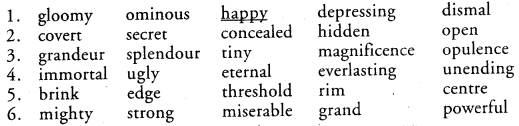
Underline the odd word in each set. The first one is done for you :
PSEB 11th Class English Solutions Poem 7 A Thing of Beauty is a Joy for Ever 1
Answer:
2. open
3. tiny
4. ugly
5. centre
6. miserable.

PSEB 11th Class English Solutions Poem 7 A Thing of Beauty is a Joy for Ever

Question 9.
Read the lines given below and answer the questions that follow :

Some shape of beauty moves away the pall
From our dark spirits. Such the sun, the moon,
Trees old, and young, sprouting a shady boon
For simple sheep; and such are daffodils.

(a) What moves away the pall from our dark spirits ?
(b) Name the heavenly bodies mentioned in the above lines
(c) Why does the poet think that the trees, sheep and daffodils can cheer up our gloomy spirit ?
(d) Do you think only daffodils can cheer our spirit up or other flowers can also do the same? Give reasons for your answer.
(e) List the two ryhming words in the passage.
Answer:
(a) Some shape of beauty removes the pall from our dark spirits.
(b) The sun and the moon.
(c) Because these are all the things of beauty that give us joy.
(d) All other flowers are as much a part of nature as the daffodils are. And a thing of beauty, wherever it is, is bound to give us joy.
(e) moon-boon.

Important Stanzas For Comprehension

Note : A complete Answer Key has been given at the end of the stanzas.

Stanza 1.

A thing of beauty is a joy for ever.
Its loveliness increases, it will never
Pass into nothingness; but will keep
A bower quiet for us, and a sleep
Full of sweet dreams, and health, and quiet breathing.

Questions
1. Name the poem and the poet.
2. What is the poetic creed of Keats ?
3. According to the poet, what blessings do beautiful things offer us ?
4. Give the words that rhyme in the given stanza.
Answers:
1. The name of the poem is A Thing of Beauty is a Joy for Ever’ and the name of the poet is John Keats.
2. Romanticism.
3. Beautiful things make us forget the sorrows and sufferings of the world. They give us peace of the mind and health of the body. They make our painful stay on this earth bearable.
4. (ever — never) ; (keep — sleep).

Stanza 2.

Therefore, on every morrow, are we wreathing
A flowery band to bind us to the earth.
Spite of despondence, of the inhuman dearth,
Of noble natures, of the gloomy days.

Questions
1. Name the poem and the poet.
2. What binds us to the earth ?
3. What dearth does the poet talk of ?
4. Write the figure of speech that has been used in the second last line of the given stanza.
Answer:
1. The name of the poem is A Thing of Beauty is a Joy for Ever’ and the name of the poet is John Keats.
2. A thing of beauty binds us to the earth.
3. It is the dearth of noble natures.
4. Alliteration.

PSEB 11th Class English Solutions Poem 7 A Thing of Beauty is a Joy for Ever

Stanza 3.

Of all the unhealthy and o’er-darkened ways
Made for our searching : yes, in spite of all,
Some shape of beauty moves away the pall
From our dark spirits.

Questions
1. Name the poem and the poet.
2. What does the poet mean by ‘o’er-darkened ways’ ?
3. What does ‘all refer to in the phrase ‘in spite of all’?
4. “Some shape of beauty moves away the pall
From our dark spirits.’ Which figure of speech is used in the given lines?
Answers:
1. The name of the poem is A Thing of Beauty is a Joy for Ever’and the name of the poet is John Keats.
2. He means mysterious things that man fails to understand.
3. The word all? here refers to all the gloom and sadness in man’s life.
4. Personification.

Stanza 4

…… and clear rills
That for themselves a cooling covert make
Gainst the hot season; the mid forest brake,
Rich with a sprinkling of fair musk-rose blooms.

Questions
1. Name the poem and the poet.
2. What do clear rills do ?
3. What protects rills from the hot season ?
4. Which figure of speech is used in the given stanza ?
Answers:
1. The name of the poem is A Thing of Beauty is a Joy for Ever’ and the name of the poet is John Keats.
2. They make for themselves a cooling covert.
3. A covert (a growth of thick low bushes) protects ‘rills from the hot season.
4. Personification.

Stanza 5.

And such too is the grandeur of the dooms
We have imagined for the mighty dead;
All lovely tales that we have heard or read;
An endless fountain of immortal drink,
Pouring unto us from the heaven’s brink.

Questions
1. Name the poem and the poet.
2. What have we imagined for the mighty dead ?
3. What lovely tales does the poet talk of ?
4. Give the rhyming words from the given stanza.
Answers:
1. The name of the poem is A Thing of Beauty is a Joy for Ever’and the name of the poet is John Keats.
2. We have imagined that they will be richly rewarded by God on the day of judgement.
3. He talks of the great myths and tales we have of the olden days.
4. (dead — read) ; (drink – brink).

A Thing of Beauty is a Joy for Ever Poem Summary in English

A Thing of Beauty is a Joy for Ever Introduction:

This poem conveys the idea that a thing of beauty is a joy for ever. It leaves a permanent impression on our mind. It stays in our imagination for ever. It never passes into nothingness. Our imagination adds new colours to it. Its loveliness increases every time we think of it.

PSEB 11th Class English Solutions Poem 7 A Thing of Beauty is a Joy for Ever

Thus it becomes a joy for ever. Besides this, it makes us forget the sorrows and sufferings of the world. It gives us peace of the mind and health of the body. It makes our painful stay on this earth bearable.

A Thing of Beauty is a Joy for Ever Summary in English:

In this poem, the poet tries to explain how a beautiful thing is a joy for ever. He says that the loveliness of a beautiful thing never fades. We find in it new beauties as we watch it day after day. It never passes into nothingness. It gives joy to the beholder for ever.

A beautiful thing is a kind of quiet bower that sends us to a sleep full of sweet dreams. It gives us health of the body and peace of the mind. The poet believes that man’s life on the earth is nothing but a tale of grief and sorrow.

There is sadness and gloom in every heart. There is a terrible lack of truly noble hearts. Many mysterious things happen that man fails to understand in spite of all efforts. None could bear to live on such an earth.

The poet says that it is beauty alone that takes away the gloom from the human heart. It is a kind of flowery band that binds us to the earth. The poet lists some such beautiful things. He says that we have the sun and the moon. There are big and small trees that give cool shade for simple sheep. There are lovely daffodils and cool clear streams. There are musk roses that bloom in forests.

Then there is also the beauty of thoughts we have for the mighty dead. We imagine that they will be suitably rewarded by God on the day of judgement. Then there are lovely tales of olden days that we have heard or read.

The poet calls all these beauties an endless fountain of immortal drink that heaven itself is pouring down for us. In other words, God himself has created these beautiful things for us so that we can derive joy from them during our stay on this earth.

A Thing of Beauty is a Joy for Ever Poem Summary in Hindi

A Thing of Beauty is a Joy for Ever Introduction:

यह कविता इस विचार को प्रस्तुत करती है कि सुन्दरता की कोई चीज़ सदा के लिए खुशी देती है। यह हमारे मन पर स्थायी प्रभाव छोड़ जाती है। यह हमारी कल्पना में सदा बनी रहती है। यह कभी लुप्त नहीं होती है। हमारी कल्पना इसमें नए रंग भर देती है। इसकी सुन्दरता हर बार बढ़ जाती है जब हम इसके बारे में सोचते हैं।

इस प्रकार यह सदा के लिए एक खुशी बन जाती है। इसके अतिरिक्त यह संसार के दुःखों और कष्टों को भुलाने में हमारी सहायता करती है। यह हमें मन की शान्ति और शरीर की तन्दुरुस्ती भी प्रदान करती है। यह धरती पर हमारे पीड़ा भरे जीवन को सहनीय बना देती है।

A Thing of Beauty is a Joy for Ever Summary in Hindi:

इस बात की व्याख्या करने का यत्न करता है कि सुन्दरता की कोई चीज़ सदा के लिए खुशी कैसे हो सकती है। वह कहता है कि एक सुन्दर चीज़ की सुन्दरता कभी धुंधली नहीं पड़ती। जैसेजैसे हम दिन-प्रतिदिन इसे देखते चले जाते हैं, हमें इसमें नई-नई सुन्दर बातें दिखाई देती हैं।

यह कभी लुप्त नहीं होती है। यह देखने वाले को सदा के लिए खुशी प्रदान करती है। एक सुन्दर चीज़ एक प्रकार का शान्ति-कुन्ज है जो हमें मीठे स्वप्नों से भरी हुई मीठी नींद की तरफ ले जाता है। यह हमें शरीर की तन्दुरुस्ती और मन की शान्ति प्रदान करती है।

PSEB 11th Class English Solutions Poem 7 A Thing of Beauty is a Joy for Ever

कवि का विश्वास है कि इस धरती पर मनुष्य का जीवन और कुछ नहीं, बल्कि दुःख और शोक की एक कहानी है। हर दिल में दुख और उदासी है। बहुत कम लोग ऐसे हैं जिनके पास वास्तव में श्रेष्ठ दिल है। ऐसी बहुतसी रहस्यमय बातें होती हैं जिन्हें मनुष्य अपने पूरे यत्नों के बावजूद समझने में असमर्थ रहता है।

कोई भी ऐसी धरती पर रहना बर्दाश्त नहीं कर सकता। कवि कहता है कि यह सिर्फ सुन्दरता ही है जो मनुष्य के दिल से उदासी को दूर करती है। यह एक किस्म की फूलों की एक डोरी है जो हमें धरती के साथ बांधे रखती है। कवि कुछ सुन्दर चीज़ों की एक सूची तैयार करता है। वह कहता है कि हमारे पास सूर्य तथा चांद हैं। वहां बड़े और छोटे पेड़ हैं जो भोली-भाली भेड़ों के लिए सुखद छाया प्रदान करते हैं।

वहां सुन्दर नरगिसी फूल हैं और स्वच्छ जल वाली सरिताएं हैं। वहां पर जंगलों में खिलने वाले बड़े-बड़े सफेद गुलाब (भी) हैं। फिर वहां पर उन विचारों की सुन्दरता भी है जो हम मरे हुए शक्तिशाली लोगों के बारे में सोचते हैं। हम कल्पना करते हैं कि अन्तिम निर्णय (कयामत) के दिन उन्हें ईश्वर की ओर से उचित पुरस्कार प्राप्त होंगे। फिर वहां पुराने दिनों की सुन्दर कहानियां हैं जो हमने सुनी हैं या पढ़ी हैं।

कवि इन सभी सुन्दरताओं को अलौकिक अमृत का एक अनन्त झरना कहता है जो स्वयं स्वर्ग हमारे लिए उंडेल रहा है। अन्य शब्दों में, स्वयं ईश्वर ने इन सुन्दर चीज़ों की रचना हमारे लिए की है ताकि हम इस धरती पर अपने निवास के दौरान उनसे प्रसन्नता प्राप्त कर सकें।

A Thing of Beauty is a Joy for Ever Poem Translation in Hindi

(Lines 1-5)

A thing of beauty is a joy for ever.
Its loveliness increases, it will never
Pass’ into nothingness; but will keep.
A bower quiet for us, and a sleep
Full of sweet dreams, and health, and quiet breathing.

Explanation : The poet says that a thing of beauty can give us a joy for ever. Its loveliness never fades in our imagination. On the contrary, it goes on increasing as our imagination adds new colours to it. It never passes into nothingness.

PSEB 11th Class English Solutions Poem 7 A Thing of Beauty is a Joy for Ever

It always remains fresh in our memory. It is a kind of quiet bower for us. We can visit this bower whenever we like. In other words, in the moments of sorrow we can recall the beauty of that thing and can be happy again. Its memory will take us to a sleep full of sweet dreams. It will keep us fit and give us full peace.

कवि कहता है कि सुन्दरता की कोई चीज़ हमें सदा रहने वाली खुशी प्रदान कर सकती है। इसकी सुन्दरता हमारी कल्पना में कभी धुंधली नहीं पड़ती है। इसके विपरीत यह बढ़ती चली जाती है क्योंकि हमारी कल्पना इसमें नए रंग भर देती है। यह कभी अपना अस्तित्व नहीं खोती। यह हमारी याद में सदा ताज़ा बनी रहती है।

यह हमारे लिए एक शान्ति-कुंज का काम करती है। हम जब चाहें इस शान्ति-कुंज में जा सकते हैं। अन्य शब्दों में, उदासी के क्षणों में हम उस चीज़ की सुन्दरता को फिर से अपने मन में ला सकते हैं तथा दोबारा प्रसन्न हो सकते हैं। इसकी याद हमें मीठे स्वप्नों से भरी हुई एक मीठी नींद की तरफ़ ले जाएगी। यह हमें स्वस्थ रखेगी और पूर्ण शान्ति प्रदान करेगी।

(Lines 6-13)

Therefore, on every morrow, are we wreathing
A flowery band to bind us to the earth,
Spite of despondence, of the inhuman dearth,
Of noble natures, of the gloomy days,
Of all the unhealthy and o’er-darkened ways
Made for our searching : yes, in spite of all,
Some shape of beauty moves away the pall
From our dark spirits.

Explanation : Here the poet says that it is only beauty that enables us to live on this earth. Beauty is a kind of flowery band that binds us to earth. It is beauty that keeps us going in our life from day to day. There are so many painful things in the world that if there were no beauty, it would be impossible to live here. There is desperation and sorrow everywhere.

There are few people who have truly a noble heart. Man’s life is absolutely hopeless. Many mysterious things, happen that man fails to understand in spite of all efforts. But despite all these painful things man continues living on this earth. The poet says that its only reason is that there are some beautiful things also in this world. It is the beauty of these things that removes the sadness from our sorrowful hearts.

यहाँ कवि कहता है कि यह केवल सुन्दरता ही है जो हमें इस धरती पर चलाए रखती है। सुन्दरता एक प्रकार की फूलों की डोरी है जो हमें धरती के साथ बांधे रखती है। यह सुन्दरता है जो हमें एक दिन से दूसरे दिन तक चलाए रखती है। संसार में दुःखी होने को इतनी चीजें हैं कि यदि सुन्दरता न होती तो यहां रहना असंभव हो जाता। वहां सभी तरफ़ निराशा और उदासी है। वहां बहुत कम लोग हैं जिनके पास वास्तव में ही एक श्रेष्ठ दिल है।

PSEB 11th Class English Solutions Poem 7 A Thing of Beauty is a Joy for Ever

मनुष्य का जीवन पूरी तरह से निराशापूर्ण है। यहां अनेकों ऐसी रहस्यमय बातें होती रहती हैं जिन्हें मनुष्य अपने पूरे यत्नों के बावजूद समझ पाने में असमर्थ रहता है। किन्तु इन सभी दुख-भरी बातों के बावजूद मनुष्य इस संसार में रहना जारी रखता है। कवि कहता है कि इसका एकमात्र कारण यह है कि इस संसार में कुछ सुन्दर चीजें भी हैं। यह इन चीजों की सुन्दरता है जो हमारे दिलों की निराशा को समाप्त कर देती है।

(Lines 14-19)

Such the sun, the moon,
Trees old, and young, sprouting a shady boon
For simple sheep; and such are daffodils
With the green world they live in; and clear rills
That for themselves a cooling covert make
‘Gainst the hot season; the mid forest brake,
Rich with a sprinkling of fair musk-rose blooms.

रंग भर देती है। यह कभी अपना अस्तित्व नहीं खोती। यह हमारी याद में सदा ताज़ा बनी रहती है। यह हमारे लिए एक शान्ति-कुंज का काम करती है। हम जब चाहें इस शान्ति-कुंज में जा सकते हैं। अन्य शब्दों में, उदासी के क्षणों में हम उस चीज़ की सुन्दरता को फिर से अपने मन में ला सकते हैं तथा दोबारा प्रसन्न हो सकते हैं। इसकी याद हमें मीठे स्वप्नों से भरी हुई एक मीठी नींद की तरफ़ ले जाएगी। यह हमें स्वस्थ रखेगी और पूर्ण शान्ति प्रदान करेगी।

(Lines 6-13)

Therefore, on every morrow, are we wreathing
A flowery band to bind us to the earth,
Spite of despondence, of the inhuman dearth,
Of noble natures, of the gloomy days,
Of all the unhealthy and o’er-darkened ways
Made for our searching : yes, in spite of all,
Some shape of beauty moves away the pall
From our dark spirits.

Explanation : Here the poet says that it is only beauty that enables us to live on this earth. Beauty is a kind of flowery band that binds us to earth. It is beauty that keeps us going in our life from day-to-day. There are so many painful things in the world that if there were no beauty, it would be impossible to live here.

There is desperation and sorrow everywhere. There are few people who have truly a noble heart. Man’s life is absolutely hopeless. Many mysterious things, happen that man fails to understand in spite of all efforts. But despite all these painful things man continues living on this earth.

The poet says that its only reason is that there are some beautiful things also in this world. It is the beauty of these things that removes the sadness from our sorrowful hearts.

यहाँ कवि कहता है कि यह केवल सुन्दरता ही है जो हमें इस धरती पर चलाए रखती है। सुन्दरता एक प्रकार की फूलों की डोरी है जो हमें धरती के साथ बांधे रखती है। यह सुन्दरता है जो हमें एक दिन से दूसरे दिन तक चलाए रखती है। संसार में दुःखी होने को इतनी चीजें हैं कि यदि सुन्दरता न होती तो यहां रहना असंभव हो जाता।

वहां सभी तरफ़ निराशा और उदासी है। वहां बहुत कम लोग हैं जिनके पास वास्तव में ही एक श्रेष्ठ दिल है। मनुष्य का जीवन पूरी तरह से निराशापूर्ण है। यहां अनेकों ऐसी रहस्यमय बातें होती रहती हैं जिन्हें मनुष्य अपने पूरे यत्नों के बावजूद समझ पाने में असमर्थ रहता है। किन्तु इन सभी दुख-भरी बातों के बावजूद मनुष्य इस संसार में रहना जारी रखता है। कवि कहता है कि इसका एकमात्र कारण यह है कि इस संसार में कुछ सुन्दर चीजें भी हैं। यह इन चीजों की सुन्दरता है जो हमारे दिलों की निराशा को समाप्त कर देती है।

(Lines 14-19)

Such the sun, the moon,
Trees old, and young, sprouting a shady boon
For simple sheep; and such are daffodils
With the green world they live in; and clear rills
That for themselves a cooling covert make
‘Gainst the hot season; the mid forest brake,
Rich with a sprinkling of fair musk-rose blooms.

Explanation : Here the poet gives a list of some beautiful things that give some charm to the life on this earth that is, otherwise, full of sorrow. He says that there are beautiful sun and moon. There are big and small trees that give cool shade for simple sheep.

There are lovely daffodils in the green world where they live. There are clear streams that make cooling bushes to save themselves from the heat of the summer. Besides this, in the midst of the. forest, there are small bushes which have a few beautiful musk-roses growing here and there.

PSEB 11th Class English Solutions Poem 7 A Thing of Beauty is a Joy for Ever

यहां कवि कुछ सुन्दर चीज़ों की एक सूची देता है जो इस धरती पर के जीवन में कुछ आकर्षण भर देती हैं जो अन्यथा उदासी-भरा है। वह कहता है कि वहां सुन्दर सूर्य और चांद हैं। वहां बड़े और छोटे पेड़ हैं जो भोलीभाली भेड़ों के लिए सुखद छाया प्रदान करते हैं। वहां सुन्दर नरगिस के फूल हैं, उस पूरे हरे-भरे संसार के साथ जिसमें वे रहते हैं।

वहां स्वच्छ जल वाली सरिताएं हैं जो अपने मार्ग के साथ-साथ गर्म मौसम से बचने के लिए ठण्ड पहुंचाने वाली झाड़ियां उगा लेती हैं। इनके अतिरिक्त जंगल के मध्य में छोटी-छोटी झाड़ियां होती हैं जिनके मध्य कहीं-कहीं सुन्दर सफ़ेद गुलाब उगे होते हैं।

(Lines 20-24)

And such too is the grandeur of the dooms
We have imagined for the mighty dead;
All lovely tales that we have heard or read;
And endless fountain of immortal drink,
Pouring unto us from the heaven’s brink.

Explanation : Continuing with the list of beautiful things, the poet says that we imagine that those mighty people will be suitably rewarded by God on the day of judgement who are lying dead in their graves. We think about those beautiful gifts and are filled with joy. Besides, there are lovely tales of olden days that we have heard or read.

The poet calls all these beautiful things ‘an endless fountain of immortal drink that heaven itself is pouring down for us. In other words, God himself has created these beautiful things for us so that we can derive joy from them during our stay on this earth. They can give us as much pleasure as the angels get from the immortal drink of the heaven.

सुन्दर चीज़ों की अपनी सूची को जारी रखते हुए कवि कहता है कि हम अन्तिम निर्णय (कयामत) के दिन ईश्वर से उन शक्तिशाली लोगों के लिए सुन्दर (उचित) पुरस्कारों की कल्पना करते हैं जो इस समय अपनी कब्रों में मरे पड़े हैं। हम उन सुन्दर उपहारों के बारे में सोचते हैं और खुशी से भर जाते हैं। इसके अतिरिक्त वहां पुराने दिनों की सुन्दर कहानियां हैं जो हमने सुनी या पढ़ी हैं।

कवि इन सभी सुन्दर चीज़ों को अलौकिक पेय (अमृत) का एक अनन्त झरना कहता है जो स्वयं स्वर्ग हमारे लिए उंडेल रहा है। अन्य शब्दों में, स्वयं ईश्वर ने इन सुन्दर चीजों की रचना हमारे लिए की है ताकि हम इस धरती पर अपने निवास के दौरान उनसे प्रसन्नता प्राप्त कर सकें। वे हमें उतनी ही खुशी प्रदान कर सकती हैं जितनी फरिश्ते स्वर्ग के अलौकिक पेय से प्राप्त करते हैं।

A Thing of Beauty is a Joy for Ever Central Idea Of The Poem of English

This poem conveys the idea that a thing of beauty is a joy for ever. It leaves a permanent impression on our mind. It stays in our imagination for ever. It never passes into nothingness. Our imagination adds new colours to it. Its loveliness increases every time we think of it.

Thus it becomes a joy for ever. Besides this, it makes us forget the sorrows and sufferings of the world. It gives us peace of the mind and health of the body. It makes our painful stay on this earth bearable.

A Thing of Beauty is a Joy for Ever Central Idea Of The Poem of Hindi

यह कविता इस विचार को प्रस्तुत करती है कि सुन्दरता की कोई चीज़ सदा के लिए खुशी देती है। यह हमारे मन पर एक स्थायी प्रभाव छोड़ जाती है। यह हमारी कल्पना में सदा बनी रहती है। यह कभी लुप्त नहीं होती है। हमारी कल्पना इसमें नए रंग भर देती है।

PSEB 11th Class English Solutions Poem 7 A Thing of Beauty is a Joy for Ever

इसकी सुन्दरता हर बार बढ़ जाती है जब हम इसके बारे में सोचते हैं। इस प्रकार यह सदा के लिए एक खुशी बन जाती है। इसके अतिरिक्त यह संसार के दुःखों और कष्टों को भुलाने में हमारी सहायता करती है। यह हमें मन की शान्ति और शरीर की तन्दुरुस्ती भी प्रदान करती है। धरती पर हमारे पीड़ा भरे जीवन को यह सहनीय बना देती है।

A Panorama of Life PSEB Guide Class 11

Let’s Not Forget the Martyrs Question Answer Class 11 English Book Chapter 7 PSEB Solutions

Punjab State Board PSEB 11th Class English Book Solutions Chapter 7 Let’s Not Forget the Martyrs Textbook Exercise Questions and Answers.

Class 11th English Book Chapter 7 Let’s Not Forget the Martyrs Question Answers

Let’s Not Forget the Martyrs Class 11 Questions and Answers

Short Answer Type Questions

Question 1.
Name the five recipients of the Param Vir Chakra mentioned in the lesson, ‘Let’s Not Forget the Martyrs.
Answer:
The five recipients of Param Vir Chakra mentioned in the lesson are —
1. Major Som Nath Sharma
2. Lieutenant Colonel Dhan Singh Thapa
3. Havildar Abdul Hamid
4. Flying Officer Nirmal Jit Singh Sekhon
5. Captain Vikram Batra.

PSEB 11th Class English Solutions Chapter 7 Let's Not Forget the Martyrs

परम वीर चक्र प्राप्त करने वाले जिन पांच व्यक्तियों का उल्लेख इस पाठ में किया गया है, वे इस प्रकार से हैं –
1. मेजर सोम नाथ शर्मा
2. लेफ्टिनेंट कर्नल धान सिंह थापा
3. हवलदार अब्दुल हमीद
4. फ्लाइंग ऑफिसर निर्मल जीत सिंह सेखों
5. कैप्टन विक्रम बतरा।

Question 2.
When and where did Major Som Nath Sharma die ?
Answer:
Major Som Nath Sharma, the very first recipient of the Param Vir Chakra died in November 1947 during the Indo-Pak War of 1947-48. He died while evicting Pakistani infiltrators and raiders from Srinagar Airport.

सबसे पहला परम वीर चक्र प्राप्त करने वाले मेजर सोम नाथ शर्मा की मृत्यु नवम्बर 1947 में भारत-पाक के 1947-48 के युद्ध के दौरान हुई थी। वह पाकिस्तानी घुसपैठियों तथा छापामारों को श्रीनगर हवाई अड्डे से बाहर खदेड़ते समय शहीद हो गया।

Question 3.
How did Major Som Nath face the mortar firing from the enemy?
Answer:
Major Som Nath Sharma died in November 1947 while evicting Pakistani invaders from Srinagar Airport during the Indo-Pak War of 1947-48. While facing the mortar firing from the enemy, Major Som Nath Sharma started filling the magazines and issuing them to his men who were operating light machine guns. He urged his men to continue fighting bravely.

मेजर सोम नाथ शर्मा नवम्बर 1947-48 के भारत-पाक युद्ध के दौरान पाकिस्तानी हमलावरों को श्रीनगर हवाई अड्डे से बाहर खदेड़ते समय शहीद हो गया था। शत्रु की ओर से हो रही मोर्टर गनों की बमबारी का सामना करते हुए मेजर सोम नाथ शर्मा मैग्ज़ीनों में गोलियां भरने लगा और उन्हें अपने साथियों को पकड़ाने लगा, जो कि हल्की मशीन गनों का इस्तेमाल कर रहे थे। उसने अपने साथियों को बहादुरी से लड़ते रहने के लिए प्रेरित किया।

PSEB 11th Class English Solutions Chapter 7 Let's Not Forget the Martyrs

Question 4.
In which war did Lt. Col. Dhan Singh Thapa distinguish himself as a great soldier ?
Answer:
Lt. Col. Dhan Singh Thapa distinguished himself as a great soldier in the Sino-Indian war of 1962. He showed great bravery in the war. During the fight, when the Chinese outran the post, Lt. Col. Thapa jumped out of his trench. He killed many of the intruders in hand-to-hand fighting. He was awarded the Param Vir Chakra for his bravery.

लेफ्टिनेंट कर्नल धान सिंह थापा ने 1962 के चीन-भारत युद्ध में एक विशिष्ट सैनिक के रूप में ख्याति प्राप्त की। उसने युद्ध में बहुत बहादुरी दिखाई। लड़ाई के दौरान जब चीनी फौज ने उनकी चौकी को उजाड़ दिया तो लेफ्टिनेंट कर्नल थापा कूद कर अपनी खन्दक से बाहर आ गया। उसने बहुत से घुसपैठियों को तो हाथापाई में ही मार डाला। उसकी बहादुरी के लिए उसे परम वीर चक्र प्रदान किया गया। .

Question 5.
Havildar Abdul Hamid is known as a ‘killer of tanks’. Why?
Answer:
Havildar Abdul Hamid is known as a ‘killer of tanks’ because he, alone, had destroyed three tanks of the enemy forces during the Indo-Pak war of 1965. During the fight, when the enemy tanks had penetrated the forward position in an hour only, Hamid moved out to a flanking position with his gun mounted on a jeep and started knocking out enemy tanks. Changing his positions quickly, he knocked out three tanks one by one.

हवलदार अब्दुल हमीद को ‘टैंको का हत्यारा’ इसलिए कहा जाता है क्योंकि उसने अकेले ही 1965 के भारतपाक युद्ध में दुश्मन सेना के तीन टैंकों को नष्ट कर दिया था। लड़ाई के दौरान, जब शत्रु के टैंकों ने केवल एक घंटे में ही फारवर्ड पोजीशन को भेद दिया, तो हमीद अपनी छोटी तोप लगी हुई जीप के साथ फ़्लैंकिंग पोजीशन में चला गया और दुश्मन के टैकों को उड़ाने लगा। जल्दी-जल्दी अपनी स्थिति बदलते हुए उसने एक-एक करके तीन टैंक उड़ा दिए।

Question 6.
What was Abdul Hamid’s role during the Sino-Indian war of 1962 ?
Answer:
Havildar Abdul Hamid was a soldier in the 4th battalian of the Grenadiers of the Indian Army. During the Sino-Indian war of 1962, Abdul Hamid as a part of his battalion participated in the battle of Namka Chu against the Chinese.

हवलदार अब्दुल हमीद भारतीय थल सेना की दि ग्रिनेडियरज की चौथी बटालियन, में एक सैनिक था। 1962 के भारत-चीन के युद्ध के दौरान अब्दुल हमीद ने अपनी पलटन के एक भाग के रूप में नमका चू की लड़ाई में चीनियों के विरुद्ध भाग लिया था।

Question 7.
Why was Flying Officer Nirmal Jit Singh Sekhon awarded the Param Vir Chakra ?
Answer:
He was awarded the Param Vir Chakra in recognition of his lone defence of Srinagar airbase from a Pakistani raid. He alone fought with the six Sabres of the enemy. He scored a direct hit on one Sabre and set another ablaze. After a long dog-fight with the remaining four Sabres, his aircraft was hit and he was killed.

उसे श्रीनगर सैनिक हवाई अड्डे को पाकिस्तानी हमले से अकेले ही बचाने के लिए सम्मान के तौर पर परम वीर चक्र प्रदान किया गया था। वह शत्रु के छ: सेबर लड़ाकू विमानों के साथ अकेला ही युद्ध करता रहा। उसने एक सेबर लड़ाकू विमान पर सीधा प्रहार किया और एक अन्य को आग के हवाले कर दिया।

बाकी के बचे चार सेबर लड़ाकू विमानों के साथ एक लम्बी ‘डॉग-फाइट’ (वायुयानों के मध्य एक किस्म की लड़ाई जिसमें वे एक-दूसरे के काफी करीब रह कर इर्द-गिर्द उड़ते रहते हैं) के बाद उसके विमान पर प्रहार हुआ और वह उसमें शहीद हो गया।

PSEB 11th Class English Solutions Chapter 7 Let's Not Forget the Martyrs

Question 8.
In which war did Captain Vikram Batra display exemplary bravery to win the Param Vir Chakra ?
Answer:
Captain Vikram Batra displayed exemplary bravery during 1999 Kargil War in Kashmir between India and Pakistan. He showed great bravery in this war. He was killed when he was saving the life of another Indian soldier. For this valour and sacrifice, he was awarded the Param Vir Chakra.

कैप्टन बतरा ने 1999 में कश्मीर में भारत और पाकिस्तान के बीच लड़े गए कारगिल युद्ध के दौरान अनुकरणीय वीरता का प्रदर्शन किया। उसने इस युद्ध में बहुत बहादुरी दिखाई। वह एक अन्य भारतीय सैनिक की जान बचाते समय शहीद हो गया। इस पराक्रम तथा बलिदान के लिए उसे परम वीर चक्र प्रदान किया गया।

Question 9.
How did Vikram Batra come to join the Indian Army ?
Answer:
He was selected to join the Indian Military Academy in Dehradun in Jessore Company of Manekshaw Battalion. In 1996, he was commissioned in the Indian Army as a Lieutenant of the 13 Jammu and Kashmir Rifles at Sopore in Jammu and Kashmir. He, soon, rose to the rank of Captain.

उसका चयन मानेकशॉ बटालियन की जेसोर कंपनी के लिए भारतीय सैनिक अकादमी देहरादून में प्रवेश के लिए किया गया था। वह 1996 में भारतीय थल सेना में जम्मू तथा कश्मीर के सोपोर में 13 जम्मू एण्ड कश्मीर राइफल्स में लेफ्टिनेंट के तौर पर नियुक्त हुआ। शीघ्र ही वह तरक्की करके कैप्टन बन गया।

Question 10.
What was the effect of the capture of Point 5140 during the Kargil War ?
Answer:
In the Kargil War between India and Pakistan, captain Vikram Batra fought very bravely. He captured Point 5140 in this war. The capture of Point 5140 inspired other soldiers so much that they captured many other points also – such as Point 5100, Point 4700, Junction Peak, Three Pimples, Point 4750 and Point 4875.

भारत तथा पाकिस्तान के बीच हुए कारगिल युद्ध के दौरान कैप्टन विक्रम बतरा बहुत वीरतापूर्वक लड़ा। इस युद्ध में उसने प्वाइंट 5140 पर कब्जा कर लिया। प्वाइंट 5140 के कब्जे ने दूसरे सैनिकों को इतना प्रेरित किया कि उन्हें कई अन्य प्वाइंटों, जैसे प्वाइंट 5100, प्वाइंट 4700, जंक्शन पीक, थ्री पिम्पल्ज़, प्वाइंट 4750 तथा प्वाइंट 4875, आदि पर भी कब्जा कर लिया।

Question 11.
Write in brief about Captain Vikram Batra who won the Param Vir Chakra.
Answer:
Captain Vikram Batra displayed exemplary bravery during the Kargil War in Kashmir between India and Pakistan in 1999. He was selected to join the Indian Military Academy in Dehradun in Jessore Company of Manekshaw Battalion. Captain Vikram Batra was killed while recapturing Point 4875.

कैप्टन विक्रम बतरा ने 1999 में कश्मीर में भारत और पाकिस्तान के बीच लड़े गए कारगिल युद्ध के दौरान अनुकरणीय वीरता का प्रदर्शन किया। उसका चयन मानेकशॉ बटालियन की जेसोर कंपनी के लिए भारतीय सैनिक अकादमी, देहरादून, में प्रवेश के लिए किया गया था। विक्रम बतरा प्वाइंट 4875 पर दोबारा कब्जा करते समय शहीद हो गया।

Question 12.
Describe the condition of Major Som Nath Sharma when his company was to be airlifted to Srinagar. Was he given permission to join his company ?
Answer:
It was 31 Oct. 1947. Major Som Nath’s company was to be airlifted to Srinagar. At that time, Som Nath’s right hand was in plaster. A few days back, he had been injured in the hockey field. But Major Som Nath insisted on being with his company during the war. Finally, he was permitted to go to Srinagar with his company.

PSEB 11th Class English Solutions Chapter 7 Let's Not Forget the Martyrs

यह 31 अक्तूबर 1947 का दिन था। मेजर सोम नाथ शर्मा की कंपनी (दल) को हवाई जहाज के द्वारा श्रीनगर ले जाया जाना था। उस समय सोम नाथ के दाहिने बाजू पर पलस्तर चढ़ा हुआ था। कुछ दिन पहले वह हॉकी के मैदान में जख्मी हो गया था। लेकिन मेजर सोम नाथ शर्मा ने युद्ध के दौरान अपनी कंपनी के साथ होने की जिद की। अन्ततः, उसे अपनी कंपनी के साथ श्रीनगर जाने की आज्ञा दे दी गई।

Question 13.
Major Dhan Singh Thapa was believed to be killed in the war. Was he really killed ?
Answer:
It was believed that Major Thapa was killed in the war. But, in fact, he was taken prisoner. When he was released from the POW camp, he resumed his military career. He retired as Lieutenant Colonel. He died in Sept. 2005.

ऐसा माना जा रहा था कि युद्ध में मेजर थापा शहीद हो गया था। लेकिन, वास्तव में, उसे बंदी बना लिया गया था। जब उसे युद्ध-बन्दी शिविर से रिहा कर दिया गया, तो वह दोबारा सेना में शामिल हो गया। वह लेफ्टिनेंट कर्नल के रूप में रिटायर हुआ। सितम्बर 2005 में उसकी मृत्यु हो गई।

Question 14.
How did Abdul Hamid’s brave action inspire his comrades ? What example did it set before the world ?
Answer:
Abdul Hamid’s brave action inspired his comrades to beat back the heavy tank assault by the enemy. His complete disregard for his own safety and his sustained acts of bravery in the face of constant enemy fire presented a marvellous example before the whole world.

अब्दुल हमीद के वीरतापूर्ण कारनामे ने उसके साथियों को शत्रु द्वारा टैंकों के साथ किए गए भारी हमले का करारा जवाब देने के लिए प्रोत्साहित किया। अपनी खुद की सुरक्षा के प्रति पूर्ण बेपरवाही तथा शत्रु के द्वारा लगातार गोलाबारी के बावजूद उसके बहादुरी के ज़बरदस्त कारनामों ने समूची दुनिया के सामने एक शानदार उदाहरण प्रस्तुत किया।

Question 15.
What is the ‘Param Vir Chakra’ ?
Answer:
The Param Vir Chakra is the highest Indian gallantry award. It is conferred on those soldiers who display exemplary courage and bravery in their fight for the honour and protection of their country.

परम वीर चक्र सर्वोच्च भारतीय वीरता पुरस्कार है। इसे उन सैनिकों को प्रदान किया जाता है जो अपने देश के सम्मान तथा रक्षा हेतु लड़ाई में साहस एवं वीरता का अनुकरणीय प्रदर्शन करते हैं।

Question 16.
Why was Major Som Nath’s company sent to Badgam village in the Kashmir valley ? What did Major Som Nath do to face the mortal bombardment from the enemy?
Answer:
Major Som Nath’s company was sent there on a fighting patrol. He started filling the magazines and issuing them to his men who were operating light machine guns. He urged his men to continue fighting bravely.

मेजर सोम नाथ की कंपनी को वहां युद्ध गश्त पर भेजा गया था। उसने मैगज़ीनों में गोलियां भर-भर कर अपने उन आदमियों को पकड़ानी शुरू कर दी जो हल्की मशीनगनें चला रहे थे। उसने अपने आदमियों को बहादुरी से लड़ते रहने के लिए प्रेरित किया।

Question 17.
How was the third Chinese attack ? What did Major Thapa do when the Chinese overran the Sirijap-1 post ? What happened to Major Thapa during the war ?
Answer:
The third Chinese attack included tanks in support of the infantry. When the Chinese overran the Sirijap-1 post, Major Thapa jumped out of his trench and killed many soldiers of the enemy in just hand-to-hand fighting. He was overpowered and captured by the enemy.

तीसरे चीनी हमले में पैदल सेना को उनकी टैकों द्वारा सहायता शामिल थी। जब चीनी सैनिकों ने सिरीजाप1 चौकी को उजाड़ डाला, मेजर थापा कूद कर अपनी खन्दक से बाहर आ गया और बहुत-से शत्रु सैनिकों को हाथापाई में ही मार गिराया। उसे शत्रु द्वारा दबोच लिया गया और बन्धक बना लिया गया।

Question 18.
What happened on 14 December 1971 in Srinagar airfield ? Who was on readiness duty at that time and how did he face the Pakistani attack ?
Answer:
Six Pakistan Air Force F-86 jets attacked Srinagar airfield on that day. Flying Officer Nirmal Jit Singh Sekhon was on readiness duty at that time. Under heavy fire, he, somehow, took off in his Gnat to engage the Sabres of the enemy. And, very soon, he destroyed two Sabres one after the other.

उस दिन पाकिस्तानी वायु सेना के छ: एफ-86 जेट विमानों ने श्रीनगर हवाई अड्डे पर धावा बोल दिया। फ्लाइंग ऑफिसर निर्मल जीत सिंह सेखों उस समय आपात्कालीन ड्यूटी पर था। भारी गोलाबारी के बीच किसी तरह उसने शत्रुओं के सेबर लड़ाकू विमानों से लड़ने के लिए अपने नेट लड़ाकू विमान में उड़ान भरी। और शीघ्र ही उसने एक के बाद एक दो सेबर लड़ाकू विमानों को नष्ट कर दिया।

PSEB 11th Class English Solutions Chapter 7 Let's Not Forget the Martyrs

Question 19.
Who was the very first recipient of the Param Vir Chakra ?
Answer:
The very first recipient of the Param Vir Chakra was Major Som Nath Sharma. He was awarded this medal for his bravery during the Indo-Pak War of 1947-48 in Kashmir. He died while evicting Pakistani raiders from Srinagar Airport.

सबसे पहला परम वीर चक्र प्राप्त करने वाला मेजर सोम नाथ शर्मा था। उसे कश्मीर में लड़े गए 1947-48 के भारत-पाक युद्ध के दौरान बहादुरी दिखाने के लिए यह पदक प्रदान किया गया। वह श्रीनगर हवाई अड्डे से पाकिस्तानी छापामारों को बाहर निकालते समय शहीद हो गया था।

Long Answer Type Questions

Question 1.
Describe the circumstances of the martyrdom of Major Som Nath Sharma.
Answer:
Som Nath Sharma’s company was fighting with the Pakistani invaders in the Badgam village during the Indo-Pak War of 1947-48 in Kashmir. Suddenly, the enemy surrounded his company from three sides and started mortar bombardment.

Despite his right hand being in plaster, Major Som Nath took the task of filling the magazines and issuing them to his men, who were operating light machine guns. While he was busy filling Nath Sharma was killed in that explosion.

1947-48 के भारत-पाक युद्ध के दौरान मेजर सोम नाथ शर्मा की कंपनी कश्मीर के बडगाम गांव में पाकिस्तानी हमलावरों के साथ लड़ रही थी। अचानक उसकी कंपनी को शत्रुओं ने तीन तरफ से घेर लिया और मोर्टर गनों से बमबारी शुरू कर दी।

अपने दाएं हाथ पर पलस्तर चढ़ा होने के बावजूद मेजर सोम नाथ ने मैग्जीनों में गोलियां भरने तथा उन्हें अपने उन साथियों को पकड़ाने का जिम्मा ले लिया, जो हल्की मशीनगनें चला रहे थे। जब वह मैग्जीनों में गोलियां भरने में व्यस्त था, एक मोर्टर बम उसके नज़दीक पड़े गोला-बारूद के ढेर के ऊपर फट गया। मेजर सोम नाथ शर्मा उस विस्फोट में शहीद हो गया।

Question 2.
Describe the role of Lt. Col. Dhan Singh Thapa during the Chinese attack.
Answer:
During the Sino-Indian War of 1962, Dhan Singh Thapa was posted in Ladakh. On 20 October, 1962, the Chinese attacked Sirijap-1 post near the Chushul Airport in Ladakh. They attacked three times with more and more ammunition and tanks.

But each time, Major Thapa, along with his men, repulsed their attack by inflicting heavy losses on the enemy. When the enemy overran the post, Dhan Singh Thapa didn’t care about his own life and jumped out of his trench. He killed many of the intruders in hand-to-hand fighting.

1962 के चीन-भारत युद्ध के दौरान धान सिंह थापा लद्दाख में तैनात था। 20 अक्तूबर 1962 को चीनियों ने लद्दाख में चुशूल हवाई अड्डे के समीप सिरीजाप-1 चौकी पर हमला कर दिया। उन्होंने ज़्यादा से ज़्यादा गोला-बारूद तथा टैकों के साथ तीन बार हमला किया।

PSEB 11th Class English Solutions Chapter 7 Let's Not Forget the Martyrs

लेकिन हरेक बार मेजर थापा ने अपने साथियों के साथ दुश्मन को भारी नुक्सान पहुंचाते हुए उनके हमले का मुंह मोड़ दिया। जब दुश्मनों ने उसकी चौकी को तहस-नहस कर दिया तो धान सिंह थापा ने अपने जीवन की परवाह न की और कूदकर अपनी खन्दक से बाहर आ गया। उसने बहुत से घुसपैठियों को हाथापाई में ही मार डाला।

Question 3.
Explain the bravery displayed by Havildar Abdul Hamid in the Indo-Pak War of 1965.
Answer:
Havildar Abdul Hamid was posted in Khem Karan Sector, Bhikhiwind, in Punjab at that time. On 10 Sept. 1965, Pakistani forces attacked near village Cheema in Khem Karan Sector with a regiment of Parton tanks. There was intense artillery shelling and tank fire everywhere.

Realising the seriousness of the situation, Hamid moved out with his gun mounted on a jeep and started firing on the enemy tanks. He destroyed two enemy tanks. When the enemy tanks spotted Hamid, they started firing at him. He was badly wounded by a highly explosive shell. But he continued firing on another enemy tank till he died.

हवलदार अब्दुल हमीद उन दिनों पंजाब में स्थित खेमकरन सेक्टर, भिखीविंड, में तैनात था। 10 सितम्बर 1965 को पाकिस्तानी सेनाओं ने पैटन टैंकों की एक रैजीमेन्ट के साथ खेम करन सेक्टर में चीमा गांव के समीप आक्रमण कर दिया। वहां हर तरफ तोपों द्वारा और टैंकों द्वारा गोलाबारी हो रही थी।

स्थिति की गंभीरता को भांपते हुए हमीद अपनी जीप पर एक (छोटी तोप) बंदूक लगाए बाहर निकल आया और दुश्मन के टैंकों पर गोलाबारी करने लगा। उसने दुश्मन के दो टैंक उड़ा दिए। जब दुश्मनों के टैंकों की निगाह हमीद पर पड़ी तो वे उस पर गोलाबारी करने लगे। वह एक बेहद विस्फोटक गोले से बुरी तरह घायल हो गया। लेकिन वह आखिरी सांस तक शत्रु के एक और टैंक पर गोलाबारी करता रहा।

Question 4.
How did Flying Officer Nirmal Jit Singh Sekhon defend the Srinagar Air Base in 1971 ?
Answer:
On 14 Dec, 1971, six Pakistan Air Force F-86 jets attacked Srinagar Airfield. Sekhon was on readiness duty at that time. The enemy aircraft dropped bombs on the ground targets. Under heavy fire, Sekhon somehow was able to take off in his Gnat and fight with the Sabres.

He scored a direct hit on one Sabre and set another ablaze. After a long dog-fight with the remaining four Sabres, his aircraft was hit and he was killed. The remaining Pakistani aircraft returned to Pakistan without pressing the attack.

14 दिसम्बर, 1971 को पाकिस्तानी वायुसेना के छ: एफ-86 जेट विमानों ने श्रीनगर. सैनिक हवाई अड्डे पर हमला कर दिया। सेखों उस समय आपात्कालीन ड्यूटी पर था। शत्रु के विमानों ने ज़मीनी लक्ष्यों पर बम गिरा दिए। भारी गोलाबारी के बीच सेखों किसी तरह अपने नैट लड़ाकू विमान में उड़ान भरने में समर्थ हो गया और उसने शत्रु के सेबर लड़ाकू विमानों के साथ टक्कर ली।

उसने एक सेबर लड़ाकू विमान पर सीधा निशाना दागा और एक अन्य को आग के हवाले कर दिया। बचे हुए चार सेबर लड़ाकू विमानों के साथ लम्बे समय तक लड़ने के बाद सेखों के विमान को गोली लगी और वह शहीद हो गया। बाकी बचे पाकिस्तानी विमान हमले को जारी रखे बगैर ही वापस पाकिस्तान चले गए।

PSEB 11th Class English Solutions Chapter 7 Let's Not Forget the Martyrs

Question 5.
Explain the part played by Captain Vikram Batra in the Kargil War in June 1999.
Answer:
During the Kargil War in 1999, Captain Vikram Batra was given the task of recapturing Point 5140. Captain Vikram decided to lead from the rear and thus shock the enemy. But when he and his men reached near the top, the enemy started firing at them.

But they didn’t bother about the heavy firing. They hurled two grenades at the machine-gun post. Captain Vikram alone killed three enemy soldiers in close combat. Though he was seriously injured, he insisted on continuing the mission.

Inspired by his courage, his men charged the enemy position and recaptured Point 5140. And thus Point 4700, Point 5100, Junction Peak, Three Pimples, Point 4750 and Point 4875 were also captured afterwards. Captain Vikram Batra was killed while recapturing Point 4875.

1999 में हुए कारगिल युद्ध के दौरान कैप्टन विक्रम बतरा को प्वाइंट 5140 पर दोबारा कब्जा करने का काम सौंपा गया। कैप्टन विक्रम ने पिछली ओर से चढ़ाई करने और इस प्रकार शत्रु के होश उड़ा देने का फैसला किया। किन्तु जैसे ही वह तथा उसके आदमी शिखर के करीब पहुंचे, शत्रुओं ने उन पर फायरिंग शुरू कर दी।

परन्तु उन्होंने भारी फायरिंग की परवाह नहीं की। उन्होंने मशीन-गन वाली चौकी पर दो हथगोले फेंक दिए। कैप्टन विक्रम ने नज़दीक की लड़ाई में अकेले ही तीन शत्रु सैनिकों को मार डाला। यद्यपि वह गंभीर रूप से घायल हो गया था, फिर भी उसने मिशन को जारी रखने की जिद की।

उसकी हिम्मत से प्रेरित होकर उसके साथियों ने शत्रु के स्थान पर धावा बोल दिया और प्वाइंट 5140 पर पुनः कब्जा कर लिया। और इसी प्रकार बाद में प्वाइंट 4700, प्वाइंट 5100, जंक्शन पीक, थ्री पिम्पल्ज़, प्वाइंट 4750 तथा प्वाइंट 4875, आदि पर भी कब्जा कर लिया गया। प्वाइंट 4875 पर दोबारा कब्जा करने के दौरान कैप्टन विक्रम बतरा शहीद हो गया।

Question 6.
How did Major Som Nath Sharma save Srinagar from falling into the hands of the enemy?
Answer:
It was 31 October 1947, when a ‘Lashkar’ of about 700 raiders entered the Badgam village in the Kashmir valley. Major Som Nath’s company was to be airlifted to Srinagar. At that time, Som Nath’s right hand was in plaster.

But Major Som Nath insisted on being with his company during the war. Finally, he was permitted to go to Srinagar with his company. During the fight, the enemy surrounded Som Nath’s company from three sides and started mortar bombardment. Many of his soldiers were killed in this bombardment. But even then, Somnath didn’t let his men lose their courage.

Exposing himself to danger, he ran from post to post and urged his men to fight bravely. Despite his right hand being in plaster, he started filling magazines and issuing them to his soldiers. Suddenly, a mortar shell exploded on the ammunition lying near him.

Major Som Nath was killed in that explosion. However, his last message sent to the Brigade Headquarters turned the tables against the enemy. The Indian troops, at once, flew into Srinagar and blocked all the routes to Srinagar. Thus Major Som Nath Sharma saved Srinagar from falling into the hands of the enemy.

PSEB 11th Class English Solutions Chapter 7 Let's Not Forget the Martyrs

यह 31 अक्तूबर 1947 की बात है जब कश्मीर घाटी के बडगाम गांव में करीब सात सौ छापामारों का एक लश्कर घुस आया। मेजर सोम नाथ शर्मा की कंपनी (दल) को हवाई जहाज द्वारा श्रीनगरं ले जाया जाना था। उस समय सोम नाथ के दाहिने बाजू पर पलस्तर चढ़ा हुआ था।

लेकिन मेजर सोम नाथ शर्मा ने युद्ध के दौरान अपनी कंपनी के साथ होने की जिद की। अन्ततः, उसे अपनी कंपनी के साथ श्रीनगर जाने की अनुमति दे दी गई। युद्ध के दौरान शत्रुओं ने सोम नाथ की कंपनी को तीन तरफ से घेर लिया और मोर्टर गनों से बमबारी शुरू कर दी।

उसके बहुत से सैनिक इस बमबारी में मारे गए। किन्तु ऐसे में भी सोमनाथ ने अपने लोगों को हिम्मत न हारने दी। वह खुद को जोखिम में डालता हुआ एक चौकी से दूसरी चौकी तक भागकर जाता रहा और अपने लोगों को बहादुरी से लड़ने के लिए प्रोत्साहित करता रहा।

अपने दाहिने बाजू पर पलस्तर चढ़े होने के बावजूद भी वह मैग्जीनों (बन्दूक में गोलियां भरने की जगह) में गोलियां भरने लगा और अपने सैनिकों को पकडाने लगा। अचानक एक मोर्टर बम उसके नजदीक पडे गोला-बारूद के ढेर के ऊपर फट गया। मेजर सोम नाथ उस विस्फोट में शहीद हो गया।

परन्तु ब्रिगेड मुख्यालय को भेजे गए उसके आखिरी संदेश ने दुश्मन का पांसा पलट दिया। भारतीय सैनिकों का दल तुरंत हवाई मार्ग द्वारा श्रीनगर आ पहुंचा और श्रीनगर की तरफ आने वाले सभी रास्तों को बंद कर दिया। इस प्रकार मेजर सोम नाथ शर्मा ने श्रीनगर को दुश्मन के हाथों में जाने से बचा लिया।

Question 7.
Abdul Hamid’s complete disregard for his own safety and his sustained acts of bravery in the face of constant enemy fire presented a marvellous example before the whole world. Elaborate
Answer:
Havildar Abdul Hamid was a soldier in the 4th battalion of ‘The Grenadiers’ of the Indian Army. Abdul Hamid was born at Dhamupur village of Ghazipur district in Uttar Pradesh on 1 July 1933.

He was enrolled into The Grenadiers’, infantry regiment in 1954. In the Indo-Pak War of 1965, Pakistani forces, with a regiment of Patton tanks, attacked a vital area near Khem Karan Sector. The enemy tanks penetrated the forward position in an hour only.

Havildar Abdul Hamid realised the gravity of the situation and he moved out to a flanking position with his gun mounted on a jeep. There was intense shelling from the enemy. But brave Hamid didn’t care and he knocked out the leading enemy tank.

Then quickly changing his position, he knocked out another enemy tank. Just then, the enemy tanks spotted him and started firing at him. But Hamid still kept on firing on another enemy tank. He was badly wounded by a highly explosive shell. Abdul Hamid’s brave action inspired his comrades to beat back the heavy tank assault by the enemy.

PSEB 11th Class English Solutions Chapter 7 Let's Not Forget the Martyrs

हवलदार अब्दुल हमीद भारतीय थल सेना की चौथी बटालियन, ‘दि ग्रिनेडियर्ज़’, में एक सैनिक था। अब्दुल हमीद का जन्म उत्तर प्रदेश के गाजीपुर जिले के धामूपुर गांव में 1 जुलाई, 1933 को हुआ था। उसे ‘दि ग्रिनेडियर्ज़’ इन्फेंट्री रेजीमेण्ट में 1954 में शामिल किया गया था।

1965 के भारत-पाक युद्ध में पाकिस्तानी सेनाओं ने पैटन टैंकों की एक रेजीमेण्ट के साथ खेम करन सेक्टर के समीप एक महत्त्वपूर्ण क्षेत्र पर धावा बोल दिया। शत्रु के टैंकों ने केवल एक घंटे में ही फॉरवर्ड पोजीशन को भेद दिया। हवलदार अब्दुल हमीद ने स्थिति की गंभीरता को भांप लिया और वह अपनी छोटी तोप लगी हुई जीप के साथ फ्लेंकिंग पोजीशन (युद्ध में वह स्थिति जिसमें दाएं या बाएं तरफ रहकर छिपकर शत्रु पर हमला किया जाता है)में चला गया।

शत्रु की तरफ से भारी गोलाबारी की गई। लेकिन बहादुर हमीद ने परवाह न की तथा उसने आगे चल रहे शत्रु टैंक को उड़ा दिया। फिर तुरंत अपनी स्थिति बदलते हुए उसने एक और शत्रु टैंक को उड़ा दिया। तभी शत्रुओं के टैंकों ने उसे ढूंढ लिया और उस पर गोलाबारी शुरू कर दी।

लेकिन हमीद ने फिर भी एक और टैंक पर गोलाबारी जारी रखी। एक शक्तिशाली विस्फोटक बम से वह बुरी तरह घायल हो गया। अब्दुल हमीद के वीरतापूर्ण कारनामे ने उसके साथियों को शत्रु द्वारा टैंकों के साथ किए गए भारी हमले का करारा जवाब देने के लिए प्रोत्साहित किया।

Objective Type Questions

Question 1.
Who wrote the chapter, ‘Let’s Not Forget The Martyrs’ ?
Answer:
Vandana Sehgal.

Question 2.
Who was Major Som Nath Sharma ?
Answer:
The very first recipient of the Param Vir Chakra.

Question 3.
Give the name of Major Som Nath Sharma’s father.
Answer:
Major General Amar Nath Sharma.

Question 4.
Who entered from Badgam from the direction of Gulmarg ?
Answer:
A tribal lashkar’ of 700 raiders.

Question 5.
When did the Chinese attack Sirijap-1 post in Ladakh ?
Answer:
On 20 October, 1962.

Question 6.
When was Dhan Singh Thapa commissioned in the Indian Army?
Answer:
On 28 August, 1949.

Question 7.
For how long did the shelling continue when Major Thapa and his men were facing the mortar firing from the Chinese ?
Answer:
It continued for two and a half hours.

Question 8.
What happened to Major Thapa during the war?
Answer:
He was overpowered and captured by the enemy.

Question 9.
When and where was Abdul Hamid born ?
Answer:
On 1 July, 1933 at Dhamupur village of Ghazipur district of Uttar Pradesh.

Question 10.
Where was Abdul Hamid posted during the Indo-Pak war of 1965 ?
Answer:
In the Khem Karan-Bhikhiwind Sector in Punjab.

PSEB 11th Class English Solutions Chapter 7 Let's Not Forget the Martyrs

Question 11.
When did Pakistani forces attack a village in the Khem Karan Sector of Punjab ?
Answer:
On 10 September, 1965.

Question 12.
What happened on 14 December, 1971 in Srinagar airfield ?
Answer:
Six Pakistani Air Force F-86 Sabre jets attacked Srinagar airfield.

Question 13.
Who was nicknamed ‘Sher Shah’ for his courage ?
Answer:
Captain Vikram Batra.

Question 14.
When and where was Captain Vikram Batra born ?
Answer:
On 9 September 1974 in Ghuggar village near Palampur in Himachal Pradesh.

Question 15.
What task was given to Captain Vikram ?
Answer:
To recapture Point 5140.

Question 16.
What were the last words of Captain Vikram Batra ?
Answer:
Jai Mata Di’.

Vocabulary And Grammar

1. Fill in the blanks in the following sentences with suitable words selected from the box below :

casualties, posthumously, overwhelming, approached, infiltrators, displayed, combat, recipient

1. Major Som Nath was the first ………. of the Param Vir Chakra.
2. Pakistani ……… crossed the Line of Control in Jammu and entered India.
3. As he could not afford to pay his fees, he ……….. the principal for help.
4. The brave officer killed two enemy soldiers in a hand-to-hand ………. .
5. The enemy suffered lots of ………… and took to their heels.
6. In 1962, the Chinese attacked the Indian Army in ……… numbers.
7. After his great sacrifice, he was ……… honoured with the highest military decoration.
8. He ………….. the highest bravery in the fight and made the enemy run away.
Answer:
1. recipient
2. infiltrators
3. approached
4. combat
5. casualties
6. overwhelming
7. posthumously
8. displayed.

2. Form adjectives from the following words :

Word — Adjective

1. Poverty — poor
2. mercy — merciful
3. power — powerful
4. destroy — destructive
5. gallantry — gallant
6. success — successful
7. bravery — brave
8. length — lengthy
9. prestige — prestigious
10. courage — courageous

3. Fill in each blank with a suitable determiner :

1. Would you like ………… tea ? (any / some)
2. ………… my life, I have been waiting for this moment. (all / some)
3. I have no time for ……….. these formalities. (any / all)
4. …………. lawyers pleaded their cases well. (every / both)
5. …………. books are to be read only in parts. (any / some)
Answer:
1. some
2. All
3. all
4. Both
5. Some.

PSEB 11th Class English Solutions Chapter 7 Let's Not Forget the Martyrs

4. Change the voice :

1. She could not help me with my lessons.
2. Our conscience has been mortgaged to money.
3. The doctor advised the patient not to eat rice.
4. The flies were laying eggs in her wounds.
5. Do you imitate others ? :
Answer:
1. I could not be helped with my lessons (by her).
2. We have mortgaged our conscience to money.
3. The patient was advised not to eat rice (by the doctor).
4. Eggs were being laid in her wounds by the flies.
5. Are others imitated by you ?

5. Identify the tenses in the given sentences :

1. Everybody is out to abuse and rape the country.
2. We have not conquered anyone.
3. My hostess will keep her promise.
4. A commission of inquiry is leaving for Hiroshima.
5. A car was waiting for us.
Answer:
1. Present Indefinite Tense
2. Present Perfect Tense
3. Future Indefinite Tense
4. Present Continuous Tense
5. Past Continuous Tense.

Let’s Not Forget the Martyrs Summary & Translation in English

Let’s Not Forget the Martyrs Summary in English:

This chapter describes the heroic deeds of some great martyrs who were honoured with Param Vir Chakra, the highest gallantry award in India. During the war, they inflicted heavy losses upon the enemy and thus changed the course of the war.

1. Major Som Nath Sharma

The very first recipient of the Param Vir Chakra was Major Som Nath Sharma. He was awarded this medal for his bravery during the Indo-Pak war of 1947-48 in Kashmir. He died while evicting Pakistani raiders from Srinagar Airport. Major Som Nath Sharma was born on 31 January 1923 at Dadh in Kangra in Himachal Pradesh. His father, Major General Amar Nath Sharma, was also a military officer.

It was 31 Oct. 1947. Major Som Nath’s company was to be airlifted to Srinagar. At that time, Som Nath’s right hand was in plaster. A few days back, he had been injured in the hockey field. But Major Som Nath insisted on being with his company during the war. Finally, he was permitted to go to Srinagar with his company.

When Major Som Nath reached Srinagar with his company, they were ordered to go to the Badgam village in the Kashmir valley. A ‘Lashkar’ of about 700 raiders had entered the village. During the fight, the enemy surrounded Som Nath’s company from three sides and started mortar bombardment. Many of his soldiers were killed in this bombardment.

But even then the Major didn’t let his men lose their courage. Exposing himself to danger, he ran from post to post and urged his men to fight bravely. Despite his right hand being in plaster, he started filling magazines and issuing them to his soldiers.

PSEB 11th Class English Solutions Chapter 7 Let's Not Forget the Martyrs

Suddenly, a mortar shell exploded on the ammunition lying near him. Major Som Nath was killed in that explosion. However, his last message sent to the Brigade Headquarters turned the tables against the enemy. The Indian troops, at once, flew into Srinagar and blocked all the routes to Srinagar. Thus Major Som Nath Sharma saved Srinagar from falling into the hands of the enemy.

2. Lieutenant Colonel Dhan Singh Thapa :

Lieutenant Colonel Dhan Singh Thapa, PVC, was an Indian Army Major in Ist Battalion, 8th Gorkha Rifles Regiment. It was 20 Oct. 1962. Major Dhan Singh Thapa was posted in Ladakh at that time. The Chinese attacked Sirijap-1 post near the Chushul airport in Ladakh.

They kept shelling for about two hours and set the whole area ablaze. But Major Thapa and his men also inflicted heavy losses on the enemy and thus repulsed their attack. The Chinese made another attack in great numbers. This time too, Major Thapa failed their attack. Third time the Chinese attacked with tanks.

Though Major Thapa and his men were weakened by the casualties suffered in earlier attacks, they didn’t lose courage. They continued fighting till the ammunition was finished. When the Chinese overran the post, Major Thapa jumped out of his trench.

He killed many of the intruders in hand-to-hand fighting. Major Thapa was awarded the Param Vir Chakra. It was believed that Major Thapa was killed in that encounter. But, in fact, he was taken prisoner. When he was released from the POW camp, he resumed his military career. He retired as Lieutenant Colonel. He died in Sept. 2005.

3. Havildar Abdul Hamid

Havildar Abdul Hamid was a soldier in the 4th battalion of The Grenadiers of the Indian Army. He died in the Khem Karan Sector during the Indo-Pak war of 1965. He was posthumously honoured with the Param Vir Chakra award for his exemplary courage and bravery displayed during the war.

Abdul Hamid was born on July 1, 1933 at Dhamupur village in Ghazipur District of Uttar Pradesh. He was enrolled into The Grenadiers, infantry regiment in 1954. In the Indo-Pak war of 1965, Abdul Hamid was posted in the Khem Karan-Bhikhiwind Sector in Punjab.

It was 10 September 1965. Pakistani forces with a regiment of Patton tanks attacked a vital area near Khem Karan Sector. There was intense artillery shelling. The enemy tanks had penetrated the forward position in an hour only.

Company Quarter Master Havildar Abdul Hamid realised the gravity of the situation. And he moved out to a flanking position with his gun mounted on a jeep. There was intense enemy shelling and tank fire. But brave Hamid didn’t care and taking an advantageous position, he knocked out the leading enemy tank.

Then quickly changing his position, he knocked out another enemy tank. Just then, the enemy tanks spotted him and started firing at him. However, an undeterred Hamid still kept on firing on another enemy tank. He was badly wounded by a highly explosive shell.

Abdul Hamid’s brave action inspired his comrades to beat back the heavy tank assault by the enemy. His complete disregard for his own safety and his sustained acts of bravery in the face of constant enemy fire presented a marvellous example before the whole world.

PSEB 11th Class English Solutions Chapter 7 Let's Not Forget the Martyrs

4. Flying Officer Nirmal Jit Singh Sekhon

Flying Officer Nirmal Jit Singh Sekhon who was an officer of the Indian Air Force was born on 17 July 1943. He was posthumously awarded the Param Vir Chakra for defending Srinagar Air Base from a Pakistani air raid during the Indo-Pak war of 1971.

During that war, he was assigned to the No. 18 Squadron, “The Flying Bullets’, flying the Folland Gnat fighter aircraft based at Srinagar. It was 14 December 1971. Six Pakistani Air Force F-86 Sabre jets attacked Srinagar airfield. Sekhon was on readiness duty at that time. The enemy aircraft dropped bombs on the ground targets.

Under heavy fire, Sekhon somehow was able to take off in his Gnat and fight with the Sabres. He scored a direct hit on one Sabre and set another Sabre ablaze. After a long fight with the remaining four Sabres, Sekhon’s aircraft was hit and he was killed. The remaining Pakistani aircraft returned to Pakistan without pressing the attack.

5. Captain Vikram Batra Captain Vikram

Batra was born on 9 Sept. 1974 in Ghuggar village near Palampur in Himachal Pradesh. He was an officer of the Indian Army. He was posthumously awarded the Param Vir Chakra for his heroic deeds during the 1999 Kargil war between India and Pakistan.

In 1996, he was commissioned in the Indian Army as a Lieutenant of the 13 JAK Rifles at Sopore in Jammu & Kashmir. He soon rose to the rank of Captain. In June 1999, his unit proceeded to Kargil sector on getting the news of a warlike situation in Kargil, Drass and Batalik sub-sectors.

Captain Vikram along with his company was sent on the first strategic and daring operation in Kargil. He was given the task of recapturing the first peak of utmost importance Point 5140, which was at an altitude of 17000 feet. Captain Vikram who was nicknamed Sher Shah for his courage decided to lead from the rear and thus shock the enemy.

He and his men ascended the sheer rock-cliff. But as they reached near the top, the enemy started firing at them with their heavy machine guns. Captain Batra and his men didn’t bother about the heavy firing and climbed up the cliff. After reaching the top, they hurled two grenades at the machine-gun post.

Captain Vikram alone killed three enemy soldiers in close combat. Though he was seriously injured, he insisted on continuing the mission. Inspired by his courage, his men charged the enemy position and recaptured Point 5140.

The capture of Point 5140 set in motion a string of successes such as Point 5100, Point 4700, Junction Peak, Three Pimples, Point 4750 and Point 4875. On 7 July, 1999, Captain Vikram Batra was killed when he tried to save an injured officer while recapturing Point 4875. His last words were Jai Mata Di’.

Let’s Not Forget the Martyrs Translation in English:

Param Vir Chakra is the highest gallantry award instituted by the government of India to be conferred on those soldiers who display exemplary courage and bravery in their fight for the honour, dignity and the protection of their motherland.

We can sleep in peace only because of the alert presence of these sentinels? at the borders of our country. The excerpts below describe the heroics of some of the recipients of this great honour. They laid down their lives but changed the course of the war through their great display of courage by inflicting heavy losses upon the foe.

PSEB 11th Class English Solutions Chapter 7 Let's Not Forget the Martyrs

Major Som Nath Sharma (1923-1947) was the first recipient of the Param Vir Chakra, the highest Indian gallantry award. He was awarded the medal posthumously for his bravery in the Kashmir operations in November 1947. He died while evicting Pakistani infiltrators and raiders from Srinagar Airport during the Indo-Pak War of 1947 – 48 in Kashmir. He belonged to the Kumaon Regiment.

Major Som Nath Sharma was born on 31 January 1923 at Dadh, Kangra, Himachal Pradesh, India. He came from a well-known military family. His father, Major General Amar Nath Sharma, was also a military officer. His company was airlifted8 to Srinagar on 31 October 1947. His right hand was in a plaster cast as a result of injuries sustained in the hockey field previously but he insisted on being with his company in combat and was given permission to go.

On 3 November, 1947, Major Som Nath Sharma’s company was ordered on a fighting patrol10 to Badgam village in the Kashmir Valley. A tribal ‘lashkar of 700 raiders approached Badgam from the direction of Gulmarg.

The company was soon surrounded by the enemy from three sides and sustained heavy casualties from the ensuing17 mortar bombardment. Under heavy fire and outnumbered seven to one, Som Nath urged17 his company to fight bravely, often exposing himself to14 danger as he ran from post to post. When heavy causalties adversely affected the firing power of his company, Major Sharma, with his right hand in plaster, took upon himself the task of filling the magazines and issuing them to men, operating light machine guns.

While he was busy fighting the enemy, a mortar shell exploded on the ammunition near him. His last message to Brigade HQ before he was killed was “The enemies are only 50 yards from us. We are under devastating fire. I shall not withdraw an inch but will fight to our last man and our last round.”

By the time the relief company of 1st Battalion Kumaon Regiment reached Badgam, the position had been overrun. However, the 200 casualties suffered by the enemy made them lose their impetus to advance. The Indian troops in the meantime flew in to Srinagar airfield and blocked all routes to Srinagar. In this manner, Som Nath Sharma prevented the fall of Srinagar.

Lieutenant Colonel Dhan Singh Thapa PVC was an Indian Army Major in 1st Battalion, 8 01 Gorkha Rifles Regiment. He was commissioned on 28 August, 1949. At 06.00 on 20 October 1962, the Chinese opened a barrage of artillery and mortar fire over Sirijap-1 post near the Chushul Airport in Ladakh.

The shelling continued till 08.30 and the whole area was set ablaze. Some shells fell on the command post and damaged the wireless set. This put the post out of communication. The Chinese then attacked in overwhelming numbers. Major Thapa and his men repulsed the attack, inflicting heavy casualties on the enemy. The Chinese mounted another attack in greater numbers after shelling the area with artillery and mortar fire.

Major Thapa once again repulsed the attack, inflicting heavy losses on the Chinese. A short while later, a third Chinese attack included tanks in support of the infantry. The defenders were weakened by the casualties suffered in earlier attacks, but held out while the ammunition lasted. When the Chinese finally overran the post, Major Thapa jumped out of his trench and killed many intruders in hand-to-hand fighting.

He was eventually overpowered and captured. Major Thapa who was awarded the Param Vir Chakra, was believed to have been killed in this engagement. But he was later discovered to have been taken prisoner.

After his release from the POW camp he resumed his military career. He retired as Lieutenant Colonel and died in September 2005. Major Thapa’s cool courage, conspicuous6 fighting qualities and leadership were in the highest traditions of our Army.

Havildar Abdul Hamid was a soldier in the 4th battalion, The Grenadiers7 of the Indian Army, who died in the Khem Karan Sector during the Indo-Pak War of 1.965. He was the posthumous recipient of the Republic of India’s highest military decoration8, the Param Vir Chakra.

Abdul Hamid was born in a poor Darzi family at Dhamupur village of Ghazipur district of Uttar Pradesh on July 1, 1933. Abdul Hamid was enrolled into The Grenadiers, infantry regiment in 1954. During the Sino-Indian War of 1962, Hamid’s battalion was a part of  infantry Brigade commanded by Brigadier John Dalvi. It participated9 in the battle of Namka Chu against the Chinese. In 1965 Indo-Pak War, Abdul Hamid was posted in the Karan.

PSEB 11th Class English Solutions Chapter 7 Let's Not Forget the Martyrs

Bhikhiwind Sector in Punjab. Successful actions by Indian armoury artillery and infantry anti-tank actions, such as those of Abdul Hamid, tarnished the reputation of the M48 Patton tanks. At 0800 hours on 10 September 1965 Pakistani forces launched an attack with a regiment of Patton tanks on a vital area ahead of village Cheema on the Bhikhiwind road in the Khem Karan Sector. Intense artillery shelling preceded the attack. The enemy tanks penetrated4 the forward position by 0900 hours.

Realising the grave situation, Company Quarter Master Havildar Abdul Hamid who was commander of an RCL gun detachment moved out to a flanking position with his gun mounted on a jeep, under intense enemy shelling and tank fire. Taking an advantageous position, he knocked out the leading enemy tank and then swiftly changing his position, he sent another tank up in flames.

By this time the enemy tanks in the area spotted him and brought his jeep under concentrated machine gun and high explosivefire. Undeterred Havildar Abdul Hamid kept on firing on yet another enemy tank with his recoilless gun. While doing so, he was mortally wounded by an enemy high explosive shell.

Havildar Abdul Hamid’s brave action inspired his comrades to put up a gallant fight and to beat back the heavy tank assault by the enemy. His complete disregard for his personal safety during the operation and his sustained acts of bravery in the face of constant enemy fire were a shining example not only to his unit but also to the whole division and were in the highest traditions of the Indian Army.

Flying Officer Nirmal Jit Singh Sekhon, PVC (17 July 1943-14 December 1971) was an officer of the Indian Air Force. He was posthumously awarded the Param Vir Chakra, India’s highest military decoration, in recognition of his lone defence of Srinagar airbase against a Pakistani air raid during the Indo-Pak War of 1971.

During the Indo-Pak War of 1971, he was assigned to No. 18 Squadron, ‘The Flying Bullets’, flying the Folland Gnat fighter aircraft based at Srinagar. On 14 December 1971, Srinagar Airfield was attacked by six Pakistan Air Force F-86 jets. Flying Officer Sekhon was on readiness duty at that time. Soon the enemy aircraft attacked the airfield, strafing ground targets. Under heavy fire, he was able to take off6 in his Gnat and engage the Sabres.

In the ensuing air battle, Sekhon scored a direct hit on one Sabre8 and set another ablaze. The latter was seen heading away towards Rajauri, trailing smoke. The four remaining Sabres pressed the attack, and after a lengthy dog-fight at tree-top level, Sekhon’s aircraft was hit, and he was killed. The remaining Pakistani aircraft returned to Pakistan without pressing the attack.

The bravery, flying skill and determination10 displayed by Flying Officer Sekhon earned him India’s highest wartime medal for gallantry, the Param Vir Chakra. His skill was later praised in an article by Salim Baig Mirza, the pilot who shot him down.

Captain Vikram Batra PVC (9 September 1974-7 July 1999) was an officer of the Indian Army, posthumously awarded the Param Vir Chakra, India’s highest and prestigious award for valour, for his actions during the 1999 Kargil War in Kashmir between India and Pakistan.

Vikram Batra was born on 9 September 1974 in Ghuggar village near Palampur, Himachal Pradesh. He was selected to join the Indian Military Academy in Dehradunt in 1996 in Jessore Company of Manekshaw Battalion, and was commissioned in the Indian Army as a Lieutenant of the 13 Jammu & Kashmir Rifles at Sopore, in Jammu and Kashmir. He rose to the rank of Captain.

On 1 June 1999, his unit proceeded to the Kargil .Sector on the eruption of a warlike situation in Kargil, Drass and Batalik sub-sectors. He was sent along with his company on the first strategic and daring operation to recapture the first peak of utmost importance Point 5140, which was at an altitude-1 of 17,000 feet.

Captain Vikram Batra was given the task of recapturing Point 5140. Nicknamed Sher Shah (‘Lion King’) in Hindi for his courage, he decided to lead the rear, as an element of : surprise would help stupefy the enemy. He and his men ascended the sheer rock-cliff, but as the group neared the top, the enemy pinned them on the face of the bare cliff with machine-gun fire.

Captain Batra, along with five of his men, climbed up regardless of the heavy firing and after reaching the top, hurled two grenades at the machine-gun post. He single-handedly killed three enemy soldiers in close combat. He was seriously injured during this, but insisted on

PSEB 11th Class English Solutions Chapter 7 Let's Not Forget the Martyrs

regrouping his men to continue with the mission. Inspired by the courage displayed by Captain Batra, the other soldiers of 13 JAK Rifles charged the enemy position and captured Point 5140 at 3:30 a.m. on 20 June 1999. His company is credited with killing at least eight Pakistani soldiers and recovering a heavy machine gun.

The capture of Point 5140 set in motion a string of successes, such as Point 5100, Point 4700, Juction Peak and Three Pimples. Along with fellow Captain Anuj Nayyar, Batra led his men to victory with the recapture of Point 4750 and Point 4875.

He attained martyrdom when he tried to rescue an injured officer during an enemy counter attack against Point 4875 in the early morning hours of 7 July 1999. His last words were, “Jai Mata Di.” (Which means “Victory to the Mother Durga !”).

Let’s Not Forget the Martyrs Summary & Translation in Hindi

Let’s Not Forget the Martyrs Summary in Hindi:

पाठ का विस्तृत सार इस पाठ में उन महान् शहीदों के बहादुरी भरे कारनामों का वर्णन है जिन्हें सर्वोच्च भारतीय वीरता पुरस्कार, परम वीर चक्र, से सम्मानित किया गया। युद्ध के दौरान उन्होंने शत्रु को भारी नुकसान पहुंचाया और युद्ध का रुख ही बदल दिया।

1. मेजर सोम नाथ शर्मा

सबसे पहला परम वीर चक्र प्राप्त करने वाला मेजर सोम नाथ शर्मा था। उसे कश्मीर में लड़े गए 1947-48 के भारत-पाक युद्ध के दौरान बहादुरी दिखाने के लिए यह पदक प्रदान किया गया। वह श्रीनगर हवाई अड्डे से पाकिस्तानी छापामारों को बाहर निकालते समय शहीद हो गया था।

मेजर सोम नाथ शर्मा का जन्म 31 जनवरी, 1923 को हिमाचल प्रदेश के कांगड़ा जिले के दाध गांव में हुआ था। उसका पिता मेजर जनरल अमर नाथ शर्मा, भी एक सैनिक अफसर था। यह 31 अक्तूबर 1947 का दिन था। मेजर सोम नाथ शर्मा की कंपनी (दल) को हवाई जहाज के द्वारा श्रीनगर ले जाया जाना था।

उस समय सोम नाथ के दाहिने बाजू पर पलस्तर लगा हुआ था। कुछ दिन पहले वह हॉकी के मैदान में जख्मी हो गया था। लेकिन मेजर सोम नाथ शर्मा ने युद्ध के दौरान अपनी कंपनी के साथ होने की जिद की। अन्ततः उसे अपनी कंपनी के साथ श्रीनगर जाने की आज्ञा दे दी गई।

जब मेजर सोम नाथ अपनी कंपनी के साथ श्रीनगर पहुंचा तो उसे कश्मीर घाटी के बडगाम गांव जाने का आदेश दिया गया। करीब सात सौ छापामारों का एक ‘लश्कर’ गांव में घुस आया था। युद्ध के दौरान शत्रुओं ने सोम नाथ की कंपनी को तीन तरफ से घेर लिया और मोर्टर गनों से बमबारी शुरू कर दी।

उसके बहुत से सैनिक इस बमबारी में मारे गए। किन्तु ऐसे में भी मेजर ने अपने लोगों को हिम्मत न हारने दी। वह खुद को जोखिम में डालता हुआ एक चौकी से दूसरी चौकी तक भागकर जाता रहा और अपने लोगों को बहादुरी से लड़ने के लिए उत्साहित करता रहा। अपने दाहिने बाजू पर पलस्तर लगे होने के बावजूद भी वह मैग्जीनों (बन्दूक में गोलियां भरने की जगह) में गोलियां भरने लगा और अपने सैनिकों को पकड़ाने लगा।

PSEB 11th Class English Solutions Chapter 7 Let's Not Forget the Martyrs

अचानक एक मोर्टर बम उसके नजदीक पड़े गोला-बारूद के ढेर के ऊपर फट गया। मेजर सोम नाथ उस विस्फोट में शहीद हो गया। परन्तु ब्रिगेड मुख्यालय को भेजे गए उसके आखिरी संदेश ने दुश्मन के विरुद्ध पासा पलट दिया। भारतीय सैनिकों का दल तुरंत हवाई मार्ग द्वारा श्रीनगर आ पहुंचा और श्रीनगर की तरफ आने वाले सभी रास्तों को बंद कर दिया। इस प्रकार मेजर सोम नाथ शर्मा ने श्रीनगर को दुश्मन के हाथों में जाने से बचा लिया।

2. लेफ्टिनेंट कर्नल धान सिंह थापा

परम वीर चक्र विजेता लेफ्टिनेंट कर्नल धान सिंह थापा भारतीय थल सेना की प्रथम बटालियन, आठवीं गोरखा राइफल्स रेजीमेण्ट में मेजर था। वह 20 अक्तूबर, 1962 का दिन था। मेजर धान सिंह थापा उस समय लद्दाख में नियुक्त था। चीनियों ने लद्दाख में चुशूल हवाई अड्डे के नज़दीक सिरीजाप- चौकी पर हमला कर दिया।

वे लगभग दो घंटे तक गोलाबारी करते रहे और उन्होंने सारे इलाके में आग लगा दी। परन्तु मेजर थापा तथा उसके साथियों ने भी शत्रु को भारी नुकसान पहुंचाया और इस प्रकार उनके हमले का मुख मोड़ दिया। चीनियों ने और अधिक संख्या में एक और हमला कर दिया। इस बार भी मेजर थापा ने उनके हमले को असफल कर दिया। तीसरी बार चीनियों ने टैंकों के साथ हमला किया। यद्यपि मेजर थापा तथा उसके साथी इन हमलों में हुए जानी नुकसान के कारण कमज़ोर हो चुके थे, लेकिन उन्होंने हिम्मत न हारी।

वे तब तक लड़ते रहे जब तक कि उनका गोला-बारूद खत्म न हो गया। जब चीनियों ने उनकी चौकी को उजाड़ दिया तो मेजर थापा कूदकर अपनी खाई से बाहर आ गया। उसने बहुत से घुसपैठियों को हाथापाई करके मार डाला। मेजर थापा को परम वीर चक्र प्रदान किया गया। ऐसा माना जा रहा था कि उस मुठभेड़ में मेजर थापा शहीद हो गया था। लेकिन, वास्तव में, उसे बंदी बना लिया गया था। जब उसे युद्ध-बन्दी शिविर से रिहा कर दिया गया, तो वह दोबारा सेना में शामिल हो गया। वह लेफ्टिनेंट कर्नल के रूप में रिटायर हुआ। सितम्बर 2005 में उसकी मृत्यु हो गई।

PSEB 11th Class English Solutions Chapter 7 Let's Not Forget the Martyrs

3. हवलदार अब्दुल हमीद

हवलदार अब्दुल हमीद भारतीय थल सेना की चौथी बटालियन, ‘दि ग्रिनेडियरज़’ में एक सैनिक था। वह 1965 के भारत-पाक युद्ध के दौरान खेम करन सेक्टर में शहीद हो गया था। उसे युद्ध के दौरान दिखाई गई उसकी अनुकरणीय हिम्मत तथा वीरता के लिए मरणोपरान्त परम वीर चक्र प्रदान किया गया।

अब्दुल हमीद का जन्म उत्तर प्रदेश के गाजीपुर जिले के धामूपुर गांव में 1 जुलाई, 1933 को हुआ था। उसे दि ग्रिनेडियरज़ इन्फेंट्री रेजीमेण्ट में 1954 में शामिल किया गया था। 1965 के भारत-पाक युद्ध में अब्दुल हमीद पंजाब के खेम करन-भिखीविंड सेक्टर में तैनात था। वह 10 सितम्बर, 1965 का दिन था।

पाकिस्तानी सेनाओं ने पैटन टैंकों की एक रेजीमेण्ट के साथ खेम करन सेक्टर के समीप एक महत्त्वपूर्ण क्षेत्र पर धावा बोल दिया। भारी गोलाबारी हुई। शत्रु के टैंकों ने केवल एक घंटे में ही फॉरवर्ड पोजीशन को भेद दिया था।

कंपनी क्वार्टर मास्टर हवलदार अब्दुल हमीद ने स्थिति की गंभीरता को भांप लिया। और वह अपनी छोटी तोप लगी हुई जीप के साथ फ्लेंकिंग पोजीशन (युद्ध में वह स्थिति जिसमें दाएं या बाएं तरफ रहकर छिपकर शत्रु पर हमला किया जाता है) में चला गया। शत्रु की तरफ से भारी गोलाबारी की गई तथा टैंकों ने गोले बरसाए।

लेकिन बहादुर हमीद ने परवाह न की तथा एक लाभदायक स्थिति का फायदा उठाते हुए उसने आगे चल रहे शत्रु टैंक को उड़ा दिया। फिर तुरंत अपनी स्थिति बदलते हुए उसने एक और शत्रु टैंक को उड़ा दिया। तभी शत्रुओं के टैंकों ने उसे ढूंढ लिया और उस पर गोलाबारी शुरू कर दी। लेकिन बिना डरे और रुके हमीद ने फिर भी एक और टैंक पर गोलाबारी जारी रखी। एक शक्तिशाली विस्फोटक बम के द्वारा वह बुरी तरह घायल हो गया।

अब्दुल हमीद के वीरतापूर्ण कारनामे ने उसके साथियों को शत्रु द्वारा टैंकों के साथ किए गए भारी हमले का करारा जवाब देने के लिए प्रोत्साहित किया। अपनी खुद की सुरक्षा के प्रति पूर्ण बेपरवाही तथा शत्रु के द्वारा लगातार गोलाबारी के बावजूद उसके बहादुरी के ज़बरदस्त कारनामों ने समूची दुनिया के सामने एक शानदार उदाहरण प्रस्तुत किया।

4. फ्लाइंग ऑफिसर निर्मलजीत सिंह सेखों

फ्लाइंग ऑफिसर निर्मलजीत सिंह सेखों, जो भारतीय वायु सेना में एक अफसर था, का जन्म 17 जुलाई, 1943 को हुआ था। 1971 को भारत-पाक युद्ध के दौरान श्रीनगर सैनिक हवाई अड्डे को शत्रुओं के हमले से बचाने की खातिर उसे मरणोपरान्त परम वीर चक्र प्रदान किया गया था।

युद्ध के दौरान वह श्रीनगर स्थित फोलेण्ड नैट फाइटर एयरक्राफ्ट उड़ाने वाले नं० 18 स्क्वॉड्रन ‘दि फ्लाइंग बुलेटस’ में तैनात था। वह 14 दिसम्बर, 1971 का दिन था। पाकिस्तानी वायु सेना के छः एफ-86 सेबर जेट विमानों ने श्रीनगर सैनिक हवाई अड्डे पर हमला कर दिया। सेखों उस समय आपात्कालीन ड्यूटी पर था। शत्रु के विमानों ने जमीनी लक्ष्यों पर बम गिरा दिए। भारी गोलाबारी के बीच सेखों किसी तरह अपने विमान

में उड़ान भरने में समर्थ हो गया और उसने शत्रु के सेबर विमानों के साथ टक्कर ली। उसने एक सेबर विमान पर सीधा निशाना दागा और एक अन्य विमान को आग के हवाले कर दिया। बचे हुए चार सेबर विमानों के साथ लम्बे समय तक लड़ने के बाद सेखों का विमान क्षतिग्रस्त हो गया और सेखों इस में शहीद हो गया।

बाकी बचे पाकिस्तानी विमान हमला किए बगैर ही वापस पाकिस्तान चले गए। फ्लाइंग ऑफिसर सेखों के इस पराक्रम, विमान उड़ाने की योग्यता तथा दृढ़ निश्चय ने उसे भारत का सर्वोच्च युद्ध-कालीन पदक, परम वीर चक्र, दिला दिया।

PSEB 11th Class English Solutions Chapter 7 Let's Not Forget the Martyrs

5. कैप्टन विक्रम बतरा

कैप्टन विक्रम बतरा का जन्म 9 सितम्बर, 1974 को हिमाचल प्रदेश में पालमपुर के समीप घग्गर गांव में हुआ था। वह भारतीय थल सेना का एक अफसर था। उसे 1999 में भारत तथा पाकिस्तान के बीच हुए कारगिल युद्ध के दौरान उसके वीरतापूर्ण कारनामों के लिए मरणोपरान्त परम वीर चक्र प्रदान किया गया।

वह 1996 में भारतीय थल सेना में जम्मू तथा कश्मीर के सोपोर में 13 जम्मू एण्ड कश्मीर राइफल्स में लेफ्टिनेंट के तौर पर नियुक्त हुआ। शीघ्र ही वह तरक्की करके कैप्टन बन गया। जून 1999 को कारगिल, द्रास तथा बटालिक सब-सेक्टरों में युद्ध जैसी स्थिति बन जाने का समाचार मिलने पर उसकी यूनिट कारगिल सेक्टर की तरफ कूच कर गई।

कैप्टन विक्रम को उसके साथियों के साथ कारगिल में युद्ध की दृष्टि से पहले महत्त्वपूर्ण तथा साहसिक सैनिक अभियान पर भेजा गया। उसे अत्यंत महत्त्व वाली पहली चोटी, प्वाइंट 5140, जिसकी समुद्र तल से ऊंचाई 17000 फुट है, पर दोबारा कब्जा करने का काम सौंपा गया।

कैप्टन विक्रम, जिसका उसकी हिम्मत के कारण उपनाम शेर शाह रखा गया था, ने पीछे से नेतृत्व करने तथा इस तरह शत्रु के होश उड़ा देने का फैसला किया। वह तथा उसके साथी तीखी खड़ी चट्टानी-चोटी पर चढ़ गए। लेकिन जैसे ही वे शिखर के करीब पहुंचे, शत्रुओं ने उन पर भारी मशीन-गनों से फायरिंग शुरू कर दी।

बतरा तथा उसके साथियों ने भारी फायरिंग की परवाह न की और वे खड़ी पहाड़ी पर चढ़ गए। शिखर पर पहुंचने के बाद उन्होंने मशीन-गन वाली चौकी पर दो हथगोले फेंक दिए। कैप्टन विक्रम ने नजदीक की लड़ाई में अकेले ही तीन शत्रु सैनिकों को मार डाला। यद्यपि वह गंभीर रूप से घायल हो गया था, फिर भी उसने मिशन को जारी रखने की जिद की। उसकी हिम्मत से प्रेरित होकर उसके साथियों ने शत्रु के स्थान पर धावा बोल दिया और प्वाइंट 5140 पर पुनः कब्जा कर लिया।

प्वाइंट 5140 पर कब्जे ने अन्य सफलताओं की श्रृंखला की शुरुआत कर दी, जैसे- प्वाइंट 5100, प्वाइंट 4700, जंक्शन पीक, थ्री पिम्पलज़, प्वाइंट 4750 तथा प्वाइंट 4875, आदि। 7 जुलाई, 1999 को प्वाइंट 4875 पर दोबारा कब्जा करने के दौरान कैप्टन विक्रम बतरा एक घायल अफसर को बचाने की कोशिश करते हुए शहीद हो गया। उसके अंतिम शब्द थे-‘जय माता दी’।

Let’s Not Forget the Martyrs Translation in Hindi:

परम वीर चक्र भारत सरकार द्वारा स्थापित किया गया सर्वोच्च वीरता पुरस्कार है जो कि उन सैनिकों को प्रदान किया जाता है जो अपनी मातृभूमि के सम्मान, गौरव तथा रक्षा के लिए लड़ते हुए अनुकरणीय साहस तथा बहादुरी का प्रदर्शन करते हैं। हमारे देश की सीमाओं पर सिर्फ इन पहरेदारों की चौकस उपस्थिति के कारण ही हम चैन की नींद सो सकते हैं। नीचे दिए गए अंश इस महान् सम्मान को पाने वाले कुछ लोगों के बहादुरी के कारनामों का वर्णन करते हैं। उन्होंने अपने जीवन बलिदान कर दिए लेकिन अपने साहस के महान् प्रदर्शन द्वारा दुश्मनों को

*मेजर सोम नाथ शर्मा (1923-1947) सर्वोच्च भारतीय वीरता पुरस्कार, परम वीर चक्र, पाने वाला पहला व्यक्ति था। उसे यह पदक नवम्बर 1947 में कश्मीर सैनिक अभियानों में वीरता दिखाने के लिए मरने के पश्चात् प्रदान किया गया। वह कश्मीर में 1947-48 के भारत-पाकिस्तान युद्ध में पाकिस्तानी घुसपैठियों तथा छापामारों को श्रीनगर हवाई अड्डे से बाहर निकालते समय शहीद हो गया था। वह चौथी कुमाऊं रेजीमेण्ट से संबंध 48रखता था।

मेजर सोम नाथ शर्मा 31 जनवरी 1923 को भारत में हिमाचल प्रदेश के कांगड़ा जिले के दाध गांव में पैदा हुआ था। वह एक जाने-माने सैनिक परिवार से था। उसका पिता, मेजर जनरल अमर नाथ शर्मा, भी एक सैनिक अधिकारी था। उसकी कंपनी को 31 अक्तूबर 1947 को हवाई जहाज़ के द्वारा श्रीनगर पहुंचाया गया। हॉकी के मैदान में लगी चोट के कारण उसके दाएं हाथ में पहले से ही पलस्तर चढ़ा हुआ था, लेकिन उसने युद्ध में अपनी कंपनी के साथ रहने की ज़िद की और उसे जाने की आज्ञा दे दी गई।

PSEB 11th Class English Solutions Chapter 7 Let's Not Forget the Martyrs

3 नवम्बर, 1947 को मेजर सोम नाथ शर्मा की कंपनी को कश्मीर घाटी के बडगाम गांव में युद्ध गश्त पर जाने का आदेश दिया गया। 700 छापामारों का एक क़बीली लश्कर’ गुलमर्ग की दिशा से बडगाम पहुंच गया था। कंपनी को शीघ्र ही तीन तरफ से घेर लिया गया तथा इसके बाद हुए मोर्टर बमवर्षा के कारण उसे भारी जानी नुकसान उठाना पड़ा। भारी गोलाबारी तथा सात के मुकाबले एक आदमी वाली स्थिति में भी सोम नाथ ने अपनी कंपनी को बहादुरी से लड़ते रहने के लिए प्रोत्साहित किया, एक चौकी से दूसरी चौकी तक दौड़कर जाने के दौरान अपने आपको अक्सर खतरों के सामने डालते हुए।

जब भारी जानी नुकसान ने उसकी कंपनी की गोलाबारी की शक्ति को बुरी तरह से प्रभावित कर दिया तो मेजर शर्मा ने, जिसके दाएं हाथ में पलस्तर चढ़ा हुआ था, मैगज़ीनों में गोलियां भरने तथा उन्हें अपने लोगों, जो कि हल्की मशीनगनें चला रहे थे, को देने का जिम्मा खुद ले लिया। जब वह दुश्मन के साथ लड़ने में व्यस्त था, तो एक मोर्टर बम उसके नज़दीक पड़े गोला-बारूद के ऊपर आ गिरा।

शहीद होने से पहले ब्रिगेड मुख्यालय को भेजा “गया उसका आखिरी संदेश था : “दुश्मन हमसे सिर्फ गज की दूरी पर है। हम भारी गोलाबारी में घिरे हैं। मैं एक इंच भी पीछे नहीं हटूंगा बल्कि मैं अपने आखिरी आदमी तथा आखिरी गोली के बचे रहने तक लड़ता रहूंगा।” प्रथम बटालियन कुमाऊं रेजीमेण्ट के राहत दल के बडगाम पहुंचने तक स्थिति बहुत बिगड़ चुकी थी।

किंतु .दुश्मन के 200 लोगों के जानी नुकसान ने उनके आगे बढ़ने के उत्साह को ठंडा कर दिया। इसी बीच भारतीय सेनाएं श्रीनगर हवाई अड्डे पर उतर गईं और उन्होंने श्रीनगर की तरफ़ आने वाले सभी रास्तों को बन्द कर दिया। इस प्रकार, सोम नाथ शर्मा ने श्रीनगर की हार को routes रोक दिया।

परम वीर चक्र विजेता लेफ़्टिनेट कर्नल धान सिंह थापा भारतीय सेना की प्रथम बटालियन, आठवीं गोरखा रेजीमेण्ट में मेजर था। 28 अगस्त, 1949 को उसकी नियुक्ति हुई। 20 अक्तूबर, 1962 को छ: बजे लद्दाख में चुशूल हवाई अड्डे के निकट सिरीजाप-1 पर चीनियों ने भारी तोपों तथा हल्की मोर्टर-गनों से गोलों की बौछार कर दी। गोलाबारी साढ़े आठ बजे तक जारी रही तथा पूरे क्षेत्र में आग लगा दी गई।

कुछ गोले कमांड पोस्ट के ऊपर गिरे तथा वायरलेस सैट को नष्ट कर दिया। इसने पोस्ट (चौकी) को संचाररहित कर दिया। फिर चीनियों ने भारी संख्या में धावा बोल दिया। मेजर थापा तथा उसके आदमियों ने हमले का मुंह मोड़ दिया, दुश्मन को भारी जानी नुक्सान पहुंचाते हुए। इलाके में भारी तोपों तथा मोर्टर-गनों से बमबारी करने के बाद चीनियों ने और भी ज्यादा संख्या में एक और हमला कर दिया।

मेजर थापा ने एक बार फिर हमले का मुंह मोड़ दिया, चीनियों को भारी नुकसान पहुंचाते हुए। कुछ देर बाद चीनियों की ओर से तीसरा हमला हुआ, जिसमें पैदल सेना की सहायता करने के लिए टैंक भी शामिल थे। पहले वाले हमलों में हुए जानी नुक्सान से रक्षक कमज़ोर हो गए थे, फिर भी वे डटे रहे जबकि उनका गोला बारूद खत्म न हो गया।

जब अन्ततः चीनियों ने चौकी के ऊपर चढ़ाई कर दी, तो मेजर थापा कूदकर अपनी खाई से बाहर आ गया और उसने कई घुसपैठियों को हाथापाई में ही मार डाला। आखिर में उसे काबू कर लिया गया और बंदी बना लिया गया। मेजर थापा जिसे परम वीर चक्र प्रदान किया गया, के बारे में विश्वास किया जा रहा था कि वह इस मुठभेड़ में मारा गया था।

लेकिन बाद में पता चला कि उसे बंदी बना लिया गया था। युद्ध-बन्दी शिविर से उसकी रिहाई के बाद उसने अपना सैनिक जीवन दोबारा शुरू कर दिया। वह लेफ्टिनेंट कर्नल के तौर पर रिटायर हुआ और सितम्बर 2005 में उसका निधन हो गया। मेजर थापा काभारी साहस, उसका शानदार युद्ध-कौशल तथा उसकी नेतृत्व की भावना हमारी सेना की सर्वोच्च परम्पराओं के अनुसार थे।

हवलदार अब्दुल हमीद भारतीय थल सेना की चौथी बटालियन, दि ग्रिनेडियरज़, में एक सैनिक था जोकि खेमकरन सेक्टर में 1965 के भारत-पाक युद्ध में शहीद हो गया था। उसने भारत के गणराज्य के सर्वोच्च सैनिक पुरस्कार परम वीर चक्र को मरने के बाद प्राप्त अब्दुल हमीद जुलाई 1, 1933 को उत्तर प्रदेश में गाज़ीपुर जिले के धामूपुर गांव में एक ग़रीब दर्जी परिवार में पैदा हुआ था।

PSEB 11th Class English Solutions Chapter 7 Let's Not Forget the Martyrs

1954 में अब्दुल हमीद दि ग्रिनेडियरज़, पैदल सैना रेजीमेण्ट में शामिल हुआ। 1962 में चीन भारत युद्ध के दौरान, हमीद की बटालियन सातवीं इन्फेन्ट्री ब्रिगेड का भाग थी जिसकी कमान ब्रिगेडियर जाह्न डाल्वी के हाथों में थी। इसने नमका चू की लड़ाई में चीनियों के विरुद्ध भाग लिया था। 1965 के भारत पाकिस्तान युद्ध में, अब्दुल हमीद खेमकरन-भिखीविंड भारतीय सेना की सर्वोच्च परम्पराओं से मेल खाते थे।

परम वीर चक्र विजेता फ्लाइंग ऑफिसर निर्मल जीत सिंह सेखों (17 जुलाई, 1943-14 दिसम्बर 1971) भारतीय वायु सेना का एक अफ़सर था। 1971 के भारत पाक युद्ध के दौरान एक पाकिस्तानी हवाई हमले से श्रीनगर सैनिक हवाई अड्डे की अकेले ही रक्षा करने के उसके कारनामे की कदर करते हुए मरने के बाद उसे भारत का सर्वोच्च सैनिक अलंकार (पुरस्कार), परम वीर चक्र, प्रदान किया गया। 1971 के भारत-पाक युद्ध के दौरान

उसे श्रीनगर में तैनात फोलैण्ड नेट नामक लड़ाकू जहाज़ उड़ाने वाले नंबर 18 स्क्वाड्रन, ‘दि फ्लाइंग बुलेटस’, में तैनात किया गया। 14 दिसम्बर, 1971 को श्रीनगर हवाई अड्डे पर पाकिस्तानी वायु सेना के छः एफ-86 जेट विमानों द्वारा हमला कर दिया गया। फ्लाइंग ऑफ़िसर सेखों उस समय आपात्कालीन ड्यूटी पर था। शीघ्र ही दुश्मन के जहाज़ ने हवाई अड्डे पर हमला कर दिया, ज़मीनी लक्ष्यों पर कम ऊंचाई से बम गिराते हुए।

भारी गोलाबारी के बीच वह अपने नेट विमान में उड़ान भरने तथा सेबर विमानों के साथ लड़ाई शुरू करने के योग्य हो गया था। इसके बाद होने वाली हवाई लड़ाई में सेखों ने एक सेबर विमान पर सीधा प्रहार किया और एक अन्य को आग के हवाले कर दिया। दूसरा जहाज़ राजौरी की तरफ धुआं छोड़ता भागता हुआ दिखाई दिया।

बाकी बचे चार सेबर विमानों ने युद्ध तेज कर दिया, तथा पेड़ के जितनी ऊंचाई पर एक लम्बी ‘डॉग-फाइट’ (वायुयानों के मध्य एक किस्म की लड़ाई जिसमें वे एक-दूसरे के काफ़ी करीब रह कर इर्द-गिर्द उड़ते रहते हैं) के बाद सेखों का जहाज़ क्षतिग्रस्त हो गया, और वह इस में शहीद हो गया। बाकी बचे पाकिस्तानी वायुयान लड़ाई किए बगैर वापस पाकिस्तान भाग गए।

फ्लाइंग ऑफिसर सेखों द्वारा दिखाई गई बहादुरी, विमान उड़ाने की कुशलता तथा दृढ़ निश्चय ने उसे वीरता के लिए दिया जाने वाला भारत का सर्वोच्च युद्धकालीन पदक, परमवीर चक्र, दिलवा दिया। बाद में उसकी कुशलता की प्रशंसा सलीम बेग़ मिर्जा, वह पायलट जिसने उसे मार गिराया था, के द्वारा एक लेख में की गई।

परम वीर चक्र विजेता कैप्टन विक्रम बतरा (9 सितम्बर 1914-7 जुलाई 1999) भारतीय थल सेना का एक अफ़सर था, जिसे भारत और पाकिस्तान के बीच कश्मीर में हुए 1999 के कारगिल युद्ध के दौरान उसकी सैनिक कार्रवाइयों के लिए भारत का वीरता के लिए दिया जाने वाला सर्वोच्च तथा प्रतिष्ठित पुरस्कार, परमवीर चक्र, मरणोपरांत प्रदान किया गया ।

विक्रम बतरा का जन्म 9 सितम्बर 1974 को हिमाचल प्रदेश में पालमपुर के निकट घुग्गर गांव में हुआ। में मानेकशॉ बटालियन की जेसोर कंपनी के लिए इंडियन मिलिट्री अकैडमी, देहरादन, में प्रवेश के लिए उसका चयन हुआ, तथा भारतीय थल सेना में उसकी नियुक्ति 13 जम्मू एण्ड कश्मीर राइफ़ल्ज़, सोपोर, में लेफ्टिनेंट के तौर पर जम्मू-कश्मीर में हुई। वह तरक्की करके कैप्टन बन गया।

PSEB 11th Class English Solutions Chapter 7 Let's Not Forget the Martyrs

1 जून 1999 को कारगिल, द्रास तथा बटालिक सब-सैक्टरों में अचानक युद्ध-जैसी स्थिति बन जाने पर उसकी यूनिट कारगिल सेक्टर की ओर चल दी। पहली अति महत्त्वपूर्ण चोटी – प्वाईंट 5140, जोकि समुद्र तल से 17,000 फुट ऊंची थी – पर दोबारा कब्जा करने के लिए उसे उसकी कंपनी के साथ पहले सैनिक महत्त्व वाले तथा साहसिक अभियान पर भेजा गया। कैप्टन विक्रम बतरा को प्वाईंट 5140 पर दोबारा कब्जा करने का काम सौंपा गया। बहादुरी के लिए जिसे हिन्दी में उपनाम शेर शाह (‘शेर राजा’) दिया गया था, उसने पीछे की तरफ से चढ़ाई करने का फैसला किया, क्योंकि अचंभे का तत्व दुश्मन के होश उड़ा देता।

वह तथा उसके आदमी तीखे चट्टानी-टीले पर चढ़ गए, लेकिन जैसे ही उसका दल चोटी के नज़दीक पहुंचा, दुश्मन ने मशीन-गन से फायरिंग करके उन्हें नंगी चट्टान के साथ चिपका दिया। अपने पांच आदमियों के साथ कैप्टन बतरा भारी फायरिंग की परवाह न करते हुए चोटी पर चढ़ गया और चोटी पर पहुंचने के बाद मशीन-गन चौकी पर दो हथगोले फेंक दिए। उसने निकट मुठभेड़ में अकेले ही हाथापाई करके तीन दुश्मन सैनिकों को मार डाला।

इस दौरान वह गंभीर रूप से घायल हो गया, लेकिन अपना अभियान जारी रखने के लिए उसने अपने लोगों को दोबारा संगठित करने का हठ किया। कैप्टन बतरा द्वारा दिखाए गए साहस से प्रेरित होकर 13 जे०ए०के० राइफल्स के दूसरे जवानों ने दुश्मन की जगह पर धावा बोल दिया और 20 जून

1999 को प्रातः साढ़े तीन बजे प्वाइंट 5140 पर दोबारा कब्जा कर लिया। उसकी कंपनी को कम से कम आठ पाकिस्तानी सैनिकों को मारने तथा उनसे एक भारी मशीन गन प्राप्त करने का श्रेय हासिल है। प्वाइंट 5140 पर कब्जे ने सफलताओं की एक लड़ी a की शुरुआत कर दी जैसे कि प्वाइंट 5100, प्वाइंट 4700, जंक्शन पीक तथा थ्री पिम्पल्ज़।

अपने एक साथी कैप्टन अनुज नैयर के साथ मिलकर बतरा प्वाइंट 4750 तथा प्वाइंट 4875 पर दोबारा कब्जा करके अपने जवानों को जीत की ओर ले गया। 7 जुलाई 1999 की प्रात:काल को प्वाइंट 4875 के विरुद्ध दुश्मन के जवाबी हमले के दौरान जब उसने एक घायल अफ़सर को बचाने की कोशिश की तो वह शहीद हो गया। उसके आखरी शब्द थे, “जयमाता दी” (जिसका अर्थ है-“मां दुर्गा की जीत हो!”)

A Panorama of Life PSEB Solutions Class 11

The Panch Parmeshwar Question Answer Class 11 English Literature Book Chapter 5 PSEB Solutions

Punjab State Board PSEB 11th Class English Book Solutions Supplementary Chapter 5 The Panch Parmeshwar Textbook Exercise Questions and Answers.

Class 11th English Literature Book Chapter 5 The Panch Parmeshwar Question Answers

The Panch Parmeshwar Class 11 Questions and Answers

Short Answer Type Questions

Question 1.
What do you know about the friendship of Jumman Sheikh and Algu Chowdhari?
Answer:
Jumman Sheikh and Algu Chowdhari were very good friends. They did not belong to the same religion, but they used to think alike. When one of them went out of the village with his family, he left his house in charge of the other. They trusted each other deeply.

जुम्मन शेख तथा अलगु चौधरी बहुत अच्छे मित्र थे। वे एक ही धर्म से संबंध नहीं रखते थे, लेकिन वे एक जैसा ही सोचा करते थे। जब उनमें से कोई एक अपने परिवार के साथ गांव से बाहर जाता, तो वह अपना घर दूसरे के हवाले कर जाता था। वे एक-दूसरे पर गहरे रूप से भरोसा करते थे।

PSEB 11th Class English Solutions Supplementary Chapter 5 The Panch Parmeshwar

Question 2.
What was the problem of Jumman Sheikh’s old aunt?
Answer:
Jumman Sheikh’s aunt had a small property. But she had no one to look after it. In fact, she had no close relative except Jumman.

जुम्मन शेख की चाची के पास थोड़ी-सी जायदाद थी। लेकिन इसकी देखभाल करने वाला कोई न था। वास्तव में, उसका जुम्मन के सिवाए और कोई करीबी रिश्तेदार न था।

Question 3.
Why did Jumman laugh at the threat of the old aunt to take the matter to the village panchayat ?
Answer:
Jumman knew that there was no one in the village who was not obliged to him. He had worked for them many times. So he was sure that he would win at the panchayat meeting. That was why Jumman laughed at the old aunt when she threatened him to go to the village panchayat.

जुम्मन जानता था कि गांव में ऐसा कोई न था जो कि उसका आभारी नहीं था। उसने बहुत बार उनका काम किया था। इसलिए उसे यकीन था कि पंचायत की बैठक में उसकी ही जीत होगी। इसलिए जुम्मन बूढी चाची की बात सुनकर हँस पड़ा जब उसने उसे गांव की पंचायत के पास जाने की धमकी दी।

Question 4.
How did the villagers react when Jumman’s old aunt contacted them about the meeting of the panchayat ?
Answer:
Some of the villagers tried to console her. Some villagers tried to put her off and others just cursed the times. There were very few people who were law-abiding and considerate and who listened to her sad story and offered her consolation.

गांव वालों में से कुछ ने उसे दिलासा देने का प्रयास किया। कुछ गांव वालों ने उसे टालने की कोशिश की तथा अन्यों ने समय को दोष दिया। ऐसे बहुत ही कम लोग थे जो कानून का सम्मान करने वाले थे तथा जो दूसरों के बारे में सोचते थे तथा जिन्होंने उसकी दुःख-भरी कहानी सुनी तथा उसे दिलासा दिया।

Question 5.
How did Algu Chowdhari react when the old aunt went to him to request him to come to the panchayat meeting ?
Answer:
Algu was in a fix when the old aunt requested him to come to the panchayat meeting. He said that he would come there, but he would not say anything during the panchayat. He said that Jumman was his dear friend and he didn’t want to spoil his friendship with him.

अलगु उलझन में पड़ गया जब बूढ़ी चाची ने उससे पंचायत की बैठक में आने के लिए विनती की। उसने कहा कि वह वहां आ तो जाएगा, किन्तु पंचायत के दौरान वह बोलेगा कुछ नहीं। उसने कहा कि जुम्मन उसका प्यारा मित्र था और वह उसके साथ अपनी मित्रता खराब नहीं करना चाहता था।

Question 6.
How did Jumman’s old aunt present her case ?
Answer:
She told the panchayat that she had transferred her property to the name of Jumman. And in return, Jumman had agreed to feed and clothe her. But Jumman had not kept his word. She was ill-treated at his house. She requested the panchayat to decide the matter.

उसने पंचायत को बताया कि उसने अपनी जायदाद जुम्मन के नाम कर दी थी। और बदले में जुम्मन ने उसे भोजन तथा कपड़े देने का वायदा किया था। लेकिन जुम्मन ने अपना वायदा नहीं निभाया। उसके घर में उसके साथ दुर्व्यवहार किया जाता था। उसने पंचायत से निवेदन किया वह उसके मामले का फैसला करे।

PSEB 11th Class English Solutions Supplementary Chapter 5 The Panch Parmeshwar

Question 7.
Whom did Jumman’s old aunt nominate as the head panch ?
Answer:
Jumman’s old aunt had transferred her property in Jumman’s name. But when she was ill-treated by Jumman and his wife, the old woman took her case to the Panchayat. She nominated Algu Chowdhari as the head panch.

जुम्मन की बूढ़ी चाची ने अपनी जायदाद जुम्मन के नाम कर दी थी। परंतु जब उसके साथ जुम्मन तथा उसकी पत्नी द्वारा दुर्व्यवहार किया गया तो बूढ़ी औरत मामले को पंचायत में ले गई। उसने अलगु चौधरी को प्रधान पंच के रूप में मनोनीत किया।

Question 8.
How did Jumman Sheikh become the enemy of his friend, Algu Chowdhari ?
Answer:
Jumman’s old aunt nominated Algu as the head panch. Being a panch, Algu stood by the truth and he gave his decision against Jumman. That was why Jumman became his enemy.
जुम्मन की बूढ़ी चाची ने प्रधान पंच के रूप में अलगु को मनोनीत किया। पंच होने के नाते उसने सच्चाई का साथ दिया और जुम्मन के विरुद्ध फैसला दिया। इसलिए जुम्मन उसका शत्रु बन गया।

Question 9.
What was the matter of dispute between Algu Chowdhari and Samjhu Sahu ? ।
Answer:
Algu had sold his ox to Samjhu. And Samjhu had promised to pay its price within one month. But Samjhu took so much work from the animal that it died. Now Samjhu refused to pay its price. He said that Algu had sold him a sick ox.

अलगु ने अपना बैल समझु को बेचा था। और समझु ने वायदा किया था कि वह इसकी कीमत एक महीने के अंदर दे देगा। लेकिन समझु ने जानवर से इतना ज़्यादा काम लिया कि वह मर गया। अब समझु ने उसकी कीमत अदा करने से मना कर दिया। उसने कहा कि अलगु ने उसे बीमार बैल बेचा था।

Question 10.
How did Algu Chowdhari and Jumman Sheikh become friends again ?
Answer:
Jumman was nominated as the head panch to solve the dispute between Algu and Samjhu. Then Jumman realized that a panch is nobody’s friend or foe. A panch cannot see anything except justice. So being a panch, he stood by truth and gave the decision in Algu’s favour. Thus they became friends again.

अलगु और समझ के बीच के झगड़े को सुलझाने के लिए जुम्मन को प्रधान पंच के रूप में मनोनीत किया गया था। तब जुम्मन को अहसास हुआ कि एक पंच किसी का मित्र या शत्रु नहीं होता। एक पंच सच्चाई के अलावा और कुछ नहीं देख सकता। इसलिए पंच होने के नाते उसने सच्चाई का साथ दिया और अलगु के पक्ष में फैसला दिया। इस प्रकार वे दोबारा मित्र बन गए।

PSEB 11th Class English Solutions Supplementary Chapter 5 The Panch Parmeshwar

Question 11.
What facts show Jumman in bad light?
Answer:
Jumman had made false promises to his aunt to look after all her needs. The aunt agreed to transfer her property in Jumman’s name. But Jumman and his wife started treating her cruelly once the paper work for the transfer was over.

जुमन ने अपनी चाची से झूठे वायदे किए थे कि वह उसकी सभी जरूरतों का ख्याल रखेगा। चाची अपनी सम्पति जुम्मन के नाम हस्तांतरित करने के लिए मान गई। लेकिन एक बार हस्तांतरण की कागजी कार्रवाई पूरी हो जाने के पश्चात् जुम्मन तथा उसकी पत्नी ने उसके साथ निर्दयतापूर्वक व्यवहार करना शुरू कर दिया।

Question 12.
Why was Jumman confident and what did he think about Algu?
Answer:
Jumman was confident of winning the case as there were many who supported Jumman for one reason or the other. Moreover, he thought that Algu, his fast friend, would give decision in his favour.

जुम्मन को विश्वास था कि वह मुकदमा जीत जाएगा, क्योंकि बहुत से ऐसे लोग थे जो किसी न किसी कारणवश उसका समर्थन करते थे। इसके अतिरिक्त, उसने सोचा कि अलगु, जोकि उसका पक्का मित्र था, उसके पक्ष में निर्णय देगा।

Question 13.
What did Jumman say in his defence ? What did he say about the monthly allowance to be paid to his aunt ?
Answer:
He said that he was never cruel or unsympathetic towards his aunt. He said that he gave respect to his aunt befitting a loyal son. He said that a small friction in the household was the sole reason behind the case.

He said that the aunt’s property was too small to make it possible for some monthly allowance to be given to her. Moreover, there was no mention of monthly allowance in the agreement.

उसने कहा कि वह अपनी चाची के प्रति कदापि निर्दय अथवा कठोर नहीं था। उसने कहा कि वह अपनी चाची को एक निष्ठावान पुत्र की तरह यथोचित सम्मान देता था। उसने कहा कि मुकदमे के पीछे मात्र एक छोटा घरेलू कलह था। उसने कहा कि चाची की सम्पत्ति तो इतनी कम थी कि यह संभव नहीं था कि उसे कोई मासिक भत्ता दिया जाए। इसके अलावा करारनामे में मासिक भत्ते का कोई जिक्र नहीं था।

PSEB 11th Class English Solutions Supplementary Chapter 5 The Panch Parmeshwar

Question 14.
How had Jumman’s feelings towards Algu changed and why ? What did Jumman want now?
Answer:
When Algu, as head panch, gave the decision against Jumman, Jumman grew hostile towards him. Jumman not only nursed hostile feelings towards Algu, he also started thirsting for revenge. And Jumman was happy when he did not have to wait for long for the opportune moment.

जब अलगु ने प्रधान पंच के रूप में जुम्मन के विरुद्ध निर्णय दिया, तो जुम्मन उसके प्रति शत्रुतापूर्ण हो उठा। जुम्मन ने न सिर्फ अलगू के प्रति शत्रुतापूर्ण भावनाएं पाल लीं, बल्कि वह बदले के लिए प्यासा भी हो उठा। और जुम्मन को प्रसन्नता हुई जब उसे उस उपयुक्त क्षण के लिए लम्बी प्रतीक्षा नहीं करनी पड़ी।

Question 15.
What made Jumman happy and what did he say? What did Algu suspect when his ox died ?
Answer:
Jumman was very happy when Algu’s ox died. Jumman called it a punishment against treachery which was ordained by God. When the ox died, Jumman called it a punishment given to Algu by God. At this, Algu suspected that it was Jumman who, blinded by the thought of revenge, must have poisoned his fine ox.

जुम्मन बहुत प्रसन्न हुआ, जब अलगु का बैल मर गया। जुम्मन ने इसे विश्वासघात का दण्ड कहा जिसका निर्णय ईश्वर द्वारा किया गया था। जब बैल मर गया, तो जुम्मन ने इसे अलगु को ईश्वर द्वारा दिया गया दण्ड कहा। इस पर अलगु को संदेह हुआ कि अवश्य ही जुम्मन ने, बदले के ख्याल में अंधे होकर, उसके बढ़िया बैल को विष दे दिया था।

Question 16.
Who was Samjhu ? What did he think about Algu’s ox ?
Answer:
Samjhu was a village trader. He carried some items to the town and brought back items from there that he would sell to the villagers. When he saw Algu’s ox, he liked it much. He hoped to make a lot of money by going to town more frequently. He took the animal and tied it in his courtyard.

समझु गांव का एक व्यापारी था। वह कुछ सामान शहर ले जाता था, और कुछ सामान वहां से ले आता था, जिसे वह गांव के लोगों को बेचता था। जब उसने अलगु के बैल को देखा, तो वह उसे बहुत भा गया। उसे आशा हुई कि वह और अधिक बार शहर जाकर बहुत पैसा बना सकता है। वह पशु को ले गया और उसे अपने आंगन में बांध दिया।

Question 17.
What was the agreement between Samjhu and Algu?
Answer:
Samjhu took the animal to his home after some haggling. He promised to make the payment within a month. Algu, anxious to get rid of the animal, agreed at once.
थोड़ा मोलभाव करने के बाद समझ पशु को अपने घर ले गया। उसने एक महीने के अन्दर पैसों का भुगतान कर देने का वचन दिया। अलगु, जोकि पशु से छुटकारा पाने के लिए आतुर था, तुरंत राजी हो गया।

Long-Answer Type Questions

Question 1.
Write a note on the theme of the story, ‘The Panch Parmeshwar’.
Answer:
The theme of the story is that a panch is neither anybody’s friend nor anybody’s enemy. He cannot see anything except justice. It is believed that God resides in the heart of a panch. Whatever comes from the lips of a panch is treated with the same respect as the words of God.

So the people accept the decision of the panches as the decision of God. A panch sits on the highest throne of justice and dharma. So he can’t stray from the truth. He cannot turn his back on justice for the sake of friendship.

No doubt, friendship is a divine bond. But it must be kept in a proper place in case of justice because man’s primary duty is to be just and true. This is what comes out in this story.

कहानी का विषय-वस्तु यह है कि एक पंच न तो किसी का मित्र होता है, और न ही किसी का शत्रु होता है। वह न्याय के अलावा और कुछ नहीं देख सकता। ऐसा विश्वास किया जाता है कि पंच के दिल में परमेश्वर का वास होता है। एक पंच के मुख से जो भी शब्द निकलता है, उसे वही सम्मान दिया जाता है जो कि परमेश्वर के शब्दों को दिया जाता है।

इसलिए लोग पंचों के फैसले को परमेश्वर का फैसला समझकर स्वीकार कर लेते हैं। एक पंच धर्म तथा न्याय के सबसे ऊंचे सिंहासन पर विराजमान होता है। इसलिए वह सच्चाई से भटक नहीं सकता। वह मित्रता की खातिर न्याय से अपना मुख नहीं मोड़ सकता।

PSEB 11th Class English Solutions Supplementary Chapter 5 The Panch Parmeshwar

इसमें कोई शक नहीं है कि मित्रता एक ईश्वरीय बन्धन होती है। लेकिन न्याय के संबंध में इसे इसके उचित स्थान पर ही रखना चाहिए क्योंकि मानव का मूल कर्त्तव्य है, न्यायप्रिय एवम् सच्चा बन कर रहना। यही बात इस कहानी में सामने आती है।

Question 2.
Bring out the relevance of the story in the Panchayat Raj System of Indian democratic
Answer:
This story was written in 1916 when India was under the British rule. At that time, the village community had a set of administrative rules as an alternative to the colonial system of governance. People used to settle their disputes quite satisfactorily in their villages with the help of the panchayat.

They never went to the court to find solution to their problems. Today even when India has become a democratic country, the Panchayat Raj system still prevails in its rural areas. Rural people still avoid going to the courts. They believe in their panchayat and abide by its decisions. So this story is relevant in the Panchayat Raj system of Indian democratic set-up also.

There are two episodes in this story that prove it. One is the dispute between Jumman Sheikh and his old aunt. The old aunt wants a monthly allowance in return of the property that she had transferred to Jumman Sheikh. But Jumman refuses to do so. The old aunt goes to the panchayat and finds solution to her problem.

The second case is between Algu Chowdhari and Samjhu Sahu. Samjhu doesn’t pay the price of the ox that he has bought from Algu. The ox has died. And Samjhu says that Algu had given him a sick ox. So he refuses to pay its price. Their problem also is solved by the panchayat.

यह कहानी 1916 में लिखी गई थी जब भारत बर्तानवी शासन के अधीन था। उस समय ग्रामीण समुदाय के पास प्रशासन के उपनिवेशी नियमों के विकल्प के रूप में कुछ प्रशासनिक नियम थे। लोग अपने-अपने गाँवों में पंचायत की सहायता से अपने झगड़ों को संतोषजनक ढंग से निपटा लिया करते थे।

वे अपनी समस्याओं का हल ढूंढने के लिए कभी भी अदालत का दरवाज़ा नहीं खटखटाते थे। आज जबकि भारत एक लोकतान्त्रिक देश बन चुका है, पंचायत राज प्रणाली ग्रामीण क्षेत्रों में अभी भी प्रचलित है। गाँवों के लोग अभी भी अदालतों में जाने से कतराते हैं। वे पंचायत में अपनी आस्था रखते हैं और इसके फैसलों का सम्मान करते हैं। इसलिए यह कहानी भारतीय लोकतान्त्रिक परिवेश की पंचायत राज प्रणाली में भी सार्थक है। इस कहानी में ऐसी दो घटनाएं हैं जो इस बात को साबित करती हैं।

PSEB 11th Class English Solutions Supplementary Chapter 5 The Panch Parmeshwar

पहली घटना है जुम्मन शेख तथा उसकी बूढ़ी चाची के बीच का झगड़ा। बूढ़ी चाची उस जायदाद के बदले में मासिक भत्ता चाहती है जो कि उसने जुम्मन शेख के नाम कर दी थी। लेकिन जुम्मन ऐसा करने से इन्कार कर देता है। बूढ़ी चाची पंचायत के पास जाती है और उसे अपनी समस्या का हल मिल जाता है।

दूसरा मामला अलगु चौधरी तथा समझु साहू के बीच का है। समझु उस बैल की कीमत अदा नहीं करता जिसे उसने अलगु से खरीदा था। बैल मर गया है। और समझु कहता है कि अलगु ने उसे बीमार बैल बेचा था। इसलिए वह उसके पैसे देने से इन्कार कर देता है। उनकी समस्या को भी पंचायत के द्वारा सुलझा दिया जाता है।

Question 3.
Write a brief character-sketch of Jumman Sheikh.
Answer:
We see many shades of Jumman’s character in this story. On one side, he is a nice fellow. He is a true friend of Algu Chowdhari. He is very helpful. On the other side, he is a liar, a cheat and a greedy fellow. He wants to have his old aunt’s all property in his name.

For this, he makes many false promises with her. And when he succeeds in it, he becomes quite indifferent and cruel to her. Here he appears to be a hateful character. But in the end of the story, he turns out to be true and just when he is nominated as the head panch in a case against Algu.

He realizes that sitting on the throne of justice and dharma, he must not stray from the truth. Though he wants to have his revenge on Algu, he stands by the truth and decides in Algu’s favour.

हम इस कहानी में जुम्मन के चरित्र के बहुत से रंग देखते हैं। एक तरफ तो वह एक नेक इन्सान है। वह अलगु चौधरी का सच्चा मित्र है। वह बहुत सहायता करने वाला है। दूसरी तरफ वह एक झूठा, धोखेबाज तथा लालची व्यक्ति है। वह अपनी बूढ़ी चाची की सारी जायदाद अपने नाम करवाना चाहता है।

इसके लिए वह उससे बहुत सारे झूठे वायदे करता है। और जब वह इसमें सफल हो जाता है, तो उसके प्रति वह बिल्कुल लापरवाह तथा निर्दय हो जाता है। यहां वह एक घृणायोग्य पात्र प्रतीत होता है। लेकिन कहानी के अंत में वह एक सच्चा एवम् न्यायप्रिय व्यक्ति साबित होता है जब अलगु के विरुद्ध एक मामले में उसे प्रधान पंच मनोनीत किया जाता है।

उसे अहसास होता है कि न्याय एवम् धर्म के सिंहासन पर बैठकर उसे सच्चाई के मार्ग से भटकना नहीं चाहिए। यद्यपि वह अलगु से अपना बदला लेना चाहता है, फिर भी वह अलगु के पक्ष में अपना फैसला देता है।

Question 4.
Write a brief character-sketch of Algu Chowdhari.
Answer:
Algu Chowdhari is a good friend of Jumman Sheikh. He is very loving and caring towards his friend. He values his friendship very much. But when he is nominated as the head panch in a case against Jumman, he decides to stand by the truth only.

He maintains the honour of a panch and does not turn his back on justice for the sake of friendship. He keeps the friendship in its proper place at that time. He knows that as a human being, his primary duty is to be true and just. He considers the case of the old aunt very thoroughly and gives his decision against Jumman. He never leaves his moral values in any condition.

Algu is loving and caring not only towards his fellow-beings, but also towards the animals. At his house, his oxen are looked after very well. He takes care of the food and water for his animals. In short, Algu Chowdhari is a man with a noble soul.

PSEB 11th Class English Solutions Supplementary Chapter 5 The Panch Parmeshwar

अलगु चौधरी जुम्मन शेख का एक अच्छा मित्र है। वह अपने मित्र के प्रति बहुत ही प्यार से भरा तथा ख्याल रखने वाला है। वह अपनी मित्रता की बहुत कदर करता है। लेकिन जब जुम्मन के विरुद्ध एक मामले में उसे प्रधान पंच मनोनीत किया जाता है, तो वह केवल सच्चाई का ही साथ देने का फैसला करता है।

वह पंच के सम्मान को कायम रखता है और मित्रता की खातिर न्याय से अपना मुख नहीं मोड़ता। उस समय वह मित्रता को उसके उचित स्थान पर रखता है। वह जानता है कि एक मनुष्य होने के नाते उसका मूल कर्त्तव्य है, सच्चा एवम् न्यायप्रिय बन कर रहना। वह बूढ़ी चाची के मामले पर गहराई से विचार करता है और अपना फैसला जुम्मन के विरुद्ध देता है। वह किसी भी हालत में अपने नैतिक मूल्य नहीं त्यागता है।

अलगु न सिर्फ अपने साथियों के लिए ही प्यार से भरा तथा उनका ख्याल रखने वाला है, अपितु वह जानवरों के प्रति भी ऐसा ही है। उसके घर पर उसके बैलों की बहुत अच्छी तरह देखभाल की जाती है। वह अपने जानवरों (पशुओं) के भोजन-पानी का ख्याल रखता है। संक्षेप में, अलगु चौधरी एक नेक आत्मा है।

Question 5.
Bring out the significance of the title of the story.
Answer:
The title of the story, ‘The Panch Parmeshwar’, reflects the main thought of the story. The main thought of the story is that rural people do believe that God resides in a panch’s heart and the panch speaks in God’s voice.

Like God, a panch is neither anybody’s friend nor anybody’s enemy. He cannot see anything except justice. He keeps his friendship also in its proper place in case of justice. Man’s primary duty is to be just and true. And a panch never forgets it.

In the eyes of the rural people, a panch is fair just like God. The characters in this story also have the same views about their panches. They consider the words of their panches as the words of God. And they accept their decisions and abide by them. No other title of the story can be more appropriate than this.

कहानी के शीर्षक, ‘दि पंच परमेश्वर, में कहानी का मुख्य विचार झलकता है। कहानी का मुख्य विचार यह है कि ग्रामीण लोग इस बात में विश्वास रखते हैं कि पंच के दिल में परमेश्वर निवास करता है और पंच परमेश्वर की आवाज़ में बोलता है। परमेश्वर की तरह ही एक पंच न तो किसी का मित्र होता है, और न ही किसी का, शत्रु। उसे न्याय के अतिरिक्त और कुछ दिखाई नहीं देता। न्याय के संबंध में वह अपनी मित्रता को भी उसके उचित स्थान पर रखता है।

मनुष्य का पहला कर्त्तव्य है, न्यायप्रिय एवम् सच्चा बनकर रहना और एक पंच यह कभी नहीं भूलता। ग्रामीण लोगों की नजरों में एक पंच परमेश्वर की तरह निष्पक्ष होता है। इस कहानी के पात्रों का भी अपने पंचों के बारे में यही विचार है। वे अपने पंचों के शब्दों को परमेश्वर के शब्द समझते हैं और वे उनके फैसलों को स्वीकार करते हैं तथा उनका सम्मान करते हैं। कहानी का कोई अन्य शीर्षक इससे ज्यादा उचित नहीं हो सकता।

Question 6.
Write in brief about Jumman Sheikh, Algu Chowdhari and Jumman’s aunt. What was the aunt’s plight in Jumman’s house ?
Answer:
Jumman Sheikh and Algu Chowdhari were very good friends. They did not belong to the same religion, but they used to think alike. They trusted each other deeply. When Jumman went to Mecca, he left his house in charge of Algu. And whenever Algu went out of the village, Jumman took care of his house.

Jumman had an old aunt who had no close relative except Jumman. She had a small property. Jumman wanted to have that property in his name. And for that, he made many false promises with the old woman. He took great care of her. He gave her good food and fine clothing.

But after the old woman transferred her property in his name, Jumman became quite indifferent towards her. His wife ill-treated the poor old woman. She didn’t give her enough food. She would curse her day and night, “God knows how long the old woman will live !” The poor old woman had to listen to such harsh words daily. But for how long after all ?

जुम्मन शेख तथा अलगु चौधरी बहुत अच्छे मित्र थे। वे एक ही धर्म के नहीं थे, लेकिन वे एक जैसा सोचा करते थे। वे एक-दूसरे पर बहुत ज़्यादा भरोसा करते थे। जब जुम्मन मक्का जाता, तो वह अपना घर अलगु की देखरेख में छोड़ देता। और जब कभी भी अलगु गाँव से बाहर कहीं जाता, तो जुम्मन उसके घर की देखभाल करता।

जुम्मन की एक बूढ़ी चाची थी जिसका जुम्मन के सिवाए और कोई करीबी रिश्तेदार न था। उसकी छोटी-सी जायदाद थी। जुम्मन उस जायदाद को अपने नाम करवाना चाहता था। उसके लिए उसने बूढ़ी औरत से बहुत से झूठे वायदे किए। वह उसकी खूब देखभाल करता।

वह उसे अच्छा-अच्छा खाना तथा अच्छे-अच्छे कपड़े ला कर देता। लेकिन जब उस बूढ़ी औरत ने अपनी जायदाद उसके नाम लिख दी तो जुम्मन उसकी तरफ से बिल्कुल बेपरवाह हो गया। उसकी पत्नी उस बेचारी बूढ़ी औरत के साथ दुर्व्यवहार करती। वह उसे भरपेट भोजन नहीं देती थी। वह उसे दिन-रात कोसती रहती-“खुदा जाने यह बुढ़िया कब तक जीवित रहेगी !” बेचारी बूढ़ी औरत को प्रतिदिन ऐसे तीखे शब्द सुनने पड़ते थे। लेकिन आखिर कब तक ?

Question 7.
What decision did Algu give on behalf of the panchayat ? How did it affect his friendship with Jumman ?
Answer:
Algu, who used to visit the courts frequently, knew a great deal about the law. He began to cross-examine Jumman. Jumman was wondering what had happened to his friend, Algu. He was shocked when Algu announced the decision.

“Jumman Sheikh ! The panches have decided that the aunt should be paid a monthly allowance because there is enough income from her property. If you are unwilling to do so, the agreement should be cancelled,” said Algu.

Jumman could never imagine that his dear friend would go against him. However, Ramdhan Misra and other members of the panchayat openly praised Algu for the just decision. This decision broke the friendship between Algu and Jumman. Jumman all the time thought about Algu’s betrayal.’ He now lived only to take revenge. He started waiting for a favourable opportunity.

PSEB 11th Class English Solutions Supplementary Chapter 5 The Panch Parmeshwar

अलगु, जो कि अक्सर कोर्ट-कचहरियों में आता-जाता रहता था, को कानून के बारे में अच्छी खासी जानकारी थी। उसने जुम्मन से जिरह करनी शुरू की। जुम्मन को हैरानी हुई कि उसके मित्र, अलगु, को आखिर क्या हो गया था। वह दंग रह गया, जब अलगु ने निर्णय दिया।

“जुम्मन शेख ! पंचों ने फैसला किया है कि चाची को मासिक भत्ता दिया जाए क्योंकि उसकी जायदाद से पर्याप्त आमदनी होती है। अगर तुम ऐसा करने के इच्छुक नहीं हो तो इकरारनामा रद्द कर दिया जाए,” अलगु ने कहा। जुम्मन कभी यह कल्पना भी नहीं कर सकता था कि उसका प्यारा मित्र उसके विरुद्ध हो जाएगा। लेकिन रामधन मिश्रा तथा पंचायत के अन्य सदस्यों ने इस न्यायपूर्ण फैसले के लिए खुल कर उसकी प्रशंसा की।

इस फैसले ने अलगु और जुम्मन के बीच की मित्रता का अन्त कर दिया। जुम्मन हर समय अलगु के द्वारा दिए गए ‘धोखे’ के बारे में सोचता रहता। अब वह केवल बदला लेने के लिए ही जी रहा था। वह उपयुक्त अवसर की प्रतीक्षा करने लगा।

Question 8.
How did Samjhu Sahu turn dishonest ? What did Algu do then ? What happened when Samjhu chose Jumman as his head panch ?
Answer:
Samjhu Sahu had bought an ox from Algu Chaudhari. He had promised to make the payment in one month. But due to the cruel treatment of Samjhu, the ox died before even one month was over. Samhju now turned dishonest.

Several months passed, but Samjhu didn’t give Algu the price of the ox. According to Samjhu, Algu had cheated him. He had given him a sick ox. So he wouldn’t pay any price for the ox. Algu went to the panchayat to decide the matter. The panchayat assembled. Ramdhan Misra asked Algu to nominate his own head panch.

But Algu said very politely, “Let Samjhu select the head panch.” Samjhu purposely proposed the name of Jumman Sheikh. On hearing this, Algu’s heart began to beat very fast. He feared that Jumman might take his revenge on him.

But as soon as Jumman was appointed Sarpanch, he felt a sense of responsibility. He thought that he was sitting on the throne of dharma. His words would be considered as the words of God. So he decided that he would not stray even an inch from the truth.

समझु साहू ने अलगु चौधरी से एक बैल खरीदा था। उसने बैल का दाम एक महीने में चुकाने का वादा किया था। लेकिन समझु के निर्दय व्यवहार के कारण बैल एक महीना पूरा होने के पहले ही मर गया। समझु अब बेईमान हो गया। कई महीने बीत गए, लेकिन समझु ने अलगु को उसके बैल के पैसे न दिए।

समझु के अनुसार अलगु ने उसे धोखा दिया था। उसने उसे एक बीमार बैल बेच दिया था। इसलिए उसने उसे कोई भी पैसा देने से इन्कार कर दिया। अलगु मामले का निपटारा करने के लिए पंचायत के पास गया। पंचायत बैठ गई। रामधन मिश्रा ने उसे अपने प्रधान पंच का नाम सुझाने के लिए कहा। लेकिन अलगु ने बड़ी विनम्रता से कहा, “समझु प्रधान पंच का चुनाव करेगा।” समझु ने जान-बूझ कर जुम्मन शेख का नाम सुझाया।

यह सुनकर अलगु का दिल धक-धक करने लगा। उसे भय था कि जुम्मन उससे अपना बदला लेगा। लेकिन जैसे ही जुम्मन को सरपंच नियुक्त किया गया, उसे ज़िम्मेदारी की भावना का एहसास हुआ। उसे महसूस हुआ कि वह धर्म के सिंहासन पर विराजमान था। उसके मुंह से निकले शब्द परमेश्वर के शब्द समझे जाएंगे। इसलिए उसने फैसला किया कि वह सच्चाई के मार्ग से एक इंच भी दूर नहीं हटेगा।

Question 9.
What happened in the panchayat when Algu took the dispute with Samjhu to the . panchayat ? How did Jumman behave as head panch ?
Answer:
Samjhu refused to make the payment for the ox Algu had sold to him. Algu took the matter to the panchayat. There Samjhu chose Jumman as the head panch. And he became sure to win the case. The panches questioned both the factions.

After a long discussion, Jumman announced the decision. He said that Samjhu Sahu would have to pay the full payment for the ox because the ox was in good health when he had bought it. “The ox died because it was made to work very hard and it was not fed and looked after properly,” said Jumman. Algu shouted with joy, “God bless the sarpanch.”

Everyone praised the decision saying, “God lives in the heart of a panch.” Then Jumman came to Algu and embraced him saying, “My brother ! Ever since you decided the case against me, I have been your deadly enemy.

But today, I learnt that a panch is neither anybody’s friend nor anybody’s foe. He can see only justice. Today I am convinced that God speaks through a panch’s lips.” And all the misunderstandings were washed away in their tears.

PSEB 11th Class English Solutions Supplementary Chapter 5 The Panch Parmeshwar

समझ ने बैल का दाम चुकाने से इन्कार कर दिया जो अलगु ने उसे बेचा था। अलगु इस मामले को पंचायत में ले गया। वहां समझु ने जुम्मन को प्रधान पंच के रूप में चुन लिया। और उसे पक्का विश्वास हो गया कि वह मुकदमा जीत लेगा। पंचों ने दोनों धड़ों से प्रश्न पूछे।

लम्बे विचार-विमर्श के बाद जुम्मन ने फैसले की घोषणा की। उसने कहा, कि समझु साहू को बैल के पूरे पैसे देने पड़ेंगे क्योंकि बैल तन्दुरुस्त था जब उसने इसे खरीदा था। “बैल इसलिए मर गया क्योंकि उससे बहुत ज्यादा सख्त काम लिया गया और उसे अच्छी तरह भोजन नहीं दिया गया तथा उसकी उचित तरीके से देखभाल नहीं की गई,” जुम्मन ने कहा। अलगु खुशी के मारे चिल्ला उठा, “भगवान् सरपंच को सुखी रखे।”

हर किसी ने यह कहते हुए फैसले की प्रशंसा की, “एक पंच के दिल में परमेश्वर बसता है।” फिर जुम्मन अलगु के पास आया और उसके गले लग कर कहने लगा, “मेरे भाई ! जबसे तुमने मेरे विरुद्ध फैसला दिया था, मैं तुम्हारा शत्रु बन बैठा था। लेकिन आज मैंने जान लिया कि एक पंच न तो किसी का मित्र होता है, और न ही किसी का शत्रु । उसे केवल न्याय दिखाई देता है। आज मुझे यकीन हो गया कि एक पंच की जुबान से परमेश्वर बोलता है।” और उनके आंसुओं से सारी ग़लतफहमियां धुल गईं।

Objective Type Questions

Question 1.
Who wrote the story, ‘The Panch Parmeshwar’ ?
Answer:
Munshi Premchand.

Question 2.
What do you know about the friendship of Jumman Sheikh and Algu Chowdhari ?
Answer:
They did not belong to the same religion, but they thought alike.

Question 3.
What was the problem of Jumman Sheikh’s old aunt ?
Answer:
She had no one of her own to look after her property.

Question 4.
What did Jumman want from his aunt ?
Answer:
He wanted to have her property in his name.

Question 5.
“God knows how long the old woman will live !” Who spoke these words ?
Answer:
Jumman Sheikh’s wife.

Question 6.
What did Jumman Sheikh agree to do in return of old aunt’s property ?
Answer:
That he would feed and clothe her.

Question 7.
Why did the old woman decide not to live with Jumman’s family ?
Answer:
Because they ill-treated her.

PSEB 11th Class English Solutions Supplementary Chapter 5 The Panch Parmeshwar

Question 8.
Why did the old woman go to the panchayat ?
Answer:
Because she wanted monthly allowance from Jumman to whom she had transferred her property.

Question 9.
Why was Jumman sure that he would win at the panchayat ?
Answer:
Because he knew that there was no one in the village who was not obliged to him.

Question 10.
Whose name did the old woman propose as the head panch?
Answer:
She proposed Algu’s name as the head panch.

Question 11.
Why didn’t Algu want to become the head panch ?
Answer:
Because he didn’t want to spoil his friendship with Jumman.

Question 12.
Who did Algu sell his ox ?
Answer:
He sold his ox to Samjhu Sahu, a trader in the village.

Question 13.
What did Samjhu sell to the villagers ?
Answer:
He sold them salt and oil.

Question 14.
Why didn’t Samjhu pay the price of the ox to Algu?
Answer:
The ox had died and Samjhu said that Algu had given him a sick ox.

Question 15.
Who did Samjhu Sahu choose as the head panch in his case against Algu?
Answer:
He chose Jumman Sheikh as the head panch.

The Panch Parmeshwar Summary in English

The Panch Parmeshwar Introduction in English:

This story introduces us to the natural agency of self-governance and justice in a rural community. It tells us about the Panchayati Raj System in which the Panch is considered the Parmeshwar (God). It is believed that God speaks through a panch’s lips.

And the people accept the decision of the panches as the decision of God. This story also tells us that friendship is a divine bond. But in case of justice, it must be kept in its proper place. Man’s primary duty is to be just and true. This fact is brought out in this story.

Algu Chowdhari and Jumman Sheikh were very good friends. They trusted each other deeply. But a misunderstanding arose between them when Algu, despite being Jumman’s friend, had to decide against Jumman in a case.

Being nominated as a panch, he was on the highest position of justice and dharma. And he had to stand by the truth. But Jumman couldn’t understand it. He realized it only when once he had to decide in favour of Algu.

PSEB 11th Class English Solutions Supplementary Chapter 5 The Panch Parmeshwar

Though he wanted to take revenge on Algu, he realized that a panch is nobody’s friend or foe. A panch cannot see anything except justice. That day, Jumman was convinced that God speaks through a panch’s lips.

The Panch Parmeshwar Summary in English:

Jumman Sheikh and Algu Chowdhari were very good friends. They did not belong to the same religion, but they used to think alike. They trusted each other deeply. When Jumman went to Mecca, he left his house in charge of Algu.

And whenever Algu went out of the village, Jumman took care of his house.Jumman had an old aunt who had no close relative except Jumman. She had a small property. Jumman wanted to have that property in his name. And for that, he made many false promises with the old woman. He took great care of her. He gave her good food and fine clothing.

But when after he old woman had transferred her property in his name, Jumman became quite indifferent towards her. His wife ill-treated the poor old woman. She didn’t give her enough food. She would curse her day and night, “God knows how long the old woman will live !” The poor old woman had to listen to such harsh words daily. But for how long after all ?

One day, she decided not to live with Jumman’s family any longer. She said to Jumman, “Just give me a few rupees and I’ll cook my own food.” Jumman grew angry at this. He refused to give her any money saying, “Does money grow here on trees ?” The old woman became very upset. She decided to solve the matter in a panchayat.

She took her stick and went from house to house in the village, telling the people about her sad story. In the end, she went to Algu and requested him to come to the panchayat meeting for her sake. Algu said that he would come there, but he would not say anything during the panchayat. He told the old woman that Jumman was his friend and he didn’t want to spoil his friendship.

The old woman asked Algu, “Would you turn your back on justice for fear of ruining your friendship ?” Then she went away, but her words kept ringing in Algu’s mind. In the evening when the panchayat sat down the old aunt appealed to them, “Members of the panchayat ! Three years ago, I transferred my property to the name of my nephew.

All of you know this. In return for this, Jumman had agreed to feed and clothe me.” She told the panchayat that Jumman had not kept his word. He and his wife ill-treated her. They did not give her enough food and adequate clothes. “I am a helpless widow. Except you all who else will listen to my grief?” She said to the panchayat members. She requested them to do the justice.

Ramdhan Misra, one of the panches, asked Jumman to settle with his aunt or name his own head panch. Jumman noticed that most of the people present in the panchayat were obliged to him in one way and the other. He was sure that he would win the case.

PSEB 11th Class English Solutions Supplementary Chapter 5 The Panch Parmeshwar

So he said, “Let my aunt select the head panch.” The old woman proposed Algu’s name as the head panch. But Algu didn’t want to involve himself in their quarrel. He tried to back out. The old woman said to him, “No one will turn his back on justice for the sake of a friendship. God resides in the heart of a panch. He speaks in God’s voice.”

When Algu’s nomination was accepted, he said, “Jumman! You and I are old friends. But at this moment, you and your old aunt are both equal in my eyes.” Then he asked Jumman to make his statement in the panchayat.

Jumman thought that Algu was talking just for effect. So he spoke very peacefully. He said that three years ago, his aunt had transferred her property to him. In return, he had agreed to look after her needs. And he had not caused her any trouble since then.

He said, “Now my aunt wants a separate monthly allowance from me. There is not enough income from her property to pay her a monthly allowance. Moreover, there is no mention of any monthly allowance in our agreement.” He further said that he would accept whatever the panchayat would decide.

Algu, who used to visit the courts frequently, knew a great deal about the law. He began to cross-examine Jumman. Jumman was wondering what had happened to his friend, Algu. He was shocked when Algu announced the decision. “Jumman Sheikh ! The panches have decided that the aunt should be paid a monthly allowance because there is enough income from her property.

If you are unwilling to do so, the agreement should be cancelled,” said Algu. Jumman could never imagine that his dear friend would go against him. However, Ramdhan Misra and other members of the panchayat openly praised Algu for the just decision.

This decision broke the friendship between Algu and Jumman. Jumman all the time thought about Algu’s betrayal. He lived now only to take revenge. And he didn’t have to wait long for his revenge. The previous year, Algu had bought a pair of beautiful, long-horned oxen from Batesar.

Unfortunately, a month after the panchayat decision, one of the oxen died. Jumman was very happy when he heard about it. “This is the punishment for treachery,” he said to his friends. Since one ox is of no use to a farmer, Algu decided to sell the other ox.

He sold it to Samjhu Sahu who was a trader in the village. Samjhu bought the ox on the condition that he would pay the price of the ox after a month. Algu wanted to get rid of the ox. So he agreed to it. Samjhu used to make one trip to the market on his ox-cart. He took gur and ghee to the market and returned with salt and oil which he sold to the villagers.

With the new ox, he started making three to four trips to the market instead of one. Samjhu was very careless towards the animal. He would neither take care of food and water for him nor give him proper rest. At Algu’s house, the ox had been looked after very well.

But here the poor animal had to go through a life of torture. He had become so weak that its bones had stuck out. One day Samjhu, while making his fourth trip to the market, had overloaded the cart. The poor ox was very much tired after the long day. It could hardly lift its feet. Samjhu began to whip it and it began to run.

But after running for a few yards, its strength failed and it collapsed on the ground. Samjhu whipped the dead animal and said, “If you had to die, why didn’t you wait till you reached home ?” There were several tins of oil and bags of salt loaded on the cart.

Samjhu couldn’t leave them unguarded. So he decided to spend the night on the cart. When he woke up in the morning, he found his money gone along with many tins of oil. He beat his head with sorrow and wept. He cursed the ox for his loss.

Several months passed, but Samjhu didn’t give Algu the price of the ox. According to Samjhu, Algu had cheated him. He had given him a sick ox. So he wouldn’t pay any price for the ox. Algu went to the panchayat to decide the matter. The panchayat sat down. Ramdhan Misra asked Algu to nominate his own head panch.

But Algu said very politely, “Let Samjhu select the head panch.” Samjhu purposely proposed the name of Jumman Sheikh. On hearing this, Algu’s heart began to beat very fast. He feared that Jumman might take his revenge on him.

But as soon as Jumman was appointed Sarpanch, he felt a sense of responsibility. He thought that he was sitting on the throne of dharma. His words would be considered as the words of God. So he decided that he would not stray even an inch from the truth.

The panches questioned both the factions. After a long discussion, Jumman announced the decision. He said that Samjhu Sahu would have to pay the full payment for the ox because the ox was in good health when he had bought it.

“The ox died because it was made to work very hard and it was not fed and looked after properly,” said Jumman. Algu shouted with joy, “God bless the sarpanch.” Everyone praised the decision. “God lives in the heart of a panch.”

from her property. If you are unwilling to do so, the agreement should be cancelled,” said Algu. Jumman could never imagine that his dear friend would go against him. However, Ramdhan Misra and other members of the panchayat openly praised Algu for the just decision.

PSEB 11th Class English Solutions Supplementary Chapter 5 The Panch Parmeshwar

This decision broke the friendship between Algu and Jumman. Jumman all the time thought about Algu’s betrayal. He lived now only to take revenge. And he didn’t have to wait long for his revenge. The previous year, Algu had bought a pair of beautiful, longhorned oxen from Batesar.

Unfortunately, a month after the panchayat decision, one of the oxen died. Jumman was very happy when he heard about it. “This is the punishment for treachery,” he said to his friends. Since one ox is of no use to a farmer, Algu decided to sell the other ox.

He sold it to Samjhu Sahu who was a trader in the village. Samjhu bought the ox on the condition that he would pay the price of the ox after a month. Algu wanted to get rid of the ox. So he agreed to it. Samjhu used to make one trip to the market on his ox-cart. He took gur and ghee to the market and returned with salt and oil which he sold to the villagers.

With the new ox, he started making three to four trips to the market instead of one. Samjhu was very careless towards the animal. He would neither take care of food and water for him nor give him proper rest. At Algu’s house, the ox had been looked after very well. But here the poor animal had to go through a life of torture.

He had become so weak that its bones had stuck out. One day Samjhu, while making his fourth trip to the market, had overloaded the cart. The poor ox was very much tired after the long day. It could hardly lift its feet. Samjhu began to whip it and it began to run. But after running for a few yards, its strength failed and it collapsed on the ground.

Samjhu whipped the dead animal and said, “If you had to die, why didn’t you wait till you reached home ?” There were several tins of oil and bags of salt loaded on the cart. Samjhu couldn’t leave them unguarded. So he decided to spend the night on the cart. When he woke up in the morning, he found his money gone along with many tins of oil. He beat his head with sorrow and wept. He cursed the ox for his loss.

Several months passed, but Samjhu didn’t give Algu the price of the ox. According to Samjhu, Algu had cheated him. He had given him a sick ox. So he wouldn’t pay any price for the ox. Algu went to the panchayat to decide the matter.

The panchayat sat down. Ramdhan Misra asked Algu to nominate his own head panch. But Algu said very politely, “Let Samjhu select the head panch.” Samjhu purposely proposed the name of Jumman Sheikh. On hearing this, Algu’s heart began to beat very fast. He feared that Jumman might take his revenge on him.

But as soon as Jumman was appointed Sarpanch, he felt a sense of responsibility. He thought that he was sitting on the throne of dharma. His words would be considered as the words of God. So he decided that he would not stray even an inch from the truth.

The panches questioned both the factions. After a long discussion, Jumman announced the decision. He said that Samjhu Sahu would have to pay the full payment for the ox because the ox was in good health when he had bought it.

“The ox died because it was made to work very hard and it was not fed and looked after properly,” said Jumman. Algu shouted with joy, “God bless the sarpanch.” Everyone praised the decision. “God lives in the heart of a panch.”

Then Jumman came to Algu and embraced him saying, “My brother ! Ever since you . decided the case against me, I have been your deadly enemy. But today I learnt that a panch is neither anybody’s friend nor anybody’s foe. He can see only justice. Today I am convinced that God speaks through a panch’s lips.” And all the misunderstandings were washed away in their tears.

The Panch Parmeshwar Summary in Hindi

The Panch Parmeshwar Introduction in Hindi:

यह कहानी ग्रामीण समाज में प्रचलित स्वशासन तथा न्याय के प्राकृतिक माध्यम से हमारा परिचय करवाती है। यह हमें पंचायती राज प्रणाली के बारे में बताती है जिसमें पंचों को परमेश्वर समझा जाता है। ऐसा माना जाता है कि एक पंच के मुख से परमेश्वर बोलता है।

PSEB 11th Class English Solutions Supplementary Chapter 5 The Panch Parmeshwar

और लोग पंचों के निर्णय को ईश्वर का निर्णय समझ कर स्वीकार कर लेते हैं। यह कहानी हमें यह भी बताती है कि मित्रता एक अनोखा बंधन होता है। परन्तु न्याय के मामले में इसे इसके उचित स्थान पर ही रखा जाना चाहिए। मनुष्य का पहला कर्त्तव्य न्यायप्रिय तथा सच्चा होना होता है। इस कहानी में इसी तथ्य को प्रस्तुत किया गया है।

अलगु चौधरी तथा जुम्मन शेख बड़े अच्छे मित्र थे। वे एक-दूसरे पर गहरा विश्वास करते थे। परन्तु उनके बीच एक गलतफहमी पैदा हो गई, जब अलगु को जुम्मन का मित्र होने के बावजूद एक मामले में जुम्मन के खिलाफ फैसला देना पड़ा। एक पंच के तौर पर चुने जाने के कारण वह न्याय तथा धर्म की सबसे ऊंची पदवी पर था और उसे सच का साथ देना ही था। परन्तु जुम्मन इस बात को समझ नहीं पाया।

उसे इसका अहसास तब हुआ जब एक बार उसे अलगु के हक में फैसला करना पड़ा। हालांकि वह अलगु से बदला लेना चाहता था, उसे अहसास हुआ था कि एक पंच किसी का मित्र अथवा किसी का शत्रु नहीं होता। एक पंच को न्याय के अतिरिक्त कोई और चीज़ दिखाई नहीं देती। उस दिन जुम्मन को पूर्ण विश्वास हो गया कि एक पंच के मुख से ईश्वर बोलता है।

The Panch Parmeshwar Summary in Hindi:

जुम्मन शेख तथा अलगु चौधरी बहुत अच्छे मित्र थे। वे एक ही धर्म के नहीं थे, लेकिन वे एक जैसा सोचा करते थे। वे एक-दूसरे पर बहुत ज़्यादा भरोसा करते थे। जब जुम्मन मक्का जाता तो वह अपना घर अलगु की देखरेख में छोड़ देता। और जब कभी अलगु गाँव से बाहर कहीं जाता तो जुम्मन उसके घर की देखभाल करता।

जुम्मन की एक बूढ़ी चाची थी जिसका जुम्मन के सिवाए और कोई करीबी रिश्तेदार न था। उसकी छोटी सी जायदाद थी। जुम्मनं उस जायदाद को अपने नाम करवाना चाहता था। उसके लिए उसने बूढ़ी औरत से बहुत से झूठे वायदे किए। वह उसकी खूब देखभाल करता। वह उसे अच्छा-अच्छा खाना तथा अच्छे-अच्छे कपड़े लाकर देता। लेकिन जब उस बूढी औरत ने अपनी जायदाद उसके नाम लिख दी तो जुम्मन उसकी तरफ से बिल्कुल बेपरवाह हो गया।

उसकी पत्नी उस बेचारी बूढ़ी औरत के साथ दुर्व्यवहार करती। वह उसे भरपेट भोजन नहीं देती थी। वह उसे दिन-रात कोसती रहती-“खुदा जाने यह बुढ़िया कब तक जीवित रहेगी !” बेचारी बूढी औरत को प्रतिदिन ऐसे तीखे शब्द सुनने पड़ते थे। लेकिन आखिर कब तक ?

एक दिन उसने फैसला कर लिया कि वह जुम्मन के परिवार के साथ अब और नहीं रहेगी। उसने जुम्मन से कहा, “मुझे सिर्फ थोड़े से पैसे दे दो, और मैं अपना खाना खुद बनाऊंगी।” इस पर जुम्मन नाराज़ हो गया और कहने लगा, “क्या यहां पैसे पेड़ों पर लगते हैं?” बूढ़ी औरत बहुत दुःखी हो गई। उसने यह मामला पंचायत में सुलझाने का फैसला किया।

उसने अपनी छड़ी उठाई और गांव के घर-घर गई, लोगों को अपना दुखड़ा सुनाते हुए। अन्त में वह अलगु के पास गई और उससे विनती की कि वह उसकी खातिर पंचायत में अवश्य आए। अलगु ने कहा कि वह आएगा ज़रूर, लेकिन वह पंचायत के दौरान कुछ बोलेगा नहीं।

उसने बूढी औरत से कहा कि जुम्मन उसका मित्र था और वह अपनी मित्रता खराब नहीं करना चाहता था। बूढी औरत ने अलगु से पूछा, “क्या तुम मित्रता के खराब होने के डर से न्याय के प्रति अपना मुंह मोड़ लोगे?” फिर वह चली गई, लेकिन उसके शब्द अलगु – के मन में गूंजते रहे।

. सायंकाल को जब पंचायत शुरू हुई तो बूढ़ी चाची ने उन लोगों से अपील की, “पंचायत के सदस्यो!” तीन साल पहले मैंने अपनी जायदाद अपने भतीजे के नाम लिख दी थी। आप सब यह जानते ही हैं। इसके बदले में जुम्मन मुझे खानां तथा कपड़े देने के लिए सहमत हो गया था।”

उसने पंचायत को बताया कि जुम्मन ने अपना वायदा नहीं निभाया। उसने तथा उसकी पत्नी ने उसके साथ बुरा बर्ताव किया। वे उसे पेट-भर भोजन अथवा पर्याप्त कपड़े नहीं देते थे। “मैं एक असहाय विधवा हूँ। आप सबके सिवाए मेरा दुखड़ा और कौन सुनेगा?” वह पंचायत के सदस्यों से बोली। उसने उनसे निवेदन किया कि वे उसके साथ न्याय करें। .

रामधन मिश्रा, जो कि पंचों में से एक था, ने जुम्मन से कहा कि या तो वह अपनी चाची के साथ झगड़ा निपटा ले या फिर अपने प्रधान पंच का नाम सुझाए। जुम्मन ने देखा कि पंचायत में उपस्थित ज्यादातर लोग किसी न किसी तरीके से उसके एहसानमंद थे। उसने यकीन था कि इस मामले में उसकी ही जीत होगी। इसलिए उसने कहा, “मेरी चाची प्रधान पंच का चयन करेगी।” बूढ़ी औरत ने प्रधान पंच के लिए अलगु का नाम सुझाया।

परन्तु अलगु उनके झगड़े में नहीं पड़ना चाहता था। उसने पीछे हटने की कोशिश की। बूढी औरत ने उससे कहा, “कोई भी व्यक्ति मित्रता की खातिर न्याय के प्रति अपना मुंह नहीं मोड़ लेता। एक पंच के दिल में परमेश्वर बसता है। वह परमेश्वर की आवाज़ में बोलता है।”

जब अलगु का नामांकन स्वीकार कर लिया गया तो उसने कहा, “जुम्मन ! तुम और मैं पुराने यार हैं। लेकिन इस घड़ी तुम और तुम्हारी बूढ़ी चाची मेरी नज़रों में एक समान हैं।” फिर उसने जुम्मन से कहा कि वह

पंचायत के सामने अपनी बात रखे। जुम्मन ने सोचा कि अलगु केवल अपना प्रभाव छोड़ने के लिए ऐसा बोल रहा था। इसलिए वह बड़ी शांतिपूर्वक बोला। उसने कहा कि तीन साल पहले उसकी चाची ने अपनी जायदाद उसके नाम कर दी थी। इसके बदले में वह उसकी देखभाल करने के लिए सहमत हो गया था। और तब से उसने उसे कोई तकलीफ नहीं दी थी। उसने कहा, “अब मेरी चाची मुझसे अलग से मासिक भत्ता चाहती है।

उसकी जायदाद से इतनी आमदनी नहीं है कि उसे मासिक भत्ता दिया जा सके। इसके अलावा हमारे इकरारनामें में किसी मासिक भत्ते का जिक्र नहीं है।” उसने आगे कहा कि पंचायत जो भी फैसला देगी, वह उसे मंजूर होगा। ___ अलगु, जो कि अक्सर कोर्ट-कचहरियों में आता-जाता रहता था, को कानून के बारे में अच्छी-खासी जानकारी थी। उसने जुम्मन से जिरह करनी शुरू की।

जुम्मन को हैरानी हुई कि उसके मित्र अलगु को आखिर क्या हो गया था। वह दंग रह गया, जब अलगु ने निर्णय दिया। “जुम्मन शेख ! पंचों ने फैसला किया है कि चाची को मासिक भत्ता दिया जाए क्योंकि उसकी जायदाद से पर्याप्त आमदनी होती है। अगर तुम ऐसा करने के इच्छुक नहीं हो तो इकरारनामा रद्द कर दिया जाए,” अलगु ने कहा। जुम्मन कभी यह कल्पना भी नहीं कर सकता था कि उसका प्यारा मित्र उसके विरुद्ध हो जाएगा। लेकिन रामधन मिश्रा तथा पंचायत के अन्य सदस्यों ने इस न्यायपूर्ण फैसले के लिए उसकी खुलकर प्रशंसा की।

इस फैसले ने अलगु और जुम्मन के बीच की मित्रता का अन्त कर दिया। जुम्मन हर समय अलगु के द्वारा दिए गए धोखे के बारे में सोचता रहता। अब वह केवल बदला लेने के लिए ही जी रहा था। पिछले साल अलगु ने बटेसर से सुन्दर, लम्बे सींगों वाले बैलों की एक जोड़ी खरीदी थी। दुर्भाग्यवश, पंचायत के फैसले के एक महीने पश्चात् ही उनमें से एक बैल मर गया। जुम्मन बहुत प्रसन्न हो गया जब उसने इसके बारे में सुना।

“यह होता है गद्दारी का परिणाम,” उसने अपने मित्रों से कहा।  क्योंकि अकेला बैल एक किसान के किसी काम का नहीं होता, इसलिए अलगु ने दूसरा बैल बेचने का फैसला किया। उसने इसे समझु साहू को बेच दिया जो कि गांव में एक व्यापारी था। समझु ने बैल इस शर्त पर खरीदा कि वह बैल के पैसे एक महीने बाद देगा। अलगु बैल से छुटकारा पाना चाहता था। इसलिए वह इसके लिए राजी हो गया।

समझु अपने छकड़े पर बाज़ार का एक चक्कर लगाया करता था। वह गुड़ तथा घी बाज़ार ले जाता और नमक तथा तेल लेकर वापस आता जो कि वह गांव के लोगों को बेचा करता था। नए बैल के साथ अब वह एक की बजाए बाज़ार में तीन या चार चक्कर लगाने लगा। समझु जानवर के प्रति बहुत ही लापरवाह था। न ही वह उसके भोजन-पानी का ख्याल रखता था और न ही वह उसे उचित विश्राम देता था।

अलगु के घर पर बैल की बड़े अच्छे ढंग से देखभाल की जाती थी। लेकिन यहां बेजुबान जानवर को बड़ा अत्याचार भरा जीवन गुज़ारना पड़ रहा था। वह इतना कमज़ोर हो गया था कि उसकी हड्डियां दिखाई देने लगी थीं। एक दिन बाज़ार का चौथा चक्कर लगाते समय समझु ने छकड़े में ज़रूरत से ज़्यादा भार लाद दिया। बेचारा जानवर सारा दिन काम करने के बाद बहुत ज्यादा थका हुआ था। वह मुश्किल से ही पांव उठा पा रहा था।

PSEB 11th Class English Solutions Supplementary Chapter 5 The Panch Parmeshwar

समझु ने चाबुक से उसकी पिटाई कर दी और वह भागने लगा। लेकिन कुछ गज दूर तक जाने के बाद ही उसकी शक्ति जवाब दे गई और वह धड़ाम से ज़मीन पर गिर पड़ा। समझु ने मरे हुए जानवर को चाबुक मारते हुए कहा, “अगर तुझे मरना ही था तो तूने घर पहुंचने तक इंतजार क्यों न किया?” छकड़े में कई टीन घी तथा नमक के बोरे लदे हुए थे। समझु उन्हें ऐसे ही छोड़कर नहीं जा सकता था। इसलिए उसने छकड़े पर ही रात काटने का फैसला किया।

जब वह प्रातः जागा तो उसने देखा कि तेल के बहुत से टीनों के साथ-साथ उसका पैसा भी चला गया था। उसने दु:ख के मारे अपना सिर पीट लिया और रोने लगा। उसने अपने इस नुक्सान के लिए बैल को गालियां दीं। कई महीने बीत गए, लेकिन समझु ने अलगु को उसके बैल के पैसे न दिए। समझु के अनुसार अलगु ने उसे धोखा दिया था। उसने उसे एक बीमार बैल बेच दिया था। इसलिए उसने उसे कोई भी पैसा देने से इन्कार कर दिया।

अलगु मामले का निपटारा करने के लिए पंचायत के पास गया। पंचायत बैठ गई। रामधन मिश्रा ने उसे अपने प्रधान पंच का नाम सुलझाने के लिए कहा। लेकिन अलगु ने बड़ी विनम्रता से कहा, “समझु प्रधान पंच का चुनाव करेगा।” समझु ने जानबूझकर जुम्मन शेख का नाम सुझाया। यह सुनकर अलगु का दिल धक-धक करने लगा।

उसे भय था कि जुम्मन उससे अपना बदला लेगा। लेकिन जैसे ही जुम्मन को सरपंच नियुक्त किया गया। उसे जिम्मेवारी की भावना का एहसास हुआ। उसे महसूस हुआ कि वह धर्म के सिंहासन पर विराजमान था। उसके मुंह से निकले शब्द परमेश्वर के शब्द समझे जाएंगे। इसलिए उसने फैसला किया कि वह सच्चाई के मार्ग से एक इंच भी दूर नहीं हटेगा।

पंचों ने दोनों धड़ों से प्रश्न पूछे। लम्बे विचार-विमर्श के बाद जुम्मन ने फैसले की घोषणा की। उसने कहा, कि समझु साहू को बैल के पूरे पैसे देने पड़ेंगे क्योंकि बैल तन्दुरुस्त था जब उसने इसे खरीदा था। “बैल इसलिए मर गया क्योंकि उससे बहुत ज़्यादा सख्त काम लिया गया और उसे अच्छी तरह भोजन नहीं दिया गया और उसकी उचित तरीके से देखभाल नहीं की गई,” जुम्मन ने कहा। अलगु खुशी के मारे चिल्ला उठा, “भगवान् सरपंच को सुखी रखे।” हर किसी ने फैसले की प्रशंसा की, “एक पंच के दिल में परमेश्वर बसता है।”

फिर जुम्मन अलगु के पास आया और उसके गले लगकर कहने लगा, “मेरे भाई ! जबसे तमने मेरे विरुद्ध फैसला दिया था, मैं तुम्हारा शत्रु बन बैठा था।” लेकिन आज मैंने जान लिया कि एक पंच न तो किसी का मित्र होता है और न ही किसी का शत्रु। उसे केवल न्याय दिखाई देता है। आज मुझे यकीन हो गया कि एक पंच की जुबान से परमेश्वर बोलता है।” और उनके आंसुओं में सारी ग़लतफहमियां धुल गईं।

सरल हिन्दी में कहानी की विस्तृत व्याख्या

जुम्मन शेख और अलगु चौधरी में गहरी मित्रता थी। वे अपने खेत मिलकर जोतते थे। वे एक-दूसरे पर गहरे रूप से भरोसा करते थे। जब जुम्मन हज के लिए मक्का जाता, तो वह अपना घर अलगु की देख-रेख में छोड़ देता
और जब भी अलगु गांव से बाहर जाता तो वह अपना घर जुम्मन के भरोसे छोड़ देता। उनका धर्म एक न था, फिर भी वे एक जैसे सोचा करते थे। यह होता है, मित्रता का सच्चा अर्थ।

जुम्मन शेख की एक बूढ़ी चाची थी। उसके पास थोड़ी सी जायदाद थी, लेकिन उसका कोई नज़दीकी रिश्तेदार न था। बहुत से झूठे वायदे करने के बाद जुम्मन ने बूढी औरत को जायदाद उसके नाम लिखवाने के लिए मना लिया। जब तक दस्तावेज कचहरी में दर्ज न हो गए, उसने खातिरदारी की झडी-सी लगा दी। वह उसके लिए खाने-पीने की महंगी चीजें तथा मिठाइयां लेकर आता।

परंतु हस्तांतरण के कानूनी दस्तावेज़ पर अंतिम मोहर ने इस शानदार काल का अंत कर दिया। जुम्मन की बीवी, करीमन, की तीखी जुबान अब रोटी के साथ कढ़ी की तरह जुड़ गई। जुम्मन भी अब और ज्यादा निर्दय तथा उदासीन हो गया। बेचारी चाची को रोज ही ढेर सारी दुःखी कर देने वाली बातें सुननी पड़ती-‘खुदा जाने यह बुढ़िया कब तक जिंदा रहेगी। वह सोचती है कि हमें तीन बीघा जमीन देकर उसने हमें खरीद ही लिया है।

जब तक उसकी दाल में घी न हो यह रोटी नहीं खा सकती। जितना पैसा हमने इसे खिलाने में खर्च कर दिया, उतने पैसों में तो हम पूरा गांव खरीद सकते थे।’ चाची इस किस्म की बात को जब तक बर्दाश्त कर सकती थी उसने किया, फिर उसने जुम्मन से शिकायत कर दी। परन्तु जुम्मन को लगा कि ऐसा करना ‘ड्यूटी पर बैठे अधिकारी’ घर की मालकिन  के काम में दखलअंदाज़ी करना होगा।

PSEB 11th Class English Solutions Supplementary Chapter 5 The Panch Parmeshwar

खैर, किसी तरह कुछ और दिनों तक ऐसे ही चलता रहा। आखिर एक दिन चाची ने जुम्मन से कह ही दिया, ‘मुझे नहीं लगता कि मैं तुम्हारे साथ अब और ज्यादा रह सकती हूं। मुझे कुछ रुपए दे दो और मैं अपना खाना खुद पकाऊंगी।’ जुम्मन ने रुखाई से उत्तर दिया, ‘पैसे क्या पेड़ों पर लगते हैं ?’ चाची ने विनम्रता से उसे बताया, “मेरी ज़रूरतें बहुत कम हैं, लेकिन फिर भी मुझे गुज़ारा तो करना ही है न।” जुम्मन ने बड़ी गंभीरता से उत्तर दिया, ‘मुझे इस बात का ज़रा-सा भी अंदाजा न था कि तुम हमेशा के लिए ही रहने के लिए आमादा थी।’

चाची बहुत दुःखी हो गई। उसने गांव की पंचायत में जाने की धमकी दी। जुम्मन एक उस शिकारी की भांति मन ही मन में हँसा, जब वह अपने शिकार को जाल में फंसाने के लिए आते देखता है। ‘हां-हां- जाओ पंचायत में। समस्या का निपटारा हो ही जाना चाहिए। मुझे भी यह रोज-रोज की बहसबाजियां पसंद नहीं।’

जुम्मन को इस बारे में कोई संदेह न था कि पंचायत की बैठक में किसकी जीत होनी थी। आखिर आस-पास के सभी गांवों में ऐसा कौन था जो किसी न किसी तरीके से उसका अहसानमंद न था ? बाद के दिनों में बूढ़ी चाची, हाथ में छड़ी पकड़े हुए एक गांव से दूसरे गांव घूमती रही। उसकी पीठ धनुष की तरह झुक गई थी। एक-एक कदम जो वह चलती, कष्टदायक था। लेकिन एक समस्या जो आ गई थी; इसे सुलझाना बहुत ज़रूरी था।

बूढ़ी औरत ने अपना रोना हरेक उस भलेमानस को कह सुनाया जो भी उसकी बात सुनने को तैयार था। कुछ ने उसे धीरज बंधाने की कोशिश की और उसे टाल दिया; अन्यों ने बुरे समय को कोसा। ऐसे बहुत ही कम लोग थे जो कि कानून का सम्मान करने वाले, दयालु तथा दूसरों का ख्याल करने वाले थे, जिन्होंने उसकी दुःखभरी कहानी को ध्यान से सुना और उसे सान्त्वना दी। अंत में वह अलगु चौधरी के पास पहुंची। उसने अपनी छड़ी नीचे रख दी, बैठ गई, और आराम करने लगी। ‘बेटा, तुम्हें भी पंचायत की बैठक में ज़रूर आना है, चाहे कुछ मिनटों के लिए ही।’

‘गांव से और भी बहत से अन्य लोग आएंगे जो कि पंचायत में हाजिर होंगे। तुम क्यों चाहती हो कि मैं चला आऊँ ?’ ‘मैंने अपनी दुःखभरी कहानी हर किसी को सुनाई है,’ उसने कहा, ‘अब उन पर निर्भर करता है कि वे आते हैं या नहीं।’ ‘मैं आऊँगा ज़रूर, लेकिन पंचायत के दौरान मैं अपना मुंह नहीं खोलूंगा।’ ‘लेकिन क्यों ?’ उसने पूछा। ‘मैं इसका क्या जवाब दे सकता हूं ? यह तो मेरी इच्छा है।

जुम्मन मेरा पुराना मित्र है और मैं उसके साथ अपने संबंधों को खराब करना बर्दाश्त नहीं कर सकता।’ ‘क्या तुम अपनी मित्रता खराब करने के डर से न्याय के प्रति अपना मुंह मोड़ लोगे ?’ हमारी एक प्रवृत्ति होती है – धार्मिक परंपराओं के बारे में परवाह न करने की; यहां तक कि हम उन्हें नष्ट भी हो जाने देंगे। लेकिन हम हमेशा आवेश में आ जाते हैं जब कभी भी हमारे मुंह पर चुनौती दी जाती है। अलगु के पास उसके प्रश्न का उत्तर न था, लेकिन उसके शब्द उसके मन में गूंजते रहे- क्या तुम अपनी मित्रता खराब होने के डर से न्याय के प्रति मुंह मोड़ लोगे ?’

पंचायत शाम को एक पेड़ के नीचे इकट्ठी हुई। शेख जुम्मन ने पहले ही मिट्टी के फर्श के ऊपर चादर बिछा दी थी। निश्चय ही, वह खुद भी अलगु चौधरी से कुछ दूरी पर बैठा था, और जब भी कोई पहुंचता, तो वह बड़ी गर्मजोशी से उसका स्वागत करता। जब सूरज डूब चुका और पंछी पेड़ों के ऊपर बैठ कर और शोर मचा-मचा कर अपनी बैठक करने लगे, तो पंचायत शुरू हुई।

बैठने की एक-एक इंच जगह पूरी भर गई, लेकिन ज्यादातर लोग तो केवल दर्शक ही थे। पंचायत नीचे बैठ गई। बूढ़ी चाची ने उनसे विनती की : ‘पंचायत के सदस्यो ! तीन साल पहले मैंने अपनी सारी जायदाद अपने भतीजे के नाम लिख दी थी। आप सब यह जानते हैं। इसके बदले में जुम्मन मुझे भोजन तथा कपड़े देने के लिए सहमत हो गया था। किसी तरह एक साल तक तो मैं सहती रही, लेकिन अब मैं उनका दुर्व्यवहार नहीं सह सकती।

न ही मुझे पर्याप्त भोजन मिला और न ही पर्याप्त कपड़े। मैं एक गरीब असहाय विधवा हूं, किसी कचहरी या दरबार में जाकर लड़ने के योग्य नहीं हूं। आप सबके सिवाए मेरे दु:खों को कौन सुनेगा ? आपका जो भी फैसला होगा, मैं मानने के लिए तैयार हूं। अगर आप लोग सोचते हैं कि मैं गलत हूं. तो आप मुझे दण्ड दे सकते हैं। अगर आपको जुम्मन दोषी लगे, तो आप लोग सारी बात उसे समझाइए। वह एक असहाय विधवा का श्राप क्यों लेना चाहता है ?

मैं आपके फैसले का खुशीखुशी पालन करूंगी।’रामधन मिश्रा, जिसके बहुत से मुवक्किलों को गांव में जुम्मन के द्वारा आसरा दिया गया था, ने कहा, ‘जुम्मन मियां, बेहतर होगा कि बूढ़ी औरत के साथ अपना मामला निपटा लो। वर्ना पंच लोग जो भी फैसला करेंगे, तुम्हें वह मानना पड़ेगा। अथवा अपने प्रधान पंच का नाम बताओ।’ जुम्मन ने देखा कि पंचायत के ज्यादातर सदस्य वे लोग थे जो किसी न किसी रूप से उसके अहसानमंद थे। वह बोला, ‘मैं पंचों के फैसले को परमेश्वर का फैसला समझकर मानूंगा। मेरी चाची प्रधान पंच का चयन करेगी।

मुझे कोई एतराज नहीं है।’ चाची चिल्लाकर बोली, ‘अरे खुदा के लोगो! आप लोग नाम क्यों नहीं सुझाते हो ताकि जरा मैं भी तो देखू ?’ जुम्मन ने गुस्से में जवाब दिया, ‘मुझे अपना मुंह खोलने के लिए मजबूर न करो। यह तुम्हारी समस्या है। तुम जिसे भी चाहती हो उसका नाम बता दो।’ चाची को लगा कि जुम्मन सारा दोष उसी के ऊपर लगाने की कोशिश कर रहा था।

PSEB 11th Class English Solutions Supplementary Chapter 5 The Panch Parmeshwar

उसने कहा, “बेटा, तुम्हें खुदा से डरना चाहिए। पंच किसी का मित्र या शत्रु नहीं होता। यह कैसी बात है ? अगर तुम किसी पर भरोसा नहीं कर सकते, तो जाने दो। मुझे विश्वास है कि तुम कम से कम अलगु चौधरी पर तो भरोसा करते ही हो। मैं प्रधान पंच के तौर पर उसका नाम सुझाती हूं।” जुम्मन शेख उल्लास से भर गया, लेकिन उसने अपनी भावनाएं छिपा लीं। शांत स्वर में उसने कहा, ‘तुम अलगु को चुनो या रामधन को, मुझे कोई फर्क नहीं पड़ता।’

अलग इस झगडे में नहीं पड़ना चाहता था। उसने पीछे हटने की कोशिश की। ‘चाची,’ उसने कहा, ‘जुम्मन और मेरे बीच गहरी मित्रता है।’ चाची ने गंभीर आवाज़ में कहा, ‘कोई भी मित्रता की खातिर न्याय के प्रति मुंह नहीं मोड़ता। एक पंच के हृदय में खुदा बसता है। वह खुदा की आवाज़ में बोलता है।’ अलगु चौधरी के नामांकन को स्वीकार कर लिया गया। अलगु चौधरी ने कहा, ‘शेख जुम्मन ! तुम और मैं पुराने मित्र हैं।

जब कभी भी जरूरत पड़ी, हमने एक-दूसरे की सहायता की। परंतु इस घड़ी, तुम और तुम्हारी चाची दोनों ही मेरी नज़रों में एक समान हैं। अब तुम ‘पंचायत’ के सामने अपनी बात कह सकते हो।’ जुम्मन को विश्वास था कि वह बाजी जीत चुका था तथा यह कि अलगु तो अपना प्रभाव छोड़ने के लिए बोल रहा था। इसलिए उसने शांतिपूर्वक कहा, ‘प्रिय सदस्यो! तीन साल पहले मेरी चाची ने अपनी जायदाद मेरे नाम लिख दी थी।

बदले में मैं उसकी ज़रूरतों का ख्याल रखने के लिए सहमत हो गया था, और जैसे कि खुदा मेरा गवाह है, आज तक मैंने उसे कोई तकलीफ नहीं पहुंचाई है। मैं उसके साथ अपनी मां के जैसा व्यवहार करता हूं, क्योंकि उसकी देखभाल करना मेरा कर्त्तव्य है। लेकिन एक परिवार के अंदर औरतों के बीच हमेशा ही मनमुटाव तो रहता ही है। उसके लिए मुझे दोषी कैसे ठहराया जा सकता है ? मेरी चाची मुझसे अलग से मासिक भत्ता चाहती है।

आप सब तो जानते हैं कि जायदाद थी कितनी। इससे इतनी आमदनी नहीं होती कि उसे मासिक भत्ता दिया जाए। इसके अलावा हमारे समझौते में किसी मासिक भत्ते का जिक्र तो है ही नहीं, वरना मुझे यह बेकार की सिरदर्दी लेने की जरूरत ही नहीं थी। मुझे बस इतना ही कहना है। बाकी पंचायत जैसा चाहे, उसे वैसा करने की छूट है।’

अलगु चौधरी अक्सर कचहरियों में आता-जाता रहता था। इसलिए वह कानून के बारे में बहुत-कुछ जानता था। वह जुम्मन से सवाल-जवाब करने लगा। हरेक प्रश्न ने जुम्मन को ऐसे चोट पहुंचाई जैसे कि उसके दिल पर मुक्के पड़ रहे हों। जुम्मन को आश्चर्य हो रहा था कि अलगु को क्या हो गया। अभी थोड़ी देर पहले ही वह अलग तरीके से बात कर रहा था। क्या उनकी पुरानी मित्रता किसी काम नहीं आने वाली थी ? जुम्मन शेख इन्हीं विचारों में खोया हुआ था, जब अलगु ने फैसले की घोषणा की : ‘जुम्मन शेख !

पंचों ने मामले के बारे में विचार कर लिया है। उन्हें लगता है कि चाची को मासिक भत्ता दिया जाना चाहिए। हमारी सम्मति है कि उसकी जायदाद से इतनी आमदनी है कि उसे इस प्रकार का भत्ता दिया जा सके। यह हमारा निर्णय है। अगर जुम्मन उसे भत्ता देने के लिए तैयार नहीं है, तो समझौता रद्द हो जाना चाहिए।’

जुम्मन अवाक् रह गया। उसका अपना मित्र ! किसने सोचा था कि वह इस तरीके से दुश्मन के जैसा व्यवहार करेगा और उसकी पीठ में छुरा भोंक देगा ? ऐसी परिस्थितियां ही होती हैं जिनमें इन्सान को सच्चे मित्रों और झूठे मित्रों की पहचान होती है। क्या भाग्य की चाल थी! उसी व्यक्ति के द्वारा धोखा दिया गया जिस पर उसने सबसे ज्यादा भरोसा किया था। लेकिन रामधन और पंचायत के दूसरे सदस्य खुलकर इस न्यायसंगत फैसले की प्रशंसा कर रहे थे।

यह थी सच्ची पंचायत। मित्रता बहुत अच्छी चीज़ होती है, लेकिन इसे इसके उचित स्थान पर ही रखा जाना चाहिए। मनुष्य का प्रथम कर्त्तव्य है, न्यायसंगत तथा सच्चा होना। यह तो नेक लोग ही हैं जिन्होंने दुनिया को थाम रखा है। वरना यह तो बहुत पहले खत्म हो गई होती।

इस फैसले ने अलगु और जुम्मन के बीच की मित्रता की बुनियादें हिलाकर रख दीं। अब वे एक-दूसरे से बातें करते हुए नहीं देखे जाते थे। उनकी पुरानी मित्रता जो कि एक मजबूत पेड़ की भांति खड़ी थी, वह सच्चाई के पहले झोंके को सहन न कर सकी। अब जब भी वह मिलते, वे एक-दूसरे के साथ औपचारिक से रहते। वे एक-दूसरे का अभिवादन बड़े ठंडे तरीके से करते जैसे तलवार म्यान का अभिवादन करती है।

अलगु का धोखा हमेशा जुम्मन के मन में बजता रहता। अब वह बदला लेने के लिए ही जी रहा था। किसी अच्छे काम के नतीजे को सामने आने में बहुत लंबा समय लग जाता है, लेकिन किसी बुरे काम का नतीजा तुरंत सामने आ जाता है।

जुम्मन को अपना बदला लेने के लिए ज्यादा लम्बे समय तक प्रतीक्षा नहीं करनी पड़ी। पिछले साल अलगु चौधरी ने बटेसर से खूबसूरत, लम्बे सींगों वाले बैलों का एक जोड़ा खरीदा था। महीनों तक पड़ोस के गांवों से लोग उनकी प्रशंसा करने के लिए आते रहे। दुर्भाग्यवश, पंचायत के फैसले के एक महीने बाद ही उनमें से एक बैल मर गया। जुम्मन ने अपने मित्रों को कहा, ‘यह होता है गद्दारी का नतीजा।

मनुष्य जैसा चाहे, वैसा कर सकता है, लेकिन अल्लाह उसके कामों के पीछे छिपी अच्छाई तथा बुराई को देखता है।’ अलगु को संदेह होता था कि बैल को जुम्मन ने जहर दिया था। उसकी पत्नी ने भी इस दुर्घटना के लिए जुम्मन को दोष दिया। एक दिन उसके और जुम्मन की पत्नी के बीच इसके बारे में भयंकर बहसबाजी हो गई।

हर किस्म के घृणित, रूखे तथा तीखे शब्दों का आदान-प्रदान हुआ। जुम्मन ने किसी तरह लड़ रहे दोनों पक्षों को शांत किया। उसने अपनी पत्नी को डांटा तथा उसे रणक्षेत्र से बाहर आ जाने के लिए तैयार कर लिया। दूसरी तरफ अलगु ने भी सख्ती से अपनी पत्नी को शांत कर लिया।

एक अकेला बैल किसान के किसी काम का नहीं होता। अलगु ने उससे मिलते-जुलते बैल की तलाश की, लेकिन वह न ढूंढ पाया। अंततः उसने बैल को बेचने का फैसला कर लिया। गांव में व्यापारी समझु साहू बैलगाड़ी चलाता था। वह बाजार में गुड़ और घी ले जाता था तथा नमक और तेल लेकर वापस आ जाता था जो कि वह गांव वालों को बेचा करता था। उसे सोचा कि अगर वह बैल उसके हाथ लग जाए तो वह एक की बजाए बाजार के तीन चक्कर प्रतिदिन लगा सकता था।

उसने बैल का निरीक्षण किया, उसे परख-परीक्षा के लिए ले गया और फिर थोड़ी सौदेबाजी करने के पश्चात् उसे अपने घर ले गया और अपने आंगन में बांध लिया। उसने एक महीने के अंदर उसके पैसे देने का वायदा किया। अलगु बैल से छुटकारा पाने को इतना व्याकुल था कि उसने परवाह नहीं की अगर पैसा बाद में भी मिलता। नए बैल के साथ समझु रोज़ तीन चक्कर लगाने लगा, यहां तक कि चार चक्कर भी।

पशु को चारा तथा पानी वगैरह देने में वह लापरवाह था, न ही वह उसे उचित आराम देता था। बाजार में वह उसके आगे थोड़ी सी सूखी घास फेंक देता। बेचारे पशु ने अभी मुश्किल से ही थोड़ा आराम किया होता, कि उसे छकड़े में दोबारा जोत दिया जाता। अलगु के घर पर बैल की अच्छी देखभाल की जाती थी, पीने के लिए ताज़ा पानी दिया जाता था। चारे के अलावा उसे अनाज दिया जाता था और थोड़ा सा घी भी।

PSEB 11th Class English Solutions Supplementary Chapter 5 The Panch Parmeshwar

सुबह और शाम को नहलाया-धुलाया जाता और उसकी मालिश की जाती। उसके आरामदायक अतीत की जगह अत्याचार भरे जीवन ने ले ली थी। वह अपने आधे आकार का ही रह गया और उसकी हड्डियां बाहर को निकल आईं।
एक दिन, जब वह चौथा चक्कर लगाने जा रहा था, समझु ने छकड़े में बहुत अधिक भार लाद लिया। सारा दिन बोझ ढो-ढो कर बेचारा जानवर थक गया था – वह मुश्किल से ही अपना पांव उठा सकता था।

समझु उसे चाबुक से मारने लगा और उसने भागना शुरू किया। कुछ गज़ तक चलने के बाद वह आराम करने के लिए रुक गया, किन्तु समझु बहुत जल्दी में था और वह जानवर को निर्दयतापूर्वक पीटने लगा। बेचारे बैल ने छकड़े को खींचने की दोबारा कोशिश की, लेकिन उसकी ताकत जवाब दे गई और वह धड़ाम से ज़मीन पर गिर पड़ा। इस बार वह उठ पाने में असमर्थ रहा।

समझु ने मरे हुए जानवर को कुछ बार और पीटा, यह शिकायत करते हुए, ‘अगर तुझे मरना ही था तो तूने घर पहुंचने तक इंतजार क्यों नहीं किया ? अब छकड़े को कौन खींचेगा ?’ छकड़े पर घी के काफी सारे टीन लाद दिये गए थे, जिनमें से कुछ बिक गए थे और बिक्री से मिले ढाई सौ रुपए उसके कमरबन्द में बंधे हुए थे। इसके अलावा नमक के बोरे भी लदे हुए थे जिन्हें किसी की निगरानी के बिना छोड़ा नहीं जा सकता था।

अन्त में उसने छकड़े में ही रात बिताने का फैसला कर लिया। जब वह सुबह जागा तो उसने देखा कि कई टीन तेल के साथ-साथ उसका पैसा भी चला गया था। उसने दुःख से अपना सिर पीट लिया और रोने लगा। वह सदमे की हालत में घर पहुंचा। जब उसकी पत्नी ने यह अशुभ समाचार सुना तो वह रोने लगी तथा अलगु चौधरी को गालियां देने लगी। वह कमीना आदमी! उसके अभागे बैल ने हमें बरबाद कर दिया! हमारी जिंदगी भर की बचत लुट गई।’

कई महीने गुज़र गए। जब कभी भी अलगु अपने बैल के पैसे मांगता तो समझु भद्दे तरीके से जवाब देता, ‘यहां हमारी जीवन-भर की बचत चली गई और तुम्हें बैल के पैसे चाहिएं। तुमने मुझे धोखा दिया है। तुमने मुझे एक बीमार बैल दे दिया। तुम मुझसे आशा करते हो कि मैं तुम्हें पैसे दूं ? क्या तुमने मुझे इतना मूर्ख समझ रखा है ? मैं एक कारोबारी परिवार से सम्बन्ध रखता हूं और मैं तुम्हें मुझे मूर्ख बनाने नहीं दूंगा।’

अन्ततः गांव के कुछ लोगों ने सुझाव दिया कि मामले का फैसला पंचायत में किया जाए, तथा समझु और अलगु राजी हो गए। पंचायत बैठ गई। रामधन मिश्रा ने पूछा, ‘अब किस बात की देरी हो रही है ? आइये हम सदस्यों का चुनाव कर लें। तो, चौधरी, तुम किसे नामांकित करते हो ?’ अलगु ने बड़ी विनम्रता से कहा, ‘समझु को ही उनका चुनाव करने दें।’ समझु खड़ा हो गया और बोला, ‘मैं जुम्मन शेख का नाम सुझाता हूं।’

यह सुनते ही अलगु का दिल जोर-जोर से धड़कने लगा, मानो उसे किसी ने चांटा मार दिया हो। रामधन अलगु का मित्र था। वह समझ गया। उसने कहा, ‘चौधरी, क्या तुम्हें कोई एतराज है ?’ चौधरी ने सब्र करते हुए कहा, ‘नहीं, मुझे कोई एतराज नहीं है।’ अपनी जिम्मेवारियों की समझ दूसरों के साथ हमारे संबंधों को सुधारने में सहायता करती है। जब कभी भी हम गलत तरीके से आचरण करते हैं, यही अन्दरूनी एहसास हमें सही मार्ग पर वापस लाने में सहायता करता है।

जैसे ही जुम्मन शेख को सरपंच नियुक्त किया गया, उसे अपनी उच्च पदवी के कारण जिम्मेवारी की भावना का एहसास हुआ। उसने सोचा, ‘मैं न्याय तथा धर्म के सर्वोच्च सिंहासन पर विराजमान हूं। मेरे होंठों से जो निकलेगा, उसे वही सम्मान दिया जाएगा जो कि अल्लाह के शब्दों को दिया जाता है। मुझे सच्चाई के मार्ग से एक इंच भी इधर-उधर नहीं होना चाहिए।

पंच लोग दोनों ही गुटों से प्रश्न पूछने लगे। काफी लम्बे समय तक दोनों गुटों तथा उनके समर्थकों के बीच बहस होती रही। सभी इस बात पर सहमत हो गए कि समझु को बैल की कीमत अदा कर देनी चाहिए। लेकिन उनमें से दो व्यक्ति इस विचार के पक्ष में थे कि समझु को भी उसके जानवर के नुक्सान के लिए मुआवजा मिलना चाहिए।

अन्य लोग इस बात पर अड़ गए कि समझु को दण्ड मिलना चाहिए ताकि दूसरे गांव वालों के लिए एक उदाहरण पेश किया जा सके कि वे अपने जानवरों / पशुओं के साथ इतनी निर्दयतापूर्वक व्यवहार न करें। अंतत: जुम्मन ने निर्णय की घोषणा कर दी।

‘अलग चौधरी और समझ साह, सदस्यों ने आपके मामले पर बड़े विस्तार से विचार किया है। यह बिल्कुल उचित वात है कि समझु को बैल के पूरे पैसे देने चाहिएं। जब उसने बैल खरीदा था, तो वह तन्दुरुस्त था। यदि उसने उस समय तुरंत नगद अदायगी कर दी होती तो वर्तमान स्थिति उत्पन्न ही न होती। बैल इसलिए मर गया क्योंकि उससे बहुत सख्त काम करवाया गया, और उसे अच्छी तरह भोजन नहीं दिया गया और उसकी अच्छे तरीके से देखभाल भी नहीं की गई।’

रामधन मिश्रा ने कहा, ‘समझु ने जान-बूझकर जानवर को मारा है, और उसे इसके लिए दण्ड मिलना चाहिए। जुम्मन ने कहा, ‘वह एक अलग मामला है। हमारा उससे कोई लेना-देना नहीं है।’ झगड़ साहू ने विनती की, ‘समझु के साथ इतनी कठोरता से पेश नहीं आना चाहिए।’

जुम्मन ने कहा, ‘यह अलगु चौधरी पर निर्भर करता है। अगर वह कोई रियायत बरतना चाहता है, तो यह उसकी अपनी दयालुता के कारण ही होगा।’ अलगु प्रसन्न हो गया। वह खड़ा हो गया और चिल्लाया, ‘भगवान् सरपंच को सुखी रखे।’ सारी भीड़ मिलकर बोली, ‘भगवान् सरपंच को सुखी रखे।’ हर किसी ने फैसले की प्रशंसा की। यह मनुष्य का काम नहीं है ; एक पंच के दिल में परमेश्वर निवास करता है। यह तो उसका आशीर्वाद था।

PSEB 11th Class English Solutions Supplementary Chapter 5 The Panch Parmeshwar

पंच के सामने झूठ का सफाया हो जाएगा। कुछ देर बाद जुम्मन अलगु के पास आया और उसे गले लगा लिया। उसने कहा, ‘मेरे भाई! जब से तुम सरपंच बने और झगड़े का फैसला मेरे विरुद्ध दिया, तबसे मैं तुम्हारा कट्टर शत्रु बन गया था। लेकिन आज एक पंच के रूप में मैंने जाना कि मैं न तो किसी का मित्र होता हूं, न ही किसी का शत्रु होता हूं। एक पंच न्याय के सिवाए कुछ नहीं देख सकता। आज मुझे यकीन हो गया कि एक पंच के होंठों (मुख) से खुदा बोलता है।’
अलगु रोने लगा। उनके आंसुओं ने उन गलतफहमियों को धो डाला जो उनके दिलों में इकट्ठी हो गई थीं।

Word Meanings
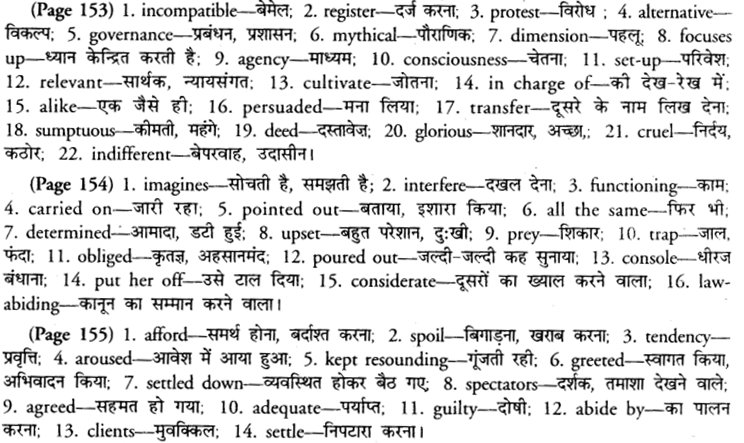
PSEB 11th Class English Solutions Supplementary Chapter 5 The Panch Parmeshwar 1
PSEB 11th Class English Solutions Supplementary Chapter 5 The Panch Parmeshwar 2
PSEB 11th Class English Solutions Supplementary Chapter 5 The Panch Parmeshwar 3
PSEB 11th Class English Solutions Supplementary Chapter 5 The Panch Parmeshwar 4

Class 11 General English Guide PSEB Pdf Supplementary Reading

The Little Black Boy Question Answer Class 11 English Book Poem Chapter 6 PSEB Solutions

Punjab State Board PSEB 11th Class English Book Solutions Poem 6 The Little Black Boy Textbook Exercise Questions and Answers.

Class 11th English Book Poem Chapter 6 The Little Black Boy Question Answers

The Little Black Boy Class 11 Questions and Answers

Question 1.
Why does the black child think that the English child is an angel ?
Answer:
The English child is white as an angel. That is why the black child thinks that the English child is an angel.

अंग्रेज़ बच्चे का रंग एक फरिश्ते की भांति सफेद है। यही कारण है कि अश्वेत बच्चे को लगता है कि अंग्रेज़ बच्चा एक फरिश्ता है।

PSEB 11th Class English Solutions Poem 6 The Little Black Boy

Question 2.
What does the rising sun give us ?
Answer:
The rising sun gives us heat and light.
उगता हुआ सूर्य हमें ऊष्मा तथा प्रकाश प्रदान करता है।

Question 3.
What are the black bodies compared to?
Answer:
The black bodies are compared to clouds or shady groves that hide from us the light of the sun.
काले शरीरों की तुलना बादलों से तथा छायादार वाटिकाओं से की गई है जो हम से सूर्य की रोशनी को छुपा लेते हैं।

Question 4.
What happens when our souls learn to bear the heat ?
Answer:
When our souls have learnt to bear the heat of love, the clouds of our black bodies will disappear. In other words, we shall no longer remain conscious of our black bodies. Then we shall be able to hear God’s voice.

जब हमारी आत्माएं प्यार की गर्मी को धारण करना सीख जाएंगी, तो हमारे काले शरीरों रूपी बादल गायब हो जाएंगे। अन्य शब्दों में, हम फिर अपने काले शरीरों के बारे में सचेत नहीं रहेंगे। तब हम ईश्वर की आवाज़ को सुन पाएंगे।

Question 5.
When will the black cloud vanish ?
Answer:
When our souls have learnt to bear the warmth of love, the clouds of our black bodies will vanish.
जब हमारी आत्माएं प्यार की गर्मी को धारण करना सीख जाएंगी तो हमारे काले शरीरों रूपी बादल गायब हो जाएंगे।

Question 6.
What will God’s voice tell the black boy and his mother to do?
Answer:
God’s voice will say to them : ‘Come out from the grove of your black bodies. You are my love and my care. You shall come with me to my golden tent and play joyfully round it like little lambs.’

ईश्वर की आवाज़ उनसे कहेगी : ‘अपने काले शरीर रूपी वाटिका से बाहर आ जाओ। तुम मेरा प्यार हो और मेरी जिम्मेवारी हो। तुम मेरे साथ मेरे सुनहरी तम्बू पर आओगे और इसके गिर्द छोटे-छोटे मेमनों की भांति प्रसन्नतापूर्वक खेलोगे।’

PSEB 11th Class English Solutions Poem 6 The Little Black Boy

Question 7.
What does the black boy want to do for the white boy ?
Answer:
He wants to win the white boy’s heart with love and become his friend.
वह गोरे लड़के का दिल प्यार से जीतना चाहता है और उसका दोस्त बनना चाहता है।

Question 8.
Do you think that the poem is about a child’s acceptance of suffering and injustice ? Give reasons for your answer
Answer:
We can’t say that the child accepts suffering and injustice. He simply wants to end it through love. He wants to win the English boy’s heart with love and be his friend.

हम यह नहीं कह सकते कि बच्चा पीड़ा तथा अन्याय को स्वीकार कर लेता है। वह तो सिर्फ इसे प्यार से खत्म करना चाहता है। वह प्यार से अंग्रेज़ लड़के का दिल जीतना चाहता है और उसका दोस्त बन जाना चाहता है।

Question 9.
Match the words given in column A with their comparisons in the poem) given in column B :
A — B
angel — black body
east — innocent child
sun – burnt face — English child
cloud — God’s home
lamb — shady grove
Answer:
angel = English child
east = God’s home
sun-burnt face = black body
cloud = shady grove
lamb = innocent child.

Question 10.
Select the correct figure of speech used in the following lines from the list given at the end of each line :
1. White as an angel is the English child ……….. . (simile, metaphor)
2. And these black bodies and this sun-burnt face Is but a cloud ……? (simile, metaphor, personification)
3. “And round my golden tent like lambs rejoice’: (simile, metaphor, personification)
Answer:
1. simile
2. metaphor
3. simile.

PSEB 11th Class English Solutions Poem 6 The Little Black Boy

Important Stanzas For Comprehension

Note : A complete Answer Key has been given at the end of the stanzas.

Stanza 1.

My mother bore me in the Southern wild,

And I am black, but O! my soul is white;
White as an angel is the English child,
And I am black, as if bereavd of light.

Questions
1. Name the poem and the poet.
2. Who is the ‘T’ in these lines ?
3. What do you understand by : ‘my soul is white ?
4. Write the figure of speech that is used in the following line :
O ! my soul is white; White as an angel ……
Answer:
1. The poem is ‘The Little Black Boy’ and the poet is William Blake.
2. The l’ in these lines is the little black boy.
3. The little black boy says that though he is black in body, his soul is pure.
4. Simile.

Stanza 2.

She took me on her lap and kissed me,
And, pointing to the east began to say :
‘Look on the rising sun – there God does live
And gives his light, and gives his heat away,
And flowers and trees and beasts and men receive
Comfort in morning, joy in the noon day.

Questions
1. Name the poem and the poet.
2. What do the heat and light of the sun represent ?
3. What is the effect of this heat and light ?
4. Give the words that rhyme in the given stanza.
Answer:
1. The poem is ‘The Little Black Boy’ and the poet is William Blake.
2. The heat and light of the sun represent the warmth of God’s love.
3. God’s heat and light give comfort and joy to flowers, trees, beasts and men.
4. (say — away — day) ; (live — receive).

Stanza 3.

And we are put on earth a little space,
That we may learn to bear the beams of love;
And these black bodies and the sun-burnt face
Is but a cloud, and like a shady grove.

Questions
1. Name the poem and the poet.
2. What does the first line mean?
3. What are we supposed to do while we are on this earth?
4. Write the figure of speech that has been used in the following line :
And these black bodies and the sun-burnt face’.
Answers:
1. The poem is ‘The Little Black Boy’ and the poet is William Blake.
2. The first line means : Our life on the earth is short.
3. Here we are supposed to learn the way of living in the warmth of love.
4. Alliteration.

PSEB 11th Class English Solutions Poem 6 The Little Black Boy

Stanza 4.

For when our souls have learnt the heat to bear,
The cloud will vanish, we shall hear His voice, Saying” :
“Come out from the grove, my love and care,
And round my golden tent like lambs rejoice.”

Questions

1. Name the poem and the poet.
2. What happens when our souls learn to bear the heat ? What heat ?
3. Which cloud will vanish? When ?
4. Write the figure of speech that has been used in the following line :
And round my golden tent like lambs rejoice’.
Answer:
1. The poem is ‘The Little Black Boy’ and the poet is William Blake.
2. When our soul learns to bear the heat (or warmth) of love, we forget all the distinctions of caste, colour and creed. The word ‘heat here refers to the hatred of others.
3. The cloud of our body-consciousness will vanish. It will vanish when we have learnt to live in the warmth of love.
4. Simile.

Stanza 5.

When I from black and he from white cloud free,
And round the tent of God like lambs we joy,
I’ll shade him from the heat, till he can bear
To lean in joy upon our father’s knee;
And then I’ll stand and stroke his silver hair,
And be like him, and he will then love me.

Questions
1. Name the poem and the poet.
2. When will the two boys be free from the black and white clouds ?
3. ……. he will then love me.’ Who will love whom? When ?
4. Write the figure of speech that has been used in the following line :
I’ll shade him from the heat, till he can bear’.
Answers:
1. The poem is ‘The Little Black Boy’ and the poet is William Blake.
2. The two boys will be free from the black and white clouds when their souls learn the lesson of love.
3. The white boy will love the black boy when he frees himself of the white cloud over his soul.
4. Alliteration.

The Little Black Boy Poem Summary in English

The Little Black Boy Introduction:

This poem gives the message of universal love and brotherhood. The poet gives very beautiful examples. He says that the sun gives its heat and light equally for all things and persons. Similarly, God gives warmth of His love to all creatures without any distinction. Man should also learn to bear the beams of love in his heart. He should love men of all castes, colours and creeds.

The Little Black Boy Summary in English:

यह कविता सब के प्रति प्यार और भ्रातृभाव का सन्देश देती है। कवि बहुत सुन्दर उदाहरण देता है। वह कहता है कि सूर्य अपना प्रकाश और अपनी ऊष्मा सभी चीज़ों और व्यक्तियों के लिए समान रूप से देता है। उसी प्रकार ईश्वर अपने प्यार की ऊष्मा सभी जीवों को बिना किसी भेदभाव के प्रदान करता है। मनुष्य को भी अपने दिल में प्यार रूपी किरणों को धारण करना सीखना चाहिए। उसे सभी जातियों, रंगों और सम्प्रदायों के लोगों से प्यार करना चाहिए।

The Little Black Boy Poem Summary in Hindi

The Little Black Boy Introduction:

In this poem, the poet gives the message of universal love and brotherhood. He gives this message by telling the story of a little black boy. One day, a little black boy says to his mother, “I am black in my body, but the English child is as white as an angel. It seems as if all light had been taken away from me.” At this, the little black boy’s mother says, “Look at the rising sun.

PSEB 11th Class English Solutions Poem 6 The Little Black Boy

God lives there. It is He who gives us light. He gives us heat also. Flowers, trees, animals and men all receive God’s light and heat. These black bodies and faces of ours have little importance. They are merely like a cloud or a shady grove that hides from us the light of the sun. When our souls have learnt to bear the warmth of love, the cloud of our black bodies will disappear.”

Thus the little black boy learnt the lesson of love from his mother. Now he tells the same thing to his little English friend. He tells him that when they free themselves from the clouds of bodies, they shall be like God’s lambs and play round His tent joyfully.

In other words, when the black boy and the white boy forget about the differences of race and colour, they will start loving each other. Then they will earn the love of God also. Thus this poem teaches the lesson of universal love.

The Little Black Boy Summary in Hindi:

इस कविता में कवि सब के प्रति प्यार और भ्रातृभाव का सन्देश देता है। इस सन्देश को वह एक छोटे से अश्वेत अर्थात् अफ्रीकी बच्चे की कहानी के माध्यम से प्रस्तुत करता है। एक दिन एक छोटा-सा काले रंग का लड़का अपनी मां से कहता है, “मेरा शरीर काले रंग का है, किन्तु अंग्रेज़ बच्चा एक फरिश्ते के समान सफ़ेद है।

ऐसा प्रतीत होता है जैसे मुझ में से सब प्रकाश निकाल लिया गया है।” इस पर उस अश्वेत लड़के की मां कहती है, “उस उदय हो रहे सूर्य की तरफ देखो। ईश्वर वहां रहता है। यह वही ईश्वर है जो हमें प्रकाश देता है। वह हमें ऊष्मा भी प्रदान करता है। फूल, जानवर, पेड़ और मनुष्य सभी ईश्वर के प्रकाश को तथा उसकी गर्मी को प्राप्त करते हैं।

हमारे ये काले शरीर और चेहरे कोई महत्त्व नहीं रखते हैं। वे मात्र एक बादल या किसी छायादार वाटिका की भांति हैं जो हम से सूर्य के प्रकाश को छिपा देते हैं। जब हमारी आत्माएं प्यार की ऊष्मा को धारण करना सीख जाएंगी, तो हमारे काले शरीरों का बादल ओझल हो जाएगा।”

PSEB 11th Class English Solutions Poem 6 The Little Black Boy

इस प्रकार छोटे अश्वेत लड़के ने अपनी मां से प्यार का पाठ सीख लिया। अब वह वही बात अपने गोरे अंग्रेज़ नन्हे मित्र से कहता है। वह उससे कहता है कि जब वे स्वयं को अपने शरीर-रूपी बादलों से मुक्त कर लेंगे तो वे ईश्वर के मेमनों की भांति हो जाएंगे और उसके तम्बू के गिर्द प्रसन्नतापूर्वक खेलेंगे।

अन्य शब्दों में, जब अश्वेत लड़का और गोरा लड़का जाति और रंग के भेद के बारे में भूल जाएंगे, तो वे एक-दूसरे से प्यार करने लगेंगे। फिर उन्हें ईश्वर का प्यार भी प्राप्त हो जाएगा। इस प्रकार यह कविता सभी से प्यार करने का पाठ पढ़ाती है।

The Little Black Boy Poem Translation in Hindi

(Lines 1-4)

My mother bore me in the southern Wild,
And I am black, but O! my soul is white;
White as an angel is the English child,
And I am black as if bereav’d of light.

Explanation : A little black boy says, ‘My mother gave me birth in the forests of Africa. I am black in my body, but my soul is white and pure. The English child is as white as an angel, but I am as black as coal. It seems as if all light (whiteness) had been taken away from me.’

PSEB 11th Class English Solutions Poem 6 The Little Black Boy

एक नन्हा-सा हब्शी (काले रंग का) लड़का कहता है, ‘मेरी माता ने मुझे अफ्रीका के जंगलों में जन्म दिया था। मेरा शरीर काला है, किन्तु मेरी आत्मा सफेद तथा पवित्र है। अंग्रेज़ बच्चा एक फरिश्ते जैसा सफेद है, किन्तु मैं एक कोयले की भांति काला हूं। ऐसा प्रतीत होता है जैसे सब प्रकाश (सफेदी) मुझसे छीन लिया गया हो।’

(Lines 5-8)

My mother taught me underneath a tree
And, sitting down before the heat of day,
She took me on her lap and kissed me,
And, pointing to the east began to say

Explanation : The little black boy again says, ‘One day my mother taught me a lesson. She was sitting under a tree. The sun had not yet become very hot. She took me on her lap and kissed me. Then she pointed to the east and began to say

नन्हा अश्वेत लड़का फिर कहता है, ‘एक दिन मेरी माता ने मुझे एक पाठ पढ़ाया। वह एक पेड़ के नीचे बैठी हुई थी। सूर्य अभी बहुत गर्म नहीं हुआ था। उसने मुझे अपनी गोद में लिया और चूमा। फिर उसने पूर्व दिशा की ओर इशारा किया और कहने लगी -‘

(Lines 9-12)

‘Look on the rising sun : there God does live
And gives his light, and gives his heat away,
And flowers and trees and beasts and men receive
Comfort in morning, joy in the noon day.

Explanation : The little black boy’s mother said to him, ‘Look at the rising sun. God lives there. It is He who gives us light. He gives us heat also. Flowers, trees, animals and men all receive God’s light and heat. God’s heat gives them comfort in the morning and joy during the noon.’

नन्हे अश्वेत लड़के की माता ने उससे कहा, ‘उदय हो रहे सूर्य की ओर देखो। ईश्वर वहीं रहता है। वही ईश्वर है जो हमें प्रकाश प्रदान करता है। वह हमें ऊष्मा भी प्रदान करता है। फूल, पेड़, जानवर और मनुष्य सभी ईश्वर के प्रकाश एवं ऊष्मा को प्राप्त करते हैं। ईश्वर की ऊष्मा उन्हें प्रात: के समय आराम और दोपहर के समय खुशी प्रदान करती है।’

(Lines 13-16)

‘And we are put on earth a little space,
That we may learn to bear the beams of love;
And these black bodies and this sun-burnt face
Is but a cloud, and like a shady grove.

Explanation : The little black boy’s mother again said, “We have been sent to this earth for a very short time. God sent us here so that we may learn to bear in our souls the beams of love. These black bodies and sunburnt faces of ours have little importance. They are merely like a cloud or a shady grove that hides from us the light of the sun.’

नन्हें अश्वेत लड़के की माता ने फिर कहा, ‘हमें इस धरती पर बहुत ही थोड़े समय के लिए भेजा गया है। ईश्वर ने हमें यहां इसलिए भेजा था ताकि हम अपनी आत्माओं में प्यार की किरणों को धारण करना सीख लें। हमारे इन काले शरीरों और सूर्य की गर्मी से झुलसे चेहरों का कोई महत्त्व नहीं है। वे मात्र एक बादल अथवा वृक्षों के छायादार झुण्ड के समान हैं जो हम से सूर्य के प्रकाश को छिपा लेते हैं।’

PSEB 11th Class English Solutions Poem 6 The Little Black Boy

(Lines 17-20)

For when our souls have learn’d the heat to bear,
The cloud will vanish, we shall hear His voice,
Saying : “Come out from the grove, my love and care,
And round my golden tent like lambs rejoice.” ?

Explanation : The little black boy’s mother again said, ‘When our souls have learnt to bear the warmth of love, the cloud of our black bodies will disappear.’ In other words, we shall no longer be conscious of our colour differences.

Then we shall be able to hear God’s This voice shall say : ‘Come out from the grove of your black bodies. You are my love and my care. You shall come with me to my golden tent and play joyfully round it like little lambs.’

नन्हे अश्वेत लड़के की माता ने फिर कहा, ‘जब हमारी आत्माएं प्यार की ऊष्मा को धारण करना सीख जाएंगी तो हमारा काले शरीरों रूपी बादल ओझल हो जाएगा।’ अन्य शब्दों में, हमें अपने रंग-भेदों का आभास नहीं रहेगा। फिर हम ईश्वर की आवाज़ को सुनने के योग्य हो जाएंगे।

वह आवाज़ कहेगी : ‘अपने काले शरीरों रूपी वृक्ष-वाटिका से बाहर आ जाओ। तुम मेरा प्यार हो और मुझे तुम्हारी चिन्ता रहती है। तुम मेरे साथ मेरे सुनहरी तम्बू में आओगे, और वहां इसके गिर्द छोटे-छोटे मेमनों की भांति प्रसन्नतापूर्वक खेला करोगे।’

(Lines 21-24)

Thus did my mother say and kissed me,
And thus I say to little English boy;
When I from black and he from white cloud free,
And round the tent of God like lambs we joy,

Explanation : The little black boy says, “This is what my mother taught me under a forest tree. Then she kissed me. Now I am telling the same thing to the little English boy. I tell him that when I free myself from the black cloud and he frees himself from the white cloud, we shall be like the lambs of God and play round His tent joyfully.’ In other words, when the black boy and the white boy forget about the difference of colour in their bodies, and start loving each other, they will earn God’s blessings.

नन्हा अश्वेत लड़का कहता है, ‘ये सब बातें मुझे मेरी मां ने जंगल के एक पेड़ के नीचे पढ़ाईं। फिर उसने मुझे चूम लिया। अब मैं वही बातें नन्हे अंग्रेज़ लड़के को बता रहा हूं। मैं उसे कह रहा हूं कि जब मैं स्वयं को काले बादल से और वह स्वयं को सफेद बादल से मुक्त कर लेगा तो हम ईश्वर के मेमनों की भांति हो जाएंगे और उसके तम्बू के गिर्द प्रसन्नतापूर्वक खेला करेंगे।’ अन्य शब्दों में, जब अश्वेत लड़का और सफेद लड़का अपने शरीरों के रंगों के बारे में भूल जाएंगे, और एक-दूसरे से प्यार करने लगेंगे तो वे ईश्वर का आशीर्वाद प्राप्त कर लेंगे।

(Lines 25-28)

I’ll shade him from the heat till he can bear
To lean in joy upon our father’s knee;
And then I’ll stand and stroke his silver hair,
And be like him and he will then love me.

Explanation : The little black boy says, “I will protect him from the hatred of the blacks. Then he’ll start loving me and will look upon my father as his own father. I shall stand by him and stroke his silver hair. Then I shall become like him and he will also love me.

नन्हा अश्वेत लड़का कहता है, ‘मैं उसे अश्वेत लोगों की घृणा से बचाऊंगा। फिर वह मुझे प्यार करने लगेगा, तथा मेरे पिता को अपने पिता के समान ही समझेगा। मैं उसके पास खड़ा हो जाऊंगा और उसके चांदी जैसे बालों पर प्यार से हाथ फेरूंगा। फिर मैं उसकी तरह हो जाऊंगा और वह भी मुझसे प्यार करने लगेगा।’

The Little Black Boy Central Idea Of The Poem in English

This poem gives the message of universal love and brotherhood. The poet gives very beautiful examples. He says that the sun gives its light and heat equally for all things and persons. Similarly, God gives warmth of His love to all creatures without any distinction. Man should also learn to bear the beams of love in his heart. He should love men of all castes, colours and creeds.

PSEB 11th Class English Solutions Poem 6 The Little Black Boy

The Little Black Boy Central Idea Of The Poem in Hindi

यह कविता सबके प्रति प्यार और भ्रातृभाव का सन्देश देती है। कवि बहुत सुन्दर उदाहरण देता है। वह कहता है कि सूर्य अपना प्रकाश और अपनी ऊष्मा सभी चीज़ों और व्यक्तियों के लिए समान रूप से देता है। उसी प्रकार ईश्वर अपने प्यार की ऊष्मा सभी जीवों को बिना किसी भेदभाव के प्रदान करता है। मनुष्य को भी अपने दिल में प्यार-रूपी किरणों को धारण करना सीखना चाहिए। उसे सभी जातियों, रंगों और सम्प्रदायों के लोगों से प्यार करना चाहिए।

A Panorama of Life PSEB Guide Class 11

Death the Leveller Question Answer Class 10 English Main Course Book Poem Chapter 2 PSEB Solutions

Punjab State Board PSEB 10th Class English Book Solutions English Main Course Book Poem 2 Death the Leveller Textbook Exercise Questions and Answers.

Class 10th English Main Course Book Poem Chapter 2 Death the Leveller Question Answers

Death the Leveller Class 10 Questions and Answers

Question 1.
What is the theme or the central idea of the poem ?
Or
Question 2.
Write the summary of the poem in your own words.
Answer:
Death comes to all. It spares none. It treats the mighty and the weak equally. It reduces everyone to dust. Therefore, it is useless to boast of one’s power or wealth. Only our good actions remain after our death. Therefore, we should always be just in our actions.

मृत्यु सभी को प्राप्त होती है। यह किसी को क्षमा नहीं करती। यह शक्तिशाली और कमज़ोर सभी के साथ एक जैसा व्यवहार करती है। यह प्रत्येक व्यक्ति को धूल में मिला देती है। इसलिए अपनी शक्ति या दौलत की डींग मारना व्यर्थ होता है। केवल हमारे अच्छे काम हमारी मृत्यु के बाद जीवित रहते हैं। इसलिए हमें अपनी क्रियाओं में सदा न्यायसंगत होना चाहिए।

PSEB 10th Class English Main Course Book Solutions Poem 2 Death the Leveller

Question 3.
What lesson do you get from this poem ?
Answer:
Death spares none. It reduces everyone to dust. It treats the mighty and the weak equally. Therefore, it is useless to boast of one’s power or wealth. Only our good actions remain after our death. So we should always be just in our actions.

मृत्यु किसी को क्षमा नहीं करती। यह प्रत्येक आदमी को धूल में मिला देती है। यह शक्तिशाली और कमज़ोर सभी के साथ एक जैसा व्यवहार करती है। इसलिए अपनी शक्ति या दौलत की डींग मारना व्यर्थ होता है। हमारी मृत्यु के बाद केवल हमारे अच्छे काम ही जीवित रहते हैं। इसलिए हमें अपने कामों में सदा न्यायसंगत होना चाहिए।

Question 4.
What does the expression ‘scythe and spade’ stand for ?
Answer:
The given expression stands for the poor peasants and labourers. These people become equal with the kings in death. Death makes no difference between them and the kings.

हंसिया और फावड़ा गरीब किसानों और मजदूरों के प्रतीक हैं। ये लोग मृत्यु में राजाओं के बराबर हो जाते हैं। मृत्यु उनमें और राजाओं में कोई भेद नहीं करती है।

Question 5.
Do the conquerors tame death or the dead ?
Answer:
Conquerors can tame only the dead. They have no power over death. Rather it is death that one day overpowers them and reduces them to dust.

विजेता केवल मृतकों को ही वश में कर सकते हैं। उनका मृत्यु के ऊपर कोई नियन्त्रण नहीं होता है। इसके विपरीत यह मृत्यु होती है जो एक दिन उन पर काबू कर लेती है और उन्हें मिट्टी में मिला देती है।

Question 6.
Explain the lines :
“Only the actions of the just
Smell sweet and blossom in their dust.”
Answer:
Death spares none. It comes to one and all. It reduces everyone to dust. Only one thing escapes death. It is one’s good and just actions. They live even after one’s death. They are never forgotten.

मृत्यु किसी को क्षमा नहीं करती है। यह सभी को प्राप्त होर्ती है। यह प्रत्येक व्यक्ति को मिट्टी में मिला देती है। केवल एक चीज़ मृत्यु से बच पाती है। यह व्यक्ति के अच्छे और न्यायसंगत काम होते हैं। वे व्यक्ति के मरने के बाद भी रहते हैं। वे कभी भुलाए नहीं जाते हैं।

PSEB 10th Class English Main Course Book Solutions Poem 2 Death the Leveller

Question 7.
This poem highlights the uselessness of human power and might. What is it that cannot be snatched by death ?
Answer:
It is only our good and just actions that cannot be snatched by death. All other things – living and non-living – mix with dust in the end. Death spares none. Only our good actions live after our death.

यह केवल हमारे अच्छे और न्यायसंगत काम होते हैं जिन्हें मृत्यु छीन नहीं सकती। शेष सभी चीजेंसजीव और निर्जीव – अन्त में मिट्टी में मिल जाती हैं। मृत्यु किसी को क्षमा नहीं करती। केवल हमारे अच्छे काम हमारी मृत्यु के बाद जीवित रहते हैं।

Objective Type Questions

Question 1.
The ultimate fate of all human beings is ___
(i) old age
(ii) life
(iii) youth
(iv) death.
Answer:
(iv) death

Question 2.
What lives after death ?
(i) Name
(ii) Good deeds
(iii) Fame
(iv) Glory.
Answer:
(ii) Good deeds

Question 3.
The glories of blood and state are just shadows. (True/False)
Answer:
True.

Answer each of the following in one word / phrase / sentence :

Question 1.
Who wrote the poem, ‘Death the Leveller ?
Answer:
James Shirley.

Question 2.
Who have to stoop to fate ?
Answer:
All men.

Question 3.
What are not substantial things ?
Answer:
The glories of our high birth and position.

Question 4.
What does the expression ‘scythe and spade stand for?
Answer:
For the poor peasants and labourers.

Question 5.
How does Death treat the mighty and the weak ?
Answer:
It treats the mighty and the weak equally.

Complete the following :

1. Death is a great
2. Man should not ………………. of his great deeds.
3. The fame and honour won by man fade away after his
Answer:
1. leveller
2. boast
3. death.

Write True or False against each statement : 

1. Conquerer can tame only the dead.
2. Only good actions live after one’s death.
3. Mighty deeds can save one from death.
Answer.
1. True
2. True
3. False.

Choose the correct option for each of the following :

Question 1.
People who win battles with their swords fail to gain victory over ……………
(a) enemy
(b) life
(c) friend
(d) death.
Answer:
(d) death.

Question 2.
Death makes no …………… between the poor and the rich.
(a) different
(b) similar
(c) difference
(d) similarity.
Answer:
(c) difference

PSEB 10th Class English Main Course Book Solutions Poem 2 Death the Leveller

Reading Comprehension

(1) The glories of our blood and state
Are shadows, not substantial things;
There is no armour against Fate;
Death lays his icy hand on kings.

1. Name the poem and the poet.
2. What are not substantial things ?
3. Explain : ‘Death lays his icy hand on kings.’
Answer:
1. The name of the poem is Death the Leveller?. The name of the poet is James Shirley.
2. The glories of our high birth and position are mere shadows. They are not substantial things.
3. Death spares not even kings. It treats the mighty and the weak equally.

(2) Sceptre and Crown
Must tumble down,
And in the dust be equal made
With the poor crooked scythe and spade.

1. Write the name of the poem and the poet.
2. Who are equal before death ?
3. What does the expression “scythe and spade’ stand for ?
Answer:
1. The name of the poem is ‘Death the Leveller. The name of the poet is James Shirley.
2. Mighty kings and the poor peasants are equal before death.
3. The given expression stands for the poor peasants and labourers.

(3) Some men with swords may reap the field,
And plant fresh laurels where they kill
But their strong nerves at last must yield;
They tame but one another still.

1. Name the poem and the poet.
2. What do some men do with swords ?
3. What do they fail to do ?
Answers
1. The name of the poem is ‘Death the Leveller’and the name of the poet is James Shirley.
2. Some men win battles with their swords.
3. They fail to gain victory over death.

(4) Early or late
They stoop to fate,
And must give up their murmuring breath
When they, pale captives, creep to death.

1. Who stoop to fate ?
2. Which two words show that meh.don’t want to die ?
3. What is meant by ‘pale captives’?
Answers
1. All men have to stoop to fate.
2. Murmuring breath.
3. The words ‘pale captives’ create an image of the helpless ones who are at the point of death.

(5) The garlands wither on your brow;
Then boast no more your mighty deeds!
Upon Death’s purple altar now
See where the victor-victim bleeds.

1. What are the garlands that wither ?
2. Why should one not boast of one’s mighty deeds ?
3. What is meant by the victor-victim ?
Answer:
1. Garlands refer to the honours of victory in wars. All these honours prove useless in death.
2. Mighty deeds can’t save one from death. Therefore, it is useless to boast of one’s mighty deeds.
3. The victor of any war becomes a victim by death. The poet calls him victor-victim.

PSEB 10th Class English Main Course Book Solutions Poem 2 Death the Leveller

(6) Your heads must come
To the cold tomb 
Only the actions of the just
Smell sweet and blossom in their dust.

1. What is that which must happen ?
2. What is “cold tomb’ a symbol of ?
3. What idea does the poet want to convey ?
Answer:
1. Everyone must meet death in the end.
2. The words ‘cold tomb’are a symbol of death.
3. Only good actions live after one’s death. Therefore, one should always be just in one’s actions.

Death the Leveller Poem Summary in English

Death the Leveller Introduction:
Death is a great leveller. It knows no difference between a king and a pauper. It treats the mighty and the weak, the rich and the poor equally. Everybody has to bow before Death’s power. Man should not boast of his great deeds. Only good actions are remembered after one’s death.

Death the Leveller Summary in English:

The glories of our high birth and position are mere shadows. They are not substantial things. There is no shield that can save us from what is destined for us. Death lays its cruel hands on kings even. Their sceptre and crown tumble down and are made equal in dust with the poor scythe and spade. In other words, kings and peasants are made equal in death.

Some men win battles by the power of sword. They may win laurels by killing others. But the strong nerves of even such men must at last bow before death. Men can defeat one another only; they can’t defeat death. All powerful men must bow before their fate and give up their murmuring breath early or late. When death overpowers them, they look like pale captives. Death ends all their pride.

The fame and honour won by you shall fade away’ after your death. So, you should not boast of your mighty achievements. You should know that all victors become victims at the purple altar of Death. Your heads, too, will have to lie under the cold tombs after your death. Only the actions of just men live after their death, and spread their fragrance all around.

PSEB 10th Class English Main Course Book Solutions Poem 2 Death the Leveller

Death the Leveller Poem Summary in Hindi

Death the Leveller Introduction:
मृत्यु एक महान् सन्तुलन स्थापित करने वाली चीज़ होती है। यह किसी राजा या रंक में कोई अन्तर नहीं समझती। यद्यपि कोई बलशाली हो या दुर्बल, धनी हो या निर्धन, यह सबके लिए एक समान होती है। सब को मृत्यु की शक्ति के आगे झुकना पड़ता है। मनुष्य को अपने बड़े-बड़े कामों की डींग नहीं मारनी चाहिए। मृत्यु के बाद केवल व्यक्ति के अच्छे काम ही याद रखे जाते हैं।

Death the Leveller Summary in Hindi:

कविता का विस्तृत सार हमारे जन्म या रुतबे की शान केवल परछाईयां होती हैं। ये महत्त्वपूर्ण चीजें नहीं हैं। ऐसा कोई कवच नहीं होता जो हमें उससे बचा सके जो हमारे भाग्य में लिखा होता है। मृत्यु अपने निर्दय हाथ राजाओं पर भी रख देती है। उनकी राजसत्ता और शाही मुकुट नीचे गिर जाता है और उन्हें धूल में हसिया और फावड़ा. उठाए निर्धनों के बराबर कर देता है। दूसरे शब्दों में, राजा और किसान मृत्यु के सामने बराबर होते हैं।

कुछ आदमी तलवार की शक्ति से युद्ध जीत सकते हैं। वे दूसरों को मार कर विजय के उपहार प्राप्त कर सकते हैं। परन्तु ऐसे आदमियों के मज़बूत मन भी अन्त में मृत्यु के सामने झुक जाते हैं। मनुष्य केवल एक-दूसरे को हरा सकते हैं; वे मृत्यु को नहीं हरा सकते। सभी शक्तिशाली मनुष्यों को अपने भाग्य के सामने झुकना पड़ता है और उन्हें जल्दी या देर से अपना श्वास त्यागना पड़ता है। जब मृत्यु उन पर काबू पा लेती है, तो वे पीले पड़े हुए बन्धकों की तरह लगते हैं। मृत्यु उनका सब घमंड समाप्त कर देती है।

तुम्हारे द्वारा प्राप्त मान और सम्मान तुम्हारी मृत्यु के बाद समाप्त हो जाएगा। इसलिए तुम्हें अपनी बलशाली उपलब्धियों पर घमंड नहीं करना चाहिए। तुम्हें यह जान लेना चाहिए कि सभी विजेता मृत्यु की बैंगनी वेदी पर पराजित हो जाते हैं। तुम्हारे सिर भी तुम्हारी मृत्यु के बाद तुम्हारी ठण्डी कब्रों के नीचे पड़े होंगे। केवल न्यायप्रिय लोगों के काम ही उनकी मृत्यु के बाद रहते हैं और सब तरफ़ अपनी सुगन्धि फैलाते हैं।

Death the Leveller Poem Translation in Hindi

1. (Lines 1-4)
The glories of our blood and state
Are shadows, not substantial things;
There is no armour against Fate;
Death lays his icy hand on kings.

Word-meanings : 1. blood-कुल, खानदान; 2. substantial-महत्त्वपूर्ण; 3. armour-कवच।

अनुवाद-हमारे जन्म या रुतबे की शान और यश केवल परछाइयों के समान होते हैं ; ये कोई महत्त्व की ठोस चीजें नहीं होती; भाग्य से बचा पाने वाला कोई कवच नहीं होता ; मृत्यु अपना बर्फ समान ठण्डा हाथ राजाओं पर भी रख देती है।

2. (Lines 5 – 8)
Sceptre and Crown
Must tumble down,
And in the dust be equal made
With the poor crooked scythe and spade.

Word-meanings : 1. sceptre-राजसत्ता; 2. crown-राजा; 3. crooked—गोल आकार वाली; 4. scythe-दराती; 5. spade—फावड़ा।

अनुवाद-राजसत्ता हो या राजा, सभी को नीचे गिरना पड़ता है, और वे धूल में मिलकर बराबर हो जाते हैंगोल आकार वाली दरांती और फावड़ा चलाने वाले गरीब किसानों के साथ। अर्थात् मृत्यु में राजा और रंक सब बराबर हो जाते हैं।

3. (Lines 9-12)
Some men with swords may reap the field,
And plant fresh laurels where they kill :
But their strong nerves at last must yield;
They tame but one another still.

Word-meanings : 1. laurels विजय के उपहार; 2. yield-हार मानना।

अनुवाद-कुछ लोग तलवारों के ज़ोर से युद्ध जीत सकते हैं और दूसरों को मार कर विजयोपहार प्राप्त कर सकते हैं। किन्तु उनके शक्तिशाली शरीरों को भी अन्त में हार माननी पड़ती है; वे केवल एक दूसरे को ही हरा सकते हैं न कि मृत्यु को।

4. (Lines 13–16)
Early or late
They stoop to fate,
And must give up their murmuring breath
When they, pale captives, creep to death.

Word-meanings : 1. stoop-झुकना; 2. murmuring-फुसफुसाते हुए; 3. captives—बन्धक; 4. creep-रंगना।

अनुवाद-जल्दी या देर से, अर्थात् कभी न कभी, उन्हें भाग्य के सामने झुकना ही पड़ता है। वे झुक जाते हैं .. भाग्य के सामने, और उन्हें अपनी फुसफुसाती हुई सांसें छोड़नी पड़ती है, जब वे पीले पड़े युद्ध-बन्दियों की भांति रेंगते हुए मृत्यु की तरफ़ बढ़ते हैं।

PSEB 10th Class English Main Course Book Solutions Poem 2 Death the Leveller

5. (Lines 17-20)
The garlands wither on your brow;
Then boast no more your mighty deeds
Upon Death’s purple altar now
See where the victor-victim bleeds.

Word-meanings : 1. wither-सूख जाना; 2. brow-माथा; 3. altar-वेदी; 4. victor- . victim-विजेता और पराजित।

अनुवाद-तुम्हारे माथे पर पहनी हुई विजय की मालाएं मुरझा जाएंगी। इसलिए अपने शक्तिशाली कामों की डींग मत हांकों ! उधर देखो, मृत्यु की बैंगनी बलि वेदी पर अब वह पराजित हुआ विजयी किस प्रकार रक्त में लथपथ हुआ पड़ा है।

6. (Lines 21-24)
Your heads must come
To the cold tomb
Only the actions of the just
Smell sweet and blossom in their dust.

Word-meanings : 1. tomb-कब्र; 2. just-न्यायपूर्ण।

अनुवाद-तुम्हारे सिरों को ठण्डी कब्रों में अवश्य ही आना होगा; केवल न्यायपूर्ण लोगों के काम ही उनके मरने के बाद उनकी धूल में फूलों के समान खिलते और महकते हैं। .

Class 10th English Main Course Book Solutions PSEB Poetry

Of Studies Question Answer Class 11 English Book Chapter 3 PSEB Solutions

Punjab State Board PSEB 11th Class English Book Solutions Chapter 3 Of Studies Textbook Exercise Questions and Answers.

Class 11th English Book Chapter 3 Of Studies Question Answers

Of Studies Class 11 Questions and Answers

Short Answer Type Questions

Question 1.
What do studies serve for?
Answer:
Studies serve for three purposes. They serve for delight, for ornament and for ability. Books give us joy in our leisure. They enable a person to make his conversation polished and beautiful. They make him capable of managing the practical affairs of daily life.

अध्ययन तीन उद्देश्यों के लिए उपयोगी हैं। वे खुशी के लिए, सजावट के लिए तथा योग्यता के लिए उपयोगी होते हैं। पुस्तकें हमें हमारे अवकाश में प्रसन्नता देती हैं। वे एक व्यक्ति को अपना वार्तालाप शिष्ट तथा सुन्दर बनाने के योग्य बनाती हैं। वे उसे दैनिक जीवन के व्यावहारिक धंधों को सुव्यवस्थित करने के योग्य बनाती हैं।

PSEB 11th Class English Solutions Chapter 3 Of Studies

Question 2.
What are the chief uses of studies ?
Answer:
Studies mould our character in a healthy manner. History makes us wise, as we learn lessons from past experiences. Poetry makes a person witty. The study of mathematics makes us subtle. We can understand difficult or deep ideas. Science makes us profound. Philosophy makes us serious and sober. Rhetoric sharpens our ability to argue and discuss.

पुस्तकों का अध्ययन हमारे चरित्र को श्रेष्ठ रूप से ढालता है। इतिहास हमें बुद्धिमान् बनाता है क्योंकि हम अतीत के अनुभवों से शिक्षा लेते हैं। कविता व्यक्ति को चतुर बनाती है। गणित का अध्ययन हमें सूक्ष्म बुद्धि वाला बनाता है। हम कठिन अथवा गहन विचार समझ पाते हैं। विज्ञान हमें गहन बनाता है। दर्शनशास्त्र हमें गंभीर और विनम्र बनाता है। व्याख्यान हमारी तर्क तथा वाद-विवाद करने की योग्यता को तीक्ष्ण बनाता है।

Question 3.
When do the studies become the humour of a scholar ?
Answer:
No doubt, studies have great importance in our life. But we cannot lead our life completely according to the rules given in the books. This is the reason that studies become the humour of a scholar when he starts judging things on the basis of rules given in the books. A scholar can judge everything according to bookish knowledge.

निस्सन्देह हमारे जीवन में अध्ययन का बहुत महत्व है। परन्तु हम अपना जीवन पूरी तरह से किताबों में दिए गए नियमों के अनुसार नहीं बिता सकते। यही कारण है कि अध्ययन एक विद्वान का मजाक बन जाता है जब वह चीजों का मूल्यांकन किताबों में दिए नियमों के अनुसार करने लगता है। एक विद्वान हर चीज का मूल्यांकन किताबी ज्ञान के आधार पर कर सकता है।

Question 4.
What do the crafty men, simple men and wise men do with the studies respectively ?
Answer:
The crafty men look down upon books. They think that cunningness will do for them; wisdom of books is of no use. Simple men admire books. They look at them with awe. But the wise men derive advantage out of books. With the help of studies, they prune their natural abilities and thus perfect their nature.

मक्कार लोग अध्ययन से घृणा करते हैं। उनके विचार से दुष्टता ही उनके लिए काफी रहेगी; पुस्तकों का ज्ञान किसी काम का नहीं है। साधारण लोग पुस्तकों की सराहना करते हैं। वे इनको प्रशंसा तथा अचम्भे से देखते हैं। परन्तु बुद्धिमान लोग पुस्तकों से लाभ प्राप्त करते हैं। पुस्तकों के अध्ययन की सहायता से वे अपनी स्वाभाविक योग्यताओं की काट-छांट करते हैं और इस प्रकार अपने स्वभाव को संपूर्ण बनाते हैं।

PSEB 11th Class English Solutions Chapter 3 Of Studies

Question 5.
Why should we read ?
Answer:
Studies offer many advantages. Books give us delight when we study them at leisure. They enable us to make our conversation polished and beautiful. Books also give us the sense to manage the practical affairs of our daily life.

पुस्तकें पढ़ने के बहुत से लाभ हैं। पुस्तकें हमें अवकाश में पढ़ते समय खुशी देती हैं। वे हमें इस योग्य बनाती हैं कि हम अपने वार्तालाप को शिष्ट और सुन्दर बना लें। पुस्तकें हमें अपने दैनिक जीवन के व्यावहारिक धन्धों को सुव्यवस्थित करने की बुद्धिमत्ता भी देती हैं।

Question 6.
‘Some books are to be tasted.’ What does the author mean by this statement ?
Answer:
Some books are good in parts only. So we should taste them, study them in parts. Here the author means to say that some books don’t need thorough reading. They may be given cursory reading only. They don’t need deep and serious reading

कुछ पुस्तकों के कुछ भाग ही अच्छे होते हैं। हमें उनका स्वाद लेना चाहिए, उनको भागों में पढ़ना चाहिए। यहां लेखक के कहने का तात्पर्य यह है कि कुछ पुस्तकों को पूरी तरह से पढ़ने की जरूरत नहीं होती। उनका सिर्फ सतही अध्ययन किया जाना चाहिए। उनका गहन तथा गंभीर अध्ययन करने की कोई जरूरत नहीं होती।

Question 7.
What do reading, conference and writing make a man respectively?
Answer:
Reading develops the mental faculties of a man. Conversation and discussion make him a man with a ready wit. Writing makes a man very exact. He can quote exact facts and figures. He learns how to state everything clearly.

अध्ययन मनुष्य के मानसिक गुणों का विकास करता है। वार्तालाप तथा वाद-विवाद उसे हाजिर जवाबी वाला मनुष्य बना देता है। लिखना एक मनुष्य को परम शुद्ध बनाता है। वह बिल्कुल सही तथ्य व आंकड़े बता सकता है। वह सीख लेता है कि प्रत्येक चीज़ को स्पष्ट रूप से कैसे बतलाए।

Question 8.
How are different types of physical activities beneficial to us ?
Answer:
Different types of physical activities and exercises cure our physical ailments. Bowling is good for the stone and the kindneys. Shooting is good for the lungs and breast. Gentle walking is useful for the stomach and riding for the head.

भिन्न-भिन्न प्रकार की शारीरिक गतिविधियां तथा व्यायाम हमारे शरीर की बीमारियों को ठीक करते हैं। गेंद मार कर बोतलों को गिराना पथरी तथा गुर्दो के लिए अच्छा होता है। तीरन्दाजी फेफड़ों तथा छाती के लिए अच्छी होती है। आराम से चलना पेट के लिए तथा घुड़सवारी करना सिर के लिए लाभदायक है।

PSEB 11th Class English Solutions Chapter 3 Of Studies

Question 9.
When should a man study mathematics?
Answer:
When a man wants to improve his concentration, he should study mathematics. Mathematics improves our concentration. The study of mathematics makes us subtle. We can understand difficult or deep ideas. It makes us intelligent.

जब कोई व्यक्ति अपनी एकाग्रता को सुधारना चाहे, तो उसे गणित का अध्ययन करना चाहिए। गणित हमारी एकाग्रता को सुधारता है। गणित का अध्ययन हमें सूक्ष्म बुद्धि वाला बनाता है। हम कठिन अथवा गहन विचार समझ पाते हैं। यह हमें बुद्धिमान बनाता है।

Question 10.
When should we study lawyers’ cases ?’
Answer:
When we lack reasoning and want to improve our intellect, we should study law and lawyers’ cases. It will make us apt to beat over matter. If we want to call up one thing to prove and illustrate another thing, we should study lawyers’ cases.

जब हम में तर्क की कमी हो और हम अपनी बुद्धि को सुधारना चाहें, तो हमें कानून तथा वकीलों के मुकदमों का अध्ययन करना चाहिए। यह हमें तेजी से निरीक्षण तथा विश्लेषण करने के योग्य बनाएगा। यदि हम किसी बात को साबित करने तथा उदाहरण सहित व्याख्या करने के उद्देश्य से किसी चीज को दिमाग में लाना चाहते हैं, तो हमें वकीलों के मुकदमों का अध्ययन करना चाहिए।

Question 11.
How are natural abilities like plants ?
Answer:
Natural abilities mean natural talents. These talents are like plants. Plants have a wild growth. They must be pruned and trimmed. Only then do they become orderly and beautiful. Same is the case with our abilities. These abilities need guidance in a right direction. Only then they become useful for society.

स्वाभाविक योग्यताओं का अर्थ है, स्वाभाविक प्रतिभाएं। ये प्रतिभाए पौधों के समान होते हैं। पौधे ऊटपटांग तरीके से उगते हैं। उनके अनावश्यक भागों को काट देना चाहिए तथा उनकी काट-छांट कर देनी चाहिए। केवल तभी वे सुव्यवस्थित तथा सुन्दर बन सकते हैं। ऐसा ही हमारी योग्यताओं के साथ होता है। इन योग्यताओं को उचित दिशा में मार्गदर्शन की आवश्यकता होती है। केवल तभी वे समाज के लिए उपयोगी बन सकेंगी।

Question 12.
What must books not be read for?
Answer:
Books should be read not to condemn or refute others. At the same time, we should not suspend our judgement, and believe whatever is written in books. Again, we should not study books merely to deliver talks and discourses.

पुस्तकों को दूसरों से घृणा करने या उनका खंडन करने के लिए नहीं पढ़ा जाना चाहिए। साथ ही, हमें अपनी परख को नहीं छोड़ना चाहिए तथा जो कुछ पुस्तकों में लिखा है उन पर अंधाधुन्ध विश्वास नहीं करना चाहिए। फिर हमें पुस्तकों का अध्ययन केवल व्याख्यान तथा उपदेश देने के लिए नहीं करना चाहिए।

Question 13.
The study of which subject can improve concentration if ‘one’s wits be wandering’ ? How?
Answer:
The study of mathematics is needed to improve our concentration. Solving mathematical problems, in fact, gives us a training in having undivided concentration. If while solving a mathematical sum, our attention wanders, we have to begin all over again. That’s a training in concentration.

गणित का अध्ययन हमारी एकाग्रता को सुधार सकता है। वास्तव में गणित की समस्याओं का समाधान हमें अविभाजित एकाग्रता प्राप्त करने का प्रशिक्षण देता है। यदि गणित का कोई प्रश्न हल करते हुए हमारा ध्यान भटक जाता है, तो हमें वह प्रश्न पुनः आरम्भ करना पड़ता है। यही एकाग्रता का प्रशिक्षण है।

PSEB 11th Class English Solutions Chapter 3 Of Studies

Question 14.
Do you agree with Bacon that ‘studies pass into character’?
Answer:
We do agree with Bacon partly, not wholly. Studies mould man’s character in a healthy manner. Books do influence our mind. Different subjects teach us wisdom, concentration, sobriety, reasoning, etc. But other factors count too. The reader’s mind, too, should be open to the ideas presented in books. Otherwise those ideas won’t pass into character.

हम बेकन से थोड़ा सहमत हैं, पूरी तरह नहीं। अध्ययन व्यक्ति के चरित्र को एक स्वास्थ्यकर ढंग से ढालता है। पुस्तकें हमारे मस्तिष्क को अवश्य ही प्रभावित करती हैं। भिन्न-भिन्न विषय हमें बुद्धिमत्ता, एकाग्रता, गम्भीरता व तर्क, इत्यादि सिखाते हैं। परन्तु अन्य तत्त्वों का भी महत्त्व होता है। पाठक का मस्तिष्क भी पुस्तकों द्वारा प्रस्तुत किए गए विचारों के लिए खुला होना चाहिए। अन्यथा वे विचार हमारे चरित्र में नहीं उतर पायेंगे।

Question 15.
Do studies have a harmful effect, according to Bacon ?
Answer:
Yes, but only excessive studies. A person who spends too much time in studying books can become lazy. Making too much use of bookish knowledge in conversation will make it artificial. Similarly, judging everything according to bookish knowledge won’t be practical.

हाँ, परन्तु केवल अत्यधिक अध्ययन। एक व्यक्ति जो पुस्तकों के अध्ययन में अत्यधिक समय व्यतीत करता है, सुस्त बन सकता है। वार्तालाप में किताबी ज्ञान का अत्यधिक प्रयोग करने से यह कृत्रिम बन जायेगा। इसी प्रकार हर चीज़ को किताबी ज्ञान से परखना व्यावहारिक नहीं होगा।

Question 16.
Studies are to mind what exercises are to body. How ?
Answer:
Exercises cure physical ailments. Similarly, studies can cure mental ailments. Mathematics improves concentration. It makes a man subtle and he can understand a deep or difficult idea. If a man cannot find differences, he should study the philosophers of the Medieval times. To improve intellect, a man should study legal cases.

व्यायाम शारीरिक बीमारियों को ठीक करते हैं। इसी प्रकार अध्ययन मानसिक बीमारियों को दूर कर सकता है। गणित एकाग्रता सुधारता है। यह व्यक्ति को सूक्ष्म बुद्धि वाला बनाता है और वह गहन अथवा कठिन विचार को समझ सकता है। यदि कोई व्यक्ति (वस्तुओं में) अन्तर नहीं ढूंढ सकता है तो उसे मध्यकाल के दार्शनिकों का अध्ययन करना चाहिए। बुद्धि को सुधारने के लिए मनुष्य को कानूनी मुकदमों का अध्ययन करना चाहिए। .

Question 17.
Some books are to be tasted, others to be swallowed, and some few to be chewed and digested.’ Explain.
Answer:
The author talks about the books of different quality. Some books are good only in parts. So they should be tasted, that is, they should be read in parts. Some books are of a mediocre quality. Not much time should be wasted on them. They should be gone through hurriedly. But some few books are of a very high quality. Such books should be read with full concentration. They should be assimilated.

लेखक भिन्न-भिन्न गुणों वाली पुस्तकों की बात करता है। कुछ पुस्तकें भागों में ही अच्छी होती हैं। अतः उनका स्वाद ही लेना चाहिए, अर्थात उन्हें भागों में ही पढ़ना चाहिए। कुछ पुस्तकें मध्यम (साधारण) श्रेणी की होती हैं। उन पर अधिक समय नष्ट नहीं करना चाहिए। उनको जल्दी-जल्दी पढ़ लेना चाहिए। परन्तु कुछ थोड़ी-सी पुस्तकें उच्चतम व श्रेष्ठ होती हैं। ऐसी पुस्तकों को पूर्ण एकाग्रता से पढ़ना चाहिए। उनको आत्मसात कर लेना चाहिए।

PSEB 11th Class English Solutions Chapter 3 Of Studies

Long Answer Type Questions

Question 1.
How do studies perfect man’s nature ?
Answer:
Studies mould man’s character in a healthy manner. They have great influence on his mind. Studies, in fact, pass into man’s character. Different subjects teach him wisdom, concentration, soboriety, reasoning, etc. History makes him wise as he learns lessons from past experiences.

Poetry makes him witry. The study of Mathematics makes him subtle and man can understand difficult or deep ideas. Science makes him profound. Philosophy makes him serious and sober. Rhetoric sharpens his ability to argue and discuss. Books enable man to make his conversation polished and beautiful. They enable man to manage the affairs of his day-to-day life most efficiently. Thus studies prune man’s natural abilities and perfect his nature.

पुस्तकों का अध्ययन मनुष्य के चरित्र को श्रेष्ठ रूप में ढालता है। उनका उसके दिमाग पर बहुत प्रभाव पड़ता है। पुस्तकों का अध्ययन वास्तव में मनुष्य के चरित्र का निर्माण करता है। विभिन्न विषय उसे बुद्धिमत्ता, एकाग्रता, गंभीरता तथा तर्क, इत्यादि सिखाते हैं। इतिहास उसे बुद्धिमान बनाता है क्योंकि वह अतीत के अनुभवों से शिक्षा लेता है।

कविता उसे चतुर बनाती है। गणित का अध्ययन उसे सूक्ष्म बुद्धि वाला बनाता है और मनुष्य कठिन अथवा गहन विचार समझ पाता है। विज्ञान मनुष्य को गहन बनाता है। दर्शन-शास्त्र उसे गम्भीर बनाता है। व्याख्यान उसमें तर्क तथा वाद-विवाद करने की योग्यता को तीक्ष्ण बनाता है। पुस्तकें मनुष्य के वार्तालाप को सुन्दर तथा शिष्ट बनाती हैं।

वे मनुष्य को इस योग्य बनाती हैं कि वह अपने दैनिक जीवन के काम-धन्धों को सकुशल रूप से व्यवस्थित कर सके। इस प्रकार पुस्तकों का अध्ययन मनुष्य की स्वाभाविक योग्यताओं की काट-छांट करता है और उसके स्वभाव को संपूर्णता प्रदान करता है।

Question 2.
How do different types of men make use of studies ?
Answer:
Different people have different attitudes towards studies. The wicked people don’t consider studies worthwhile. They look down upon books. They are full of cunningness and they think that their cunningness will do for them. According to them, wisdom of books is of no use.

Simple-minded people have respect for books. They know the value of books in man’s life. But they just admire books and look at them with awe. But the wise men, says the author, derive advantage out of books. With the help of studies, they make their conversation polished and beautiful.

Wisdom and knowledge gained from the books makes them capable of managing the practical affairs of daily life. With the help of studies, they prune their natural abilities and thus perfect their nature.

अध्ययन के प्रति भिन्न-भिन्न लोगों का भिन्न-भिन्न दृष्टिकोण होता है। दुष्ट लोग पुस्तकों के अध्ययन को व्यर्थ मानते हैं। वे पुस्तकों से घृणा करते हैं। वे धूर्तता से भरे होते हैं और उनके विचार से दुष्टता ही उनके लिए काफी रहेगी। उनके अनुसार पुस्तकों की बुद्धिमत्ता किसी काम की नहीं होती है।

साधारण लोग पुस्तकों का सम्मान करते हैं। वे मनुष्य के जीवन में पुस्तकों के मूल्य को समझते हैं। परन्तु वे पुस्तकों की सिर्फ सराहना करते हैं और इनको प्रशंसा तथा अचम्भे से देखते हैं। परन्तु बुद्धिमान लोग, लेखक कहता है, पुस्तकों से लाभ प्राप्त करते हैं। पुस्तकों के अध्यययन की मदद से वे अपने वार्तालाप को शिष्ट तथा सुंदर बना लेते हैं।

पुस्तकों से प्राप्त हुआ ज्ञान तथा बुद्धिमत्ता उन्हें दैनिक जीवन के व्यावहारिक धंधों को सुव्यवस्थित करने के योग्य बनाता है। पुस्तकों के अध्ययन की सहायता से वे अपनी स्वाभाविक योग्यताओं की काट-छांट करते हैं और इस प्रकार अपने स्वभाव को संपूर्ण बनाते हैं।

Question 3.
What does the author say about different types of books ?
Answer:
The author talks about the books of different quality. He says that some books are good in parts only. So they should be tasted, that is they should be read in parts only. Then there are some books of mediocre quality. They don’t deserve a thoughtful study.

So not much time should be wasted on them. They should be swallowed. In other words, they should be gone through hurriedly. But there are some books which are really good. These books are of a high quality. Such books should be read thoroughly and with full concentration. They should be read seriously and deeply. In short, such books should be assimilated.

लेखक भिन्न-भिन्न गुणों वाली पुस्तकों की बात करता है। वह कहता है कि कुछ पुस्तकें सिर्फ भागों में ही अच्छी होती हैं। इसलिए उनका स्वाद ही लेना चाहिए, अर्थात् उन्हें भागों में ही पढ़ना चाहिए। फिर कुछ पुस्तकें होती हैं जो मध्यम (साधारण) श्रेणी की होती हैं। उन्हें गौर से नहीं पढ़ा जाना चाहिए।

इसलिए उन पर अधिक समय नष्ट नहीं करना चाहिए। उन्हें निगल जाना चाहिए। अन्य शब्दों में, उनको जल्दी जल्दी पढ़ लेना चाहिए। परन्तु कुछ पुस्तकें होती हैं जो वास्तव में बहुत अच्छी होती हैं। ऐसी पुस्तकें उच्चतम व श्रेष्ठ होती हैं। ऐसी पुस्तकों को अच्छी तरह तथा पूर्ण एकाग्रता से पढ़ना चाहिए। उनका अध्ययन गहनता से तथा गंभीरतापूर्वक करना चाहिए। संक्षेप में, ऐसी पुस्तकों को आत्मासात कर लेना चाहिए।

PSEB 11th Class English Solutions Chapter 3 Of Studies

Question 4.
What must man have if he writes, confers or reads little ?
Answer:
The author says that there are some sort of qualities which a man should possess, if he writes or confers or reads little. He says that if a man writes little, he must have a great memory. With his good memory, he will be able to retain the things in his mind.

Then the author says that if a man confers little, he must have a present wit. According to the author, present wit would make him able to tackle the unexpected and unpleasant situations at times occurring in his life. And if a man reads little, says the author, he must have cunningness. It would make him look confident. Then he would seem to know that he does not know in fact.

लेखक कहता है कुछ किस्म के गुण हैं जो एक मनुष्य में होने चाहिएं यदि वह कम लिखता है, अथवा कम बातचीत करता है अथवा कम पढ़ता है। वह कहता है कि यदि कोई व्यक्ति कम लिखता हो, तो उसकी याद्दाश्त बहुत तेज़ होनी चाहिए। अपनी अच्छी याद्दाश्त की मदद से वह बातों को अपने दिमाग में याद रख सकेगा।

फिर लेखक कहता है कि यदि व्यक्ति कम वार्तालाप करता है, तो उसे हाज़िर-जवाब अवश्य होना चाहिए। लेखक के अनुसार, हाज़िर-जवाबी उसे जीवन में समय-समय पर होने वाली अप्रत्याशित तथा असुखद परिस्थितियों का सामना करने के काबिल बनाएगी। और यदि व्यक्ति कम पढ़ता है, तो लेखक कहता है, उसके अन्दर धूर्तता (चालाकी) अवश्य होनी चाहिए। इससे वह विश्वस्त दिखाई देगा। फिर ऐसा प्रतीत होगा कि वह सब जानता है जो कि वह वास्तव में नहीं जानता होगा।

Question 5.
How do studies pass into the character ?
Answer:
Studies have a great influence on human character. They remove mental deficiencies and improve our character. They enable us to make our conversation polished and beautiful. They make us capable of managing the practical affairs of daily life.

Studies indeed are of immense value in our life. Studies have a great influence on our mind as well. Different subjects teach us wisdom, concentration, sobriety, reasoning, etc. History makes us wise as we learn lessons from past experiences. Poetry makes us witty.

Mathematics makes us subtle. Science makes us profound. Philosophy makes us sober and serious. Rhetoric sharpens our ability to argue and discuss. Thus, studies pass into our character and mould it in a healthy manner.

अध्ययनों का मानव-चरित्र पर बड़ा प्रभाव होता है। ये मानसिक त्रुटियों को दूर करते हैं तथा हमारे चरित्र को सुधारते हैं। ये हमें अपना वार्तालाप शिष्ट तथा सुंदर बनाने योग्य बनाते हैं। वे हमें दैनिक जीवन के व्यावहारिक धंधों को व्यवस्थित करने के योग्य बनाते हैं। हमारे जीवन में अध्ययन की सचमुच बहुत महत्ता है।

अध्ययन का हमारे मस्तिष्क पर भी बहुत प्रभाव पड़ता है। भिन्न-भिन्न विषय हमें बुद्धिमत्ता, एकाग्रता, गम्भीरता तथा तर्क, इत्यादि सिखाते हैं। इतिहास हमें बुद्धिमान बनाता है क्योंकि हम अतीत के अनुभवों से शिक्षा लेते हैं। कविता हमें हाज़िरजवाब बनाती है। गणित हमें सूक्ष्म बुद्धि वाला बनाता है।

विज्ञान हमें गहन बनाती है। दार्शनिकता हमें शांत तथा गम्भीर बनाती है। व्याख्यान हममें तर्क तथा वाद-विवाद करने की योग्यता को तीक्ष्ण बनाता है। इस प्रकार अध्ययन हमारे चरित्र का निर्माण करता है और इसे एक श्रेष्ठ रूप प्रदान करता है।

Question 6.
What are the different ways of reading books ?
Answer:
The author suggests different ways of reading books. As Bacon says : ‘Some books are to be tasted, others to be swallowed, and some few to be chewed and digested.’. It means there are different types of books, and a reader should have a different approach towards them.

Some books, for example, are good in parts only. So they should be tasted, that is, they should be read in parts only. Then, there are books that don’t deserve a thoughtful study. They should be swallowed. In other words, we should go through them hurriedly. But there are really good books too books of high quality. Such books should be thoroughly read and assimilated.

There are books of a fourth kind too. These books are of a very low quality. Such books should be read by proxy. They should not be read in original. They should be studied through notes, etc. These are the ways of reading different books.

लेखक पुस्तकें पढ़ने के भिन्न-भिन्न तरीके सुझाता है। जैसा कि बेकन कहता है, “कुछ पुस्तकों का स्वाद लेना चाहिए, कुछ पुस्तकों को निगल जाना चाहिए तथा कुछ थोड़ी-सी ऐसी होती हैं जिन्हें चबाया तथा हजम किया जाना चाहिए।” इसका अर्थ है कि पुस्तकें भिन्न-भिन्न प्रकार की होती हैं तथा एक पाठक को उनके प्रति भिन्न-भिन्न व्यवहार रखना चाहिए।

उदाहरणतः कुछ पुस्तकों के केवल कुछ भाग ही अच्छे होते हैं। अतः उनका स्वाद लेना चाहिए, अर्थात् उनको भागों में ही पढ़ना चाहिए। तब कुछ ऐसी पुस्तकें होती हैं, जिनको गौर से नहीं पढ़ा जाना चाहिए। उनको निगल जाना चाहिए। दूसरे शब्दों में, हमें उन्हें शीघ्रता से पढ़ना चाहिए। परन्तु वास्तव में श्रेष्ठ पुस्तकें भी होती हैं – उच्च कोटि की पुस्तकें । इन पुस्तकों को पूर्णतः पढ़ना चाहिए तथा अपने अन्दर आत्मसात करना चाहिए।

पुस्तकों की एक चौथी किस्म भी होती है। ये पुस्तकें बड़े निम्न स्तर वाली होती हैं। ऐसी पुस्तकों को किसी अन्य व्यक्ति द्वारा किए गए रूपांतर में पढ़ना चाहिए। इन्हें इनके मूल रूप में नहीं पढ़ना चाहिए। इन्हे नोट्स, इत्यादि के जरिए पढ़ना चाहिए। ये भिन्न-भिन्न पुस्तकों को पढ़ने के तरीके हैं।

Question 7.
What are the advantages of studies ?
Answer:
Studies offer many advantages. Books give us delight when we study them at leisure. They enable us to make our conversation polished and beautiful. Books also give us the sense to manage the practical affairs of our daily life.

Studies mould our character in a healthy manner. History makes us wise, as we learn lessons from past experiences. Poetry makes a person witty. The study of mathematics makes us subtle. We can understand difficult or deep ideas. Science makes us profound. Philosophy makes us serious and sober. Rhetoric sharpens our ability to argue and discuss.

Books are useful in another way also. They serve as an effective cure for many mental ailments. Mathematics improves our concentration. The philosophers of the Middle Ages teach us to find differences. If we lack reasoning, we should study law and lawyers’ cases. Thus studies offer a variety of advantages.

PSEB 11th Class English Solutions Chapter 3 Of Studies

पुस्तकें पढ़ने के बहुत से लाभ होते हैं। पुस्तकें हमें अवकाश में पढ़ते समय खुशी देती हैं। वे हमें इस योग्य बनाती हैं कि हम अपने वार्तालाप को सुन्दर बना लें। पुस्तकें हमें अपने दैनिक जीवन के व्यावहारिक धन्धों को सुव्यवस्थित करने की बुद्धिमत्ता भी देती हैं। पुस्तकों का अध्ययन हमारे चरित्र को श्रेष्ठ रूप से ढालता है।

इतिहास हमें बुद्धिमान् बनाता है क्योंकि हम अतीत के अनुभवों से शिक्षा लेते हैं। कविता व्यक्ति को चतुर बनाती है। गणित का अध्ययन हमें सूक्ष्म बुद्धि वाला बनाता है। हम कठिन अथवा गहन विचार समझ पाते हैं। विज्ञान हमें गहन बनाता है। दर्शनशास्त्र हमें गंभीर और विनम्र बनाता है। व्याख्यान हमारी तर्क तथा वाद-विवाद करने की योग्यता को तीक्ष्ण बनाता है। पुस्तकें एक और तरीके से भी लाभदायक होती हैं।

वे बहुत-सी मानसिक बीमारियों के प्रभावशाली उपचार का कार्य करती हैं। गणित हमारी एकाग्रता को सुधारता है। मध्यकाल के दार्शनिक हमें अन्तर करना सिखाते हैं। यदि हम में तर्क की कमी है तो हमें कानून तथा वकीलों के मुकदमों का अध्ययन करना चाहिए। अतः पुस्तकों के अध्ययन के बहुत से लाभ होते हैं।

Question 8.
Give the substance of the essay, ‘Of Studies’.
Answer:
Of Studies’ tells us the importance of studying books. Books are a source of delight and usefulness. They entertain us when we read them at leisure. They make our conversation polished and beautiful. Excessive studies, however, will make us lazy and pedant.

Studies do give us an insight into the working of human mind. But we should not read books to condemn or contradict others. Nor should we use our bookish knowledge for delivering talks and discourses. The real aim of studies is the acquisition of wisdom. Books are of different kinds. Some are to be studied in parts. There are books which we should go through hurriedly.

But really good books should be studied thoroughly, with full concentration. Studies have a great influence on human character. They remove mental deficiencies and improve our character. They, indeed, are of immense value.

‘Of Studies हमें पुस्तकों के अध्ययन की महत्ता बताता है। पुस्तकें खुशी तथा उपयोगिता का स्रोत हैं। जब हम अवकाश में इन्हें पढ़ते हैं, तो ये हमारा मनोरंजन करती हैं। ये हमारे वार्तालाप को शिष्ट और सुन्दर बनाती हैं। परन्तु पुस्तकों का अत्यधिक अध्ययन हमें सुस्त तथा विद्यागर्वी बना देता है।

पुस्तकों का अध्ययन हमें मानव-मस्तिष्क के कार्य के ढंग का अन्तर्ज्ञान देता है। हमें दूसरों की निन्दा अथवा उनकी बात काटने के लिए पुस्तकें नहीं पढ़नी चाहिएं। न ही हमें अपने किताबी ज्ञान का प्रयोग भाषण अथवा उपदेश देने के लिए करना चाहिए। अध्ययन का वास्तविक उद्देश्य ज्ञान की प्राप्ति है। पुस्तकें भिन्न-भिन्न प्रकार की होती हैं। कुछ को भागों में ही पढ़ना चाहिए। कुछ पुस्तकें ऐसी हैं जिन्हें हमें शीघ्रता से पढ़ लेना चाहिए।

परन्तु वास्तविक श्रेष्ठ पुस्तकों को पूर्ण एकाग्रता के साथ पूरी तरह पढ़ना चाहिए। अध्ययन का मानव-चरित्र पर बड़ा प्रभाव होता है। यह मानसिक त्रुटियों को दूर करता है तथा हमारे चरित्र को सुधारता है। सचमुच उनकी अत्यधिक महत्ता है।

Objective Type Questions

Question 1.
Who wrote the essay, ‘Of Studies’ ?
Answer:
Francis Bacon.

Question 2.
How many purposes does the study of books serve ?
Answer:
Three purposes.

Question 3.
When do the books give us joy ?
Answer:
When we study, When we study them in loneliness.

Question 4.
What is the harm of spending too much time in studies ?
Answer:
It makes us lazy and ease-loving.

Question 5.
What perfects the study of books ?
Answer:
Experience.

Question 6.
For what purpose should we read books ?
Answer:
To think deep and gain wisdom.

PSEB 11th Class English Solutions Chapter 3 Of Studies

Question 7.
What sort of books should be read by proxy ?
Answer:
The books of lower quality.

Question 8.
What must a man have if he writes little ?
Answer:
A good memory.

Question 9.
What influence does writing poetry have on man?
Answer:
It makes a man creative.

Vocabulary And Grammar

1. Fill in the blanks in the following sentences with suitable words selected from the box below :

learned , extract, perfect ,crafty, chew, exact ,contradict

1. This gold …………. carries a purity of 95 percent.
2. Many a ………….. professor took part in the conference.
3. You must ……….. your food well.
4. ………….. persons are sometimes caught in their own nets.
5. This passage is an …………. from a speech by Nehru.
6. Your reply must be ………….. and to the point.
7. Practice makes a man ……………. .
8. I do not mean to …………….. what you are saying.
Answer:
1. ornament
2. learned
3. chew
4. Crafty
5. extract
6. exact
7. perfect
8. contradict.

2. Form nouns from the following words :

Word –Noun

1. consider — consideration
2. punish — punishment
3. believe — belief
4. opt — option
5. idle — idleness
6. weak — weakness
7. dictate — dictation
8. violent — violence
9. intelligent — intelligence
10. obey — obedience

PSEB 11th Class English Solutions Chapter 3 Of Studies

3. Fill in each blank with a suitable preposition :

1. Her face was a criss-cross ……. wrinkles.
2. She used to get up …………. the morning and get me ready …………. school.
3. He rules ………… a vast empire.
4. I never bothered ……………… learn the prayer.
5. The driver jumped …………… the car.
Answer:
1. of
2. in; for
3. over
4. to
5. out of.

4. Change the voice :

1. Baron Hausberg buys all my pictures.
2. Will Pakistan build a nuclear breeder ?
3. His conduct amazed us.
4. Who is creating this mess?
5. He is said to be very rich.
Answer:
1. All my pictures are bought by Baron Hausberg.
2. Will a nuclear breeder be built by Pakistan ?
3. We were amazed at his conduct.
4. By whom is this mess being created ?
5. They say that he is very rich.

5. Change the form of narration :

1. My mother said to me, “You will miss the train.”
2. “Gandhiji believed in non-violence,” said the Prime Minister.
3. Rita said to me, “Trust in God and do the right.”
4. “Don’t run away, Hughie,” said he.
5. “What an amazing model !” shouted Trevor.
Answer:
1. My mother told me that I would miss the train.
2. The Prime Minister said that Gandhiji believed in non-violence.
3. Rita advised me to trust in God and do the right.
4. He asked Hughie not to run away.
5. Trevor shouted that it was an amazing model.

Of Studies Summary & Translation in English

Of Studies Summary in English:

According to Bacon, studying books serves three useful purposes. They are a source of entertainment for us in our leisure. They enable us to make our conversation polished and beautiful. They enable us to manage the affairs of our day-to-day life most efficiently. Thus studies give us profit as well as pleasure.

But excessive studies can prove harmful. Spending too much time on studies will make us lazy. Using bookish knowledge in conversation will make it artificial. Judging everybody and everything according to the bookish knowledge too is no good. The author calls it the mere whim of a scholar. There is nothing sensible about it.

PSEB 11th Class English Solutions Chapter 3 Of Studies

Different people have different attitudes towards studies. The wicked people look down upon books. They think that cunningness will do for them; wisdom of books is of no use. Simple-minded people admire books. They look at them with awe.

But the wise men derive advantage out of books. A person, however, must have clear aims of studying books. We should not use bookish knowledge to contradict and condemn others. We should not have blind faith in books. We should not suspend our judgement and believe all that is written in books. Moreover, the aim of studies is not to indulge in talks and discourses.

The aim of studies, in fact, is the acquisition of wisdom. We must develop the wisdom to judge the actions, achievements and values of men and society.

According to Bacon, every book should not be read with the same interest and concentration. There are books and books in the world. There are good books and bad books – well-written books and badly-written books, as they say. There are books of high quality and books of low quality. Time on books should be spent according to their quality.

Bacon beautifully remarks : Some books are to be tasted, others to be swallowed, and some few to be chewed and digested.’ It means that some books should be read in parts – they are good in parts only. Some books should be swallowed. We should go through them hurriedly.

They don’t deserve our time and concentration. But some books are of a very high quality. We must read them with full concentration. We must digest them, assimilate them. But there are certain books which need not be read in original. Reading them through notes and extracts will be enough. Such books are read through proxy.

Bacon goes on to say : ‘Reading maketh a full man; conference a ready man; and writing an exact man. In other words, it means that reading develops the mental faculties of man; conversation and discussion make him quick-witted. Writing makes him an accurate man. He can quote exact facts and figures. Studies have a great influence on the human mind. History makes men wise. Poetry makes him witty and Mathematics, subtle. Science makes man profound and philosophy makes him sober and serious.

PSEB 11th Class English Solutions Chapter 3 Of Studies

Books have curative powers too. Physical exercises cure physical ailments while studies cure a man of his mental deficiencies. Mathematics cures lack of concentration. If a man cannot find differences, he should study the philosophers of the Middle Ages. Similarly, if a man lacks reasoning, he should study law and lawyers’ cases. Thus, Bacon believes that every defect of the mind has a special remedy.

Of Studies Translation in English:

Francis Bacon (1561-1626), “the brightest, wisest and meanest? of mankind”, is known as the father of the English essay and the father of modem English prose. Eke was a voluminous writer. His essays mostly deal with the ethicall qualities of men or with matters pertaining to the government or the state. They are full of practical wisdom of life. His style is aphoristic ,formal, impersonal and informative.

In the present essay Bacon describes the advantages of studies. This is one of his most popular essays. Studies give pleasure, embellish our conversation and augment our practical abilities. Different men view studies differently.

Reading, writing and conversation are all necessary to perfect and develop the powers of a man. A study of different subjects carries with it different advantages. Studies cure mental ailments or defects just as certain sports and exercises cure specific physical ailments.

Studies serve for delight, for ornament, and for ability. Their chief use for delight, is in privateness and retiring, for ornament, is in discourse, and for ability, is in the judgement and disposition of business.

PSEB 11th Class English Solutions Chapter 3 Of Studies

For expert men can execute, and perhaps judge of particulars, one by one, but the general counsels, and the plots and marshalling of affairs, come best from those that are learned. To spend too much time in studies is sloth; to use them too much for ornament is affectation; to make judgement wholly by their rules, is the humour of a scholar.

They perfect nature and are perfected by experience: for natural abilities are like natural plants that need pruning by study; and studies themselves do give forth directions too much at large, except they be bounded in by experience. Crafty men condemn studies; simple men admire them; and wise men use them for they teach not their own use; but that is a wisdom without them, and above them, won by observation.

Read not to contradict and confute, nor to believe and take for granted, nor to find talk and discourse; but to weigh and consider. Some books are to be tasted, others to be swallowed, and some few to be chewed and digested, that is, some books are to be read only in parts; others to be read but not curiously, and some to be read wholly and with diligence and action.

Some books also may be read by deputy, and extracts made of them by others, but that would be only in the less important arguments and the meaner sort of books, else distilled books are like common distilled waters, flashy things.

Reading maketh a full man; conference a ready man; and writing an exact man. And therefore if a man writes little; he had need have a great memory; if he confers little, he had need have a present wit, and if he reads little, he had need have much cunning, to seem to know that he doth not. Histories make men wise, poets witty; the mathematics subtle; natural philosophy deep; moral grave ; logic and rhetoric able to contend. About studia in mores (Studies pass into the character).

Nay there is no stand or impediment in the wit, but may be wrought out by fit studies: like as diseases of the body may have appropriate exercise. Bowling is good for the stone and reins shooting for the lungs and breast, gentle walking for the stomach; riding for the head, and the like.

PSEB 11th Class English Solutions Chapter 3 Of Studies

So if a man’s wit be wandering, let him study the mathematics, for in demonstration if his wit be not apt to distinguish or find differences, let him study the schoolmen; for they are cymini sectores If he be not apt to beat over matters, and to call up one thing to prove and illustrate another, let him study the lawyers’ cases. So every defect of the mind may have a special

Of Studies Summary & Translation in Hindi

Of Studies Summary in Hindi:

लेख का विस्तृत सार बेकन के विचार में पुस्तकें पढ़ने के तीन लाभदायक उद्देश्य हैं। वे हमारे अवकाश में मनोरंजन का साधन हैं। वे हमारे वार्तालाप को शिष्ट तथा सुन्दर बनाती हैं। वे हमें इस योग्य बनाती हैं कि हम अपने दैनिक जीवन के धन्धों को सकुशल रूप से व्यवस्थित कर सकें। इस प्रकार पुस्तकें हमें लाभ तथा मनोरंजन दोनों ही प्रदान करती हैं। परन्तु अत्यधिक अध्ययन हानिकारक सिद्ध हो सकता है।

अध्ययन करने में अत्यधिक समय बिताना हमें सुस्त बना देगा। वार्तालाप में किताबी ज्ञान का प्रयोग इसको कृत्रिम बना देगा। प्रत्येक व्यक्ति तथा प्रत्येक वस्तु को किताबी ज्ञान के अनुसार परखना भी कोई अच्छी बात नहीं है। लेखक इसे एक विद्वान् के मन की लहर मात्र कहता है। इसमें कुछ भी बुद्धिमत्ता की बात नहीं है।

अध्ययन के प्रति भिन्न-भिन्न लोगों का भिन्न-भिन्न दृष्टिकोण होता है। दुष्ट लोग अध्ययन से घृणा करते हैं। उनके विचार में दुष्टता ही उनके लिए काफी रहेगी। पुस्तकों का ज्ञान किसी काम का नहीं है। साधारण लोग पुस्तकों की सराहना करते हैं। वे इनको प्रशंसा व अचम्भे से देखते हैं। परन्तु बुद्धिमान लोग पुस्तकों से लाभ प्राप्त करते हैं। परन्तु एक व्यक्ति के पुस्तकों के अध्ययन के स्पष्ट उद्देश्य होने चाहिएं। हमें किताबी ज्ञान का प्रयोग दूसरों की बात काटने तथा निन्दा करने के लिए नहीं करना चाहिए। हमें पुस्तकों में अन्धविश्वास नहीं होना चाहिए।

हमें अपनी परख को रोक कर उन सब बातों पर विश्वास नहीं कर लेना चाहिए जोकि पुस्तकों में लिखी हुई हैं। इसके अतिरिक्त अध्ययन का उद्देश्य वार्तालाप तथा व्याख्यान करना नहीं है। वास्तव में अध्ययन का उद्देश्य ज्ञान की प्राप्ति है। हम में मनुष्यों तथा समाज के कार्यों, उपलब्धियों तथा महत्ताओं को परखने की बुद्धिमत्ता होनी चाहिए।

PSEB 11th Class English Solutions Chapter 3 Of Studies

बेकन के विचार से प्रत्येक पुस्तक को सामान्य रुचि तथा एकाग्रता के साथ नहीं पढ़ना चाहिए। संसार में पुस्तकें ही पुस्तकें हैं। अच्छी पुस्तकें हैं तथा बुरी पुस्तकें हैं – ऐसा कहा जाता है कि अच्छी लिखी पुस्तकें तथा बुरी लिखी पुस्तकें होती हैं। उच्च श्रेणी की पुस्तकें होती हैं तथा घटिया श्रेणी की पुस्तकें होती हैं।

पुस्तकों पर समय उनके गुण के हिसाब से लगाना चाहिए। बेकन ने बड़े सुन्दर तरीके से कहा, “कुछ पुस्तकों का स्वाद चखना चाहिए, कुछ को निगल जाना चाहिए तथा कुछ थोड़ी-सी पुस्तकें ऐसी होती हैं जिनको चबाना तथा हज़म करना चाहिए।” इसका अर्थ यह है कि कुछ पुस्तकों को भागों में पढ़ना चाहिए – वे भागों में ही अच्छी होती हैं।

कुछ पुस्तकों को निगल जाना चाहिए। उन्हें शीघ्रता से पढ़ डालना चाहिए। वे हमारे समय तथा एकाग्रता की अधिकारी नहीं होती। परन्तु कुछ पुस्तकें श्रेष्ठ गुण वाली होती हैं। हमें उन्हें पूर्ण एकाग्रता के साथ पढ़ना चाहिए। हमें उन्हें हज़म करना चाहिए, रचा-बसा लेना चाहिए। परन्तु कुछ पुस्तकें ऐसी होती हैं जिन्हें मूल रूप से पढ़ने की आवश्यकता नहीं होती। इन पुस्तकों को किसी अन्य व्यक्ति द्वारा किए गए रूपान्तर में पढ़ना चाहिए!

बेकन आगे कहता है : “अध्ययन एक मनुष्य को पूर्ण बनाता है, वार्तालाप उसे तत्पर बनाता है तथा लिखने से वह परम शुद्ध बन जाता है।” दूसरे शब्दों में इसका अर्थ यह है कि अध्ययन मनुष्य की मानसिक योग्यताओं का विकास करता है; वार्तालाप तथा वाद-विवाद उसे चालाकी वाला बना देते हैं। लिखना उसे शुद्ध बनाता है।

वह शुद्ध तथ्य तथा आंकड़े लिख सकता है। मानव मस्तिष्क पर अध्ययन का बहुत बड़ा प्रभाव होता है। इतिहास मनुष्य को बुद्धिमान बनाता है। कविता उसे चतुर और गणित उसे सूक्ष्म बनाता है। विज्ञान उसे गहरा और दार्शनिकता उसे शांत तथा गम्भीर बनाती है। किताबों में आरोग्यकर शक्तियां होती हैं।

शारीरिक व्यायाम शारीरिक बीमारियों का इलाज करते हैं जबकि अध्ययन मानसिक त्रुटियों को दूर करता है। गणित विद्या एकाग्रता की कमी को दूर करती है। यदि कोई मनुष्य अन्तर नहीं ढूंढ सकता है तो उसे मध्यकाल के दार्शनिकों का अध्ययन करना चाहिए। इसी प्रकार यदि उसमें तर्कशक्ति नहीं है तो उसे कानून तथा वकीलों के मुकदमें पढ़ने चाहिएं। इस प्रकार बेकन विश्वास करता है कि मस्तिष्क की प्रत्येक त्रुटि का एक विशेष उपचार होता है।

Of Studies Translation in Hindi:

फ्रांसिस बेकन (1561-1626), जो कि मानवता में “सबसे अधिक होनहार, बुद्धिमान तथा घटिया” था, को अंग्रेज़ी लेख तथा आधुनिक अंग्रेज़ी गद्य के जन्मदाता के रूप में जाना जाता है। वह एक बहुत ज्यादा लिखने वाला लेखक था। उसके लेख ज़्यादातर लोगों के नैतिक गुणों से सम्बन्ध रखते हैं या सरकार अथवा राज्य से सम्बन्ध रखते हैं।

वे जीवन की व्यावहारिक बुद्धिमत्ता से भरपूरैं। उसकी शैली सूक्तिपूर्ण, औपचारिक, अवैयक्तिक तथा ज्ञान देने वाली है।
प्रस्तुत लेख में बेकन अध्ययन करने के लाभों का वर्णन करता है। यह उसके सबसे प्रसिद्ध लेखों में से एक है। अध्ययन हमें आनंद देता है, हमारे वार्तालाप को सुन्दर बनाता है तथा हमारी व्यावहारिक योग्यताओं में बढ़ोतरी करता है। भिन्न-भिन्न लोग अध्ययन को भिन्न-भिन्न दृष्टिकोण से देखते हैं।

पढ़ना, लिखना तथा बातचीत करना व्यक्ति की शक्तियों को संपूर्ण बनाने तथा विकसित करने के लिए अति आवश्यक हैं। भिन्न-भिन्न विषयों के अध्ययन के भिन्न-भिन्न लाभ होते हैं। अध्ययन मानसिक बीमारियों या त्रुटियों को दूर करता है, बिल्कुल वैसे ही जैसे कुछ विशेष खेल तथा व्यायाम कुछ विशेष शारीरिक रोगों को दूर करते हैं।

PSEB 11th Class English Solutions Chapter 3 Of Studies

अध्ययन आनंद, सुंदरता तथा योग्यता प्रदान करता है। आनंद से संबंधित उसका फायदा अकेलेपन तथा फुरसत के समय में ही लिया जा सकता है, सुन्दरता के सम्बन्ध में उसका फायदा बातचीत करने में ही लिया जा सकता है, तथा योग्यता के सम्बन्ध में उसका फायदा परख करने में अथवा दैनिक कार्यों की व्यवस्था करने में ही लिया जा सकता है।

क्योंकि विशेषज्ञ लोग काम कर सकते हैं, और शायद व्यक्तिगत मामलों की परख कर सकते हैं, एक एक करके, लेकिन आम सलाहें, तथा योजनाएं तथा चीज़ों की व्यवस्था सबसे उत्तम ढंग से उन लोगों के द्वारा की जाती है जो विद्वान होते हैं। अध्ययन में बहुत ज्यादा समय व्यतीत करना आलसी बना देता है; वार्तालाप को सुंदर बनाने के लिए उसका अत्यधिक प्रयोग बनावटीपन

लाता है। पूरी तरह से उसके नियमों के अनुसार फैसला करना विद्वानों के मन का वहम होता है। वह हमारे स्वभाव को संपूर्ण बनाता है तथा खुद भी अनुभव के द्वारा संपूर्ण बन जाता है : क्योंकि स्वाभाविक योग्यताएं प्राकृतिक पौधों की भांति होती हैं जिन्हें अध्ययन के मार्गदर्शन द्वारा काट-छांट की आवश्यकता होती है; तथा अध्ययन खुद भी आमतौर पर बहुत ज्यादा निर्देश देता है, सिवाए जब उसे अनुभव के द्वारा सीमित न कर दिया गया हो।

दुष्ट लोग अध्ययन से घृणा करते हैं; साधारण लोग उसकी प्रशंसा करते हैं; तथा बुद्धिमान लोग उसका प्रयोग करते हैं: क्योंकि वे (पुस्तकें) सिर्फ अपना प्रयोग करना नहीं सिखातीं; बल्कि वह समझदारी भी सिखाती हैं जो उनके बगैर भी होती है, तथा उनसे ऊपर भी होती है, जो

जिंदगी का ध्यानपूर्वक अध्ययन करने से प्राप्त होती है। किसी की बात का खंडन करने के लिए तथा किसी को गलत साबित करने के लिए न पढ़ें, न ही बिना जांचे परखे किसी बात को स्वीकार करने के लिए पढ़ें (न ही अन्धविश्वास करने के लिए पढ़ें), न ही वार्तालाप तथा व्याख्यान की तलाश में पढ़ें; बल्कि इसलिए पढ़ें ताकि आप ध्यानपूर्वक आंकलन कर सकें तथा सोचने-समझने की शक्ति विकसित कर सकें।

कुछ पुस्तकों का स्वाद चखना चाहिए, अन्यों को निगलना चाहिए, तथा कुछ थोड़ी-सी पुस्तकें ऐसी होती हैं जिनको चबाना तथा हज़म करना चाहिए, यानि कि कुछ पुस्तकों के केवल भागों को ही पढ़ना चाहिए; दूसरी पुस्तकों को भी पढ़िए लेकिन उत्सुकतापूर्वक नहीं, तथा कुछ पुस्तकों को पूरी तरह पढ़ना चाहिए तथा बड़े ध्यान से और निरंतर प्रयास के साथ। कुछ पुस्तकों को किसी दूसरे व्यक्ति के द्वारा भी

पढ़ा जा सकता है। (यानि कि अगर किसी दूसरे व्यक्ति ने कोई पुस्तक पढ़ी है तो उसके साथ उस पुस्तक के बारे में बातचीत करके), तथा उनके अंशों को पढ़कर जो किसी और के द्वारा लिखे गए हैं, लेकिन वे पुस्तकें कम महत्त्वपूर्ण विषय-वस्तु वाली होंगी तथा घटिया दर्जे की होंगी, ऐसी पुस्तकें जिनमें मौलिक पुस्तक के सिर्फ अंश | ही हों, वे तो साधारण शुद्ध किए हुए पानी की भांति होती हैं स्वादहीन, खोखली चीजें।

अध्ययन मनुष्य को संपूर्ण बनाता है; वार्तालाप उसे तत्पर बनाता है; तथा लिखना उसे परम शुद्ध बना देता है। और इसलिए अगर कोई व्यक्ति कम लिखता है; तो उसे अत्यधिक याद्दाश्त की आवश्यकता है; अगर वह लोगों के साथ कम बातचीत करता है, तो उसे हाज़िर-जवाब होने की आवश्यकता है, और अगर वह कम पढ़ता है, तो उसे बहुत चतुराई की आवश्यकता है ताकि देखने में ऐसा प्रतीत हो कि उसके अंदर कोई कमी नहीं है।

सारे इतिहास लोगों को बुद्धिमान बनाते हैं, कवि लोगों को कल्पनाशील बनाते हैं; गणित उन्हें सूक्ष्म (तीव्र बुद्धि वाला) बनाता है; नैतिक दर्शन उन्हें गंभीर बनाता है; तर्क तथा प्रभावशाली तरीके से बोलने या लिखने की कला उन्हें वाद-विवाद करने की योग्यता प्रदान करते हैं।

स्वाद चरित्र बन जाते हैं (अध्ययन चरित्र में उतर जाता है)। नहीं, दिमाग़ में कोई अवरोध या रुकावट नहीं होती है लेकिन (अगर कोई हो तो) उसे अध्ययन के द्वारा दूर किया जा सकता है जिस तरह शरीर की बीमारियों को सही व्यायाम के द्वारा दूर किया जा सकता है। गेंद मार के बोतलों को गिराना पथरी तथा गुर्दो के लिए, तीरन्दाजी फेफड़ों तथा छाती के लिए; आराम से चलना पेट के लिए; घुड़सवारी सिर के लिए लाभदायक है तथा इसी तरह अन्य भी।

PSEB 11th Class English Solutions Chapter 3 Of Studies

इसलिए अगर किसी व्यक्ति में एकाग्रता की कमी हो तो उसे गणित का अध्ययन करना चाहिए, अगर कोई व्यक्ति अन्तर नहीं ढूंढ सकता तो उसे मध्य काल के यूरोपीय दार्शनिकों तथा अध्यापकों का अध्ययन करना चाहिए : क्योंकि वे सब बाल की खाल निकालने वाले हैं। अगर वह तेजी से निरीक्षण तथा विश्लेषण नहीं कर सकता, तो किसी बात को साबित करने तथा उदाहरण सहित व्याख्या करने के उद्देश्य से किसी बात को दिमाग़ में लाने के लिए उसे वकीलों के मुकद्दमें पढ़ने चाहिएं। दिमाग़ की हरेक त्रुटि को दूर करने के लिए कोई न कोई नुस्खा या उपचार हो सकता है।

A Panorama of Life PSEB Solutions Class 11

Some Glimpses of Ancient Indian Thought and Practices Question Answer Class 10 English Main Course Book Chapter 5 PSEB Solutions

Punjab State Board PSEB 10th Class English Book Solutions English Main Course Book Chapter 5 Some Glimpses of Ancient Indian Thought and Practices Textbook Exercise Questions and Answers.

Class 10th English Main Course Book Chapter 5 Some Glimpses of Ancient Indian Thought and Practices Question Answers

Some Glimpses of Ancient Indian Thought and Practices Class 10 Questions and Answers

Short Answer Type Questions

Question 1.
What caused desperation to the gods ?
Answer:
There was a fight between the demons and the gods. The demons seemed to have an upper hand. It caused desperation to the gods.

असुरों और देवताओं के बीच एक युद्ध हुआ। असुरों का पलड़ा भारी प्रतीत होता था। इससे देवताओं में निराशा पैदा हो गई।

Question 2.
Who did the gods go to in desperation ?
Answer:
The gods went to Lord Vishnu. They wanted to know the way to defeat the demons.

देवता भगवान् विष्णु के पास गए। वे असुरों को पराजित करने का तरीका जानना चाहते थे।

PSEB 10th Class English Main Course Book Solutions Chapter 5 Some Glimpses of Ancient Indian Thought and Practices

Question 3.
What was Lord Vishnu’s advice to the gods ?
Answer:
Lord Vishnu advised the gods to get a mighty sword prepared from the bones of some great sage.

भगवान् विष्णु ने देवताओं को सलाह दी कि वे एक शक्तिशाली तलवार प्राप्त करें जो किसी महान् सन्त की अस्थियों से बनी हो।

Question 4.
What was the sacrifice of Saint Dadhichi ?
Answer:
He laid down his life so that his bones could be made into an invincible weapon for the gods.

उसने अपने प्राणों का बलिदान कर दिया ताकि उसकी अस्थियों से देवताओं के लिए एक अपराजेय शस्त्र बनाया जा सके।

Question 5.
What is the real spirit behind the yajnas performed in our homes ?
Answer:
It is the spirit of charity, renunciation, sacrifice and detachment.

यह दान, त्याग, बलिदान और वैराग्य की भावना होती है।

Question 6.
What does the tradition of feeding birds and animals prove ?
Answer:
It proves that the people of our country believe in the unity and sanctity of all life.

इससे सिद्ध होता है कि हमारे देश के लोग सम्पूर्ण जीवन की एकता तथा पवित्रता में विश्वास रखते हैं।

Question 7.
Why did some scholars laugh at Ashtavakra ?
Answer:
Ashtavakra had a deformed body. He looked very ugly. Therefore, some scholars laughed at him.

अष्टवक्र का शरीर टेढ़ा-मेढ़ा था। वह बहुत कुरूप लगता था। इसलिए कुछ विद्वान उस पर हंस पड़े।

Question 8.
How did Ashtavakra react when some scholars laughed at him ?
Or
How did Ashtavakra react ?
Answer:
Ashtavakra became very angry. He called them skinners because they measured the worth of a person from his skin.

अष्टवक्र बहुत क्रोधित हो उठा। उसने उन्हें चर्मकार कहा क्योंकि वे किसी व्यक्ति का मूल्य उसकी चमड़ी से आंकते थे।

Question 9.
What did Vivekananda say to the lady who laughed at his ____ simple dress ?
Answer:
He said that it was the tailor who made a man in the lady’s country. But in his own country, it was the real worth and character of a person that mattered.

उसने कहा कि उस औरत के देश में एक दर्जी होता है जो किसी व्यक्ति को बनाता है। किन्तु उसके अपने देश में व्यक्ति का वास्तविक मूल्य और उसका चरित्र होता है जिसका महत्त्व होता है।

Question 10.
What was the status of women in ancient India ?
Answer:
In ancient India, women enjoyed a high status. No auspicious function was considered complete without their participation.

प्राचीन भारत में औरतों का दर्जा ऊंचा था। कोई भी शुभ कार्य उनकी भागीदारी के बिना पूरा नहीं माना जाता था।

PSEB 10th Class English Main Course Book Solutions Chapter 5 Some Glimpses of Ancient Indian Thought and Practices

Question 11.
Why did Shivaji bow his head before the woman who was brought to him as a gift ?
Answer:
Shivaji had great regard for women. He looked upon them as his mothers. That was why he called that woman mother and bowed his head before her.

शिवाजी औरतों के प्रति बहुत सम्मान रखते थे। वह उन्हें अपनी माताएं मानते थे। इसीलिए उन्होंने उस औरत को मां कहा और उसके सामने अपना सिर झुकाया।

Question 12.
Why, according to you, were the wars fought in the Mahabharata and Ramayana sacred ?
Answer:
These wars were fought to defend and uphold the honour of motherhood. That was why they were considered sacred.

ये युद्ध मातृत्व की रक्षा और उसे बनाए रखने के लिए लड़े गए थे। इसी कारण से वे पवित्र माने जाते थे।

Question 13.
What does Lord Rama’s meeting with a Bheel woman and eating the tasted berries show ?
Answer:
It shows that in ancient India, there was never any discrimination on the basis of caste, creed or profession.

इससे पता चलता है कि प्राचीन भारत में कभी भी जाति, नस्ल या व्यवसाय के आधार पर भेद-भाव नहीं होता था।

Long Answer Type Questions

Question 1.
Why, according to the author, should those people be ashamed of themselves who believe in female foeticide ?
Answer:
The author says that India is a land where women were always held in great regard. No auspicious ceremony was considered complete without their participation. The two great epics, the Ramayana and the Mahabharata, also uphold the honour of women. In such a country, the evil of female foeticide is indeed a matter to be ashamed of.

लेखक कहता है कि भारत एक ऐसा देश है जहां औरतों का सदा ही बहुत सम्मान किया जाता था। उनके शामिल हुए बिना कोई भी शुभ अनुष्ठान सम्पूर्ण नहीं माना जाता था। रामायण और महाभारत के दो महाकाव्य भी औरतों के सम्मान का समर्थन करते हैं। ऐसे देश में कन्या-भ्रूण हत्या वास्तव में ही एक शर्मिंदा होने की बात है।

Question 2.
How does the author support the idea of the victory of the good over the evil ?
Answer:
The author gives the examples of Dadhichi and Sri Guru Gobind Singh’s sons. These great souls sacrificed their lives for the cause of good. Dadhichi sacrificed his life to give the gods an invincible weapon against the asurs. The young sons of Sri Guru Gobind Singh sacrificed their lives for the sake of their faith and the principles of justice.

लेखक दधीचि और गुरु गोबिन्द सिंह के पुत्रों का उदाहरण देता है। इन महान आत्माओं ने अच्छाई की खातिर अपने जीवन बलिदान कर दिए। दधीचि ने असुरों के विरुद्ध देवताओं को एक अजेय शस्त्र प्रदान करने के लिए अपना जीवन बलिदान कर दिया। गुरु गोबिन्द सिंह के छोटे पुत्रों ने अपने धर्म और न्याय के सिद्धान्तों की खातिर अपने जीवन बलिदान कर दिए।

Question 3.
What is the basic difference between the position of women in society in the ancient times and now ?
Answer:
In the ancient times, women enjoyed a very high position. No auspicious ceremony was considered complete without their participation. They were never looked upon as objects of lust. Now women are not given their due regard. The incidents of dowry killings and female foeticide are matters of shame for us.

प्राचीन समय में औरतों को बहुत ऊंचा स्थान प्राप्त था। कोई भी शुभ अनुष्ठान औरतों की उपस्थिति के बिना पूरा नहीं माना जाता था। उन्हें कभी भी वासनापूर्ति की चीज़ नहीं माना जाता था। परन्तु अब औरतों को उचित सम्मान नहीं दिया जाता है। दहेज के कारण होने वाली मौतें और कन्या-भ्रूण की हत्या हमारे लिए लज्जा की बातें हैं।

Question 4.
What does the practice of langar’ stand for ? Explain.
Answer:
Langar is a symbol of love and fellow-feeling. It is a symbol of brotherhood and equality. It tells us that we should eat only after we have shared our meal with others. By sharing our meals with others, we develop a great feeling of love and brotherhood.

लंगर प्यार और सहभावना का प्रतीक है। यह भाईचारे और समानता का प्रतीक है। यह हमें बताता है कि हमें केवल तब खाना चाहिए जब हम दूसरों के साथ अपना भोजन बांट चुके हों। दूसरों के साथ अपना भोजन बांटने से हम प्यार और भाईचारे की महान भावनाओं को विकसित करते हैं।

PSEB 10th Class English Main Course Book Solutions Chapter 5 Some Glimpses of Ancient Indian Thought and Practices

Question 5.
Give an example to prove that in ancient India, there was no discrimination on the basis of caste.
Answer:
We find a great example of it in the Ramayana. Lord Rama ate the tasted berries from a Bheel woman. The woman was a shudra while Rama was a ksatriya. It shows that in ancient India, there was no discrimination on the basis of caste.

रामायण में हमें इसका एक महान उदाहरण मिलता है। भगवान राम ने एक भील औरत से जूठे बेर खाए थे। वह औरत एक शूद्र थी जब कि राम एक क्षत्रिय थे। इससे पता चलता है कि प्राचीन भारत में जाति के आधार पर कोई भेद-भाव नहीं था।

Vocabulary and Grammar

Objective Type Questions

Question 1.
Some scholars laughed at Ashtavakra’s ….
(i) joke
(ii) friend
(iii) luck
(iv) deformed body
Answer:
(iv) deformed body

Question 2.
In ancient India, the woman was always considered a goddess. (True /False)
Answer:
True

Question 3.
The gods went to Lord Vishnu in desperation. (True /False)
Answer:
True

Question 4.
Who was losing in the battle between the gods and the demons ?
Answer:
The gods

Question 5.
What did Saint Dadhichi advise the gods to make ?
(i) An arrow
(ii) A sword
(iii) Bones
(iv) None of these.
Answer:
(iv) None of these.

Question 6.
Shivaji bowed his head before the …………….
(i) man
(ii) woman
(iii) teacher
(iv) king
Answer:
(ii) woman

Answer each of the following in one word / phrase / sentence :

Question 1.
In the fight beween the demons and gods, who was winning initially ?
Answer:
The demons.

Question 2.
Who was Dadhichi ?
Answer:
He was a great saint.

Question 3.
What did Dadhichi give to gods ?
Answer:
He gave them all the bones of his body.

Question 4.
Who is the author of this chapter ?
Answer:
Dr. D.V. Jindal.

Question 5.
How did the young sons of Sri Guru Gobind Singh sacrifice their life?
Answer:
They chose to be bricked alive for the sake of their faith.

Question 6.
What does ‘Vasudhev Kutumbukam’ stand for?
Answer:
It stands for the entire universe is our family’.

Question 7.
Who was Ashtavakra ?
Answer:
He was a well-known sage.

Question 8.
Why were the gods depressed ?
Answer:
Because the demons seemed to be winning.

PSEB 10th Class English Main Course Book Solutions Chapter 5 Some Glimpses of Ancient Indian Thought and Practices

Question 9.
Why was Ashtavakra angry ?
Answer:
Because the scholars were laughing at his misshapen body.

Question 10.
What supreme quality of Chatrapati Shivaji has been highlighted in the chapter ?
Answer:
His quality of giving highest respect to women.

Complete the following:

1. The fight took place between gods and ………….
2. Dadhichi readily gave his …………… to gods.
3. The two sons of Sri Guru Gobind Singh were ………….
4. The elder ones treat it as their duty to feed ………….
5. The great sage, Ashtavakra, came to the court of ………….. have always been given high respect in India.
Answer:
1. demons
2. bones
3. bricked alive
4. the birds and animals
5. king Janaka
6. Women.

Write True or False against each statement :

1. The demons seemed to be losing the fight.
2. Gods went to Lord Brahma for advice.
3. Feeding birds shows our people’s belief in the unity of all life.
4. Ashtavakra was a very handsome sage.
5. Chhatrapati Shivaji was very respectable to women.
6. In Lord Rama’s time, there was no discrimination on the basis of cast or creed.
Answer:
1. False
2. False
3. True
4. False
5. True
6. True.

Choose the correct option for each of the following:

Question 1.
A long fight took place
(a) among demons themselve
(b) among gods
(c) between demons and gods
(d) none of the above.
Answer:
(c) between demons and gods

Question 2.
What was to be made from Sage Dadhichi’s bones ?
(a) A thunderbolt (Vajrapatt).
(b) A bow.
(c) A chakra.
(d) A spear.
Answer:
(a) A thunderbolt (Vajrapatt).

Question 3.
Indians feel happy to feed ……
(a) birds
(b) beasts
(c) animals
(d) both (a) and (c).
Answer:
(d) both (a) and (c).

Question 4.
In ancient India, women enjoyed ……….
(a) complete freedom
(b) a very high status
(c) all luxuries
(d) quarrels and fights.
Answer:
(b) a very high status

PSEB 10th Class English Main Course Book Solutions Chapter 5 Some Glimpses of Ancient Indian Thought and Practices

Some Glimpses of Ancient Indian Thought and Practices Summary & Translation in English

Some Glimpses of Ancient Indian Thought and Practices Introduction:
In this chapter, the author tells about the traditions and practices prevalent in ancient India. He says that our old philosophy teaches us the spirit of detachment. But now corruption, greed and lust for easy money have overshadowed this noble philosophy. Our old philosophy teaches us that the whole universe is one family. But now we have forgotten this philosophy. In ancient India, there was no discrimination on the basis of caste, creed or sex. But now such discrimination is quite prevalent. Women are not getting their rightful place in the society. The practice of female foeticide has become very common.

Some Glimpses of Ancient Indian Thought and Practices Summary & Translation in English

(Page 72)

In a fight between the demons’ and the gods once, the demons were having an Upper hand. In desperation and anxiety, the gods went to Lord Vishnu to find out as to how they could vanquish the demons. The Lord advised them to get a mighty sword (ah underbolt, Vajarpatt) prepared from he bones of some great sage. Accordingly; he gods approached the sage Dadhichi, great saint. Dadhichi took no time in laying down his life so that his bones could be made into an invincible weapon (amoghastra). This victory of the good over evil is the rarest of the rare examples of great renunciation and sacrifice that this culture teaches.

Who can forget the supreme sacrifice of the young sons of Sri Guru Gobind Singh ? They chose to be bricked alive for the sake of their faith and the canons of justice and true liberty. Our philosophy and thought teach us to renounce , to sacrifice, to give away in charity in the real spirit of detachment. ‘Idam naa mam’ (This does not belong to me) is the real spirit behind the yajnas we are called upon to perform frequently in our homes. Should corruption, greed and lust for easy money have any place in a country rich with such noble and lofty traditions ?

(Page 73)

The elder ones of this country, as per tradition coming down from thousands of years to this day, consider it a divine and blessed duty to feed the birds flying in the sky, the animals moving about on. this earth and the insects living in small holes inside the earth. This noble tradition is ocular proof of the fact that the people of this country believe in the unity of life, anywhere and everywhere.

‘Vasudhev Kutumbukam’, the entire Universe is one family, is the basic thought that works here and in the various such ceremonies like the tradition of ‘langar’ in the holy temples and Gurudwaras and the message of the holy Gurus contained in the directive: ‘Eat only after you have shared your meal with others, (Wand chakra).’ This idea of distribution applies not to food only; it extends well up to the entire resources and funds that are available to man. Do we still need to be taught to love the entire mankind as our kith and king and respect the sanctity of life through total non-violence

Once, the story goes, king Janaka of Maithil (present Bihar) called a meeting of the scholars to discuss some ticklish issue based on high philosophic thought. A well-known sage named Ashtavakra (so called – because of his deformed body) was also invited to this meeting. As Ashtavakara entered the portals of the palace hall and walked up the passage, some scholars already present there burst into a derisive laughter. How could such a deformed and misshapen person discuss high philosophy, they felt.

Ashtavakra thundered back to the king, “O King ! I feel ashamed of being invited to this assembly of skinners(persons who deal in animal skins; Charamkars). It is only a skinner who measures intelligence or status of a person from his skin or physical looks or the colour and shape of his skin or body.”

PSEB 10th Class English Main Course Book Solutions Chapter 5 Some Glimpses of Ancient Indian Thought and Practices

(Page 74)

This put the entire assembly to shame and brought them to their knees to beg pardon of this great saint. Colour of the skin or shape of the body has never been a measure of intelligence or status in this country. Lord Rama’s eating of the tasted berries from a Bheel woman (a Shudra woman who used to sprinkle water on the earth with the help of a leather bag) is a sufficient proof of the fact that there was never any discrimination on the basis of caste, creed or profession of a person in ancient India. One is here also reminded of what the enlightened sage, Swami Vivekananda, said to a lady in America who laughed at his ‘simple’ dress : “Madam, in your country, it is the tailor who makes a man; in my country it is the intrinsic worth and character of a person that make him or her great.”

Isn’t it unwise to support, tacitly or otherwise, any talk of such discrimination on such frivolous bases today ? The history of this great land is full of examples where no auspicious function was considered to be held properly without the participation of women. So much so, that if no woman could somehow make it to the function, a statue of the woman was created to mark her auspicious presence. This only proves that a woman in this great land was never looked upon as an object of lust or sex; she was always considered a devi (goddess), Kanjak (a young, unmarried girl child fit to be worshipped), the mother of mankind, the ardhangini, the inseparable but equal wheel of the rat ha (chariot) of life.

(Page 75)

This fitly explains Chhatrapati Shivaji’s bowing his head before a woman and respectfully restoring her dignity Shivaji’s bowing his head before a woman and respectfully restoringid her dignity as a mother when some misguided soldiers of his victorious army presented her to Shivaji as gift. This too explains that the great wars in both the sacred epics, the Ramayana and the Mahabharata, were fought for defending and upholding the honour of this matrishakti, the powerful motherhood. Does this not put those to shame who think of resorting to female foeticide or denying the female sex their rightful place in the affairs of the world ?

Some Glimpses of Ancient Indian Thought and Practices Summary & Translation in Hindi

Some Glimpses of Ancient Indian Thought and Practices Introduction:
इस पाठ में लेखक प्राचीन भारत में प्रचलित परम्पराओं और रिवाजों के बारे में बताता है। वह कहता है कि हमारा प्राचीन दर्शन हमें विराग की भावना सिखाता है। परन्तु अब भ्रष्टाचार, लालच और लालसा ने इस उत्तम दर्शन को ढक लिया है। हमारा प्राचीन दर्शन हमें सिखाता है कि पूरा ब्रह्माण्ड एक परिवार है। परन्तु अब हम इस दर्शन को भूल चुके हैं। प्राचीन भारत में जाति, धर्म या लिंग के आधार पर कोई भेदभाव नहीं होता था। परन्तु अब इस प्रकार का भेदभाव बहुत आम है। औरतों को समाज में उनका उचित स्थान नहीं मिल रहा। कन्या-भ्रूण हत्या एक आम बात हो चुकी है।

Some Glimpses of Ancient Indian Thought and Practices Summary & Translation in Hindi

(Page 72)

असुरों और देवताओं के मध्य युद्ध के दौरान एक बार असुरों का पलड़ा भारी हो रहा था। निराशा और चिंता से भर कर देवतागण भगवान् विष्णु के पास यह जानने के लिए गए कि वे किस प्रकार असुरों को हरा सकते थे। भगवान् ने उन्हें सलाह दी कि वे किसी महान् सन्त की हड्डियों से तैयार की गई एक शक्तिशाली तलवार (वज्रपात) प्राप्त करें। इसी उद्देश्य से देवतागण सन्त दधीचि के पास पहुँचे जो एक महान् सन्त था। दधीचि ने अपने प्राणों का बलिदान करने में कोई देर न की ताकि उसकी हड्डियों से एक अजेय शस्त्र (अमोघास्त्र)

बनाया जा सके। बुराई के ऊपर अच्छाई की यह विजय महान् त्याग और बलिदान के उन दुर्लभतम् उदाहरणों में से एक है जो यह संस्कति सिखाती है। श्री गुरु गोबिन्द सिंह के छोटे-छोटे पुत्रों के महानतम् बलिदान को कौन भूल सकता है ? उन्होंने स्वेच्छा से अपने धर्म, न्याय के आदर्शों तथा वास्तविक स्वतन्त्रता के लिए स्वयं को ईंटों में चिनवा लिया। हमारा दर्शन और हमारे विचार हमें त्याग करना, बलिदान करना, वैराग्य की सच्ची भावना के साथ अपना सर्वस्व दान में दे देना सिखाते हैं। ‘इदम् न माम’ (यह मेरी नहीं है) ही वह वास्तविक भावना है जो उन यज्ञों में निहित होती है जिन्हें हमें अपने घरों में विभिन्न अवसरों पर प्रायः आयोजित करने को कहा जाता है। क्या भ्रष्टाचार, लालच और किसी भी तरीके से धन कमाने की लालसा का कोई स्थान ऐसे देश में होना चाहिए जो ऐसी श्रेष्ठ तथा उच्च परम्पराओं से समृद्ध हो ?

PSEB 10th Class English Main Course Book Solutions Chapter 5 Some Glimpses of Ancient Indian Thought and Practices

(Page 73)

इस देश के बुजुर्ग व्यक्ति, हजारों वर्षों से आज तक चली आ रही परम्परा के अनुसार, इसे अपना दैवी और पवित्र कर्त्तव्य मानते हैं कि वे आकाश में उडते हए पक्षियों. इस धरती पर विचरने वाले पशओं तथा धरती के अन्दर अपने छोटे-छोटे. बिलों में रहने वाले कीड़े मकौड़ों के लिए खाने को दें। यह उत्तम परम्परा इस तथ्य का प्रत्यक्ष प्रमाण है कि इस देश के लोग किसी भी जगह और हर जगह जीवन की एकता में विश्वास रखते ‘वसुधैव कुटुम्बकम्’ (पूरा विश्व एक परिवार है) वह मूल विचार है जो यहां काम करता है, और उन विभिन्न अनष्ठानों में भी जैसे कि पवित्र मंदिरों और गुरुद्वारों में लंगर की परम्परा, तथा महान् गुरुओं के उस संदेश में जो इस निर्देश में निहित है कि: ‘भोजन तभी’

करो जब तुमने अपना भोजन अन्य व्यक्तियों के साथ बाँट लिया हो (वंड छको)।’ बांटने का यह विचार केवल भोजन पर ही लागू नहीं होता, यह उन सभी स्रोतों तथा निधियों पर भी लागू होता है जो मनुष्य को प्राप्त हैं। क्या अभी भी हमें यह सिखाए जाने की आवश्यकता है कि हम सम्पूर्ण मानवता को अपना सम्बन्धी समझें और सम्पूर्ण अहिंसा के माध्यम से जीवन की पवित्रता का सम्मान करें ?
ऐसी कहानी है कि एक बार मैथिल (आज का बिहार) के राजा जनक ने किसी जटिल समस्या पर, जो उच्च दार्शनिक विचारों पर आधारित थी, विचार-विमर्श करने के लिए एक सभा बुलाई। अष्टवक्र नाम के एक प्रसिद्ध ऋषि को भी उस सभा में निमन्त्रित किया गया था।

(उसका नाम उसके शरीर की अंग-विकृति के कारण ऐसा पड़ गया था।) जैसे ही अष्टवक्र ने महल के सभा-भवन में प्रवेश किया और गलियारे में चल कर आने लगा, वहां पहले से उपस्थित कुछ विद्वान उपहास भरे ठहाके लगाने लगे। ऐसा अंग-विकृत तथा कुरूप व्यक्ति किस प्रकार उच्च दर्शन के विषय में चर्चा कर सकता था. उन्होंने ऐसा सोचा। इस पर अष्टवक्र ने गरजती हुई आवाज़ में राजा से कहा, “हे राजन ! चर्मकारों (पशु-चमड़ी का व्यापार करने वाले लोगों) की इस सभा में निमन्त्रित किए जाने पर मुझे लज्जा आ रही है। यह केवल एक चर्मकार ही होता है जो किसी व्यक्ति की बुद्धिमत्ता अथवा उसके पद का माप उसकी त्वचा तथा उसकी शारीरिक आकृति या उसकी त्वचा अथवा शरीर के रंग और आकृति से करता है।

(Page 74)

इस पर पुरी सभा लज्जित हो गई और वे उस महान् ऋषि से क्षमा मांगने के लिए अपने घुटनों के बल हो गए। त्वचा का रंग या शरीर की आकृति इस देश में कभी भी बुद्धिमत्ता अथवा ऊंचे पद का मापदंड नहीं रहे हैं।

भगवान् राम द्वारा एक भीलनी (एक शूद्र स्त्री जो चर्म मशक द्वारा ज़मीन पर पानी छिड़का करती थी) के जूठे बेरों को खाना इस तथ्य का पर्याप्त प्रमाण है कि प्राचीन भारत में जाति, धर्म अथवा व्यवसाय के आधार पर कभी भी किसी व्यक्ति से कोई भेद-भाव नहीं किया जाता था। यहां उस बात की भी याद आ जाती है जो उस प्रबुद्ध सन्त, स्वामी विवेकानन्द, ने अमरीका की उस स्त्री से कही थी जिसने उसके अत्यन्त सादे वस्त्रों का मज़ाक उड़ाया था, “मैडम, आपके देश में किसी व्यक्ति को एक दर्जी बनाता है; मेरे देश में किसी व्यक्ति के आंतरिक गुण और उसका चरित्र होते हैं जो उसे महान् बनाते हैं।”

PSEB 10th Class English Main Course Book Solutions Chapter 5 Some Glimpses of Ancient Indian Thought and Practices

क्या यह मूर्खता नहीं होगी कि प्रत्यक्ष या अप्रत्यक्ष रूप से ऐसे महत्त्वहीन आधारों पर इस तरह के भेद-भाव वाली किसी चर्चा का आजकल अनुमोदन किया जाए? इस महान् देश का इतिहास ऐसे उदाहरणों से भरा पड़ा है जहां स्त्रियों द्वारा भाग लिए बिना कोई भी शुभ कार्य उचित रूप से आयोजित नहीं समझा जाता था। यहां तक कि यदि कोई स्त्री किसी कारण से उस कार्य में सम्मिलित नहीं हो पाती थी तो उसकी शुभ उपस्थिति के प्रतीक के रूप में उस स्त्री की मूर्ति बनवाई जाती थी। इससे केवल यही सिद्ध होता है कि इस महान् देश में स्त्री को वासना या कामेच्छा पूरी करने वाली चीज़ कभी नहीं समझा जाता था; उसे सदा एक देवी, एक कंजक (एक छोटी उम्र की अविवाहित कन्या जिसकी पूजा की जानी चाहिए), मानव-मात्र की मां, अर्धांगिनी, जीवन रथ का अभिन्न किन्तु बराबरी वाला पहिया माना जाता था।

(Page 75)

छत्रपति शिवाजी द्वारा एक स्त्री के सामने सिर झुकाने और एक मां की तरह उसकी प्रतिष्ठा को पुनः स्थापित करने के पीछे यही भावना काम कर रही थी जब उनकी विजयी सेना के कुछ पथभ्रष्ट सैनिकों ने उस स्त्री को शिवाजी के सामने एक उपहार के रूप में प्रस्तुत किया। यह हमें यह भी बताता है कि दोनों पवित्र महाकाव्यों, रामायण और महाभारत, में महायुद्ध इसी मातृशक्ति के सम्मान की रक्षा के लिए और उसे बनाए रखने के लिए लड़े गए थे। क्या यह बात उन लोगों को लज्जा से नहीं भर देती जो कन्या-भ्रूण हत्या की बात सोचते हैं अथवा विश्व के मामलों में स्त्रियों को उनका न्याय-संगत स्थान नहीं देते हैं ?

English Main Course Book Class 10 Solutions PSEB Prose

A Gift for Christmas Question Answer Class 10 English Main Course Book Chapter 4 PSEB Solutions

Punjab State Board PSEB 10th Class English Book Solutions English Main Course Book Chapter 4 A Gift for Christmas Textbook Exercise Questions and Answers.

Class 10th English Main Course Book Chapter 4 A Gift for Christmas Question Answers

A Gift for Christmas Class 10 Questions and Answers

Short Answer Type Questions

Question 1.
Why was Della crying ?
Answer:
Della wanted to buy a Christmas gift for Jim, but she didn’t have money for it. So she was crying.

डैला जिम के लिए एक क्रिसमस उपहार खरीदना चाहती थी, किन्तु उसके पास इसके लिए पैसे नहीं थे। इसलिए वह रो रही थी।

Question 2.
Describe the poverty of Della’s house.
Answer:
Signs of poverty were everywhere in the house. She had only a little couch. It was also very very dirty.

घर में सब जगह निर्धनता के चिन्ह थे। उसके पास केवल एक छोटा-सा सोफा था। यह भी बहुत गन्दा था।

PSEB 10th Class English Main Course Book Solutions Chapter 4 A Gift for Christmas

Question 3.
What type of present had Deila planned for Jim ?
Answer:
Della wanted to buy a fine present for Jim. She wanted it to be something rare which Jim could feel proud of.

डैला जिम के लिए कोई सुन्दर उपहार खरीदना चाहती थी। वह कोई ऐसी चीज़ चाहती थी जो दुर्लभ हो और जिस पर जिम गर्व महसूस कर सके।

Question 4.
What were the two prized possessions of Jim and Della ?
Answer:
Jim had a golden watch. Before him, it had been his father’s and grandfather’s. Della had lovely brown hair that reached below her knees.

जिम के पास एक सुनहरी घड़ी थी। उससे पहले यह उसके पिता की और उसके दादा की रही थी। डैला के पास भूरे रंग के सुन्दर बाल थे जो उसके घुटनों के नीचे तक पहुंचते थे।

Question 5.
Describe the present Della bought for Jim.
Answer:
Della bought a platinum watch-chain for Jim. It was simple but well made.

डैला ने जिम के लिए प्लैटिनम की बनी घड़ी की एक चेन खरीदी। यह सादी किन्तु अच्छी बनी हुई लगती थी।

Question 6.
How did Della manage to buy the gift ?
Answer:
Della had beautiful long hair. She sold it for twenty dollars. Thus she was able to buy a Christmas gift for Jim.

डैला के बाल लम्बे और सुन्दर थे। उसने इन्हें बीस डॉलर में बेच दिया। इस प्रकार वह जिम के लिए एक क्रिसमस उपहार खरीदने के योग्य हो गई।

Question 7.
What did Della think when she looked at herself in the mirror ?
Answer:
Della looked at herself in the mirror. She looked like a boy. She became very nervous. She thought Jim would be very angry with her.

डैला ने खुद को आइने में देखा। वह एक लड़के के जैसी लगती थी। वह बहुत घबरा गई। उसने सोचा जिम उससे बहुत नाराज़ होगा।

Question 8.
What was Jim’s reaction on seeing Della’s hair gone ?
Answer:
There was a strange expression in Jim’s eyes. It was not anger or surprise.
It was not disapproval also. He simply stared at her fixedly.

जिम की आँखों में एक विचित्र भाव था। यह न तो गुस्सा था, और न ही हैरानी। यह न पसन्द करने का भाव भी नहीं था। वह केवल उसे एकटक घूरता रहा।

PSEB 10th Class English Main Course Book Solutions Chapter 4 A Gift for Christmas

Question 9.
What explanation did Delle give to Jim ?
Answer:
Della said that she wanted to buy a Christmas present for Jim, but she had not the money. So she had to sell her hair to get the money.

डैला ने कहा कि वह जिम के लिए क्रिसमस का कोई उपहार खरीदना चाहती थी किन्तु उसके पास पैसे नहीं थे। इसलिए उसे पैसे प्राप्त करने के लिए अपने बाल बेचने पड़े।

Question 10.
What was in the package that Jim had brought for Della ?
Answer:
The package contained a beautiful set of combs. Della had seen them in a shop window. She had liked them but had never hoped she could get them.

पैकेट में कंघियों का एक सुन्दर जोड़ा था। डैला ने इन्हें एक दुकान की खिड़की में देखा था। उसे ये पसन्द थीं किन्तु उसे कभी आशा नहीं थी कि वह उन्हें प्राप्त कर सकेगी।

Question 11.
How did Jim manage to buy the present for Della ?
Answer:
Jim had a beautiful gold watch. He sold it to buy a present for Della.

जिम के पास एक सुन्दर सुनहरी घड़ी थी। डैला के लिए उपहार खरीद पाने के लिए उसने इसे बेच दिया।

Long Answer Type Questions

Question 1.
‘Expenses had been greater than she had calculated.’ Why ?
Answer:
Jim earned only twenty dollars a week. Out of it, eight dollars went for the house rent. Thus only twelve dollars were left for the family to live on. With all her parsimony, Della could save only 1.87 dollars. Naturally, the expenses had been greater than expected.

जिम सप्ताह में केवल बीस डॉलर कमाता था। इसमें से आठ डालर घर के किराए के लिए निकल जाते थे। इस प्रकार परिवार के निर्वाह के लिए केवल बारह डालर बच पाते थे। अपनी पूरी किफ़ायत के बावजूद डैला केवल 1.87 डालर बचा पाई थी। स्वाभाविक रूप से खर्चे आशा से अधिक रहे थे।

Question 2.
Describe in your own words the incident of Della’s selling her hair.
Answer:
Della wanted to buy a nice Christmas present for Jim, but she had not the money for it. She thought of selling her beautiful brown hair. She went to a shop that dealt in hair goods. There she sold her hair for twenty dollars. She at once took the money and ran to the market to buy a present for Jim.

डैला जिम के लिए क्रिसमस का एक सुन्दर उपहार खरीदना चाहती थी, किन्तु उसके पास इसके लिए पैसे नहीं थे। उसने अपने सुन्दर भूरे बाल बेचने का मन बनाया। वह एक दुकान पर गई जहां बालों की बनी चीजें बेची जाती थीं। वहां उसने अपने बाल बीस डालर में बेच दिए। उसने तुरन्त पैसे लिए और जिम के लिए उपहार खरीदने बाज़ार की तरफ़ दौड़ पड़ी।

Question 3.
Why was Della pleased with her selection of the present for Jim ?
Answer:
Jim had a gold watch of which he was very proud. Della bought a platinum chain for Jim’s watch. She wanted to give it to him as a Christmas present. The platinum chain was simple but well made. Della felt that it had been made for Jim and no one else. She was certain that Jim would be very pleased to have it.

जिम के पास सोने की एक घड़ी थी जिस पर उसे बहुत गर्व था। डैला ने जिम की घड़ी के लिए प्लैटिनम की एक चेन खरीदी। वह उसे यह क्रिसमस उपहार के रूप में देना चाहती थी। प्लैटिनम चैन सादी थी किन्तु बढ़िया बनी हुई थी। डैला को महसूस हुआ कि वह जिम के लिए बनी थी, तथा और किसी के लिए नहीं। उसे विश्वास था कि उसे प्राप्त करके जिम बहुत प्रसन्न होगा।

PSEB 10th Class English Main Course Book Solutions Chapter 4 A Gift for Christmas

Question 4.
Why does the story writer call Jim ‘a poor fellow’ ?
Answer:
Jim was only twenty-two and he was burdened with a family. He earned only twenty dollars a week. Out of it, eight dollars went for the house rent. Thus very little was left to run the house. Jim had no overcoat or gloves. He looked very thin and serious. That is why the story writer calls him ‘a poor fellow’.

जिम की आयु केवल बाईस वर्ष की थी और वह एक परिवार के बोझ तले दबा हुआ था। वह सप्ताह में केवल बीस डालर कमाता था। इसमें से आठ डालर मकान के किराए में चले जाते थे। इस प्रकार घर चलाने के लिए बहुत थोड़े पैसे बचते थे। जिम के पास कोई ओवरकोट या दस्ताने नहीं थे। वह बहुत दुबला-पतला और गम्भीर दिखाई देता था। इसी कारण कहानी-लेखक उसे ‘बेचारा आदमी’ कहता है।

Question 5.
What do you think about the expression in Jim’s eyes ? Was it shock, surprise or anger ? Why ?
Answer:
When Jim looked at Della without her hair, a strange expression came in his eyes. It was not anger or surprise. It was not disapproval also. He simply stared at her fixedly. He had brought for her a costly pair of combs, but now he saw that she had no hair to wear them. It was this fact that had turned him blank.

जब जिम ने डैला को उसके बालों के बिना देखा तो उसकी आंखों में एक अजीब-सा भाव आ गया। यह कोई क्रोध या हैरानी का भाव नहीं था। यह पसन्द न आने का भाव भी नहीं था। वह केवल एकटक नज़र से उसे देखता रहा। वह उसके लिए कंघियों का एक कीमती जोड़ा लेकर आया था किन्तु अब उसने देखा कि उन्हें पहनने के लिए उसके कोई बाल नहीं थे। यही बात थी जिसने उसे भावशून्य बना
दिया था।

Question 6.
Both Jim and Della gave each other the gifts of rare love. How ? Explain.
Answer:
Jim and Della had two precious things. One was Della’s lovely long hair and the other was Jim’s gold watch. Della sold her hair to buy a Christmas present for Jim. And Jim sold his gold watch to buy a set of combs for Della’s hair. Thus their gift proved of no use for each other. Still they were the gifts of rare love. They showed how deeply the two loved each other.

जिम और डैला के पास दो कीमती चीजें थीं। एक थी – डैला के सुन्दर लम्बे बाल और दूसरी थी – जिम की सुनहरी घड़ी। डैला ने जिम के लिए एक क्रिस्मस उपहार खरीदने के लिए अपने बाल बेच दिए तथा जिम ने डैला के बालों के लिए कंघियों का एक जोड़ा खरीद पाने के लिए अपनी सोने की घड़ी बेच दी। इस प्रकार उनके उपहार एक-दूसरे के लिए किसी काम के न सिद्ध हुए। फिर भी वे दुर्लभ प्यार के उपहार थे। उनसे पता चलता था कि वे एक-दूसरे से कितना गहरा प्यार करते थे।

Vocabulary and Grammar

Question 1.
Supply suitable gerunds in the blanks :
Answer:
1. becoming
2. sleeping
3. climbing
4. pruning
5. annoying
6. living
7. putting
8. swimming
9. working
10. doing.

Question 2.
(a) Combine the nouns with gerunds in the table to form meaningful compound. nouns :
Answer:
1. fruit-picking
2. lorry-driving
3. birdwatching
4. coal-mining
5. weightlifting
6. fish-farming.

(b) Now combine the gerunds with the nouns to form compound nouns :
Answer:
1. waiting room
2. diving board
3. driving licence
4. dining hall
5. swimming pool
6. housing committee
7. skating rink.

Question 3.
Fill in the blanks with the suitable word :
Answer:
1. weakness
2. shout
3. sweet
4. timid
5. foal
6. keys
7. bleat
8. shame
9. deer
10. definite.

Question 4.
Fill in the blanks with the phrases given below :
Answer:
1. look after
2. look ahead
3. look out
4. took up
5. Put on
6. Put out
7. put off
8. put forward.

Question 5.
Correct the following sentences :
Answer:
1. To save the child, he jumped into the well.
2. You have to answer for your misbehaviour.
3. He did not agree to my proposal.
4. We should abide by the decision of the management.
5. He has been accused of theft.
6. You must apologize to the boss for your misbehaviour.
7. The student assured the teacher of his honesty.
8. Della was absorbed in her studies.
9. The nurse is attending on your father.
10. He is addicted to drugs.

PSEB 10th Class English Main Course Book Solutions Chapter 4 A Gift for Christmas

Question 6.
Rewrite the following in the Indirect form of Narration
Answer:
1. Speaking with difficulty, Jim asked Della if she had cut off her hair.
Della replied that she had cut it off and sold it. She asked Jim if he didn’t like her just as well, without her hair.
2. Della told Jim that he didn’t have to look for it. She urged Jim to be good to her because she had done it all for him.
3. Della asked Jim if it wasn’t lovely. She added that she had hunted all over the town to find it and Jim would have to look at his watch a hundred times a day then. She asked Jim to give her his watch as she wanted to see how it (the chain) looked on it.

Objective Type Questions

Question 1.
The signs of richness were everywhere in their house. (True/False)
Answer:
False

Question 2.
What did Della buy for Jim as a Christmas gift ?
(i) Jeans
(ii) Set of combs
(iii) Watch
(iv) Watch-chain.
Answer:
(iv) Watch-chain.

Question 3.
The proud possession of Jim was …
(i) salary
(ii) Della
(iii) gold watch
(iv) flat.
Answer:
(iii) gold watch

Question 4.
Who did not have enough money to buy a Christmas present ?
(i) Jim
(ii) Della
(iii) Both of them
(iv) None of them.
Answer:
(iii) Both of them

Question 5.
Della sold her hair for ……………. dollars.
Answer:
twenty

Question 6.
What did Jim buy for Della as a Christmas gift?
(i) Jeans
(ii) Set of combs
(iii) Watch
(iv) Watch-chain.
Answer:
(ii) Set of combs

Answer each of the following in one word / phrase / sentence :

Question 1.
Who is the author of the story, ‘A Gift for Christmas’?
Answer:
O’ Henry.

Question 2.
How much money had Della saved ?
Answer:
One dollar and eighty-seven cents.

Question 3.
Why had Della been saving money ?
Answer:
She wanted to give a Christmas gift to her husband.

Question 4.
Did Della feel happy in her home ?
Answer:
No, she felt unhappy with her modest home.

Question 5.
What was Della’s ambition ?
Answer:
She wanted to live a rich person’s life.

PSEB 10th Class English Main Course Book Solutions Chapter 4 A Gift for Christmas

Question 6.
What were the two precious possessions of Della and Jim ?
Answer:
Della’s beautiful hair and Jim’s ancestral gold watch.

Question 7.
How much did Della get in exchange for her hair ?
Answer:
Twenty dollars.

Question 8.
What did Jim need badly?
Answer:
A new overcoat and a pair of gloves.

Question 9.
How did Della look with her cropped hair ?
Answer:
She looked like a schoolboy.

Question 10.
What did Jim buy for Della ?
Answer:
A beautiful set of combs for her hair.

Complete the following :

1. Della wanted to buy a …………………. for Jim.
2. Della got twenty …………………. in exchange for her hair.
3. The two proud possessions in Youngs’ home were and ……………
4. Jim was ………………. to see Della with cropped hair.
5. Jim needed a …………………. and a pair of …………..
6. Jim sold his ………………. to buy a gift for Della.
Answer:
1. Christmas gift
2. dollars
3. Della’s hair, Jim’s gold watch
4. speechless
5. new overcoat, gloves
6. gold watch.

Write True or False against each statement :

1. Della’s household showed their poverty.
2. Della was accustomed to dreaming big.
3. Della sold her hair to buy a set of combs.
4. Jim hated Della with her short hair.
5. The gifts proved very useful to both of them.
6. Jim and Della’s love increased on receiving those ‘useless’ gifts.
7. Della bought a platinum watch-chain for Jim.
Answer:
1. True
2. True
3. False
4. False
5. False
6. True
7. True.

Choose the correct option for each of the following :

Question 1.
Della was crying because ………
(a) she had lost her purse
(b) she did not love Jim
(c) she had no money for a gift
(d) she had a terrible headache.
Answer:
(c) she had no money for a gift

Question 2.
The inside of Della’s home showed …………
(a) their poverty
(b) their good taste
(c) cracks in walls
(d) a lot of furniture.
Answer:
(a) their poverty

Question 3.
At the young age of twenty-two, Jim was burdened with ………
(a) a joint family
(b) a big responsibility
(c) heavy debt
(d) a family.
Answer:
(d) a family.

Question 4.
The ‘useless’ gifts of Della and Jim showed their …………
(a) innocence
(b) stupidity
(c) ignorance
(d) deep love for each other.
Answer:
(d) deep love for each other.

PSEB 10th Class English Main Course Book Solutions Chapter 4 A Gift for Christmas

A Gift for Christmas Summary & Translation in English

A Gift for Christmas Introduction:
Jim and Della were husband and wife. They had great love for each other. There were two precious possessions in their house. One was Jim’s gold watch. The other was Della’s hair. It was Christmas eve. They wished to give something wonderful as a gift to each other. But they had no money to buy the gifts. Della sold her hair and bought a platinum chain for Jim’s gold watch. On the other hand, Jim sold his gold watch and bought a beautiful set of combs for Della’s hair. But when they came back home, they found that their gifts were of no use to them. Jim was without his watch and Della was without her hair. But their love for each other made the Christmas eve most enjoyable for them.

A Gift for Christmas Summary & Translation in English

(Page 46)

One dollar and eighty-seven cents. That was all. And sixty cents of it was in pennies. Pennies saved one and two at a time. Three times Della counted it. And the next day would be Christmas. There was clearly nothing that Della could do except to throw herself on the dirty little couch and cry. While Della is crying let us take a look at her home which is a furnished flat at $8 a week. You see signs of poverty

wherever you turn your eyes. What else can you expect1 when Della’s husband, Mr. James Dillingham Young, earns just2 $20 a week ? Della finished crying. She went up to the looking-glass and began to powder her cheeks. Then she stood by the window and looked out dully at a grey cat walking on a grey fence in a grey backyard. Tomorrow would be Christmas Day, and she had only $1.87 with which to buy Jim a present. She had been saving every penny she could for months, with this result. Twenty dollars a week doesn’t go far. Expenses had been greater than she had calculated. They always are. Only $1.87 to buy a present for Jim. Her Jim. Oh, the many happy hours she had spent planning for something nice for him . Something fine and rare, worthy of the honour of being owned by Jim.

Suddenly Della turned away from the window and stood before the glass. Her eyes were shining brilliantly, but her face had lost its colour all of a sudden, Rapidly she pulled down her hair and let it fall to its full length.Now, there were two possessions of the James Dillingham Youngs in which they both took great pride. One was Jim’s gold watch that had been his father’s and his grandfather’s. The other was Della’s hair. Della let fall her beautiful hair and it looked like a cascade of brown waters.

It reached below her knees. Quickly and nervously she combed it and did it up again. For a minute she faltered. Tears appeared in her eyes.

(Page 47)

That was only for a moment. She put on her old brown jacket, she put on her old brown hat. With her eyes shining brightly she fluttered out of the door and down the stairs to the street. She stopped at a shop with the sign ‘Mme Sofronio. Hair Goods of All Kinds’. The shop was located on the second floor. Della ran up the stairs.
‘Will you buy my hair ?’ asked Della.
‘I buy hair,’ said Madame. ‘Take your hat off and let me have a look at it.’
Down came the brown cascade.

‘Twenty dollars,’ said Madame, lifting the beautiful hair with her experienced hand.
‘Give it to me quickly,’ said Della.
Della spent the next two hours in the stores eagerly looking for Jim’s present. She found it at last. It surely had been made for Jim and no one else. There was no other like it in any of the stores. It was a platinum watch-chain, simple but well made. It was worthy of the watch. As soon as she saw it she decided that it was the right present for Jim. She paid twenty-one dollars for it and hurried home with the 87 cents that remained.

When Della reached home, pleased with the present, she grew nervous as she thought calmly about what she had done. She looked at the reflection in the mirror long, carefully, and critically. She brought out her curling irons and began to curl her hair carefully. The tiny curls made her look like a schoolboy. ‘If Jim doesn’t kill me,’ she said to herself, ‘before he takes a second look at me, he’ll say I look like a boy. But what could I do ? Oh ! What could I do with a dollar and eighty-seven cents ?’

Page -48

At seven o’clock the coffee was made and everything arranged to get dinner ready. Jim was never late. Della sat on the corner of the table near the door with the watch chain in hater hand. Then she heard his step on the stairs. She turned white for just a moment. She prayed, ‘Please God, make him think I am still pretty.’

The door opened and Jim stepped in and closed it. He looked thin and very serious. Poor fellow, he was only twenty- two and he was burdened with a family . He needed a new overcoat and he was without gloves. Jim’s eyes were fixed on Della, and there was an expression in them that she could not read, and it terrified her. It was not anger, nor surprise. He simply stared at her with a strange expression on his face.

Della got off the table and moved towards him. ‘Jim, darling,’ she cried,‘don’t look at me that way. I had my hair cut off and sold it because I had to buy a Christmas present for you. I just had to do it. My hair grows so fast you don’t mind, do you ? Say Merry Christmas ! Jim, and let’s be happy. You don’t know what a nice what a beautiful present I’ve got for you.’

You’ve cut off your hair ?’ asked Jim, speaking with difficulty.‘Cut it off and sold it,’ said Della. ‘Don’t you like me just as well , without my hair ?’ Jim looked about the room curiously . You say, your hair is gone ?’ he said with an air almost of disbelief .You needn’t look for it,’ said Della. ‘It’s sold, I tell you sold and gone. It’s Christmas Eve, Jim. Be good to me, because I did it all for you.’

Jim seemed to wake up at last, and to understand. He kissed Della. He suddenly remembered that he had brought something for Della too. He drew a package from his overcoat pocket and threw it upon the table.

Page – 49

‘Don’t make any mistake, Della,’ he said, ‘about me. Whatever happens I shall always love you just the same. Now open the package and you will understand why I behaved as I did.’ Della’s white fingers quickly opened the package. And then at first a scream of joy followed by a quick feminine change to tears.

For there lay The Combs the set of combs, side and back, that Della had seen in a Broadway window and liked so much. They were beautiful combs, so expensive and they were hers now. But alas, the hair in which she was to wear them was sold and gone ! She took them up lovingly, smiled through her tears and said, ‘My hair grows so fast, Jim !’
And then Della jumped up like a little cat and cried, ‘Oh, oh !’

Jim had not yet seen his beautiful present. She held it out to him eagerly on her open palm.
‘Isn’t it lovely, Jim ? I hunted all over town to find it. You’ll have to look at your watch a hundred times a day now. Give me your watch. I want to see how it looks on it.’

Instead of obeying, Jim sat down on the couch and put his hands under the back of his head and smiled.
‘Dell,’ said he, ‘let’s put our Christmas presents away and keep them awhile. They are too nice to use just at present. I sold the watch to get the money to buy your combs. And now please get the dinner ready.’

PSEB 10th Class English Main Course Book Solutions Chapter 4 A Gift for Christmas

A Gift for Christmas Summary & Translation in Hindi

A Gift for Christmas Introduction:
जिम और डैला पति-पत्नी थे। उनके दिलों में एक-दूसरे के लिए बहुत प्यार था। उनके घर में दो बहुमूल्य वस्तुएं थीं। एक तो जिम की सोने की घड़ी थी। दूसरी डैला के बाल थे। क्रिसमस की पूर्व-संध्या थी। वे एकदूसरे को कोई आश्चर्यजनक उपहार भेंट करना चाहते थे। परन्तु उनके पास उपहार खरीदने के लिए पैसे नहीं थे। डैला ने अपने बाल बेच दिए और जिम की सोने की घड़ी के लिए एक प्लैटिनम की जंजीर खरीद ली। दूसरी ओर, जिम ने अपनी सोने की घड़ी बेच दी और डैला के लम्बे बालों के लिए कंघियों का एक सुन्दर सैट खरीद लिया। परन्तु जब वे घर वापस आए तो उन्होंने पाया कि उनके उपहारों का उनके लिए कोई लाभ नहीं था। जिम के पास घड़ी नहीं थी और डैला के बाल नहीं थे। परन्तु उनके पारस्परिक प्यार के कारण क्रिसमस की संध्या उनके लिए अत्यन्त खुशी भरी हो गई।

A Gift for Christmas Summary & Translation in Hindi

(Page 46)

एक डॉलर और सत्तासी सैंट। केवल इतनी ही रकम थी। और इसमें भी साठ सैंट पेनियों (छोटे सिक्के) थे। वे पेनियां जो एक-एक और दो-दो करके जमा की गई थीं। डैला ने इसे तीन बार गिना। और अगले दिन क्रिसमस होनी थी। स्पष्ट रूप से डैला के पास कुछ अन्य करने को नहीं था, सिवाए इसके कि वह स्वयं को अपने छोटे-से गंदे सोफे पर पटक दे और रोने लगे। जिस दौरान डैला रो रही है, आइए हम उसके घर पर एक नज़र डाल लें जो कि आवश्यक वस्तुओं से सज्जित एक फ़्लैट है जिसका किराया आठ डॉलर प्रति सप्ताह है।

जिधर भी आप नज़र घुमाएं, आपको ग़रीबी के चिन्ह नज़र आएंगे। आप और क्या आशा कर सकते हैं जब डैला का पति, मिस्टर जेम्ज़ डिलिंगम यंग, प्रति $20 सप्ताह मात्र बीस डॉलर कमाता है ? डैला ने रोना बंद कर दिया। वह दर्पण के सामने गई और अपने गालों पर पाउडर लगाने लगी। फिर वह खिड़की की बगल में खड़ी हो गई और नीरस भाव से बाहर को देखा जहां एक धूसर रंग की बिल्ली धूसर रंग के पिछवाड़े में धूसर रंग के अहाते पर चली जा रही थी। अगला दिन क्रिस्मस का होने वाला था और उसके पास जिम के लिए उपहार खरीदने को मात्र 1.87 डॉलर थे। वह कई महीनों से प्रत्येक पैनी बचाती आ रही थी जो वह बचा सकती थी और उसका परिणाम केवल इतना हुआ था।

प्रति सप्ताह बीस डॉलर ज़्यादा नहीं चलते हैं। खर्चे उससे ज़्यादा हो जाते जितना वह अनुमान लगाया करती। वे हमेशा हो जाते हैं। जिम के लिए उपहार $1.87 खरीदने को मात्र 1.87 डॉलर। उसका अपना जिम। ओह, कितने प्रसन्नतापूर्ण घण्टे उसने जिम के लिए किसी बढ़िया चीज़ की योजना बनाते हुए बिताए थे! कोई ऐसी चीज़ जो बढ़िया और दुर्लभ हो, जो जिम द्वारा रखे जाने के सम्मान की पात्र हो।

अचानक डैला खिड़की से हटी और दर्पण के सामने खड़ी हो गई। उसकी आंखें तेज़ चमक लिए हुए थीं किन्तु उसका चेहरा अचानक ही अपनी सारी लालिमा खो बैठा। शीघ्रता से उसने अपने बाल खोल कर नीचे किए और उन्हें उनकी पूरी लंबाई तक गिरने दिया। अब जेम्ज़ डिलिंगम यंग परिवार के पास दो कीमती चीजें थीं जिन पर वह दोनों बहुत गर्व करते थे। एक तो जिम की सुनहरी घड़ी थी जो उससे पहले उसके पिता और उसके दादा के पास रह चुकी थी। दूसरी चीज़ डैला के बाल थे। डैला ने अपने सुंदर बालों को नीचे तक गिरने दिया और ये भूरे पानी के एक झरने के जैसे लग रहे थे। ये उसके घुटनों के नीचे तक पहुंच रहे थे। जल्दी से और घबराहटपूर्वक उसने बालों में कंघी की और उन्हें फिर से बान्ध लिया। एक पल के लिए वह हिचकिचा गई। उसकी आंखों में आंसू भर आए।

PSEB 10th Class English Main Course Book Solutions Chapter 4 A Gift for Christmas

(Page 47)

ऐसा केवल एक पल ही रहा। उसने अपनी पुरानी भूरी जैकेट पहनी तथा अपना पुराना भूरे रंग का हैट पहन लिया। अपनी आंखों में एक तेज़ चमक लिए हुए वह तेज़ी से दरवाजे से बाहर निकली और सीढ़ियों से उतर कर गली में आ गई। वह एक दुकान के पास रुकी जहां लिखा था’ ‘मैडम सोफ्रोनियो। बालों से बनी सभी प्रकार की चीजें’। दुकान दूसरी मन्ज़िल पर स्थित थी। डैला भागती हुई सीढ़ियों से ऊपर को गई। “क्या आप मेरे बाल खरीदेंगी ?” डैला ने पूछा। “हां, मैं बाल ही खरीदती हूं,” मैडम ने कहा। “अपना हैट उतारो और मुझे इन्हें एक नज़र देखने दो।” भूरा झरना तुरन्त नीचे को बह आया।

“बीस डॉलर,” मैडम ने उन संदर बालों को अपने अभ्यस्त हाथों से उठाते हुए कहा। “जल्दी से यह मुझे दे दीजिए,” डैला ने कहा। डैला ने अगले दो घंटे जिम के लिए उपहार की उत्सुकतापूर्वक खोज करते हुए दुकानों में बिताए। अंत में उसे यह मिल गया। निश्चय ही यह जिम के लिए बनाया गया था, किसी भी अन्य के लिए नहीं। इसके जैसा कोई अन्य किसी भी दुकान में नहीं था। यह प्लैटिनम की बड़ी एक घड़ी वाली चेन थी, सादी किन्तु अच्छी बनी हुई। यह उस घड़ी के लिए उपयुक्त थी। ज्योंही डैला ने इसे देखा, उसने निश्चय कर लिया कि जिम के लिए यह बिल्कुल उपयुक्त उपहार था। उसने चेन के लिए इक्कीस डॉलर का भुगतान किया और बचे हुए सत्तासी सैंट लिए हुए तेज़ी से घर की तरफ चल दी।

जब डैला अपने उपहार पर प्रसन्न होती हुई घर पहुंची तो वह घबराने लगी जब उसने शांतिपूर्वक विचार किया कि वह क्या कर बैठी थी। दर्पण में अपने प्रतिबिम्ब को वह बड़े ध्यान से, आलोचनात्मक ढंगपूर्वक लंबे समय तक देखती रही। उसने बाल धुंघराले करने वाली अपनी लोहे की कंघियां निकाली और सावधानीपूर्वक अपने बालों को धुंघराले बनाने लगी। उन छोटे-छोटे छल्लों में वह एक स्कूली लड़के जैसी लग रही थी। “कहीं जिम मुझे मार ही न दे,” उसने स्वयं से कहा, “इससे पहले कि वह मुझ पर दूसरी नज़र डाले, वह कहेगा मैं एक लड़के जैसी लगती हूं। किन्तु मैं क्या कर सकती थी? ओह ! मैं एक डॉलर और सत्तासी सैंट से क्या कर सकती थी ?”

(Page 48)

सात बजे उसने काफ़ी बनाई और रात्रि भोज तैयार करने के लिए सभी चीजें तैयार कर लीं। जिम कभी देर से नहीं आता था। घड़ी की चेन अपने हाथ में लिए हुए डैला दरवाजे के पास एक मेज के कोने पर बैठ गई। तब उसे सीढ़ियों से आती जिम के कदमों की आवाज़ सुनाई दी। वह केवल एक पल के लिए सफ़ेद पड़ गई। वह प्रार्थना करने लगी, “हे ईश्वर, कृपा करके उसे यह विचार देना कि मैं अभी भी सुंदर हूँ।” दरवाजा खुला और जिम ने अंदर कदम रखा और इसे बंद कर दिया। वह दुबला और बहुत गंभीर लग रहा था। बेचारा जिम, वह सिर्फ बाईस वर्ष का था और परिवार के बोझ में दबा था! उसे एक नए ओवर कोट की ज़रूरत थी और उसके पास दस्तानें नहीं थे। जिम की नज़र डैला पर टिकी थी और उसकी आँखों में एक ऐसा भाव था जिसे डैला पढ़ न पाई और इससे वह भयभीत हो उठी। उस भाव में न क्रोध था और न ही आश्चर्य । वह अपने चेहरे पर एक विचित्र-सा भाव लिए उसकी तरफ़ टकटकी लगाए देखता रहा। डैला मेज़ से नीचे उतरी और जिम की तरफ बढ़ी। “जिम, मेरे प्रिय,” उसने चिल्लाते हुए कहा, “मुझे इस

तरह न देखो। मैंने अपने बाल कटवा दिए और बेच दिए क्योंकि मुझे तुम्हारे लिए क्रिसमस का उपहार खरीदना था। मुझे ऐसा करना ही था। मेरे बाल बहुत जल्दी बढ़ आते हैं, तुम्हें बुरा तो नहीं लगा है, क्या लगा है ? जिम, ‘शुभ क्रिसमस!’ कहो और आओ हम खुशी मनाएँ। तुम नहीं जानते मैं तुम्हारे लिए कितना बढ़िया,कितना सुंदर उपहार लाई हूं।” “तुमने अपने बाल कटवा दिए ?” जिम ने पूछा,
मुश्किल से बोलते हुए। “हाँ, कटवा दिए और बेच दिए.” डैला ने कहा। “क्या तुम मुझे बालों के बिना भी उतना ही पसंद नहीं ? करते हो ?” जिम ने उत्सुकतापूर्वक कमरे में इधर-उधर देखा।
“तुम कहती हो तुम्हारे बाल नहीं रहे ?” उसने लगभग अविश्वास के भाव से कहा।

“तुम्हें उन्हें ढूँढने की कोई जरूरत नहीं है,” डैला ने कहा। “वे बिक चुके हैं, मैं तुम्हें बता रही हूं बिक चुके हैं और जा चुके हैं। आज क्रिसमस की पूर्व-संध्या है, जिम। मेरे प्रति अच्छे बने रहो क्योंकि मैंने वह सब तुम्हारी खातिर किया था।” अन्त में मानो जिम जाग उठा हो और समझने लगा हो। उसने डैला को. चूमा। अचानक उसे याद आया कि वह डैला के लिए भी एक उपहार लाया था। उसने अपने ओवरकोट की जेब में से एक पैकट बाहर निकाला और इसे मेज़ पर फेंक दिया।

Page – 49

“डैला, मेरे विषय में कोई ग़लत मत सोचो,” उसने कहा, “यद्यपि कुछ भी हो जाए, मैं हमेशा तुम्हें उतना ही प्यार करता रहूंगा। अब पैकेट को खोलो और तुम समझ जाओगी कि मैंने वैसा व्यवहार क्यों किया जो मैं कर रहा था।” डैला की सफ़ेद अंगुलियों ने तेज़ी से पैकेट को खोला। और फिर पहले तो प्रसन्नता-भरी एक चीख़ निकली और इसके बाद औरतों वाले आंसू बहने शुरू हो गए। क्योंकि वहां वे कंघियां पड़ी हुई थीं – कंघियों का एक सैट जिसे डैला ने ब्रॉडवे बाज़ार की एक दुकान पर खिड़की में देखा था और उन्हें बहुत पसंद किया था।

वे सुंदर कंघियां थीं, बहुत कीमती तथा अब वे उसकी थीं। किन्तु अफसोस कि वे बाल जिनमें उसने ये पहननी थीं, बिक चुके थे और जा चुके थे! डैला ने प्यार से उन कंघियों भीतर से मुस्कराई और बोली, “मेरे बाल बहुत जल्दी बढ़ आते हैं, जिम !” और तब डैला एक छोटी बिल्ली की भांति उछली और चिल्लाई, “वाह, वाह !” जिम ने अभी अपना सुंदर उपहार नहीं देखा था। डैला ने इसे उत्सुकतापूर्वक अपनी खुली हथेली पर रखकर उसकी तरफ़ बढ़ाया। “क्या यह सुंदर नहीं है, जिम ? मैंने इसे पाने के लिए पूरा शहर छान मारा। अब तुम्हें दिन में सौ बार अपनी घड़ी की तरफ़ देखना पड़ेगा। लाओ, मुझे अपनी घड़ी दो। मैं देखना चाहती हूं कि यह इस पर कैसी लगती है।”

उसका कहा मानने की बजाए, जिम सोफे पर बैठ गया, और उसने अपने हाथ अपने सिर के पीछे रख लिए और मुस्कराया। “डैल,” उसने कहा, “आओ, हम अपने-अपने क्रिसमस उपहार एक तरफ़ रख दें और थोड़ी देर के लिए इन्हें पड़ा रहने दें। वे इतने अच्छे हैं कि उनका प्रयोग वर्तमान में अभी नहीं किया जा सकता। तुम्हारी कंघियां खरीदने के लिए पैसे प्राप्त करने को मैंने घड़ी बेच दी। और अब कृपया खाना तैयार कर दो।”

English Main Course Book Class 10 Solutions PSEB Prose

Confessions of a Born Spectator Question Answer Class 11 English Book Poem Chapter 5 PSEB Solutions

Punjab State Board PSEB 11th Class English Book Solutions Poem 5 Confessions of a Born Spectator Textbook Exercise Questions and Answers.

Class 11th English Book Poem Chapter 5 Confessions of a Born Spectator Question Answers

Confessions of a Born Spectator Class 11 Questions and Answers

Question 1.
What is the poet glad about ?
Answer:
The poet has always remained a spectator. He has never taken part in any athletics competition. He has never been hurt or wounded. All his limbs are intact. Naturally he is very glad.

कवि सदा ही एक दर्शक रहा है। उसने कभी किसी खेल-स्पर्धा में हिस्सा नहीं लिया है। उसे कभी कोई चोट अथवा घाव नहीं हुआ है। उसके सभी अंग सलामत है। स्वाभाविक रूप से वह अत्यंत प्रसन्न है।

PSEB 11th Class English Solutions Poem 5 Confessions of a Born Spectator

Question 2.
The poet admires the athletes. Give reasons for this admiration.
Answer:
The poet admires the athletes for their heroic deeds. He admires them for their fighting spirit and strong determination.

वह खिलाड़ियों के वीरतापूर्ण कार्यों के लिए उनकी प्रशंसा करता है। वह उनकी मुकाबले की भावना तथा दृढ़ इच्छा-शक्ति के लिए प्रशंसा करता है।

Question 3.
Why does he call his spirit bashful ?
Answer:
He calls his spirit bashful because he feels weak and shy in the field of games and sports.
कवि अपनी आत्मा को लज्जालु कहता है क्योंकि वह खेल-कूद के क्षेत्र में स्वयं को कमज़ोर और लज्जालु महसूस करता है।

Question 4.
Write a few lines on the struggle between the poet’s ego and prudence.
Answer:
The poet loves to watch the heroic deeds of athletes. Sometimes, his ego goads him to show his mettle in sports. But then his prudence warns him of the dangers and risks of sports. So he follows the advice of prudence and resolves to remain a spectator. Thus prudence wins.

कवि खिलाड़ियों के वीरतापूर्ण कारनामे देखना पसंद करता है। कई बार उसका अहंकार उसे खेलों में अपनी दिलेरी दिखाने को उत्साहित करता है। किन्तु फिर उसकी समझदारी उसे खेलों के खतरों और जोखिमों के बारे में चेतावनी देती है। इसलिए वह समझदारी द्वारा दी गई नसीहत को मान लेता है और एक दर्शक बना रहने का निश्चय कर लेता है। इस तरह समझदारी की जीत हो जाती है।

Question 5.
List the things that the poet is ready to do for the athletes.
Answer:
He is ready to drink to the health of the athletes. He can dine with them. In order to watch their game, he is prepared to buy even costly tickets.

वह खिलाड़ियों के स्वास्थ्य के लिए शुभकामनाएं देने की खातिर जाम टकराने के लिए भी तैयार है। वह उनके साथ बैठ कर भोजन कर सकता है। उनका खेल देखने के लिए वह महंगी टिकटें खरीदने के लिए भी तैयार है।

Question 6.
Look at the following lines taken from the poem :
My limp and bashful spirit feeds
On other people’s heroic deeds.
What does the poet mean to convey in these lines ? Select the proper option :
(a) He is not sure of his own capabilities to perform such deeds.
(b) He does not like to perform heroic deeds.
(c) He is scared of getting hurt while performing such deeds.
Answer:
(a) He is not sure of his own capabilities to perform such deeds.

Question 7.
Read the following line :
Buy tickets worth their weight in radium.
Now select the correct meaning of this line from the given statements :
(a) The poet gives radium to buy tickets.
(b) The poet would pay anything for buying tickets to watch the games.
(c) The poet does not buy tickets.
Answer:
(b) The poet would pay anything for buying tickets to watch the games.

PSEB 11th Class English Solutions Poem 5 Confessions of a Born Spectator

Question 8.
Read the following lines and answer the questions that follow :
I’m glad that when my struggle begins
Twixt prudence and ego, prudence wins.

(a) The poet’s ego urges him to show some heroism on the playfield. How often does he show it ?
(b) Do you think he wants to show this heroism ?
(c) Write a short note on the poet’s ‘struggle’.
(d) What is he glad about ?
(e) These two lines contain the theme of the poem. Explain.
Answer:
(a) He never shows any heroism on the playfield. He wants to remain a spectator always.

(b) No, he does not want to show this heroism.

(c) The poet watches the heroic deeds of the athletes. His ego goads him to perform similar acts. But his prudence warns him of the dangers and risks of sports. Thus there goes on a struggle between his ego and prudence. However, he follows the advice of the prudence and thus his prudence wins.

(d) The poet has always been a spectator. He has never taken part in any athletics competition. He has never been hurt or wounded. All his limbs are intact. Naturally, he is very glad.

(e) These two lines contain the theme of the poem which is the poet wants to remain a spectator always’. He doesn’t want to take part in any games. His ego sometimes urges him to show some heroism on the playfield. But, his prudence warms him of the dangers of injury. And the spectator listens to the voice of his prudence.

Important Stanzas For Comprehension

Note : A complete Answer Key has been given at the end of the stanzas.

Stanza 1

One infant grows up and becomes a jockey,
Another plays basketball or hockey,
This one the prize ring hates to enter,
That one becomes a tackle or centre,
I am just as glad as glad can be
That I’m not them, that they’re not me.

Questions
1. Give the name of the poet and the poem from which these lines have been taken.
2. What are generally the ambitions of children in games?
3. What peculiarity do you notice in the speaker ?
4. Give the rhyme scheme used in the given stanza.
Answers:
1. These lines have been taken from the poem, Confessions of a Born Spectator’, written by Ogden Nash.
2. Children are often very fond of games. They want to shine in the field of horse riding, boxing, basketball, football, hockey, etc.
3. Generally people are fond of games and want to take part in them. But the speaker is content to remain a spectator.
4. aa bb cc.

PSEB 11th Class English Solutions Poem 5 Confessions of a Born Spectator

Stanza 2.

With all my heart do I admire
Athletes who sweat for fun or hire,
Who take the field in gaudy pomp,
And maim each other as they romp,
My limp and bashful spirit feeds
On other people’s heroic deeds.

Questions
1. Give the name of the poet and the poem from which these lines have been taken.
2. What does the speaker admire ? Who is the speaker ?
3. What do the athletes do to each other ?
4. Give the figure of speech that has been used in the last two lines of the given stanza.
Answers:
1. These lines have been taken from the poem, Confessions of a Born Spectator’, written by Ogden Nash.
2. The speaker admires all types of athletes; those who play for fun as well as those who play for money. The speaker is one of the spectators.
3. The athletes injure each other in a match or contest.
4. Personification.

Stanza 3.

Now A runs ninety yards to score,
B knocks the champion to the floor.
C risking vertebrae and spine,
Lashes his steed across the line, …
‘You’d think my ego it would please
To swap positions with one of these.

Questions
1. Give the name of the poet and the poem from which these lines have been taken.
2. Who are A, B and C in the above lines ?
3. How do you think C risks his vertebrae and spine ?
4. Give the words that rhyme in the given stanza.
Answers:
1. These lines have been taken from the poem, ‘Confessions of a Born Spectator’, written by Ogden Nash.
2. A, B and Care athletes competing in various games.
3. C is running a horse race. He can fall off his horse and break his vertebrae and spine.
4. (score–floor) ; (spine — line) ; (please — these).

Stanza 4.

Well, ego might be pleased enough,
But zealous athletes play so rough,
They do not ever, in their dealings
Consider one another’s feelings.
I’m glad that when my struggle begins
Twixt prudence and ego, prudence wins.

Questions
1. Give the name of the poet and the poem from which these lines have been taken.
2. How will the ego of the speaker be pleased ?
3. What is it about athletes that the speaker doesn’t like ?
4. Write the figure of speech that is used in the following line :
‘Twixt prudence and ego, prudence wins.’
Answers:
1. These lines have been taken from the poem, Confessions of a Born Spectator’, written by Ogden Nash.
2. The speaker’s ego will be pleased if he also makes a mark in the field of sports and games.
3. Athletes play very rough. They don’t care about one another’s feelings.
4. Personification.

Stanza 5.

When swollen eye meets gnarled fist
When snaps the knee, and cracks the wrist,
When calm officialdom demands
Is there a doctor in the stands ?
My soul in true thanksgiving speaks
For this most modest of physiques.

Questions
1. Give the name of the poet and the poem from which these lines have been taken.
2. What dangers of sports are hinted at in these lines?
3. Why is the speaker filled with a feeling of gratitude ?
4. Give the words that rhyme in the given stanza.
Answers:
1. These lines have been taken from the poem, Confessions of a Born Spectator’, written by Ogden Nash.
2. Swollen eyes, broken knees and cracked wrists are some of the dangers involved in sports.
3. The speaker is filled with a feeling of gratitude for keeping his weak body safe from the dangers and risks of sports.
4. (fist – wrist) ; (demands – stands) ; (speaks — physiques).

Stanza 6.

Athletes, I’ll drink to you Or eat with you,
Or anything except compete with you,
Buy tickets worth their weight in radium,
To watch you gambol in a stadium
And reasssure myself anew.
That you’re not me and I’m not you.

Questions
1. Give the name of the poet and the poem from which these lines have been taken.
2. What is the speaker prepared to do ?
3. What is he not prepared to do ?
4. Give the rhyme scheme of the given stanza.
Answers:
1. These lines have been taken from the poem, Confessions of a Born Spectator’, written by Ogden Nash.
2. The speaker is prepared to drink to the health of athletes. He is prepared to eat with them.
3. He is not prepared to compete with the athletes.
4. aaa bb aa.

Confessions of a Born Spectator Poem Summary in English

Confessions of a Born Spectator Introduction:

In this poem, the poet makes fun of athletes. But the fun is light-hearted. It is not meant to be taken seriously. The poet loves to watch the players in various contests. But he never thinks of taking part in them himself. He does not want to have his bones broken and his body injured. He is content to remain a spectator-‘That you are not me and I’m not you.’

PSEB 11th Class English Solutions Poem 5 Confessions of a Born Spectator

Confessions of a Born Spectator Summary in English:

In this poem, the poet makes fun of athletes. But the fun is light-hearted. The poet says that when the children grow up, they feel interested in different sports. One child grows up and becomes a professional horse rider. Another plays basketball or hockey. This one hates to enter the boxing ring. That one loves to play rugby at a particular position in the field.

But the poet says that he is a born spectator. He feels most glad to think that he is not like them, or that they are not like him. The poet admires all the athletes who play for fun or for money. He likes to see the players enter the field in their showy dresses. He also loves to see them hurt and injure each other in the play. But the poet is a born spectator.

He says that his weak and shy spirit loves to feed on the heroic deeds of other people. One player runs ninety yards to score a point for victory. Another one knocks down even a champion. Another endangers even his vertebrae and spine to win a prize in horse riding. One might think that the sight of these brave acts would arouse the poet’s own ego. Then he too would like to be one of the participants in these competitions.

The poet says that his ego might be pleased to change places with some player or athlete. But their game seems to him to be very rough. In their play, they show no regard for one another’s feelings. The born spectator says that often a struggle begins between his ego and his prudence. His ego goads him to become a champion, but his prudence restrains him from doing so.

In boxing, the hard-clenched fist of one boxer strikes at the swollen eye of the opponent. In other games, too, knees are broken and wrists are cracked. While all this violence takes place, the officials show no great concern for the injured players. They merely ask in an indifferent tone if there is any doctor in the stands. Seeing all this, the born spectator feels thankful to God for keeping his weak body safe from such dangers and risks.

Finally considering all the dangers and risks that athletes have to face, the poet decides to remain a spectator. He says that he can drink to the health of athletes. He can eat with them but he can’t compete with them. He would buy even costly tickets to watch their game. But he would never change places with them. The poet reassures himself afresh that he is not like the athletes and the athletes are not like him.

Confessions of a Born Spectator Poem Summary in Hindi

Confessions of a Born Spectator Introduction:

इस कविता में कवि खिलाड़ियों का मजाक उड़ाता है। लेकिन मज़ाक हल्का-फुल्का है। इसे गम्भीरतापूर्वक नहीं लिया जाना चाहिए। कवि भिन्न-भिन्न स्पर्धाओं में खिलाड़ियों को खेलते देखना पसन्द करता है। किन्तु वह स्वयं उनमें भाग लेने के सम्बन्ध में कभी नहीं सोचता है। वह अपनी हड़ियों को तुड़वाना और अपने शरीर को घायल करवाना नहीं चाहता है। वह एक दर्शक बना रहने में ही सन्तुष्ट है – इस बात में ‘कि आप मैं नहीं हो और मैं आप नहीं हूँ।’

Confessions of a Born Spectator Summary in Hindi:

कविता का विस्तृत सार इस कविता में कवि खिलाड़ियों का मजाक उड़ाता है। परन्तु यह मज़ाक हल्के-फुल्के ढंग का है। कवि कहता है कि जब बच्चे बड़े हो जाते हैं तो वे विभिन्न खेलों में रुचि लेने लगते हैं। कोई बच्चा बड़ा होकर पेशेवर घुड़सवार बन जाता है। कोई दूसरा बास्किटबॉल अथवा हॉकी खेलने लगता है। इधर एक बच्चा मुक्केबाज़ी के अखाड़े में प्रवेश करने से घृणा करता है। उधर कोई दूसरा खेल के मैदान में किसी विशेष स्थिति पर रगबी खेलना पसन्द करता है।

किन्तु कवि कहता है कि वह एक पैदाइशी दर्शक है। उसे यह सोच कर अत्यन्त प्रसन्नता अनुभव होती है कि वह उनके जैसा नहीं है, अथवा यह कि वे उसके जैसे नहीं हैं। कवि सभी खिलाड़ियों की प्रशंसा करता है, जो शौक के लिए अथवा पैसे के लिए खेलते हैं। उसे अच्छा लगता है जब वह खिलाड़ियों को भड़कीली पोशाकें पहने हुए मैदान में उतरते देखता है। उसे तब भी अच्छा लगता है जब वे खेल में एक-दूसरे को चोट पहुंचाते हैं और घायल कर देते हैं।

किन्तु कवि एक पैदाइशी दर्शक है। वह कहता है कि उसकी कमज़ोर और लज्जालु आत्मा दूसरे लोगों के वीरतापूर्ण कारनामों को देखकर ही सन्तुष्ट रहना पसन्द करती है। एक खिलाड़ी विजय के अंक प्राप्त करने के लिए नब्बे गज़ की दौड़ दौड़ता है। एक दूसरा किसी चैम्पियन तक को धराशायी कर देता है। कोई अन्य घुड़सवारी में विजयोपहार प्राप्त करने के लिए अपनी पीठ के मनकों और रीढ़ की हड्डी को भी खतरे में डाल देता है। कोई यह सोच सकता है कि इन वीरतापूर्ण क्रियाओं को देख कर कवि का अपना अभिमान जागृत हो उठेगा।

PSEB 11th Class English Solutions Poem 5 Confessions of a Born Spectator

तब वह भी इन मुकाबलों में एक भागीदार बनना चाहेगा। कवि कहता है कि उसका अहंकार शायद किसी खिलाड़ी या पहलवान के साथ जगह बदलने में खुशी महसूस करे। किन्तु उनका खेल उसे बहुत क्रूरता भरा प्रतीत होता है। अपने खेल में वे एक-दूसरे की भावनाओं के प्रति कोई आदर नहीं दिखलाते हैं। पैदाइशी दर्शक कहता है कि उसके अहम् और उसकी समझदारी के बीच प्रायः एक विवाद खड़ा हो जाता है।

उसका अहंकार उसे एक सर्वविजयी खिलाड़ी बनने को प्रेरित करता है, किन्तु उसकी समझदारी उसे ऐसा करने से रोकती है। मुक्केबाज़ी में एक मुक्केबाज़ का कठोर कसा हुआ चूंसा विरोधी की सूजी हुई आँख पर प्रहार करता है। दूसरे खेलों में भी घुटने टूट जाते हैं और कलाइयां चटक जाती हैं। जब यह सारी हिंसा होती है तो अधिकारी लोग घायल खिलाड़ियों के लिए कोई विशेष चिन्ता व्यक्त नहीं करते हैं।

वे मात्र एक भावना रहित स्वर में पूछते हैं कि क्या कोई डॉक्टर दर्शक-दीर्घा में बैठा हुआ है। इन सभी बातों को देख कर पैदाइशी दर्शक ईश्वर का धन्यवाद करता है कि उसने उसके कमज़ोर शरीर को इस तरह के खतरों और जोखिमों से सुरक्षित रखा हुआ है। अन्ततः उन सभी जोखिमों और खतरों को ध्यान में रखते हुए, जिनका सामना खिलाड़ियों को करना पड़ता है, कवि यह निश्चय करता है कि वह सदा एक दर्शक ही बना रहेगा।

वह कहता है कि वह खिलाड़ियों के स्वास्थ्य के लिए शुभकामनाएँ दे सकता है। वह उनके साथ बैठ कर भोजन कर सकता है, परन्तु वह उनके साथ खेल-मुकाबला कभी नहीं कर सकता। उनका खेल देखने के लिए वह भारी कीमत पर टिकट खरीद सकता है। किन्तु वह उनके साथ जगह बदलने की बात कभी नहीं सोच सकता है। कवि अपने मन में फिर से यह निश्चय दोहराता है कि न तो खिलाड़ी लोग उसके जैसा बनें और न ही वह उनमें से किसी एक के जैसा बने।

Confessions of a Born Spectator Poem Translation in Hindi

(Lines 1-6)

One infant grows up and becomes a jockey,
Another plays basketball or hockey,
This one the prize ring hates to enter,
that one becomes a tackle or centre,
I am just as glad as glad can be
That I’m not them, that they’re not me.

Explanation : One child grows up and becomes a professional horse rider. Another plays basketball or hockey. This one hates to enter the boxing ring. That one loves to play rugby at a particular position in the field. But the poet (or the born spectator) feels most glad to think that he is not any one of them, or that they are not like him.

PSEB 11th Class English Solutions Poem 5 Confessions of a Born Spectator

कोई बच्चा बड़ा होकर पेशेवर घुड़सवार बन जाता है। कोई दूसरा बास्किटबॉल अथवा हॉकी खेलने लगता है। इधर एक बच्चा मुक्केबाजी के अखाड़े में प्रवेश करने से घृणा करता है। उधर दूसरा बच्चा खेल-मैदान में किसी विशेष स्थिति पर रगबी खेलना पसन्द करता है। किन्तु कवि (अथवा पैदाइशी दर्शक) को यह सोच कर अत्यन्त प्रसन्नता अनुभव होती है कि वह उनके जैसा नहीं है, अथवा यह कि वे उसके जैसे नहीं हैं।

(Lines 7-12)

With all my heart do I admire
Athletes who sweat for fun or hire,
Who take the field in gaudy pomp,
And maim each other as they romp,
My limp and bashful spirit feeds
On other people’s heroic deeds.

Explanation : The born spectator says that he admires all sorts of athletes – those who play for fun and also those who play for money. He likes to see the players enter the field in their showy dresses. He also likes to see them injure each other in their play. The born spectator says that his weak and shy spirit loves to feed on the heroic deeds of other people. He himself would never take part in them.

पैदाइशी दर्शक कहता है कि वह सभी तरह के खिलाड़ियों की प्रशंसा करता है – जो मनोरंजन के लिए खेलते हैं और वे भी जो पैसे के लिए खेलते हैं। उसे अच्छा लगता है जब वह खिलाड़ियों को भड़कीली पोशाकें पहने हुए मैदान में उतरते देखता है। उसे तब भी अच्छा लगता है जब वे खेल में एक-दूसरे को घायल कर देते हैं। पैदाइशी दर्शक कहता है कि उसकी कमज़ोर और लज्जालु आत्मा दूसरे लोगों के वीरतापूर्ण कारनामों को देखकर ही सन्तुष्ट रहना पसन्द करती है। वह स्वयं उनमें कभी भाग लेना पसन्द नहीं करता है।

(Lines 13-18)

Now A runs ninety yards to score,
B knocks the champion to the floor.
C risking vertebrae and spine,
Lashes his steed across the line,
You’d think my ego it would please
To swap positions with one of these.

Explanation : One player runs ninety yards to score a victory. Another knocks down even a champion. Another endangers his vertebrae and spine to win a prize in horse riding. One might think that the born spectator’s ego might like to change places with one of these prize fighters.

एक खिलाड़ी विजय प्राप्त करने के लिए नब्बे गज़ की दौड़ दौड़ता है। एक दूसरा खिलाड़ी किसी योद्धा तक को भी धराशायी कर देता है। कोई अन्य घुड़सवारी में विजयोपहार प्राप्त करने के लिए अपने पीठ के मनकों और रीढ़ की हड्डी को भी खतरे में डाल देता है। कोई यह सोच सकता है कि पैदाइशी दर्शक का अहम् शायद इन खिलाड़ियों में से किसी एक के साथ अपना स्थान बदलने की इच्छा रखता हो।

(Lines 19-24)

Well, ego might be pleased enough,
But zealous athletes play so rough,
They do not ever, in their dealings
Consider one another’s feelings.
I’m glad that when my struggle begins
‘Twixt prudence and ego, prudence wins.

Explanation : The born spectator says that his ego might be pleased to change places with some player or athlete, but their game seems to him to be very rough. In their play, they show no regard for one another’s feelings. The born spectator says that often a struggle begins between his ego and his prudence. His ego goads him to become a champion, but his prudence restrains him from doing so. He feels glad that his prudence wins in the end.

PSEB 11th Class English Solutions Poem 5 Confessions of a Born Spectator

पैदाइशी दर्शक कहता है कि उसका अहम् शायद किसी खिलाड़ी या पहलवान के साथ जगह बदलने में खुशी महसूस करे, किन्तु उनका खेल उसे बहुत क्रूरता वाला प्रतीत होता है। अपने खेल में वे एक-दूसरे की भावनाओं के प्रति कोई आदर नहीं दिखलाते हैं। पैदाइशी दर्शक कहता है कि उसके अहम् और उसकी समझदारी के बीच प्रायः एक विवाद खड़ा हो जाता है। उसका अहम् उसे एक सर्वविजयी खिलाड़ी बनने को प्रेरित करता है, किन्तु उसकी समझदारी उसे ऐसा करने से रोकती है। उसे प्रसन्नता महसूस होती है कि अन्त में उसकी समझदारी जीत जाती है।

(Lines 25–30)

When swollen eye meets gnarled fist
When snaps the knee, and cracks the wrist,
When calm officialdom demands
Is there a doctor in the stands ?
My soul in true thanksgiving speaks
For this most modest of physiques.

Explanation : In boxing, the hard clenched fist of one boxer strikes at the swollen eye of the opponent. In other games, too, knees are broken and wrists are cracked. While all this violence goes on, the officials show no great concern for the injured players. They merely ask in an indifferent tone if there is any doctor in the stands. Seeing all this the born spectator feels thankful to God for keeping his weak body safe from such dangers and risks.

मुक्केबाजी में एक मुक्केबाज़ का कठोर कसा हुआ चूंसा विरोधी की सूजी हुई आँख पर प्रहार करता है। दूसरे खेलों में भी घुटने टूट जाते हैं और कलाइयां चटक जाती हैं। जब यह सब हिंसा हो रही होती है तो अधिकारी लोग घायल खिलाड़ियों के लिए कोई विशेष चिन्ता व्यक्त नहीं करते हैं। वे मात्र एक भावना-रहित स्वर में पूछते हैं कि क्या कोई डॉक्टर दर्शक-दीर्घा में बैठा हुआ है। इन सभी बातों को देख कर पैदाइशी दर्शक ईश्वर का धन्यवाद करता है कि उसने उसके कमज़ोर शरीर को इस तरह के खतरों और जोखिमों से सुरक्षित रखा हुआ है।

(Lines 31-37)

Athletes, I’ll drink to you
Or eat with you,
Or anything except compete with you,
Buy tickets worth their weight in radium,
To watch you gambol in a stadium
And reassure myself anew
That you’re not me and I’m not you.

Explanation : Keeping all the above-mentioned things in view, the born spectator has decided to remain a spectator and never to become a player. He says that he will gladly drink to the health of athletes and also dine with them. He is willing to do anything with them except compete with them. In order to watch their game, he is even prepared to buy tickets worth their weight in radium. But he can never think of changing places with them. The born spectator reassures himself afresh that neither the athletes takes his place nor he becomes one of them.

उपर्युक्त सभी बातों को ध्यान में रखते हुए पैदाइशी दर्शक ने सदा एक दर्शक ही बना रहने और कभी एक खिलाड़ी न बनने का निश्चय कर लिया है। वह कहता है कि वह खिलाड़ियों के स्वास्थ्य के लिए शुभकामना व्यक्त करने के लिए प्रसन्नतापूर्वक प्याले टकरा सकता है और उनके साथ भोजन भी कर सकता है। वह उनके साथ खेलमुकाबला करने के अतिरिक्त कोई भी अन्य बात करने को तैयार है। उनका खेल देखने के लिए वह टिकटों के भार के बराबर रेडियम का मूल्य देने को भी तैयार है। किन्तु वह उनके साथ जगह बदलने की बात कभी नहीं सोच सकता है। पैदाइशी दर्शक अपने मन में फिर से यह निश्चय दोहराता है कि न तो खिलाड़ी लोग उसकी जगह लें और न ही वह उनमें से किसी एक जैसा बने।

PSEB 11th Class English Solutions Poem 5 Confessions of a Born Spectator

Confessions of a Born Spectator Central Idea Of The Poem in English

In this, poem the poet makes fun of athletes. But the fun is light-hearted. It is not meant to be taken seriously. The poet loves to watch the players in various contests. But he never thinks of taking part in them himself. He does not want to have his bones broken and his body injured. He is content to remain a spectator ‘That you’re not me and I’m not you.’

Confessions of a Born Spectator Central Idea Of The Poem in Hindi

इस कविता में कवि खिलाड़ियों का मज़ाक उड़ाता है। किन्तु मज़ाक हल्का-फुल्का है। इसे गम्भीरतापूर्वक नहीं लिया जाना चाहिए। कवि भिन्न-भिन्न स्पर्धाओं में खिलाड़ियों को देखना पसन्द करता है। किन्तु वह स्वयं उनमें भाग लेने के सम्बन्ध में कभी नहीं सोचता है। वह अपनी हड्डियों को तुड़वाना और अपने शरीर को घायल नहीं करवाना चाहता है। वह एक दर्शक बना रहने में ही सन्तुष्ट है – इस बात में कि ‘आप मैं नहीं हो, और मैं आप

A Panorama of Life PSEB Guide Class 11

Secret of Happiness Question Answer Class 10 English Main Course Book Chapter 3 PSEB Solutions

Punjab State Board PSEB 10th Class English Book Solutions English Main Course Book Chapter 3 Secret of Happiness Textbook Exercise Questions and Answers.

Class 10th English Main Course Book Chapter 3 Secret of Happiness Question Answers

Secret of Happiness Class 10 Questions and Answers

Short Answer Type Questions

Question 1.
Which is the greatest day in an individual’s life ?
Answer:
It is when the individual begins for the first time to realize himself.

ऐसा तब होता है जब व्यक्ति सर्वप्रथम स्वयं को जानने लगता है।

Question 2.
What enthralled the student in the Psychology class ?
Answer:
The professor in the Psychology class said that an average man fails because he does not learn to control and consolidate his powers. The student was enthralled because he realized that this very thing was the cause of his own failures.

मनोविज्ञान की कक्षा में प्रोफैसर ने बताया कि एक आम आदमी इसलिए असफल होता है क्योंकि वह अपनी शक्तियों को काबू करना और उन्हें संगठित करना नहीं सीखता। इससे विद्यार्थी रोमांचित हो उठा क्योंकि उसे महसूस हो गया कि उसकी अपनी असफलताओं का यही कारण था।

PSEB 10th Class English Main Course Book Solutions Chapter 3 Secret of Happiness

Question 3.
Did the boy change as a result of realization ?
Answer:
Yes, as a result of the self-realization, the boy changed a lot. He became highly successful in his life.

हां, आत्म-ज्ञान की वजह से लड़के में भारी बदलाव आ गया। वह अपने जीवन में अत्यधिक सफल बन गया।

Question 4.
What is there in the personality of every man ?
Answer:
In the personality of every individual, there is a great reservoir of unused power.

प्रत्येक व्यक्ति के व्यक्तित्व में अप्रयुक्त शक्ति का एक भारी भण्डार होता है।

Word-meanings :

  • सामना करना
  • कष्ट देना, पीड़ित करना
  • में विश्वास प्रकट करना।

Question 5.
How can weak personalities become strong ?
Answer:
Every individual has an immense store of unused power. By using this store, weak personalities can become strong.

प्रत्येक व्यक्ति के पास अप्रयुक्त शक्ति का विशाल भण्डार होता है। इस भण्डार का प्रयोग करने से कमज़ोर व्यक्तित्व मज़बूत बन सकते हैं।

Question 6.
What would Chesterton preach if he had just one sermon to deliver ?
Answer:
He would preach against fear and also tell the way to conquer it.

वह भय के विरुद्ध प्रवचन करता और इसे जीत पाने का रास्ता भी बताता।

Question 7.
What are the different types of fear experienced by people ?
Answer:
People experience many types of fear. There are financial fears, fears of ill health and fears about the future. There are also fears about the consequences of past acts.

लोग कई प्रकार के भय अनुभव करते हैं। वहां वित्तीय भय, बुरे स्वास्थ्य के भय और भविष्य के बारे में भय होते हैं। वहां अतीत में की गई क्रियाओं के परिणामों के भय भी होते हैं।

PSEB 10th Class English Main Course Book Solutions Chapter 3 Secret of Happiness

Question 8.
What did the author of ‘Secret of Happiness’ find when he flung the door open ?
Answer:
He found only a little chipmunk there. It ran off into the darkness as the author flung the door open.

वहां उसे केवल एक छोटी-सी गिलहरी दिखाई दी। यह तुरन्त अन्धेरे में भाग गई जब लेखक ने झटके से दरवाजा खोला।

Question 9.
How can one have a real escape from fear ?
Answer:
We must have faith in God. We must have faith that we are not alone. We must have faith that God is always with us and cares for us. Such faith can give us real peace of mind and freedom from all fear.

हमें ईश्वर में अवश्य विश्वास रखना चाहिए। हमें विश्वास रखना चाहिए कि हम अकेले नहीं हैं। हमें विश्वास रखना चाहिए कि ईश्वर सदा हमारे साथ है और हमारी चिन्ता करता है। इस तरह का विश्वास हमें मन की वास्तविक शान्ति और सब तरह के भय से मुक्ति प्रदान कर सकता है।

Question 10.
What was the priceless secret discovered by Mr. Kagawa ?
Answer:
Mr. Kagawa discovered that if a person immerses himself over a long period in the grace of God, he can attain peace that nothing can destroy.

मिस्टर कगावा ने यह बात खोज निकाली कि यदि कोई व्यक्ति एक लम्बे समय तक स्वयं को ईश्वरकृपा में डुबो लेता है तो वह ऐसी गहरी शान्ति प्राप्त कर सकता है जिसे कोई भी चीज़ नष्ट नहीं कर सकती।

Long Answer Type Questions

Question 1.
Describe, in your own words, how the professor changed the total attitude of the student.
Answer:
The student was totally unsuccessful in his studies. His professor told the class that an average man fails because he does not learn to control and consolidate his powers. The professor gave the example of the burning glass. The student realized the cause of his own failures. Thus his attitude towards life changed totally.

वह विद्यार्थी अपनी पढ़ाई में पूरी तरह से असफल रहा था। उसके प्रोफैसर ने कक्षा को बताया कि एक आम आदमी असफल रहता है क्योंकि वह अपनी शक्तियों को काबू और संगठित करना नहीं सीखता। प्रोफैसर ने जलाने वाले शीशे का उदाहरण दिया। विद्यार्थी को अपनी असफलताओं का कारण समझ में आ गया। इस प्रकार जीवन के प्रति उसका दृष्टिकोण पूरी तरह बदल गया।

Question 2.
Write a small paragraph on The Proper Use of Human Energy’.
Answer:
Every human being has an immense source of energy. But sadly, an average man uses only twenty percent of his mental power. The rest of it remains unused. If human beings learn to use their unused powers, they can face and master all circumstances. Thus through the proper use of human energy, complete peace can be attained.

प्रत्येक मनुष्य के पास ऊर्जा का विशाल स्त्रोत होता है। परन्तु दुःख की बात यह है कि साधारण आदमी अपनी मानसिक शक्ति का केवल बीस प्रतिशत ही प्रयोग करता है। इसका शेष भाग अप्रयुक्त ही पड़ा रहता है। यदि मनुष्य अपनी अप्रयुक्त शक्तियों का प्रयोग करना सीख लें, तो वे सभी प्रकार की परिस्थितियों का सामना कर सकते हैं और उन पर विजय प्राप्त कर सकते हैं। इस प्रकार मानव-शक्ति के उपयुक्त प्रयोग के द्वारा संपूर्ण शान्ति प्राप्त की जा सकती है।

PSEB 10th Class English Main Course Book Solutions Chapter 3 Secret of Happiness

Question 3.
Relate the incident of North Woods in your own words. Answer: Once the author was staying in a lonely cabin in the North Woods. The night was very dark. The author heard some noises outside his cabin. He thought there were gangsters with machine guns and pistols. But the author conquered his fear and flung the door open. He found there only a little chipmunk that at once ran off into the darkness.

एक बार लेखक नार्थ वुडज़ में स्थित एक एकान्त केबिन में ठहरा हुआ था। रात बहुत अन्धेरी थी। लेखक को अपने केबिन के बाहर कुछ आवाजें सुनाई दी। उसने समझा वहां मशीनगनों और पिस्तौलों के साथ डाकू आ गए थे। परन्तु लेखक ने अपने भय पर काबू पा लिया और झटके से दरवाज़ा खोल दिया। वहां उसे मात्र एक छोटी-सी गिलहरी दिखाई दी जो तुरन्त अन्धेरे में भाग गई।

Question 4.
Write, in brief, the message given by Mr. Kagawa.
Answer:
Mr. Kagawa said that we must have faith in God. We must have faith that God is always with us and cares for us. Such faith can give us real peace of mind and freedom from fear. Nothing can destroy such peace.

मिस्टर कगावा ने कहा कि हमें अवश्य ईश्वर में विश्वास रखना चाहिए। हमें अवश्य विश्वास रखना चाहिए कि ईश्वर सदा हमारे साथ है और वह हमारी चिन्ता करता है। इस तरह का विश्वास हमें वास्तविक शान्ति और भय से मुक्ति प्रदान कर सकता है। इस तरह की शान्ति को कोई भी चीज़ नष्ट नहीं कर सकती है।

Vocabulary and Grammar

Question 1.
Give the synonyms of :
Answer:
(a) eminent — famous
(b) adversary — enemy
(c) profound — deep
(d) poise — calmness
(e) obstacle — hindrance
(f) illustration — example
(g) futile — pointless
(h) abundant — plentiful
(i) conquer — defeat
(j) total — complete.

Question 2.
Give the antonyms of :
Answer:
(a) destroy — create
(b) opponent — companion
(c) shakable — unshakable
(d) optimism — pessimism
(g) ignorance — knowledge
(e) strength — weakness
(f) ordinary — special
(g) cautious — reckless.
(h) real — imaginary
(i) fact — fiction

PSEB 10th Class English Main Course Book Solutions Chapter 3 Secret of Happiness

Question 3.
Give one word for each of the following expressions :
Answer:
(a) psychology
(b) sermon
(c) optimist
(d) journal
(e) atheist.

Question 4.
Frame sentences to show distinction between the following pairs of words :
Answer:
1. Birth–I have been living here since my birth.
Berth-I was lucky to have a berth on the train.

2. Familiar-There was something vaguely familiar about him.
Familial-A protective familial environment has made him a dull person.

3. Gate-We drove through the palace gate.
Gait-The old man was walking with an unsteady gait.

4. Adept-He is adept at mending clocks.
Adapt-She adapted herself quickly to the new climate.

5. Mental-The experience caused him much mental suffering.
Mantle The clever minister took on the mantle of supreme power.

6. Root-Vines have very long roots.
RouteWe drove home by the shortest route.

7. Peace-After years of fighting, the people longed for peace.
Piece-He lost one of the pieces of his model engine.

Question 5.
Fill in the blanks with suitable articles :
Answer:
1. The dog is a faithful animal.
2. Tanuja is an honest girl.
3. I saw an American and a European at the market.
4. We visited the Golden Temple at Amritsar.
5. The Himalayas have many ranges.
6. I use an umbrella in the rainy season.
7. Chandigarh is the capital of Punjab.

Question 6.
Change the following sentences into passive voice :
Answer:
1. He is known to me very well.
2. My help was sought by them.
3. It is time for goodbye to be said.
4. Milk is contained in this jug.
5. Foul language should not be used.
6. I will be received by my father.
7. She was annoyed at me.

Question 7.
Fill in the blanks with the appropriate comparatives or superlatives of the adjectives given in the brackets :
Answer:
1. Milk is thicker than water.
2. The pen is mightier than the sword.
3. Ludhiana is the largest city of Punjab.
4. It is easier said than done.
5. The condition of the patient is much better now.
6. Better late than never.

Question 8.
Fill in the blanks with a non-finite:
1. He used the illustration of the burning glass.
2. The great success of life lies in putting a key into the lock and releasing that terrific power.
3. If I had only one sermon to preach, I would preach people to shun fear.
4. We allow ourselves to be made miserable by fear.
5. The person who wishes to become adept in the art of living must learn to subdue his fears.
6. I sat rooted to my chair.
7. I wanted to get out of there.
8. I found the door broken.
9. He did not learn the art of controlling his powers.
10. Having faith in God gives a lot of strength: more

Objective Type Questions

Question 1.
Which illustration was used by the professor of Psychology ?
Question
The familiar illustration of the burning glass.

Question 2.
Who declared to give sermon against fear ?
(i) Professor of Psychology
(ii) Gilbert Chesterton
(iii) Author
(iv) Kagawa.
Answer:
(ii) Gilbert Chesterton

Question 3
values are needed in the world today.
Answer:
(i) Moral

Question 4.
The author found an elephant when he flung open the door. (True/False)
Answer:
False

Question 5.
We should have faith that is always with us.
(i) God
(ii) somebody
(iii) everyman
(iv) nobody.
Answer:
(i) God

PSEB 10th Class English Main Course Book Solutions Chapter 3 Secret of Happiness

Question 6. ……….
in God gives us real peace of mind.
(i) Fear
(ii) Hatred
(iii) Faith
(iv) Anger.
Answer:
(iii) Faith

Answer each of the following in one word / phrase / sentence :

Question 1.
Who is the author of the essay, ‘Secret of Happinessf ?
Answer.
Norman Vincent Peale.

Question 2.
Which is the greatest day in man’s life ?
Answer.
When he begins to realize himself.

Question 3.
Why does an average man fail ?
Answer.
Because he has not learnt to control and consolidate his powers.

Question 4.
How much of the powers possessed by a man is used by him ?
Answer.
Only a very small part.

Question 5.
What is there in the personality of an individual ?
Answer.
A great store of unused power.

Question 6.
What does the author teach us about fear ?
Answer.
Fear should never overcome us.

Question 7.
How did a student of psychology class change himself ?
Answer.
He changed himself by self-realization.

Question 8.
How can a weak person become strong ?
Answer.
By using his large store of unused power.

Question 9.
How can we overcome fear ?
Answer.
By convincing ourselves that God is always with us.

Question 10.
What was the message given by Mr Kagawa ?
Answer.
He advised us to have faith in God.

Complete the following :

1. Man’s greatest day is when he starts ………… himself.
2. Man fails because he fails to ………… his desires.
3. We can have a real escape from fear when we have faith in …………
4. The ways of destiny are …………
5. Man can succeed if he can bring his unused powers to a …………
6. An average man uses only about ………… per cent of his mental capacity.
Answer:
1. realising
2. control
3. God
4. strange
5. focus
6. twenty.

Write True or False against each statement :

1. A man feels great when he starts realizing himself.
2. The college student mentioned in the essay was no good in the athletic field.
3. We can get over our fears if we have faith in God.
4. An average human uses about 60 percent of his mental powers.
5. Fear is one of the commonest enemies of man.
6. A fear is, in many ways, like a ghost.
Answer:
1. True
2. False
3. True
4. False
5. True
6. True.

PSEB 10th Class English Main Course Book Solutions Chapter 3 Secret of Happiness

Choose the correct option for each of the following :

Question 1.
Destiny has its own ………………… ways.
(a) strange
(b) predictable
(c) funny
(d) horrible.
Answer:
(a) strange

Question 2.
We can escape fear by ………….
(a) arming ourselves
(b) self-confidence
(c) having faith in God
(d) none of the above.
Answer:
(c) having faith in God

Question 3.
The only sermon of Chesterton would be against
(a) war
(b) greed
(c) love
(d) fear
Answer:
(d) fear

Question 4.
In many respects, fear is comparable to a …..
(a) professor
(b) teacher
(c) preacher
(d) ghost.
Answer:
(d) ghost.

Secret of Happiness Summary & Translation in English

Secret of Happiness Introduction:

In this chapter, the author tells us how we can gain success in our life. He says that we should realize our powers. He says that an average man uses only twenty percent of his mental powers. Every man has a big store of unused powers. If he can use this power, he will be able to master all circumstances. Fear is one of the biggest enemies of man. If we wish to become adept in the art of living, we must learn to conquer our fears. We should have faith in ourselves. If we have faith in ourselves, we can be free from every fear. And then we shall have total peace of mind.

Secret of Happiness Summary & Translation in English

Page 31.

Dynamics of Self-Realization

The greatest day in any individual’s life is when he begins for the first time to realize himself. It happened to a college student friend of mine once with dramatic suddenness. He was as unsuccessful in his studies as he was efficient upon the athletic field. Destiny, however, has its own strange ways. One day in a class in Psychology, our student friend suddenly became enthralled as the professor described how the average man fails because he does not learn to control and consolidate his powers. He used the familiar illustration of the burning glass. The rays of the sun, falling upon a piece of paper, have little effect. Let them, however, be drawn by the burning glass to a focus and they create an intense heat which will quickly burn a hole in the paper.

The professor pointed out that the man who succeeds is the one who can draw his dissipated and therefore futile powers to a focus . Our student said that in a flashing illumination he saw the cause of his own failure and oblivious of all in the room and under the spell of a veritable new birth leaped to his feet, crying, “I see it; I see it.” What had happened ? He had met himself, a new self, his real self, which he never before had seen and the revelation changed him from a failure to a potential success, the possibilities of which were later abundantly realized. He was now a grand success in whatever he chose to do.

(Page 32)

You Are Greater than You Think.

In his famous address on ‘The Energies of Men’, William James, a geat psychologist, said, “Men habitually use only a small part of the powers which they possess and which they might use under appropriate circumstances.” A scientist is reported recently to have said that the average man uses but twenty percent of his brain power. When you think of some people, that sounds like optimism. Think of it – you are using, if you are an average person, only one fifth of your mental capacity.

Consider what you could make of life if you increased that by only fifty percent. In the personality of every individual there is a great reservoir of unused power. But in many of us just a miserable little trickle is getting through, and on that we live and do our work. The great secret of life is to put a key into the lock, turn back the sluice gates and let that power, like a terrific stream, flow into your mind and personality. It will transform you into a person of strength and effectiveness,well able to meet and master all circumstances. The important thing to emphasize is that it is a source of inward power by which weak personalities can become strong; divided personalities can become unified; hurt minds can be healed; and the secret of peace and poise attained.

The Escape from Fear
A British publishing house issued, some years ago, a volume of sermons, under the title, If I Could Preach Only Once. One of these sermons was by Gilbert Chesterton, “If I had only one sermon to preach,” Chesterton declared, “it would be sermon against fear.”

PSEB 10th Class English Main Course Book Solutions Chapter 3 Secret of Happiness

(Page 33)

Why should this eminent man of letters 11 single out so ordinary an adversary? First of all, because fear is one of man’s most common enemies. It touches every one of us in some way. Many people, for example, have financial fears. We have fears of ill health, anticipating the direful consequences of being overtaken by some bodily affliction. We allow ourselves to be made miserable by fear of what the future holds or fears of the consequences of past acts and decisions. Fears of one kind and another haunt us and cast a shadow over our happiness.

No person is at his best or in full control of his powers if he is the victim of fear. In many ways fear lays its paralyzing hand upon an individual and becomes a chief obstacle to the full development of personality and to the achievement of success in life. The person who wishes to become adept in the art of living must learn to conquer and subdue his fears.

This is a problem common to us all, and I want to state at the outset the encouraging fact that any and every individual can escape from fear. Remember this, however, only you can conquer your fears. Others may help you but ultimately you must do it yourself. The first step and, for that matter, a large part of the campaign against one’s fears is to get a complete and thorough. going knowledge of them. Bring them out into the light of day and watch them shrivel up.

A fear is not unlike a ghost. It frightens you in the gloom, but there isn’t much to it when you get it into the light. Most of the things one fears never happen; at least they do not amount to anything. As one frog in a pond may sound like a hundred when one is trying to sleep, so one little fact may be enlarged by mental fear and distorted imaging out of all proportion to its real size.

Page – 34

Once in a lonely cabin1 on a dark night, deep in the North Woods, I heard on the porch noises that sent a shiver up my spine. It sounded like the cautious approach of several intruders. I sat transfixed , rooted to my chair, with every hair seemingly standing on end. Newspaper accounts of a recent murder in that section flashed across my mind. This is the end, I thought, but I was far from being prepared to die. I didn’t want to die; I wanted to get out of there.

Finally, unable to stand the suspense longer and desperation lending bravado,leaped to the door and flung it open, expecting to see a whole array of gangsters with machine guns and pistols. Instead, a little chipmunk scurried off into the darkness, leaving me limp and mortified but yet the learner of a great lesson, namely, that it is very salutary to get a good look at your fears, and that when you do, they are much less impressive than you had imagined them to be.

Faith in God

A great Japanese, Kagawa, a preacher and social worker, once visited our country. Everyone noted that he carried about himself a sense of peace and poise, an inner strength and confidence that was truly remarkable. Kagawa had discovered a priceless secret, and he gave us his secret by saying, that if one will do as he did, ‘immerse oneself over a long period in the grace of God’, one will enter into a profound calm that nothing can destroy. Kagawa said that encountering mobs, threatened by soldiers, hurt by opponents, the calm never left him. His eyesight was threatened; disease afflicted him; but he never lost his calm. He testified that he was often amazed by the depth of this peace. This he assured us he had found in God. In that relationship he lost all his fears.

(Page 35)

There is the real escape from fear. Get a deep, unshakable faith in the fact that you are not alone, but that God watches over you and cares for you and will bring you through all difficulties. Then you will have total peace of mind. Confidence, not fear, will be yours forever.

Secret of Happiness Summary & Translation in Hindi

Secret of Happiness Introduction:

इस अध्याय में लेखक हमें यह बताता है कि हम जीवन में सफलता कैसे प्राप्त कर सकते हैं। वह कहता है कि हमें अपनी शक्तियों को समझना चाहिए। वह कहता है कि एक आम आदमी अपनी मानसिक शक्तियों का केवल बीस प्रतिशत प्रयोग करता है। प्रत्येक मनुष्य के पास अप्रयुक्त शक्ति का एक बड़ा भण्डार होता है। वह यदि उस शक्ति का प्रयोग कर पाए तो वह हर प्रकार की परिस्थिति पर काबू पा सकता है। डर मनुष्य के सबसे बड़े शत्रुओं में से एक है। यदि हम जीने की कला में कुशल होना चाहते हैं तो हमें अपने भयों पर काबू पाना सीखना चाहिए। हमें स्वयम् पर विश्वास होना चाहिए। यदि हमें स्वयम् पर विश्वास होगा तो हम हर प्रकार के भय से मुक्त हो सकेंगे। और तब हमारे मन को पूर्ण शान्ति मिलेगी।

Secret of Happiness Summary & Translation in Hindi

आत्मज्ञान का गति-विज्ञान

किसी भी व्यक्ति के जीवन का महानतम् दिन वह होता है जब उसे पहली बार आत्मज्ञान होने लगता है। ऐसा एक बार मेरे एक मित्र के साथ, जो कॉलेज का विद्यार्थी था, नाटकीय ढंग से अचानक हुआ। वह अपनी पढ़ाई में उतना ही असफल था जितना वह खेल-कूद के मैदान में कुशल था। किन्तु भाग्य के अपने ही विचित्र ढंग होते हैं। एक दिन मनोविज्ञान की कक्षा में मेरा वह विद्यार्थी-मित्र रोमांचित हो उठा जब प्रोफैसर ने बताया कि एक औसत व्यक्ति इसलिए असफल रहता है क्योंकि वह अपनी शक्तियों पर नियंत्रण करना और उन्हें मजबूत करना नहीं सीखता।

उसने जलाने वाले शीशे वाले सुपरिचित उदाहरण का प्रयोग किया। कागज़ के एक टुकड़े पर पड़ती हुई सूर्य की किरणों का कोई प्रभाव नहीं होता। किन्तु यदि जलाने वाले शीशे द्वारा उन्हें केंद्रित कर दिया जाए तो उनसे तीव्र ताप पैदा हो जाता है जो उस कागज़ में जल्दी ही जला कर एक छेद बना देगा। प्रोफैसर ने बताया कि एक सफल व्यक्ति वही होता है जो अपनी कमज़ोर हो चुकी, और इस प्रकार बेकार पड़ी, शक्तियों को केंद्रित कर सकता है। हमारे उस विद्यार्थी ने कहा कि एक चौंधिया देने वाले ज्ञान-प्रकाश में उसने अपनी स्वयं की असफलता को पहचान लिया,और कमरे में बैठे सभी व्यक्तियों के प्रति पूरी तरह से अनजान हुआ और अपने उस नए जन्म से सम्मोहित हुआ, वह उछल कर अपने पांवों पर खड़ा हो गया और चिल्लाते हुए बोला, “मैं समझ गया; मैं समझ गया।”

क्या हुआ था? उसका स्वयं से मिलन हो गया था, एक नए व्यक्तित्व से, उसके वास्तविक व्यक्तित्व से, जिसे उसने पहले कभी नहीं देखा था और उस रहस्योद्घाटन ने उसकी असफलता को संभावित सफलता में परिवर्तित कर दिया, और जिसकी संभावनाओं को बाद में पर्याप्त रूप से अर्जित कर लिया गया। अब वह प्रत्येक उस काम में भारी सफलता प्राप्त करता जो भी वह करने का मन बनाता।”

PSEB 10th Class English Main Course Book Solutions Chapter 3 Secret of Happiness

(Page 32)

आप उससे अधिक महान है जितना आप सोचते हैं-‘व्यक्तियों की शक्तियाँ’, इस विषय पर दिए गए अपने प्रसिद्ध भाषण में महान् मनोवैज्ञानिक विलियम जेम्ज़ ने कहा, “लोग आदतन उन शक्तियों का एक छोटा-सा अंश ही इस्तेमाल करते हैं जो उनके पास होती हैं और जिन शक्तियों का इस्तेमाल वे शायद उपयुक्त परिस्थितियों में कर सकते हैं।” किसी वैज्ञानिक ने हाल में ही कहा था कि एक औसत व्यक्ति अपने मस्तिष्क की शक्ति के केवल बीस प्रतिशत का ही इस्तेमाल करता है। जब आप कुछ व्यक्तियों के बारे में विचार करते हैं तो यह बात एक आशावाद के जैसी लगती है। तनिक सोचिए – यदि आप एक औसत व्यक्ति हैं तो आप अपने मानसिक सामर्थ्य का केवल पांचवां भाग ही इस्तेमाल कर रहे हैं।

यह सोचिए कि आप अपने जीवन को कैसा बना सकते यदि आप उस अंश को केवल पचास प्रतिशत बढ़ा लेते। प्रत्येक व्यक्ति के व्यक्तित्व के अंदर बिना इस्तेमाल की गई शक्ति. का एक महान् भंडार होता है। किन्तु हम में से अनेकों में उस भंडार की मात्र एक हल्की-सी टपकन ही निकल रही होती है, और उसी पर हम जीवित रहते हैं और अपना काम चलाते रहते हैं। जीवन| का महान् रहस्य यही है कि आप ताले में चाबी डालें, जल-द्वारों को खोलें और उस शक्ति को एक शक्तिशाली| प्रवाह की भांति अपने मस्तिष्क और व्यक्तित्व के अंदर बह कर आने दें। यह आप को एक शक्तिशाली और प्रभावी व्यक्ति में बदल देगी जो सब परिस्थितियों का सामना करने और उन पर स्वामित्व स्थापित करने में पूरी तरह समर्थ होगा। वह महत्त्वपूर्ण बात जिस पर बल देने की ज़रूरत है, यह है कि आंतरिक शक्ति का यह एक स्त्रोत है जिससे कमजोर व्यक्तित्व शक्तिशाली बन सकते हैं, विभक्त व्यक्तित्व एकीकृत हो सकते हैं, चोट खाए मस्तिष्कों को राहत मिल सकती है, और शांति और मानसिक संतुलन के रहस्य का भेद जाना जा सकता है।

भय से छुटकारा

कुछ वर्ष पूर्व एक बर्तानवी प्रकाशन संस्थान ने प्रवचनों की एक पुस्तक जारी की जिसका शीर्षक था- यदि मैं केवल एक बार भी प्रवचन कर पाता। इन प्रवचनों में से एक प्रवचन गिल्बर्ट चेस्टर्टन की रचना थी। “यदि मेरे पास देने को केवल एक प्रवचन होता,” चेस्टर्टन ने ऐसा कहा, “तो यह भय के विरुद्ध एक प्रवचन होता।”

(Page 33)

इस प्रसिद्ध विद्वान ने भय जैसे एक साधारण शत्रु को क्यों चुना? सर्वप्रथम इसलिए क्योंकि भय मनुष्य के सबसे सामान्य शत्रुओं में से एक होता है। यह हममें से प्रत्येक को किसी न किसी रूप में प्रभावित करता है। उदाहरण के रूप में बहुत से लोगों को वित्तीय भय होते हैं। हमें खराब स्वास्थ्य के भय होते हैं, किसी शारीरिक कष्ट से ग्रस्त होने के खतरनाक परिणामों का हम पूर्वानुमान लगाने लगते हैं। हम स्वयं को उस भय से दुःखी बना लेते हैं कि भविष्य में क्या होगा, अथवा उस भय से कि हमारे अतीत के काम और निर्णयों के क्या परिणाम होंगे।

एक या दूसरी किस्म के डर हमें निरन्तर सताते रहते हैं और हमारी प्रसन्नता को ग्रसित करते रहते कोई भी व्यक्ति अपने सर्वोत्तम स्वरूप में नहीं होता अथवा अपनी शक्तियों पर पूरे नियंत्रण की स्थिति में| नहीं होता यदि वह भय का शिकार हो। कई तरह से भय एक व्यक्ति पर अपना अशक्त बना देने वाला हाथ रख देता है और उसके व्यक्तित्व के संपूर्ण विकास में और उसके जीवन में सफलता प्राप्त करने में एक मुख्य बाधा बन जाता है। वह व्यक्ति जो जीने की कला में दक्ष बनने की इच्छा रखता है, उसे अपने भयों पर विजय पाना और उन्हें दबाए रखना सीखना होगा।

यह हम सभी के लिए एक समस्या है और मैं शुरू में ही यह उत्साहवर्द्धक तथ्य बता देना चाहता हूं कि कोई भी और हर कोई भय से छुटकारा पा सकता है। किन्तु यह याद राखए कि केवल आप हा अपन भया पर विजय पा सकते हैं। अन्य व्यक्ति यद्यपि आप की सहायता करें, किन्तु अंत में आप को यह काम स्वयं ही करना होगा। पहला कदम और वास्तव में भी किसी भी व्यक्ति द्वारा अपने भयों के विरुद्ध अभियान का एक मुख्य अंश यह होता है कि वह उन भयों के विषय में सम्पूर्ण और गहरी जानकारी प्राप्त करे।

उनको दिन की रोशनी में लेकर आइए और फिर उन्हें मुरझाता हुआ और कुम्हलाता हुआ देखिए। भय किसी भूत से भिन्न नहीं होता है। यह आप को अंधेरे में डराता है, किन्तु जब आप इसे प्रकाश में ले कर आते हैं तो इसमें अधिक कुछ भी नहीं रहता। अधिकतर चीजें जिनसे व्यक्ति डरता है, वे कभी घटित नहीं होती हैं; कम से कम उनका कोई सार नहीं होता है। जिस तरह किसी तालाब में एक मेढक की टर्राहट सौ मेंढकों जैसी प्रतीत हो सकती है जब कोई व्यक्ति सोने का प्रयत्न कर रहा हो, उसी तरह एक छोटी-सी चीज़ को मानसिक डर तथा विकृत कल्पना के द्वारा उसके वास्तविक आकार से कहीं अधिक बड़ा अनुपात प्रदान किया जा सकता है।

Page – 34

एक बार नार्थ वुड्स (नामक घने जंगल) के काफी भीतर की तरफ़ एक अंधेरी रात के समय एक एकांत केबिन में बैठे हुए मैंने बरामदे से आती हुई कुछ आवाजें सुनीं जिनसे मेरी रीढ़ की हड्डी में एक कंपकंपी दौड़ गई। ये आवाजें कई घुसपैठियों द्वारा सावधानी पूर्वक पास आने के जैसी लग रही थीं। मैं जड़ हो कर अपनी कुर्सी से जकड़ा हुआ बैठा रहा, मेरा एक-एक रोम खड़ा हुआ प्रतीत हो रहा था। उस क्षेत्र में हाल ही में हुई एक हत्या के विषय में समाचार-पत्रों द्वारा किए गए वर्णन मेरेमन में अचानक आने लगे। मैंने सोचा कि मेरा अंत आ गया था किन्तु मैं मरने के लिए बिल्कुल तैयार नहीं था। मैं मरना नहीं चाहता था; मैं वहां से बच निकलना चाहता था। अंत में उस दुविधा को और अधिक सहने में असमर्थ हो कर, और हताशा वाली वीरता से भर कर मैं दरवाज़े की तरफ झपटा और इसे एक झटके के साथ खोल दिया, यह आशा करते हुए कि वहां डाकुओं की एक पूरी सेना मशीन-गनें और पिस्तौलें लिए हुए होगी। इसकी बजाए वहां एक छोटी-सी गिलहरी दौड़ कर अन्धेरे की तरफ़ भाग गई और मैं वहां निष्क्रिय और लज्जित-सा हुआ खड़ा रह गया, किन्तु फिर भी मैंने एक महान् शिक्षा ग्रहण कर ली कि अपने भयों पर एक भरपूर नज़र डाल लेना बहुत हितकारी होता है, तथा यह कि जब आप ऐसा कर लेते हैं तो वे (भय) उतने डरावनेनहीं रहते जितनी आप ने उनके बारे में कल्पना कर ली थी।

ईश्वर में आस्था.

एक महान् जापानी (उपदेशक तथा समाज-सेवक) कगावा एक बार हमारे देश में आया। प्रत्येक व्यक्ति का ध्यान इस ओर गया कि उसमें शान्ति तथा मानसिक सन्तुलन की भावना, एक आंतरिक शक्ति और आत्म विश्वास था जो सचमुच ही असाधारण था। कगावा ने एक अमूल्य रहस्य का भेद पा लिया था, तथा उसने हमें अपना रहस्य यह कहते हुए बताया कि यदि कोई व्यक्ति वैसा ही करेगा जैसा कि वह स्वयं करता है, “एक लंबे समय तक स्वयं को ईश्वर-कृपा में डुबो ले’, तो वह ऐसी गहरी शांति प्राप्त कर लेगा जिसे कोई भी चीज़ नष्ट नहीं कर सकेगी। कगावा ने कहा कि लोगों की भारी भीड़ का सामना करने, सैनिकों द्वारा धमकाए जाने,विरोधियों द्वारा चोट पहुंचाए जाने के बावजूद भी शान्ति ने उसका साथ कभी नहीं छोड़ा था। उसकी आंखों की रोशनी खतरे में पड़ गई थी, रोग उसे कष्ट दे रहे थे; किन्तु उसने शांति का दामन कभी नहीं छोड़ा। उसने विश्वासपूर्ण ढंग से कहा कि अक्सर इस शान्ति की गहराई से वह चकित रह जाता था। उसने हमें यह विश्वास दिलाया कि यह शान्ति उसे ईश्वर से प्राप्त हुई थी। इस संबंध के कारण उसने सब भयों से मुक्ति पा ली थी।

PSEB 10th Class English Main Course Book Solutions Chapter 3 Secret of Happiness

(Page 35)

भय से छुटकारा पाने का वहां एक वास्तविक तरीका है। इस तथ्य में आप एक गहरी और अटल आस्था रखिए कि आप अकेले नहीं हैं, अपितु ईश्वर आप पर पूरी निगरानी रखता है और आप का पूरा ध्यान रखता है और वह आप को सभी कठिनाइयों से बाहर ले आएगा। तब आप को पूर्ण मानसिक शान्ति प्राप्त हो जाएगी।

English Main Course Book Class 10 Solutions PSEB Prose