Punjab State Board PSEB 12th Class Maths Book Solutions Chapter 6 Application of Derivatives Ex 6.3 Textbook Exercise Questions and Answers.
PSEB Solutions for Class 12 Maths Chapter 6 Application of Derivatives Ex 6.3
Question 1.
Find the slope of the tangent to the curve y = 3x4 – 4x at x = 4.
Solution.
The given curve is y = 3x4 – 4x
Differentiating w.r.t. x, we get
\(\frac{d y}{d x}\) = \(\frac{d}{d x}\) (3x4 – 4x)
⇒ \(\frac{d y}{d x}\) = 3 × 4x3 – 4 × 1
= 12x3 – 4
The slope of the tangent to the given curve at x = 4 is given by
\(\frac{d y}{d x}\) = 12(4)3 – 4
= 12(64) – 4 = 764.

Question 2.
Find the slope of the tangent of the curve y = \(\frac{x-1}{x-2}\), x ≠ 2 at x = 10.
Solution.
The given curve is y = \(\frac{x-1}{x-2}\)
Differentiating w.r.t. x, we get
\(\frac{d y}{d x}\) = \(\frac{(x-2)(1)-(x-1)(1)}{(x-2)^{2}}\)
= \(\frac{x-2-x+1}{(x-2)^{2}}=\frac{-1}{(x-2)^{2}}\)
The slope of the tangent at x = 10 is given by
\(\left[\frac{d y}{d x}\right]_{x=10}=\frac{-1}{(10-2)^{2}}=\frac{-1}{8^{2}}=\frac{-1}{64}\)
Hence, the slope of the tangent at x = 10 is \(\frac{-1}{64}\).
Question 3.
Find the slope of the tangent to curve y = x3 – x + 1 at the point whose x-coordinate is 2.
Solution.
The given curve is y = x3 – x +1
\(\frac{d y}{d x}\) = 3x2 – 1
The slope of the tangent to a curve at (x0, y0) is \(\left[\frac{d y}{d x}\right]_{\left(x_{0}, y_{0}\right)}\).
It is given that x0 = 2.
Hence, the slope of the tangent at the point where the x-coordinate is 2, is
\(\left[\frac{d y}{d x}\right]_{\left(x_{0}, y_{0}\right)}\) = 3(2)2 – 1 = 12 – 1 = 11.
Question 4.
Find the slope of the tangent to the curve y = x3 – 3x + 2 at the point whose x-coordinate is 3.
Solution.
The given curve is y = x3 – 3x + 2
∴ \(\frac{d y}{d x}\) = 3x2 – 3
The slope of the tangent to a curve at (x0, y0) is \(\left[\frac{d y}{d x}\right]_{\left(x_{0}, y_{0}\right)}\).
Hence, the slope of the tangent at the point where the x-coordinate is 3, is
\(\left[\frac{d y}{d x}\right]_{\left(x_{0}, y_{0}\right)}\) = 3 (3)2 – 3 = 27 – 3 = 24
Question 5.
Find the slope of the normal to the curve x = a cos3 θ, y = a sin3 θ at θ = -.
Solution.
It is given that x = a cos3 θ and y = a sin3 θ
Differentiating x and y both w.r.t. θ, we get
\(\frac{d x}{d \theta}\) = 3a cos2 θ (- sin θ)
= – 3a cos2 θ sin θ
\(\frac{d y}{d \theta}\) = 3a sin2 θ cos θ
\(\frac{d y}{d \theta}\) = \(\frac{\left(\frac{d y}{d \theta}\right)}{\left(\frac{d x}{d \theta}\right)}=\frac{3 a \sin ^{2} \theta \cdot \cos \theta}{-3 a \cos ^{2} \theta \cdot \sin \theta}=-\frac{\sin \theta}{\cos \theta}\) = – tan θ
Therefore, the slope of the tangent at θ = \(\frac{\pi}{4}\) is given by
\(\left[\frac{d y}{d x}\right]_{\theta=\frac{\pi}{4}}\) = – tan \(\frac{\pi}{4}\) = – 1
Hence, the slope of the normal at θ = \(\frac{\pi}{4}\) is given by \(-\frac{1}{\text { slope of the tangent at }\left(\theta=\frac{\pi}{4}\right)}=\frac{-1}{-1}\) = 1.
Question 6.
Find the slope of the normal to the curve x = 1 – a sin θ, y = b cos2 θ at θ = \(\frac{\pi}{2}\).
Solution.
It is given that x = 1 – a sin θ and y = b cos2 θ
Differentiating x and y both w.r.t. θ, we get
\(\frac{d x}{d \theta}\) = – a cos θ and
\(\frac{d y}{d \theta}\) = 2b cos θ (- sin θ) = – 2b sin θ cos θ
∴ \(\frac{d y}{d x}\) = \(\frac{\left(\frac{d y}{d \theta}\right)}{\left(\frac{d x}{d \theta}\right)}=\frac{-2 b \sin \theta \cos \theta}{-a \cos \theta}=\frac{2 b}{a} \sin \theta\)
Therefore, the slope of the tangent at θ = \(\frac{\pi}{2}\) is given by
\(\left[\frac{d y}{d x}\right]_{\theta=\frac{\pi}{2}}=\frac{2 b}{a} \sin \frac{\pi}{2}=\frac{2 b}{a}\)
Hence, the slope of the normal at θ = \(\frac{\pi}{2}\) is given by
\(\frac{1}{\text { slope of the tangent at }\left(\theta=\frac{\pi}{4}\right)}=\frac{-1}{\left(\frac{2 b}{a}\right)}=-\frac{a}{2 b}\)
Question 7.
Find points at which the tangent to the curve y = x3 – 3x2 – 9x + 7 is parallel to the x-axis.
Solution.
The equation of the given curve is y = x3 – 3x2 – 9x + 7
Differentiating w.r.t. x, we get
∴ \(\frac{d y}{d x}\) = 3x2 – 6x – 9
Now, the tangent is parallel to the x-axis if the slope of the tangent is zero.
∴ 3x2 – 6x – 9 = 0
⇒ x2 – 2x – 3 = 0
⇒ (x – 3)(x + 1) = 0
⇒ x = 3 or x = – 1
When x = 3, y = (3)3 – 3(3)2 – 9(3) + 7
= 27 – 27 – 27 + 7 = – 20
When x = – 1, then y = (- 1)3 – 3 (- 1)2 – 9 (- 1) + 7
= – 1 – 3 + 9 + 7 = 12
Hence, the point at which the tangent is parallel to the x-axis, are (3,- 20) and (- 1, 12).
Question 8.
Find a point on the curve y = (x – 2)2 at which the tangent is parallel to the chord joining the points (2, 0) and (4, 4).
Solution.
If a tangent is parallel to the chord joining the points (2, 0) and (4, 4), then slope of the tangent = Slope of the chord
The slope of the chord = \(]\frac{4-0}{4-2}=]\frac{4}{2}\) = 2
Now, the slope of the tangent to the given curve at a point (x, y) is given by
\(\frac{d y}{d x}\) = 2(x – 2) dx
∵ Slope of the tangent = Slope of the chord
∴ 2 (x – 2) = 2
⇒ x – 2 = 1
⇒ x = 3
When x = 3, then y = (3 – 2)2 = 1
Hence, the required point is (3, 1).
Question 9.
Find the point on the curvey x3 – 11x + 5 at which the tangcnt is y = x – 11.
Solution.
Equation of the given curve is y = x3 – 11x + 5
Differentiating w.r.t. x, we get
\(\frac{d y}{d x}\) = 3x2 – 11 ……………..(i)
Also the slope of the tangent y = x – 11
coefficient of x= 1 …………(ii)
Equating Eqs. (i) and (ii), we get
3x2 – 11 = 1
⇒ 3x2 + 12
x2 = 4, x = ± 2
When x = 2,then y = x – 11 = 2 – 11 = – 9
When x = – 2, then y = x – 11 = – 2 -11 = – 13
But (- 2, – 13) does not lie on the curve
Hence, y = x – 11 is the tangent at(2, – 9).
Question 10.
Find the equation of all lines having slope – 1 that are tangents to the curve y = \(\frac{1}{x-1}\), x ≠ 1.
Solution.
The equation of the given curve is y = \(\frac{1}{x-1}\), x ≠ 1
The slope of the tangents to the given curve at any point (x, y) is given by \(\frac{d y}{d x}=\frac{-1}{(x-1)^{2}}\)
If the slope of the tangent is – 1, then we have
⇒ \(\frac{-1}{(x-1)^{2}}\) = – 1
⇒ (x – 1)2 = ± 1
⇒ x – 1 = ± 1
⇒ x = 2, 0
When, x = 0, then y = – 1 and when x = 2, then y = 1.
Thus, there are two tangents to the given curve having slope – 1.
These are passing through the points (0, – 1) and (2, 1).
∴ The equation of the tangent through (0,- 1) is given by
y – (- 1) = – 1 (x – 0)
⇒ y + 1 = – x
⇒ y + x + 1 = 0
∴ The equation of the tangent through (2, 1) is given by
y – 1 = – 1 (x – 2)
⇒ y – 1 = – x + 2
⇒ y + x – 3 = 0
Hence, the equations of the required lines are y + x + 1 = 0 and y + x – 3 = 0.
Question 11.
Find the equation of all lines having slope 2 which are tangents to the curve y = \(\frac{1}{x-3}\), x ≠ 3.
Solution.
The equation of the given curve is y = \(\frac{1}{x-3}\).
The slope of the tangent to the given curve at any point (x, y) is given by
\(\frac{d y}{d x}=\frac{-1}{(x-3)^{2}}\)
If the slope of the tangent is 2, then we have
\(\frac{-1}{(x-3)^{2}}\) = 2
⇒ 2 (x – 3)2 = – 1
⇒ (x – 3)2 = \(\frac{-1}{4}\)
This is not possible since the LH.S. is positive while the R.H.S. is negative.
Hence, there is no tangent to the given curve having slope 2.
Question 12.
Find the equation of all lines having slope O which are tangent to the curve y = \(\frac{1}{x^{2}-2 x+3}\)
Solution.
The equation of the given curve is y = \(\frac{1}{x^{2}-2 x+3}\)
The slope of the tangent to the given curve at any point (x, y) is given by
\(\frac{d y}{d x}=\frac{-(2 x-2)}{\left(x^{2}-2 x+3\right)^{2}}=\frac{-2(x-1)}{\left(x^{2}-2 x+3\right)^{2}}\)
If the slope of the tangent is 0, then we have
\(\frac{-2(x-1)}{\left(x^{2}-2 x+3\right)^{2}}\) = 0
⇒ – 2 (x – 1) = 0
⇒ x = 1
When x = 1, then y = \(\frac{1}{1-2+3}=\frac{1}{2}\)
∴ The equation of the tangent through (1, \(\frac{1}{2}\)) is given by
y – \(\frac{1}{2}\) = 0 (x – 1)
⇒ y – \(\frac{1}{2}\) = 0
⇒ y = \(\frac{1}{2}\)
Hence, the equation of the required line is y = \(\frac{1}{2}\).
Question 13.
Find points on the curve \(\frac{x^{2}}{9}+\frac{y^{2}}{16}\) = 1 at which the tangents are
(i) parallel to x-axis
(ii) parallel to y-axis
Solution.
The equation of the given curve is \(\frac{x^{2}}{9}+\frac{y^{2}}{16}\) = 1.
On differentiating both sides w.r.t. x, we have
\(\frac{2 x}{9}+\frac{2 y}{16} \cdot \frac{d y}{d x}\) = 0
⇒ \(\frac{d y}{d x}=\frac{-16 x}{9 y}\)
(i) The tangent is parallel to the x-axis, if the slope of the tangent is 0 i.e., \(\frac{-16 x}{9 y}\) = 0
which is possible if x = 0.
Then, \(\frac{x^{2}}{9}+\frac{y^{2}}{16}\) = 1 for x = 0;
⇒ y2 = 16
⇒ y = ± 4
Hence, the points at which the tangents are parallel to the x-axis are (0, 4) and (0, – 4).
(ii) The tangent is parallel to the y-axis if the slope of the normal is 0, which gives
\(\frac{-1}{\left(\frac{-16 x}{9 y}\right)}=\frac{9 y}{16 x}\) = 0
⇒ y = 0
Then, \(\frac{x^{2}}{9}+\frac{y^{2}}{16}\) = 1 for y = 0
⇒ x = ± 3
Hence, the points at which the tangents are parallel to the y-axis are (3, 0) and (- 3, 0).
Question 14.
Find the equations of the tangent and normal to the given curves at the indicated points :
(i) y = x4 – 6x3 + 13x2 – 10x + 5 at (0, 5)
(ii) y = x4 – 6x3 + 13x2 – 10x + 5 at (1, 3)
(iii) y = x3 at (1, 1)
(iv) y = x2 at (0, 0)
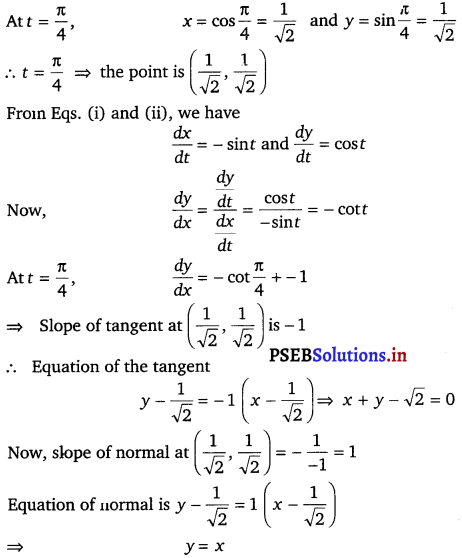
(v) x – cos t and y = sin t at t = \(\frac{\pi}{4}\)
Solution.
(i) The equation of the given curve is
y = x4 – 6x3 + 13x2 – 10x + 5
Differentiating w.r.t. x, we get
\(\frac{d y}{d x}\) = 4x3 – 18x2 + 26 x – 10
Putting x = 0, \(\frac{d y}{d x}\) at (0, 5) = – 10
∴ Slope of tangent at (0, 5) = – 10
Thus, the equation of tangent at P(0, 5) is
y – y1 = \(\left(\frac{d y}{d x}\right)_{a t P}\) (x – x1)
⇒ y – 5 = – 10 (x – 0)
⇒ y + 10x – 5 = 0
and the equation of normal at P(0, 5)
(x – x1) + \(\left(\frac{d y}{d x}\right)_{a t P}\) (y – y1) = 0
⇒ (x – 0) + (- 10)(y – 5) = 0
⇒ x – 10y + 50 = 0.
(ii) The equation of the given curve is y = x4 – 6x3 + 13x2 – 10x + 5
Differentiating w.r.t. x, we get
∴ \(\frac{d y}{d x}\) = 4x3 – 18x2 + 26x – 10
Putting x = 1,
\(\frac{d y}{d x}\) = 4 – 18 + 26 – 10 = 2
∴ Slope of tangent at (1, 3) is 2.
∴ Equation of tangent at (1, 3) is
y – 3 = 2 (x – 1)
⇒ y – 3 = 2x – 2
⇒ y = 2x + 1
and, equation of normal is
(x – 1) + 2 . (y – 3) = 0
⇒ x – 1 + 2y – 6 = 0
⇒ x + 2y – 7 = 0
(iii) The equation of the given curve is y = x3
∴ \(\frac{d y}{d x}\) = 3x2
Now, \(\frac{d y}{d x}\) at (1, 1) dx = 3 (1)2 = 3
i.e., slope of tangent at (1, 1) is 3
Equation of the tangent at (1, 1) is
y – 1 = 3(x – 1)
⇒ y – 1 = 3x – 3
⇒ y = 3x – 2
and, equation of normal at (1, 1) is
(x – 1) + 3 (y – 1) – 0
⇒ x – 1 + 3y – 3 = 0
⇒ x + 3y – 4 = 0
(iv) The equation of the given curve is y = x2
Differentiating w.r.t. x, we get
\(\frac{d y}{d x}\) = 2x
Now, \(\frac{d y}{d x}\) at (0, 0) is 0
i.e., slope of tangent at (0, 0) is 0
∴ Equation of tangent at (0, 0) is
y – 0 = 0 (x – 0)
⇒ and Equation of normal at (0, 0) is
(x – 0) + 0 (y – 0) = 0
⇒ x = 0
(v) The equation of the given curve is
x = cos t ……………(i)
y = sin t …………….(ii)
From Eqs. (i) and (ii), we have
Question 15.
Find the equation of the tangent line to the curve y = x2 – 2x + 7 which is
(i) parallel to the line 2x – y + 9 = 0.
(ii) perpendicular to the line 5y – 15x = 13.
Solution.
The equation of the given curve is y = x2 – 2x + 7
On differentiating both sides w.r.t. x, we get
\(\frac{d y}{d x}\) = 2x – 2
(i) The equation of the line is
2x – y + 9 = 0
⇒ y = 2x + 9
This is of the form y = mx + c.
∴ Slope of the line = 2
If a tangent is parallel to the line 2x – y + 9 = 0, then the slope of the tangent is equal to the slope of the line.
Therefore, we have 2 = 2x -2
⇒ 2x = 4
⇒ x = 2
When, x = 2, then y = 4 – 4 + 7 = 7
Thus, the equation of the tangent passing through (2, 7) is given by y – 7 = 2 (x – 2)
⇒ y – 2x – 3 = 0
Hence, the equation of the tangent line to the given curve (which is parallel to line(2x – y + 9 = 0) is y – 2x – 3 = 0.
(iii) The equation of the line is 5y – 15x = 13
⇒ y = 3x + \(\frac{13}{5}\)
This is of the form y = mx + c
∴ Slope of the line = 3
If a tangent is perpendicular to the line 5y – 15x = 13,
then the slope of the tangent is \(\frac{-1}{\text { Slope of the line }}=\frac{-1}{3}\)
⇒ 2x – 2 = \(-\frac{1}{3}\)
⇒ 2x = \(-\frac{1}{3}\) + 2
⇒ 2x = \(\frac{5}{3}\)
⇒ x = \(\frac{5}{6}\)
When, x = \(\frac{5}{6}\), then y = \(\frac{25}{36}-\frac{10}{6}+7\)
= \(\frac{25-60+252}{36}\frac{217}{36}\)
Thus, the equation of the tangent passing through (\(\frac{5}{6}\), \(\frac{217}{36}\)) is given by
y – \(\frac{217}{36}\) = – \(\frac{1}{3}\) (x – \(\frac{5}{6}\))
⇒ \(\frac{36 y-217}{36}\) = – \(\frac{1}{18}\) (6x – 5)
⇒ 36y – 217 = – 2 (6x – 5)
⇒ 36y – 217 = – 12x + 10
⇒ 36y + 12x – 227 = 0
Hence, the equation of the tangent line to the given curve (which is perpendicular to line 5y -15x = 13 is 36y + 12x – 227 = 0.
Question 16.
Show that the tangents to the curve y = 7x3 + 11 at the points where x = 2 and x = – 2, are parallel.
Solution.
The equation of the given curve is y = 7x3 + 11.
Differentiating w.r.t. x, we get
\(\frac{d y}{d x}\) = 21x2
The slope of the tangent to a curve at (x0, y0) is \(\left[\frac{d y}{d x}\right]_{\left(x_{0}, y_{0}\right)}\)
Therefore, the slope of the tangent at the point where x = 2, is given by
\(\left[\frac{d y}{d x}\right]_{x=2}\) = 21 (2)2 = 84
Also, the slope of the tangent at the point where x = -2, is given by dv
\(\left[\frac{d y}{d x}\right]_{x=-2}\) = 21 (- 2)2 = 21 × 4 = 84
It is observed that the slopes of the tangents at the points where x = 2 and x = – 2 are equal.
Hence, the two tangents are parallel.
Question 17.
Find the points on the curve y = x3 at which the slope of the tangent is equal to the y-coordinate of the point.
Solution.
The equation of the given curve is y = x3
Differentiating w.r.t. x, we get
\(\frac{d y}{d x}\) = 3x2
The slope of the tangent at the point (x, y) is given by
\(\left[\frac{d y}{d x}\right]_{(x, y)}\) = 3x2
When the slope of the tangent is equal to the y-coordinate of the point.
Then, y = 3x2
Also, we have y = x3
3x2 = x3
⇒ x2 (x – 3) = 0
⇒ x = 0, x = 3
When, x = 0, then y = 0 and when x = 3, then y = 3(3)2 = 27.
Hence, the required points are (0, 0) and (3, 27).
Question 18.
For the curve y = 4x3 – 2x2, find all the points at which the tangent passes through the origin.
Solution.
The equation of the given curve is y = 4x3 – 2x2.
Differentiating w.r.t. x, we get
\(\frac{d y}{d x}\) = 12x2 – 10x4
Therefore, the slope of the tangent at a point (x, y) is 12x2 – 10x4.
The equation of the tangent at (x, y) is given by
Y – y = (12x2 – 10x4) (X – x) ……………(i)
When the tangent passes through the origin (0, 0), then X = Y = 0
Therefore, Eq.(i) reduces to
– y = (12x2 – 10x4) (- x)
⇒ y = 12x3 – 10x5
Also, we have y = 4x3 – 2x2
∴ 12x3 – 10x5 = 4x3 – 2x5
⇒ 8x5 – 8x3 = 0
⇒ x5 – x3 = 0
⇒ x3 (x2 – 1) = 0
⇒ x = 0, ± 1
When x = 0, then y 4 (0)3 – 2(0)5 = 0
When, x = 1, then y = 4 (1)3 – 2(1)5 = 2
When x = – 1, then y = 4(- 1)3 – 2(-l)5 = – 2
Hence, the required points are (0, 0), (1, 2) and (- 1, – 2).
Question 19.
Find the points on the curve x2 + y2 – 2x – 3 = 0 at which the tangents are parallel to the x-axis.
Solution.
The equation of the given curve is x2 + y2 – 2x – 3 = 0
On differentiating both sides w.r.t. x, we have
2x + 2y \(\frac{d y}{d x}\) – 2 = 0
⇒ y \(\frac{d y}{d x}\) = 1 – x
⇒ \(\frac{d y}{d x}=\frac{1-x}{y}\)
Now, the tangents are parallel to the x- = axis if the slope of the tangent is 0.
∴ \(\frac{1-x}{y}\) = 0
⇒ 1 – x = 0
⇒ x = 1
But, x2 + y2 – 2x – 3 = 0 for x = 1.
⇒ y2 = 4
⇒ y = ± 2
Hence, the points at which the tangents are parallel to the x-axis, are (1, 2) and (1, – 2).
Question 20.
Find the equation of the normal at the point (am2, am3) for the curve ay2 = x3.
Solution.
The equation of the given curve is ay2 = x3.
On differentiating both sides w.r.t. x, we have
2ay \(\frac{d y}{d x}\) = 3x2
⇒ \(\frac{d y}{d x}=\frac{3 x^{2}}{2 a y}\)
The slope of a tangent to the curve at (x0, y0) is \(\left[\frac{d y}{d x}\right]_{\left(x_{0}, y_{0}\right)}\).
⇒ The slope of the tangent to the given curve at (am2, am3) is
\(\left[\frac{d y}{d x}\right]_{\left(a m^{2}, a m^{3}\right)}=\frac{3\left(a m^{2}\right)^{2}}{2 a\left(a m^{3}\right)}=\frac{3 a^{2} m^{4}}{2 a^{2} m^{3}}=\frac{3 m}{2}\)
∴ Slope of normal at (am2, am3)
\(\frac{-1}{\text { Slope of the tangent at }\left(a m^{2}, a m^{3}\right)}=\frac{-2}{3 m}\)
Slope of the tangent at (am2, am3)
Hence, the equation of the normal at (am2, am3) is given by
y – am3 = \(\frac{-2}{3 m}\) (x – am2)
⇒ 3my – 3am4 = – 2x + 2am2
2x + 3my – am2 (2 + 3m2)= 0.
Question 21.
Find the equation of the normals to the curve y = x3 + 2x + 6 which are parallel to the line x + 14y + 4 = 0.
Solution.
The equation of the given curve is y = x3 + 2x + 6
The slope of the tangent to the given curve at any point (x, y) is given by
\(\frac{d y}{d x}\) = 3x2 + 2
∴ Slope of normal at any point is given at any point (x, y)
= Slope of the tangent at the point (x, y) = \(\frac{-1}{3 x^{2}+2}\)
The equation of the given line is
x + 14 y + 4 = 0
⇒ y = \(-\frac{1}{14} x-\frac{4}{14}\)
(Which is of the form y = mx + c)
∴ Slope of the given line = \(\frac{-1}{14}\)
If the normal is parallel to the line, then we must have the slope of the normal being equal to the slope of the line.
∴ \(\frac{-1}{3 x^{2}+2}=\frac{-1}{14}\)
⇒ 3x2 + 2 = 14
= 3x2 = 12
x2 = 4
When x = 2, then y = 8 + 4 + 6=18
When x = – 2, then y = – 8 – 4 + 6 = – 6
Therefore, there are two normals to the given curve with slope \(\frac{-1}{14}\) and passing through the points (2, 18) and (- 2, – 6).
Thus, the equation of the normal through (2, 18) is given by y – 18 = \(\frac{-1}{14}\) (x – 2)
⇒ 14y – 252 = – x + 2
⇒ x + 14y – 254 = 0
And. the equation of the normal through (- 2, – 6) is given by
y – (- 6) = \(\frac{-1}{14}\) [x – (- 2)]
y + 6 = – (x + 2)
⇒ 14y + 84 = – x – 2
⇒ x + 14y + 86 = 0
Hence, the equation of the normals to the given curve (which are parallel to the given line) are x + 14y – 254 = 0 and x + 14y + 86 = 0.
Question 22.
Find the equations of the tangent and normal to the parabola y2 = 4ax at the point (at2, 2at).
Solution.
The equation of the given parabola is y2 = 4ax
On differentiating y2 = 4ax w.r.t. x, we have
2y \(\frac{d y}{d x}\) = 4a
⇒ \(\frac{d y}{d x}=\frac{2 a}{y}\)
Now, the slope of the normal at (at2, 2at) is given by = \(Slope of the tangent at \left(a t^{2}, 2 a t\right)\) = – t
Slope of the tangent at (at2, 2at)
Thus, the equation of the normal at (at2, 2at) is given as
y – 2at = – t (x – at2)
⇒ y – 2at = – tx + at3
y = – tx + 2at + at3
Question 23.
Prove that the curves x = y2 and xy = k cut a right angles, if 8k2 = 1.
[Note: Two curves intersect at right angle if the tangents to the curves at the point of intersection are perpendicular to each other.]
Solution.
The equations of the given curves are x = y2 and xy = k
Putting x = y2 in xy = k, we get
y3 = k
⇒ y = k1/3
∴ x = k2/3
Thus, the point of intersection of the given curves is (k2/3, k1/3)
On differentiating x = y2 with respect to x, we get
1 = 2y \(\frac{d y}{d x}\)
⇒ \(\frac{d y}{d x}=\frac{1}{2 y}\)
Therefore, the slope of the tangent to the curve x = y2 at (k2/3, k1/3) is
\(\left[\frac{d y}{d x}\right]_{\left(k^{2 / 3}, k^{1 / 3}\right)}=\frac{1}{2 k^{1 / 3}}\)
∴ Slope of the tangent to the curve xy = k at (k 2/3, k”3) is given by
\(\left[\frac{d y}{d x}\right]_{\left(k^{2 / 3} \cdot k^{1 / 3}\right)}=\left[\frac{-y}{x}\right]_{\left(k^{2 / 3} \cdot k^{1 / 3}\right)}\)
= \(-\frac{k^{1 / 3}}{k^{2 / 3}}=-\frac{-1}{k^{1 / 3}}\)
We know that two curves intersect at right angles if the tangents to the curve at the point of intersection i.e., at (k2/3, k1/3) are perpendicular to each other.
This implies that we should have the product of the tangents as – 1.
Thus, the given two curves cut at right angles, if the product of the slopes of their respective tangents at (k2/3, k1/3) is – 1.
i.e., \(\left(\frac{1}{2 k^{1 / 3}}\right)\left(\frac{-1}{k^{1 / 3}}\right)\) = – 1
⇒ 2k2/3 = 1
⇒ (2k2/3)3 = (1)3
⇒ 8k2 = 1
Hence, the given two curves cut at right angles, if 8k2 = 1.
Question 24.
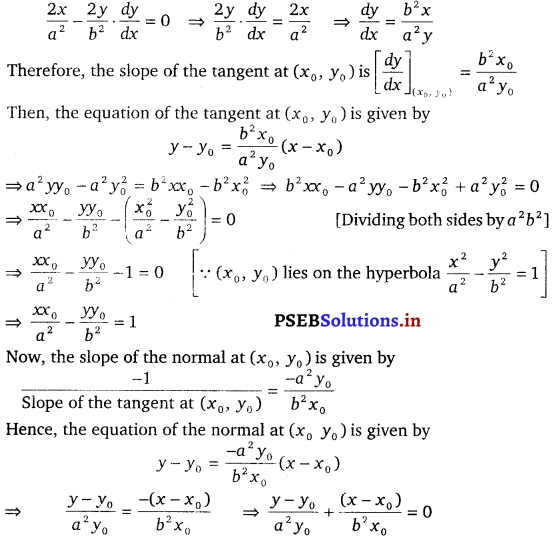
Find the equations of the tangent and normal to the hyperbola \(\frac{x^{2}}{a^{2}}-\frac{y^{2}}{b^{2}}\) = 1 at the point (x0, y0).
Solution.
The equation of the hyperola is \(\frac{x^{2}}{a^{2}}-\frac{y^{2}}{b^{2}}\) = 1
Differentiating w.r.t x, we get
Question 25.
Find the equation of the tangent to the curve y = \(\sqrt{3 x-2}\), which is parallel to the line 4x – 2y + 5 = 0.
Solution.
The equation of the given curve is y = \(\sqrt{3 x-2}\)
The slope of the tangent to the given curve at any point (x, y) is given by
\(\frac{d y}{d x}=\frac{3}{2 \sqrt{3 x-2}}\)
The equation of the given line is 4x – 2y + 5 = 0
⇒ y = 2x + (which is of the form y = mx + c)
∴ Slope of the line = 2
Now, the tangent to the given curve is parallel to the line 4x – 2y – 5 = 0 .
If the slope of the tangent is equal to the slope of the line.
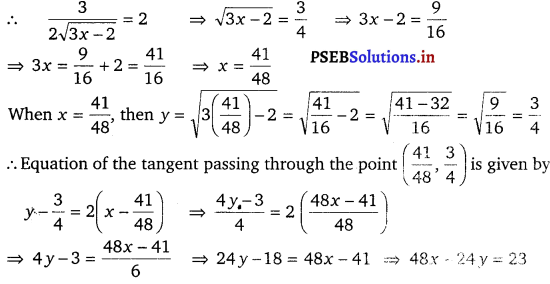
Hence, the equation of the required tangent is 48x – 24y = 23.
Direction (26 – 27):
Choose the correct answer.
Question 26.
The slope of the normal to the curve y = 2x2 + 3 sin x at x = 0 is
(A) 3
(B) \(\frac{1}{3}\)
(C) – 3
(D) = – \(\frac{1}{3}\)
Solution.
The equation of the given curve is y = 2x2 + 3 sin x
Slope of the tangent to the given curve at x = 0 is given by \(\left[\frac{d y}{d x}\right]_{x=0}\) = 0 + 3 cos 0 = 3
Hence, the slope of the normal to the given curve at x = 0 is given by \(\frac{-1}{\text { Slope of the tangent at }(x=0)}=\frac{-1}{3}\)
The correct answer is (D).
Question 27.
The line y = x + 1 is a tangent to the curve y2 = 4x at the point
(A) (1, 2)
(B) (2, 1)
(C) (1, – 2)
(D) (- 1, 2)
Solution.
The equation of the given curve is y2 = 4x …………..(i)
Differentiating w.r.t x, we get
2y \(\frac{d y}{d x}\) = 4
∴ \(\frac{d y}{d x}=\frac{4}{2 y}=\frac{2}{y}\)
The given line is y = x +1 (which is of the form y = mx + c)
∴ Slope of this line is 1.
The line y = x +1 is a tangent to the given curve, if the slope of the line is equal to the slope of the tangent.
Also, the line must intersect the curve.
Thus, we must have \(\frac{2}{y}\) = 1
⇒ y = 2
On putting y = 2 in Eq. (i), we get
22 = 4x
⇒ x = 1
Hence, the line y = x + 1 is a tangent to the given curve at the point (1, 2).
So, the correct answer is (A).