PSEB 5th Class Hindi Solutions Chapter 11 साहसी दीपा

Punjab State Board PSEB 5th Class Hindi Book Solutions Chapter 11 साहसी दीपा Textbook Exercise Questions and Answers.

PSEB Solutions for Class 5 Hindi Chapter 11 साहसी दीपा (2nd Language)

साहसी दीपा अभ्यास

नीचे गुरुमुखी और देवनागरी लिपि में दिये गये शब्दों को पढ़ो और हिन्दी शब्दों को लिखने का अभ्यास करो :

  • ਲੜਕੀ = लड़की
  • ਨੌਕਰੀ = नौकरी
  • ਸਹੇਲੀ = सहेली
  • ਨਦੀ = नदी
  • ਬਹਾਦੁਰ = बहादुर
  • ਮਗਰਮੱਛ = मगरमच्छ

PSEB 5th Class Hindi Solutions Chapter 11 साहसी दीपा

नीचे एक ही अर्थ के लिए पंजाबी और हिन्दी भाषा में शब्द दिये गये हैं। इन्हें ध्यान से पढ़ो और हिन्दी शब्दों को लिखो :

  • ਬਾਰ੍ਹਾਂ = बारह
  • ਜੀਉਂਦੇ = जीवित
  • ਪ੍ਰਸੰਸਾ = सराहना।
  • ਇਨਾਮ = पुरस्कार

पढ़ो, समझो और लिखो

(क) च् + छ = च्छ = अच्छा, मगरमच्छ
न् + य = न्य = धन्यवाद
ल् + द = ल्द = जल्दी
स् + क = स्क = पुरस्कार

बताओ

प्रश्न 1.
दीपा कैसी लड़की थी?
उत्तर :
दीपा साहसी लड़की थी।

प्रश्न 2.
दीपा नदी के किनारे क्या कर रही थी?
उत्तर :
दीपा नदी के किनारे कपड़े धो रही थी।

PSEB 5th Class Hindi Solutions Chapter 11 साहसी दीपा

प्रश्न 3.
‘बचाओ-बचाओ’ की आवाजें किसने लगाईं?
उत्तर :
बचाओ-बचाओ’ की आवाजें हरीश ने लगाईं।

प्रश्न 4.
दीपा की सहेली ने उसे नदी में कूदने से मना क्यों किया?
उत्तर :
पानी में तेजी से बढे आ रहे मगरमच्छ को देखकर दीपा की सहेली ने दीपा को पानी में कूदने से मना किया।

प्रश्न 5.
दीपा ने रवि को डूबने से कैसे बचाया?
उत्तर :
दीपा झट से पानी में कूद गई और रवि को पानी से निकाल कर बाहर ले आई। इस प्रकार उसने रवि को डूबने से और मगरमच्छ से बचाया।

प्रश्न 6.
दीपा को कौन-सा पुरस्कार, कब मिला?
उत्तर :
दीपा को वीरता का पुरस्कार 26 जनवरी को मिला।

वाक्य पूरे करो

होशियार किनारे मगरमच्छ बहादुर धन्यवाद वीरता पुरस्कार।

  1. दीपा ………………………. और ………………………. लड़की थी।
  2. नदी में ………………………. था।
  3. दीपा रवि को ………………………. पर ले आई।
  4. रवि और हरीश के माता-पिता ने दीपा का ………………………. किया।
  5. दीपा को 26 जनवरी के दिन ………………………. मिला।

उत्तर :

  1. दीपा बहादुर और होशियार लड़की थी।
  2. नदी में मगरमच्छ था।
  3. दीपा रवि को किनारे पर ले आई।
  4. रवि और हरीश के माता-पिता ने दीपा का धन्यवाद किया।
  5. दीपा को 26 जनवरी के दिन वीरता पुरस्कार मिला।

PSEB 5th Class Hindi Solutions Chapter 11 साहसी दीपा

वाक्य बनाओ

  1. हिम्मत,
  2. धन्यवाद,
  3. बहादुरी,
  4. पुरस्कार,
  5. ठान लेना,
  6. हिम्मत बंधाना,
  7. एक न मानना,
  8. खाली हाथ लौटना,
  9. अपना-सा मुँह लेकर रह जाना।

उत्तर :

  1. हिम्मत-वह बहुत हिम्मत करके मेरे पास आया।
  2. धन्यवाद-मुख्याध्यापक ने अतिथि का धन्यवाद किया।
  3. मगरमच्छ-मगरमच्छ पानी में रहता है।
  4. पुरस्कार-दीपा को उसकी बहादुरी पर वीरता पुरस्कार मिला।
  5. ठान लेना-मैंने इस प्रतियोगिता को जीतने की ठान ली है।
  6. एक न मानना-वह अपने माता-पिता की एक नहीं मानता, अपने मन की करता है।
  7. हिम्मत बँधाना-दीपा ने हरीश को हिम्मत बँधाई।
  8. खाली हाथ लौटना-मगरमच्छ को खाली हाथ लौटना पड़ा।
  9. अपना सा मुँह लेकर रह जाना-मगरमच्छ शिकार हाथ से निकलते देखकर अपना सा मुँह लेकर रह गया।

पढ़ो, समझो और लिखो

साल = वर्ष
लड़की = बालिका
किनारा = तट
जीवित – ज़िन्दा
उत्तर :
उपरोक्त रेखांकित शब्दों के पर्यायवाची शब्द सामने दर्शाये गए हैं। विद्यार्थी इन पर्याय-शब्दों को स्मरण रखें।

लिंग बदलो

  1. माता = ……………………….
  2. लड़की = ……………………….

उत्तर :

  1. माता = पिता।
  2. लड़की = लड़का।

PSEB 5th Class Hindi Solutions Chapter 11 साहसी दीपा

समझो

गाँव = शहर
घर = बाहर
डूबना = तैरना
वीर = कायर
उत्तर :
उपरोक्त रेखांकित शब्दों के विपरीतार्थक शब्द उनके सामने लिखे गए हैं। विद्यार्थी इन्हें समझकर कण्ठस्थ कर लें।

इनसे नये शब्द बनाओ

  1. च्छ
  2. न्य
  3. स्क
  4. ल्द

उत्तर :

  1. च्छ = स्वच्छ।
  2. न्य = अन्य।
  3. स्क= पुरस्कार।
  4. ल्द = जल्द।

रचनात्मक अभिव्यक्ति

PSEB 5th Class Hindi Solutions Chapter 11 साहसी दीपा 1
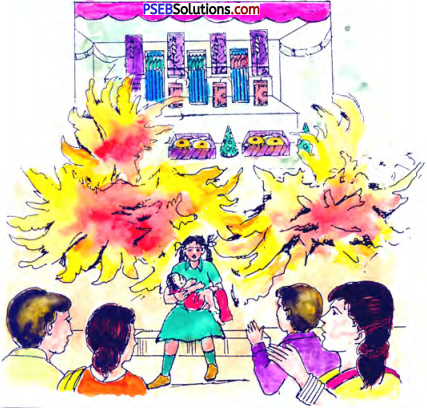
चित्र देखकर नीचे दिए गए शब्दों की सहायता से वाक्य पूरे करो

साहसी दुकान दीवाली पटाखों आग बच्चा बचा

…………………………………. का त्योहार है। बाज़ार में …………………………………. की दुकानें सजी हुई हैं। एक दुकान में अचानक …………………………………. लग गई है। एक …………………………………. आग में फँस गया है। वह ज़ोर-ज़ोर से चिल्ला रहा है। एक बालिका उसे जान पर खेलकर …………………………………. रही है। वह …………………………………. बालिका है।
उत्तर :
दीवाली का त्योहार है। बाज़ार में पटाखों की दुकानें सजी हुई हैं। एक दुकान में अचानक आग लग गई है। एक बच्चा आग में फँस गया है। वह ज़ोर-ज़ोर से चिल्ला रहा है। एक बालिका उसे जान पर खेलकर बचा रही है। वह साहसी बालिका है।

PSEB 5th Class Hindi Solutions Chapter 11 साहसी दीपा

साहसी दीपा बहुवैकल्पिक प्रश्न

प्रश्न 1.
दीपा कैसी लड़की थी?
(i) साहसी
(i) निडर
(iii) योगी
(iv) सुंदर।
उत्तर :
(i) साहसी

प्रश्न 2.
दीपा नदी किनारे क्या कर रही थी?
(i) कपड़े धो रही थी
(ii) कपड़े सिल रह थे
(iii) खेल रही थी
(iv) सो रही थी।
उत्तर :
(i) कपड़े धो रही थी

प्रश्न 3.
‘ठान लेना’ का अर्थ है
(i) पक्का इरादा
(ii) पक्की बात
(iii) पक्के लोग
(iv) पक्की रस्सी।
उत्तर :
(i) पक्का इरादा

PSEB 5th Class Hindi Solutions Chapter 11 साहसी दीपा

प्रश्न 4.
अगर ‘गाँव’-शहर है तो ‘घर ………………………………. है।
(i) बाहर
(ii) बाह्य
(iii) बाहरी
(iv) बाहु।
उत्तर :
(i) बाहर।

साहसी दीपा Summary in Hindi

पाठ का सार माधोपुर गाँव में दीपा नामक लड़की रहती थी। उसकी आयु बारह वर्ष की थी। उसके पिता शहर में नौकरी करते थे और माँ घर में बीमार रहती थी। दीपा बड़ी बहादुर लड़की थी। सारे घर के कामकाज करती और नदी में कपड़े धोने भी जाती थी।

एक दिन दीपा अपनी सहेली के साथ नदी के किनारे कपडे धो रही थी और थोड़ी ही दूरी पर रवि और हरीश नदी में नहा रहे थे। नहाते-नहाते रवि नदी में डूबने लगा तो हरीश ने उसे बचाने की कोशिश की और सहायता के लिए चिल्लाने लगा।

PSEB 5th Class Hindi Solutions Chapter 11 साहसी दीपा 2

उसकी आवाज़ सुनकर दीपा उसकी सहायता के लिए दौड़ी तो उसकी सहेली ने उसे मना कर दिया क्योंकि उसने देखा कि पानी में मगरमच्छ रवि की ओर चला आ रहा था। लेकिन दीपा ने इसकी परवाह नहीं की और पानी में कूद गई। उसने जल्दी से रवि को पकड़ा और किनारे पर ले आई।

PSEB 5th Class Hindi Solutions Chapter 11 साहसी दीपा

इस प्रकार उसने रवि को मगरमच्छ से बचा लिया। इतने में दीपा की सहेली रवि और हरीश के माता-पिता को ले आई। अपने बच्चों को सुरक्षित देखकर वे बहुत खुश हुए और दीपा का धन्यवाद किया। गाँव के सभी लोगों ने भी दीपा के साहस की सराहना की।

दीपा की बहादुरी पर उसे 26 जनवरी को पुरस्कार दिया गया।

साहसी दीपा शब्दार्थ Meanings

  • होशियार = सावधान, चौकस
  • कोशिश = प्रयास, यत्न
  • मगरमच्छ = गहरे जल में पाया जाने वाला बहुत बड़ा, भीषण एवं हिंसक जंतु, घड़ियाल
  • चंगुल = हाथ की उँगलियों के मोड़ने से बनी मुद्रा, पकड़, काबू
  • धन्यवाद = कृतज्ञता
  • सराहना = प्रशंसा प्रकट करने का शब्द
  • पुरस्कार = इनाम

PSEB 9th Class SST Solutions Geography Chapter 5 प्राकृतिक वनस्पति तथा जंगली जीवन

Punjab State Board PSEB 9th Class Social Science Book Solutions Geography Chapter 1a भारत : आकार व स्थिति Exercise Questions and Answers.

PSEB Solutions for Class 9 Social Science Geography Chapter 1a भारत : आकार व स्थिति

SST Guide for Class 9 PSEB भारत : आकार व स्थिति Textbook Questions and Answers

(क) नक्शा कार्य (Map Work) :

प्रश्न 1.
भारत के रेखाचित्र में भरें(i) कुदरती वनस्पति के कोई 3 किस्म के क्षेत्र। (ii) किसी पांच राज्यों में राष्ट्रीय पार्क। (iii) पंजाब की सुरक्षित जलगाहें (पंजाब के रेखाचित्र में)।
उत्तर-
यह प्रश्न विद्यार्थी MBD Map Master की सहायता से स्वयं करें।

प्रश्न 2.
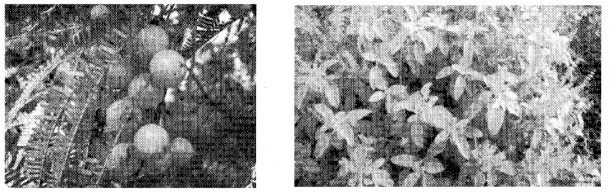
निम्न दी गई तस्वीरों में वृक्ष पहचान कर वनस्पति की प्रकार बताएं।
PSEB 9th Class Social Science Guide भारत आकार व स्थिति Important Questions and Answers (1)
उत्तर-
यह प्रश्न विद्यार्थी स्वयं करें।

प्रश्न 3.
अपने क्षेत्र के 10 वृक्षों, 5 जानवरों तथा 5 पक्षियों की तस्वीरें चार्ट पर लगाकर नाम लिखें।
उत्तर-
यह प्रश्न विद्यार्थी स्वयं करें।

(ख) निम्न के उत्तर एक शब्द से एक वाक्य में दें:

  1. पौधे ………. की ……….. से ………… विधि द्वारा अपना भोजन तैयार करते हैं।
  2. पंजाब का ………… फीसदी क्षेत्र वनों के अधीन है जो कि ……….. वर्ग किलोमीटर है।
  3.  …………. मंडल में वनस्पति उगती है और ……… की प्रकार ……… पर असर डालती है।

उत्तर-

  1. सूर्य, किरणें, फोटोसिंथेसिस
  2. 6.07%, 3058.
  3. जीव, मिट्टी, वनस्पति।

प्रश्न 4.
पृथ्वी का वो कौन-सा मंडल है जिसमें जीवन है :
(i) वायु मंडल
(ii) थल मंडल
(iii) जल मंडल
(iv) जीव मंडल।
उत्तर-
(iv) जीव मंडल में।

प्रश्न 5.
इनमें से कौन-से जिले में सबसे अधिक वन मिलते हैं ?
(i) मानसा
(ii) रूपनगर
(iii) अमृतसर
(iv) बठिंडा।
उत्तर-
(ii) रूपनगर में।

प्रश्न 6.
चिंकारा कौन-से जानवर की प्रकार है ?
उत्तर-
चिंकारा एक छल्लेदार सींगों वाला हिरन है।

प्रश्न 7.
बीड़ क्या होती है ?
उत्तर-
कुछ क्षेत्रों में घनी वनस्पति होती थी तथा इसके छोटे बड़े टुकड़ों को बीड़ कहते हैं।

प्रश्न 8.
उप उष्ण झाड़ीदार वनस्पति में मिलती घास का नाम लिखें।
उत्तर-
यहां लंबी प्रकार का घास-सरकंडा मिलता है।

प्रश्न 9.
पंजाब के कुल क्षेत्रफल का कितने फीसदी क्षेत्र वनों के अधीन है ?
उत्तर-
6.07%.

प्रश्न 10.
झाड़ियां व कांटेदार वनस्पति वाले क्षेत्रों में कौन-से जानवर मिलते हैं ?
उत्तर-
यहां ऊंट, शेर, बब्बर शेर, खरगोश, चूहे इत्यादि मिलते हैं।

(ग) इन प्रश्नों के संक्षेप उत्तर दें :

प्रश्न 1.
फलोरा व फौना क्या है ? स्पष्ट करें।
उत्तर-
किसी विशेष क्षेत्र में मिलने वाले पौधों के लिए फलोरा शब्द प्रयोग किया जाता है। उस क्षेत्र के पौधे उस क्षेत्र की जलवायु, मिट्टी, वर्षा इत्यादि पर निर्भर करते हैं। इस प्रकार किसी क्षेत्र में मिलने वाले जानवरों की प्रजातियों को फौना कहा जाता है। प्रत्येक क्षेत्र में मिलने वाले जानवरों की प्रजातियां भी अलग-अलग होती हैं।

प्रश्न 2.
वनों की रक्षा क्यों आवश्यक है, लिखें।
उत्तर-

  1. वन जलवायु पर नियंत्रण रखते हैं। सघन वन गर्मियों में तापमान को बढ़ने से रोकते हैं तथा सर्दियों में तापमान को बढ़ा देते हैं।
  2. सघन वनस्पति की जड़ें बहते हुए पानी की गति को कम करने में सहायता करती हैं। इससे बाढ़ का प्रकोप कम हो जाता है। दूसरे जड़ों द्वारा रोका गया पानी भूमि के अंदर समा लिए जाने से भूमिगत जल-स्तर (Water-table) ऊंचा उठ जाता है। वहीं दूसरी ओर धरातल पर पानी की मात्रा कम हो जाने से पानी नदियों में आसानी से बहता रहता है।
  3. वृक्षों की जड़ें मिट्टी की जकड़न को मज़बूत किए रहती हैं और मिट्टी के कटाव को रोकती हैं।
  4. वनस्पति के सूखकर गिरने से जीवांश के रूप में मिट्टी को हरी खाद मिलती है।
  5. हरी-भरी वनस्पति बहुत ही मनोरम दृश्य प्रस्तुत करती है। इससे आकर्षित होकर लोग सघन वन क्षेत्रों में यात्रा, शिकार तथा मानसिक शांति के लिए जाते हैं। कई विदेशी पर्यटक भी वन-क्षेत्रों में बने पर्यटन केंद्रों पर आते हैं। इससे सरकार को विदेशी मुद्रा प्राप्त होती है।
  6. सघन वन अनेक उद्योगों के आधार है। इनमें से कागज़, लाख, दियासिलाई, रेशम, खेलों का सामान, प्लाईवुड, गोंद, बिरोजा आदि उद्योग प्रमुख हैं।

प्रश्न 3.
सदाबहार वनों की विशेषताएं लिखें।
उत्तर-

  1. सदाबहार वनों के सभी पत्ते एक साथ नहीं झड़ते तथा हमेशा हरे रहते हैं।
  2. यह वन गर्म तथा नमी वाले क्षेत्रों में मिलते हैं जहां पर 200 सैंटीमीटर से अधिक वर्षा होती है।
  3. सदाबहार वनों के पेड़ 60 मीटर या उससे ऊंचे भी जा सकते हैं।
  4. यह वन घने होने के कारण एक छतरी (Canopy) बना लेते हैं। जहां से कई बार तो सूर्य की किरणें धरातल तक नहीं पहुंच पातीं।
  5. पेड़ों के नीचे बहुत-से छोटे-छोटे पौधे उग जाते हैं तथा आपस में उलझ जाते हैं जिस कारण इनमें निकलना मुश्किल होता है।

प्रश्न 4.
पंजाब की प्राकृतिक वनस्पति से जान-पहचान करवाएं।
उत्तर-
इस समय पंजाब के कुल क्षेत्रफल का केवल 6.07% हिस्सा ही वनों के अंतर्गत आता है। इसका काफी बड़ा भाग मनुष्यों द्वारा उगाया जा रहा है। पंजाब की प्राकृतिक वनस्पति को कई भागों में बांटा जा सकता है

  1. हिमालय प्रकार की सीधी शीत उष्ण वनस्पति
  2. उपउष्ण झाड़ीदार पर्वतीय वनस्पति
  3. उपउष्ण झाड़ीदार वनस्पति वनस्पति
  4. उष्ण शुष्क पतझड़ी वनस्पति
  5. उष्ण कांटेदार वनस्पति।

प्रश्न 5.
आंवला, तुलसी तथा सिनकोना के क्या लाभ हो सकते हैं, लिखें।
उत्तर-

  1. आंवला-आंवला विटामिन सी से भरा होता है तथा यह व्यक्ति की पाचन शक्ति को ठीक करने में सहायता करता है। आंवला कब्ज, शूगर तथा खांसी को दूर करने के लिए भी प्रयोग किया जाता है।
  2. तुलसी-अगर किसी को बुखार, खांसी या जुकाम हो जाए तो तुलसी काफी लाभदायक होती है।
  3. सिनकोना-सिनकोना के पौधे की छाल को कुनीन बनाने के लिए प्रयोग किया जाता है जिसे मलेरिया ठीक करने के लिए दिया जाता है।

(घ) निम्नलिखित प्रश्नों के विस्तृत उत्तर दें:

प्रश्न 1.
प्राकृतिक वनस्पति मानव समाज के फेफड़े होते हैं, कैसे ?
उत्तर-
इसमें कोई शंका नहीं है कि प्राकृतिक वनस्पति मानवीय समाज के फेफड़े होते हैं। अग्रलिखित बिंदुओं से यह स्पष्ट हो जाएगा

  1. जंगल बड़ी मात्रा में ऑक्सीजन छोड़ते हैं तथा कार्बन-डाइऑक्साइड का प्रयोग करते हैं। यह ऑक्सीजन जानवरों तथा मनुष्यों को जीवन देती है।
  2. जंगल पृथ्वी में मौजूद पानी के स्तर को ऊंचा करने में काफी सहायता करते हैं।
  3. जंगल के पेड़ों में मौजूद पानी सूर्य की गर्मी के कारण वाष्प बनकर उड़ता रहता है जो वायु के तापमान को कम करने में सहायता करता है।
  4. जंगलों में बहुत-से जीव रहते हैं तथा उन्हें भोजन तथा रहने का स्थान जंगल में ही मिलता है।
  5. हमारे वातावरण को सुंदर तथा स्वस्थ बनाने में भी जंगल काफी सहायक होते हैं।
  6. पवन की गति को कम करने, ध्वनि प्रदूषण को कम करने तथा सूर्य में चमक को कम करने में जंगल काफी सहायता करते हैं।
  7. वृक्ष की जड़ें मिट्टी के कणों को पकड़ कर रखती हैं जिस कारण जंगलों से भूमि क्षरण नहीं होती।
  8. वर्षा करवाने में भी जंगल काफी सहायक होते हैं।
  9. जंगलों से हम कई प्रकार की लकड़ी प्राप्त करते हैं।
  10. जंगलों के कारण ही कई प्रकार के उद्योगों का विकास हो पाया है।

प्रश्न 2.
प्राकृतिक वनस्पति को कौन-से भौगोलिक तत्त्व प्रभावित करते हैं ?
उत्तर-
अलग-अलग क्षेत्रों में बहुत-सी भौगोलिक विभिन्नताएं होती हैं जिस कारण वहां की प्राकृतिक वनस्पति भी अलग-अलग होती है। इस कारण प्राकृतिक वनस्पति को कई तत्त्व प्रभावित करते हैं जिनका वर्णन इस प्रकार है

  1. भूमि अथवा धरातल (Land on Relief)-किसी भी क्षेत्र की भूमि का वनस्पति पर प्रत्यक्ष या अप्रत्यक्ष प्रभाव पड़ता है। मैदानों, पर्वतों, डैल्टा इत्यादि की वनस्पति एक समान नहीं हो सकती। भूमि के स्वभाव का वनस्पति पर प्रभाव पड़ता है। ऊंचे पर्वतों पर लंबे वृक्ष मिलते हैं परंतु मैदानों पर पर्णपाती (Deciduous) वृक्ष मिलते हैं।
  2. मृदा (Soil)-मृदा पर ही वनस्पति पैदा होती है। अलग-अलग स्थानों पर अलग-अलग प्रकार की मिट्टी मिलती है, जो अलग-अलग प्रकार की वनस्पति का आधार है। जैसे कि मरुस्थल में रेतली मिट्टी मिलती है जिस कारण वहां पर कांटेदार झाड़ियां मिलती हैं। नदियों के डैल्टे पर बढ़िया प्रकार की वनस्पति पाई जाती है। पर्वतों की ढलानों पर मिट्टी की परत गहरी होती है जिस कारण वहां पर लंबे पेड़ मिलते हैं।
  3. तापमान (Temperature) वनस्पति की विविधता तथा विशेषता तापमान तथा वायु की नमी पर निर्भर करती है। हिमालय पर्वत की ढलानों तथी दक्षिणी पठार के पर्वतों पर 915 मीटर की ऊंचाई से ऊपर तापमान में नयी वनस्पति के उगने तथा बढ़ने को प्रभावित करती है। इस कारण वहां की वनस्पति मैदानी क्षेत्रों से अलग होती है।
  4. सूर्य की रोशनी (Sunlight) किसी भी क्षेत्र में कितनी सूर्य की रोशनी आती है, इस पर भी वनस्पति निर्भर करती है। किसी भी स्थान पर कितनी सूर्य की रोशनी आएगी यह वहां की अक्षांश रेखाओं (Parallels of Latitudes) तथा भूमध्य रेखा से दूरी, समुद्र तल से ऊंचाई तथा ऋतु पर निर्भर करता है। गर्मियों में अधिक रोशनी मिलने के कारण वृक्ष तेजी से बढ़ते हैं।
  5. वर्षा (Rainfall)-जिन क्षेत्रों में अधिक वर्षा होती है वहां पर सदाबहार वन मिलते हैं। वह घने भी होते हैं। परंतु वहां कम वर्षा होती है जहां पर पर्णपाती वन (Deciduous Forests) मिलते हैं। जहां पर बहुत ही कम वर्षा होती है, जैसे कि मरुस्थल, वहां पर जंगल भी काफी कम या न के समान होते हैं। इस प्रकार वर्षा की मात्रा पर भी वनस्पति का प्रकार निर्भर करता है।

प्रश्न 3.
भारतीय जंगलों को जलवायु के आधार पर बांटें व वृक्षों के नाम भी लिखें।
उत्तर-
भारतीय जंगलों को जलवायु के आधार पर कई भागों में विभाजित किया जा सकता है जिसका वर्णन इस प्रकार है

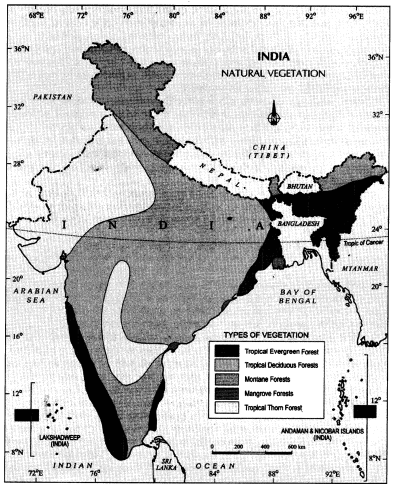
  1. उष्ण सदाबहार वन (Tropical Evergreen Forests)-इस प्रकार के वन मुख्य रूप से अधिक वर्षा (200 सें०मी० से अधिक) वाले भागों में मिलते हैं। इसलिए इन्हें बरसाती वन भी कहते हैं। ये वन अधिकतर पूर्वी हिमालय के तराई प्रदेश पश्चिमी घाट, पश्चिमी अंडमान, असम, बंगाल तथा ओडिशा के कुछ भागों में पाए जाते हैं। इन वनों में पाए जाने वाले मुख्य वृक्ष महोगनी, ताड़, बांस, रबड़, चपलांस, मैचोलश तथा कदंब हैं।
  2. पतझड़ी अथवा मानसूनी वन (Tropical Deciduous or Monsoon Forests)-पतझड़ी या मानसूनी वन भारत के उन प्रदेशों में मिलते हैं जहां 100 से 200 सें.मी. तक वार्षिक वर्षा होती है। भारत में ये मुख्य रूप से हिमालय के निचले भाग, छोटा नागपुर, गंगा की घाटी, पश्चिमी घाट की पूर्वी ढलानों तथा तमिलनाडु क्षेत्र में पाए जाते हैं। इन वनों में पाए जाने वाले मुख्य वृक्ष सागवान, साल, शीशम, आम, चंदन, महुआ, ऐबोनी, शहतूत तथा सेमल हैं। गर्मियों में ये वृक्ष अपनी पत्तियां गिरा देते हैं, इसलिए इन्हें पतझड़ी वन भी कहते हैं।
  3. झाड़ियां या कांटेदार जंगल (The Scrubs and Thorny Forest)-इस प्रकार के वन उन क्षेत्रों में पाए जाते हैं जहां वार्षिक वर्षा का मध्यमान 20 से 60 सें० मी० तक होता है। भारत में ये वन राजस्थान, पश्चिमी हरियाणा, दक्षिणपश्चिमी पंजाब और गुजरात में पाए जाते हैं। इन वनों में रामबांस, खैर, पीपल, बबूल, थोअर और खजूर के वृक्ष प्रमुख हैं।
  4. ज्वारीय वन (Tidal Forests)-ज्वारीय वन नदियों के डेल्टाओं में पाए जाते हैं। यहां की मिट्टी भी उपजाऊ होती है और पानी भी अधिक मात्रा में मिल जाता है। भारत में इस प्रकार के वन महानदी, गोदावरी, कृष्णा, कावेरी आदि के डेल्टाई प्रदेशों में मिलते हैं। यहां की वनस्पति को मैंग्रोव अथवा सुंदर वन भी कहा जाता है। कुछ क्षेत्रों में ताड़, कैंस, नारियल इत्यादि के वृक्ष भी मिलते हैं।
  5. पर्वतीय वन (Mountains Forests) – इस प्रकार को वनस्पति हिमालय पर्वतीय क्षेत्रों तथा दक्षिण में नीलगीर की पहाड़ियों पर पायी जाती हैं। इस वनस्पति में वर्षा की मात्रा तथा ऊंचाई बढ़ने के साथ-साथ अंतर आता है। कम ऊंचाई पर सदाबहार वन पाये जाते हैं, तो अधिक ऊंचाई पर केवल घास तथा कुछ फूलदार पौधे ही मिलते हैं।

PSEB 9th Class Social Science Guide भारत आकार व स्थिति Important Questions and Answers (2)

प्रश्न 4. पंजाब की प्राकृतिक वनस्पति के वर्गीकरण पर प्रकाश डालें।
उत्तर-पंजाब के अलग-अलग भागों में धरातल, जलवायु तथा मिट्टी की प्रकार अलग-अलग होने के कारण यहां अलग-अलग प्रकार की वनस्पति मिलती है तथा इनका वर्णन इस प्रकार है

1. हिमालय प्रकार की आर्द्र शीत-उष्ण वनस्पति (Himalayan Type Moist Temperate Vegetation)पंजाब के पठानकोट की धार कलां तहसील में इस प्रकार की वनस्पति पाई जाती है। पंजाब के इस हिस्से में वर्षा भी अधिक होती है तथा यह पंजाब के अन्य भागों से ऊंचाई पर भी स्थित है। यहां कई प्रकार के वृक्ष मिल जाते हैं जैसे कि कम ऊंचाई वाले चील के वृक्ष, शीशम, शहतूत, पहाड़ी बबूल, आम इत्यादि।

2. उप उष्ण चील वनस्पति (Sub Tropical Pine Vegetation)—पंजाब के कई जिलों की कई तहसीलों में इस प्रकार की वनस्पति मिलती है जैसे कि पठानकोट जिले की पठानकोट तहसील तथा होशियारपुर जिले की मुकेरियां, दसूहा तथा होशियारपुर तहसीलें। यहां चील के वृक्ष काफी कम मिलते हैं तथा उनकी प्रकार भी बढ़िया नहीं होती। यहां शीशम, खैर, शहतूत तथा अन्य कई प्रकार के वृक्ष पाए जाते हैं।

3. उप उष्ण झाड़ीदार पर्वतीय वनस्पति (Sub Tropical Scrub Hill Vegetation)-होशियारपुर तथा रूपनगर ज़िलों के पूर्वी भागों तथा पठानकोट जिले के बाकी बचे भागों में इस प्रकार की वनस्पति मिलती है। इस क्षेत्र में आज से चार-पांच सदियों पहले तक काफी घने जंगल मिलते हैं परंतु काफी अधिक वृक्षों की कटाई, जानवरों के चरने, जंगलों की आग तथा भूमि-क्षरण के कारण यहां की वनस्पति झाड़ीदार हो गई है। यहां कई प्रकार के वृक्ष मिलते हैं जैसे कि शीशम, खैर, बबूल, शहतूत, बकायन, नीम, सिंबल, बांस, अमलतास इत्यादि। यहां लंबी घास भी उगती है जिसे सरकंडा कहते हैं जिसे रस्सियों तथा कागज़ बनाने के लिए प्रयोग किया जाता है।

4. उष्ण-शुष्क पतझड़ी वनस्पति (Tropical Dry Deciduous Vegetation)-पंजाब के शुष्क तथा गर्म क्षेत्रों में इस प्रकार की वनस्पति पाई जाती है। कंडी क्षेत्र के मैदान, पंजाब के लहरदार तथा ऊंचे नीचे मैदान तथा मध्यवर्तीय मैदानों में इस प्रकार की वनस्पति मिलती है। किसी समय यहां पर घनी वनस्पति हुआ करती थी। आज भी घनी वनस्पति के कुछ छोटे बड़े टुकड़े मिल जाते हैं जिन्हें बीड़, झंगीया झिड़ी के नाम से पुकारा जाता है। एस०ए०एस० नगर तथा पटियाला के क्षेत्रों में भी घने वृक्षों वाले क्षेत्र मिलते हैं जिन्हें बीड़ कहा जाता है। बीड़ भादसों, छत्तबीड़, बीड़ भुन्नरहेड़ी, बीड़ मोती बाग इत्यादि इनमें प्रमुख हैं। यहां नीम, टाहली, बरगद, पीपल, आम, बबूल, निम्ब इत्यादि के वृक्ष मिलते हैं। यहां सफैदा तथा पापुलर के पेड़ भी लगाए जाते हैं।

5. उष्ण कांटेदार वनस्पति (Tropical Thorny Vegetation)—पंजाब के कई क्षेत्र ऐसे भी हैं जहां कम वर्षा होती है तथा वहां इस प्रकार की वनस्पति मिलती है। बठिंडा, मानसा, फाजिलका के कई भागों, फिरोजपुर तथा फरीदकोट के मध्य दक्षिण भागों में कांटेदार वनस्पति मिलती है। यहां के कई क्षेत्रों में तो वनस्पति है ही नहीं। कांटेदार झाड़ियां, थोहर (Cactus), शीशम, जण्ड, बबूल इत्यादि वृक्ष यहां पर मिलते हैं।

प्रश्न 5.
जंगली जीवन व उसकी सुरक्षा विधियों पर विस्तार से लिखें।
उत्तर-
वनस्पति की तरह ही हमारे देश में जीव-जंतुओं की काफी विभिन्नता है। भारत में इनकी 89000 प्रजातियां मिलती हैं। देश के ताज़ा तथा खारे पानी में 2500 से अधिक प्रकार की मछलियां मिलती हैं। इस प्रकार पक्षियों की भी 2000 से ऊपर प्रजातियां पाई जाती हैं। हमारे वनों में काफी महत्त्वपूर्ण पशु-पक्षी मिलते हैं। परंतु अफसोस की बात है कि पक्षियों तथा जानवरों की अनेक प्रजातियां देश में से लुप्त हो चुकी हैं। इस कारण जंगली जीवों की रक्षा करना हमारे लिए बहुत ही आवश्यक है। मनुष्य ने अपने व्यक्तिगत लाभ के लिए वनों को काट कर तथा जानवरों का शिकार करके एक दुखद स्थिति उत्पन्न कर दी है। आज गैंडा, चीता, बंदर, शेर इत्यादि काफी कम संख्या में मिलते हैं।

इस कारण प्रत्येक नागरिक का यह कर्त्तव्य है कि वह जंगली जीवों की रक्षा करे।
PSEB 9th Class Social Science Guide भारत आकार व स्थिति Important Questions and Answers (3)

जंगली जीवों की सुरक्षा विधियां-

  1. वैसे तो सरकार ने कई राष्ट्रीय उद्यान तथा वन्य जीव अभ्यारण्य बनाए हैं परंतु और राष्ट्रीय उद्यान तथा वन्य जीव अभ्यारण्य बनाए जाने की आवश्यकता है।
  2. वन्य जीवों के शिकार पर कठोर पाबंदी लगाई जानी चाहिए तथा इस पाबंदी को कठोरता से लागू किया जाना चाहिए।
  3. राष्ट्रीय उद्यानों तथा वन्य जीव अभ्यारण्यों में जीवों के खाने का उचित प्रबंध होना चाहिए।
  4. जो प्रजातियां खत्म होने की कगार पर पहुंच चुकी हैं उन्हें संभालने तथा बचाने की तरफ विशेष ध्यान दिया जाना चाहिए।
  5. जंगलों तथा राष्ट्रीय उद्यानों में शिकारियों तथा चरवाहों को दाखिल होने की आज्ञा नहीं दी जानी चाहिए।
  6. अभ्यारण्यों तथा राष्ट्रीय उद्यानों में जीवों के लिए मैडिकल सुविधाएं भी होनी चाहिए ताकि किसी बिमारी होने की स्थिति में उन्हें बचाया जा सके।
  7. बड़े स्तर पर प्रशासकीय निर्णय लिए जाने चाहिए ताकि इन्हें बचाने के निर्णय जल्दी लिए जा सकें। 8. आम जनता में जंगली जीवों को संभालने के प्रति जागरुकता फैलाने के लिए सैमीनार करवाए जाने चाहिए।

PSEB 9th Class Social Science Guide भारत : आकार व स्थिति Important Questions and Answers

बहुविकल्पीय प्रश्न :

प्रश्न 1.
किसी क्षेत्र में मौजूद सभी प्राणियों को ……… कहा जाता है।
(क) फौना
(ख) फलौरा
(ग) वायुमंडल
(घ) जलमंडल।
उत्तर-
(क) फौना

प्रश्न 2.
भारतीय जंगल सर्वेक्षण विभाग का हैडक्वाटर कहां पर है ?
(क) मंसूरी
(ख) देहरादून
(ग) दिल्ली
(घ) नागपुर।
उत्तर-
(ख) देहरादून

प्रश्न 3.
इनमें से कौन-सा तत्त्व प्राकृतिक वनस्पति की भिन्नता के लिए उत्तरदायी है ?
(क) भूमि
(ख) मिट्टी
(ग) तापमान
(घ) उपर्युक्त सभी।
उत्तर-
(घ) उपर्युक्त सभी।

प्रश्न 4.
उष्ण सदाबहार वन के पत्ते हमेशा ………….. रहते हैं।
(क) हरे
(ख) पीले
(ग) झड़ते
(घ) लाल।
उत्तर-
(क) हरे

प्रश्न 5.
कौन-से जंगलों के वृक्ष 60 मीटर या उससे ऊपर जा सकते हैं ?
(क) उष्ण पतझड़ी जंगल
(ख) उष्ण सदाबहार जंगल
(ग) ज्वारीय जंगल
(घ) कांटेदार जंगल।
उत्तर-
(ख) उष्ण सदाबहार जंगल

प्रश्न 6.
इनमें से कौन-सा वृक्ष हमें कोणधारी जंगलों में मिलता है ?
(क) स्परूस
(ख) चील
(ग) फर
(घ) उपर्युक्त सभी।
उत्तर-
(घ) उपर्युक्त सभी।

प्रश्न 7.
घनी वनस्पति के छोटे-बड़े टुकड़ों को पंजाब में क्या कहते हैं ?
(क) झांगी
(ख) झिड़ी
(ग) बीड़
(घ) उपर्युक्त सभी।
उत्तर-
(घ) उपर्युक्त सभी।

प्रश्न 8.
पंजाब का कितना क्षेत्र प्राकृतिक वनस्पति के अंतर्गत आता है ?
(क) 5.65%
(ख) 3.65%
(ग) 4.65%
(घ) 6.65%.
उत्तर-
(ख) 3.65%

प्रश्न 9.
पंजाब के किस जिले में सबसे अधिक प्राकृतिक वनस्पति है ?
(क) बठिंडा
(ख) पटियाला
(ग) रूपनगर
(घ) फरीदकोट।
उत्तर-
(ग) रूपनगर

प्रश्न 10.
पंजाब के जंगलात विभाग में लगभग …… लोग कार्य कर रहे हैं।
(क) 5500
(ख) 6500
(ग) 7500
(घ) 8500.
उत्तर-
(ख) 6500

प्रश्न 11.
भारत में सबसे बड़ा स्तनधारी प्राणी कौन-सा है ?
(क) हाथी
(ख) गैंडा
(ग) हिप्पो
(घ) जिराफ।
उत्तर-
(क) हाथी

प्रश्न 12.
……….. भारत का राष्ट्रीय पक्षी है।
(क) कबूतर
(ख) मोर
(ग) कोयल
(घ) फलैमिंगो।
उत्तर-
(ख) मोर

रिक्त स्थान की पूर्ति करें :

  1. भारत में ………. राष्ट्रीय उद्यान तथा ……… वन्यजीव अभ्यारण्य बनाए गए हैं।
  2.  ………. विटामिन सी से भरपूर होता है।
  3. ……… की गुठलियां शूगर कंट्रोल करने के लिए प्रयोग की जाती हैं।
  4. नीम को संस्कृत में ……… कहा जाता है।
  5. पृथ्वी पर जीवन के चार मंडल-जीव मंडल, …………. , ………….. तथा वायु मंडल के कारण ही संभव है।
  6. मनुष्य के चारों मंडलों का एक-दूसरे पर निर्भर होना ही ……………… कहलाता है।

उत्तर-

  1. 103, 544
  2. आंवला
  3. जामुन
  4. सर्व रोग निवारक
  5. थलमंडल, जलमंडल
  6. ईको सिस्टम।

सही/ग़लत:

  1. जंगली जीव सुरक्षा कानून 1972 में बना था।
  2. किसी क्षेत्र की संपूर्ण वनस्पति को फलौरा कहते हैं।
  3. भारत की प्राकृतिक वनस्पति को आठ श्रेणियों में बांटा गया है।
  4. ऊष्ण पतझड़ी वनस्पति में वृक्ष सारा साल हरे-भरे रहते हैं।
  5. भारत का 21.53% हिस्सा ही जंगलों के अंतर्गत आता है।
  6. ज्वारी जंगल नमकीन पानी में रह सकते हैं।

उत्तर-

  1. (✓)
  2. (✓)
  3. (✗)
  4. (✗)
  5. (✓)
  6. (✓)

अति लघु उत्तरों वाले प्रश्न

प्रश्न 1.
पृथ्वी के चार मंडल कौन-से हैं ?
उत्तर-
थलमंडल, वायुमंडल, जलमंडल तथा जीवमंडल।

प्रश्न 2.
जीव मंडल क्या है ?
उत्तर-
जीव मंडल पृथ्वी का वह मंडल है जिसमें कई प्रकार के जीव रहते हैं।

प्रश्न 3.
फौना (Fauna) क्या है ?
उत्तर-
किसी भी क्षेत्र में किसी समय पर रहने वाले सभी प्राणियों को फौना कहा जाता है।

प्रश्न 4.
फ्लौरा (Flora) क्या है ?
उत्तर-
किसी क्षेत्र या समय में मौजूद संपूर्ण वनस्पति को फलौरा कहा जाता है।

प्रश्न 5.
ईकोसिस्टम कैसे बनता है ?
उत्तर-
किसी क्षेत्र में प्राणियों तथा पौधों की एक-दूसरे पर निर्भर प्रजातियां ईकोसिस्टम का निर्माण करती है।

प्रश्न 6.
प्राकृतिक वनस्पति क्या होती है ?
उत्तर-
वह वनस्पति जो स्वयं तथा बिना किसी मानवीय प्रभाव के उत्पन्न होती है उसे प्राकृतिक वनस्पति कहते हैं।

प्रश्न 7.
प्राकृतिक वनस्पति कौन-से तत्त्वों पर निर्भर करती है ?
उत्तर-
प्राकृतिक वनस्पति भूमि, मृदा, तापमान, सूर्य की रोशनी का समय, वर्षा इत्यादि पर निर्भर करती है।

प्रश्न 8.
ऊंचे पहाड़ों पर कौन-से वक्ष उगते हैं ?
उत्तर-
ऊंचे पहाड़ों पर चील तथा स्परूस के वृक्ष उगते हैं।

प्रश्न 9.
कौन-सी मिट्टी में बहुत घनी वनस्पति उत्पन्न होती है ?
उत्तर-
डैल्टाई मिट्टी में बहुत घनी वनस्पति उत्पन्न होती है।

प्रश्न 10.
प्रकाश संश्लेषण क्या होता है ?
उत्तर-
पौधों की सूर्य की रोशनी से भोजन तैयार करने की विधि को प्रकाश संश्लेषण कहा जाता है।

प्रश्न 11.
भारतीय वनस्पति को कितनी श्रेणियों में विभाजित किया जाता है ?
उत्तर-
भारतीय वनस्पति को पांच श्रेणियों में विभाजित किया जाता है।

प्रश्न 12.
उष्ण सदाबहार जंगलों की एक विशेषता बताएं।
उत्तर-
यहां वृक्षों के पत्ते एक साथ नहीं झड़ते जिस कारण यह संपूर्ण वर्ष हरे ही रहते हैं।

प्रश्न 13.
ऊष्ण सदाबहार जंगल किन क्षेत्रों में मिलते हैं ?
उत्तर-
जो भाग गर्म तथा नम होते हैं तथा जहां वार्षिक 200-300 सैंटीमीटर वर्षा होती है।

प्रश्न 14.
कौन से जंगलों को वर्षा वन कहा जाता है ?
उत्तर-
ऊष्ण सदाबहार वनों को वर्षा वन कहा जाता है।

प्रश्न 15.
ऊष्ण सदाबहार वनों में कौन-से वृक्ष मिलते हैं ?
उत्तर-
महोगनी, रोज़वुड, ऐबोनी, बांस, शीशम, रबड़, सिनकोना, मैगवोलिया इत्यादि।

प्रश्न 16.
सिनकोना वृक्ष की छाल कहाँ पर प्रयोग की जाती है ?
उत्तर-
सिनकोना वृक्ष की छाल कुनीन की दवा बनाने के लिए प्रयोग की जाती है।

प्रश्न 17.
ऊष्ण सदाबहारी वन किन प्रदेशों में मिलते हैं ?
उत्तर-
पश्चिमी घाट की पश्चिमी ढलानों, उत्तर-पूर्व भारत की पहाड़ियों, तमिलनाडु तट, पश्चिमी बंगाल के कुछ हिस्से, ओडिशा, अंडेमान निकोबार, लक्षद्वीप।

प्रश्न 18.
ऊष्ण पतझड़ी वन कितनी वर्षा वाले क्षेत्रों में पाए जाते हैं ?
उत्तर-
70 से 200 सैंटीमीटर वर्षा वाले क्षेत्रों में।

प्रश्न 19.
ऊष्ण पतझड़ी जंगलों की एक विशेषता बताएं।
उत्तर-
इन जंगलों में ऋतु के हिसाब से पत्ते झड़ते हैं।

प्रश्न 20.
ऊष्ण पतझड़ी जंगल कितने प्रकार के होते हैं ?
उत्तर-
दो प्रकार-नम तथा शुष्क पतझड़ी जंगल।

प्रश्न 21.
नम पतझड़ी जंगल कितनी वर्षा वाले क्षेत्रों में होते हैं ?
उत्तर-
100 से 200 सैंटीमीटर वर्षा वाले क्षेत्रों में।

प्रश्न 22.
नम पतझड़ी जंगल कहां पर मिलते हैं ?
उत्तर-
उत्तर-पूर्वी राज्यों में, पश्चिमी घाट, ओडिशा, छत्तीसगढ़ के कुछ भागों में।

प्रश्न 23.
नम पतझड़ी जंगलों में कौन-से वृक्ष मिलते हैं ?
उत्तर-
साल, टीक, देओदार, संदलवुड, शीशम, खैर इत्यादि।

प्रश्न 24.
शुष्क पतझड़ी जंगलों में कौन-से वृक्ष मिलते हैं ? ।
उत्तर-
पीपल, टीक, नीम, सफ़ेदा, साल इत्यादि।

प्रश्न 25.
झाड़ियां तथा कांटेदार जंगल कहां पर मिलते हैं ?
उत्तर-
यह जंगल उन क्षेत्रों में मिलते हैं जहां 70 सैंटीमीटर से कम वर्षा होती है।

प्रश्न 26.
झाड़ियां तथा कांटेदार जंगल कौन-से राज्यों में मिलते हैं ?
उत्तर-
राजस्थान, पंजाब, हरियाणा, गुजरात, उत्तर प्रदेश इत्यादि।

प्रश्न 27.
कौन-सी नदियों के डैल्टा में ज्वारी जंगल होते हैं ?
उत्तर-
गंगा-ब्रह्मपुत्र, महानदी, गोदावरी, कृष्णा तथा कावेरी।

प्रश्न 28.
सुंदरवन क्या है ?
उत्तर-
गंगा तथा ब्रह्मपुत्र नदियों के डैल्टा क्षेत्र में मिलने वाले जंगलों को सुंदरवन कहा जाता है क्योंकि यहां सुंदरी वृक्ष काफी मिलते हैं।

प्रश्न 29. पर्वतीय जंगलों में कौन-से वृक्ष मिलते हैं ?
उत्तर-चील, स्परूस, दियार, फर, ओक, अखरोट इत्यादि।

प्रश्न 30.
पर्वतीय जंगलों में कौन-से जानवर मिलते हैं ?
उत्तर-
हिरन, याक, बर्फ में रहने वाला चीता, बारासिंगा, भालू, जंगली भेड़ें, बकरियां इत्यादि।

प्रश्न 31.
पंजाब में कौन-सी मृदाएं मिलती हैं ?
उत्तर-
जलोढ़ी मृदा, रेतली मृदा, चिकनी मृदा, दोमट मृदा, पर्वतीय मृदा तथा खारी मृदा।

प्रश्न 32.
अंग्रेजों ने प्राकृतिक वनस्पति को बचाने के लिए क्या किया ?
उत्तर-
उन्होंने जंगलों की हदबंदी की तथा पशुओं के चरने पर रोक लगाई।

प्रश्न 33.
पंजाब में कौन-से प्रकार की वनस्पति मिलती है ?
उत्तर-
हिमालय प्रकार की आई शोत ऊष्ण वनस्पति, उप ऊष्णू चील वनस्पति, उप ऊष्ण झाड़ेदार पर्वतीय वनस्पति, ऊष्ण खुष्क पतझड़ी वनस्पति तथा ऊष्ण कांटेदार वनस्पति।

प्रश्न 34.
बीड़ किसे कहते हैं ?
उत्तर-
मैदानों में घनी वनस्पति के कुछ छोटे-बड़े टुकड़े मिलते हैं जिन्हें बीड़ कहा जाता है।

प्रश्न 35.
पंजाब का कितना क्षेत्र प्राकृतिक वनस्पति के अंतर्गत आता है ?
उत्तर-
केवल 6.07%।

प्रश्न 36.
पंजाब के किस जिले में प्राकृतिक वनस्पति सबसे अधिक है ?
उत्तर-
रूपनगर जिले में – 37.19%.

प्रश्न 37.
जंगलों का एक महत्त्व बताएं।
उत्तर-
वृक्ष कार्बन-डाइऑक्साइड लेकर ऑक्सीजन छोड़ते हैं जो मनुष्य के लिए बहुत आवश्यक है।

प्रश्न 38.
जंगली जीवन क्या होता है ?
उत्तर-
प्राकृतिक अरण्यों अर्थात् वनों में मौजूद जानवरों, पक्षियों तथा कीड़े-मकौड़े इत्यादि को जंगली जीवन कहा जाता है।

प्रश्न 39.
हमारे देश में जानवरों की कितनी प्रजातियां रहती हैं ?
उत्तर-
हमारे देश में जानवरों की 89,000 प्रजातियां रहती हैं जो विश्व के जानवरों की प्रजातियों का 6.5% बनता है।

प्रश्न 40.
भारतीय जंगलों में मिलने वाले जानवरों के नाम लिखें।
उत्तर-
हाथी, गैंडे, बारासिंगा, शेर, बंदर, लंगूर, लोमड़ी, मगरमच्छ, घड़ियाल, कछुए इत्यादि।

प्रश्न 41.
किस जानवर को ‘बर्फ का बैल’ कहा जाता है ?
उत्तर-
याक को।

प्रश्न 42.
कस्तूरी किस जानवर से प्राप्त होती है ?
उत्तर-
कस्तूरी थम्मन नामक हिरन से प्राप्त होती है।

प्रश्न 43.
भारत में पक्षियों की कितनी प्रजातियां रहती हैं ?
उत्तर-
लगभग 2000 प्रजातियां।

प्रश्न 44.
शीत ऋतु में भारत आने वाले कुछ प्रवासी पक्षियों के नाम लिखें।
उत्तर-
साइबेरियाई सास, ग्रेटर फलैमिंगो, स्टालिंग, रफ्फ, रोज़ी पैलीकन, आमटील इत्यादि।

प्रश्न 45.
जंगली जीवों के लिए भारतीय बोर्ड कब तथा क्यों स्थापित किया गया था ?
उत्तर-
1972 में ताकि लोगों को जंगली जानवरों को संभालने के लिए जागृत किया जा सके।

प्रश्न 46.
आरक्षित जीव मंडल क्या है ?
उत्तर-
यह बहुउद्देशीय सुरक्षित क्षेत्र हैं जिनका कार्य ईकोसिस्टम में प्रवृत्ति की अनेकता को संभाल कर रखता है।

प्रश्न 47.
बिल को क्यों प्रयोग किया जाता है ?
उत्तर-
बिल को कब्ज तथा दस्त ठीक करने के लिए प्रयोग किया जाता है।

प्रश्न 48.
सर्पगंधा को क्यों प्रयोग किया जाता है ?
उत्तर-
रक्त प्रवाह में सुधार करने के लिए।

लघु उत्तरों वाले प्रश्न

प्रश्न 1.
जीवमंडल पर एक नोट लिखो।
उत्तर-
पृथ्वी के चार मंडल होते हैं तथा उनमें से जीव मंडल ऐसा मंडल है जहां कई प्रकार के जीव रहते हैं। यह एक जटिल क्षेत्र है जहां पर बाकी तीन मंडल आपस में मिलते हैं। क्योंकि इस मंडल में जीवन मौजूद है, इस कारण इसका हमारे जीवन में काफी महत्त्व है। इसमें बैक्टीरिया जैसे सूक्ष्मजीव से लेकर हाथी जैसे बड़े जीव रहते हैं। सभी प्रकार के जीवों को दो भागों में विभाजित किया जाता है तथा वह हैं-वनस्पति जगत् तथा प्राणी जगत्। वनस्पति जगत् को फ्लौरा कहा जाता है जिसमें प्रत्येक प्रकार की वनस्पति आ जाती है। प्राणी जगत् को फौना कहा जाता है जिसमें जीव मंडल में मौजूद सभी प्राणी आ जाते हैं।

प्रश्न 2.
प्राकृतिक वनस्पति अलग-अलग क्षेत्रों में अलग-अलग क्यों होती है ?
उत्तर-
प्राकृतिक वनस्पति अलग-अलग क्षेत्रों में अलग-अलग होती है क्योंकि प्राकृतिक वनस्पति को अलगअलग भौगोलिक तत्त्व प्रभावित करते हैं। किसी स्थान पर जिस प्रकार के भौगोलिक तत्त्व होंगे, वहां उस प्रकार की वनस्पति ही उत्पन्न होगी। प्राकृतिक वनस्पति को कई तत्त्व प्रभावित करते हैं जैसे कि:

  1. भूमि (Land)
  2. मृदा (Soil)
  3. तापमान (Temperature)
  4. वर्षा (Rainfall)
  5. सूर्य की रोशनी का समय (Duration of Sunlight)।

प्रश्न 3.
ऊष्ण सदाबहार जंगलों की विशेषताएं लिखें।
उत्तर-

  1. ऊष्ण सदाबहार जंगल वह क्षेत्र होते हैं जहां 200 सैंटीमीटर से अधिक वर्षा होती है।
  2. वृक्षों के पत्ते इकट्ठे नहीं झड़ते जिस कारण यह संपूर्ण वर्ष हरे रहते हैं।
  3. यह घने जंगल गर्म तथा नम क्षेत्रों में मिलते हैं।
  4. इन जंगलों के वृक्ष 60 मीटर से भी ऊंचे हो जाते हैं तथा घने होने के कारण यह एक छतरी (Canopy) बना लेते हैं। इस कारण कई स्थानों पर सूर्य की रोशनी भूमि तक भी नहीं पहुंच पाती।
  5. महोगनी, रोज़वुड, ऐबोनी, बांस, शीशम, सिनकोना रबड़ इत्यादि इस क्षेत्र में मिलने वाले वृक्ष हैं।
  6. यह पश्चिमी घाट की ढलानों, उत्तर पूर्वी भारत की पहाड़ियों, पश्चिमी बंगाल तथा ओडिशा के कुछ भागों, लक्षद्वीप तथा अंडमान निकोबार में मिलते हैं।

प्रश्न 4.
ऊष्ण पतझड़ी अथवा मानसूनी जगलों की कुछ विशेषताएं बताएं।
उत्तर-

  1. ऊष्ण पतझड़ी जंगल उन क्षेत्रों में होते हैं जहां 70 से 200 सैंटीमीटर तक वर्षा होती है।
  2. इन जंगलों के वृक्षों के पत्ते मौसम के अनुसार झड़ते हैं जो गर्मियों में लगभग छ: से आठ हफ्तों के बीच होता है।
  3. यह जंगल दो प्रकार के होते हैं-नम पतझड़ी जंगल (100 से 200 सैंटीमीटर वर्षा) तथा शुष्क पतझड़ी जंगल (70-100 सैंटीमीटर वर्षा)।
  4. यहां टीक, संदलवुड, साल, शीशम, देओदार, खैर, पीपल, नीम, टीक, सफैदा इत्यादि वृक्ष उगते हैं।
  5. यह सदाबहार जंगलों की तरह घने तो नहीं होते परंतु फिर भी काफी घने होते हैं।

प्रश्न 5.
पंजाब में मिलने वाली मिट्टियों (मृदाओं) के नाम बताएं।
उत्तर-
पंजाब के अलग-अलग क्षेत्रों में मिट्टी के कई प्रकार मिलते हैं जिनके नाम निम्नलिखित हैं :

  1. जलोढ़ या दरियाई मिट्टी (Alluvial or River Soil)
  2. रेतली मिट्टी (Sandy Soil)
  3. चिकनी मिट्टी (Clayey Soil)
  4. दोमट मिट्टी (Loamy Soil)
  5. पर्वतीय मिट्टी अथवा कंडी की मिट्टी (Hill Soil or Kandi Soil)
  6. सोडिक अथवा ख़ारी मिट्टी. (Sodic and Saline Soil)।

प्रश्न 6.
अंग्रेजों ने प्राकृतिक वनस्पति को बचाने के लिए कौन-से प्रयास किए ?
उत्तर-
वृक्षों की लगातार कटाई के कारण, पशुओं के चरने तथा कानूनों की कमी के कारण पंजाब में वनस्पति का क्षेत्र काफी तेजी से कम हो रहा था। इस कारण अंग्रेजों ने वनस्पति को बचाने के लिए कुछ प्रयास किए जैसे कि :

  1. जंगलों की हदबंदी की गई तथा जंगलों को कई भागों में विभाजित किया गया।
  2. जंगलों में पशुओं के चरने पर रोक लगा दी गई ताकि प्राकृतिक वनस्पति बची रह सके।
  3. कृषि को बढ़ाने के लिए अतिरिक्त वनस्पति को साफ किया गयाँ तथा भूमि को कृषि योग्य बनाया गया। इससे अधिक अनाज पैदा करके जनता की आवश्यकताओं की पूर्ति की गई।

प्रश्न 7.
भारत के जंगली जीवन पर एक नोट लिखें।
उत्तर-
जो जंगली जीव, पक्षी तथा कीड़े-मकौड़े, प्राकृतिक आरण्य अर्थात् जंगलों में रहते हैं, उन्हें जंगली जीवन कहा जाता है। भारत में कई प्रकार की प्राकृतिक स्थितियों के मिलने के कारण तथा मिट्टी के प्रकार के अंतर होने के कारण यहां कई प्रकार के प्राकृतिक आरण्य मिलते हैं। इस कारण यहां जंगली जीवन भी कई प्रकार का मिलता है। भारत में 89,000 से अधिक जानवरों की प्रजातियां मिलती हैं जोकि संसार में मिलने वाले जानवरों की प्रजातियों का लगभग 6.5% बनता है। इस प्रकार हमारे देश में पक्षियों की 2000 प्रजातियां, मछलियों की 2546 प्रजातियां, रेंगने वाले जीवों की 458 प्रजातियां तथा कीड़े-मकौड़ों की 60,000 से भी अधिक प्रजातियां मिल जाती हैं।

प्रश्न 8.
भारत में सर्दियों में कौन-से प्रवासी पक्षी आते हैं ?
उत्तर-
सर्दियों में कई अन्य देशों से प्रवासी पक्षी हमारे देश में आते हैं जिनके नाम इस प्रकार हैं :

  1. ग्रेटर फलैमिंगो
  2. साइबेरिआई सारस
  3. काले पंखों वाली स्टिलट
  4. आम ग्रीन सारक
  5. रफ़ल
  6. रोज़ी पैलीकन
  7. लांगबिल्ड।
  8. आम टील
  9. गढ़वाल।

प्रश्न 9.
भारत में गर्मियों में आने वाले प्रवासी पक्षियों के नाम लिखें।
उत्तर-
भारत में गर्मियों में कई प्रकार के प्रवासी पक्षी आते हैं जिनके नाम इस प्रकार हैं :

1. ब्लु चीकड बी ईटर
2. कूम्ब डक
3. कुकु (कोयल)
4. ब्लु टेल्ड बी ईटर
5. युरेशियन गोलफन ओरीओल
6. एशियन कोयल।
7. ब्लैक क्राऊनड नाइट हैरोन।

प्रश्न 10.
जंगली जीवों को बचाने के सरकारी प्रयासों का वर्णन करें।
उत्तर-

  1. 1952 में सरकार ने जंगली जीवों के लिए भारतीय बोर्ड का गठन किया जिसका कार्य सरकार को जीवों को संभालने की सलाह देना, लोगों को जंगली जानवरों को संभालने के लिए जागृत करना तथा जंगली जीव अभ्यारण्य इत्यादि का निर्माण करना है।
  2. 1972 में जंगली जीव सुरक्षा कानून बनाया गया ताकि खत्म होने की कगार तक पहुंच चुके जंगली जीवों की संभाल तथा उनका शिकारियों से बचाव किया जा सके।
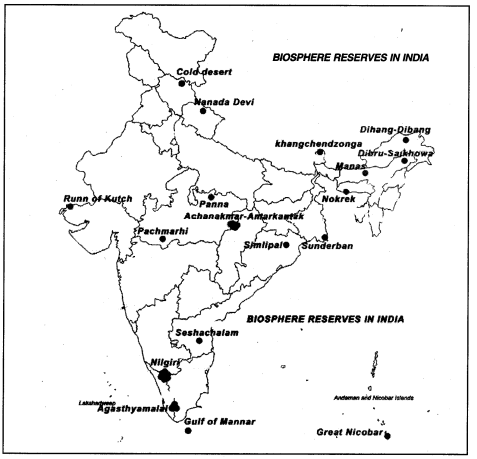
  3. देश में कई आरक्षित जीव मंडल (Biosphere Reserves) का निर्माण किया गया ताकि जानवरों की अनेकता को संभाल कर रखा जा सके। अब तक 18 आरक्षित जीव मंडल बनाए जा चुके हैं।
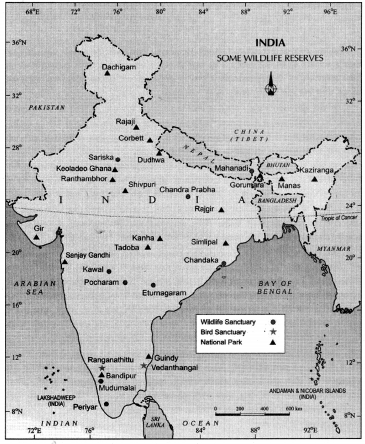
  4. जंगली जीवों को बचाने के लिए तथा उन्हें संभालने के लिए देश में 103 राष्ट्रीय उद्यान तथा 555 जंगली जीव अभ्यारण्य बन चुके हैं जहां शिकार करना गैर कानूनी है।

प्रश्न 11.
हमारी प्राकृतिक वनस्पति का वास्तव में प्राकृतिक न रहने के क्या कारण हैं ?
उत्तर-
हमारी प्राकृतिक वनस्पति वास्तव में प्राकृतिक नहीं रही। यह केवल देश के कुछ ही भागों में दिखाई पड़ती है। अन्य भागों में इसका बहुत बड़ा भाग या तो नष्ट हो गया है या फिर नष्ट हो रहा है। इसके निम्नलिखित कारण हैं

  1. तेजी से बढ़ती हुई हमारी जनसंख्या
  2. परंपरागत कृषि विकास की प्रथा
  3. चरागाहों का विनाश या अति चराई
  4. ईंधन व इमारती लकड़ी के लिए वनों का अंधाधुंध कटाव
  5. विदेशी पौधों में बढ़ती हुई संख्या।

प्रश्न 12.
देश के वन क्षेत्र का क्षेत्रीय तथा राज्यों के स्तर पर वर्णन कीजिए।
उत्तर-
देश के विकास तथा वातावरण के बीच संतुलन बनाए रखने के लिए देश की कम-से-कम 33 प्रतिशत भूमि पर वन अवश्य होने चाहिएं। परंतु भारत की केवल 22.7 प्रतिशत भूमि ही वनों के अधीन है। राज्यों के स्तर पर इसका वितरण बहुत ही असमान है, जो निम्नलिखित ब्योरे से स्पष्ट है-

  1. त्रिपुरा (59.6%), हिमाचल प्रदेश (48.1%), अरुणाचल प्रदेश (45.8%), मध्य प्रदेश तथा छत्तीसगढ़ (32.9%) तथा असम (29.3%) में अपेक्षाकृत अधिक वन क्षेत्र हैं।
  2. पंजाब (2.3%), राजस्थान (3.6%), गुजरात (8.8%), हरियाणा (12.1%), पश्चिमी बंगाल (12.5%) तथा उत्तर प्रदेश जैसे राज्यों में 15% से भी कम भूमि वनों के अधीन है।
  3. केंद्रीय शासित प्रदेशों में अंडमान व निकोबार द्वीप समूह में सबसे अधिक (94.6%) तथा राष्ट्रीय राजधानी क्षेत्र दिल्ली में सबसे कम (2.1%) वन क्षेत्र हैं।

PSEB 9th Class Social Science Guide भारत आकार व स्थिति Important Questions and Answers (4)

प्रश्न 13.
पतझड़ या मानसूनी वनस्पति पर संक्षेप में टिप्पणी लिखें।
उत्तर-
वह वनस्पति जो ग्रीष्म ऋतु के शुरू होने से पहले अधिक वाष्पीकरण को रोकने के लिए अपने पत्ते गिरा देती है, पतझड़ या मानसून की वनस्पति कहलाती है। इस वनस्पति को वर्षा के आधार पर आई व आर्द्र-शुष्क दो उपभागों में बांटा जा सकता है।

  1. आई पतझड़ वन-इस तरह की वनस्पति उन चार बड़े क्षेत्रों में पाई जाती है, जहां पर वार्षिक वर्षा 100 से 200 से० मी० तक होती है।
    इन क्षेत्रों में पेड़ कम सघन होते हैं परंतु इनकी ऊंचाई 30 मीटर तक पहुंच जाती है। साल, शीशम, सागौन, टीक, चंदन, जामुन, अमलतास, हलदू, महुआ, शारबू, ऐबोनी, शहतूत इन वनों के प्रमुख वृक्ष हैं। .
  2. शुष्क पतझड़ी वनस्पति-इस प्रकार की वनस्पति 50 से 100 सें. मी. से कम वर्षा वाले क्षेत्रों में मिलती है।
    इसकी लंबी पट्टी पंजाब से आरंभ होकर दक्षिण के पठार के मध्यवर्ती भाग के आस-पास के क्षेत्रों तक फैली हुई है। बबूल, बरगद, हलदू यहां के मुख्य वृक्ष हैं।

प्रश्न 14.
पूर्वी हिमालय में किस प्रकार की वनस्पति मिलती है ?
उत्तर-
पूर्वी हिमालय में 4000 किस्म के फूल और 250 किस्म की फर्न मिलती है। यहां की वनस्पति पर ऊंचाई के बढ़ने से तापमान और वर्षा में आए अंतर का गहरा प्रभाव पड़ता है।

  1. यहां 1200 मीटर की ऊंचाई तक पतझड़ी वनस्पति के मिश्रित वृक्ष अधिक मिलते हैं।
  2. यहां 1200 से लेकर 2000 मीटर की ऊंचाई तक घने सदाबहार वन मिलते हैं। साल और मैंगनोलिया इन वनों के प्रमुख वृक्ष हैं। इनमें दालचीनी, अमूरा, चिनोली तथा दिलेनीआ के वृक्ष भी मिलते हैं। .
  3. यहां पर 2000 से 2500 मीटर की ऊंचाई तक तापमान कम हो जाने के कारण शीतोष्ण प्रकार (Temperate type) की वनस्पति पाई जाती है। इसमें ओक, चेस्टनट, लॉरेल, बर्च, मैपल तथा ओलढर जैसे चौड़ी पत्ती वाले वृक्ष मिलते हैं।

प्रश्न 15.
प्राकृतिक वनस्पति के अंधाधुंध कटाव से होने वाली हानियों का वर्णन कीजिए।
उत्तर-
प्राकृतिक वनस्पति का हमारे जीवन में बहुत महत्त्व है। परंतु पिछले कुछ वर्षों में प्राकृतिक वनस्पति की अंधाधुंध कटाई की गई है। इस कटाई से हमें निम्नलिखित हानियां हुई हैं

  1. प्राकृतिक वनस्पति की कटाई से वातावरण का संतुलन बिगड़ गया है।
  2. पहाड़ी ढलानों और मैदानी क्षेत्रों के वनस्पति विहीन होने के कारण बाढ़ व मृदा अपरदन की समस्याएं उत्पन्न हो गई हैं।
  3. पंजाब के उत्तरी भागों में शिवालिक पर्वतमालाओं के निचले भाग में बहने वाले बरसाती नालों के क्षेत्रों में वनकटाव से भूमि कटाव की समस्या के कारण बंजर जमीन में वृद्धि हुई है।
  4. मैदानी क्षेत्रों का जल-स्तर भी प्रभावित हुआ है जिससे कृषि को सिंचाई की समस्या से जूझना पड़ रहा है।

प्रश्न 16.
मिट्टी कटाव के कारणों पर प्रकाश डालिए।
उत्तर-
मिट्टी का कटाव मुख्य रूप से दो कारणों से होता है-

  1. भौतिक क्रियाओं द्वारा तथा मानव क्रियाओं द्वारा। आज के समय में मानव क्रियाओं से मिट्टियों के कटाव की प्रक्रिया बढ़ती जा रही है।
  2. भौतिक तत्त्वों में उच्च तापमान, बर्फीले तूफान, तेज़ हवाएं, मूसलाधार वर्षा तथा तीव्र ढलानों की गणना होती है। ये मिट्टियों के कटाव के प्रमुख कारक हैं। मानवीय क्रियाओं में जंगलों की कटाई, पशुओं की बेरोकटोक चराई, स्थानांतरी कृषि की दोषपूर्ण पद्धति, खानों की खुदाई आदि तत्त्व आते हैं।

प्रश्न 17.
शुष्क पतझड़ी वनस्पति पर संक्षिप्त नोट लिखो।
उत्तर-
इस प्रकार की वनस्पति 50 से 100 से० मी० से कम वर्षा वाले क्षेत्रों में मिलती है।
क्षेत्र-इसकी एक लंबी पट्टी पंजाब से लेकर हरियाणा, दक्षिण-पश्चिमी उत्तर प्रदेश, पूर्वी राजस्थान, काठियावाड़, दक्षिण के पठार के मध्यवर्ती भाग के आस-पास के क्षेत्रों में फैली हुई है।
प्रमुख वृक्ष-इस वनस्पति में शीशम या टाहली, बबूल, बरगद, हलदू जैसे वृक्ष प्रचुर मात्रा में पाए जाते हैं। इसमें चंदन, महुआ, सीरस तथा सागवान जैसे कीमती वृक्ष भी मिलते हैं। ये वृक्ष प्रायः गर्मियां शुरू होते ही अपने पत्ते गिरा देते हैं।

प्रश्न 18.
वन्य प्राणियों की रक्षा करना प्रत्येक नागरिक का कर्त्तव्य क्यों है ?
उत्तर-
हमारे वनों में बहुत-से महत्त्वपूर्ण पशु-पक्षी पाए जाते हैं। परंतु खेद की बात यह है कि पक्षियों और जानवरों की अनेक जातियां हमारे देश से लुप्त हो चुकी हैं। अत: वन्य प्राणियों की रक्षा करना हमारे लिए बहुत आवश्यक है। मनुष्य ने अपने व्यक्तिगत लाभ के लिए वनों को काटकर तथा जानवरों का शिकार करके दुःखदायी स्थिति उत्पन्न कर दी है। आज गैंडा, चीता, बंदर, शेर और सारंग नामक पशु-पक्षी बहुत ही कम संख्या में मिलते हैं। इसलिए प्रत्येक नागरिक का यह कर्त्तव्य है कि वह वन्य प्राणियों की रक्षा करे।

प्रश्न 19.
हमारे जीवन में पशुओं का क्या महत्त्व है ?
उत्तर-
हमारे देश में विशाल पशु धन पाया जाता है, जिन्हें किसान अपने खेतों पर पालते हैं। पशुओं से किसान को गोबर प्राप्त होता है, जो मृदा की उर्वरता को बनाए रखने में उसकी सहायता करता है। पहले किसान गोबर को ईंधन के रूप में प्रयोग करते थे, परंतु अब प्रगतिशील किसान गोबर को ईंधन और खाद दोनों रूपों में प्रयोग करते हैं। खेत में गोबर को उर्वरक के रूप में प्रयोग करने से पहले वे उससे गैस बनाते हैं जिस पर वे खाना बनाते हैं और रोशनी प्राप्त करते हैं। पशुओं की खालें बड़े पैमाने पर निर्यात की जाती हैं। पशुओं से हमें ऊन प्राप्त होती है।

प्रश्न 20.
वन्य जीवों के संरक्षण पर एक संक्षेप टिप्पणी लिखें।
उत्तर-
वन्य जीवों का संरक्षण-भारत में विभिन्न प्रकार के वन्य जीव पाए जाते हैं। उनकी उचित देखभाल न होने से जीवों की कई एक जातियां या तो लुप्त हो गई हैं या लुप्त होने वाली हैं। इन जीवों के महत्त्व को देखते हुए अब इनकी सुरक्षा और संरक्षण के उपाय किये जा रहे हैं। नीलगिरि में भारत का पहला जीव आरक्षित क्षेत्र स्थापित किया गया। यह कर्नाटक, तमिलनाडु तथा केरल के सीमावर्ती क्षेत्रों में फैला हुआ है। इसकी स्थापना 1986 में की गई थी। नीलगिरि के पश्चात् 1988 ई० में उत्तराखंड (वर्तमान) में नंदा देवी का जीव आरक्षित क्षेत्र बनाया गया। उसी वर्ष मेघालय में तीसरा ऐसा ही क्षेत्र स्थापित किया गया। एक और जीव आरक्षित क्षेत्र अंडमान तथा निकोबार द्वीप समूह में स्थापित किया गया है। इन जीव आरक्षित क्षेत्रों के अतिरिक्त भारत सरकार द्वारा अरुणाचल प्रदेश, तमिलनाडु, राजस्थान, गुजरात तथा असम में भी जीव आरक्षित क्षेत्र स्थापित किए गए हैं।

दीर्घ उत्तरों वाले प्रश्न

प्रश्न 1.
“देश में उष्ण सदाबहार वनस्पति से लेकर अल्पाइन वनस्पति तक का क्रम मिलता है।” इस कथन की पुष्टि कीजिए।
उत्तर-
भारत की वनस्पति में व्यापक विविधता देखने को मिलती है। इसका मुख्य कारण है-देश में पाई जाने वाली विविध प्रकार की जलवायु दशाएं तथा धरातलीय असमानता। केवल पर्वतीय क्षेत्रों में ही ऊंचाई के साथ-साथ एक के बाद एक वनस्पति क्षेत्र पाए जाते हैं। यहां उष्ण सदाबहार वनस्पति से लेकर अल्पाइन वनस्पति तक देखने को मिलती है। निम्नलिखित विवरण से यह बात स्पष्ट हो जाएगी-

  1. शिवालिक श्रेणियों के वन-हिमालय की गिरिपाद शिवालिक श्रेणियों में ऊष्ण कटिबंधीय आर्द्र पर्णपाती वन पाए जाते हैं। आर्थिक दृष्टि से इन वनों का सबसे महत्त्वपूर्ण वृक्ष साल हैं। यहां पर बांस भी बहुत होता है।
  2. 1200 से 2000 मीटर की ऊंचाई पर पाए जाने वाले वन-समुद्र तल से 1200 से लेकर 2000 मीटर तक की ऊंचाई पर घने सदाबहार वन पाए जाते हैं। इन वनों में सदा हरित चौड़ी पत्ती वाले साल तथा चेस्टनट के वृक्ष सामान्य रूप में मिलते हैं। ऐश तथा बीच इन वनों के अन्य वृक्ष हैं।
  3. 2000 से 2500 मीटर की ऊंचाई पर पाये जाने वाले वन-समुद्र तल से 2000 से लेकर 2500 मीटर की ऊंचाई तक शीतोष्ण कटिबंध के शंकुधारी वन पाए जाते हैं। इन वनों में मुख्य रूप से बीच, चीड़, सीडर, सिल्वर, फ़र तथा स्परूस के वृक्ष मिलते हैं। हिमालय की आंतरिक श्रेणियों में तथा अपेक्षाकृत शुष्क भागों में देवदार का वृक्ष भलीभांति पनपता है।
  4. 2500 मीटर से अधिक ऊंचाई पर पाये जाने वाले वन-समुद्र तल से 2500 मीटर से अधिक ऊंचाई पर अल्पाइन वन पाये जाते हैं। सिल्वर, फ़र, चीड़, भुर्ज (बर्च) तथा जूनिपर (हपूशा) इन वनों के प्रमुख वृक्ष हैं। इसके पश्चात् अल्पाइन वनों का स्थान झाड़ियां, गुल्म तथा घास-भूमियां ले लेती हैं।
    दक्षिणी पठार के पहाड़ी भागों में भी पर्वतीय वनस्पति मिलती है। यहां के नीलगिरि पर्वतीय क्षेत्रों में 200 सें० मी० से अधिक वर्षा होती है। इसी कारण यहां पर चौड़े-पत्तों वाले सदाबहार वन 1800 मीटर तक की ऊंचाई पर मिल जाते हैं। दक्षिण भारत में इनको ‘शोला वन’ कहा जाता है। इनमें जामुन, मैचीलस, मैलियोसोमा, सैलटिस आदि प्रमुख वृक्ष हैं। परंतु 1800 से 3000 की ऊंचाई पर शीतोष्ण कोणधारी वनस्पति मिलती है। इसमें सिल्वर, फर, चीड़, बर्च, पीला चम्पा जैसे वृक्ष मिलते हैं। इससे अधिक ऊंचाई पर छोटी-छोटी घास मिलती है।

प्रश्न 2.
प्राकृतिक वनस्पति (वनों) के लाभों का वर्णन करो।
उत्तर-
प्राकृतिक वनस्पति से हमें कई प्रत्यक्ष तथा परोक्ष लाभ होते हैं।
प्रत्यक्ष लाभ-प्राकृतिक वनस्पति से होने वाले प्रत्यक्ष लाभों का वर्णन इस प्रकार है-

  1. वनों से हमें कई प्रकार की लकड़ी प्राप्त होती है, जिसका प्रयोग इमारतें, फ़र्नीचर, लकड़ी-कोयला इत्यादि बनाने में होता है। इसका प्रयोग ईंधन के रूप में भी होता है।
  2. खैर, सिनकोना, कुनीन, बहेड़ा व आंवले से कई प्रकार की औषधियां तैयार की जाती हैं।
  3. मैंग्रोव, कंच, गैंबीअर, हरड़, बहेड़ा, आंवला और बबूल इत्यादि के पत्ते, छिलके व फलों को सूखाकर चमड़ा रंगने का पदार्थ तैयार किया जाता है।
  4. पलाश व पीपल से लाख, शहतूत से रेशम, चंदन से तुंग व तेल और साल से धूपबत्ती व बिरोज़ा तैयार किया जाता है।

परोक्ष लाभ-प्राकृतिक वनस्पति से हमें निम्नलिखित परोक्ष लाभ होते हैं-

  1. वन जलवायु पर नियंत्रण रखते हैं। सघन वन गर्मियों में तापमान को बढ़ने से रोकते हैं तथा सर्दियों में तापमान को बढ़ा देते हैं।
  2. सघन वनस्पति की जड़ें बहते हुए पानी की गति को कम करने में सहायता करती हैं। इससे बाढ़ का प्रकोप कम हो जाता है। दूसरे जड़ों द्वारा रोका गया पानी भूमि के अंदर समा लिए जाने से भूमिगत जल-स्तर (Water-table) ऊंचा उठ जाता है। वहीं दूसरी ओर धरातल पर पानी की मात्रा कम हो जाने से पानी नदियों में आसानी से बहता रहता है।
  3. वृक्षों की जड़ें मिट्टी की जकड़न को मज़बूत किए रहती हैं और मिट्टी के कटाव को रोकती हैं।
  4. वनस्पति के सूखकर गिरने से जीवांश के रूप में मिट्टी को हरी खाद मिलती है।
  5. हरी-भरी वनस्पति बहुत ही मनोरम दृश्य प्रस्तुत करती है। इससे आकर्षित होकर लोग सघन वन क्षेत्रों में यात्रा, शिकार तथा मानसिक शांति के लिए जाते हैं। कई विदेशी पर्यटक भी वन-क्षेत्रों में बने पर्यटन केंद्रों पर आते हैं। इससे सरकार को विदेशी मुद्रा प्राप्त होती है।
  6. सघन वन अनेक उद्योगों के आधार हैं। इनमें से कागज़, लाख, दियासिलाई, रेशम, खेलों का सामान, प्लाईवुड, गोंद, बिरोज़ा इत्यादि उद्योग प्रमुख हैं।

प्रश्न 3.
भारतीय मिट्टियों की किस्मों एवं विशेषताओं का उल्लेख कीजिए।
उत्तर-
भारत में कई प्रकार की मिट्टियां पाई जाती हैं। इनके गुणों के आधार पर इन्हें निम्नलिखित वर्गों में बांटा जा सकता है-

  1. जलोढ़ मिट्टी (Alluvial Soil) भारत में जलोढ़ मिट्टी उत्तरी मैदान, राजस्थान, गुजरात तथा दक्षिण के तटीय मैदानों में सामान्य रूप से मिलती है। इसमें रेत, गाद तथा मृत्तिका मिली होती है। जलोढ़ मिट्टी दो प्रकार की होती हैखादर तथा बांगर।
    जलोढ़ मिट्टियां सामान्यतः सबसे अधिक उपजाऊ होती हैं। इन मिट्टियों में पोटाश, फॉस्फोरस अम्ल तथा चूना पर्याप्त मात्रा में होता है। परंतु इनमें नाइट्रोजन तथा जैविक पदार्थों की कमी होती है।-
  2. काली अथवा रेगड़ मिट्टी (Black Soil)—इस मिट्टी का निर्माण लावा के प्रवाह से हुआ है। यह मिट्टी कपास की फसल के लिए बहुत लाभदायक है। अतः इसे कपास वाली मिट्टी भी कहा जाता है। इस मिट्टी का स्थानीय नाम ‘रेगड़’ है। यह मिट्टी दक्कन ट्रैप प्रदेश की प्रमुख मिट्टी है। यह पश्चिम में मुंबई से लेकर पूर्व में अमरकंटक पठार, उत्तर में गुना (मध्य प्रदेश) और दक्षिण में बेलगाम तक त्रिभुजाकार क्षेत्र में फैली हुई है।
    काली मिट्टी नमी को अधिक समय तक धारण कर सकती है। इस मृदा में लौह, पोटाश, चूना, एल्यूमीनियम तथा मैग्नीशियम की मात्रा अधिक होती है। परंतु नाइट्रोजन, फॉस्फोरस तथा जीवांश की मात्रा कम होती है।
  3. लाल मिट्टी (Red Soil)-इस मिट्टी का लाल रंग लोहे के रवेदार तथा परिवर्तित चट्टानों में बदल जाने के कारण होता है। इसका विस्तार तमिलनाडु, कर्नाटक, आंध्र प्रदेश, ओडिशा, दक्षिणी बिहार, झारखंड, पूर्वी मध्य प्रदेश, छत्तीसगढ़ तथा उत्तरी-पूर्वी पर्वतीय राज्यों में है। लाल मिट्टी में नाइट्रोजन तथा चूने की कमी, परंतु मैग्नीशियम, एल्यूमीनियम तथा लोहे की मात्रा अधिक होती है।।
  4. लैटराइट मिट्टी (Laterite Soil) इस मिट्टी में नाइट्रोजन, चूना तथा पोटाश की कमी होती है। इसमें लोहे तथा एल्यूमीनियम ऑक्साइड की मात्रा अधिक होने के कारण इसका स्वभाव तेज़ाबी हो जाता है। इसका विस्तार विंध्याचल, सतपुड़ा के साथ लगे मध्य प्रदेश, ओडिशा पश्चिमी बंगाल की बैसाल्टिक पर्वतीय चोटियों, दक्षिणी महाराष्ट्र तथा उत्तर-पूर्व में शिलांग के पठार के उत्तरी तथा पूर्वी भाग में है।
  5. मरुस्थलीय मिट्टी (Desert Soil)—इस मिट्टी का विस्तार पश्चिम में सिंधु नदी से लेकर पूर्व में अरावली पर्वतों तक है। यह राजस्थान, दक्षिणी पंजाब व दक्षिणी हरियाणा में फैली हुई है। इसमें घुलनशील नमक की मात्रा अधिक होती है। परंतु इसमें नाइट्रोजन तथा ह्यूमस की बहुत कमी होती है। इसमें 92% रेत व 8% चिकनी मिट्टी का अंश होता है। इसमें सिंचाई की सहायता से बाजरा, ज्वार, कपास, गेहूं, सब्जियां आदि उगाई जा रही हैं।
  6. खारी व तेजाबी मिट्टी (Saline & Alkaline Soil)—यह उत्तर प्रदेश, राजस्थान, हरियाणा व पंजाब के दक्षिणी भागों में छोटे-छोटे टुकड़ों में मिलती है। खारी मिट्टियों से सोडियम भरपूर मात्रा में मिलता है। तेज़ाबी मिट्टी में कैल्शियम व नाइट्रोजन की कमी होती है। इसी लवणीय मिट्टी को उत्तर प्रदेश में औसढ़’ या ‘रेह’, पंजाब में ‘कल्लर’ या ‘थुड़’ तथा अन्य भागों में ‘रक्कड़’ कार्ल और ‘छोपां’ मिट्टी भी कहा जाता है।
  7. पीट एवं दलदली मिट्टी (Peat & Marshy Soil)-इसका विस्तार सुंदरवन डेल्टा, उड़ीसा के तटवर्ती क्षेत्र, तमिलनाडु के दक्षिण-पूर्वी तटवर्ती भाग, मध्यवर्ती बिहार तथा उत्तराखंड के अल्मोड़ा में है। इसका रंग जैविक पदार्थों की अधिकता के कारण काला तथा तेजाबी स्वभाव वाला होता है। जैविक पदार्थों की अधिकता के कारण कहीं-कहीं इसका रंग नीला भी है।
  8. पर्वतीय मिट्टी (Mountain Soil)—इस मिट्टी में रेत, पत्थर तथा बजरी की मात्रा अधिक होती है। इसमें चूना कम लेकिन लोहे की मात्रा अधिक होती है। यह चाय की खेती के लिए अनुकूल होती है। इसका विस्तार असम, लद्दाख, लाहौल-स्पीति, किन्नौर, दार्जिलिंग, देहरादून, अल्मोड़ा, गढ़वाल व दक्षिण में नीलगिरि के पर्वतीय क्षेत्र में है।

प्रश्न 4.
भारत में पाये जाने वाले वन्य प्राणियों का वर्णन करो।
उत्तर-
वनस्पति की भांति ही हमारे देश के जीव-जंतुओं में भी बड़ी विविधता है। भारत में इनकी 81,000 जातियां पाई जाती हैं। देश के ताज़े और खारे पानी में 2500 जातियों की मछलियां मिलती हैं। इसी प्रकार यहां पर पक्षियों की भी 2000 जातियां पाई जाती हैं। मुख्य रूप से भारत के वन्य प्राणियों का वर्णन इस प्रकार है-

  1. हाथी-हाथी राजसी ठाठ-बाठ वाला पशु है। यह ऊष्ण आर्द्र वनों का पशु है। यह असम, केरल तथा कर्नाटक के जंगलों में पाया जाता है। इन स्थानों पर भारी वर्षा के कारण बहुत घने वन मिलते हैं।
  2. ऊंट-ऊंट गर्म तथा शुष्क मरुस्थलों में पाया जाता है।
  3. जंगली गधा-जंगली गधे कच्छ के रण में मिलते हैं।
  4. एक सींग वाला गैंडा-एक सींग वाले गैंडे असम और पश्चिमी बंगाल के उत्तरी भागों के दलदली क्षेत्रों में पाए जाते हैं।
  5. बंदर-भारत में बंदरों की अनेक जातियां मिलती हैं। इनमें से लंगूर सामान्य रूप से पाया जाता है। पूंछ वाला बन्दर (मकाक) बड़ा ही विचित्र जीव है। इसके मुंह पर चारों ओर बाल उगे होते हैं जो एक प्रभामण्डल के समान दिखाई देते हैं।
  6. हिरण-भारत में हिरणों की अनेक जातियां पाई जाती हैं। इनमें चौसिंघा, काला हिरण, चिंकारा तथा सामान्य हिरण प्रमुख हैं। यहां हिरणों की कुछ अन्य जातियां भी मिलती हैं। इनमें कश्मीरी बारहसिंघा, दलदली मृग, चित्तीदार मृग, कस्तूरी मृग तथा मूषक मृग उल्लेखनीय हैं।
  7. शिकारी जंतु-शिकारी जंतुओं में भारतीय सिंह का विशिष्ट स्थान है। अफ्रीका के अतिरिक्त यह केवल भारत में ही मिलता है। इसका प्राकृतिक आवास गुजरात में सौराष्ट्र के गिर वनों में है। अन्य शिकारी पशुओं में शेर, तेंदुआ, लामचिता (क्लाउडेड लियोपार्ड) तथा हिम तेंदुआ प्रमुख हैं।
  8. अन्य जीव-जंतु-हिमालय की श्रृंखलाओं में भी अनेक प्रकार के जीव-जंतु रहते हैं। इनमें जंगली भेड़ें तथा पहाड़ी बकरियां विशेष रूप से उल्लेखनीय हैं। भारतीय जंतुओं में भारतीय मोर, भारतीय भैंसा तथा नील गाय प्रमुख हैं। भारत सरकार कुछ जातियों के जीव-जंतुओं के संरक्षण के लिए विशेष प्रयत्न कर रही है।

PSEB 11th Class Chemistry Solutions Chapter 2 Structure of Atom

Punjab State Board PSEB 11th Class Chemistry Book Solutions Chapter 2 Structure of Atom Textbook Exercise Questions and Answers.

PSEB Solutions for Class 11 Chemistry Chapter 2 Structure of Atom

PSEB 11th Class Chemistry Guide Structure of Atom InText Questions and Answers

Question 1.
(i) Calculate the number of electrons which will together weigh one gram.
(ii) Calculate the mass and charge of one mole of electrons.
Answer:
(i) Mass of one electron = 9.1 × 10⁻³¹ g
Number of electrons in 1.0 g = \(\frac{1}{9.1 \times 10^{-31}}\) = 1.098 x 1030 electrons

(ii) One mole of electron = 6.022 × 10²³ electrons
Mass of 1 electron = 9.1 × 10⁻³¹ kg
Mass of 6.022 × 10²³ electrons – (9.1 x 10⁻³¹ kg) × (6.022 x 10²³)
= 5.48 × 10⁻⁷ kg
Charge on one electron = 1.602 × 10⁻¹⁹ coulomb
Charge on one mole of electrons = 1.602 × 10-19 × 6.022 × 1023
= 9.65 × 10⁴ coulomb.

PSEB 11th Class Chemistry Solutions Chapter 2 Structure of Atom

Question 2.
(i) Calculate the total number of electrons present in one mole of methane.
(ii) Find (a) the total number and (b) the total mass of neutrons in 7 mg of 14C.
(Assume that mass of a neutron = 1.675 × 10⁻²⁷ kg)
(iii) Find (a) the total number and (b) the total mass of protons in 34 mg of NH3 at STP.
Will the answer change if the temperature and pressure are changed?
Answer:
(i) Number of electrons present in 1 molecule of methane (CH4)
= {1(6) + 4(1)} = 10 electrons
Number of electrons present in 1 mole i.e., 6.022 × 10²³ molecules of
methane = 6.022 × 1023 × 10 = 6.022 × 1024 electrons
(ii) (a) Mass of a neutron = 1.675 × 10⁻²⁷ kg
14.0 g of 14C contains 1 mole of atoms of C-14
∴ 14.0 g of 14C contains 8 × 6.022 × 1023 neutrons
[∵ each atom of C-14 contains 8 neutrons]
7 mg (= 7 × 10⁻³ g) of 14C contains
= \(\frac{6.022 \times 10^{23} \times 8 \times 7 \times 10^{-3}}{14}\) = 2.4092 × 10²¹ neutrons

(b) Mass of one neutron = 1.675 × 1027 kg
Mass of 2.4092 × 10²¹ neutrons
= (2.4092 × 10²¹)(1.675 × 10⁻²⁷ kg) = 4.035 × 10⁻⁶ kg

(iii) 1 mole of NH3 contains protons = 7 + 3 = 10 moles of protons
= 6.022 × 1023 × 10 protons = 6.022 × 1024 protons

(a) 17 gNH3 contains 6.022 × 1024 protons.
Number of protons in 34 mg NH3 will contain
= \(6.022 \times 10^{24} \times 34 \times 10^{-3}\) = 1.2046 x 10²² Protons

(b) Mass of one proton = 1.675 x 10⁻²⁷ kg
Total mass of protons in 34 mg of NH3
– (1.675 × 10⁻²⁷ kg) (1.2046 × 10²²)
= 2.0177 × 10⁻⁵ kg
The number of protons, electrons and neutrons in an atom is independent of temperature and pressure conditions. Hence, the obtained values will remain unchanged if the temperature and pressure is changed.

Question 3.
How many neutrons and protons are there in the following nuclei?
\({ }_{6}^{13} \mathrm{C},{ }_{8}^{16} \mathrm{O},{ }_{12}^{24} \mathrm{Mg},{ }_{26}^{56} \mathrm{Fe},{ }_{38}^{88} \mathrm{Sr}\)
Answer:
\({ }_{6}^{13} \mathrm{C}\)C : Atomic mass =13
Atomic number = Number of protons = 6
Number of neutrons = (Atomic mass) – (Atomic number)
= 13 – 6 = 7
\({ }_{8}^{16} \mathrm{O}\) :
Atomic mass =16
Atomic number = 8
Number of protons = 8
Number of neutrons = (Atomic mass) – (Atomic number)
= 16 – 8 = 8
\({ }_{12}^{24} \mathrm{Mg}\) : Atomic mass = 24
Atomic number = Number of protons = 12
Number of neutrons = (Atomic mass) – (Atomic number)
= 24-12 = 12
\({ }_{26}^{56} \mathrm{Fe}\) : Atomic mass = 56
Atomic number = Number of protons = 26
Number of neutrons = (Atomic mass) – (Atomic number)
= 56 – 26 = 30
\({ }_{38}^{88} \mathrm{Sr}\) : Atomic mass = 88
Atomic number = Number of protons = 38
Number of neutrons = (Atomic mass) – (Atomic number)
= 88 – 38 = 50

Question 4.
Write the complete symbol for the atom with the given atomic number (Z) and atomic mass (A)
(i) Z = 17, A = 35
(ii) Z = 92, A = 233
(iii) Z = 4, A = 9
Answer:
(i) Z = 17, A = 35
Since the no. of protons = 17 – no. of electrons
∴ The atom is chlorine, Cl: \({ }_{17}^{35} \mathrm{Cl}\)

(ii) Z = 92, A = 233
No. of protons = 92
∴ The atom is uranium, U : \({ }_{92}^{233} U\)

(iii) Z = 4, A = 9
No. of protons = 4
∴ The atom is Beryllium, Be : \({ }_{4}^{9} \mathrm{Be}\)

PSEB 11th Class Chemistry Solutions Chapter 2 Structure of Atom

Question 5.
Yellow light emitted from a sodium lamp has a wavelength (A.) of 580 nm. Calculate the frequency (υ) and wave number (\(\overline{\mathbf{v}}\)) of the ‘ yellow light.
Answer:
We know that,
Frequency, v = \(\frac{c}{\lambda}\)
1 nm = 10-9 m
580 nm = 580 × 10-9 m = 580 x 10-7 cm
v = \(\) = 5.17 × 10¹⁴s-1
(velocity of light = 3 × 10⁸ m/s)
Wave number, \(\bar{v}=\frac{1}{\lambda}\)
= \(\frac{1}{580 \times 10^{-7}}\) = 1.72 × 104 cm-1

Question 6.
Find energy of each of the photons which
(i) correspond to light of frequency 3 × 10¹⁵ Hz.
(ii) have wavelength of 0.50 Å
Answer:
(i) Energy E = hv
where, h = Planck’s constant = 6.626 × 10⁻³⁴ Js
and v = frequency of light = 3 × 10¹⁵ Hz
E= (6.626 × 10⁻³⁴)(3 × 10¹⁵)
E = 1.988 × 10⁻¹⁸ J

(ii) Energy E = \(\frac{h c}{\lambda}\)
where, h = Planck’s constant = 6.626 × 10⁻³⁴ Js
c = velocity of light in vacuum = 3 × 10⁸ m/s
= wavelength = 0.50Å = 0.50 × 10⁻¹⁰
E = \(\frac{\left(6.626 \times 10^{-34}\right)\left(3 \times 10^{8}\right)}{0.50 \times 10^{-10}}\) = 3.976 × 10⁻¹⁵ J

Question 7.
Calculate the wavelength, frequency and wave number of a light wave whose period is 2.0 × 10⁻¹⁰ s.
Answer:
Frequency of light (v) = \(\frac{1}{\text { Time period }}=\frac{1}{2.0 \times 10^{-10} \mathrm{~s}}\) = 5.0 × 10⁹s-1
Wavelength of light (λ) = \(\frac{c}{v}\)
where, c = velocity of light in vacuum = 3 × 10⁸ m/s
λ = \(\frac{3 \times 10^{8}}{5.0 \times 10^{9}}\) = 6.0 × 10⁻² m
Wave number(\(\bar{v}\)) of light
= \(\frac{1}{\lambda}=\frac{1}{6.0 \times 10^{-2}}\) = 1.66 × 101m-1 = 16.66m-1

Question 8.
What is the number of photons of light with a wavelength of 4000 pm that provide 1 J of energy?
Answer:
Energy (E) of a photon = hv = \(\frac{h c}{\lambda}\)
where, = wavelength of light = 4000 pm = 4000 × 10-12 m
(∵ 1 pm = 10-12 m)
c = velocity of light in vacuum = 3 × 10⁸ m/s
h = Planck’s constant = 6.626 × 10⁻³⁴ Js
E = \(\frac{6.626 \times 10^{-34} \times 3 \times 10^{8}}{4000 \times 10^{-12}}\) = 4.9695 × 10⁻¹⁷J
Number of protons, N = \(\frac{1}{4.9695 \times 10^{-17}}\) = 2.0122 × 10¹⁶ protons.

Question 9.
A photon of wavelength 4 × 10⁻⁷ m strikes on metal surface, the work function of the metal being 2.13 eV. Calculate (i) the energy of the photon (eV), (ii) the kinetic energy of the emission, and (iii) the velocity of the photoelectron (1 eV = 1.6020 × 10⁻¹⁹ J).
Answer:
(i) Energy (E) of a photon = hv = \(\frac{h c}{\lambda}\)
where,
h = Planck’s constant = 6.626 × 10⁻³⁴ Js
c = velocity of light in vacuum = 3 × 10⁸ m/s
λ = wavelength of photon =4 × 10⁻⁷ m
E = \(\frac{\left(6.626 \times 10^{-34}\right)\left(3 \times 10^{8}\right)}{4 \times 10^{-7}}\)
= 4.9695 × 10⁻¹⁹j = \(\frac{4.9695 \times 10^{-19}}{1.602 \times 10^{-19}}\) [∵ 1 eV = 1.602 x 10⁻¹⁹J]
= 3.10 eV
Hence, the energy of the photon is 3.10 eV.

(ii) The kinetic energy of emission Ek is given by
= hv – hv0 = (E – W) eV
= 3.10 – 2.13 eV = 0.97 eV
Hence, the kinetic energy of emission is 0.97 eV.

(iii) The velocity of a photoelectron is given by
KE = \(\frac{1}{2}\) mv2 – hv – hv0 = 0.97 eV
\(\frac{1}{2}\)mv2 = 0.97 × 1.602 × 10-19 J
(∵ 1 eV = 1.602 x 10⁻¹⁹ J)
\(\frac{1}{2}\) × 9.11 × 10⁻³¹ kg × v2 = 0.97 × 1.602 × 10-19 J
(∵ mass of electron = 9.11 × 10⁻³¹ kg)
v2 = \(\frac{0.97 \times 1.602 \times 10^{-19} \times 2}{9.11 \times 10^{-31}}\) = 0.341 × 10¹²
v = 0.584 × 106 = 5.84 × 10⁵ m/s
Hence, the velocity of the photoelectron is 5.84 × 10⁵ ms-1.

Question 10.
Electromagnetic radiation of wavelength 242 run is just sufficient to ionise the sodium atom. Calculate the ionisation energy of sodium in kJ mol-1.
Answer:
Energy (E) = \(\frac{h c}{\lambda}\)
= \(\frac{\left(6.626 \times 10^{-34} \mathrm{Js}\right)\left(3 \times 10^{8} \mathrm{~ms}^{-1}\right)}{242 \times 10^{-9} \mathrm{~m}}\)
= 0.0821 × 10⁻¹⁷ J
This energy is sufficient for ionisation of one Na atom.
E = 6.02 × 1023 × 0.0821 × 10-17 J/mol
E = 4.945 × 10⁵ J/mol = 4.945 × 10² kJ/mol

PSEB 11th Class Chemistry Solutions Chapter 2 Structure of Atom

Question 11.
A 25 watt bulb emits monochromatic yellow light of wavelength of 0.57 (am. Calculate the rate of emission of quanta per second.
Answer:
Power of bulb, P = 25 watt = 25 Js-1
Wavelength,
λ = 0.57 µm = 0.57×10⁻⁶ m
Energy of one photon,
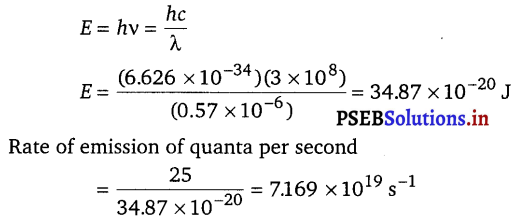
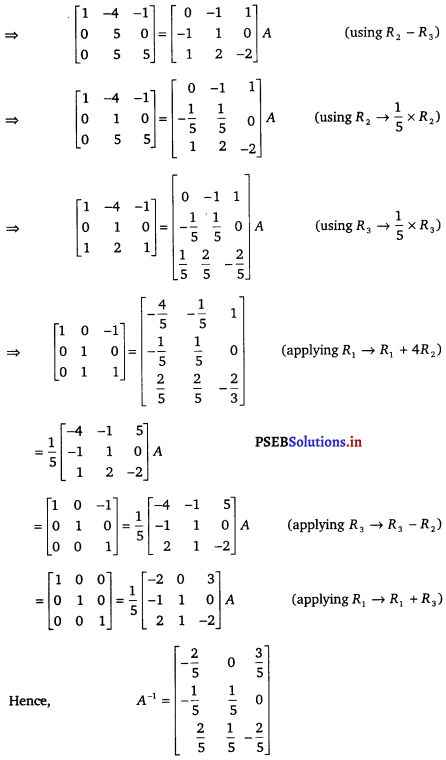
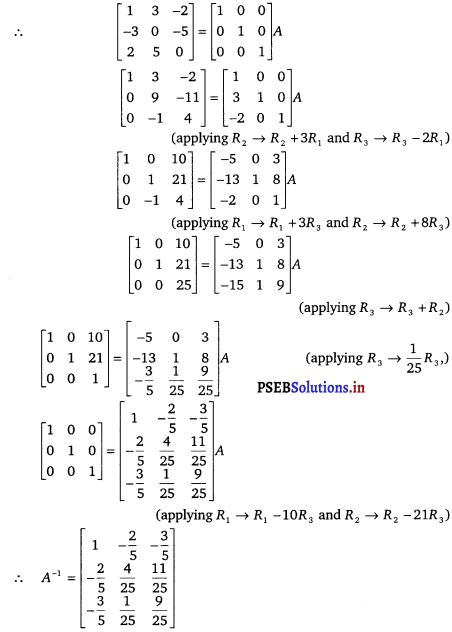
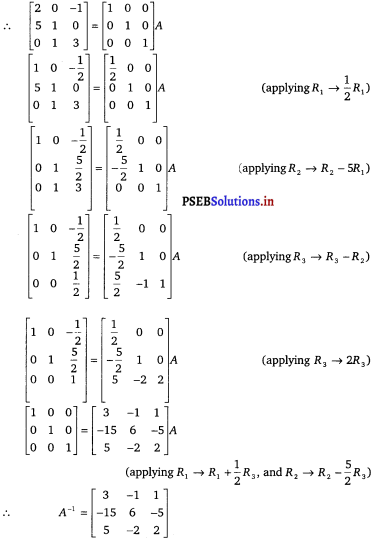
PSEB 11th Class Chemistry Solutions Chapter 2 Structure of Atom 1

Question 12.
Electrons are emitted with zero velocity from a metal surface when it is exposed to radiation of wavelength 6800Å. Calculate threshold frequency (v0) and work function (W0) of the metal.
Answer:
Threshold wavelength of radiation
λ0 = 6800Å = 6800 × 10-10 m
Threshold frequency (v0) of the metal
= \(\frac{c}{\lambda_{0}}=\frac{3 \times 10^{8} \mathrm{~ms}^{-1}}{6800 \times 10^{-10} \mathrm{~m}}\) = 4.41 × 10¹⁴s-1
Thus, the threshold frequency (v0) of the metal is 4.41 × 10¹⁴s-1.
Hence, work function (W0) of the metal = hv0
= (6.626 × 10⁻³⁴Js)(4.41 × 10¹⁴s-1)= 2.922 × 10⁻¹⁹ J

Question 13.
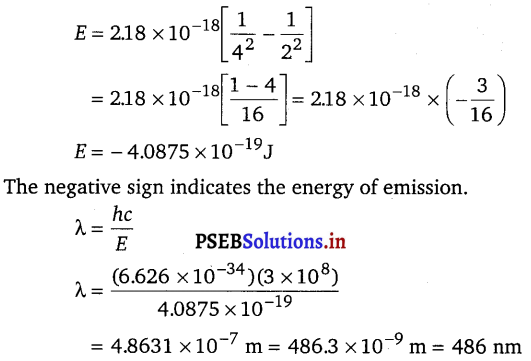
What is the wavelength of light emitted when the electron in a hydrogen atom undergoes transition from an energy level with n = 4 to an energy level with n = 2 ?
Answer:
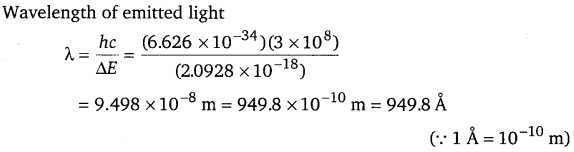
The ni = 4 to nf= 2 transition will give rise to a spectral line of the
Balmer series. The energy involved in the transition is given by the relation,
E = 2.18 × 10⁻¹⁸ \(\left[\frac{1}{n_{i}^{2}}-\frac{1}{n_{f}^{2}}\right]\)
PSEB 11th Class Chemistry Solutions Chapter 2 Structure of Atom 2

Question 14.
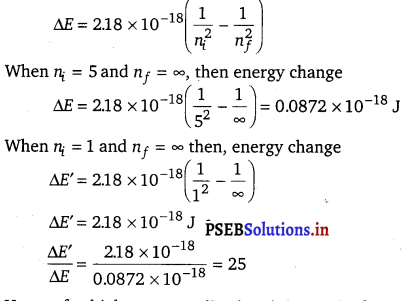
How much energy is required to ionise a H atom if the electron occupies n = 5 orbit? Compare your answer with the ionization enthalpy of H atom (energy required to remove the electron from n – 1 orbit).
Answre:
Energy change, ΔE = Ef – Ei
PSEB 11th Class Chemistry Solutions Chapter 2 Structure of Atom 3
Hence, far higher energy (25 times) is required to remove an electron from first orbit.

Question 15.
What is the maximum number of emission lines when the excited electron of a H atom in n = 6 drops to the ground state?
Answer:
The maximum number of emission lines
= \(\frac{n(n-1)}{2}=\frac{6(6-1)}{2}\) = 3 × 5 = 15

Question 16.
(i) The energy associated with the first orbit in the hydrogen atom is -2.18 × 10⁻¹⁸ J atom-1. What is the energy associated with the fifth orbit?
(ii) Calculate the radius of Bohr’s fifth orbit for hydrogen atom.
Answer:
(i) Energy associated with the fifth orbit of hydrogen atom is calculated as :
E5 = \(\frac{-\left(2.18 \times 10^{-18}\right)}{(5)^{2}}=\frac{-2.18 \times 10^{-18}}{25}\)
E5 = -8.72 × 10⁻²⁰ J
(ii) Radius of Bohr’s nth orbit for hydrogen atom is given by,
rn = (0.0529 nm) n2
For, n= 5
r5 = (0.0529 nm) (5)2
r5 = 1.3225 nm

PSEB 11th Class Chemistry Solutions Chapter 2 Structure of Atom

Question 17.
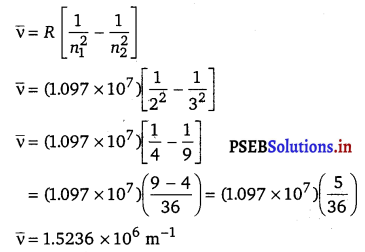
Calculate the wave number for the longest wavelength transition in the Balmer series of atomic hydrogen.
Answer:
For the Balmer series, a transition from n1= 2 to n2 = 3 is allowed.
PSEB 11th Class Chemistry Solutions Chapter 2 Structure of Atom 4

Question 18.
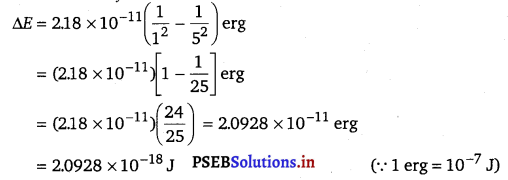
What is the energy in joules, required to shift the electron of the hydrogen atom from the first Bohr orbit to the fifth Bohr orbit and what is the wavelength of the light emitted when the electron returns to the ground state? The ground state electron energy is -2.18 × 10⁻¹¹ ergs.
Answer:
ΔE = E5 – E1 = 2.18 × 10⁻¹¹ (\(\left(\frac{1}{n_{i}^{2}}-\frac{1}{n_{f}^{2}}\right)\))erg
(ni = 1st orbit and nf = 5th orbit)
PSEB 11th Class Chemistry Solutions Chapter 2 Structure of Atom 5
PSEB 11th Class Chemistry Solutions Chapter 2 Structure of Atom 6 - 2

Question 19.
The electron energy in hydrogen atom is given by En = (-218 × 10-18)/n2J. Calculate the energy required to remove an electron completely from n = 2 orbit. What is the longest wavelength of light in cm that can be used to cause this transition?
Answer:
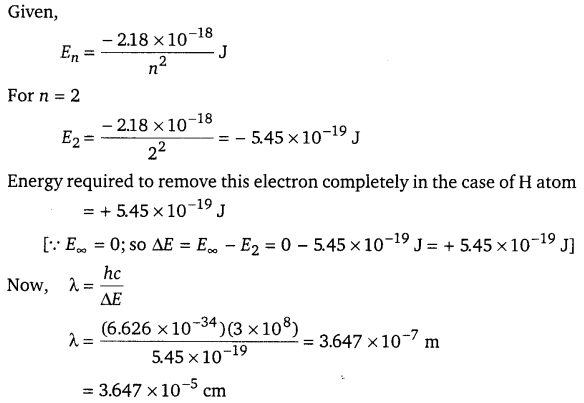
PSEB 11th Class Chemistry Solutions Chapter 2 Structure of Atom 6 - 3

Question 20.
Calculate the wavelength of an electron moving with a velocity of 2.05 × 10⁷ ms-1.
Answer:
According to de Broglie’s equation,
λ = \(\frac{h}{m v}\)
where, λ = wavelength of moving electron
m = mass of electron = 9.1 × 10⁻³¹ kg
h= Planck’s constant – 6.626 × 10⁻³⁴ Js
v = velocity of electron = 2.05 × 10⁷ ms-1
λ = \(\frac{6.626 \times 10^{-34} \mathrm{Js}}{\left(9.1 \times 10^{-31} \mathrm{~kg}\right)\left(2.05 \times 10^{7} \mathrm{~ms}^{-1}\right)}\)
λ = 3.548 × 10⁻¹¹ m
Hence, the wavelength of the electron moving with a velocity of
2.5× 10⁷ ms-1 is 3.548 x 10⁻¹¹m.

Question 21.
The mass of an electron is 9.1 x 10⁻³¹ kg. If its K.E. is 3.0 x 10⁻²⁵ J, calculate its wavelength.
Answer:
Kinetic energy, K.E. = \(\frac{1}{2}\) mv2
∴ Velocity(v) = \(\sqrt{\frac{2 \mathrm{KE}}{m}}=\sqrt{\frac{2\left(3.0 \times 10^{-25}\right)}{9.1 \times 10^{-31} \mathrm{~kg}}}=\sqrt{0.6593 \times 10^{6}}\)
_ 6.626 x 10~34 Js
~ (9.1 x 10⁻³¹ kg)(811.579 ms-1)
λ = 8.968 x 10⁻⁷ m
Hence, the wavelength of the eliectron is 8.968 x 10⁻⁷ m or 8968 Å.

Question 22.
Which of the following are isoelectronic species i.e., those having the same number of electrons?
Na+, K+, Mg2+, Ca2+, S2-, Ar
Ans. No. of electrons in Na+ = 10 [11-1]
No. of electrons in K+ = 18 [19-1]
No. of electrons in Mg2+ = 10 [12-2]
No. of electrons in Ca2+ =18 [20 – 2]
No. of electrons in S2- = 18 [16 + 2]
No. of electrons in Ar = 18
∴ Na+ , Mg2+ are isoelectronic (10 e each)
∴ Ca2+, K+, S2-, Ar are isoelectronic (18 e each).

PSEB 11th Class Chemistry Solutions Chapter 2 Structure of Atom

Question 23.
(i) Write the electronic configurations of the following ions:
(a) H (b) Na+ (c)02- (d)F
(ii) What are the atomic numbers of elements whose outermost electrons are represented by
(a) 3s1 (b) 2p3 (c) 3p5?
(iii) Which atoms are indicated by the following configurations?
(a) [He] 2s1 (b) [Ne] 3s2 3p3 (c) [Ar] 4s23d1.
Answer:
(i) (a) H ion
The electronic configuration of H atom is 1s1.
A negative charge on the species indicates the gain of an electron by it.
∴ Electronic configuration of H = 1s2

(b) Na+ ion
The electronic configuration of Na atom is 1s2 2s2 2p6 3s1.
A positive charge on the species indicates the loss of an electron by it.
∴ Electronic configuration of Na+ = 1s2 2s2 2p6 3s° or 1s2 2s2 2p6

(c) O2- ion
The electronic configuration of O atom is 1s22s2 2p4
A dinegative charge on the species indicates that two electrons are gained by it.
∴ Electronic configuration of 02- ion is 1s2 2s2 2p6

(d) F ion
The electronic configuration of F atom is 1s22s22p5.
A negative charge on the species indicates the gain of an electron by it.
∴ Electronic configuration of F“ ion is 1s2 2s2 2p6.

(ii) (a) 3s1
Completing the electronic configuration of the element as 1s2 2s2 2p6 3s1. .-. Number of electrons present in the atom of the element = 2 +2 + 6 +1=11
∴ Atomic number of the element = 11

(b) 2p3
Completing the electronic configuration of the element as 1s2 2s2 2p3
∴ Number of electrons present in the atom of the element = 2+ 2+ 3 = 7
∴ Atomic number of the element = 7

(c) 3p5
Completing the electronic configuration of the element as 1s2 2s2 2p6 3s2 3 P5
∴ Number of electrons present in the atom of the element
2 + 2 + 6 + 2 + 5 = 17
∴ Atomic number of the element = 17

(iii) (a) [He] 2s1
The electronic configuration of the element is [He]2s1 = 1s22s1.
∴ Atomic number of the element = 3
Hence, the element with the electronic configuration [He] 2s1 is lithium (Li).

(b) [Ne] 3s2 3p3
The electronic configuration of the element is
[Ne] 3s2 3p3 = 1s2 2s2 2p6 3s2 3p3
∴ Atomic number of the element = 15
Hence, the element with the electronic configuration [Ne] 3s2 3p3 is phosphorus (P).

(c) [Ar] 4s2 3d1
The electronic configuration of the element is [Ar] 4s2 3d1 = 1s2 2s2 2p6 3s2 3p6 4s2 3d1.
∴ Atomic number of the element = 21
Hence, the element with the electronic configuration [Ar] 4s2 3d2 is scandium (Sc).

Question 24.
What is the lowest value of n that allows g orbitals to exist?
Answer:
For g-orbitals, l = 4.
As for any value ‘n’ of principal quantum number, the Azimuthal quantum number (l) can have a value from zero to (n —1).
∴ For l = 4, minimum value of n = 5

Question 25.
An electron is in one of the 3d orbitais. Give the possible values of n, l and ml for this electron.
Answer:
For the 3d orbital:
Principal quantum number (n) = 3
Azimuthal quantum number (L) = 2
Magnetic quantum number (ml) = – l to + l including 0 = -2 -1, 0, 1, 2

PSEB 11th Class Chemistry Solutions Chapter 2 Structure of Atom

Question 26.
An atom of an element contains 29 electrons and 35 neutrons. Deduce (i) the number of protons and (ii) the electronic configuration of the element.
Answer:
No. of protons in a neutral atom = No. of electrons = 29
Electronic configuration = 1s2 2s2 2p6 3s2 3p6 3d10 4s1.

Question 27.
Give the number of electrons in the species : H2+, H2 and 02+.
Answer:
H2+ = one ; H2 = two ; 02+ = 15

Question 28.
(i) An atomic orbital has n = 3. What are the possible values of l and ml ?
(ii) List the quantum numbers ml and l of electron in 3rd orbital.
(iii) Which of the following orbitals are possible ?
1p, 2s, 2p and 3f.
Answer:
(i) For n = 3; l = 0, 1 and 2.
For l = 0 ; ml = 0
For l = 1; ml = +1, 0, -1
For l = 2 ; ml = +2, +1,0, +1, + 2
(ii) For an electron in 3rd orbital ; n = 3; l = 2 ; ml can have any of the values -2, -1, 0,
+ 1, +2.
(iii) 1p and 3f orbitals are not possible.

Question 29.
Using s, p and d notations, describe the orbitals with follow ing quantum numbers :
(a) n = 1, l = 0
(b) n = 4, l = 3
(c) n = 3, l = 1
(d) n = 4, l = 2
Answer:
(a) 1s orbital
(b) 4f orbital
(c) 3p orbital
(d) 4d orbital

Question 30.
From the following sets of quantum numbers, state which are possible. Explain why the others are not possible.
(i) n = 0, l = 0, ml = 0, ms = +1/2
(ii) n = 1, l = 0, ml = 0, ms – – 1/2
(iii) n = 1, l = 1, ml = 0, ms= +1/2
(iv) n = 1, l = 0, ml = +1, ms= +1/2
(v) n = 3, l = 3, ml = -3, ms = +1/2
(vi) n = 3, l = 1, ml = 0, ms= +1/2
Answer:
(i) The set of quantum numbers is not possible because the minimum value of n can be 1 and not zero.
(ii) The set of quantum numbers is possible.
(iii) The set of quantum numbers is not possible because, for n = 1, l can not be equal to 1. It can have 0 value.
(iv) The set of quantum numbers is not possible because for l = 0. mt cannot be + 1. It must be zero.
(v) The set of quantum numbers is not possible because, for n = 3, l ≠ 3.
(vi) The set of quantum numbers is possible.

Question 31.
How many electrons in an atom may have the following quantum numbers ?
(a) n = 4 ; ms = -1/2
(b) n = 3, l = 0.
Answer:
(a) For n = 4
Total number of electrons = 2n2 = 2 × 16 = 32
Half out of these will have ms = —1/2
∴ Total electrons with ms (-1/2) = 16
(b) For n = 3
l= 0 ; ml = 0, ms +1/2, -1/2 (two e)

Question 32.
Show that the circumference of the Bohr orbit for the hydrogen atom is an integral multiple of the de Broglie wavelength associated with the electron revolving around the orbit.
Answer:
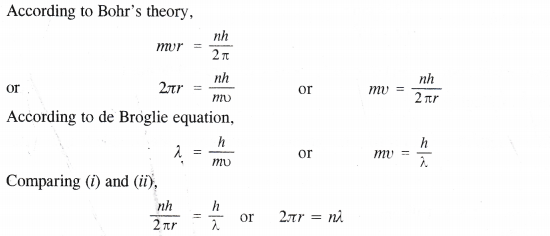
PSEB 11th Class Chemistry Solutions Chapter 2 Structure of Atom 20
Thus, the circumference (2πr) of the Bohr orbit for hydrogen atom is an integral multiple of the de Broglie wavelength.

PSEB 11th Class Chemistry Solutions Chapter 2 Structure of Atom

Question 33.
Calculate the number of atoms present in :
(i) 52 moles of He
(ii) 52 u of He
(iii) 52 g of He.
Answer:
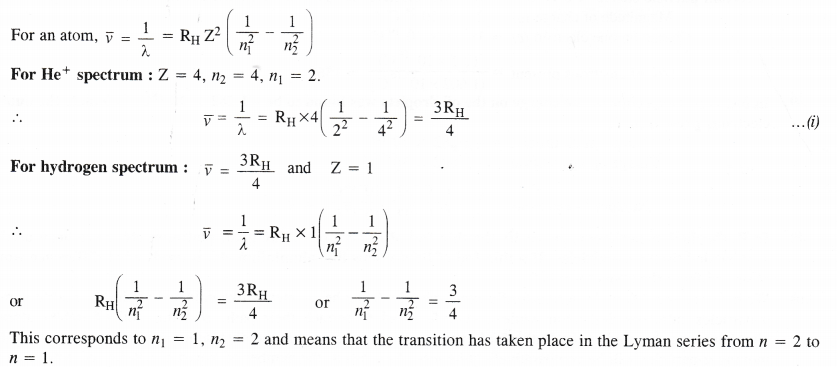
PSEB 11th Class Chemistry Solutions Chapter 2 Structure of Atom 21

Question 34.
Calculate the energy required for the process :
He+fe) → He2+(g) + e
The ionisation energy’ for the H atom in the ground state is 2.18 × 10⁻¹⁸  J atom-1
Answer:

PSEB 11th Class Chemistry Solutions Chapter 2 Structure of Atom 22

For H atom (Z = 1), En =2.18 × 10⁻¹⁸ × (l)2 J atom-1 (given)
For He+ ion (Z = 2), En =2.18 × 10-18 × (2)2 = 8.72 × 10⁻¹⁸ J atom-1 (one electron species)

Question .35.
If the diameter of carbon atom is 0.15 nm, calculate the number of carbon atoms which can be placed side by side in a straight line across a length of a scale of length 20 cm long.
Answer:

PSEB 11th Class Chemistry Solutions Chapter 2 Structure of Atom 23

Question 36.
2 × 10⁸ atoms of carbon are arranged side by side. Calculate the radius of carbon atom if the length of this arrangement is 2.4 cm.
Answer:
The length of the arrangement = 2.4 cm
Total number of carbon atoms present = 2 ×10⁸

PSEB 11th Class Chemistry Solutions Chapter 2 Structure of Atom 24
Radius of each carbon atom = 12(1.2 × 10⁻⁸) = 6.0 × 10⁻⁹cm = 0.06 nm

Question 37.
The diameter of zinc atom is 2.6 Å. Calculate :
(a) the radius of zinc atom in pm
(b) number of atoms present in a length of 1.6 cm if the zinc atoms are arranged side by side length wise.
Answer:
(a) Radius of zinc atom =Undefined control sequence = 1.3 Å = 1.3 × 10⁻¹⁰m = 130 × 10-12m = 130 pm
(b) Length of the scale = 1.6 cm = 1.6 × 10¹⁰ pm
Diameter of zinc atom = 260 pm

PSEB 11th Class Chemistry Solutions Chapter 2 Structure of Atom 25

Question 38.
A certain particle carries 2.5 x 10⁻¹⁶ C of static electric charge. Calculate the number of electrons present in it.
Answer:

PSEB 11th Class Chemistry Solutions Chapter 2 Structure of Atom 26

Question 39.
In Millikan’s experiment, the charge on the oil droplets was found to be – 1.282 x 10⁻¹⁸C. Calculate the number of electrons present in it.
Answer:
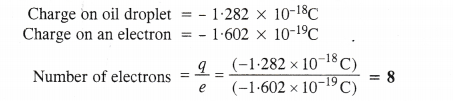
PSEB 11th Class Chemistry Solutions Chapter 2 Structure of Atom 27

PSEB 11th Class Chemistry Solutions Chapter 2 Structure of Atom

Question 40.
In Rutherford experiment, generally the thin foil of heavy atoms like gold, platinum etc. have been used to be bombarded by the a-particles. If a thin foil of light atoms like aluminium etc. is used, what difference would be observed from the above results ?
Answer:
We have studied that in the Rutherford’s experiment by using heavy metals like gold and platinum, a large number of a-particles sufferred deflection while a very few had to retrace their path.

If a thin foil of lighter atoms like aluminium etc. be used in the Rutherford experiment, this means that the obstruction offered to the path of the fast moving a-particles will be comparatively quite less.

As a result, the number of a-particles deflected will be quite less and the particles which are deflected back will be negligible.

Question 41.
Symbols \(_{ 35 }^{ 79 }{ Br }\) and 79Br can be written whereas symbols \(_{ 79 }^{ 35 }{ Br }\) and 35Br are not accepted. Answer in brief.
Answer:
In the symbol \(_{ A }^{ B }{ X }\) of an element :
A denotes the atomic number of the element
B denotes the mass number of the element.
The atomic number of the element can be identified from its symbol because no two elements can have the atomic number. However, the mass numbers have to be mentioned in order to identify the elements. Thus,
Symbols \(_{ 35 }^{ 79 }{ Br }\) and 79Br are accepted because atomic number of Br will remain 35 even if not mentioned. Symbol \(_{ 79 }^{ 35 }{ Br }\) is not accepted because atomic number of Br cannot be 79 (more than the mass number = 35). Similarly, symbol 35Br cannot be accepted because mass number has to be mentioned. This is needed to differentiate the isotopes of an element.

Question 42.
An element with mass number 81 contains 31.7% more neutrons as compared to protons. Assign the symbol to the element.
Answer:
An element can be identified by its atomic number only. Let us find the atomic number.
Let the number of protons = x
Number of neutrons = x + [\(\frac { x\times 31.7 }{ 100 } \) = (x × 0.317x)
Now, Mass no. of element = no. of protons =no. neutrons
81 = x + x + 0-317 x = 2.317 x or x = \(\frac { 81 }{ 2.317 } \) = 35
∴ No. of protons = 35, No. of neutrons = 81 – 35 =46
Atomic number of element (Z) = No. of protons = 35
The element with atomic number (Z) 35 is bromine \(_{ 35 }^{ 81 }{ Br }\).

Question 43.
An ion with mass number 37 possesses one unit of negative charge. If the ion contains 11 -1% more neutrons than the electrons, find the symbol of the ion.
Answer:
Let the no. of electron in the ion = x
∴ the no. of protons = x – 1 (as the ion has one unit negative charge)
and the no. of neutrons = x + \(\frac { x\times 11.1 }{ 100 } \) = 1.111 x
Mass no. or mass of the ion = No. of protons + No. of neutrons
(x – 1 + 1.111 x)
Given mass of the ion = 37
∴ x- 1 + 1.111 x = 37 or 2.111 x = 37 + 1 = 38
x = \(\frac { 38 }{ 2.111 } \) = 18
No. of electrons = 18 ; No. of protons = 18 – 1 = 17
Atomic no. of the ion = 17 ; Atom corresponding to ion = Cl
Symbol of the ion = \(_{ 17 }^{ 37 }{ Cl }\)

Question 44.
An ion with mass number 56 contains 3 units of positive charge and 30.4% more neutrons than electrons. Assign symbol to the ion.
Answer:
Let the no. of electrons in the ion = x
∴ the no. of the protons = x + 3 (as the ion has three units positive charge)
and the no. of neutrons = x + \(\frac { x\times 31.7 }{ 100 } \) = xc + 0.304 x
Now, mass no. of ion = No. of protons + No. of neutrons
= (x + 3) + (x + 0.304x)
∴ 56 = (x + 3) + (x + 0.304x) or 2.304x = 56 – 3 = 53
x = \(\frac { 53 }{ 2.304 } \) = 23
Atomic no. of the ion (or element) = 23 + 3 = 26
The element with atomic number 26 is iron (Fe) and the corresponding ion is Fe3+.

Question 45.
Arrange the following type of radiations in increasing order of frequency:
(a) radiation from microwave oven (b) amber light from traffic signal (c) radiation from FM radio (d) cosmic rays from outer space and (e) X-rays.
Answer:
The increasing order of frequency is as follows :
Radiation from FM radio < Radiation from microwave oven < Amber light from traffic signal < X-rays < Cosmic rays from outer space.

PSEB 11th Class Chemistry Solutions Chapter 2 Structure of Atom

Question 46.
Nitrogen laser produces a radiation at a wavelength of 337.1 nm. If the number of photons emitted is 5.6 x 1024 , calculate the power of this laser.
Answer:
Power of laser (E) = \(\frac{n h c}{\lambda}\)
= \(\frac{\left(5.6 \times 10^{24}\right)\left(6.626 \times 10^{-34} \mathrm{Js}\right)\left(3 \times 10^{8} \mathrm{~ms}^{-1}\right)}{\left(337.1 \times 10^{-9} \mathrm{~m}\right)}\)
= 0.3302 x 10⁷ J = 3.33 x 10⁶ J
Hence, the power of the laser is 3.33 x 10⁶ J.

Question 47.
Neon gas is generally used in the sign boards. If it emits strongly at 616 nm, calculate (a) the frequency of emission, (b) distance travelled by this radiation in 30 s (c) energy of quantum and (d) number of quanta present if it produces 2 J of energy.
Answer:
(a) Frequency (v) of emission can be calculated as: c = v x λ
where, λ – wavelength = 616 nm = 616 x 10-9 ms-1
c = velocity of light = 3.0 x 10⁸ ms-1
v = \(\frac{c}{\lambda}=\frac{3.0 \times 10^{8}}{616 \times 10^{-9}}\) = 4.87 x 10¹⁴s-1

(b) Distance travelled in 1 second = 3.0 x 10⁸ m
Distance travelled in 30 seconds = 30 x 3.0 x 108 m = 9 x 10⁹ m
(c) Energy of the photon (quantum)
E= hv = 6.626 x 10-34 x 4.87 x 1014J
= 32.26 x 10⁻²⁰ J

(d) Number of quanta = \(\frac{Total energy produced}
{Energy of one quantum}\)
= \(\frac{2}{32.26 \times 10^{-20}}\) = 6.2 x 10¹⁸

Question 48.
In astronomical observations, signals observed from the distant stars are generally weak. If the photon detector receives a total of 3.15 x 10⁻¹⁸ J from the radiations of 600 rnn, calculate the number of photons received by the detector.
Answer:
Energy of one photon, E = \(\frac{h c}{\lambda}\)
= \(\frac{\left(6.626 \times 10^{-34} \mathrm{Js}\right)\left(3 \times 10^{8} \mathrm{~ms}^{-1}\right)}{\left(600 \times 10^{-9} \mathrm{~m}\right)}\) = 3.313 x 10<sup>-19</sup> J
Number of photons = \(\frac{Total energy received}{Energy of one photon}\)
= \(\frac{3.15 \times 10^{-18} \mathrm{~J}}{3.313 \times 10^{-19} \mathrm{~J}}\)

Question 49.
Lifetimes of the molecules in the excited states are often measured by using pulsed radiation source of duration nearly in the nano second range. If the radiation source has the duration of 2 ns and the number of photons emitted during the pulse source is 2.5 x 10¹⁵, calculate the energy of the source.
Answer:
Duration of radiation source = 2 ns = 2 x 10⁻⁹ s
No. of photons (n) = 2.5 x 10¹⁵
Frequency of radiation
v = \(\frac{1}{2.0 \times 10^{-9} \mathrm{~s}}\) = 5.0 x 10⁸s-1
Energy (E) of source = n x hv
E= (2.5 x 10¹⁵)(6.626 x 10⁻³⁴Js) (5.0 x 10⁸)
E = 8.282 x 10⁻¹⁰J
Hence, the energy of the source (E) is 8.282 x 10⁻¹⁰ J.

Question 50.
The longest wavelength doublet absorption transition is observed at 589 and 589.6 nm. Calculate the frequency of each transition and energy difference between two excited states.
Answer:
For λ1 = 589 nm = 589 x 10-9
Frequency of transition (v1) = \(\) = 5.093 x 10¹⁴s-1
Similarly, for λ2 = 589.6 nm = 589.6 x 10⁻⁹m
Frequency of transition (v2) = \(\frac{c}{\lambda_{2}}=\frac{3.0 \times 10^{8} \mathrm{~ms}^{-1}}{589.6 \times 10^{-9} \mathrm{~m}}\) = 5.088 x 10¹⁴s-1
Energy difference (ΔE) between excited states = E1 – E2
ΔE = h(v1 – v2)
= (6.626 × 10⁻³⁴Js) (5.093 × 10¹⁴ – 5.088 × 10¹⁴)s-1
= (6.626 × 10⁻³⁴Js) (0.005 × 10⁻¹⁴) s-1
ΔE = 3.31 × 10⁻²²

Question 51.
The work function for caesium atom is 1.9 eV. Calculate (a) the threshold wavelength and (b) the threshold frequency of the radiation. If the caesium element is irradiated with a wavelength 500 nm, calculate the kinetic energy and the velocity of the ejected photoelectron.
Answer:
It is given that the work function (W0) for caesium atom is 1.9 eV.
(a) Work function,
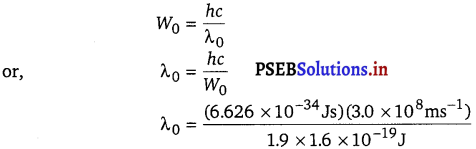
PSEB 11th Class Chemistry Solutions Chapter 2 Structure of Atom 6 1
λ0 = 6.53 × 10⁻⁷ m
= 653 × 10-9m = 653nm.
Hence the threshold wave length is 653nm

(b) threshold frequency
v0 = \(\frac{W_{0}}{h}\)
v0 = \(\frac{1.9 \times 1.6 \times 10^{-19} \mathrm{~J}}{6.626 \times 10^{-34} \mathrm{Js}}\) = 4.59 x 10¹⁴s-1
Hence the threshold frequency of radiation is 4.59 x 10¹⁴s-1
According to the question :
wavelength used in irradiation = 500nm
Kinetic Energy = h(v – v0)
= hc( \(\frac{1}{\lambda}-\frac{1}{\lambda_{0}}\) )
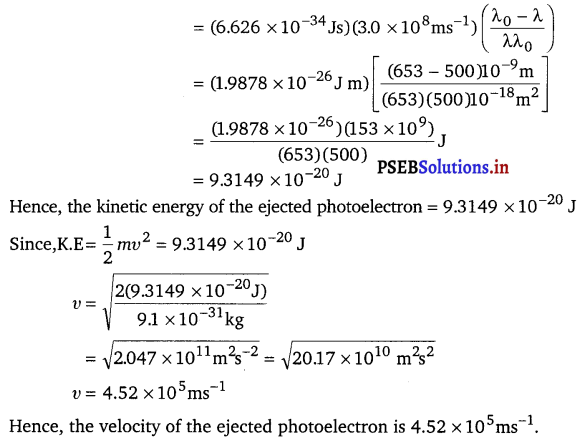
PSEB 11th Class Chemistry Solutions Chapter 2 Structure of Atom

Question 52.
Following results are observed when sodium metal is irradiated with different wavelengths. Calculate (a) threshold wavelength and, (b) Planck’s constant.

PSEB 11th Class Chemistry Solutions Chapter 2 Structure of Atom 8
Answer:
PSEB 11th Class Chemistry Solutions Chapter 2 Structure of Atom 8
Mass of electron, m = 9.1 × 10⁻³¹ kg
Here, λ = 500 × 10-9 m
vmax = 2.55 ×10⁵ms-1
λ0 = ?
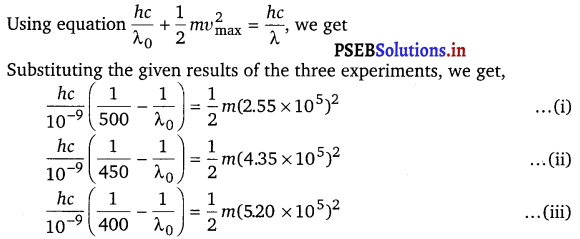
PSEB 11th Class Chemistry Solutions Chapter 2 Structure of Atom 9
PSEB 11th Class Chemistry Solutions Chapter 2 Structure of Atom 10

Question 53.
The ejection of the photoelectron from the silver metal in the photoelectric effect experiment can be stopped by applying the voltage of 0.35 V when the radiation 256.7 nm is used. Calculate the work function for silver metal.
Answer:
h = 6.626 × 10⁻³⁴ Js
V0 = 0.35 volt
e = 1.6 × 10⁻¹⁹ C
λ = 256.7 nm = 256.7 × 10⁻⁹ m
W0 = ? (eV)
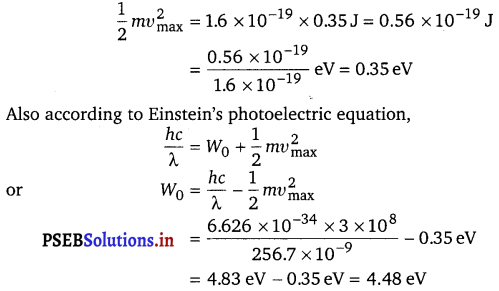
PSEB 11th Class Chemistry Solutions Chapter 2 Structure of Atom 11

Question 54.
If the photon of the wavelength 150 pm strikes an atom and one of its inner bound electrons is ejected out with a velocity of 1.5 x 10⁷ms-1, calculate the energy with which it is bound to the nucleus.
Answer:
λ = wavelength = 150 pm = 150 × 10-12 m
v = velocity = 1.5 × 10⁷ ms-1
Kinetic energy of the ejected electron
= \(\frac{1}{2}\) mv7 = \(\frac{1}{2}\) x 9.1 x 10-31 x (1.5 x 107 )2 J = 0.102 x 10⁻¹⁵ J
Energy of the incident radiation
hv= hv0 +\(\frac{1}{2}\)mv2
E = hv = \(\frac{h c}{\lambda}=\frac{6.626 \times 10^{-34} \times 3.0 \times 10^{8}}{150 \times 10^{-12}}\)
= 1.325 × 10⁻¹⁵ J
Minimum energy required to eject the electron
E0 = E – K.E.
= (1.325 × 10⁻¹⁵ – 0.102 × -15 ) J
= 1.223 × 10⁻¹⁵J
= \(\frac{1.223 \times 10^{-15}}{1.602 \times 10^{-19}} \mathrm{eV}\)
[ 1J = 1.602 × 10⁻¹⁹ eV]
= 7.6 × 10³ eV

Question 55.
Emission transitions in the Paschen series end at orbit n = 3 and start from orbit n and can be represented as v = 3.29 x 10¹⁵ (Hz) \(\left[\frac{1}{3^{2}}-\frac{1}{n^{2}}\right]\)
Calculate the value of n if the transition is observed at 1285 nm. Find the region of the spectrum.
Answer:
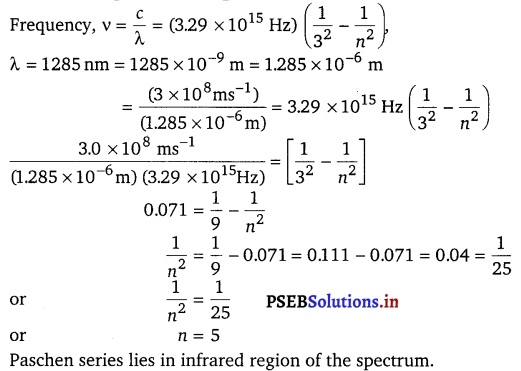
PSEB 11th Class Chemistry Solutions Chapter 2 Structure of Atom 12

PSEB 11th Class Chemistry Solutions Chapter 2 Structure of Atom

Question 56.
Calculate the wavelength for the emis8ion transition if it starts from the orbit having radius 1.3225 mn and ends at 211.6 pm. Name the series to which this transition belongs and the region of the spectrum.
Answer:
The radius of the nth orbit of hydrogen like particles is given by
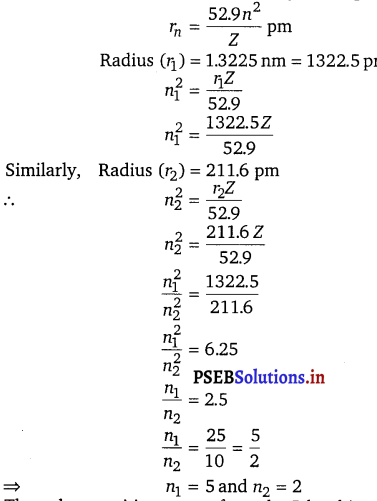
PSEB 11th Class Chemistry Solutions Chapter 2 Structure of Atom 13
Thus, the transition ocurs from the 5th orbit to the 2nd orbit. It belongs to the Balmer series.
Wave number ( \(\bar{V}\) ) for the transition is given by,
\(\bar{v}=\frac{1}{\lambda}=1.097 \times 10^{7}\left(\frac{1}{2^{2}}-\frac{1}{5^{2}}\right)=1.097 \times 10^{7}\left(\frac{21}{100}\right)\)
= 2.303 × 10⁶ m-1
∴ Wavelength ) associated with the emission transition is given by,
λ = \(\frac{1}{\bar{v}}=\frac{1}{2.303 \times 10^{6} \mathrm{~m}^{-1}}\)
= 0.434 × 10-6 = 434 nm
∴ This transition belongs to Balmer series and comes in the visible region of the spectrum.

Question 57.
Dual behaviour of matter proposed by de Broglie led to the discovery of electron microscope often used for the highly magnified images of biological molecules and other type of material. If the velocity of the electron in this microscope is 1.6 x 10⁶ ms-1, calculate de Broglie wavelength associated with this electron.
Answer:
From Broglie’s equation,
λ = \(\frac{h}{m v}\)
λ = \(\frac{6.626 \times 10^{-34} \mathrm{Js}}{\left(9.1 \times 10^{-31} \mathrm{~kg}\right)\left(1.6 \times 10^{6} \mathrm{~ms}^{-1}\right)}\) (1J = 1 kgm2s-2)
= 4.55 × 10⁻¹⁰ m = 455 pm
∴ de Broglie’s wavelength associated with the electron is 455 pm.

Question 58.
Similar to electron diffraction, neutron diffraction microscope is also used for the determination of the structure of molecules. If the wavelength used here is 800 pm, calculate the characteristic velocity associated with the neutron.
Answer:
From de Broglie’s equation,
λ = \(\frac{h}{m v}\)
v = \(\frac{h}{m \lambda}\)
mass of neutron, m = 1.675 × 10⁻²⁷ kg
λ = 800pm = 800 × 10-12 m
v = \(\frac{6.626 \times 10^{-34} \mathrm{Js}}{\left(1.675 \times 10^{-27} \mathrm{~kg}\right)\left(800 \times 10^{-12} \mathrm{~m}\right)}\) = 4.94 × 10²ms-1
= 494 ms-1
∴ Velocity associated with the neutron is 494 ms-1.

Question 59.
If the velocity of the electron in Bohr’s first orbit is 2.19 × 10⁶ms-1, calculate the de Broglie wavelength associated with it.
Answer:
According to de Broglie’s equation,
λ = \(\frac{h}{m v}\)
Mass of electron = 9.1 × 10⁻³¹ kg, h = 6.626 × 10⁻³⁴ Js,
velocity = 2.19 × 10⁶ ms-1
= \(\frac{6.626 \times 10^{-34} \mathrm{Js}}{\left(9.1 \times 10^{-31} \mathrm{~kg}\right)\left(2.19 \times 10^{6} \mathrm{~ms}^{-1}\right)}\) = 3.32 × 10⁻¹⁰m
= 3.32 × 10⁻¹⁰m × \(\frac{100}{100}\) = 332 × 10-12 m
λ = 332pm
∴ Wavelength associated with the electron is 332 pm.

PSEB 11th Class Chemistry Solutions Chapter 2 Structure of Atom

Question 60.
The velocity associated with a proton moving in a potential difference of 1000 V is 437 × 105 ms-1. If the hockey ball of mass 0.1 kg is moving with this velocity, calculate the wavelength associated with this velocity.
Answer:
Wavelength associated with the velocity of hockey ball,
λ = \(\frac{h}{m v}\)
λ = \(\frac{6.626 \times 10^{-34} \mathrm{Js}}{(0.1 \mathrm{~kg})\left(4.37 \times 10^{5} \mathrm{~ms}^{-1}\right)}\)
λ = 1.516 × 10-38 m

Question 61.
If the position of the electron is measured within an accuracy of ± 0.002 nm, calculate the uncertainty in the momentum of the electron. Suppose the momentum of the electron is \(\frac{h}{4 \pi_{m}}\) × 0.05 nm, is there any problem in defining this value.
Answer:
From Heisenberg’s uncertainty principle,
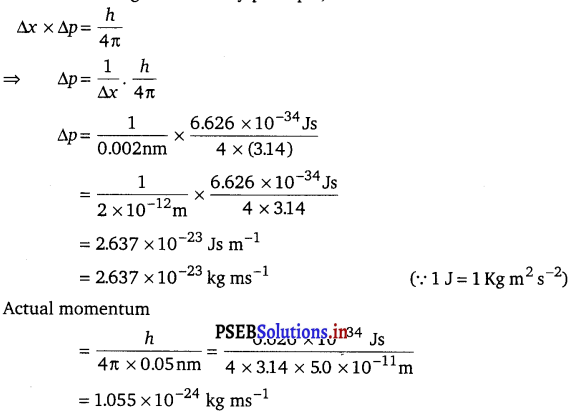
PSEB 11th Class Chemistry Solutions Chapter 2 Structure of Atom 14
Since the magnitude of the actual momentum is smaller than the uncertainty, the value cannot be defined.

Question 62.
The quantum numbers of six electrons are given below. Arrange them in order of increasing energies. If any of these comhination(s) has/have the same energy lists.
1. n = 4, l = 2, ml = -2, ms = – \(\frac{1}{2}\)
2. n = 3, l = 2, ml= 1, ms = + \(\frac{1}{2}\)
3. n = 4, l = 1, ml = 0, ms = +\(\frac{1}{2}\)
4. n = 3, l – 2, ml = -2, ms = –\(\frac{1}{2}\)
5. n = 3, l = 1, ml = -1, ms = + \(\frac{1}{2}\)
6. n = 4, l = 1, ml = 0, ms = + \(\frac{1}{2}\)
Answer:
For n = 4 and l = 2, the orbital occupied is 4d.
For n = 3 and l = 2, the orbital occupied is 3d.
For n = 4 and l = 1, the orbital occupied is 4p.
Hence, the six electrons i.e., 1, 2, 3, 4, 5 and 6 are present in the 4d, 3d, 4p, 3d, 3p and 4p orbitals respectively.
Therefore, the increasing order of energies are
5(3p) < 2(3d) = 4(3d) < 6(4p) = 3(4p) < 1(4d).

Question 63.
The bromine atom possesses 35 electrons. It contains 6 electrons in 2p orbital,6 electrons in 3p orbital and 5 electrons in 4p orbital. Which of these electron experiences the lowest effective nuclear charge.
Answer:
Effective nuclear charge decreases as the distance of the orbitals increases from the nucleus. Hence, 4p electrons experience the lowest effective nuclear charge.

Question 64.
Among the following pairs of orbitals which orbital will experience the larger effective nuclear charge? (i) 2s and 3s, (ii) 4d and 4f, (iii) 3d and 3p.
Answer:
Nuclear charge is defined as the net positive charge experienced by an electron in the orbital of a multi-electron atom. The closer the orbital, the greater is the nuclear charge experienced by the electron (s) in it.
(i) The electron(s) present in the 2s orbital will experience greater nuclear charge (being closer to the nucleus) than the electron(s) in the 3s orbital.
(ii) 4d will experience greater nuclear charge than 4/ since 4d is closer to the nucleus.
(iii) 3p will experience greater nuclear charge since it is closer to the nucleus than 3/.

Question 65.
The unpaired electrons in A1 and Si are present in 3p orbital. Which electrons will experience more effective nuclear charge from the nucleus?
Answer:
13Al = 1s22s22p63s23p1
14Si = 1s22s22p63s23p2
Si (+4) has greater nuclear charge than aluminium (+3). Hence, 3p unpaired electrons of Si experience greater effective nuclear charge than Al.

PSEB 11th Class Chemistry Solutions Chapter 2 Structure of Atom

Question 66.
Indicate the number of unpaired electrons in
(a) P, (b) Si, (c) Cr, (d) Fe and (e) Kr.
Answer:
(a) Phosphorus (P) : Atomic number = 15
The electronic configuration of P is : 1s2 2s2 2p6 3s2 3p3

The orbital picture of P can be represented as :
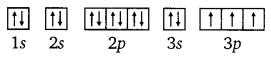
PSEB 11th Class Chemistry Solutions Chapter 2 Structure of Atom 15
From the orbital picture, phosphorus has three unpaired electrons
(b) Silicon (Si) : Atomic number = 14
The electronic configuration of Si is : 1s2 2s2 2p6 3s2 3p2
The orbitai picture of Si can be represented as :
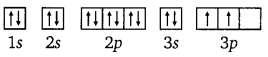
PSEB 11th Class Chemistry Solutions Chapter 2 Structure of Atom 16
From the orbital picture, silicon has two unpaired electrons.
(c) Chromium (Cr) : Atomic number = 24
The electronic configuration of Cr is : 1s2 2s2 2p6 3s2 3p6 4s1 3d5
The orbital picture of chromium is :

PSEB 11th Class Chemistry Solutions Chapter 2 Structure of Atom 17
From the orbital picture, chromium has six unpaired electrons.
(d) Iron (Fe) : Atomic number = 26

The electronic configuration of Fe is : 1s2 2s2 2p6 3s2 3p6 4s2 3d6
The orbital picture of Fe is:

PSEB 11th Class Chemistry Solutions Chapter 2 Structure of Atom 18
From the orbital picture, iron has four unpaired electrons.
(e) Krypton (Kr) : Atomic number = 36
The electronic configuration of Kr is : 1s2 2s2 2p6 3s2 3p6 4s2 3d10 4p6
The orbital picture of krypton is :

PSEB 11th Class Chemistry Solutions Chapter 2 Structure of Atom 19
Since all orbitals are fully occupied, there are no unpaired electrons in krypton.

Question 67.
(a) How many sub-shells are associated with n = 4? (b) How many electrons will be present in the sub-shells having ms value of \(\) 1/2 for n – 4?
Answer:
(a) n = 4 (Given)
For a given value of ‘rt, V can have values from zero to n -1.
l = 0, 1, 2, 3
Thus, four sub-shells are associated with n = 4, which are s, p, d and f
(b) Number of orbitals in the nth shell = n2
For n = 4
Number of orbitals = 16
If each orbital is taken fully, then it will have 1 electron with ms value of \(-\frac{1}{2}\)
Number of electrons with ms value of (\(-\frac{1}{2}\)) is 16.

PSEB 11th Class Chemistry Important Questions Chapter 4 Chemical Bonding and Molecular Structure

Punjab State Board PSEB 11th Class Chemistry Important Questions Chapter 4 Chemical Bonding and Molecular Structure Important Questions and Answers.

PSEB 11th Class Chemistry Important Questions Chapter 4 Chemical Bonding and Molecular Structure

Very Short Answer Type Questions

Question 1.
In \(\mathrm{PO}_{4}^{3-}\) ion formal charge on the oxygen atom of P—O bond is
Answer:
In \(\mathrm{PO}_{4}^{3-}\) ion, formal charge on each O-atom of P—O bond
= \(\frac{\text { total charge }}{\text { Number of O-atoms }}=-\frac{3}{4}\) = -0.75

Question 2.
Which of the following molecules show super octet?
CO2, CIF3, SO2, IF5
Answer:
ClF3 and IF5 are super octet molecules.

PSEB 11th Class Chemistry Important Questions Chapter 4 Chemical Bonding and Molecular Structure

Question 3.
Which of the following has highest lattice energy and why?
CsF, CsCl, CsBr, Csl
Answer:
CsF has highest lattice energy because ‘F’ is smallest in size and is more electronegative, therefore, it has maximum ionic character and maximum force of attraction, hence, highest lattice energy.

Question 4.
Account for the following:
The experimentally determined N—F bond length in NF3 is greater than the sum of the single covalent radii of N and F.
Answer:
This is because both N and F are small and hence, have high electron density. So, they repel the bond pairs thereby making the N—F bond length larger.

Question 5.
What is valence bond approach for the formation of covalent * bond?
Answer:
A covalent bond is formed by the overlapping of half-filled atomic orbitals.

Question 6.
Why axial bonds of PCI5 are longer than equatorial bonds?
Answer:
This is due to greater repulsion on the axial bond pairs by the equatorial bond pairs of electrons.

Question 7.
Which type of atomic orbitals can overlap to form molecular orbitals?
Answer:
Atomic orbitals with comparable energies and proper orientation can overlap to form molecular orbitals.

Question 8.
Why KHF2 exists but KHCl2 does not?
Answer:
Due to H-bonding in HF, we have
PSEB 11th Class Chemistry Solutions Chapter 4 Chemical Bonding and Molecular Structure 1

PSEB 11th Class Chemistry Important Questions Chapter 4 Chemical Bonding and Molecular Structure

This can dissociate to give \(\mathrm{HF}_{2}^{-}\) ion and hence, KHF2 exists but there is no H-bonding in H-Cl. So, \(\mathrm{HCl}_{2}^{-}\) ion does not exist and hence, KHCl2 also does not exist.

Question 9.
How many nodal planes are present in n(2px) and n(2px) molecular orbitals?
Answer:
One and two respectively.

Question 10.
What is the magnetic character of the anion of K02?
Answer:
Anion of KO2 is \(\mathrm{O}_{2}^{-}\) (superoxide ion) which has one unpaired electron and hence is paramagnetic.

Short Answer Type Questions

Question 1.
Describe the change in hybridisation (if any) of the Al-atom in
the following reaction:
AlCl3 + Cl → \(\mathrm{AlCl}_{\mathbf{4}}^{-}\)
Answer:
Electronic configuration of Al in ground state,
13Al = 1s2, 2s2,2p6,3s2,3p1x
In excited state = 1s2, 2s2, 2p6, 3s1, 3p1x, 3p1y
In the formation of AlCl3, Al undergoes sp2 hybridisation and it is trigonal
planar in shape. While in the formation of AlCl4, Al undergoes sp3
hybridisation.
It means empty 3Pz orbital also involved in hybridisation.
Thus, the shape of AlCl4 ion is tetrahedral.

Question 2.
Arrange the following in order of decreasing bond angle, with appropriate reason
\(\mathrm{NO}_{2}, \mathrm{NO}_{2}^{+}, \mathrm{NO}_{2}^{-}\)
Answer:
\(\mathrm{NO}_{2}, \mathrm{NO}_{2}^{+}, \mathrm{NO}_{2}^{-}\). This is because \(\mathrm{NO}_{2}^{+}\) has no lone pair of electrons
(i.e., has only bond pairs on two sides) and hence it is linear.

NO2 has one unshared electron while \(\mathrm{NO}_{2}^{-}\) has one unshared electron pair. There are greater repulsion on N—O bonds in case of \(\mathrm{NO}_{2}^{-}\) than in case of NO2

PSEB 11th Class Chemistry Solutions Chapter 4 Chemical Bonding and Molecular Structure 2

Question 3.
Among the molecules, \(\mathbf{O}_{2}^{-}, \mathbf{N}_{2}^{+}, \mathrm{CN}^{-}\) and \(\mathbf{O}_{2}^{+}\) identify the species which is isoelectronic with CO.
Answer:
Isoelectronics species are those species which have the same number of electrons. CO in total has 14 electrons (6 from carbon and 8 from oxygen). Out of the given ions CN is the ion which has 14 electrons (6 from carbon 7 from Nitrogen and 1 from the negative charge). Thus CN ion is isoelectronic with CO.

PSEB 11th Class Chemistry Important Questions Chapter 4 Chemical Bonding and Molecular Structure

Question 4.
Which is more polar : COa or N20? Give reason.
Answer:
N2Ois more polar than CO2. This is because CO2 is linear and symmetrical.
Its net dipole moment is zero im
on the other hand, is linear but unsymmetrical. It is considered as a resonance hybrid of the following two structures

PSEB 11th Class Chemistry Solutions Chapter 4 Chemical Bonding and Molecular Structure 3

It.has a net dipole moment of 0.116 D.

Question 5.
Aluminium forms the ion Al3+, but not Al4+ why?
Answer:
Aluminium [Ne]3s2 3p1 can achieve the electronic configuration of the nearest noble gas (Ne) by losing only three electrons. : Al3+ = 1s2 2s2 2p6.
Aluminium will not form Al4+ ion because an extremely high amount of energy would be required to remove an electron from the stable noble gas configuration.

Long Answer Type Questions

Question 1.
On the basis of VSEPR theory, predict the shapes of the following
(i) \(\mathbf{N H}_{2}^{-}\) (ii) O3
Answer:
(i) Shape of \(\mathbf{N H}_{2}^{-}\)
Number of valence electrons on central N atom = 5 + 1 (due to one unit negative charge) = 6
Number of atoms linked to it = 2
∴ Total number of electron pairs around N
= \(\frac{6+2}{2}\) = 4 and number of bond pairs = 2
∴ Number of lone pairs = 4 —2 = 2. Thus, the ion is of the type AB2E2
Hence, it has bent shape (V-shape).

(ii) Shape of O3
While predicting geometry of molecules containing the double (or multiple) bond is considered as one electron pair, e.g., in case of ozone, its two resonating structures are

PSEB 11th Class Chemistry Solutions Chapter 4 Chemical Bonding and Molecular Structure 4

Thus, the central O-atom is considered to have two bond pairs and one lone pair, i.e., it is of the type AB2E. Hence, it is a bent molecule. Thus, the two resonating structures will be

PSEB 11th Class Chemistry Solutions Chapter 4 Chemical Bonding and Molecular Structure 5

Question 2.
In each of the following pairs of compounds, which one is more covalent and why?
(i) AgCl, Agl
(ii) BeCl2,MgCl2
(iii) SnCl2, SnCl4
(iv) CuO, CuS
Answer:
Applying Fajans’ rules, the result can be obtained in each case as follows :
(i) Agl is more covalent than AgCl. This is because I ion is larger in size than Cl ion and hence, is more polarised than Cl ion.
(ii) BeCl2 is more covalent thanMgCl2. This is because Be2+ ion is smaller in size than Mg2 ion and hence has the greater polarising power.
(iii) SnCl4 is more covalent than SnCl2. This is because Sn4+ ion has greater charge and smaller size than Sn2+ ion and hence has greater polarising power.
(iv) CuS is more covalent than CuO. This is because S2- ion has larger size
than O2- ion and hence is more polarised than O2- ion.

PSEB 11th Class Chemistry Solutions Chapter 5 States of Matter

Punjab State Board PSEB 11th Class Chemistry Book Solutions Chapter 5 States of Matter Textbook Exercise Questions and Answers.

PSEB Solutions for Class 11 Chemistry Chapter 5 States of Matter

PSEB 11th Class Chemistry Guide States of Matter InText Questions and Answers

Question 1.
What will be the minimum pressure required to compress 500 dm3 of air at 1 bar to 200 dm3 at 30° C?
Answer:
Given,
Initial pressure, P1 =1 bar
Initial volume, V1 = 500 dm3
Final volume, V2 = 200 dm3
Final pressure, P2 = ?
Sipce the temperature remains constant at30°C.
According to Boyle’s law,
P1V1 = P2V2
⇒ P2 = \(\frac{p_{1} V_{1}}{V_{2}}=\frac{1 \times 500}{200}\) bar = 2.5 bar
Therefore, the minimum pressure required is 2.5 bar.

PSEB 11th Class Chemistry Solutions Chapter 5 States of Matter

Question 2.
A vessel of 120 mL capacity contains a certain amount of gas at 35°C and 1.2 bar pressure. The gas is transferred to another vessel of volume 180 mL at 35°C. What would be its pressure?
Answer:
Given,
Initial pressure, P1 =1.2 bar
Initial volume, V1 = 120 mL
Final volume, V2 = 180 mL
Final pressure, P2 = ?
Since the temperature remains constant at 35°C.
According to Boyle’s law,
⇒ P2 = \(\frac{p_{1} V_{1}}{V_{2}}=\frac{1.2 \times 120}{180}\) bar = 0.8 bar
Therefore, the pressure would be 0.8 bar.

Question 3.
Using the equation of state pV = nRT; show that at a given temperature density of a gas is proportional to gas pressure p.
Answer:
The equation of state is given by
pV = nRT
PSEB 11th Class Chemistry Solutions Chapter 5 States of Matter 1
or d = \(\frac{p M}{R T}\)
If T constant, then d ∝ p.

Question 4.
At 0°C, the density of a certain oxide of a gas at 2 bar is same as that of dinitrogen at 5 bar. What is the molecular mass of the oxide?
Answer:
Density (d) of the substance at temperature (T)
d = \(\frac{p M}{R T}\)
When T and d are same and R is constant then
p1M1 = p2M2
Given, P1 = 2 bar
p2 = 5 bar
Molecular mass of nitrogen, M2 = 28g/mol
Now, M1 = \(\frac{M_{2} p_{2}^{2}}{p_{1}}=\frac{28 \times 5}{2}\) = 70 g/mol
Hence, the molecular mass of the oxide is 70 g/ mol.

Question 5.
Pressure of 1 g of an ideal gas A at 27°C is found to be 2 bar. When 2 g of another ideal gas B is introduced in the same flask at same temperature the pressure becomes 3 bar. Find a relationship between their molecular masses.
Answer:
For ideal gas A, the ideal gas equation is given by
pAV – nART …(i)
Where, pA and nA represent the pressure and number of moles of gas A. For ideal gas B, the ideal gas equation is given by
pBV = nBRT …(ii)
Where, pB and nB represent the pressure and number of moles of gas B.
Number of moles of A gas, nA = \(\frac{1}{M_{A}}\) [MA = molar mass of gas A]
Number of moles of B gas, nB = \(\frac{2}{M_{B}}\) [MB = molar mass of gas B]
Pressure of gas A, pA = 2 bar
Total pressure Ptotal = pA + pB = 3 bar
Pressure of gas B, pB = ptotal – pA = 3 – 2 = 1 bar
V, R and T are same for both the gases.
Hence from eqs. (i) and (ii)
PSEB 11th Class Chemistry Solutions Chapter 5 States of Matter 2

PSEB 11th Class Chemistry Solutions Chapter 5 States of Matter

Question 6.
The drain cleaner, Drainex contains small hits of aluminum which react with caustic soda to produce dihydrogen. What volume of dihydrogen at 20°C and one bar will be released when 0.15g of aluminum reacts?
Answer:
PSEB 11th Class Chemistry Solutions Chapter 5 States of Matter 3

Question 7.
What will be the pressure exerted by a mixture of 3.2 g of methane and 4.4g of carbon dioxide contained in a 9 dm3 flask at 27°C?
Answer:
Mass of CH4 = \(\frac{\text { Mass of } \mathrm{CH}_{4}}{\text { Molar mass of } \mathrm{CH}_{4}}\)
[Molar mass of CH4 = 12 + 4 x 1 = 16]
= \(\frac{3.2}{16}\) = 0.2 mol
Mass of CO2 = \(\frac{4.4}{44}\) = 0.1 mol
[Molar mass of CO2 = 12 + 2 x 16 = 44]
Total moles = 0.2 + 0.1 = 0.3 mol
Pressure P = \(\frac{n R T}{V}=\frac{0.3 \times 8.314 \times 300}{9 \times 10^{-3}}\) = 8.314 x 10⁴ Pa

Question 8.
What will be the pressure of the gaseous mixture when o.5L of H2 at 0.8 bar and 2.0 L of dioxygen at 0.7 bar are introduced in a 1L vessel at 27°C?
Answer:
To calculate the partial pressure of H2, Le., pH2
V1 = 0.5L, V2 = 1L, p1 = 0.8 bar, p2 = ?
Temperature remaining constant, applying Boyl&s Law
p1V1=p2V2
0.8 x 0.5= p2 x 1
or P2 = 0.4 bar
To calculate the partial pressure of O2 i.e., PO2
V1 = 2.0L, V2 = 1L, p1 = 0.7 bar, P2 = ?
Applying Boyle’s Law
p1V1 = p2V2
0.7 x 2.0 = 1 x p2
or p2 = 1.4 bar.
If p is final pressure of the gas mixture, then according to Dalton’s Law of partial pressures
p = pH2 + pO2 = (0.4 +1.4)
= 1.8 bar

Question 9.
Density of a gas is found to be 5.46 g/dm3 at 27°C at 2 bar pressure. What will be its density at STP?
Answer:
Given,
d1 = 5.46 g/dm3
p1 = 2 bar
T1 = 27°C = (27 + 273)K = 300 K
P2 = 1 bar
T2 = °C = 273 K
d2 = ?
Density a = \(\frac{M p}{R T}\)
For same gas at different temperatures and pressures
PSEB 11th Class Chemistry Solutions Chapter 5 States of Matter 4

PSEB 11th Class Chemistry Solutions Chapter 5 States of Matter

Question 10.
34.05 ml. of phosphorus vapour weighs 0.0625g at 546°C and 0.1 bar pressure. What is the molar mass of phosphorus?
Answer:
Given,
p= 0.1 bar
V= 34.05 mL = 34.05 x 10⁻³L
R = 0.083 bar dm3K-1 mol-1
T = 546°C = (546 + 273) K = 819 K
Mass, M = 0.0625 g
Now, pV = nRT
n = \(\frac{p V}{R T}=\frac{0.1 \times 34.05 \times 10^{-3}}{0.083 \times 819}\)= 5.0 x 10⁻⁵ mol-1
∴ Molar mass of phosphorus = \(\frac{0.0625}{5.0 \times 10^{-5}}\) = 1250 g mol-1
Hence, the molar mass of phosphorus is = 1250 g mol-1

Question 11.
A student forgot to add the reaction nixture to the round bottomed flask at 27°C but instead he/she placed the flask on the flame. After a lapse of time, he realized his mistake, and using a pyrometer he found the temperature of the flask was 477°C. What fraction of air would have been expelled out?
Answer:
Let the volume of the round bottomed flask = V cm3 at 27°C = 300 K
V1 = V, T1 = (27 + 273)K = 300K, V2 =?,
T2 = 477° C = (477 + 273)K
According to Charles’s law,
\(\frac{V_{1}}{T_{1}}=\frac{V_{2}}{T_{2}}\)
V2 = \(\frac{V_{1} T_{2}}{T_{1}}=\frac{750 \mathrm{~V}}{300}\) = 2.5V
Therefore, volume of air expelled out = 2.5 V – V = 1.5 V
Hence, fraction of air expelled out = \(\frac{1.5 \mathrm{~V}}{2.5 \mathrm{~V}}\) = 0.6

Question 12.
Calculate the temperature of 4.0 mol of a gas occupying 5 dm3 at 3.32 bar. (R = 0.083 bar dm3K-1 mol-1).
Answer:
Given,
n = 4.0 mol, V = 5 dm3, p = 3.32 bar, R = 0.083 bar dm3K-1mol-1
Applying ideal gas equation ‘
pV = nRT
T = \(\frac{p V}{n R}=\frac{3.32 \times 5}{4 \times 0.083}\) = 50K
Hence, the required temperature is 50 K.

Question 13.
Calculate the total number of electrons present in 1.4g of dinitrogen gas.
Answer:
Molar mass of dinitrogen (N2) = 28 g mol-1 Mass
Moles = \(\frac{Mass}{Molar mass}\)
nN2 = \(\frac{1.4}{28}\) = 0.05 mol
1 mol = 6.022 x 10²³ molecules
0.05 mol = 0.05 x 6.022 x 1023 molecules
= 0.3011 x 10²³ molecules
Now, 1 molecule of N2 contains = 14 electrons.
Therefore, 0.3011 x 10²³ molecules will contain = 14 x 0.3011 x 1023
= 4.214 x 10²³ electrons

Question 14.
How much time would it take to distribute one Avogadro number of wheat grains, if 1010 grains are distributed each second?
Answer:
Avogadro number, NA = 6.022 x 10²³
PSEB 11th Class Chemistry Solutions Chapter 5 States of Matter 5
Hence, the time taken would be 1.909 x 10⁶ years.

Question 15.
Calculate the total pressure in a mixture of 8 g of dioxygen and 4 g of dihydrogen confined in a vessel of 1 dm3 at 27°C.
R 0.083 bar dm3 K-1 mol-1
Answer:
Moles of O2 = \(\frac{\text { Mass }}{\text { Molar weight }}=\frac{8}{32}\) = 0.25 mol
Moles of H2 = \(\frac{4}{2}\) = 2 mol
Therefore, total number of moles in the mixture = 0.25 + 2- 2.25 mol
Given, V = 1 dm3
n = 2.25 mol
R = 0.083 bar dm3K-1mol-1
T = 27°C = 300K
pV= nRT
⇒ Pressure, p = \(\frac{n R T}{V}=\frac{2.25 \times 0.083 \times 300}{1}\) = 56.025 bar.
Hence, the total pressure of the mixture is 56.025 bar.

PSEB 11th Class Chemistry Solutions Chapter 5 States of Matter

Question 16.
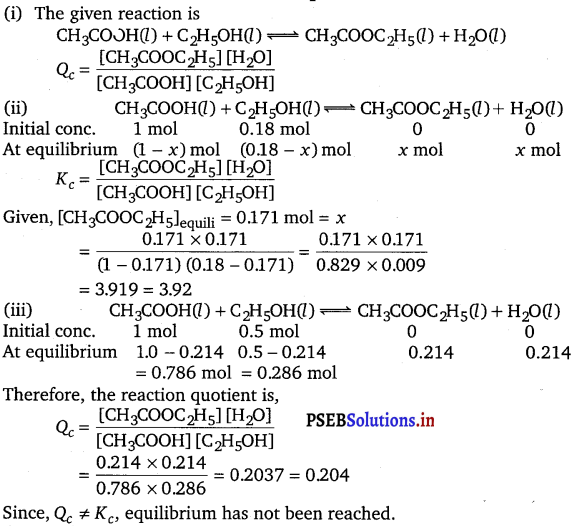
Pay load is defined as the difference between the mass of displaced air and the mass of the balloon. Calculate the pay load when a balloon of radius 10m, mass 100kg is filled with helium at 1.66 bar at 27°C.(Density of air = 1.2 kg m-3 and R = 0.083 bar dm3K-1 mol-1)
Answer:
Given,
Radius of the balloon, r = 10m
∴ Volume of the balloon = \(\frac{4}{3} \pi r^{3}=\frac{4}{3} \times \frac{22}{7}\) x 103 = 4190.5 m3(approx)
∴ Mass of displaced air = Vdisplaced air x density of air
= 4190.5 x 1.2 kg = 5028.6 kg
Now, mass of helium (m) filled in balloon
\(m_{\mathrm{He}}=\frac{M p V}{R T}\)
Here, M = 4 x 10⁻³ kg mol-1
p= 1.66 bar
V = Volume of the balloon = 4190.5 x 103 dm3
R = 0.083 bar dm3K-1mol-1
T = 27°C = 300 K
Then mHe = \(\frac{4 \times 10^{-3} \times 1.66 \times 4190.5 \times 10^{3}}{0.083 \times 300}\) = 1117.5kg(approx)
Now, total mass of the balloon filled with helium
= (100 +1117.5)kg = 1217.5kg
Hence, pay load = mass of displaced air – mass of balloon
= (5028.6 -1217.5) kg = 3811.1 kg
Hence, the pay load of the balloon is 3811.1 kg

Question 17.
Calculate the volume occupied by 8.8g of CO2 at 31.1°C and 1 bar pressure. (R = 0.083 bar LK-1 mol-1).
Answer:
We know that,
pV = nRT m
pV = \(\frac{m}{M} R T\)
V = \(\frac{m R T}{M p}\)
Here, m = 8.8 g
R = 0.083 bar LK-1mol-1
T = 31.1°C = 304.1 K
M = 44 g mol-1
p = 1 bar
Then, volume V = \(\frac{8.8 \times 0.083 \times 304.1}{44 \times 1}\) = 5.048 L
Hence, the volume occupied is 5.048 L.

Question 18.
2.9 g of a gas at 95°C occupied the same volume as 0.184 g of dihydrogen at 17°C, at the same pressure. What is the molar mass of the gas?
Answer:
Applying the ideal gas equation pV = nRT
PSEB 11th Class Chemistry Solutions Chapter 5 States of Matter 6
Hence, the molar mass of the gas is 40 g mol-1 .

Question 19.
A mixture of dihydrogen and dioxygen at one bar pressure contains 20% by weight of dihydrogen. Calculate the partial pressure of dihydrogen.
Answer:
Let the weight of dihydrogen be 20 g and the weight of dioxygen be 80g.
Moles of dihydrogen,
nH2 = 20/2 = 10 mol
Moles of dioxygen,
nO2 = 80/32 = 2.5 mol
Given,
Total pressure of the mixture, ptotal = 1 bar
Then, partial pressure of dihydrogen,
pH2 = \(\frac{n_{\mathrm{H}_{2}}}{n_{\mathrm{H}_{2}}+n_{\mathrm{O}_{2}}} \times p_{\text {total }}=\frac{10}{10+2.5} \times 1\) = 0.8 bar
Hence, the partial pressure of dihydrogen is 0.8 bar.

Question 20.
What would be the SI unit for the quantity pV2 T2 / n?
Answer:
The SI unit of \(\frac{p V^{2} T^{2}}{n}\) is given by
= \(\frac{\left(\mathrm{Nm}^{-2}\right)\left(\mathrm{m}^{3}\right)^{2}(\mathrm{~K})^{2}}{\mathrm{~mol}}\) = Nm4K2mol-1

Question 21.
In terms of Charles’ law explain why -273°C is the lowest possible temperature.
Answer:
According to Charles’ law,
Vt = V0 [1 + \(\frac{t}{273}\) ]
At t = -273° C
Vt = V0 = [1 – \(\frac{273}{273}\) ] = 0
Thus, at -273° C, volume of a gas becomes zero and below this temperature the volume becomes negative, which is meaningless.

PSEB 11th Class Chemistry Solutions Chapter 5 States of Matter

Question 22.
Critical temperature for carbon dioxide and methane are 31.1° C and -81.9°C respectively. Which of these has stronger intermolecular forces and why?
Answer:
Higher is the critical temperature of a gas, easier is its liquefaction. This means that the intermolecular forces of attraction between the molecules of a gas are directly proportional to its critical temperature. Hence, intermolecular forces of attraction are stronger in the case of C02.

Question 23.
Explain the physical significance of van der Waals parameters.
Answer:
Significance of constant ‘a’ : The value of constant ‘a’ is a measure of the magnitude of intermolecular forces between the molecules of the gas. Its units are atm L mol-2 . Larger the value of ‘a’ larger will be the intermolecular forces among the gas molecules.
Significance of constant ‘b’ : The constant ‘b’ is called co-volume or excluded volume per mol of a gas. Its units are litre mol-1.The volume of V is four times the actual volume of the molecules. It is measure of effective size of the gas molecules.

PSEB 8th Class Social Science Solutions Chapter 14 हस्तशिल्प तथा उद्योग

Punjab State Board PSEB 8th Class Social Science Book Solutions History Chapter 14 हस्तशिल्प तथा उद्योग Textbook Exercise Questions and Answers.

PSEB Solutions for Class 8 Social Science History Chapter 14 हस्तशिल्प तथा उद्योग

SST Guide for Class 8 PSEB हस्तशिल्प तथा उद्योग Textbook Questions and Answers

I. नीचे लिखे प्रश्नों के उत्तर लिखें :

प्रश्न 1.
भारत के लघु (छोटे) उद्योगों के पतन के कोई दो कारण लिखें।
उत्तर-

  1. इन उद्योगों के मुख्य संरक्षक देशी रियासतों के राजा, उनके परिवार के सदस्य तथा उनके अधिकारी और कर्मचारी थे। जब देशी रियासतों की समाप्ति शुरू हो गई तो पुराने उद्योगों को स्वाभाविक रूप से धक्का लगा।
  2. भारत के लघु उद्योगों में बनी वस्तुएं नई श्रेणी के लोगों को पसन्द नहीं थीं। वे अंग्रेज़ों के प्रभाव में थे। अत: इन्हें यूरोप की वस्तुएं भारत की वस्तुओं की अपेक्षा अधिक अच्छी लगती थीं।

प्रश्न 2.
भारत के लघु उद्योगों के द्वारा तैयार की गई वस्तुओं का मूल्य अधिक क्यों होता था ? .
उत्तर-
भारत के लघु उद्योगों द्वारा तैयार की गई वस्तुओं का मूल्य इसलिए अधिक होता था, क्योंकि इन्हें तैयार करने के लिए अधिक परिश्रम करना पड़ता था।

प्रश्न 3.
भारत में सूती कपड़े का प्रथम उद्योग कब तथा कहां स्थापित हुआ ?
उत्तर-
भारत में सूती कपड़े का प्रथम उद्योग (कारखाना) 1853 ई० में मुम्बई में स्थापित हुआ।

PSEB 8th Class Social Science Solutions Chapter 14 हस्तशिल्प तथा उद्योग

प्रश्न 4.
भारत में पहला पटसन उद्योग कब तथा कहां लगाया गया ?
उत्तर-
भारत में पहला पटसन उद्योग 1854 ई० में सीरमपुर (बंगाल) में लगाया गया।

प्रश्न 5.
भारत में कॉफी का पहला बाग कब तथा कहां लगाया गया ?
उत्तर-
भारत में कॉफी का पहला बाग 1840 ई० में दक्षिण भारत में लगाया गया।

प्रश्न 6.
चाय का पहला बाग कब तथा कहां लगाया गया ?
उत्तर-
चाय का पहला बाग़ 1852 ई० में असम में लगाया गया।

प्रश्न 7.
19वीं सदी में लघु उद्योगों के पतन के बारे में लिखें।
उत्तर-
भारत में अंग्रेजी शासन की स्थापना से पहले भारत के गांव आत्म-निर्भर थे। गांवों के लोग जैसे कि लोहार, जुलाहे, किसान, बढ़ई, चर्मकार, कुम्हार आदि मिलकर गांव की आवश्यकताओं को पूरा करने के लिए वस्तुएं तैयार कर लेते थे। उनकी दस्तकारियां या लघु उद्योग उनकी आय के साधन होते थे। परन्तु अंग्रेज़ी शासन की स्थापना होने के कारण गांवों के लोग भी अंग्रेज़ी कारखानों में तैयार की गई वस्तुओं का उपयोग करने लगे क्योंकि वे बढ़िया एवं सस्ती होती थीं। अतः भारत के नगरों एवं गांवों के लघु उद्योगों का पतन होने लगा और कारीगर (शिल्पकार) बेकार हो गये।

प्रश्न 8.
आधुनिक भारतीय उद्योगों के महत्त्व के बारे में लिखें।
उत्तर-
भारत में आधुनिक उद्योगों के विकास से आर्थिक एवं सामाजिक जीवन पर महत्त्वपूर्ण प्रभाव पड़े। इसके परिणामस्वरूप समाज में दो श्रेणियों का जन्म हुआ-पूंजीपति तथा मज़दूर। पूंजीपति मजदूरों का अधिक-से-अधिक शोषण करने लगे। वे मजदूरों से अधिक-से-अधिक काम ले कर कम-से-कम पैसे देते थे। अत: सरकार ने मजदूरों की दशा सुधारने के लिए फैक्टरी-एक्ट पास किये। औद्योगिक विकास होने के कारण कई नये नगरों का निर्माण भी हुआ। ये नगर आधुनिक जीवन एवं संस्कृति के केन्द्र बने।

प्रश्न 9.
नील उद्योग पर नोट लिखें।
उत्तर-
अंग्रेजों को इंग्लैंड में अपने कपड़ा उद्योग के लिए नील की आवश्यकता थी। अतः उन्होंने भारत में नील की खेती को बढ़ावा दिया। इसका आरम्भ 18वीं शताब्दी के अन्त में बिहार तथा बंगाल में हुआ। नील के अधिकतर बड़े-बड़े बाग यूरोप वालों ने लगाए, जहां भारतीयों को काम पर लगाया गया। 1825 में नील की खेती के अधीन 35 लाख बीघा भूमि थी। परन्तु 1879 ई० में नकली नील तैयार होने के कारण नील की खेती में कमी आने लगी। परिणामस्वरूप 1915 ई० तक नील की खेती के अधीन केवल 3-4 लाख बीघा जमीन ही रह गई।

प्रश्न 10.
कोयले की खानों पर नोट लिखें।
उत्तर-
भारत में अंग्रेजों द्वारा स्थापित सभी नये कारखाने कोयले से चलते थे। रेलों के लिए भी कोयला चाहिए था। इसलिए कोयला खानों में से कोयला निकालने की ओर विशेष ध्यान दिया गया। 1854 ई० में बंगाल के रानीगंज जिले में कोयले की केवल 2 खानें थीं। परन्तु 1880 तक इनकी संख्या 56 तथा 1885 तक 123 हो गई।

PSEB 8th Class Social Science Solutions Chapter 14 हस्तशिल्प तथा उद्योग

II. रिक्त स्थानों की पूर्ति करें:

1. देशी रियासतों के राजा महाराजा …………. उद्योगों द्वारा तैयार की गई वस्तुओं का प्रयोग करते थे।
2. नई पीढ़ी के लोग लघु उद्योगों द्वारा तैयार किए गए माल को ………… नहीं करते थे।
3. सभी नए कारखाने ……………. से चलते थे।
उत्तर-

  1. लघु
  2. पसंद
  3. कोयले।।

III. प्रत्येक वाक्य के सामने ‘सही’ (✓) या ‘गलत’ (✗) का चिन्ह लगाएं:

1. भारतीय नगरों एवं गांवों के लघु उद्योगों के पतन से कारीगर बेकार हो गए। – (✓)
2. इंग्लैंड में औद्योगिक क्रांति 19वीं सदी में आई। – (✗)
3. मशीनों द्वारा तैयार की गई वस्तुओं का दाम अधिक होता था। – (✗)
4. 18वीं सदी में भारत का कच्चा माल इंग्लैंड जाने लगा। – (✓)

IV. सही जोड़े बनाएं :

PSEB 8th Class Social Science Solutions Chapter 14 हस्तशिल्प तथा उद्योग 1
उत्तर-

  1. टी (चाय) कंपनी
  2. सेरमपुर (बंगाल)
  3. रानीगंज।

PSEB 8th Class Social Science Guide हस्तशिल्प तथा उद्योग Important Questions and Answers

वस्तुनिष्ठ प्रश्न (Multiple Choice Questions)

सही विकल्प चुनिए :

प्रश्न 1.
कॉफी का पहला बाग़ कब लगाया गया ?
(i) 1834 ई०
(ii) 1839 ई०
(iii) 1840 ई०
(iv) 1854 ई०।
उत्तर-
1840 ई०

प्रश्न 2.
भारत में नील उद्योग कहां से शुरू हुआ ?
(i) बिहार तथा बंगाल
(ii) कर्नाटक तथा तमिलनाडु
(iii) पंजाब तथा हरियाणा
(iv) मध्य भारत।
उत्तर-
बिहार तथा बंगाल

प्रश्न 3.
भारत में पटसन उद्योग का पहला कारखाना कब लगाया गया ?
(i) 1820 ई०
(ii) 1824 ई०
(iii) 1834 ई०
(iv) 1854 ई०।
उत्तर-
1854 ई० ।

PSEB 8th Class Social Science Solutions Chapter 14 हस्तशिल्प तथा उद्योग

अति छोटे उत्तर वाले प्रश्न

प्रश्न 1.
अंग्रेजी शासन की स्थापना से पहले आर्थिक दृष्टि से गांवों की स्थिति कैसी थी ?
उत्तर-
अंग्रेजी शासन की स्थापना से पहले गांव आर्थिक दृष्टि से आत्म-निर्भर थे।

प्रश्न 2.
भारतीय दस्तकारों द्वारा बनी वस्तुएं मशीनों द्वारा बनी वस्तुओं का मुकाबला क्यों न कर सकीं ?
उत्तर-
भारतीय दस्तकारों द्वारा बनी वस्तुएं मशीनों द्वारा बनी वस्तुओं का मुकाबला इसलिए न कर सकी क्योंकि मशीनी वस्तुएं साफ़ तथा सुन्दर होने के साथ-साथ सस्ती भी थीं।

प्रश्न 3.
नई श्रेणी के लोगों को भारत के लघु उद्योगों द्वारा बनी वस्तुएं क्यों पसन्द नहीं थीं ?
उत्तर-
क्योंकि वे पश्चिमी-सभ्यता के प्रभाव में थे।

प्रश्न 4.
पटसन उद्योग में क्या-क्या वस्तुएं बनाई जाती थीं ?
उत्तर-
टाट तथा बोरियां।

प्रश्न 5.
भारत के कॉफी उद्योग को हानि क्यों पहंची ?
उत्तर-
भारत की कॉफी का मुकाबला ब्राज़ील की कॉफी से था जो बहुत अच्छी थी। इसलिए भारत के कॉफी उद्योग को हानि पहुंची।

प्रश्न 6.
भारत में अंग्रेज़ी काल में विकसित किन्हीं छः आधुनिक उद्योगों के नाम बताओ।
उत्तर-

  • सूती कपड़ा उद्योग
  • पटसन उद्योग
  • कोयला उद्योग
  • नील उद्योग
  • चाय
  • कॉफी।

प्रश्न 7.
फैक्टरी एक्ट क्यों पास किए गए ?
उत्तर-
फैक्टरी एक्ट मज़दूरों की दशा सुधारने के लिए पास किए गए।

प्रश्न 8.
आदि मानव अपने आप को गर्म रखने के लिए किस चीज़ से बने वस्त्र पहनता था ?
उत्तर-
पशुओं की खाल से बने वस्त्र।

छोटे उत्तर वाले प्रश्न

प्रश्न 1.
भारत में कपड़ा बुनने का विकास कैसे हुआ ? खुदाइयों से कपड़े की बुनाई के बारे में क्या प्रमाण मिले हैं ?
उत्तर-
आदि मानव अपने आप को गर्म रखने के लिए पशुओं की खाल से बने कपड़े पहनता था। कताई एवं बुनाई . की खोज इसके बहुत समय पश्चात् हुई थी। ऐसा माना जाता है कि भारत में जुलाहों ने कपड़ा तैयार करने के लिए सबसे पहले घास के रेशों का उपयोग किया था। तत्पश्चात् उन्होंने इस पर नमूने बनाने और करघे पर धागों का उपयोग करना सीखा। समय बीतने पर रेशों और नमूनों में और अधिक सुधार हुआ।

प्रमाण-प्राचीन वस्तुओं का अध्ययन करने वाले वैज्ञानिकों को मोहनजोदड़ो तथा हड़प्पा की खुदाइयों से सूत की कताई तथा रंगदार सूती कपड़े के अवशेष मिले हैं। इस के अतिरिक्त उन्हें कश्मीर में कई स्थानों की खुदाई से चरखे, दरियां आदि प्राप्त हुए हैं। इनसे संकेत मिलता है कि लगभग 4,000 साल.पूर्व लोग कपड़ा बुनना जानते थे।

PSEB 8th Class Social Science Solutions Chapter 14 हस्तशिल्प तथा उद्योग

प्रश्न 2.
भारत में कपड़ा उद्योग का पतन क्यों हुआ ? इसे नया जीवन कैसे मिला ?
उत्तर-
भारतीय कपड़े संसार-भर में प्रसिद्ध थे। यूरोप के व्यापारी कपड़े एवं मसालों का व्यापार करने के लिए ही भारत में आये थे। उन्होंने भारत में सूती कपड़े के कारखाने लगाए थे। इन उद्योगों में साधारण हथकरघों की अपेक्षा अधिक कपड़े का उत्पादन किया जाता था। परन्तु इंग्लैंड में औद्योगिक क्रान्ति आने के कारण भारत में कपड़ा-व्यापार का पतन आरम्भ हो गया। परन्तु 20वीं शताब्दी में महात्मा गांधी के मार्गदर्शन में भारत में फिर से हाथ से बुने सूती एवं – रेशमी कपड़े तैयार किये जाने लगे, जिससे भारतीय कपड़ा-उद्योग पुनः अस्तित्व में आया।
सरकार की नई आर्थिक नीति से भी कपड़ा-उद्योग ने पहले से कहीं अधिक उन्नति की। सरकार ने कपड़े का आयात-निर्यात करने के लिए बहुत-सी सुविधाएं प्रदान की।

प्रश्न 3.
अंग्रेज़ी काल में भारत में पटसन उद्योग पर एक नोट लिखो।
उत्तर-
पटसन उद्योग में मुख्य रूप से टाट तथा बोरियां बनाई जाती थीं। इस उद्योग पर यूरोप के लोगों का अधिकार था। इस उद्योग का पहला कारखाना 1854 ई० में सीरमपुर (बंगाल) में लगाया गया। इसके बाद भी पटसन उद्योग के अधिकतर कारखाने बंगाल में ही लगाये गए। 20वीं शताब्दी के आरम्भ तक इन कारखानों की संख्या 36 हो गई थी।

निबन्धात्मक प्रश्न

प्रश्न 1.
भारत में लघु उद्योगों के पतन के कारणों का वर्णन करें।
उत्तर-
भारत में लघु-उद्योगों के पतन के मुख्य कारण निम्नलिखित थे

1. भारत की देशी रियासतों की समाप्ति-अंग्रेजों ने बहुत-सी भारतीय रियासतों को समाप्त कर दिया था। इस कारण लघु उद्योगों को बहुत हानि पहुंची क्योंकि इन रियासतों के राजा-महाराजा तथा उनके परिवार के सदस्य लघु उद्योगों द्वारा तैयार की गई वस्तुओं का उपयोग करते थे।

2. भारतीय लघु उद्योगों द्वारा तैयार वस्तुओं का महंगा होना-भारतीय लघु उद्योगों द्वारा तैयार की गई वस्तुओं का मूल्य अधिक होता था, क्योंकि उन्हें तैयार करने के लिए अधिक परिश्रम करना पड़ता था। दूसरी ओर मशीनों द्वारा तैयार की गई वस्तुओं का मूल्य कम होता था। अत: लोग लघु उद्योगों द्वारा तैयार की गई वस्तुओं को नहीं खरीदते थे। परिणामस्वरूप भारतीय लघु उद्योगों का पतन आरम्भ हो गया।

3. मशीनी वस्तुओं की सुन्दरता-इंग्लैंड के कारखानों में मशीनों द्वारा तैयार वस्तुएं भारत के लघु उद्योगों द्वारा तैयार वस्तुओं की अपेक्षा अधिक साफ तथा सुन्दर होती थीं। अतः भारतीय लोग मशीनों द्वारा तैयार वस्तुओं को अधिक पसन्द करते थे। यह बात भारत के लघु उद्योगों के पतन का कारण बनी।

4. नई श्रेणी के लोगों की रुचि-नई श्रेणी के लोगों पर पश्चिमी संस्कृति का प्रभाव था। दूसरे, मशीनों द्वारा तैयार वस्तुएं बहुत साफ और सुन्दर होती थीं। अतः नई पीढ़ी के लोग लघु उद्योगों द्वारा तैयार वस्तुओं को पसन्द नहीं करते थे।

5. भारत से कच्चा माल इंग्लैंड भेजना-18वीं शताब्दी में यूरोप में औद्योगिक क्रान्ति आई। इसके कारण वहां बहुत बड़े-बड़े कारखाने स्थापित किये गये। इन कारखानों में माल तैयार करने के लिए कच्चे माल की बहुत आवश्यकता थी, जिसे इंग्लैंड का कच्चा माल पूरा न कर सका। इस कारण भारत का कच्चा माल इंग्लैंड भेजा जाने लगा। इससे भारतीय कारीगरों के पास कच्चे माल की कमी हो गई। फलस्वरूप देश के लघु उद्योग पिछड़ गये।

प्रश्न 2.
प्रमुख आधुनिक भारतीय उद्योगों का वर्णन करें।
उत्तर-
अंग्रेजी शासन के समय भारत में बहुत-से नये उद्योगों की स्थापना हुई जिनमें प्रमुख उद्योग निम्नलिखित थे
1. सूती कपड़ा उद्योग-भारत में सूती कपड़े का पहला उद्योग (कारखाना) 1853 ई० में मुम्बई में लगाया गया। इसके पश्चात् 1877 ई० में कपास उगाने वाले बहुत से क्षेत्रों जैसे कि अहमदाबाद, नागपुर आदि में कपड़ा मिलें स्थापित की गईं। 1879 ई० तक भारत में लगभग 59 सूती कपड़ा मिलें स्थापित की जा चुकी थीं। जिनमें लगभग 43,000 लोग काम करते थे। 1905 ई० में कपड़ा मिलों की संख्या 206 हो गई थी। इनमें लगभग 1,96,000 मजदूर काम करते थे।

2. पटसन का उद्योग-पटसन का उद्योग बोरियां तथा टाट बनाने का काम करता था। इस उद्योग पर यूरोप के लोगों का अधिकार था। इस उद्योग का पहला कारखाना 1854 ई० में सैरमपुर अथवा सीरमपुर (बंगाल) में खोला गया। इसके बाद भी पटसन उद्योग के सबसे अधिक कारखाने बंगाल प्रान्त में ही खोले गये। 20वीं शताब्दी के आरम्भ तक इन कारखानों की संख्या 36 हो गई थी।

3. कोयले की खानें-भारत में अंग्रेजों द्वारा स्थापित सभी नये कारखाने कोयले से चलते थे। रेलों के लिए भी कोयला चाहिए था। इसलिए कोयला खानों में से कोयला निकालने की ओर विशेष ध्यान दिया गया। 1854 ई० में बंगाल के रानीगंज जिले में कोयले की केवल 2 खानें थीं। परन्तु 1880 तक इनकी संख्या 56 तथा 1885 तक 123 हो गई।

4. नील उद्योग-अंग्रेजों को इंग्लैंड में अपने कपड़ा उद्योग के लिए नील की आवश्यकता थी। अत: उन्होंने भारत में नील की खेती को बढ़ावा दिया। इसका आरम्भ 18वीं शताब्दी के अन्त में बिहार तथा बंगाल में हुआ। नील के अधिकतर बड़े-बड़े बाग यूरोप वालों ने लगाए, जहां भारतीयों को काम पर लगाया गया। 1825 में नील की खेती के अधीन 35 लाख बीघा भूमि थी। परन्तु 1879 ई० में नकली नील तैयार होने के कारण नील की खेती में कमी आने लगी। परिणामस्वरूप 1915 ई० तक नील की खेती के अधीन केवल 3-4 लाख बीघा जमीन ही रह गई।

5. चाय-1834 ई० में असम में एक कम्पनी की स्थापना की गई। 1852 ई० में अंग्रेजों ने असम में चाय का पहला बाग लगाया। 1920 ई० तक चाय की खेती लगभग 7 लाख एकड़ भूमि में होने लगी। उस समय 34 करोड़ पाऊंड मूल्य की चाय भारत से बाहर के देशों में भेजी जाती थी। तत्पश्चात् कांगड़ा तथा नीलगिरि की पहाड़ियों में भी चाय के बाग लगाए गए।

6. कॉफी-कॉफी का पहला बाग़ 1840 ई० में दक्षिण भारत में लगाया गया। तत्पश्चात् मैसूर, कुर्ग, नीलगिरि और मालाबार क्षेत्रों में भी कॉफी के बाग लगाये गये। ब्राज़ील की कॉफी के साथ इसका मुकाबला होने के कारण इस उद्योग को बहुत हानि पहुंची।

7. अन्य उद्योग-19वीं शताब्दी के अन्त से लेकर 20वीं शताब्दी के आरम्भ तक बहुत से नये कारखाने स्थापित किये गये। इनमें लोहा-इस्पात, चीनी, कागज, दियासलाई बनाने और चमड़ा रंगने के कारखाने प्रमुख थे।

PSEB 11th Class Chemistry Solutions Chapter 6 Thermodynamics

Punjab State Board PSEB 11th Class Chemistry Book Solutions Chapter 6 Thermodynamics Textbook Exercise Questions and Answers.

PSEB Solutions for Class 11 Chemistry Chapter 6 Thermodynamics

PSEB 11th Class Chemistry Guide Thermodynamics InText Questions and Answers

Question 1.
Choose the correct answer. A thermodynamic state function is a quantity
(i) used to determine heat changes
(ii) whose value is independent of path
(iii) used to determine pressure volume work
(iv) whose value depends on temperature only.
Answer:
(ii) A thermodynamic state function is a quantity whose value is independent of path. Functions like p, V, T etc., depend only on the state of a system and not on the path.

PSEB 11th Class Chemistry Solutions Chapter 6 Thermodynamics

Question 2.
For the process to occur under adiabatic conditions, the correct condition is:
(i) ΔT = 0 (ii) Δp = 0
(iii) q = 0 (iv) w = 0
Answer:
(iii) A system is said to be under adiabatic conditions if there is no exchange of heat between the system and its surroundings. Hence, under adiabatic conditions, q = 0.

Question 3.
The enthalpies of all elements in their standard states are:
(i) unity
(ii) zero
(iii) < 0
(iv) different for each element
Answer:
(ii) The enthalpies of all elements in their standard states are zero.

Question 4.
\(\Delta \boldsymbol{U}^{\ominus}\) of combustion of methane is – X kJ mol-1. The value of \(\Delta \boldsymbol{H}^{\ominus}\) is
(i) = ΔU
(ii) > ΔU
(iii) \(\Delta \boldsymbol{U}^{\ominus}\)
(iv) = 0
Answer:
(iii) CH4(g) + 2O2(g) > CO2(g) + 2H2O(l)
Δng = np-nr = 1 – 3 =-2
Hence,\(\Delta \boldsymbol{H}^{\ominus}\) = \(\Delta \boldsymbol{U}^{\ominus}\) + Δ ngRT
\(\Delta \boldsymbol{H}^{\ominus}\) = – X – 2RT
Hence, \(\Delta \boldsymbol{H}^{\ominus}\) < \(\Delta \boldsymbol{U}^{\ominus}\)

Question 5.
The enthalpy of combustion of methane, graphite and dihydrogen at 298 K are, -890.3 kJ mol-1 – 393.5 kJ mol-1 and -285.8 kJ mol-1 respectively. Enthalpy of formation of CH4(g) will be
(i) -748kJmol-1
(ii) -52.27kJ mol-1
(iii) +748kJ mol-1
(iv) +52.26kJ mol-1
Answer:
According to the equation
(i) CH4(g) + 2O2(g) → CO2(g) + 2H2O(l); ΔH = -890.3 kJ mol-1

(ii) C(s) + O2(g) → CO2(g); ΔH = – 393.5 kJ mol-1

(iii) H2(g) + \(\frac{1}{2}\)O2(g) → H2O(l); ΔH = -285.8 kJ mol-1
Multiplying equation (iii) by 2, we get equation (iv).

(iv) 2H2(g) + O2(g) → 2H2O(l); ΔH = – 571.6 kJ mol-1
Adding eqs. (ii) and (iv), we get

(v) (C(s) +2H2(g) + 2O2(g) → CO2(g) + 2H2O(l); ΔH = – 965.1 kJ mol-1
Reversing eqs. (i)

(vi) CO2(g) + 2H2O(l) → CH4(g) + 2O2(g); ΔH = +890.3 kJ mol-1
Adding eqs. (v) and (vi), we get
C(s) + 2H2(g) → CH4(g); ΔH = – 74.8 kJ mol-1
Hence, option (i) is correct.

PSEB 11th Class Chemistry Solutions Chapter 6 Thermodynamics

Question 6.
A reaction, A + B → C + D +q is found to have a positive entropy change. The reaction will be
(i) possible at high temperature
(ii) possible only at low temperature
(iii) not possible at any temperature
(iv) possible at any temperature
Answer:
(iv) For a reaction to be spontaneous, AG should be negative.
ΔG = ΔH – TΔS
According to the question, for the given reaction,
ΔS = positive
ΔH = negative (since heat is evolved)
=> ΔG = negative
Therefore, the reaction is spontaneous at any temperature.
Hence, option (iv) is correct.

Question 7.
In a process, 701 J of heat is absorbed by a system and 394 J of work is done by the system. What is the change in internal energy for the process?
Answer:
According to the first law of thermodynamics,
ΔU = q + W …(i)
Given,
q = +701 J (heat is absorbed here, q is positive)
W=- 394 J
(work is done by the system hence W is negative)
Substituting the values in expression (i), we get
ΔU= +701 J + (-394 J)
ΔH = 307 J
Hence, the change in internal energy for the given process is 307 J.

Question 8.
The reaction of cyanamide, NH2CN(s) with dioxygen was carried out in a bomb calorimeter, and ΔU was found to be – 742.7 kJ mol-1 at 298K. Calculate enthalpy change for the reaction at 298 K.
NH2CN(s) + \(\frac{3}{2}\)O2(g) → N2(g) + CO2(g) + H2O(l)
Answer:
The given reaction is
NH2CN(s) + \(\frac{3}{2}\)O2(g) → N2(g) + CO2(g) + H2O(l)
Difference of moles of gaseous products and reactants,
Δng = np – nr = 2 – \(\frac{3}{2}=\frac{1}{2}\) = 0.5 mol
Given, ΔU=- 742.7kJ mol-1
Enthalpy change ΔH = ΔU + ΔngRT
= – 742.7 + (0.5 x 8.314 x 10-3 x 298)
= – 742.7 +1238.786 x 10-3
= – 741.46 kJ mol-1

Question 9.
Calculate the number of kJ of heat necessary to raise the temperature of 60.0 g of aluminium from 35°C to 55°C. Molar heat capacity of Al is 24 J mol-1K-1.
Answer:
Given, mass of Al = 60.0 g
ΔT= 55 – 35 = 20°C
No.of moles of Al = \(\frac{60.0}{27}\) mol
Molar heat capacity of Al
= 24 J mol-1K-1
Heat, q = n.C . ΔT
= [ \(\frac{60}{27}\) mol )(24 J mol-1K-1)(20 K)
q= 1066.7 J
q = 1.07 kJ

PSEB 11th Class Chemistry Solutions Chapter 6 Thermodynamics

Question 10.
Calculate the enthalpy change on freezing of 1.0 mol of water at 10.0°C to ice at – 10.0°C. ΔfusH = 6.03 kJ mol-1 at 0°C.
Cp[H2O(l)] – 75.3 J mol-1K-1
Cp[H2O(s)] = 36.8J mol-1K-1
Answer:
(i) Heat change required to lower the temperature of water from 10.0°Cto0°C
ΔH1= n x Cp x ΔT= 1.0 x 75.3 x (-10) = – 753 J mol-1
(ii) Heat change required to convert 1 mol of H2O(l) at 0°C to H2O(s) at 0°C
ΔH2 = ΔHfusion = – 6.03 kJ mol-1 as heat is given out
(iii) Heat change required to change 1 mole of ice from 0°C to -10.0° C
ΔH3 = – 36.8 x 10 x 1 = – 368 J mol-1
Total heat change
= ΔH1 + ΔH2 + ΔH3 = (- 0.753 – 6.03 – 0.368) kJ mol-1
∴ Total enthalpy change = – 7.151 kJ mol-1
As in each step, heat is evolved, each step will have a negative sign with ΔH

Question 11.
Enthalpy of combustion of carbon to CO2 is -393,5 kJ mol-1. Calculate the heat released upon formation of 35.2 g of CO2 from carbon and dioxygen gas.
Answer:
The reaction for the combustion of carbon into CO2 is
C(s) + O2(g) → CO2(g); ΔH = – 393.5 kJ mol-1 (1 mole CO2 – 44g)
Heat released in the formation of 44 g CO2 = 393.5 kJ
∴ Heat released in the formation of 35.2 g CO2
\(\frac{393.5 \mathrm{~kJ}}{44 \mathrm{~g}}\) x 5.2g = 314.8 kJ mol-1

Question 12.
Enthalpies of formation of CO(g), CO(2)(g), N2O(g) and N2O4(g) are -110, -393, 81and 9.7 kJ mol-1 respectively. Find the value of ΔrH for the reaction:
N2O4(g) + 3CO(g) → N2O(g) + 3CO2(g)
Answer:
ΔfH (CO) = -110 kJ mol-1
ΔHf(CO2) = -393 kJ mol-1
ΔfH (N2O)= 81 kJ mol-1
ΔfH (N2O4) = 9.7 kJ mol-1
The given reaction is
N2O4(g) + 3CO(g) → N2O(g) + 3CO2(g); ΔrH = ?
PSEB 11th Class Chemistry Solutions Chapter 6 Thermodynamics 1
= [81 + 3 (-393)] – [9.7 + 3 (-110)] kJ = [81 -1179]-[9.7-330] kJ
ΔrH = – 777.8 kJ.

Question 13.
Given : N2(g) + 3H2(g) → 2NH3(g); \(\Delta_{\boldsymbol{r}} \boldsymbol{H}^{\ominus}\) = -92.4kJ mol-1.
What is the standard enthalpy of formation of NH3 gas?
Answer:
Given, N2(g) + 3H2(g) → 2NH3(g); ΔrH = – 92.4 kJ mol-1
Chemical reaction for the enthalpy of formation of NH3(g) is as follows :
\(\frac{1}{2}\)N2(g) + \(\frac{3}{2}\)H2(g) → NH3(g)
∴ Standard enthalpy of formation of NH3(g)
= \(\frac{1}{2}\)\(\Delta H^{\theta}\) = \(\frac{1}{2}\) (-92.4 kJ mol-1) = -46.2 kJ mol-1

Question 14.
Calculate the standard enthalpy of formation of CH3OH(l) from the following data:
CH3OH(l) + \(\frac{3}{2}\)O2(g) → CO2(g) + 2H2O(l); \(\Delta_{\boldsymbol{r}} \boldsymbol{H}^{\ominus}\) = -726 kJ mol-1
C(graphite) + O2(g) → CO2(g); \(\Delta_{\boldsymbol{c}} \boldsymbol{H}^{\ominus}\) = – 393 kJ mol-1
H2(g) + \(\frac{1}{2}\)O2(g) → H2O(l); \(\Delta_{\boldsymbol{f}} \boldsymbol{H}^{\ominus}\) = – 286 kJ mol-1
Answer:
PSEB 11th Class Chemistry Solutions Chapter 6 Thermodynamics 2
PSEB 11th Class Chemistry Solutions Chapter 6 Thermodynamics 3

PSEB 11th Class Chemistry Solutions Chapter 6 Thermodynamics

Question 15.
Calculate the enthalpy change for the process
CCl4(g) → C(g) + 4Cl(g)
and calculate bond enthalpy of C—Cl in CCl4(g).
\(\Delta_{\mathbf{v a p}} \boldsymbol{H}^{\ominus}\)(CCl4) = 30.5kJ mol-1. \(\Delta_{\boldsymbol{f}} \boldsymbol{H}^{\ominus}\)(CCl4) = – 135.5kJ mol-1.
\(\Delta_{a} \boldsymbol{H}^{\ominus}(\mathbf{C})\) = 715.0kJ mol-1, \(\Delta_{\boldsymbol{a}} \boldsymbol{H}^{\ominus}\left(\mathbf{C l}_{\mathbf{2}}\right)\)(Cl2) = 242 kJ mol-1; where \(\Delta_{\boldsymbol{a}} \boldsymbol{H}^{\ominus}\) is enthalpy of atomisation.
Answer:
Given,
(i) CCl4(Z) → CCl4(g); \(\Delta_{\mathrm{vap}} H^{\ominus}\) = +30.5 kJ mol-1
(ii) C(s) → C(g); \(\Delta_{a} H^{\ominus}\) = 715.0 kJ mol-1
(iii) Cl2(g) → 2Cl(g); \(\Delta_{a} H^{\ominus}\) = 242 kJ mol-1
(iv) C(s) + 2Cl2(g) → CCl4 a); \(\Delta_{f} H^{\ominus}\) = – 135.5KJ mol-1

Enthalpy change for the given process
CCl4(g) → C(g) + 4Cl(g); \(\Delta_{r} H^{\ominus}\) = ?

Add (i) and (iv) and subtract (ii) and (iii) x 2
CCl4(l) + C(s) + 2Cl2(g) – C(s) – 2Cl2 (g) → CCl4(g) + CCl4(g) – C(g) – 4Cl(g)
or \(\Delta_{r} H^{\ominus}\) = 30.5 -135.5 – 715 – 484 = -1304 kJ
0 = CCl4(g) – C(g) + 4Cl(g); \(\Delta_{r} H^{\ominus}\) = -1304kJ
CCl4(g) → C (g) + 4Cl(g); \(\Delta_{r} H^{\ominus}\) = 1304 kJ
There are four bonds of C—Cl in CCl4.
Bond enthalpy of C—Cl bond
= \(\frac{1304}{4}\) mol-1
= 326 kJmol-1

Question 16.

For an isolated system, ΔU = 0, what will be ΔS ?
Ans. For an isolated system, ΔU = 0 and for a spontaneous process, total entropy change must be positive. For example, consider the diffusion of two gases A and B into each other in a closed container which is isolated from the surroundings.

The two gases A and B are separated by a movable partition. When partition is removed, the gases begin to diffuse into each other and the system becomes more disordered. It shows that ΔS > 0 and ΔU = 0 for this process.
Moreover, ΔS =\(=\frac{q_{\mathrm{rev}}}{T}=\frac{\Delta H}{T}=\frac{\Delta U+p \Delta V}{T}=\frac{p \Delta V}{T}\) (∴ ΔU = 0)
i.e., TΔS or ΔS > 0

PSEB 11th Class Chemistry Solutions Chapter 6 Thermodynamics

Question 17.
For the reaction at 298 K, 2A + B > C
ΔH = 400kJ mol-1 and ΔS = 0.2kJK-1mol-1 At what temperature will the reaction become spontaneous considering ΔH and ΔS to be constant over the temperature range?
Answer:
Given, ΔH = 400 kJ mol-1, ΔS = 0.2 kJ K-1mol-1
Gibbs free energy, ΔG = ΔH – TΔS
0 = 400 kJ mol-1 – T x 0.2 kJ K-1mol-1
(ΔG = 0 at equilibrium)
T = \(\frac{400 \mathrm{~kJ} \mathrm{~mol}^{-1}}{0.2 \mathrm{~kJ} \mathrm{~K}^{-1} \mathrm{~mol}^{-1}}\)
T = 2000 K
For the reaction to be spontaneous, ΔG must be negative. Hence, for the given reaction to be spontaneous, T should be greater than 2000 K.

Question 18.
For the reaction,
2Cl(g) → Cl2(g), what are the signs of ΔH and ΔS?
Answer:
ΔH and ΔS are negative.
The given reaction represents the formation of chlorine molecule from chlorine atoms. Here, bond formation is taking place. Therefore, energy is being released. Hence, ΔH is negative.
Also, two moles of atoms have more randomness than one mole of a molecule. Since spontaneity is decreased, ΔS is negative for the given reaction.

Question 19.
For the reaction : 2A(g) + B(g) → 2D(g)
\(\Delta \boldsymbol{U}^{\ominus}\) = – 10.5 kJ and ΔS = – 441 JK-1.
Calculate \(\Delta \boldsymbol{G}^{\ominus}\) for the reaction, and predict whether the reaction may occur spontaneously.
Answer:
For the given reaction,
2A(g) + B(g) → 2D(g)
Δng = 2 – 3 = -1 mol
Substituting the value of \(\Delta \boldsymbol{U}^{\ominus}\) in the expression ofΔH
\(\Delta H^{\ominus}=\Delta U^{\ominus}+\Delta n_{g} R T\)
= (-10.5 kJ) + (-1) x (8.314 x 10-3kJK-1 mol-1) x (298 K)
= -10.5 kJ-2.48 kJ
\(\Delta H^{\ominus}\) = -12.98 kJ
We know that,
\(\Delta G^{\ominus}=\Delta H^{\ominus}-T \Delta S^{\ominus}\)
= -12.98 kJ – (298K) x ( – 44.1 JK-1)
= -12.98 kJ + 13.14kJ
\(\Delta G^{\ominus}\) = +0.16 kJ
Since, \(\Delta G^{\ominus}\) is positive, the reaction will not occur spontaneously.

Question 20.
The equilibrium constant for a reaction is 10. What will be the value of \(\Delta G^{\ominus}\)? R = 8.314 JK-1mol-1, T = 300 K.
Answer:
\(\Delta G^{\ominus}\) = – 2303RT log Kc
Given, Kc = 10, T = 300 K, R = 8.314 J K-1 mol-1
\(\Delta G^{\ominus}\) = (- 2.303) (8.314 JK-1mol-1) (300K) (loglO) (∵ log 10 = 1)
= – 5744.14 Jmol-1 = – 5.744 kJmol-1

Question 21.
Comment on the thermodynamic stability of NO(g), given
\(\frac{1}{2}\)N2(g) + \(\frac{1}{2}\)O2(g) → NO(g); \(\Delta_{\boldsymbol{r}} \boldsymbol{H}^{\ominus}\) = 90 kJ mol-1
NO(g) + \(\frac{1}{2}\)O2(g) → NO2(g); \(\Delta_{\boldsymbol{r}} \boldsymbol{H}^{\ominus}\) = – 74 kJ mol-1
Answer:
NO(g) is unstable because formation of NO is endothermic (energy is absorbed) but NO2(g) is formed because its formation is exothermic (energy is released).
Hence, unstable NO(g) changes to stable NO2(g).

PSEB 11th Class Chemistry Solutions Chapter 6 Thermodynamics

Question 22.
Calculate the entropy change in surroundings when 1.00 mol of H2O(Z) is formed under standard conditions. \(\Delta_{\boldsymbol{f}} \boldsymbol{H}^{\ominus}\) = – 286
kJ mol-1.
Answer:
Enthalpy change for the formation of 1 mol of H2O(Z)
H2(g) + \(\frac{1}{2}\)O2(g) → H2O(l); \(\Delta_{f} H^{\mathrm{s}}\) = -286 kJ mol-1
Energy released in the above reaction is absorbed by the surroundings. * It means,
qsurr = + 286 kJ mol-1
Entropy change ΔSsurr = \(=\frac{q_{\mathrm{surr}}}{T}=\frac{286 \mathrm{~kJ} \mathrm{~mol}^{-1}}{298 \mathrm{~K}}\)
ΔSsurr = 0.95973 kJ K-1 mol-1 = 959.73 J mol-1K-1

PSEB 9th Class SST Solutions Geography Chapter 3b पंजाब : जलतन्त्र

Punjab State Board PSEB 9th Class Social Science Book Solutions Geography Chapter 3b पंजाब : जलतन्त्र Exercise Questions and Answers.

PSEB Solutions for Class 9 Social Science Geography Chapter 3b पंजाब : जलतन्त्र

SST Guide for Class 9 PSEB पंजाब : जलतन्त्र Textbook Questions and Answers

(क) नक्शा कार्य (Map Work):

प्रश्न 1.
पंजाब के रेखाचित्र में दिखाएं :
(i) रावी, ब्यास, सतलुज तथा घग्गर
(ii) कोई चार नहरें
(iii) कोई चार चो।
उत्तर-
यह प्रश्न विद्यार्थी MBD Map Master की सहायता से स्वयं करें।

प्रश्न 2.
नदियों का प्रदूषण कैसे रोका जाए, इस विषय पर कक्षा में अध्यापक से चर्चा करें।
उत्तर-
यह प्रश्न विद्यार्थी स्वयं करें।

PSEB 9th Class SST Solutions Geography Chapter 3b पंजाब : जलतन्त्र

प्रश्न 3.
अपने समीप नदी या नहर में हो रहे प्रदूषण के लिए अध्यापक व अधिकारियों को सूचना दें।
उत्तर-
यह प्रश्न विद्यार्थी स्वयं करें।

PSEB 9th Class SST Solutions Geography Chapter 3a भारत : जलप्रवाह

(ख) निम्न वस्तुनिष्ठ प्रश्नों के उत्तर दें:

प्रश्न 1.
कौन-सी नदी का उद्गम स्थान मान सरोवर के पास रक्षताल झील है ?
(i) घग्गर
(ii) ब्यास
(iii) सतलुज
(iv) ब्रह्मपुत्र।
उत्तर-
(iii) सतलुज।

प्रश्न 2.
पंजाब में कितनी नदियां हैं-
(i) तीन
(ii) चार
(iii) पाँच
(iv) आठ।
उत्तर-(i) तीन।

प्रश्न 3.
रणजीत सागर अथवा थीन डैम का निर्माण कौन-सी नदी पर हुआ है ?
(i) ब्यास
(ii) रावी
(iii) सतलुज
(iv) इनमें से कोई नहीं।
उत्तर-
(ii) रावी।

प्रश्न 4.
भंगी और बाशा चोअ कौन-से जिले में पड़ते हैं ?
(i) फिरोज़पुर
(ii) गुरदासपुर
(iii) होशियारपुर
(iv) कोई भी नहीं।
उत्तर-
(iii) होशियारपुर।

प्रश्न 5.
कौन-सा कथन गलत है और कौन-सा सही है
(i) रावी, ब्यास व सतलुज बारामारसी नदियां हैं।
(ii) काली बेई व पावर्ती, ब्यास की सहायक नदियां हैं।
(iii) प्राकृतिक जल का शुद्धतम रूप वर्षा का जल है। .
(iv) पंजाब में 10 हैडवर्क्स तथा 20,786 किलोमीटर नहरें हैं।
उत्तर-

  1. सही,
  2. सही,
  3. सही,
  4. गलत।

प्रश्न 6.

बिस्त दोआब में बिस्त से क्या अभिप्राय है ?
उत्तर-
ब्यास तथा सतलुज दरियाओं के पहले शब्दों ‘बि’ तथा ‘सत’ को मिला. कर बिस्त शब्द बना है।
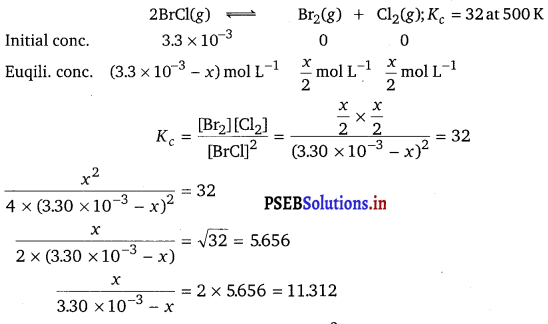
PSEB 9th Class SST Solutions Geography Chapter 3b पंजाब : जलतन्त्र

प्रश्न 7.
हरीके झील से राजस्थान को पानी ले जाने वाली दो नहरें कौन-कौन सी हैं ?
उत्तर-
राजस्थान फीडर नहर जिसे इंदिरा गांधी कमांड नहर भी कहा जाता है।

प्रश्न 8.
पंजाब की कौन-सी नहर हरियाणा को जल प्रदान करती है ?
उत्तर-
घग्गर नदी।

प्रश्न 9.
अपर बारी दोआब नहर का स्त्रोत क्या है ?
उत्तर-
माधोपुर हैडवर्कस।

प्रश्न 10.
पौंग डैम का निर्माण कौन-सी नदी पर किया गया है ?
उत्तर-
ब्यास दरिया।

(ग) प्रश्नों के संक्षेप उत्तर दें:

प्रश्न 1.
ब्यास व रावी की सहायक नदियों की सारणी बनाएं।
उत्तर-
व्यास-ब्यास की सहायक नदियां हैं-सुकन्तरी, पार्वती, सोहां, उहल तथा काली बेईं।
रावी-ऊज, सक्की किरन नाला रावी की प्रमुख नदियां हैं।

प्रश्न 2.
चोअ क्या होते हैं ? किन्हीं चार के नाम लिखें।
उत्तर-
चोअ छोटी मौसमी नदियां होती हैं जो वर्षा की ऋतु में पानी से पूर्णतया भर जाती हैं। बहुत सी चौएं कटारधार तथा सोलहासिंगी पहाड़ियों से शुरू होती हैं। पंजाब के कण्डी क्षेत्र में बहुत सी मौसमी चौएं हैं। बाणा चोअ, टोसां चोअ, बलाचौर चोअ, गढ़शंकर चोअ, नरियाला चोअ, मैली चोअ इत्यादि कुछ प्रमुख चौ हैं।

प्रश्न 3.
पंजाब के नदी, नहरों के प्रदूषण से अवगत करवायें।
उत्तर-
जब पानी में अनावश्यक वस्तुएं मिला दी जाती हैं जिस से पानी प्रयोग करने लायक नहीं रहता, इसे जल प्रदूषण कहते हैं। इसमें कोई शंका नहीं है कि पंजाब की सभी नदियों तथा नहरों में काफ़ी अधिक जल प्रदूषण है। भारत सरकार के कई विभागों तथा मन्त्रालयों का भी मानना है कि पंजाब की नहरों में काफ़ी अधिक जल प्रदूषण है तथा इनमें खतरनाक ज़हर भर रहा है। यह ज़हर पानी की सहायता से हमारी भोजन प्रणाली में पहुँच रहा है तथा लोग इससे खतरनाक बिमारियों का शिकार हो रहे हैं। उदाहरण के लिए बुड्ढा नाला पूर्णतया तेजाबी हो चुका है। हमें सभी नदियों को बचाने की आवश्यकता है ताकि हम पानी के साथ-साथ अपने जीवन को बचा कर रख सकें।

(घ) निम्न प्रश्नों के विस्तृत उत्तर दें

प्रश्न 1.
सतलुज नदी, उस पर बनाये डैमों तथा उसकी सहायक नदियों की जानकारी दें।
उत्तर-
सतलुज नदी तिब्बत में 4630 मीटर की ऊँचाई पर स्थित मानसरोवर झील से रक्षताल नामक स्थान से शुरू होता है। जब यह हिमालय पर्वत को पार कर रहा होता है तो गहरी खाइयां बनाता है। सतलुज मैदानों में भाखड़ा में दाखिल होता है तथा यहां ही भाखड़ा डैम बनाया गया है। नंगल से सतलुज दरिया दक्षिण दिशा की तरफ बढ़ता है तथा जब यह रोपड़ पहुँचता है तो इसमें सुआं, सरसा नदियां, मौसमी चोअ मिल जाते हैं। फिरोजपुर जिले में यह हरीके पत्तण से 60 किलोमीटर की दूरी पर स्थित सुलेमानकी नामक स्थान से पाकिस्तान में चला जाता है। सतलुज दरिया पर भाखड़ा बाँध के साथ-साथ कोटला बाँध, नाथपा झाखड़ी तथा नंगल बाँध भी बनाए गए हैं। सुआं, ब्यास तथा चिट्टी बेईं सतलुज की सहायक नदियां हैं। मक्खु में गिद्दड़ पिण्डी तथा चिट्टी बेईं सतलुज में मिल जाती है। सतलुज दरिया पर कई बाँधों के साथ-साथ रोपड़ तथा हरीके हैडवर्क्स भी बनाए गए हैं।

PSEB 9th Class SST Solutions Geography Chapter 3b पंजाब : जलतन्त्र

प्रश्न 2.
पंजाब के नहर प्रबन्ध के विषय में लिखें। इससे कृषि को क्या लाभ हैं ?
उत्तर-
पंजाब की अधिकतर जनता कृषि या इससे संबंधित कार्यों में लगी हुई है तथा पंजाब में ही 1960 के दशक में हरित क्रान्ति की शुरूआत हुई। हरित क्रान्ति में सिंचाई की बहुत बड़ी भूमिका थी क्योंकि किसान फसलों की सिंचाई के लिए केवल वर्षा पर निर्भर नहीं रह सकता। इस कारण पंजाब ने समय-समय पर अपनी नहरी व्यवस्था को काफी विकसित किया। पंजाब में 14500 किलोमीटर लंबी नहरें तथा 5 हैडवर्क्स हैं। यहां 10 नहरें भी हैं जिनके नाम हैंसरहिन्द नहर, अपर बारी दोआब नहर, बिस्त दोआब नहर, भाखड़ा मेन लाइन नहर, फिरोज़पुर/सरहिन्द फीडर प्रबन्ध, कश्मीर नहर, मक्खु, नहर, शाह नहर, राजस्थान फीडर तथा बीकानेर नहर। इन 10 नहरों में से 8 नहरों का वर्णन इस प्रकार है-

नहर उत्पात का स्थान लंबाई
1. भाखड़ा मेन लाइन नंगल बैराज 161.36 कि०मी०
2. राजस्थान फीडर हरीके हैडवर्क्स 149.53 कि०मी०
3. सरहिन्द फीडर II हरीके हैडवर्क्स 136.53 कि०मी०
4. सरहिन्द रोपड़ हैडवर्क्स 59.44 कि०मी०
5. बिस्त दोआब रोपड़ हैडवर्क्स 43.00 कि०मी०
6. अपर बारी दोआब माधोपुर हैडवर्क्स 42.35 कि०मी०
7. पूर्वी नहर हुसैनीवाला हैडवर्क्स 8.02 कि०मी०
8. शाह नहर मुकेरियां हाईडल चैनल 2.23 कि०मी०

कृषि को लाभ-इस नहरी व्यवस्था से पंजाब की कृषि को काफी लाभ हुआ जिसका वर्णन इस प्रकार है-

  1. इन नहरों से पंजाब की कृषि को सारा साल पानी मिलता रहता है।
  2. सिंचाई के साधन बढ़ने से किसान साल में दो या अधिक फसलें उगाने में सफल हो गए हैं।
  3. अधिक फसलें उगाने से किसानों को काफ़ी फायदा हुआ है तथा उनकी आय भी बढ़ गई है।
  4. दरियाओं तथा नहरों पर डैम बना कर पानी को रोका गया ताकि वर्षा न होने की स्थिति में किसानों तक पानी पहुँचाया जा सके।
  5. डैमों से बिजली तैयार की गई जिससे उद्योगों तथा घरों को 24 घण्टे बिजली प्राप्त हुई।

प्रश्न 3.
पंजाब के चोअ और रौअ कौन-कौन से हैं ? विस्तत नोट लिखें।
उत्तर-
चौएं छोटी छोटी वर्षा पर आधारित तथा मौसमी नदियां होती हैं जो वर्षा के मौसम में पानी से भर जाती हैं। पंजाब में एक कण्डी क्षेत्र है जहां बहुत-सी चौएं मौजूद हैं। इनमें से कई चौओं का जन्म कटारधार तथा सेलासिंगी की पहाड़ियों में होता है। जब वर्षा आती है तो इन चौओं में पानी भर जाता है। पंजाब सरकार ने इनमें से कई चौओं को बंद करने में सफलता प्राप्त कर ली है तथा इनमें आने वाले वर्षा के पानी को कृषि अथवा अन्य कार्यों के लिए प्रयोग किया जा रहा है।

होशियारपुर जिले के दक्षिण पश्चिम में 93 चौएं मौजूद हैं जिनमें से बहुत से काली बेईं तथा चिट्टी बेईं में जाकर मिल जाते हैं। होशियारपुर में बहुत से चौएं हैं जिनमें कुछ काफी प्रमुख हैं जैसे कि टोसां चौ, बणा चौ, गढ़शंकर चौ, बलाचौर चौ, मैली चौ, नरियाला चौ, नंगल शहीदां चौ, गोंदपुर चौ, दसूहा चौ इत्यादि। इन पर नियन्त्रण रखने के लिए पंजाब सरकार ने कण्डी क्षेत्र विकास (Kandi Area Development) को भी शुरू किया है। पंजाब में कुछ बरसाती नाले भी हैं जैसे कि पटियाला की राव, जैंतिया देवी की रौ, बुड्ढ़ा नाला इत्यादि।

PSEB 9th Class Social Science Guide पंजाब : जलतन्त्र Important Questions and Answers

बहुविकल्पीय प्रश्न (Multiple Choice Questions)

प्रश्न 1.
पंजाब कौन-से दो शब्दों से मिलकर बना है ?
(क) पंज + आब
(ख) पंजा + आहब
(ग) पंज + अहाब
(घ) पं + जाहब।
उत्तर-
(क) पंज + आब

PSEB 9th Class SST Solutions Geography Chapter 3b पंजाब : जलतन्त्र

प्रश्न 2.
अब पंजाब में कितने दरिया हैं ?
(क) दो
(ख) तीन
(ग) चार
(घ) पाँच।
उत्तर-
(ख) तीन

प्रश्न 3.
इनमें से कौन-सा मौसमी दरिया है ?
(क) घग्गर
(ख) सकी किरन
(ग) काली बेई
(घ) उपर्युक्त सभी।
उत्तर-
(घ) उपर्युक्त सभी।

प्रश्न 4.
इनमें से कौन-सा बारहमासी दरिया है ?
(क) रावी
(ख) ब्यास
(ग) सतलुज
(घ) उपर्युक्त सभी।
उत्तर-
(घ) उपर्युक्त सभी।

प्रश्न 5.
रणजीत सागर डैम किस दरिया पर बना है ?
(क) रावी
(ख) सतलुज
(ग) ब्यास
(घ) चिनाब।
उत्तर-
(क) रावी

प्रश्न 6.
पौंग डैम किस दरिया पर बना है ?
(क) रावी
(ख) सतलुज
(ग) ब्यास
(घ) जेहलम।
उत्तर-
(ग) ब्यास

PSEB 9th Class SST Solutions Geography Chapter 3b पंजाब : जलतन्त्र

प्रश्न 7.
होशियारपुर में कितने चौएं हैं ?
(क) 70
(ख) 93
(ग) 84
(घ) 54.
उत्तर-
(ख) 93

रिक्त स्थान की पूर्ति करें (Fill in the Blanks)

1. सन् …………. में भारत तथा पाकिस्तान के विभाजन का सबसे बड़ा नुकसान …….. को हुआ।
2. रावी, ब्यास तथा सतलुज ……….. दरिया हैं।
3. रणजीत सागर डैम का कार्य ………… में पूर्ण हुआ था।
4. सुकन्तरी ………. की प्रमुख सहायक नदी है।
5. ………… किसी समय सरस्वती नदी का हिस्सा थी।

उत्तर-

  1. 1947, पंजाब,
  2. बारहमासी,
  3. 2001,
  4. ब्यास,
  5. घग्गर

सही/ग़लत (True/False)

1. जेहलम, चिनाब तथा सिन्धु पाकिस्तान वाले पंजाब में रह गए।
2. रावी ककझ मंझ नाम के स्थान पर पाकिस्तान में प्रवेश करता है।
3. रणजीत सागर डैम से 1600 वाट बिजली उत्पन्न होती है।
4. ब्यास दरिया पर पौंग डैम बनाया गया है।
5. रावी दरिया से राजस्थान फीडर नहर निकाली गई है।

उत्तर-

अति लघु उत्तरों वाले प्रश्न।।

प्रश्न 1.
पंजाब शब्द का क्या अर्थ है ?
उत्तर-
पंजाब शब्द दो शब्दों ‘पंज-आब’ से मिलकर बना है जिसका अर्थ है पाँच दरियाओं की धरती।

प्रश्न 2.
1947 के पश्चात् कौन-से दरिया पंजाब में रह गए।
उत्तर-
सतलुज, रावी तथा ब्यास।

प्रश्न 3.
1947 के पश्चात् कौन-से दरिया पाकिस्तान वाले पंजाब में चले गए ?
उत्तर-
जेहलम, चिनाब तथा सिन्धु।

प्रश्न 4.
बारहमासी दरिया कौन-से होते हैं ?
उत्तर-
वह दरिया जिनमें सम्पूर्ण वर्ष पानी रहता है उन्हें बारहमासी दरिया कहते हैं।

प्रश्न 5.
बारहमासी दरियाओं में सम्पूर्ण वर्ष पानी कहां से आता है ?
उत्तर-
बारहमासी दरियाओं में पहाड़ों से पिघली बर्फ का पानी सम्पूर्ण वर्ष आता रहता है।

PSEB 9th Class SST Solutions Geography Chapter 3b पंजाब : जलतन्त्र

प्रश्न 6.
पंजाब के कुछ मौसमी दरियाओं के नाम लिखो।
उत्तर-
घग्गर, काली बेईं, चिट्टी बेईं, ऊज, चक्की खड्ड, स्वात इत्यादि।

प्रश्न 7.
किन्हीं दो अवशेषी दरियाओं के नाम लिखें।
उत्तर-
बुड्डा नाला तथा सक्की किरन नाला।

प्रश्न 8.
रावी दरिया का जन्म कहां पर होता है ?
उत्तर-
रावी दरिया कुल्लू की पहाड़ियों में स्थित रोहतांग दर्रे के उत्तर में 4116 मीटर की ऊंचाई से शुरू होता है।

प्रश्न 9.
रावी दरिया पर कौन-सा डैम बनाया गया है तथा इसमें से कौन-सी नहर निकाली गई है ?
उत्तर-
रावी दरिया पर रणजीत सागर डैम बनाया गया है तथा इससे अपर बारी दोआब नहर निकाली गई है।

प्रश्न 10.
रावी दरिया पर कौन-से हैडवर्क्स बनाए गए हैं ?
उत्तर-
शाहपुर कण्डी के नज़दीक धाना या बसन्तपुर, कटारधार, माधोपुर हैडवर्क्स तथा माधोपुर ब्यास लिंक पर कठुआ फीडर।

प्रश्न 11.
रणजीत सागर डैम के बारे में बताएं।
उत्तर-
यह रावी दरिया पर बनाया गया डैम है जिससे 600 मेगावाट बिजली पैदा होती है। यह 1981 में शुरू हुआ था तथा मार्च 2011 में इसका कार्य पूर्ण हुआ था।

प्रश्न 12.
ब्यास दरिया कहां से निकलता है ?
उत्तर-
ब्यास दरिया ब्यास कुण्ड से निकलता है जो हिमाचल प्रदेश में रोहतांग दर्रे के पास 4060 मीटर की ऊंचाई पर स्थित है।

प्रश्न 13.
व्यास दरिया पर कौन-से डैम बनाए गए हैं ?
उत्तर-
हिमाचल प्रदेश में पंडोह तथा पंजाब में पौंग डैम।

प्रश्न 14.
ब्यास से कौन सी नहर निकाली गई है ?
उत्तर-
ब्यास से राजस्थान फीडर नहर निकाली गई है जिसे इंदिरा गांधी कमांड नहर का नाम भी दिया गया है।

PSEB 9th Class SST Solutions Geography Chapter 3b पंजाब : जलतन्त्र

प्रश्न 15.
ब्यास की सहायक नदियों के नाम लिखें।
उत्तर–
पार्वती, सुकन्तरी, सौहां, उम्मन तथा काली बेईं।

प्रश्न 16.
सतलुज दरिया कहां पर शुरू होता है ?
उत्तर-
सतलुज दरिया तिब्बत में मानसरोवर झील के नज़दीक स्थित रक्षताल से शुरू होता है।

प्रश्न 17.
सतलुज दरिया कहां पर पाकिस्तान में प्रवेश करता है ?
उत्तर-
सतलुज दरिया फिरोज़पुर में सुलेमान की नामक स्थान से पाकिस्तान में प्रवेश करता है।

प्रश्न 18.
सतलुज दरिया पर कौन-से डैम बनाए गए हैं ?
उत्तर-
नाथपा झाखड़ी, नंगल डैम, कौटला डैम।

प्रश्न 19.
घग्गर किस प्रकार की नदी है ?
उत्तर-
घग्गर दक्षिणी पंजाब में बहने वाली एक मौसमी नदी है ।

प्रश्न 20.
घग्गर कहां से निकलती है ?
उत्तर-
घग्गर नदी सिरमौर की पहाड़ियों से निकलती है।

प्रश्न 21.
पंजाब के किस क्षेत्र में बहुत से चोअ मिलते हैं ?
उत्तर-
कण्डी क्षेत्र में।

प्रश्न 22.
चोअ क्या होता है ?
उत्तर-
चोअ एक छोटी सी नदी होती है जो वर्षा के मौसम में पानी से भर जाती है।

प्रश्न 23.
पंजाब के किस जिले में बहुत से चोअ हैं ?
उत्तर-
होशियारपुर जिले में।

प्रश्न 24.
पंजाब की नहरों की लंबाई बताएं।
उत्तर-
पंजाब की नहरों की लंबाई 14500 किलोमीटर है।

प्रश्न 25.
पंजाब की सबसे लंबी नहर कौन-सी है ?
उत्तर-
भाखड़ा मेन लाइन जिसकी लंबाई 161.36 किलोमीटर है।

प्रश्न 26.
कौन-सा दरिया किसी समय सरस्वती नदी का सहायक होता था ?
उत्तर-
घग्गर दरिया किसी समय सरस्वती नदी का सहायक होता था।

PSEB 9th Class SST Solutions Geography Chapter 3b पंजाब : जलतन्त्र

लघु उत्तरों वाले प्रश्न

प्रश्न 1.
पंजाब के जलतन्त्र के बारे में बताएं।
उत्तर-
पंजाब दो शब्द ‘पंज’ तथा ‘आब’ से मिलकर बना है जिसका अर्थ है पाँच दरियाओं की धरती। पंजाब में 1947 से पहले कई दरिया होते थे परन्तु देशों के विभाजन के कारण जेहलम, चिनाब, सिन्धु तथा बहुत सी नदियां पाकिस्तान में चली गईं। अब पंजाब में केवल तीन दरिया रावी, ब्यास तथा सतलुज ही हैं। यह तीनों दरिया बारहमासी हैं जिनमें पहाड़ों की बर्फ पिघलने के कारण सारा साल पानी रहता है। यहां बहुत से मौसमी दरिया भी हैं जैसे कि घग्गर, ऊज, काली बेईं, चिट्टी बेईं, स्वान, नूरपुर बेदी चोअ इत्यादि। यहां अवशेषी दरिया, जैसे कि बुड्ढा नाला तथा सक्की किरन नाला भी मिलते हैं।
PSEB 9th Class SST Solutions Geography Chapter 3b पंजाब जलतन्त्र 1

प्रश्न 2.
रावी की सहायक नदियों के बारे में बताएं।
उत्तर-
जब रावी दरिया माधोपुर पहुँचता है तो इसमें कई सहायक नदियां आकर मिल जाती हैं। इनमें सबसे महत्त्वपूर्ण ऊज नदी है। इसके साथ ही सक्की किरन नाला रावी के साथ-साथ चलता है तथा भारत और पाकिस्तान की सरहद पर इसमें मिल जाता है। रावी दरिया पर चार हैडवर्क्स भी बनाए गए हैं जिनके नाम हैं माधोपुर ब्यास लिंक पर कठुआ फीडर, शाहपुर कण्डी के नज़दीक धाना या बसन्तपुर, माधोपुर हैडवर्क्स तथा कटारधार।

प्रश्न 3.
ब्यास दरिया की सहायक नदियों के बारे में बताएं।
उत्तर-
सुकन्तरी-उग्मन, पारबती, काली बेईं तथा सौहां ब्यास की कुछ सहायक नदियां हैं। तलवाड़ा पहुँच कर सौहां ब्यास में मिल जाती हैं। हरीके के नज़दीक काली बेईं होशियारपुर तथा कपूरथला से होते हुए ब्यास में मिल जाती है। ब्यास दरिया पर पौंग डैम तथा पंडोह डैम को भी बनाया गया है।

प्रश्न 4.
घग्गर पर एक नोट लिखें।
उत्तर-
पंजाब में काफी पहले सरस्वती नदी बहती थी तथा घग्गर भी उसका ही हिस्सा थी। परन्तु अब घग्गर एक मौसमी नदी है जो दक्षिण पंजाब में बहती है। यह सिरमौर की पहाड़ियों से निकलती है। मुबारकपुर नाम के स्थान पर यह मैदानी इलाकों में आ जाती है। इसके पश्चात् यह पटियाला, घनौर तथा हरियाणा के इलाकों को पार करती हैं। इसके पश्चात् यह राजस्थान के रेगिस्तान में जाकर खत्म हो जाती है।

दीर्घ उत्तर वाला प्रश्न

प्रश्न-रावी दरिया पर एक नोट लिखें।
उत्तर-रावी पंजाब का एक बारहमासी दरिया है जिसमें सारा साल पानी रहता है क्योंकि पहाड़ों की बर्फ पिघलने के कारण इसमें लगातार पानी आता रहता है। रावी दरिया कुल्लू की पहाड़ियों में रोहतांग दर्रे के उत्तर से शुरू होता है जिसकी ऊंचाई 4116 मीटर है। रावी दरिया अपने आरंभिक स्थान (Place of Origin) से लगातार बहते हुए धौलाधार तथा पीर पंजाल की पहाड़ियों को पार करता है तथा वहां बनी हुई गतॊ (Depressions) से बहते हुए चम्बा तथा डलहौजी को पार करता है। पठानकोट में माधोपुर नाम के स्थान पर यह मैदानों में प्रवेश कर जाता है। रावी के ऊपर रणजीत सागर डैम तथा थीन डैम बनाए गए हैं तथा इनके लिए माधोपुर हैडवर्क्स बनाया गया है। यहां से अपर बारी दोआब नहर भी निकाली गई है। इसके पश्चात् रावी दरिया पठानकोट, गुरदासपुर तथा अमृतसर जिलों में से निकलता है। यह भारत व पाकिस्तान की सरहद निश्चित करता है। कलझ मंझ नाम के स्थान पर यह पाकिस्तान में चला जाता है। पाकिस्तान में यह सिधानी नाम के स्थान पर चिनाब में मिल जाता है। ऊज नदी तथा सक्की किरन वाला रावी की प्रमुख सहायक नदियां हैं।

PSEB 11th Class Chemistry Solutions Chapter 7 Equilibrium

Punjab State Board PSEB 11th Class Chemistry Book Solutions Chapter 7 Equilibrium Textbook Exercise Questions and Answers.

PSEB Solutions for Class 11 Chemistry Chapter 7 Equilibrium

PSEB 11th Class Chemistry Guide Equilibrium InText Questions and Answers

Question 1.
A liquid is in equilibrium with its vapour in a sealed container at a fixed temperature. The volume of the container is suddenly increased.
(a) What is the initial effect of the change on vapour pressure?
(b) How do rates of evaporation and condensation change initially?
(c) What happens when equilibrium is restored finally and what will be the final vapour pressure?
Answer:
(a) If the volume of the container is suddenly increa50sed, then the vapour pressure would decrease initially. This is because the amount of vapour remains the same, but the volume increases suddenly. As a result, the same amount of vapour is distributed in a larger volume.
(b) Since the temperature is constant, the rate of evaporation also remains constant. When the volume of the container is increased, the density of the vapour phase decreases. As a result, the rate of collisions of the vapour particles also decreases. Hence, the rate of condensation decreases initially.
(c) When equilibrium is restored finally, the rate of evaporation becomes equal to the rate of condensation. In this case, only the volume changes while the temperature remains constant. The vapour pressure depends on temperature and not on volume. Hence, the final vapour pressure will be equal to the original vapour pressure of the system.

Question 2.
What is Kc for the following equilibrium when the equilibrium concentration of each substance is: [SO2] = 0.60M,[O2] = 0.82M and [SO3] = 1.90 M?
2SO2(g) + O2(g) ↔ 2SO3(g)
Answer:
The given reaction is
2SO2(g) + O2(g) ↔ 2SO3(g)
Equilibrium constant
Kc = \(\frac{\left[\mathrm{SO}_{3}\right]^{2}}{\left[\mathrm{SO}_{2}\right]^{2}\left[\mathrm{O}_{2}\right]}=\frac{(1.90 \mathrm{M})^{2}}{(0.60 \mathrm{M})^{2}(0.82 \mathrm{M})}\)
= 12.238 M-1

PSEB 11th Class Chemistry Solutions Chapter 7 Equilibrium

Question 3.
At a certain temperature and total pressure of 105 Pa, iodine vapour contains 40% by volume of I atoms I2(g) ⇌ 2I(g)
Calculate Kp for the equilibrium.
Answer:
Given, I2(g) ⇌ 2I(g)
I atoms in iodine vapours = 40% by volume
So, iodine vapours of I2 molecules = 60% by volume
PSEB 11th Class Chemistry Solutions Chapter 7 Equilibrium 1

Question 4.
Write the expression for the equilibrium constant, Kc for each of the following reactions:
(i) 2NOCl(g) ⇌ 2NO (g) + Cl2(g)
(ii) 2CU(NO3)2(S) ⇌ 2CuO(s) + 4NO2(g) + O2(g)
(iii) CH3COOC2H5(oq) + H2O(l) ⇌ CH3COOH(aq) + C2H5OH(ag)
(iv) Fe3+(aq) + 3OH(aq) ⇌ Fe(OH)3(s)
(v) I2(s) + 5F2 ⇌ 2IF5
Answer:
PSEB 11th Class Chemistry Solutions Chapter 7 Equilibrium 2

Question 5.
Find out the value of Kc for each of the following equilibria from the value of Kp.
(i) 2NOCl(g) ⇌ 2NO(g) + Cl2(g); Kp = 1.8 x 10⁻² at 500 K
(ii) CaCO3(s) ⇌ CaO(s) + CO2(g); Kp = 167 at 1073 K
Answer:
The relation between Kp and Kc is given as
Kp = Kc(RT)Δn
(i) 2NOCl(g) ⇌ 2NO(g) + Cl2(g); Kp = 1.8 x 10⁻² at 500 K.
Δn = 3 – 2 = 1
R = 0.0831 bar L mol-1K-1
T = 500 K
Kp =1.8 x 10⁻²
Kp = Kc( RT)Δn
1.8 x 10-2 = Kc(0.0831 x 500)1
Kc = \(\frac{1.8 \times 10^{-2}}{0.0831 \times 500}\) = 4.33 x 10⁻⁴

(ii) CaCO3(s) ⇌ CaO(s) + CO2(g); Kp = 167 at 1073 K
Δn = 2 -1 = 1
R = 0.0831 bar L mol-1K-1
T = 1073 K
Kp =167
Now, Kp = Kc(RT)Δn
⇒ 167 = Kc(0.0831 x 1073)1
⇒ Kc = \(\frac{167}{0.0831 \times 1073}\) = 1.87

Question 6.
For the following equilibriuih, Kc = 6.3 x 10¹⁴ at 1000 K
NO(g) + O3(g) ⇌ NO2(g) + O2(g)
Both the forward and reverse reactions in the equilibrium are elementary bimolecular reactions. What is Kc, for the reverse reaction?
Answer:
It is given that Kc for the forward reaction is 6.3 x 10¹⁴ at 1000 K.
Then, Kc for the reverse reaction will be,
NO2(g) + O3(g) ⇌ NO(g) + O3(g)
Kc = \(\frac{1}{K_{c}}=\frac{1}{6.3 \times 10^{14}}\) = 1.59 x 10⁻¹⁵

Question 7.
Explain why pure liquids and solids can be ignored while writing the equilibrium constant expression?
Answer:
For a pure substance (both solids and liquids),
PSEB 11th Class Chemistry Solutions Chapter 7 Equilibrium 3
Now, the molecular mass and density (at a particular temperature) of a pure substance is always fixed and is accounted for in the equilibrium constant. Therefore, the values of pure substances are not mentioned in the equilibrium constant expression.

PSEB 11th Class Chemistry Solutions Chapter 7 Equilibrium

Question 8.
Reaction between N2 and O2 takes place as follows:
2N2(g) + O2(g) ⇌ 2N2O(g)
If a mixture of 0.482 mol of N2 and 0.933 mol of O2 is placed in a 10 L reaction vessel and allowed to form N2O at a temperature for which Kc = 2.0 x 10-37 , determine the composition of equilibrium mixture.
Answer:
Let the concentration of N2O at equilibrium be x.
The given reaction is :
PSEB 11th Class Chemistry Solutions Chapter 7 Equilibrium 4

The value of equilibrium constant i.e., Kc = 2.0 x 10-37 is very small which means negligible amounts of N2 and O2 react.
PSEB 11th Class Chemistry Solutions Chapter 7 Equilibrium 5

Question 9.
Nitric oxide reacts with Br2 and gives nitrosyl bromide as per reaction given below:
2NO(g) + Br2(g) ⇌ 2NOBr(g)
When 0.087 mol of NO and 0.0437 mol of Br2 are mixed in a closed container at constant temperature, 0.0518 mol of NOBr is obtained at equilibrium. Calculate equilibrium amount of NO andBr2.
Answer:
The balanced chemical equation is
PSEB 11th Class Chemistry Solutions Chapter 7 Equilibrium 6
Given, 2x = 0.0518
x = 0.0259 mol
Moles of NO at equilibrium = 0.087 – 2x
= 0.087-0.0518
= 0.0352 mol
Moles of Br2 at equilibrium = 0.0437 – x
= 0.0437 – 0.0259
= 0.0178 mol

Question 10.
At 450 K, Kp = 2.0 x 10¹⁰/bar for the given reaction at equilibrium.
2SO2(g) + O2(g) ⇌ 2SO3(g)
What is Kc at this temperature?
Answer:
The given reaction is
2SO2(g) + O2(g) ⇌ 2SO3Cg)
Δn = 2 – 3 = -1
T = 450 K
R = 0.0831 bar L K-1 mol-1
Kp = 2.0 x 10¹⁰ bar-1
We know that,
Kp = Kc(RT)Δn
=> 2.0 x 10¹⁰ bar-1 = kc(0.0831 L bar K-1 mol-1 x 450 K)-1
\(K_{c}=\frac{2.0 \times 10^{10} \mathrm{bar}^{-1}}{\left(0.0831 \mathrm{~L} \mathrm{barK} \mathrm{K}^{-1} \mathrm{~mol}^{-1} \times 450 \mathrm{~K}\right)^{-1}}\)
Kc = (2.0 x 10¹⁰ bar-1) (0.0831 L bar K-1mol-1450 K)
= 74.79 x 10¹⁰ L mol-1 = 7.48 x 10¹¹ L mol-1

Question 11.
A sample of HI(g) is placed in flask at a pressure of 0.2 atm. At equilibrium the partial pressure of HI(g) is 0.04 atm. What is Kp for the given equilibrium?
2HI(g) ⇌ H2(g) + I2(g)
Answer:
The given reaction is
PSEB 11th Class Chemistry Solutions Chapter 7 Equilibrium 6 1
∵ Decrease is pressure of HI = 0.2 – 0.04 = 0.16 atm;
So equilibrium pressure of H2 is \(\frac{0.16}{2}\) = 0.08 atm and for I2 is \(\frac{0.16}{2}\) = 0.08 atm
as two moles of HI on dissociation gives 1 mol of H2 and 1 mol of I2.
Therefore,
Kp = \(\frac{p_{\mathrm{H}_{2}} \times p_{\mathrm{I}_{2}}}{\left(p_{\mathrm{HI}}\right)^{2}}=\frac{0.08 \times 0.08}{(0.04)^{2}}=\frac{0.0064}{0.0016}\) = 4.0
Hence, the value of Kp is 4.0.

Question 12.
A mixture of 1.57 mol of N2,1.92 mol of H2 and 8.13 mol of NH3 is introduced into a 20 L reaction vessel at 500 K. At this temperature, the equilibrium constant, Kc for the reaction
N2(g) + 3H2(g) ⇌ 2NH3(g) is 1. 7 x 10².
Is the reaction mixture at equilibrium? If not, what is the direction of the net reaction?
Answer:
The given reaction is :
N2(g) + 3H2(g) 2NH3(g)
Given, [N2] = \(\frac{1.57}{20}\) = 0.0785 M
[H2] = \(\frac{1.92}{20}\) = 0.096 M
[NH3] = \(\frac{8.13}{20}\) = 0.4065 M
Now, reaction quotient Qc. is :
Qc = \(\frac{\left[\mathrm{NH}_{3}\right]^{2}}{\left[\mathrm{~N}_{2}\right]\left[\mathrm{H}_{2}\right]^{3}}=\frac{(0.4065)^{2}}{(0.0785)(0.096)^{3}}\) = 2.4 x 10³M-2
Since Qc ≠ Kc the reaction mixture is not in equilibrium.
Again Qc > Kc. Hence, the reaction will proceed in the reverse direction.

PSEB 11th Class Chemistry Solutions Chapter 7 Equilibrium

Question 13.
The equilibrium constant expression for a gas reaction is, Kc = \(\frac{\left[\mathrm{NH}_{3}\right]^{4}\left[\mathrm{O}_{2}\right]^{5}}{\left[\mathrm{NO}^{4}\left[\mathrm{H}_{2} \mathrm{O}\right]^{6}\right.}\)
Write the balanced chemical equation corresponding to this expression.
Answer:
The balanced chemical equation corresponding to the given expression can be written as :
4NO(g) + 6H2O(l) ⇌ 4NH3(g) + 5O2(g)

Question 14.
One mole of H2O and one mole of CO are taken in 10 L vessel and heated to 725 K. At equilibrium 40% of water (by mass) reacts with CO according to the equation,
H2O(g) + CO(g) ⇌ H2(g) + CO2(g)
Calculate the equilibrium constant for the reaction.
Answer:
The given reaction is
PSEB 11th Class Chemistry Solutions Chapter 7 Equilibrium 7
H2O reacted = 40% of 1 mol of H2O = 0.4 mol
x = 0.4 mol 1 – x = 1 – 0.4 = 0.6 mol
Therefore, the equilibrium constant for the reaction,
Kc = \(\) = 0.444

Question 15.
At 700 K, equilibrium constant for the reaction
H2(g) + I2(g) ⇌ 2HI(g)
is 54.8. If 0.5 mol L-1 of Hl(g) is present at equilibrium at 700 K, what are the concentration of H2(g) and I2(g) assuming that we initially started with HI(g) and allowed it to reach equilibrium at 700 K?
Answer:
The given reaction is
H2(g) + I2(g) ⇌ 2HI(g); Kc = 54.8
Or the reaction
2HI(g) ⇌ H2(g) + I2(g); Kc‘ = \(\)
Given, [HI] = 0.5 mol L-1
According to equation
[H2] = [I2] = x mol L-1
Therefore,
\(\frac{\left[\mathrm{H}_{2}\right]\left[\mathrm{I}_{2}\right]}{[\mathrm{HI}]^{2}}=K_{c}^{\prime}\)
⇒ \(\frac{x \times x}{(0.5)^{2}}=\frac{1}{54.8}\)
⇒ x2 = \(\frac{0.25}{54.8}\)
⇒ x = 0.06754
x = 0.068 mol L-1
Hence, at equilibrium, [H2] = [I2] = x = 0.068 mol L-1

Question 16.
What is the equilibrium concentration of each of the substances in the equilibrium when the initial concentration of IC1 was 0.78 M?
2ICl(g) ⇌ I2(g) + Cl2(g); Kc = 0.14
Answer:
PSEB 11th Class Chemistry Solutions Chapter 7 Equilibrium 8

Question 17.
Kp = 0.04 atm at9 K for the equilibrium shown below. What is the equilibrium concentration of C2H6 when it is placed in a flask at 4.0 atm pressure and allowed to come to equilibrium?
Answer:
PSEB 11th Class Chemistry Solutions Chapter 7 Equilibrium 9

Question 18.
Ethyl acetate is formed by the reaction between ethanol acid and acetic acid and the equilibrium is represented as :
CH3COOH(l) + C2H5OH (l) ⇌ CH3COOC2H5(Z) + H2O(l)
(i) Write the concentration ratio (reaction quotient), Qc, for this reaction (note: water is not in excess and is not a solvent in this reaction)
(ii) At 293 K, if one starts with 1.00 mol of acetic acid and 0.18 mol of ethanol, there is 0.171 mol of ethyl acetate in the final equilibrium mixture. Calculate the equilibrium constant.
(iii) Starting with 0.5 mol of ethanol and 1.0 mol of acetic acid and maintaining it at 293 K, 0.214 mol of ethyl acetate is found after sometime. Has equilibrium been reached?
Answer:
PSEB 11th Class Chemistry Solutions Chapter 7 Equilibrium 10

Question 19.
A sample of pure PCl5 was introduced into an evacuated vessel at 473K. After equilibrium was attained, concentration of PCl5 was found to be 0.5 x 10⁻¹ mol L-1. If value of K is 8.3 x 10⁻³, what are the concentrations of PCl3 and Cl2 at equilibrium?
PCl5 (g) ⇌ PCl3(g) + Cl2(g)
Answer:
The given reaction is
PSEB 11th Class Chemistry Solutions Chapter 7 Equilibrium 11
It is given that the value of equilibrium constant, K = 8.3 x 10⁻³.
Kc = \(\frac{\left[\mathrm{PCl}_{3}\right]\left[\mathrm{Cl}_{2}\right]}{\left[\mathrm{PCl}_{5}\right]}\)
[Given, [PCl5]equili = 0.5 x 10⁻¹ mol L-1]
\(\frac{x \times x}{0.5 \times 10^{-1}}\) = 8.3 x 10⁻³
⇒ x2 = 4.15 x10⁻⁴
⇒ x = 2.04 x 10-2 = 0.0204 mol L-1 = 0.02 mol L-1
Therefore, at equilibrium,
[Pcl3] = [Cl2] = 0.02 mol L-1

PSEB 11th Class Chemistry Solutions Chapter 7 Equilibrium

Question 20.
One of the reaction that takes place in producing steel from iron ore is the reduction of iron (H) oxide by carbon monoxide to give iron metal and CO2.
FeO(s) + CO(g) ⇌ Fe(s) + CO2 (g); Kp = 0.265 atm at 1050 K. What are the equilibrium partial pressures of CO and 2 at 1050 K if the initial partial pressures are PCo = 1.4 atm and pCO2 = 0.80 atm?
Answer:
(i) The given reaction is
PSEB 11th Class Chemistry Solutions Chapter 7 Equilibrium 12
Since Qp > Kp, the reaction will proceed in the backward direction.
Therefore, we can say that the pressure of CO will increase while the pressure of CO2 will decrease.
Now,let the increase in pressure of CO = decrease in pressure of CO2 be p.
Hence pCO2 = 0.80 – p and PCO = 1.4 + p
and Kp = \(\frac{p_{\mathrm{CO}_{2}}}{p_{\mathrm{CO}}}\)
0.265 = \(\frac{0.80-p}{1.4+p}\)
0.371 + 0.265p = 0.80 — p= 1.265p= 0.429
p = 0.339atm
Hence, at equilibrium
PCO2 = 0.80 – 0.339 = 0.461 atm
And, equilibrium partial pressure of
PCO = 1.4 + 0.339 = 1.739 atm.

Question 21.
Equilibrium constant, Kc for the reaction
N2(g) + 3H2(g) ⇌ 2NH3(g) at 500 K is 0.06 1.
At a particular time, the analysis shows that composition of the
reaction mixture is 3.0 mol L-1 N2,2.0 mol L-1 H2 and 0.5 mol L-1 NH3 Is the reaction at equilibrium? if not in which direction
does the reaction tend to proceed to reach equilibrium?
Answer:
The given reaction is
N2(g) + 3H2(g) ⇌ 2NH3(g);Kc = 0.061 at 500K
Given, [N2] = 3.0mol L-1, [H2] = 2.0 mol L-1, [NH3] = 0.5 mol L-1
So, Q = \(\frac{\left[\mathrm{NH}_{3}\right]^{2}}{\left[\mathrm{~N}_{2}\right]\left[\mathrm{H}_{2}\right]^{3}}=\frac{(0.5)^{2}}{(3.0)(2.0)^{3}}\) = 0.0104
It is given that Kc = 0.06 1
Since Qc ≠ Kc, the reaction is not at equilibrium.
Since Qc < Kc, the reaction will proceed in the forward direction to reach equilibrium.

Question 22.
Bromine monochloride, BrCl decomposes into bromine and chlorine and reaches the equilibrium:
2BrCl(g) ⇌ Br2(g) + Cl2(g)
for which Kc = 32 at 500 K. If initially pure BrCl is present at a concentration of 3.3 x 10⁻³ mol L-1, what is its molar concentration in the mixture at equilibrium?
Answer:
PSEB 11th Class Chemistry Solutions Chapter 7 Equilibrium 13
x = 11.312(3.30 x 10⁻³ – x)
x = 0.03732 – 11.312x
x + 11.312x = 0.03732
x = \(\frac{0.03732}{12.312}\)= 3.0321 x 10⁻³ mol L-1
[BrCl]equili = (3.30 x 10⁻³ – 3.032 x 10⁻³) mol L-1
= 2.68 x 10⁻⁴ mol L-1

Question 23.
At 1127 K and 1 atm pressure, a gaseous mixture of CO and CO2 in equilibrium with solid carbon has 90.55% CO by mass
C(s) + CO2(g) ⇌ 2CO(g)
Calculate Kc for this reaction at the above temperature.
Answer:
Let the total mass of the gaseous mixture be 100g.
Mass of CO = 90.55 g
and, mass of CO2 = (100 – 90.55) = 9.45 g
Now, number of moles of CO,
nCO = \(\frac{90.55}{28}\) = 3.234 mol
(Molar mass of CO = 28 g mol-1 )
Now, number of moles of CO2,
nCO = \(\)
(Molar mass of CO2 = 44 g mol-1 )
PSEB 11th Class Chemistry Solutions Chapter 7 Equilibrium 14 1
For the given reaction, Δn = 2 -1 = 1
We know that,
Kp = Kc(RT)Δn
⇒ 14.19 = Kc(0.0831 x 1127)1
⇒ Kc = 0.154 (approximately)

PSEB 11th Class Chemistry Solutions Chapter 7 Equilibrium

Question 24.
Calculate (a) \(\Delta \boldsymbol{G}^{\ominus}\) and (b) the equilibrium constant for the formation of N02 from NO and Oa at 298K
NO(g) + \(\frac{1}{2}\)O2(g) ⇌ NO2(g)
where \(\Delta_{f} \boldsymbol{G}^{\ominus}\) (N02)= 52.0 kJ/mol; \(\Delta_{f} \boldsymbol{G}^{\ominus}\) (NO) = 87.0kJ/mol;
\(\Delta_{f} \boldsymbol{G}^{\ominus}\) (O2) = 0 kJ/mol
Answer:
(a) The given reaction is
N0(g) + \(\frac{1}{2}\)O2(g) ⇌ NO2(g)
PSEB 11th Class Chemistry Solutions Chapter 7 Equilibrium 14
= (52.0 – 87.0 + \(\frac{1}{2}\) x 0 )kJ mol-1 = -35.0 kJ mol-1

(b) \(\Delta_{r} G^{\ominus}\) = – 2.303 RT logKc
-35.0 = – 2.303 x 0.0831 x 298 log Kc
∴ log Kc= \(\frac{35}{5.7058}\)= 6.134
∴ Kc = antilog 6.134 = 1.361 x 10⁶.

Question 25.
Does the number of moles of reaction products increase, decrease or remain same when each of the following equilibria is subjected to a decrease in pressure by increasing the volume?
(a) PCl5(g) ⇌ PCl3(g) +Cl2(g)
(b) CaO (s) + CO2 (g) ⇌ CaCO3 (s)
(c) 3Fe(s) + 4H2O (g) ⇌ Fe3O4 (s) + 4H5(g)
Answer:
(a)The number of moles of reaction products will increase. According to Le-Chatelier’s principle, if pressure is decreased, then the equilibrium shifts in the direction in which the number of moles of gases is more. In the given reaction, the number of moles of gaseous products is more than that of gaseous reactants. Thus, the reaction will proceed in the forward direction. As a result, the number of moles of reaction products will increase.
(b) The number of moles of reaction products will decrease.
(c) The number of moles of reaction products remains the same

Question 26.
Which of the following reactions will get affected hy increasing the pressure?
Also, mention whether change will cause the reaction to go into forward or backward direction.
(i) COCl2(g) ⇌ CO(g) +Cl2(g)
(ii) CH4(g) + 2S2(g) ⇌ CS2(g) + 2H2S(g)
(iii) CO2(g) + C(S) ⇌ 2CO(g)
(iv) 2H2(g) +CO(g) ⇌ CH3OH(g)
(v) CaCO3(s) ⇌ CaO(s) + CO2(g)
(vi) 4NH3(g) + 5O2(g) ⇌ 4NO(g) + 6H2O(g)
Answer:
In all the above reactions, the reaction no. (ii) proceeds with the same no. of moles on both sides
i.e., np = nr = 3 .
∴ This reaction will not be affected by the increase in pressure i. e., the direction of equilibrium will not be affected by the increase in pressure. All other reactions will be affected by the increase in pressure.
(i) COCl2(g) ⇌ CO(g) +Cl2(g)
np > nr , np = 2; nr = 1
∴ Equilibrium will shift to the left increasing pressure.
(iii) CO2(g) + C(S) ⇌ 2CO(g)
Here, nr – 1; np = 2, therefore np > nr
∴ Equilibrium will go to left on increase of pressure.
(iv) 2H2(g) +CO(g) ⇌ CH3OH(g)
Here, nr = 3; np = 1 therefore np < nr
∴ Equilibrium will shift to the right on increasing pressure.
(v) CaCO3(s) ⇌ CaO(s) + CO2(g)
Here nr = 0; np = 1, therefore np > nr
∴ Equilibrium will shift backwards (left) on increasing the pressure.
(vi) 4NH3(g) + 5O2(g) ⇌ 4NO(g) + 6H2O(g)
Here nr = 9; np = 10, therefore np > nr
∴ Equilibrium will shift backwards on increasing the pressure.

Question 27.
The equilibrium constant for the following reaction is 1.6 x 10⁵ at 1024 K.
H2(g) + Br2(g) ⇌ 2HBr(g)
Find the equilibrium pressure of all gases if 10.0 bar of HBr is introduced into a sealed container at 1024K.
Answer:
Given reaction is H2(g) + Br2(g)⇌ 2HBr(g); Kp = 1.6 x 10⁵ at 1024 K
Therefore, for the reaction 2HBr(g) ⇌ H2(g)+Br2(g), the equilibrium constant will be,
PSEB 11th Class Chemistry Solutions Chapter 7 Equilibrium 15
p = 2.5 x 1-2(5.0 x 10⁻³)p
p+(5.0 x 10⁻³)p = 2.5 x 10⁻²
(1005 x 10-3)p = 2.5 x 10⁻²
p = 2.49 x 10⁻² bar = 2.5 x 10⁻² bar
rherefore, at equilibrium,
[H2] = [Br2] = 2.49 x 10⁻² bar
[HBr] =10 — 2 x (2.49 x 10-2) bar
= 9.95 bar = 10 bar

Question 28.
Dihydrogen gas is obtained from natural gas by partial oxidation with steam as per following endothermic reaction:
CH4(g) + H2O(g) ⇌ CO(g) + 3H2(g)
(a) Write an expression for Kp for the above reaction.
(b) How will the values of kp and composition of equilibrium mixture be affected by
(i) increasing the pressure
(ii) increasing the temperature
(iii) Using a catalyst?
Answer:
(a) The given reaction is
CH4(g) + H4O(g) ⇌ CO(g) + 3H2(g)
\(K_{p}=\frac{p_{\mathrm{CO}} \times p_{\mathrm{H}_{2}}^{3}}{p_{\mathrm{CH}_{4}} \times p_{\mathrm{H}_{2} \mathrm{O}}}\)
(b) (1) According to LeChatelier’s principle, the equilibrium will shift in the backward direction.
(ii) According to Le-Chatelier’s principle, as the reaction is endothermic, the equilibrium will shift in the forward direction.
(iii) The equilibrium of the reaction is not affected by the presence of a catalyst. A catalyst only increases the rate of a reaction. Thus, equilibrium will be attained quickly.

PSEB 11th Class Chemistry Solutions Chapter 7 Equilibrium

Question 29.
Describe the effect of:
(a) addition of H2
(b) addition of CH3OH
(e) removal of CO (d) removal of CH3OH
on the equilibrium of the reaction:
2H2(g) + CO (g) ⇌ CH3OH(g)
Answer:
2H2(g) + CO(g) ⇌ CH3OH(g)
According to Le Chatelier’s principle,
(a) Addition of H2 (increase in concentration of reactants) shifts the equilibrium in forward direction (more product is formed).
(b) Addition of CH3OH (increase in concentration of product) shifts the equilibrium in backward direction.
(c) Removal of CO also shifts the equilibrium in backward direction.
(d) Removal of CH3OH shifts the equilibrium in forward direction.

Question 30.
At 473K, equilibrium constant Kc for decomposition of phosphorus pentachloride, PCl5 is 8.3 x 10⁻³. If decomposition is depicted as,
PCl5(g) ⇌ PCl3(g) + Cl2(g); \(\Delta_{\boldsymbol{r}} \boldsymbol{H}^{\ominus}\) = 1240 kJ mol-1
(a) Write an expression for Kc for the reaction.
(b) What is the value of Kc for the reverse reaction at the same temperature?
(c) What would be the effect on Kc if
(i) more PCl5 is added
(ii) pressure is increased?
(iii) the temperature is increased?
Answer:
PCl5(g) ⇌ PCl3(g) + Cl2(g); Kc = 8.3 x 10⁻³
(a) Kc = \(\frac{\left[\mathrm{PCl}_{3}\right]\left[\mathrm{Cl}_{2}\right]}{\left[\mathrm{PCl}_{5}\right]}\)
(b) Value of Kc for the reverse reaction at the same temperature is
K’c = \(\frac{1}{K_{c}}=\frac{1}{8.3 \times 10^{-3}}\) = 1.2048 x 102 = 120.48
(c) (i) Addition pf PCl5 have no effect on Kc because Kc is constant at constant temperature.
(ii) Kc does not change with pressure.
(iii) The given reaction is endothermic, hence on increasing the temperature, Kc will increase.

Question 31.
Dihydrogen gas used in Haber’s process is produced by reacting methane from natural gas with high temperature steam. The first stage of two stage reaction involves the formation of CO and H2. In second stage, CO formed in first stage is reacted with more steam in water gas shift reaction,
CO(g) +H2O (g) ⇌ CO2(g) + H2(g)
If a reaction vessel at 400° C is charged with an equimolar mixture of CO and steam such that pCO = PH2O = 4.0 bar, what will be the partial pressure of H2 at equilibrium? KP = 10.1 at 400°C
Answer:
The given reaction is
CO(g) + H20(g) ⇌ C02(g) + H2(g)
PSEB 11th Class Chemistry Solutions Chapter 7 Equilibrium 16
p = 12.71 – 3.17p
4.17 p = 12.71
p = \(\frac{12.71}{4.17}\) = 3.04 bar
Hence PH2 = 3.04 bar

Question 32.
Predict which of the following reaction will have appreciable concentration of reactants and products:
(a) Cl2(g) ⇌ 2Cl(g);Kc = 5 x 10-39
(b) Cl2(g) + 2NO(g) ⇌ 2NOCl(g); Kc = 3.7 x 10⁸
(c) Cl2(g) + 2NO2(g) ⇌ 2NO2Cl(g); Kc = 1.8
Answer:
Following conclusions can be drawn from the values of Kc:
(a) Since the value of Kc is very small, this means that the molar concentration of the products is very small as compared to that of the reactants.
(b) Since the value of Kc is quite large, this means that the molar concentration of the products is very large as compared to that of the reactants.
(c) Since the value of Kc is 1.8, this means that both the products and reactants have appreciable concentration.

Question 33.
The value of Kc for the reaction
3O2(g) ⇌ 2O3(g)
is 2.0 x 10-50 at 25°C. If the equilibrium concentration of O2 in air at 25°C is 1.6 x 10⁻², what is the concentration of O3?
Answer:
The given reaction is
3O2(g) ⇌ 2O3(g)
Then K
It is given that Kc = 2.0 x 10-50 and [02(g)] = 1.6 x 10⁻²
Then, we have,
\(2.0 \times 10^{-50}=\frac{\left[\mathrm{O}_{3}\right]^{2}}{\left[1.6 \times 10^{-2}\right]^{3}}\)
⇒ [O3]2 = 2.0 x 10-50 x (1.6 x 10-2)3
⇒ [O3]2 = 8.192 x 10-56
⇒ [O3] = 2.86 x 10⁻²⁸ M
Hence, the concentration of O3 is 2.86 x 10⁻²⁸ M.

Question 34.
The reaction, CO(g) + 3H2(g) ⇌ CH4(g) + H2O(g) is at equilibrium at 1300 K in a 1L flask. It also contain 0.30 mol of CO, 0.10 mol of H2 and 0.02 mol of H20 and an unknown amount of CH4 in the flask. Determine the concentration of CH4 in the mixture. The equilibrium constant, Kc for the reaction at the given temperature is 3.90.
Answer:
The given equation is
CO(g) + 3H2(g) ⇌ CH4(g) + H2O(g)
Therefore,
\(\frac{\left[\mathrm{CH}_{4}\right]\left[\mathrm{H}_{2} \mathrm{O}\right]}{[\mathrm{CO}]\left[\mathrm{H}_{2}\right]^{3}}=K_{c}\)
Given, Kc = 3.90, [CO] = 0.30 mol, [H2] = 0.10 mol and [H2O] \(\frac{\left[\mathrm{CH}_{4}\right] \times 0.02}{0.3 \times(0.1)^{3}}\) = 3.90
[CH4] = \(\frac{3.90 \times 0.3 \times(0.1)^{3}}{0.02}=\frac{0.00117}{0.02}\)
= 0.0585 M= 5.85 x 10⁻²M
Hence, the concentration of CH4 at equilibrium is 5.85 x 10⁻² M.

PSEB 11th Class Chemistry Solutions Chapter 7 Equilibrium

Question 35.
What is meant by the conjugate acid-base pair? Find the conjugate acid/base for the following species :
\(\mathrm{HNO}_{2}, \mathrm{CN}^{-}, \mathrm{HClO}_{4}, \mathrm{~F}^{-}, \mathrm{OH}^{-}, \mathrm{CO}_{3}^{2-} \text { and } \mathrm{S}^{2-}\)
Answe:
A conjugate acid-base pair is a pair that differs only by one proton.
The conjugate acid-base for the given species is mentioned in the table below:
PSEB 11th Class Chemistry Solutions Chapter 7 Equilibrium 17

Question 36.
Which of the followings are Lewis acids
\(\mathbf{H}_{2} \mathbf{O}, \mathbf{B F}_{3}, \mathrm{H}^{+} \text {and } \mathrm{NH}_{4}^{+}\)
Answer:
Lewis acids are those acids which can accept a pair of electrons. For example, BF3, H+ and \(\mathrm{NH}_{4}^{+}\) are Lewis acids.

Question 37.
What will be the conjugate bases for the Bronsted acids : HF, H2SO4 and \(\mathrm{HCO}_{3}^{-}\)?
Answer:
The table below lists the conjugate bases for the given Bronsted acids :
PSEB 11th Class Chemistry Solutions Chapter 7 Equilibrium 18

Question 38.
Write the conjugate acids for the following Bronsted bases: \(\mathbf{N H}_{2}^{-}\), NH3 andHCOC.
Answer:
The table below lists the conjugate acids for the given Bronsted bases : Bronsted base Conjugate acid
PSEB 11th Class Chemistry Solutions Chapter 7 Equilibrium 19

Question 39.
The species : H2O, HCO3, HSO4 and NH3 can act both as Bronsted acids and bases. For each case give the corresponding conjugate acid and base.
Answer:
The table below lists the conjugate acids and conjugate bases for the given species :
PSEB 11th Class Chemistry Solutions Chapter 7 Equilibrium 20

Question 40.
Classify the following species into Lewis acids and Lewis bases and show how these act as Lewis acid/base: (a) OH (b)F (c)H+ (d) BCl3
OH and F are electron rich species and can donate electron pair. Hence, these act as Lewis base.
PSEB 11th Class Chemistry Solutions Chapter 7 Equilibrium 21

H+ and BCl3 are electron deficient species and can accept electron pair. Hence, these act as Lewis acid.
PSEB 11th Class Chemistry Solutions Chapter 7 Equilibrium 22

Question 41.
The concentration of hydrogen ion in a sample of soft drink is 3.8 x 10⁻³ M. What is its pH?
Answer:
Given,
[H+] = 3.8 x 10⁻³ M
∴ pH value of soft drink = – log[H+] = – log(3.8 x 10⁻³)
= – log3.8 – log10-3 = – log3.8 + 3 log10
= – log3.8 + 3
= -0.58 + 3
= 2.42

Question 42.
The pH of a sample of vinegar is 3.76. Calculate the concentration of hydrogen ion in it.
Answer:
Given, pH = 3.76
We know that,
pH = – log[H+]
⇒ log[H+] = -pH
⇒ [H+] = antilog (-pH)
= antilog (-3.76) -1 +1 = antilog \(\overline{4} .24\) = 1.74 x 10⁻⁴ M Hence, the concentration of hydrogen ion in the given sample of vinegar is 1.74 x 10⁻⁴ M.

Question 43.
The ionization constant of HF, HCOOH and HCN at 298 K are 6.8 x 10⁻⁴, 1.8 x 10⁻⁴ and 4 8 x 10⁻⁹ respectively. Calculate the ionization constants of the corresponding conjugate base.
Answer:
If Ka is the ionization constant of a weak acid and Kb is the ionization constant of its conjugate base then Ka.Kb = Kw
or Kb = \(\frac{K_{w}}{K_{a}}\)
Given, Ka of HF = 6.8 x 10⁻⁴
Hence, Kb of its conjugate base F
= \(\frac{K_{w}}{K_{a}}=\frac{1 \times 10^{-14}}{6.8 \times 10^{-4}}\)= 1.5 x 10⁻¹¹
(Kw = ionic product of water =1 x 10-14 at 298 K)
Given, Ka of HCOOH = 1.8 x 10-4
= \(\frac{K_{w}}{K_{a}}=\frac{1 \times 10^{-14}}{1.8 \times 10^{-4}}\) = 5.6 x 10⁻¹¹
Hence, Kb of its coagulate base CN
Given, Ka of HCN = 4.8 x 10⁻⁹
Hence, Kb of its coagulate base HCOO
= \(\frac{K_{w}}{K_{a}}=\frac{1 \times 10^{-14}}{4.8 \times 10^{-9}}\) = 2.08 x 10⁻⁶

PSEB 11th Class Chemistry Solutions Chapter 7 Equilibrium

Question 44.
The ionization constant of phenol is 1.0 x 10⁻¹⁰. What is the concentration of phenolate ion in 0.05 M solution of phenol? What will be its degree of ionization if the solution is also 0.01 M in sodium phenolate?
Answer:
Ionization of phenol :
C6H5OH + H2O ⇌ C6H5O + H3O+
PSEB 11th Class Chemistry Solutions Chapter 7 Equilibrium 23

Question 45.
The first ionization constant of H2S is 9.1 x 10⁻⁸. (i) Calculate the concentration of HS ion in its 0.1 M solution. (ii) How will this concentration be affected if the solution is 0.1 M in HCI also? (ifi) If the second dissociation constant of H2S is 1.2 x 10⁻¹³, calculate the concentration of S2- under both conditions.
Answer:
PSEB 11th Class Chemistry Solutions Chapter 7 Equilibrium 24
Hence, concentration of [HS] is decreased in the presence of 0.1 M
HCI due to common-ion effect.
(iii) For second dissociation constant,
HS + H2O ⇌ H3O+ + S2- (In absence of HCl)
[HS] = 9.54 x 10⁻⁵ M
\(K_{a_{2}}=\frac{\left[\mathrm{H}_{3} \mathrm{O}^{+}\right]\left[\mathrm{S}^{2-}\right]}{\left[\mathrm{HS}^{-}\right]}\)
PSEB 11th Class Chemistry Solutions Chapter 7 Equilibrium 25

Question 46.
The ionization constant of acetic acid is 1.74 x 10⁻⁵. Calculate the degree of dissociation of acetic acid in its 0.05 M solution. Calculate the concentration of acetate ion in the solution and its pH.
Answer:
CH3COOH CH3COO + H+
Ka for CH3COOH = 1.74 x 10⁻⁵
[CH3COOH] = c = 0.05 M
CH3COOH CH3COO + H+ [where α = degree of dissociation and c = molar concentration]
PSEB 11th Class Chemistry Solutions Chapter 7 Equilibrium 26
[CH3COO] = 0.933 x 10-3 = 9.33 x 10⁻⁴ M
pH = – log[H+] = – log (9.33 x 10⁻⁴)
= – (-4) – log9.3 = 4 – 0.9 = 3.03

Question 47.
It has been found that the pH of a 0.01M solution of an organic acid is 4.15. Calculate the concentration of the anion, the ionization constant of the acid and its pKa.
Answer:
Let the organic acid be HA.
⇒ HA ⇌ H+ + A
Concentration of HA = 0.01 M
pH = 4.15
-log[H+] = pH= 4.15
log[H+] = – 4.15
log[H+] = 5.85
[H+] = antilog \(\overline{5} .85\)
= 7.080 x 10⁻⁵
Ka = \(\frac{\left[\mathrm{H}^{+}\right]\left[\mathrm{A}^{-}\right]}{[\mathrm{HA}]}\)
Now, [H+] = [A] = 7.08 x 10⁻⁵ M
Then Ka = \(
Ka = 5.01 x 10⁻⁷
PKa = – logKa = – log(5.01 x 10⁻⁷)
pKa = 7 – 0.699 = 6.301

Question 48.
Assuming complete dissociation, calculate the pH of the following solutions:
(a) 0.003 M HCl
(b) 0.005 M NaOH
(c) 0.002 M HBr
(d) 0.002 M KOH
Answer:
(a) HCl (aq) ⇌ H+ (aq) + Cl(aq)
[HCl]= 0.003 M
As HC1 is completely dissociated into H+ ions
∴ [H+] = [HCl] = 0.003 M
pH = – log[H+] = – log [3 x 10⁻³]
= 3 + (-0.4771) = 2.523
(b) NaOH(aq) ⇌ Na+(aq) + OH (aq)
[NaOH] = 0.005 = 5 x 10⁻³ M
[OH] = [NaOH] = 5 x 10⁻³ M
∴ [latex]\left[\mathrm{H}^{+}\right]=\frac{K_{w}}{\left[\mathrm{OH}^{-}\right]}=\frac{1.0 \times 10^{-14}}{5.0 \times 10^{-3}}\)
[H+]= 2.0 x 10⁻¹²
∴ pH = – log(2 x 10-12) = – (-12) – log2
= 12 – 0.30 = 11.70
[log2 = 0.30]

(c)
PSEB 11th Class Chemistry Solutions Chapter 7 Equilibrium 27
[HBr] = 0.002 M
[H+]= [HBr] = 0.002 M= 2.0 x 10⁻³ M
pH = – log[H+] = – log[2 x 10⁻³]
=- (-3) – log2
= 3 – log2
= 3 – 0.3 = 2.70

PSEB 11th Class Chemistry Solutions Chapter 7 Equilibrium

(d)
PSEB 11th Class Chemistry Solutions Chapter 7 Equilibrium 28
[OH] = 0.002 M
[H+] = \(\frac{K_{w}}{\left[\mathrm{OH}^{-}\right]}=\frac{1.0 \times 10^{-14}}{0.002}\) = 2 x 10-12
pH = – log[H+] = -(-12) – log 5 = 12 – 0.70 = 11.30

Question 49.
Calculate the pH of the following solutions:
(a) 2 g of TIOH dissolved in water to give 2 litre of solution.
(b) 0.3 g of Ca(OH)2 dissolved in water to give 500 niL of solution.
(c) 0.3 g of NaOH dissolved in water to give 200 mL of solution.
(d) 1 mL of 13.6 M HC1 is diluted with water to give 1 litre of solution.
Answer:
PSEB 11th Class Chemistry Solutions Chapter 7 Equilibrium 29

(d) 1 mL of 13.6 M HC1 is diluted with water to give 1 litre of solution HC1 is completely dissociated to give H+ ions
[HCl] = ?
M1V1 = M2V2
1 mL of 13.6 M HCl = 1000 mL of M2
M2 = \(\frac{1 \times 13.6}{1000}\) = 0.0136 M
[HC1] = [H+] = 0.0136 M pH = – log[H+] = – log(1.36 x 10⁻²)
= – (-2) – log 1.36 = 2 – 0.13 = 1.87

Question 50.
The degree of ionization of a 0.1 M bromoacetic acid solution is 0.132. Calculate the pH of the solution and the pKa of bromoacetic acid.
Answer:
α (Degree of ionization) = 0.132
c (molar cone.) = 0.1 M
PSEB 11th Class Chemistry Solutions Chapter 7 Equilibrium 29 1
∴ H+ = c x α = 0.1 x 0.132 = 0.0132
pH = – logH+ = – log(1.32 x 10⁻²)
= – (-2) – log 1.32 = 2 – 0.12 = 1.88
pKa = -logKa
Now, Ka = cα2
Ka = 0.1 x (0.132)2 = 1.74 x 10⁻³
∴ pKa = – log (1.74 x 10⁻³) = – (-3) – log1.74 = 3 – 0.24 = 2.76

Question 51.
The pH of 0.005 M codeine (C18H21NO3) solution is 9.95.
Calculate its ionization constant and pKb.
Answer:
Molar cone, of codeine, c = 0.005 = 5 x 10⁻³
pH = 9.95
pOH = 14 – 9.95 = 4.05 (∵ pH + pOH = 14)
pOH = – log [OH]
log[OH] = -4.05= \(\overline{5} .95\)
[OH] = antilog \(\overline{5} .95\)
= 8.91 x 10⁻⁵
kb = \(\left(\frac{8.91 \times 10^{-5}}{5 \times 10^{-3}}\right)^{2}\) = 1.588 x 10⁻⁶
pKb = – logKb = – log(1.588 x 10⁻⁶)
= 6 + (-0.2009) = 5.7991 = 5.80

PSEB 11th Class Chemistry Solutions Chapter 7 Equilibrium

Question 52.
What is the pH of 0.001 M aniline solution? The ionization constant of aniline can be taken from table 7.7 (427 x 10-10). Calculate the degree of ionization of aniline in the solution. Also calculate the ionization constant of the conjugate acid of aniline.
Answer:
Given, Kb = 4.27 x 10⁻¹⁰, c = 0.001 M
\(\mathrm{C}_{6} \mathrm{H}_{5} \mathrm{NH}_{2}+\mathrm{H}_{2} \mathrm{O} \rightleftharpoons \mathrm{C}_{6} \mathrm{H}_{5} \mathrm{NH}_{3}^{+}+\mathrm{OH}^{-}\)
PSEB 11th Class Chemistry Solutions Chapter 7 Equilibrium 30
[0H] = 6.534 x 10⁻⁷
pOH = — log(6.534 x 10⁻⁷)
= 7+ (-0.8152)= 6.18
pH + pOH =14
pH 14—6.18=7.82
PSEB 11th Class Chemistry Solutions Chapter 7 Equilibrium 31
Thus, the ionization constant of the conjugate acid of aniline is 2.34 x 10⁻⁵.

Question 53.
Calculate the degree of ionization of 0.05 M acetic acid if its pKa value is 4.74.
How is the degree of dissociation affected when its solution also contains (a) 0.01 M (b) 0.1 M in HCl?
Answer:
PKa = – log Ka,
4.74 =-logKa
log Ka = -4.74 = \(\overline{5} .26\)
Ka = antilog \(\overline{5} .26\) = 1.82 x 10⁻⁵
PSEB 11th Class Chemistry Solutions Chapter 7 Equilibrium 32
[CH3COOH is a weak acid and HC1 is a strong acid, so we can assume
that (cα + 0.01) 0.01]
PSEB 11th Class Chemistry Solutions Chapter 7 Equilibrium 33
In the presence of strong acid, dissociation of weak acid i.e., CH3COOH decreases due to common ion effect.

Q.54. The Ionization constant of dimethylanilne is 54 x 10.
Calculate Its degree of ionization in its 0.02 M solution. What
percentage of dimethylamine is ionized if the solution is also
0.1MInNaOH?
Ans. Given, Kb = 5.4 x 10
c=0.02M
PSEB 11th Class Chemistry Solutions Chapter 7 Equilibrium 34
It means that in the presence of 0.1 M NaOH, 0.54% of dimethylamine will get dissociated.

Question 55.
Calculate the hydrogen ion concentration in the following biological fluids whose pH are given below :
(a) Human muscle-fluid, 6.83 (b) Human stomach fluid, 1.2
(c) Human blood, 7.38 (d) Human saliva, 6.4.
Answer:
(a) pH of Human muscle fluid = 6.83
pH = – log[H+] log[H+] = -6.83 = \(\overline{7} .17\)
[H+] = antilog \(\overline{7} .17\)
[H+] = 1.48 x 10⁻⁷ M

(b) pH of Human stomach fluid =1.2
log[H+] = -1.2 = \(\overline{2} .80\)
[H+] = antilog \(\overline{2} .80\)
.-. [H+] = 6.3 x 10⁻² M

(c) pH of Human blood = 7.38
log[H+] = – 7.38 = \(\overline{8} .62\)
.-. [H+] = antilog \(\overline{8} .62\) = 4.17 x 10⁻⁸ M

(d) pH of Human saliva = 6.4
log[H+] =-6.4 = \(\overline{7} .60\)
[H+] = antilog \(\overline{7} .60\) = 3.98 x 10⁻⁷ M

Question 56.
The pH of milk, black coffee, tomato juice, lemon juice and egg white are 6.8, 5.0, 4.2, 2.2 and 7.8 respectively. Calculate corresponding hydrogen ion concentration in each.
Answer:
The hydrogen ion concentration in the given substances can be calculated by using the given relation: pH = – log[H+]
(i) pH of milk = 6.8
Since, pH = -log[H+]
6.8 = -log[H+] log[H+] = -6.8 = \(\overline{7} .20\)
[H+] = antilog (\(\overline{7} .20\)) = 1.5 x 10~7 M

(ii) pH of black coffee = 5.0
Since, pH = – log[H+]
5.0 = – log[H+] log[H+] = – 5.0
[H+] = antilog (-5.00) = 10-5 M

(iii) pH of tomato juice = 4.2
Since, pH = – log[H+]
4.2 = – log[H+]
log[H+] = – 4.2 = \(\overline{5} .80\)
[H+] = antilog (\(\overline{5} .80\)) = 6.31 x 10⁻⁵M

(iv) pH of lemon juice = 2.2
Since, pH = – log[H+]
2.2 = – log[H+]
log[H+] = -2.2 = \(\overline{3} .8\)
[H+] – antilog (\(\overline{3} .8\)) = 6.31 x 10⁻³ M

PSEB 11th Class Chemistry Solutions Chapter 7 Equilibrium

(v) pH of egg white = 7.8
Since, pH = -log[H+]
7.8 = – log[H+]
log[H+]= -7.8 = \(\overline{8} .20\)
[H+] = antilog (\(\overline{8} .20\)) = 1.58 x 10⁻⁸ M

Question 57.
0.561 g of KOH is dissolved in water to give 200 mL of solution at 298 K. Calculate the concentrations of potassium, hydrogen and hydroxyl ions. What is its pH?
Answer:
Molar cone, of KOH = \(\frac{0.561 \times 1000}{56.1 \times 200}\) = 0.05M
56.1 x 200
KOH being a strong electrolyte, is completely ionized in aqueous solution.
KOH(aq) ⇌ K+(aq) + OH(aq)
[OH] = 0.05 M = [K+]
[H+][OH] = kw
[H+] = \(\) = 2 x 10-13
pH = – log[H+] = – log[2 x 10-13]
= – (-13) – log2 = 13 – 0.03
∴ pH = 12.70

Question 58.
The solubility of Sr(OH)2 at 298 K is 19.23 g/L of solution. Calculate the concentrations of strontium and hydroxyl ions and the pH of the solution.
Answer:
Solubility of Sr(OH)2 = 19.23 g/L
Then, concentration of Sr(OH)2 = \(\frac{19.23}{121.63 \times 1}\) M = 0.1581 M
Sr(OH)2(aq) Sr2+(aq) + 2(OH)(aq)
∴ [Sr2+] = 0.1581 M
[OH] – 2 x 0.1581 M = 0.3162 M
Now
Kw = [OH] [H+]
\(\frac{1 \times 10^{-14}}{0.3162}\) = [H+]
[H+] = 3.16 x 10⁻¹⁴
pH = – log[H+]
pH = 14 – 0.4997 = 13.5003 ≈ 13.5

Question 60.
The pH of 0.1 M solution of cyanic acid (HCNO) is 2.34. Calculate the ionization constant of the acid and its degree of ionization in the solution.
Answer:
Given, pH = 2.34
Molar cone, (c) = 0.1 M
HCNO H+ + CNO
pH = – log[H+]
2.34 = -log[H+]
log[H+] =-2.34 = \(\overline{3} .66\)
.-. [H+] = antilog \(\overline{3} .66\) = 4.57 x 10⁻³ M
[H+] = \(\sqrt{K_{a}^{c}}\)
4.57 x 10-3 = \(\sqrt{K_{a}^{c}}\)
Ionization constant,
Ka = 2.088 x 10⁻⁴
Degree of ionization α = \(\sqrt{\frac{K_{a}}{c}}=\sqrt{\frac{2.088 \times 10^{-14}}{0.1}}\)
α = 0.0457

Question 61.
The ionization constant of nitrous acid is 45 x 104. Calculate the pH of 0.04 M sodium nitrite solution and also its degree of hydrolysis.
Answer:
Hydrolysis constant Kh = \(\frac{K_{w}}{K_{a}}\)
where Kw = Ionic product of water, Ka = Ionisation constant of the acid
PSEB 11th Class Chemistry Solutions Chapter 7 Equilibrium 35
pOH = -log(9.42 x 10⁻⁷)= 7-0.97= 6.03
∴ pH = 14 – pOH = 14 – 6.03 = 7.97

Question 62.
A 0.02 M solution of pyridinium hydrochloride has pH = 3.44. Calculate the ionization constant of pyridine.
Answer:
Given, pH = 3.44
We know that,
PH = – log[H+]
.-. [H+]= 3.63 x 10⁻⁴
Then Kh = \(\frac{\left(3.63 \times 10^{-4}\right)^{2}}{0.02}\) (Concentration = 0.02M)
=> Kh = 6.6 x 10⁻⁶
Now, Kh = \(\frac{K_{w}}{K_{a}}\)
Ka = \(\frac{K_{w}}{K_{h}}=\frac{1 \times 10^{-14}}{6.6 \times 10^{6}}\)
= 1.51 x 10⁻⁹

PSEB 11th Class Chemistry Solutions Chapter 7 Equilibrium

Question 63.
Predict if the solutions of the following salts are neutral, acidic or basic:
NaCl, KBr, NaCN, NH4NO3, NaNO2 and KF
Answer:
PSEB 11th Class Chemistry Solutions Chapter 7 Equilibrium 36
PSEB 11th Class Chemistry Solutions Chapter 7 Equilibrium 37

Question 64.
The ionization constant of chloroacetic acid is 1.35 x 10⁻³ . What will be the pH of 0.1 M acid and its 0.1 M sodium salt solution?
Answer:
Given that Ka = 1.35 x 10⁻³.
=> Ka = cα2
α = \(\sqrt{\frac{K_{a}}{c}}=\sqrt{\frac{1.35 \times 10^{-3}}{0.1}}\)
(∵ Concentration of acid = 0.1 M)
= \(\sqrt{1.35 \times 10^{-2}}\) =0.116
.-. [H+]= cα = 0.1 x 0.116 = 0.0116
=> pH = – log[H+] = – log[0.0116] = 1.94
To find pH of 0.1 M sodium salt, we use the formula
pH = – \(\frac{1}{2}\)[log Cw + log Ka – log c]
= –\(\frac{1}{2}\)[log1 x 10-14 + log(1.35 x 10⁻³) – log(0.1)]
= –\(\frac{1}{2}\)[-14 + (-3 + 0.1303) – (-1)]
= – \(\frac{1}{2}\) [-15.8697] = 7.93485 ≈ 7.94

Question 65.
Ionic product of water at 310 K is 2.7 x 10⁻¹⁴. What is the pH of neutral water at this temperature?
Answer:
Ionic product,
Kw = [H3O+] [OH]
= 2.7 x 10⁻¹⁴ at 310 K
H2O + H2O *=* [H30+][OH]
[H30+]= [OH]
Therefore, [H30+] = \(\sqrt{2.7 \times 10^{-14}}\)
⇒ = 1.64 x 10⁻⁷ M
⇒ [H30+] = 1.64 x 10⁻⁷
⇒ pH = – log[H30+] = – log[1.64 x 10-7 = 6.78
Hence, the pH of neutral water is 6.78.

Question 66.
Calculate the pH of the resultant mixtures :
(a) 10 mL of 0.2 M Ca(OH)2 + 25 mL of 0.1 M HC1
(b) 10 mL of 0.01 M H2SO4 + 10 mL of 0.01 M Ca(OH)2
(c) 10 mL of 0.1 M H2SO4 + 10 mL of 0.1 M KOH
Answer:
PSEB 11th Class Chemistry Solutions Chapter 7 Equilibrium 38

Question 67.
Determine the solubilities of silver chromate, barium chromate, ferric hydroxide, lead chloride and mercurous iodide at 298 K from their solubility product constants.
[Ksp(Ag2CrO4) = 1.1 x 10⁻¹², Ksp(BaCrO4) = 1.2 x 10⁻¹⁰,
Ksp[Fe(OH)3] = 1.0 x 10-38, Ksp(PbCl2) = 1.6 x 10⁻⁵
Ksp(Hg2I2) = 4.5 x 10⁻²⁹]
Determine also the molarities of individual ions.
Answer:
(i) Silver chromate : Ag2CrO4⇌ 2Ag+ + CrO42-, Ksp = 1.1 x 10⁻¹²
Then, Ksp = [Ag+]2[CrO42-]
Let the solubility of Ag2CrO4 be s.
⇒ [Ag+] = 2s and [CrO42-] = s
Then, Ksp = (2s)2 s – 4s3
⇒ 1.1 x 10-12 = 4s3
0.275 x 10-12 = s3
s = 0.65 x 10⁻⁴ M
Molarity of Ag+ = 2s = 2 x 0.65 x 10-4
= 1.30 x 10⁻⁴ M
Molarity of CrO42- = s = 0.65 x 10⁻⁴ M

(ii) Barium chromate : BaCrO4 ⇌ Ba2+ + \(\mathrm{CrO}_{4}^{2-}\); Ksp = 1.2 x 10⁻¹⁰
Then, Ksp = [Ba2+] [latex]\mathrm{CrO}_{4}^{2-}[/latex]
Let s be the solubility of BaCrO4.
⇒ [Ba2+] = s and [latex]\mathrm{CrO}_{4}^{2-}[/latex] = s
⇒ Ksp = s2
⇒ 1.2 x 10-10 = s2
⇒ s = 1.09 x 10⁻⁵ M
Molarity of [Ba2+] = Molarity of [latex]\mathrm{CrO}_{4}^{2-}[/latex] = s = 1.09 x 10⁻⁵ M

(iii) Ferric hydroxide: Fe(OH)3 ⇌ Fe2+ + 3OH; Ksp = 1.0.x 10-38

Ksp = [Fe2+][OH]3
Let s be the solubility of Fe(OH)3
⇒ [Fe3+] = s and [OH] = 3s
⇒ Ksp = s. (3s)3 = s x 27x3
Ksp = 27x4
1.0 x 10-38 = 27x4
0.037 x 10-38 = s4
0.00037 x 10-36 = s4
s = 1.39 x 10⁻¹⁰ M
Molarity of [Fe3+] = s = 1.39 x 10⁻¹⁰ M
Molarity of [OH] = 3s = 4.17 x 10⁻¹⁰ M

(iv) Lead chloride : PbCl2 ⇌ Pb2+ + 2Cl; Ksp = 1.6 x 10⁻⁵
Ksp = [Pb2+][Cl]2
Let s be the solubility of PbCl2.
⇒ [Pb2+] = s and [Cl] = 2s
Thus, Ksp = s. (2s)2 = 4s3
⇒ 1.6 x 10-5 = 4s3
⇒ 0.4 x 10-5 = s3
4 x 10-6 = s3
⇒ s = 1.59 x 10⁻² M
Molarity of [Pb2+] = s = 1.59 x 10⁻² M
Molarity of [Cl] = 2s = 3.18 x 10⁻² M

PSEB 11th Class Chemistry Solutions Chapter 7 Equilibrium

(v) Mercurous iodide : Hg2I2 ⇌ \(\mathrm{Hg}_{2}^{2+}\) + = 4.5 x 10⁻²⁹
Ksp = [\(\mathrm{Hg}_{2}^{2+}\) ] []I]
Let s be the solubility of [Hg2I2]
⇒ [Hg2] = s and [I] = 2s
Ksp = (s).(2s)2 = 4s3
⇒ 4s3 = 4.5 x 10⁻²⁹
⇒ s3 = 1.125 x 10⁻²⁹
s = 2.24 x 10⁻¹⁰ M
Molarity of [ \(\mathrm{Hg}_{2}^{2+}\) ] = s = 2.24 x 10⁻¹⁰ M
Molarity of [I] = 2s = 4.48 x 10⁻¹⁰ M.

Question 68.
The solubility product constant of Ag2CrO4 and AgBr are
1.1 x 10⁻¹² and 5.0 x 10⁻¹³ respectively. Calculate the ratio of the molarities of their saturated solutions.
Answer:
Let s be the solubility of Ag2CrO4
Thus, Ag2CrO4 ⇌ 2Ag2+ + \(\mathrm{CrO}_{4}^{-}\); Ksp = 1.1 x 10⁻¹²
Ksp = [Ag2+]2. [latex]\mathrm{CrO}_{4}^{-}[/latex]
=> [Ag2+] = (2s)2 and [latex]\mathrm{CrO}_{4}^{-}[/latex] = s
Ksp = (2s)2. s= 4s3
1.1 x 10-12 = 4s3
s = 6.5 x 10⁻⁵ M

Let s be the solubility of AgBr.
AgBr(s) ⇌ Ag+ + Br; Ksp = 5.0 x 10⁻¹³
Ksp = s2 = 5.0 x 10⁻¹³
s = \(\sqrt{5.0 \times 10^{-13}}\)
∴ s = 7.07 x 10⁻⁷ M

Therefore, the ratio of the molarities of their saturated solution is
\(\frac{s\left(\mathrm{Ag}_{2} \mathrm{CrO}_{4}\right)}{s(\mathrm{AgBr})}=\frac{6.5 \times 10^{-5} \mathrm{M}}{7.07 \times 10^{-7} \mathrm{M}}\) = 9.19

Question 69.
Equal volumes of 0.002 M solutions of sodium iodate and cupric chlorate are mixed together. Will it lead to precipitation of copper iodate? (For cupric iodate, Ksp = 7.4 x 10⁻⁸).
Ans. 2NaIO3 + Cu(ClO3)3 → 2NaClO3 + Cu(IO3)2
Molar cone, of both solutions before mixing = 0.002 M
Molar cone, of both solution after mixing
\(\left[\mathrm{IO}_{3}^{-}\right]=\left[\mathrm{Cu}^{2+}\right]=\frac{0.002}{2}\)= 0.001 M
Cu(IO3)2 ⇌ Cu2+ + \(2 \mathrm{IO}_{3}^{-}\)
[Cu2+] = 0.001 M
\(\) = 0.001 M
Ionic product = [Cu2+]\(\left[\mathrm{IO}_{3}^{-}\right]^{2}\)
– 1 x 10-3 x [1 x 10-3]2 = 1 x 10⁻⁹
Ksp = 7.4 x 10⁻⁸
Cu(IO3)2 is precipitated if [Cu2+] .\(\left[\mathrm{IO}_{3}^{-}\right]^{2}\) > Ksp
Since, the ionic product is less than the solubility product. Hence there will be no precipitation.

Question 70.
The ionization constant of benzoic acid is 6.46 x 10⁻⁵ and Ksp for silver benzoate is 2.5 x 10 . How many times is silver benzoate
more soluble in a buffer of pH 3.19 compared to its solubility in pure water?
Answer:
PSEB 11th Class Chemistry Solutions Chapter 7 Equilibrium 39

where s is the solubility of C6H5COOAg
pH = 3.19
pH = -log[H+]
log[H+] = – pH = -3.19 = \(\overline{4} .81\)
[H+] = antilog \(\overline{4} .81\) = 6.46 x 10⁻⁴
PSEB 11th Class Chemistry Solutions Chapter 7 Equilibrium 40
C6H5COOAg is 3.2 times more soluble in buffer than in pure water.

PSEB 12th Class Maths Solutions Chapter 3 Matrices Ex 3.4

Punjab State Board PSEB 12th Class Maths Book Solutions Chapter 3 Matrices Ex 3.4 Textbook Exercise Questions and Answers.

PSEB Solutions for Class 12 Maths Chapter 3 Matrices Ex 3.4

Direction (1 – 17) Using elementary transformations, find the inverse of each of the matrices.

Question 1.
\(\left[\begin{array}{cc}
1 & -1 \\
2 & 3
\end{array}\right]\)
Solution.
Let A = \(\left[\begin{array}{cc}
1 & -1 \\
2 & 3
\end{array}\right]\)
We know that A = IA

PSEB 12th Class Maths Solutions Chapter 3 Matrices Ex 3.4 1

PSEB 12th Class Maths Solutions Chapter 3 Matrices Ex 3.4

Question 2.
\(\left[\begin{array}{ll}
2 & 1 \\
1 & 1
\end{array}\right]\)
Solution.
Let A = \(\left[\begin{array}{ll}
2 & 1 \\
1 & 1
\end{array}\right]\)

We know that A = IA

PSEB 12th Class Maths Solutions Chapter 3 Matrices Ex 3.4 2

Question 3.
\(\left[\begin{array}{ll}
1 & 3 \\
2 & 7
\end{array}\right]\)
Solution.
Let A = \(\left[\begin{array}{ll}
1 & 3 \\
2 & 7
\end{array}\right]\)
We know that A = IA

PSEB 12th Class Maths Solutions Chapter 3 Matrices Ex 3.4 3

PSEB 12th Class Maths Solutions Chapter 3 Matrices Ex 3.4

Question 4.
\(\left[\begin{array}{ll}
2 & 3 \\
5 & 7
\end{array}\right]\)
Solution.
Let A = \(\left[\begin{array}{ll}
2 & 3 \\
5 & 7
\end{array}\right]\)
We know that A = IA

PSEB 12th Class Maths Solutions Chapter 3 Matrices Ex 3.4 4

PSEB 12th Class Maths Solutions Chapter 3 Matrices Ex 3.4 5

PSEB 12th Class Maths Solutions Chapter 3 Matrices Ex 3.4

Question 5.
\(\left[\begin{array}{ll}
2 & 1 \\
7 & 4
\end{array}\right]\)
Solution.
\(\left[\begin{array}{ll}
2 & 1 \\
7 & 4
\end{array}\right]\)
We know that A = IA

PSEB 12th Class Maths Solutions Chapter 3 Matrices Ex 3.4 6

PSEB 12th Class Maths Solutions Chapter 3 Matrices Ex 3.4

Question 6.
\(\left[\begin{array}{ll}
2 & 5 \\
1 & 3
\end{array}\right]\)
Solution.
Let A = \left[\begin{array}{ll}
2 & 5 \\
1 & 3
\end{array}\right]
We know that A = IA

PSEB 12th Class Maths Solutions Chapter 3 Matrices Ex 3.4 7

PSEB 12th Class Maths Solutions Chapter 3 Matrices Ex 3.4 8

PSEB 12th Class Maths Solutions Chapter 3 Matrices Ex 3.4

Question 7.
\(\left[\begin{array}{ll}
\mathbf{3} & 1 \\
5 & 2
\end{array}\right]\)
Solution.
Let A = \(\left[\begin{array}{ll}
\mathbf{3} & 1 \\
5 & 2
\end{array}\right]\)

We know that A = IA

PSEB 12th Class Maths Solutions Chapter 3 Matrices Ex 3.4 9

Question 8.
\(\left[\begin{array}{ll}
4 & 5 \\
3 & 4
\end{array}\right]\)
Solution.
Let A = \(\left[\begin{array}{ll}
4 & 5 \\
3 & 4
\end{array}\right]\)
We know that A = IA

PSEB 12th Class Maths Solutions Chapter 3 Matrices Ex 3.4 10

PSEB 12th Class Maths Solutions Chapter 3 Matrices Ex 3.4

Question 9.
\(\left[\begin{array}{cc}
3 & 10 \\
2 & 7
\end{array}\right]\)
Solution.
Let A = \(\left[\begin{array}{cc}
3 & 10 \\
2 & 7
\end{array}\right]\)
We know that A = IA

PSEB 12th Class Maths Solutions Chapter 3 Matrices Ex 3.4 11

Question 10.
\(\left[\begin{array}{cc}
3 & -1 \\
-4 & 2
\end{array}\right]\)
Solution.
\(\left[\begin{array}{cc}
3 & -1 \\
-4 & 2
\end{array}\right]\)
We know that A = IA.

PSEB 12th Class Maths Solutions Chapter 3 Matrices Ex 3.4 12

PSEB 12th Class Maths Solutions Chapter 3 Matrices Ex 3.4

Question 11.
\(\left[\begin{array}{rr}
2 & -6 \\
1 & -2
\end{array}\right]\)
Solution.
Let A = \(\left[\begin{array}{rr}
2 & -6 \\
1 & -2
\end{array}\right]\)
We know that A = IA.

PSEB 12th Class Maths Solutions Chapter 3 Matrices Ex 3.4 13

Question 12.
\(\left[\begin{array}{cc}
6 & -3 \\
-2 & 1
\end{array}\right]\)
Solution.
Let A = \(\left[\begin{array}{cc}
6 & -3 \\
-2 & 1
\end{array}\right]\)
We know that A = IA.

PSEB 12th Class Maths Solutions Chapter 3 Matrices Ex 3.4 14

Now, in the above equation, we can see all the zeroes in the second law of the matrix on the L.H.S.
Threrefore, A-1 does not exist.

PSEB 12th Class Maths Solutions Chapter 3 Matrices Ex 3.4

Question 13.
\(\left[\begin{array}{cc}
\mathbf{2} & -\mathbf{3} \\
-1 & 2
\end{array}\right]\)
Solution.
Let A = \(\left[\begin{array}{cc}
\mathbf{2} & -\mathbf{3} \\
-1 & 2
\end{array}\right]\)

We know that A = IA.

PSEB 12th Class Maths Solutions Chapter 3 Matrices Ex 3.4 15

⇒ \(\left[\begin{array}{ll}
1 & 0 \\
0 & 1
\end{array}\right]=\left[\begin{array}{ll}
2 & 3 \\
1 & 2
\end{array}\right] A\) (applying R1 → R1 + R2)

∴ A-1 = \(\left[\begin{array}{ll}
2 & 3 \\
1 & 2
\end{array}\right]\)

Question 14.
\(\left[\begin{array}{ll}
2 & 1 \\
4 & 2
\end{array}\right]\)
Solution.
Let A = \(\left[\begin{array}{ll}
2 & 1 \\
4 & 2
\end{array}\right]\)
We know that A = IA
∴ \(\left[\begin{array}{ll}
2 & 1 \\
4 & 2
\end{array}\right]=\left[\begin{array}{ll}
1 & 0 \\
0 & 1
\end{array}\right] A\)

Applying R1 → R1 – \(\frac{1}{2}\) R2, we have
\(\left[\begin{array}{ll}
0 & 0 \\
4 & 2
\end{array}\right]=\left[\begin{array}{rr}
1 & -\frac{1}{2} \\
0 & 1
\end{array}\right] A\)

Now, in the above equation, we can see all the zeroes in the first row of the matrix on the L.H.S.
Therefore, A-1 does not exist.

PSEB 12th Class Maths Solutions Chapter 3 Matrices Ex 3.4

Question 15.
\(\left[\begin{array}{rrr}
2 & -3 & 3 \\
2 & 2 & 3 \\
3 & -2 & 2
\end{array}\right]\)
Solution.
let A = \(\left[\begin{array}{rrr}
2 & -3 & 3 \\
2 & 2 & 3 \\
3 & -2 & 2
\end{array}\right]\)
We know that A = IA

PSEB 12th Class Maths Solutions Chapter 3 Matrices Ex 3.4 16

PSEB 12th Class Maths Solutions Chapter 3 Matrices Ex 3.4 17

PSEB 12th Class Maths Solutions Chapter 3 Matrices Ex 3.4

Question 16.
\(\left[\begin{array}{ccc}
1 & 3 & -2 \\
-3 & 0 & -5 \\
2 & 5 & 0
\end{array}\right]\)
Solution.
Let A = \(\left[\begin{array}{ccc}
1 & 3 & -2 \\
-3 & 0 & -5 \\
2 & 5 & 0
\end{array}\right]\)
We know that A = IA

PSEB 12th Class Maths Solutions Chapter 3 Matrices Ex 3.4 18

PSEB 12th Class Maths Solutions Chapter 3 Matrices Ex 3.4

Question 17.
\(\left[\begin{array}{ccc}
2 & 0 & -1 \\
5 & 1 & 0 \\
0 & 1 & 3
\end{array}\right]\)
Solution.
Let A = \(\left[\begin{array}{ccc}
2 & 0 & -1 \\
5 & 1 & 0 \\
0 & 1 & 3
\end{array}\right]\)
We know that A = IA

PSEB 12th Class Maths Solutions Chapter 3 Matrices Ex 3.4 19

Question 18.
Matrices A and B will be inverse of each other only if
(A) AB = BA
(B) AB = BA = 0
(C) AB = 0,BA = I
(D) AB = BA = I
Solution.
We know that if A is a square matrix of order m, and if there exists another square matrix B of the same order m, such that AB = BA = I, then B is said to be the inverse of A.
In this case, it is clear that A is the inverse of B.
Thus, matrices A and B will be inverse of each other only if AB = BA = I. Hence, the correct answer is (D).